
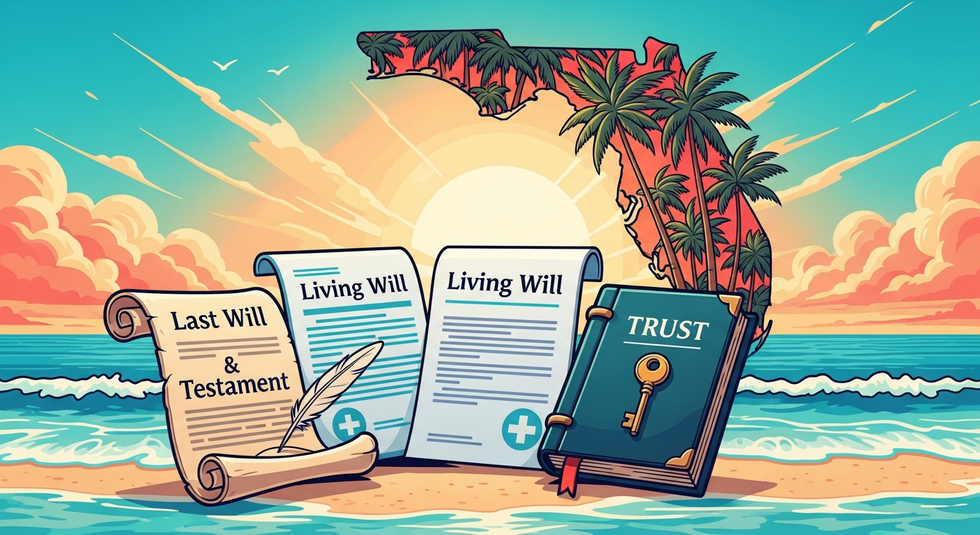
Key Highlights
- A Last Will and Testament directs the distribution of your assets after you die and goes through probate.
- A living will is an advance directive that details your preferences for medical decisions if you become incapacitated.
- A living trust manages your assets during your life and after your death, often to avoid probate.
- Each document has specific legal requirements for signing and witnessing to be valid in Florida.
Introduction
When it comes to estate planning in Florida, the terminology can be confusing. You've likely heard the terms “Will,” “Living Will,” and “Living Trust,” and you might think they're all similar. While their names sound alike, these three legal documents serve vastly different purposes. Understanding these differences is crucial for creating a comprehensive plan that protects you, your assets, and your loved ones. This guide will clarify what each document does according to Florida law, helping you make informed decisions for your future.
Understanding Florida Estate Planning Documents
Navigating estate planning can feel overwhelming, but it's about putting a clear plan in place. The core of a solid Florida estate plan involves several key legal documents that control different aspects of your life and assets. Some documents handle your finances after you pass away, while others address your health care wishes if you cannot speak for yourself. Let's look at the main functions of a Last Will and Testament, a Living Will, and a Living Trust.
What Is a Last Will & Testament in Florida?
A Last Will and Testament, commonly just called a “will,” is a legal document that dictates the distribution of your assets after you pass away. According to Florida law, a will is the cornerstone of many estate plans, providing a formal way to transfer property from your name to your chosen beneficiaries.
Once you die, your will is submitted to a court in a process called probate. This court-supervised procedure ensures your debts are paid and your assets are distributed according to your instructions. We'll now explore its key functions and when it takes effect.
Key Functions of a Will
The primary purpose of a will is to ensure the orderly distribution of your assets after you're gone. It provides a clear roadmap for your Personal Representative and the probate court to follow, helping to prevent disputes among family members.
A will is a powerful tool within your estate plan that accomplishes several critical tasks. While it doesn't offer the same level of asset protection as some other instruments, it provides structure and legal authority for your final wishes.
Key functions include:
- Directing Distribution of Assets: You can specify who gets what, from real estate to personal keepsakes.
- Naming a Personal Representative: You appoint a trusted individual or institution to manage your estate.
- Appointing a Guardian for Minor Children: If you have children under 18, you can designate who will care for them.
When Does a Will Take Effect?
A common misconception is that a will is active during your lifetime, but that's not the case. A will is a dormant document until your death. It has no legal power or authority over your assets or decisions while you are alive. Only after you pass away does the legal framework of your will come into play.
Upon your death, your designated Personal Representative must submit the will to the appropriate Florida court to initiate the probate process. Probate is the formal legal procedure that validates your will, settles any outstanding debts or taxes, and officially transfers your assets to your named beneficiaries.
So, is probate required if there is a will in Florida? Yes, in most cases. A will is essentially a set of instructions for the probate court. Assets titled solely in the deceased's name must go through probate to be legally transferred.
Role of the Testator and Personal Representative
When creating a will, there are two central figures: the testator and the Personal Representative. The “testator” is you—the person creating the will. As the testator, you are outlining your final wishes for your property.
The “Personal Representative” is the person or institution you appoint in your will to carry out those wishes. This individual is responsible for navigating the probate process, which includes gathering assets, paying creditors, and distributing the remaining property to the beneficiaries. The Personal Representative is accountable to the court and the beneficiaries.
Under Florida law, a will must be signed by the testator in the presence of two witnesses. While notarization is not strictly required for a will to be valid, it is highly recommended. A “self-proving” affidavit, which is notarized, can speed up the probate process significantly.
What Is a Living Will in Florida?
A living will is a legal document that allows you to state your medical preferences regarding life-prolonging treatment if you become incapacitated. It is not related to your property but is a crucial part of your health care planning. Under Chapter 765 of the Florida Statutes, any competent adult has the right to make these health care decisions in advance.
This document gives you a voice when you cannot speak for yourself, ensuring your wishes are followed during a difficult time. Let's examine its main purposes and how it fits with other advance directives.
Major Purposes and Uses
The main purpose of a living will is to document your medical wishes ahead of time, providing clarity and peace of mind for you and your family. It removes the burden of making difficult medical decisions from your loved ones during an already stressful time.
A living will specifically addresses end-of-life care. What happens if I don't have a living will in Florida? Without one, Florida law dictates who makes these decisions for you—a spouse, adult children, parents, or even a court-appointed guardian. This person may not be who you would have chosen or know what you would have wanted.
A living will serves several key functions:
- It instructs physicians to provide, withhold, or withdraw life-prolonging procedures.
- It can reduce family disputes over your medical care.
- It works alongside a health care surrogate designation, which names someone to enforce your wishes.
How a Living Will Works with Advance Directives
A living will is just one type of advance directive. In Florida, a comprehensive plan for your health care usually includes a combination of documents that work together. These documents ensure your medical treatment preferences are clearly communicated and legally recognized.
So, how does a Florida living will relate to other advance directives? It is often paired with a Designation of Health Care Surrogate. While the living will states what you want (your specific medical wishes), the health care surrogate designation names who you want to make decisions on your behalf. This person, your surrogate, uses your living will as a guide to make real-time choices.
Together, these advance directives form a powerful plan. You might also include a HIPAA release form, which grants your surrogate access to your private medical information. This complete package ensures your wishes are known and can be legally carried out by someone you trust.
What Medical Decisions Are Covered?
A living will specifically addresses critical medical decisions related to life-prolonging procedures when you are in a certain medical state. It focuses on situations where you have a terminal condition, an end-stage condition, or are in a persistent vegetative state with no reasonable chance of recovery.
Your living will allows you to clearly express your medical wishes regarding these difficult choices. You can decide in advance what measures you do or do not want. This prevents confusion and ensures your personal values are honored.
Examples of what medical decisions are covered include:
- Life Support: Your preferences on using machines like ventilators to help you breathe.
- Artificial Nutrition and Hydration: Whether you want to receive food and water through feeding tubes.
What Is a Florida Living Trust?
A Florida living trust, also known as a Florida revocable living trust, is a versatile estate planning tool used to manage your assets. Unlike a will, a trust is created and operates during your lifetime.
This instrument provides control over your property while you're alive and can simplify how it's handled after your death, often by avoiding the probate process entirely. Now, let's explore its features and benefits.
Main Features and Benefits
A living trust offers powerful features for asset management and is a popular component of a comprehensive estate plan. Its primary benefit is probate avoidance. Since the trust assets are not in your individual name at death, they can be distributed to beneficiaries without court supervision, saving time and expense.
Another key feature is privacy. Because a trust avoids probate, the details of your assets and who inherits them remain private, unlike a will, which becomes a public record. The difference between a living will and a living trust in Florida is clear here: a living will handles medical choices, while a living trust handles financial assets.
The main benefits of a living trust include:
- Probate Avoidance: Allows for faster distribution of trust assets.
- Incapacity Planning: A successor trustee can manage your finances if you become unable to do so.
- Privacy: Keeps your financial affairs out of the public record.
- Control: Provides continuous asset management during your life and after death.
Who Is the Trustee and Settlor?
When you create a revocable trust in Florida, two key roles are established: the settlor and the trustee. The “settlor” (also called a “grantor”) is the person who creates the trust agreement and transfers their assets into it. Essentially, if you are creating the trust, you are the settlor.
The “trustee” is the person or institution responsible for managing the trust's assets. In most revocable trusts, you, the settlor, will also name yourself as the initial trustee. This allows you to maintain full control over your assets during your lifetime—you can buy, sell, or spend them just as you did before.
The trust document also names a “successor trustee.” This person takes over management of the trust if you become incapacitated or upon your death. So, who controls the instrument? You do, as the settlor and initial trustee. Later, your chosen successor trustee takes control.
Probate Avoidance and Asset Management
One of the most significant advantages of a living trust is probate avoidance. By transferring ownership of your assets to the trust, you remove them from your personal estate. This means that upon your death, these trust assets can be distributed directly to your beneficiaries without going through the lengthy and public probate process.
For effective asset management, it's crucial to “fund” the trust. This involves retitling assets like real estate, bank accounts, and brokerage accounts into the name of the trust. Any assets left out of the trust may still require probate. This answers a common question: Is probate required if there is a will in Florida? Yes, for assets not in a trust. That is why a “pour-over” will is often used with a trust to catch any forgotten assets and move them into the trust after death.
| Asset Type | How to Title for a Trust |
|---|---|
Real Estate |
“John Doe, as Trustee of the John Doe Revocable Trust” |
Bank Accounts |
Change account ownership to the name of the trust. |
Brokerage Accounts |
Update the title on investment accounts to the trust. |
Personal Property |
Use a general assignment to transfer items to the trust. |
Key Differences: Will, Living Will, and Living Trust
Though they sound similar, a will, a living will, and a living trust have fundamentally different roles in your estate planning. A will directs asset distribution after death, a living will outlines medical wishes during incapacitation, and a living trust manages assets during your life and after death, primarily to avoid probate.
Confusing them can leave significant gaps in your plan. Understanding their distinct timing, control, and legal terms is essential for ensuring your wishes are fully protected. Let's break down these key distinctions.
When Each Document Applies
The timing of when each document becomes effective is a crucial distinction. They are designed to operate at different points in your life and under different circumstances, which is why a complete estate plan often includes all three.
A Last Will and Testament only takes effect after you die. As discussed, a will is dormant during your lifetime and serves as a set of instructions for the probate court upon your death. In contrast, a living trust is active from the moment you create and fund it, managing assets while you are alive, during incapacity, and after death.
A living will is unique because it applies only when you are alive but unable to make your own medical decisions.
- Living Will: Active during lifetime incapacitation.
- Living Trust: Active from creation, through incapacity, and after death.
- Last Will & Testament: Active only after death.
Who Controls Each Instrument?
Each of these estate planning documents is controlled by a different person or “fiduciary” with specific legal responsibilities. Knowing who controls each instrument is key to understanding how your wishes will be carried out under Florida law.
For a Last Will and Testament, the “Personal Representative” is in charge. You name this person in your will, and they are appointed by the probate court to manage your estate after you die. In a living trust, the “Trustee” is the one in control. Initially, this is usually you, the settlor. Upon your incapacity or death, your designated “Successor Trustee” takes over.
A living will's directives are carried out by your medical providers, guided by your “Health Care Surrogate.” You appoint this person in a separate document to make health decisions and enforce the wishes you outlined in your living will.
Legal Terms Explained: Trustee vs. Personal Representative
The terms “Trustee” and “Personal Representative” are often confused, but they have distinct roles governed by different legal requirements under Florida law. A Personal Representative is the fiduciary appointed in a will to administer a decedent's estate through probate. Their authority comes from the court, and their primary job is to wind up the deceased's affairs.
In contrast, a Trustee is the fiduciary who manages assets held in a trust. A Trustee's authority comes from the trust document itself, not a court. Their responsibilities can begin during the settlor's lifetime and continue long after their death. While both fiduciaries must act in the best interests of the beneficiaries, their duties and the legal framework they operate within are quite different.
A Trustee's role often involves ongoing asset management, whereas a Personal Representative's duties are generally concluded once the probate process is complete. There is no inherent asset protection difference based on the title, but the structures they manage (trusts vs. probate estates) have different implications.
Legal Requirements and Formalities in Florida
To ensure your estate planning documents are legally enforceable, you must follow specific formalities required by Florida law. These legal requirements for signing, witnesses, and notarization vary depending on the document. Failing to adhere to these rules can render a document invalid, meaning your wishes may not be honored.
It's critical to execute each document correctly. Below, we'll detail the specific requirements for wills, living wills, and living trusts so you can be confident in your plan.
Witnesses and Notarization for Wills
For a will to be valid in Florida, it must be executed with strict adherence to legal formalities. The testator must sign the will at the end of the document, or another person can sign on the testator's behalf and in their presence.
The most critical requirement involves witnesses. The signing must be done in the presence of at least two credible witnesses, who must also sign the will in the presence of the testator and each other. This formal process is designed to prevent fraud or undue influence.
While notarization of the will itself is not mandatory for its validity, it is a highly recommended practice in estate planning.
- A will must be in writing.
- It must be signed by the testator and two witnesses.
- A notarized “self-proving affidavit” can be attached, which simplifies the probate process by pre-validating the signatures. This is different from the simple witness requirement for a living will.
Living Will Signing and Revocation Rules
A Florida living will also has specific legal requirements to be valid. Like a traditional will, it must be in writing and signed by the principal (the person making the will). It must also be signed in the presence of two witnesses. However, the witness rules are slightly different: at least one witness cannot be a spouse or a blood relative.
Yes, you can update or revoke your Florida living will after it is signed. Florida law allows you to change your mind at any time as long as you are competent. Revocation can be done in several ways, including by signing a new document, by physically destroying the old one, or even by a clear verbal statement of your intent to revoke it.
It's wise to review your health care advance directives periodically, especially after major life events, to ensure they still reflect your wishes. Proper revocation is effective when it is properly communicated to your health care provider.
Creating a Valid Florida Living Trust
Creating a valid Florida living trust also involves specific legal requirements, though they differ from those for wills. The trust document must be in writing and signed by the settlor. While a Florida revocable living trust does not require witnesses or notarization to be technically valid for holding assets like bank accounts, these formalities are essential if the trust will hold real estate.
To transfer Florida real estate into a trust, the trust document must be executed with the same formalities as a deed: signed by the settlor in front of two witnesses and a notary. For this reason, it is standard practice and highly recommended to have any trust document witnessed and notarized.
Given the complexities of drafting a trust document and properly funding the trust, it is crucial to work with an experienced attorney. An attorney can ensure your trust is valid, properly funded, and aligned with your overall estate planning goals.
Conclusion
In conclusion, understanding the distinctions between a Last Will & Testament, a Living Will, and a Living Trust is crucial for effective estate planning in Florida. Each of these documents serves unique purposes that cater to different aspects of your life and legacy. A Last Will handles the distribution of assets upon death, while a Living Will outlines your medical wishes in critical situations. Meanwhile, a Living Trust offers benefits like avoidance of probate and ongoing asset management. By clarifying these differences, you can make informed decisions that align with your specific needs. If you're ready to take control of your estate plan, contact us for a free consultation to discuss which options are best for you.
Frequently Asked Questions
Is probate required if there is a will in Florida?
Yes, in most cases, a will must go through probate in Florida. The will acts as an instruction manual for the probate court to follow. Probate is the legal process of validating the will and transferring assets, making it a necessary step in the estate planning legal requirements under Florida law.
Can you update or revoke your Florida living will?
Absolutely. Under Florida statute, you can change or revoke your living will at any time, as long as you are mentally competent. You can make a new advance directive, physically destroy the old one, or verbally express your intent for revocation of your prior medical decisions.
Do you need witnesses or notarization for these documents?
Yes, both a will and a living will require two witnesses to be valid under Florida's legal requirements. While notarization is not mandatory for a living will, it is highly recommended for a will to make it “self-proving.” A trust that will hold real estate must also be witnessed and notarized.
https://quality.healthfinder.fl.gov/report-guides/advance-directives

Comments
There are no comments for this post. Be the first and Add your Comment below.
Leave a Comment