
Almost every week, someone sits down across from us in Fort Myers, slides a will across the table, and says some version of the same thing: "Mom had a will, so we don't have to do probate, right?"
The short answer: No. In Florida, a will does not avoid probate — a will is the instruction manual for probate. Any asset titled in the decedent's sole name with no beneficiary designation and no survivorship rights still has to pass through the probate court before it can legally reach the people named in the will. The will tells the judge who should inherit and who should serve as personal representative, but the will itself has to be filed with the clerk and admitted to probate before it controls anything. The only reliable ways to bypass probate in Florida are put in place while you are alive: a funded revocable living trust, joint ownership with survivorship rights, payable-on-death and beneficiary designations, and Lady Bird deeds for real estate.
Key Highlights
- A Florida will must be deposited with the clerk of the circuit court within 10 days after the custodian learns of the death (Fla. Stat. § 732.901) — having a will triggers a filing duty rather than excusing one.
- Probate applies only to probate assets: property owned in the decedent's sole name that has no provision for automatic succession of ownership at death.
- Florida's summary administration threshold doubled from $75,000 to $150,000 effective July 1, 2026 under Ch. 2026-57, Laws of Florida, so many estates that once required full formal probate now qualify for the fast track.
- Florida law does not presume survivorship: under Fla. Stat. § 689.15, a transfer to two or more people creates a tenancy in common unless the document expressly provides for the right of survivorship — except for married couples holding as tenants by the entireties.
- Florida has no transfer-on-death deed for real estate; the Lady Bird (enhanced life estate) deed is the Florida equivalent.
- Even the simplest formal administration stays open at least three months, because creditors get three months from first publication of the notice to creditors to file claims (Fla. Stat. § 733.702).
Introduction
The confusion is understandable. A will feels like the finish line of estate planning — you signed it, you had it witnessed, you put it in the safe. It is reasonable to assume that document does the work.
What a will actually does is narrower and more specific than most people expect, and understanding the difference is what separates a plan that works from one that leaves your family in the Lee County Justice Center for eight months. This guide walks through what happens to a Florida will after death, which assets still land in probate court, which ones skip it entirely, what the process costs, and how to decide whether your family needs a will, a trust, or both.
Does a Will Avoid Probate in Florida?
No. A will directs probate; it does not replace it. If you own anything in your sole name — a house in Bonita Springs, a checking account, a car — that property goes through the probate process whether or not you left a last will.
The Short Answer: A Will Usually Does Not Avoid Probate
A will is a set of instructions that only becomes enforceable once a Florida probate court accepts it as valid. Until the court admits it, no bank, brokerage, or title company will transfer anything based on it. The will determines who inherits; probate is the legal process that actually moves the ownership of your assets from your name to theirs.
There is one narrow sense in which a will can reduce court involvement: if the probate estate is small enough, Florida allows an abbreviated proceeding instead of full formal probate. That is still probate — just faster.
Why Many Florida Families Assume a Will Avoids Probate
This is the single most common misconception we encounter, and it comes from two places. First, popular culture treats "the reading of the will" as the moment inheritance happens. Second, families who have watched assets transfer smoothly — a jointly held home, a life insurance payout — assume the will made that happen, when in fact the titling or the beneficiary designation did.
The result is a plan that looks complete on paper and behaves very differently in practice. Families often discover the gap at the worst possible moment, three weeks after a funeral, when a bank refuses to release funds without letters of administration.
What a Will Actually Does After Death
A Florida will does three concrete jobs. Each matters, and none of them is "avoid court."
Naming Beneficiaries
Your will names the people or charities who receive your probate assets and in what shares. Without it, Florida's intestacy statutes decide, and they do not account for stepchildren, unmarried partners, or the friend who cared for you for a decade.
Naming a Personal Representative
Florida calls the executor a personal representative. Your will nominates that person, and the judge appoints them if they qualify — which matters here, because a nonresident personal representative generally must be a close relative of the decedent. Out-of-state adult children are frequently surprised by that rule.
Providing Instructions for Asset Distribution
Beyond naming names, a well-drafted will handles the mechanics: what happens if a beneficiary dies first, how minor children's shares are held, who gets the personal property, and whether a testamentary trust holds funds until a young beneficiary is older. These instructions govern the distribution of assets once the court process is complete.
Why Does Probate Still Happen When There Is a Will?
Probate happens because someone with legal authority has to verify the will, transfer title, and settle debts — and only a court can confer that authority. A will cannot appoint its own executor or clear its own creditors.
Probate Validates the Will
A signed document is not automatically a valid will. The court confirms it meets Florida's execution requirements, that it is the most recent version, and that no one is contesting it. Interested persons served with the notice of administration have three months to challenge the will's validity, the venue, or the court's jurisdiction (Fla. Stat. § 733.212).
Probate Transfers Probate Assets
Title companies and financial institutions need a court order — specifically, letters of administration — before they will move an asset out of a dead person's name. That is the practical engine of probate proceedings. The will says who should receive the Sanibel condo; the court order is what actually lets the deed be recorded.
Probate Resolves Debts and Claims
One of probate's real functions is giving the deceased person's estate a clean, time-limited way to deal with creditors. The personal representative publishes a notice to creditors in a local newspaper and serves known creditors directly. Creditors then have three months from first publication, or 30 days from service if that is later, to file claims. After that window closes, most untimely claims are barred — a protection that only exists inside a probate proceeding.
Why Florida Law Requires Court Oversight
The personal representative handles other people's money. Court oversight exists so beneficiaries have recourse, creditors get notice, and the transfer of assets is documented in a way the world can rely on. These legal requirements can feel bureaucratic when the family all gets along, but they are what makes a Florida deed or bank transfer stick decades later.
What Happens After Someone Dies With a Will in Florida?
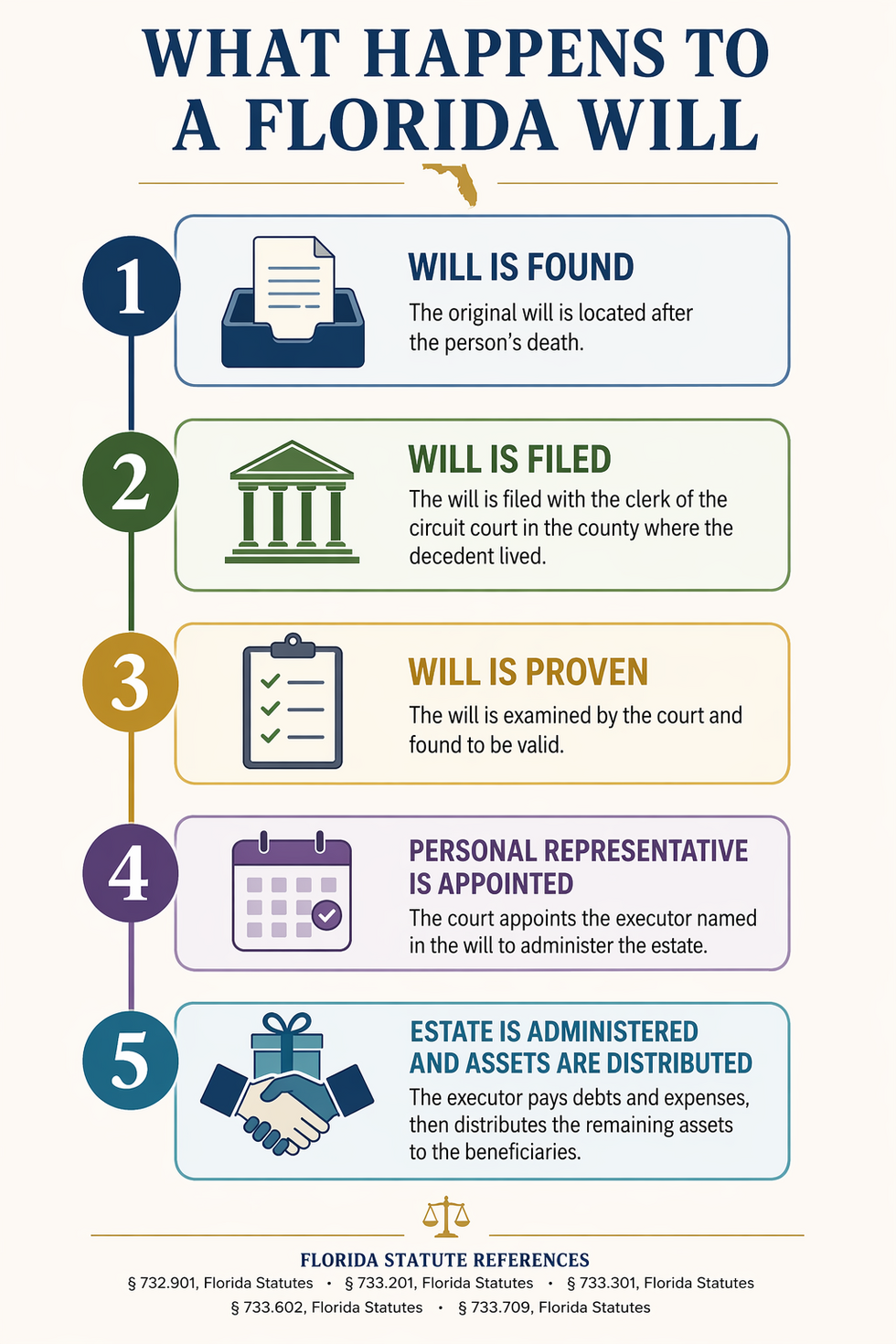
Five steps, in order. In the Twentieth Judicial Circuit — Lee, Collier, Charlotte, Hendry, and Glades counties — everything is e-filed through the Florida Courts E-Filing Portal, and most families never appear in a courtroom.
Step 1: File the Will
The custodian of the will must deposit the original with the clerk of the circuit court in the county where the decedent lived, within 10 days of learning of the death. There is no fee to deposit a will. Depositing it is not the same as opening probate — it is a separate, mandatory step, and skipping it can expose the custodian to costs and attorney fees.
Step 2: Open Probate
A petition for administration is filed with the probate court, along with the death certificate. If the estate qualifies for summary administration, the petition asks the court to distribute assets directly. Otherwise the court opens a formal probate and issues letters of administration to the personal representative.
Step 3: Inventory Assets
The personal representative identifies, values, and files an inventory of the probate assets — generally within 60 days of appointment under Florida Probate Rule 5.340. This is where scattered financial accounts, a forgotten brokerage account up north, or an un-retitled certificate of deposit surfaces.
Step 4: Pay Debts
The notice to creditors is published, valid claims are paid, and improper ones are challenged. Legitimate debts, taxes, and administration expenses are paid before beneficiaries receive anything. Distributing early is the classic way a personal representative creates personal liability.
Step 5: Distribute Assets
Once claims are resolved, the remaining property passes to the beneficiaries named in the will. A final accounting and petition for discharge close the estate and release the personal representative.
If a Will Doesn't Avoid Probate, Why Is Having One Still Important?
Because a will controls the outcome of probate, and the alternative — dying without one — hands that control to a statute written for the average family rather than yours.
You Decide Who Receives Your Property
With a will, you choose. Without one, Florida decides, and the statute has no idea that your daughter has a disability, that your son already received his share as a down payment, or that you wanted the Naples condo to stay in the family.
You Choose Who Will Manage Your Estate
Nominating your own personal representative avoids a contested appointment. When there is no will and the heirs cannot agree, the judge picks after a hearing — an expensive way to start an administration.
You Reduce the Risk of Family Disputes
Ambiguity is what fuels litigation. A clear will, executed with proper formalities, gives a judge very little room to second-guess the decedent's wishes and gives resentful relatives very little to work with.
You Avoid Florida Intestacy Rules
Florida's intestacy statutes are a default, not a plan. They apply whenever there is no valid will.
What Happens If You Die Without a Will
Under Fla. Stat. § 732.102, a surviving spouse takes the entire intestate estate if all of the decedent's descendants are also descendants of that spouse and the spouse has no other descendants. But if either spouse has a child from a prior relationship, the surviving spouse takes only one-half and the children take the rest. Blended families in Southwest Florida are routinely blindsided by that split.
Common Problems Families Face Without Estate Planning
No named guardian for minor children. A surviving spouse forced to co-own a home with adult stepchildren. Homestead property passing subject to constitutional restrictions nobody anticipated. An unmarried partner of twenty years receiving nothing at all. None of these are exotic — they are the ordinary consequences of skipping the estate planning process.
Which Assets Still Go Through Probate Even If You Have a Will?
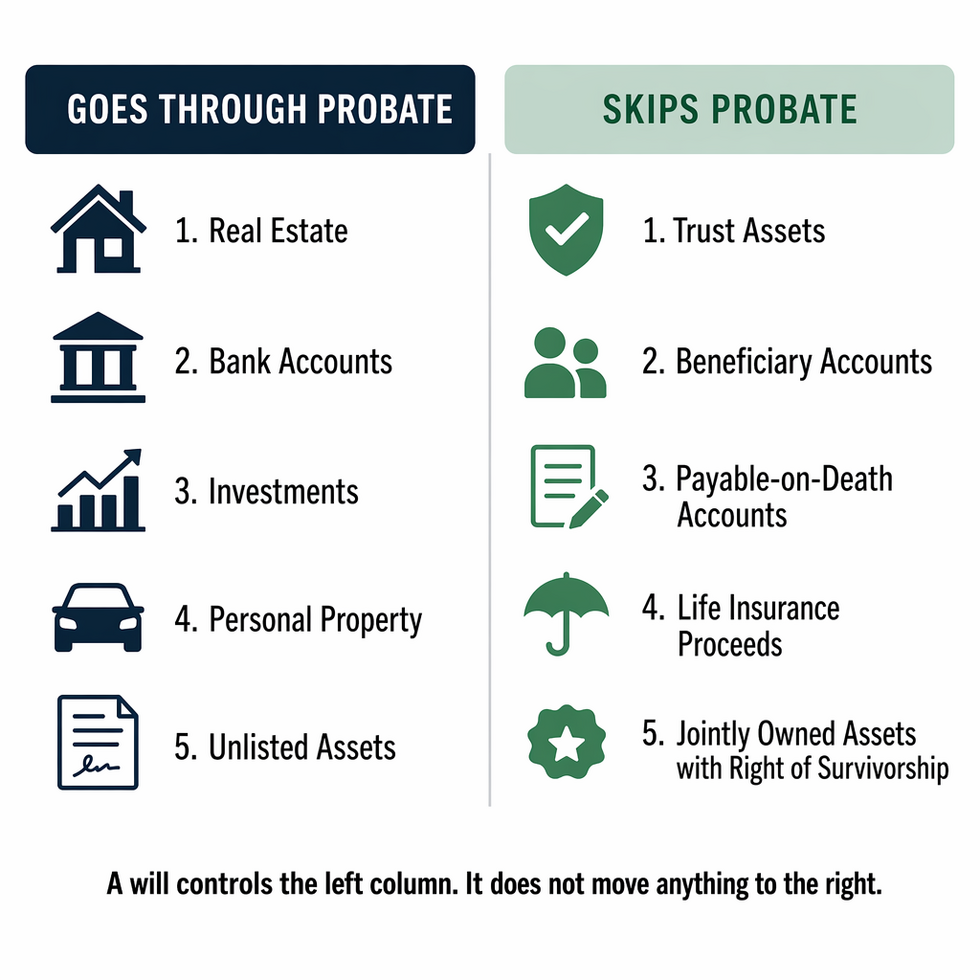
Probate reaches anything owned in the decedent's sole name with no automatic succession built in. Here is what that typically means in practice.
Real Estate Owned Individually
A home, condo, or vacant lot titled only in the decedent's name is a probate asset. So is real estate held with someone else as tenants in common. Florida homestead property follows its own constitutional rules and is often protected from creditors, but it still typically requires a court order determining homestead status before title is clear.
Bank Accounts Without Beneficiary Designations
A checking or savings account in one name, with no payable-on-death designation and no joint owner, goes through probate. This is the most common and most easily avoided probate asset we see.
Investment Accounts Without Transfer Instructions
Brokerage and investment accounts with no transfer-on-death instruction land in probate the same way. Many custodians offer TOD designations at no cost; families simply never complete the form.
Vehicles Owned Solely by the Deceased
Cars, boats, and trailers titled solely in the decedent's name are probate assets, though Florida's exempt property rules give a surviving spouse or children rights to up to two qualifying motor vehicles under Fla. Stat. § 732.402.
Personal Property and Valuable Collections
Furniture, jewelry, artwork, firearms, and collections pass through probate unless they were placed in a trust. Household furnishings up to $20,000 in net value also fall within the exempt property statute.
Business Interests Held Individually
A solely owned LLC membership interest or shares in a closely held corporation are probate assets. Without an operating agreement or buy-sell arrangement in place, the business can stall while the estate is administered — which is why business succession planning belongs in the same conversation as the will.
Why Asset Ownership Matters
How an asset is titled beats what the will says, every time. A will governs only probate assets. If the account has a beneficiary and the will says something different, the beneficiary designation wins.
Commonly Overlooked Probate Assets
Certificates of deposit rolled over years ago and never re-designated. Old savings bonds. A final paycheck. Refunds from a canceled insurance policy. A timeshare in Orlando. An out-of-state mineral interest. These small items are what most often force a full formal probate on an otherwise simple estate.
What Assets and Strategies Can Help Avoid Probate in Florida?
Probate avoidance is a titling exercise done during life. These are the tools that actually work in Florida.
Assets Held in a Revocable Living Trust
A revocable living trust avoids probate for anything actually transferred into it. You serve as your own trustee while you are able; at death, your successor trustee distributes the trust assets under the trust documents without court involvement. Clients often ask whether putting the house in a trust means a loss of control — with a revocable trust it does not, because you can sell, refinance, amend, or revoke at any time. The critical word is funded: an unfunded trust in a drawer accomplishes nothing, and we see that failure often.
Jointly Owned Property With Survivorship Rights
Property held with survivorship rights passes to the surviving owner automatically by operation of law. Florida is stricter here than most states: under § 689.15, joint tenancy does not carry an automatic right of survivorship unless the instrument expressly says so. Married couples holding as tenants by the entireties are the exception — survivorship is built in. Sloppy joint tenancy arrangements are a recurring source of unintended probate.
Payable-on-Death and Beneficiary Designations
Payable-on-death designations on bank accounts and TOD designations on investment accounts are free, take minutes, and keep those financial assets out of probate entirely. Name contingent beneficiaries too — if your primary beneficiary predeceases you and there is no backup, the asset falls back into your probate estate.
Retirement Accounts and Life Insurance Policies
Retirement accounts and life insurance policies with a living named beneficiary pass directly, outside probate. If the beneficiary is your estate, or the form was never updated after a divorce, the proceeds become part of your estate and are exposed to creditor claims.
Using a Lady Bird Deed for Florida Real Estate
Florida has not adopted a statutory transfer-on-death deed, so there is no Florida TOD deed for real estate. The Florida equivalent is the Lady Bird deed, also called an enhanced life estate deed: you keep full control and the right to sell or mortgage during your lifetime, and the property passes to your named remainder beneficiaries at death without probate. It is a creature of Florida common law and title practice rather than statute, so drafting quality matters.
Why Asset Titling Matters
Titling is the mechanism; the will is only the fallback. One of the most effective ways to protect your family is an afternoon spent confirming how each account and deed is actually titled — not how you remember titling it.
Common Probate Avoidance Mistakes
Naming a minor child directly as a beneficiary, which forces a guardianship. Adding an adult child as joint owner on a home, which exposes the property to that child's creditors and divorce and creates gift tax reporting issues once the transfer exceeds the federal gift tax annual exclusion ($19,000 per recipient for 2026, per the IRS). Creating a trust and never funding it.
How to Keep Probate-Avoidance Plans Up to Date
Review beneficiary designations every few years and after any major life change. Confirm new accounts were opened with the trust as owner. When you buy a property in Estero or refinance one in Cape Coral, check that the deed still reads the way your plan assumes it does — refinancing sometimes takes property out of a trust and nobody puts it back.
Do You Need a Will, a Trust, or Both?
Most Florida families need both. The trust does the heavy lifting; the will is the safety net for anything the trust missed.
How a Will and Living Trust Handle Asset Transfers
| Last will | Revocable living trust | |
|---|---|---|
|
Takes effect |
Only at death, after court admission |
Immediately upon signing and funding |
|
Probate required |
Yes, for probate assets |
No, for assets titled in the trust |
|
Who acts |
Personal representative appointed by the court |
Successor trustee, no appointment needed |
|
Public record |
Yes — filed with the clerk |
No — stays private |
|
Incapacity planning |
None |
Successor trustee steps in without guardianship |
|
Typical setup cost |
Lower |
Higher |
When a Will May Be Enough
If your assets are modest, your real estate is homestead held with your spouse as tenants by the entireties, and your accounts all carry beneficiary designations, a well-drafted will plus careful titling may be all you need. Small estates that fall under the $150,000 summary administration threshold can move through court quickly.
When a Living Trust May Be Worth Considering
Trusts earn their cost when there is real estate in more than one state, substantial assets, a blended family, a beneficiary with special needs, privacy concerns, or a desire to control distributions over time rather than handing a lump sum to a 22-year-old.
When Using Both Makes Sense
The standard Florida trust-based plan pairs a revocable trust with a pour-over will. The trust holds the assets; the pour-over will catches anything you forgot to retitle and directs it into the trust. You also still need a will to nominate a guardian for minor children — a trust cannot do that.
Key Differences in Cost, Privacy, and Probate Exposure
| Factor | Will-based plan | Trust-based plan |
|---|---|---|
|
Upfront cost |
Lower |
Higher |
|
Cost at death |
Probate filing fees, personal representative and attorney compensation |
Trust administration, usually less than formal probate |
|
Privacy |
Will and inventory become part of the court file |
Trust terms stay private |
|
Probate exposure |
Full, for all solely owned assets |
Minimal, if funding is complete |
|
Out-of-state property |
May require a second ancillary probate |
Avoided if deeded to the trust |
How Much Does Probate Cost in Florida?
Expect filing fees in the low hundreds, plus compensation for the personal representative and the attorney that scales with the size of the estate. A straightforward formal administration commonly runs into the thousands; summary administration costs a fraction of that.
Typical Court Costs and Filing Fees
Clerk filing fees for opening a probate matter generally run a few hundred dollars, varying by county and by the type of administration. There is also the cost of publishing the notice to creditors in a local newspaper and obtaining certified death certificates. Check the current schedule with the clerk in the county of filing — the Lee County Clerk of Courts publishes its fees online.
Personal Representative Expenses
Florida presumes reasonable executor compensation of 3% of the first $1 million of the compensable estate, stepping down for larger estates (Fla. Stat. § 733.617). Family members serving as personal representative frequently waive this. There are also out-of-pocket costs — travel, appraisals, property maintenance, insurance on a vacant home.
Probate Attorney Fees
Florida publishes a presumed-reasonable fee schedule for ordinary attorney services in a formal administration under Fla. Stat. § 733.6171:
| Compensable estate value | Presumed reasonable fee |
|---|---|
|
$40,000 or less |
$1,500 |
|
More than $40,000 up to $70,000 |
Add $750 |
|
More than $70,000 up to $100,000 |
Add $750 |
|
Next $900,000 (above $100,000) |
3% |
|
Above $1 million up to $3 million |
2.5% |
|
Above $3 million up to $5 million |
2% |
|
Above $5 million up to $10 million |
1.5% |
|
Above $10 million |
1% |
That schedule is not mandatory. Any attorney intending to charge from it must disclose in writing that there is no mandatory statutory fee, that the fee need not be based on estate size, that it is negotiable, and that you are free to hire someone other than the lawyer who drafted the will. Many Southwest Florida firms, ours included, quote flat legal fees for routine administrations.
Additional Costs for Complex Estates
Extraordinary services — a will contest, selling real estate, running the decedent's business, an elective share proceeding, ancillary administration of out-of-state property, or postmortem tax advice — are billed separately from the ordinary-services schedule.
What Factors Increase Probate Costs?
Litigation, most of all. After that: real property that has to be sold, business interests, assets in multiple states, aggressive creditors, missing or uncooperative beneficiaries, poor records, and a will that is ambiguous enough to require construction by the court.
How Can Estate Planning Reduce Probate Costs?
By shrinking the probate estate. Every asset that passes by trust, survivorship, or beneficiary designation is an asset that never enters the compensable value on which fees are calculated. Proper planning done in advance is almost always cheaper than the administration it prevents.
Why Probate Has Costs
Someone has to do the work — inventorying, noticing, accounting, filing — and both the personal representative and the attorney are entitled to reasonable compensation for it. The costs are real work, not a penalty.
Strategies That Can Help Reduce Probate Expenses
Fund the trust completely. Add payable-on-death and TOD designations to every account that allows them. Use a Lady Bird deed for Florida real estate. Consolidate stray accounts. Keep an updated asset list so your personal representative is not paying an attorney to play detective.
How Probate Affects Families Even When There Is a Will
Probate is slower, more public, and more emotionally taxing than most families expect — and having a will changes none of that.
Delays in Receiving Inheritance
Even the simplest formal probate stays open at least three months for the creditor claim period, and The Florida Bar's own consumer pamphlet on probate suggests a simple estate reasonably takes about five or six months. Meanwhile a surviving spouse may be covering a mortgage and Florida property insurance alone.
Court Oversight and Administrative Delays
Rejected filings, scheduling, and waiting on institutions all add time. None of it is dramatic; it is simply slow. Probate delays are usually an accumulation of small waits rather than one big fight.
Public Record Concerns
The will, the petition, and the identities of the beneficiaries become part of a public court file. Florida shields documents containing financial detail about the estate from public inspection, but the existence of the case and its basic contents are open. A trust keeps all of it private.
Family Conflicts During Estate Administration
Probate creates a formal forum, deadlines, and notices — which can turn quiet disagreements into filed objections. Family disputes are far more likely when beneficiaries feel uninformed.
Financial Impact on Beneficiaries
Inheritances arrive months later than expected. Carrying costs on a vacant Punta Gorda home — taxes, insurance, lawn service — come out of the estate before anyone inherits.
Emotional Challenges During Probate
The personal representative is usually a grieving spouse or child, now handling deadlines and creditor paperwork during the worst year of their life. Reducing that burden is a legitimate planning goal in itself.
When Does Probate or Estate Planning Become Too Complex to Handle Alone?
When the stakes stop being administrative and start being legal. These are the situations where professional guidance pays for itself.
If You Want to Minimize Probate for Your Family
Probate avoidance requires coordinating deeds, account titling, trust funding, and beneficiary forms so they all point the same direction. Getting one piece wrong — a deed that was never recorded, a beneficiary form that names a deceased person — undoes the rest.
If You Own Significant Assets
Larger estates raise questions about the federal estate tax exemption ($15 million per person for 2026), basis planning, and how to structure gifts. Florida imposes no state estate or income tax, which is part of why so many families relocate here, but the federal rules still apply.
If You Own Real Estate in Multiple States
Property in another state generally requires a separate ancillary probate there. Snowbirds with a home in Ohio and a condo in Marco Island are the classic case, and a trust usually solves it.
If You Have a Blended Family
Second marriages, stepchildren, and children from prior relationships are where Florida's intestacy and homestead rules produce the harshest surprises. This is not a do-it-yourself situation.
If You Own a Business
A business needs a plan for who runs it on day one after your death, how the interest is valued, and whether a buy-sell agreement funds a buyout. State laws and your operating agreement interact in ways a generic will cannot address.
Warning Signs Your Estate Plan Needs Review
Your documents predate a move to Florida. Your trust was never funded. Your beneficiary forms name an ex-spouse. Your named personal representative has died or moved out of state. Your plan references accounts you no longer have.
Life Events That Should Trigger an Update
Marriage or divorce. The birth of children or grandchildren. A death in the family. Buying or selling real estate. Selling a business. Relocating to Florida. A significant change in the value or makeup of your assets.
Probate Attorney vs Estate Planning Attorney: Which Lawyer Do You Need?
If someone has died, you need a probate attorney. If you are planning ahead, you need an estate planning attorney. Many Florida firms do both — ours does.
Estate Planning Attorney: Planning Before Death
An estate planning attorney builds the plan: wills, trusts, powers of attorney, health care directives, deeds, and beneficiary coordination. The goal is that your family never needs the probate side of the practice.
Probate Attorney: Administering an Estate After Death
A probate attorney represents the personal representative through administration — petitions, notices, creditor claims, inventories, accountings, and discharge. Under Florida Probate Rule 5.030, a personal representative in a formal administration must be represented by a Florida attorney unless the personal representative is the sole interested person or is a Florida lawyer.
Many Florida Law Firms Handle Both
There is a real advantage to a firm that does both: an estate attorney who regularly administers estates knows exactly which planning shortcuts fail in practice, because they are the ones cleaning them up.
How to Choose the Right Florida Probate Attorney
Look for someone who does this work every day, explains fees in writing, and returns calls. In a Florida probate matter, those three things predict your experience better than anything else.
Experience With Florida Probate Law
Florida probate has features that catch out-of-state and general-practice lawyers: homestead, the elective share, exempt property, the nonresident personal representative restriction. Ask how much of the firm's practice is Florida probate.
Experience With Probate Avoidance Strategies
An attorney who also plans estates will tell you when probate is unnecessary — for instance, when everything passed by beneficiary designation and there is nothing to administer at all.
Communication and Responsiveness
Ask who your day-to-day contact will be and how quickly calls and emails are returned. Most complaints about probate lawyers are about silence, not competence.
Fee Transparency
Get the fee structure in writing before you engage anyone: flat fee or statutory schedule, what is included, what counts as extraordinary, and who pays costs.
Reviews and Professional Reputation
Read reviews for patterns rather than outliers. You can confirm any Florida lawyer's licensure and disciplinary history through The Florida Bar's member directory.
Questions to Ask During a Consultation
Does this estate qualify for summary administration? What is your fee, and is it flat or statutory? How long do you expect this to take? Who will I be working with? What do you need from me first?
Red Flags to Watch For
Refusal to put fees in writing. A guaranteed timeline. Pressure to sign at the first meeting. No clear answer about whether summary administration applies. Handling probate as a sideline to an unrelated practice area.
How to Compare Probate Attorneys
Talk to two or three. Compare the fee structure, who actually does the work, and whether the lawyer explained your options — including the option of a simpler proceeding — or went straight to formal administration.
Need Help Deciding Whether a Will or Trust Is Right for Your Family?
The Nussbickel Law Firm, P.A. is a Fort Myers law firm devoted exclusively to estate planning, probate, and trust administration. We help Southwest Florida families in Lee, Collier, and Charlotte counties build plans that hold up, and we represent personal representatives and beneficiaries through Florida probate proceedings — including out-of-state families with a Florida property or account to resolve.
If you have a will and you are not certain whether it will keep your family out of probate court, that is a short conversation with a clear answer. We will look at how your home, accounts, and retirement plans are actually titled, tell you plainly where the gaps are, and give you the right tools to close them — whether that means a trust, a Lady Bird deed, or simply updating three beneficiary forms. Effective estate planning is usually less complicated and less expensive than families expect. Schedule a consultation or call our Fort Myers office.
Frequently Asked Questions About Wills and Probate in Florida
Will every will go through probate in Florida?
Every will must be deposited with the clerk within 10 days of death, but not every estate requires a full probate administration. If all assets passed by trust, survivorship, or beneficiary designation, there may be nothing left to probate. If there are solely owned assets, the will must be admitted to probate for those assets to transfer.
Can probate be avoided if there is a will?
Not by the will itself. Probate is avoided by how assets are titled during life — trust ownership, survivorship rights, payable-on-death designations, and Lady Bird deeds. A will only directs what happens inside probate.
What assets are exempt from probate in Florida?
Assets that pass outside probate include trust property, jointly held property with express survivorship rights or tenancy by the entireties, life insurance and retirement accounts with living named beneficiaries, POD and TOD accounts, and property conveyed by a Lady Bird deed. Separately, § 732.402 "exempt property" — household furnishings up to $20,000, two qualifying vehicles, and certain college savings plans — is protected from creditor claims within probate.
Does a living trust avoid probate?
Yes, for the assets actually titled in the trust's name. An unfunded trust avoids nothing. Funding is the step families most often skip.
Is a trust better than a will in Florida?
Neither is better in the abstract. A trust avoids probate, plans for incapacity, and stays private; a will is simpler and cheaper to create and is the only document that can nominate a guardian for minor children. Most complete Florida plans use both.
Do bank accounts go through probate?
Only if the account is in the decedent's sole name with no payable-on-death beneficiary and no joint owner with survivorship rights. Adding a POD designation is free and takes a few minutes at the branch.
Does real estate always go through probate?
No. Real estate held as tenants by the entireties, titled in a trust, deeded with express survivorship rights, or conveyed by Lady Bird deed passes outside probate. Individually owned property does go through probate, though Florida homestead follows special constitutional rules.
What is a Lady Bird deed in Florida?
A Lady Bird deed, or enhanced life estate deed, lets you keep full ownership and control of your home during life — including the right to sell or mortgage it without the remainder beneficiaries' consent — while passing it automatically at death without probate. Florida recognizes it through common law and title practice rather than a statute, so it should be drafted by a Florida attorney.
How long does probate take in Florida?
Summary administration for small estates often finishes in a few weeks to a couple of months. Formal probate commonly runs six months to a year, because the creditor claim period alone is three months from first publication. Contested estates and estates that must sell real property take longer.
How much does probate cost in Florida?
Filing fees are typically a few hundred dollars. Attorney compensation for ordinary services in a formal administration is presumed reasonable at $1,500 to $3,000 for estates up to $100,000, plus 3% of value above that, under § 733.6171 — but that schedule is negotiable, and many firms offer flat fees.
Can a probate attorney help avoid future probate?
Yes. Families often come in for an administration and leave with their own plans fixed, having just watched what happens without one. Any competent Florida probate attorney can also do the additional planning that keeps the next generation out of court.
What is the difference between probate and estate administration?
They largely overlap. "Probate" refers specifically to the court proceeding that proves the will and transfers probate assets; "estate administration" describes the whole job of settling a deceased person's affairs, including non-probate assets, tax filings, and trust administration that happens outside court.
Do I need both a will and a trust?
Usually yes, if you use a trust. The trust holds your assets and avoids probate; a pour-over will catches anything you did not retitle and names a guardian for minor children. A will alone is a reasonable plan for simpler estates.
How often should I update my estate plan?
Review it every three to five years, and immediately after marriage, divorce, a death in the family, the birth of children, a move to or from Florida, or a substantial change in your assets. Reviewing beneficiary designations at the same time is what makes the review worthwhile.
Gregory J. Nussbickel is the founder of The Nussbickel Law Firm, P.A. in Fort Myers, Florida. His practice is devoted exclusively to estate planning, probate, and trust administration for families throughout Southwest Florida.
This article is for general information only and is not legal advice. Reading it does not create an attorney-client relationship. Probate law changes, and every estate is different — speak with a licensed Florida attorney about your specific situation.

Comments
There are no comments for this post. Be the first and Add your Comment below.
Leave a Comment