

If you have both a will and a living trust, it's fair to wonder what happens if they don't line up — especially after a loved one dies and the family finds two documents that seem to say different things. It's one of the most common questions we hear from families across Lee, Collier, and Charlotte counties, and the answer is more reassuring than most people expect.
The short answer: For any given asset, a will does not override a trust, and a trust does not override a will — because they usually control different property. A trust controls whatever you actually transferred into it during your life (a home retitled into the trust, a bank account held in the trust's name). A will controls the assets you owned in your own name at death that have no other beneficiary. If the same asset appears to be covered by both, the one that legally controls is decided by how the asset was titled: property that was properly moved into your trust is governed by the trust, and your will cannot give away something the trust already owns. The rare exception is narrow — under Fla. Stat. § 736.0602, a later will can amend or revoke a revocable trust only if the trust doesn't specify its own exclusive method for changes, which most well-drafted Florida trusts do.
Key highlights, before we dig in:
- A will and a funded trust generally govern separate pools of assets, so neither "beats" the other.
- Whichever document controls a specific asset is determined by title and beneficiary designations, not by which document is newer.
- A pour-over will does not override a trust — it works with it, catching stray assets and sending them into the trust.
- The most common real-world "conflict" isn't a legal contest at all; it's an unfunded trust — a trust that was signed but never had assets transferred into it.
The rest of this guide walks through how Florida sorts all of this out, the funding mistakes that create most conflicts, when a new will can (and can't) change a trust, and how to keep your own plan from tangling.
Does a Will Override a Trust?
The Short Answer
No — not for property the trust actually holds. In Florida, a revocable living trust and a last will and testament are two different tools that usually direct two different sets of assets. The trust governs assets titled in the name of the trust; the will governs assets you owned individually with no beneficiary named. Because they normally point at separate property, the question of one "overriding" the other rarely comes up the way people imagine.
Why a Trust Usually Takes Priority
When people say a trust "wins," what they really mean is that a trust controls the asset because the asset belongs to the trust. Once you sign a deed moving your Cape Coral home into your trust, or retitle a brokerage account into the trust's name, that property is owned by the trust — not by you personally. At death, you can only pass through your will what you still owned in your own name. You cannot devise, or give away by will, something the trust already owns. That is why, for trust-held assets, the trust's terms control and a conflicting line in the will has nothing to operate on.
The Key Exception: Assets Outside the Trust
The flip side is just as important. Anything you didn't move into the trust — a car still in your sole name, a bank account you opened later and never retitled, a vacant lot in Lehigh Acres you bought last year — is not controlled by the trust at all. Those assets pass under your will (through probate) or by beneficiary designation. So the real dividing line isn't "will versus trust." It's "what's inside the trust versus what's outside it."
Which Assets Are Controlled by a Will and Which by a Trust?
The cleanest way to see it is asset by asset. What controls a given item is how it's titled and whether it names a beneficiary — not the existence of a will or trust in the abstract.
| Asset type | Governed by | Probate required? | Common mistake |
|---|---|---|---|
|
Home retitled into your trust |
The trust |
No |
Signing the trust but never recording the deed |
|
Home in your sole name |
Your will (or intestacy) |
Yes |
Assuming the trust covers it automatically |
|
Bank/brokerage account in the trust's name |
The trust |
No |
Opening a new account and forgetting to title it in the trust |
|
Account in your sole name, no beneficiary |
Your will |
Yes |
Leaving it out of both the trust and any POD designation |
|
Payable-on-death (POD) or transfer-on-death (TOD) account |
The beneficiary designation |
No |
A POD name that contradicts the will or trust |
|
Life insurance / annuity |
The beneficiary designation |
No |
Naming an ex-spouse or a deceased beneficiary |
|
Retirement account (IRA, 401(k)) |
The beneficiary designation |
No |
Naming the estate or trust without checking tax results |
|
Vehicle or personal property in your sole name |
Your will |
Sometimes |
Not addressing it anywhere |
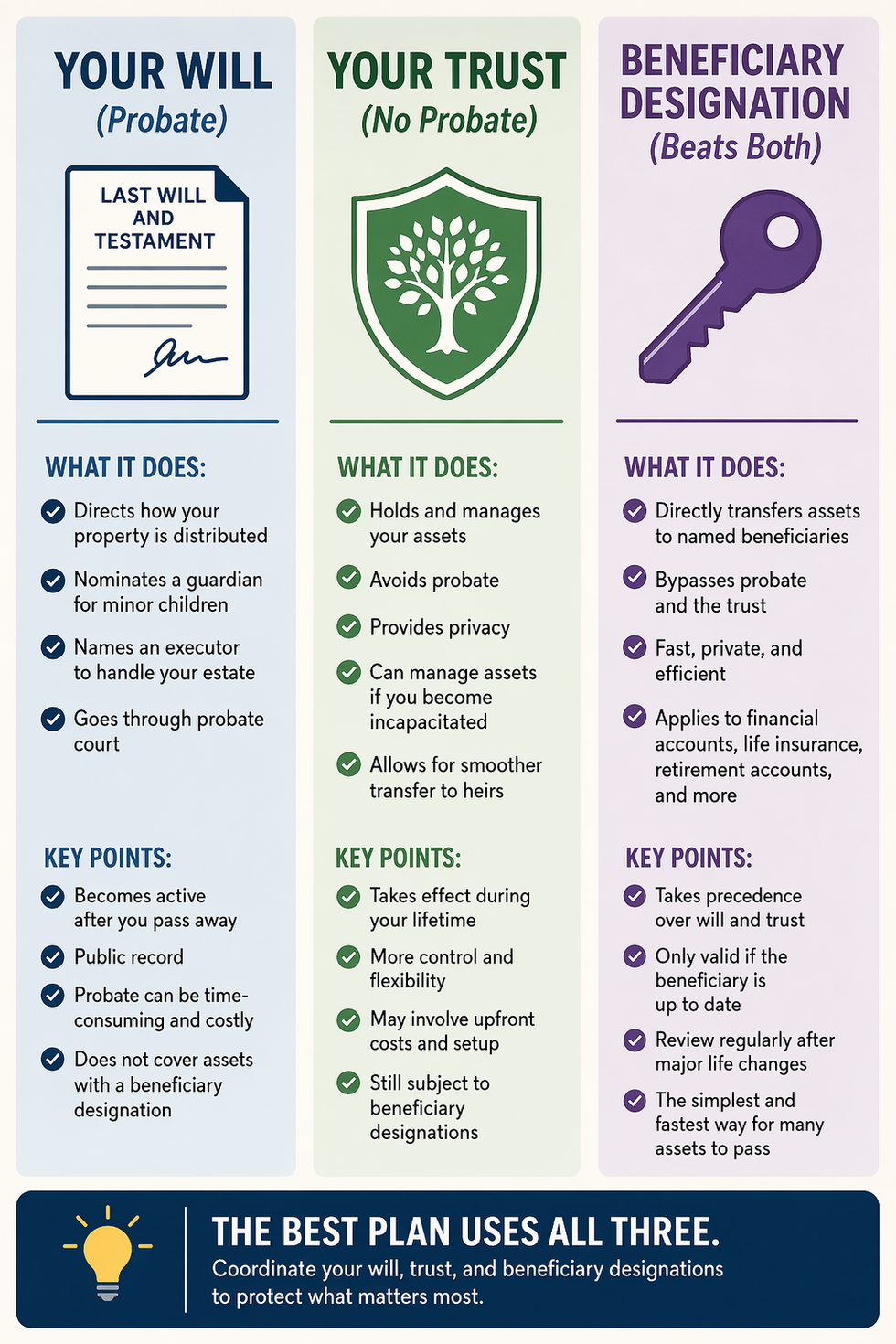
Two takeaways from the table. First, beneficiary designations quietly beat both your will and your trust for the specific account they cover, because those assets pass by contract directly to the named person. Second, the "common mistake" column is where nearly every real conflict is born — usually from an asset that was never routed to the right place.
What Happens If Your Will and Trust Say Different Things?
Which Document Takes Priority for the Same Asset?
If a single asset genuinely appears in both documents, follow the title. If the asset was transferred into the trust during life, the trust controls and the will's contrary gift fails, because the asset was no longer yours to give by will. If the asset was still in your individual name at death, the will controls it through probate. The documents rarely "fight" — one of them simply has no authority over that particular asset.
How Courts Resolve Conflicting Estate Planning Documents
When a dispute does reach a Florida probate court — most often filed here in the Twentieth Judicial Circuit for families in Fort Myers, Naples, or Punta Gorda — the judge starts with ownership and titling, then looks to the language of each instrument. A properly funded trust is administered under the Florida Trust Code (Chapter 736); the probate estate is administered under the Probate Code (Chapter 732). The court's job is to give effect to each document over the property it actually controls.
How Courts Determine Which Document Reflects Your Intent
Where language is ambiguous, Florida courts look for the maker's intent — the settlor's intent for a trust, the testator's intent for a will. Evidence includes the dates of the documents, the specific wording, and whether one document expressly refers to the other. This is exactly why clean, consistent drafting matters: the less a court has to interpret, the less room there is for an expensive family dispute.
Common Estate Planning Mistakes That Lead to Will and Trust Conflicts
Almost every "my will and trust conflict" problem traces back to one of these five habits.
Updating Only Your Will
People often revise a will after a life change and assume the trust updated itself. It didn't. A will and a trust are separate documents; changing one does not change the other. If your wishes shift, both may need attention.
Forgetting to Fund the Trust
This is the single most common problem we see. A trust only controls what you put into it. A trust signed years ago but never funded — no deed recorded, no accounts retitled — is an empty shell, and the assets you meant to protect end up passing under your will through probate instead.
Naming Different Beneficiaries
If your will leaves the Naples condo to one child and your trust leaves it to another, you've created a conflict that only titling can resolve — and you've likely created hurt feelings the day the family reads both documents. Consistency across every instrument prevents this.
Buying New Property Outside the Trust
Funding a trust isn't a one-time event. Every time you buy a new home, open a new account, or acquire a Gulf-access property, that asset starts life in your individual name. If you don't retitle it into the trust, it falls outside your trust plan.
Ignoring Beneficiary Designations
Retirement accounts, life insurance, and POD/TOD accounts pass by designation, ignoring both your will and your trust. An outdated beneficiary — an ex-spouse, a deceased relative — overrides everything you wrote elsewhere. For retirement accounts, the tax stakes are real: the IRS beneficiary rules, including the SECURE Act's 10-year payout rule for many non-spouse heirs, mean a careless designation can accelerate income taxes for the people you love. Review these designations whenever your plan changes.
Can You Change a Trust With a New Will?
Why a New Will Usually Doesn't Amend a Trust
Usually, no. Under Fla. Stat. § 736.0602, a settlor may revoke or amend a revocable trust by "substantial compliance with a method provided in the terms of the trust." Most professionally drafted Florida trusts specify an exclusive method — typically a signed written amendment delivered to the trustee. When the trust names its own method, that's how it must be changed, and a later will won't do the job.
How Revocable Trusts Are Properly Updated
The clean way to change a revocable living trust is a formal trust amendment (or a full restatement if the changes are extensive), signed with the same care as the original. Section 736.0602 does contain a limited fallback: if the trust's terms don't provide a method, the settlor may amend or revoke by a later will or codicil that expressly refers to the trust or specifically devises property that would otherwise pass under it. But relying on that fallback is risky drafting — the safe, predictable route is a proper amendment to the trust itself.
When an Irrevocable Trust Can Be Changed
An irrevocable trust is a different animal. By design, it generally can't be amended or revoked at will. Florida law does provide limited avenues — judicial modification, nonjudicial settlement agreements among the beneficiaries, decanting into a new trust, and similar tools under Chapter 736 — but these are technical, fact-specific, and not something to attempt from a form. If you're dealing with an irrevocable trust, that's a conversation to have with counsel before anyone signs anything.
How Probate Affects a Will and a Trust
Why Trust Assets Usually Avoid Probate
Assets held in a funded revocable trust skip probate because the trust — not the deceased individual — owns them, so there's nothing for the probate court to transfer. A successor trustee steps in and distributes the trust property privately, under the trust's terms, without a court file open to the public. Avoiding that public process is one of the main reasons Southwest Florida families choose trusts in the first place, a point AARP echoes in its plain-English comparison of wills and living trusts.
When Probate Is Still Required
Probate is still needed for assets that were in the decedent's sole name with no beneficiary and no trust title — precisely the assets a will governs. If those assets are modest, Florida offers a shortcut called summary administration. That threshold recently changed: effective July 1, 2026, Fla. Stat. § 735.201 allows summary administration when the estate subject to administration (less property exempt from creditors) does not exceed $150,000 — doubled from the old $75,000 cap by Chapter 2026-57, Laws of Florida. Estates that were too large for the shortcut a year ago may now qualify.
What Happens If the Trust Was Never Properly Funded
Here's where the will and trust finally interact directly. If you meant to fund your trust but left assets in your own name, those assets don't just disappear — they pass under your pour-over will. A pour-over will is a safety net: it directs any leftover individually owned assets into your trust after death, so they can be distributed under the trust's terms. The catch is that pouring assets over usually requires probate first, which undercuts the "avoid probate" goal. Funding the trust during life is what keeps that from happening.
Why Most Estate Plans Use Both a Will and a Trust
When a Will May Be Enough
For some families, a well-drafted will plus smart beneficiary designations is plenty. If your estate is straightforward, your assets are modest, and much of what you own already passes by POD/TOD or survivorship, a trust may be more machinery than you need.
When a Trust Provides Greater Protection
A revocable living trust earns its keep when you want to avoid probate, keep your affairs private, plan for incapacity without a court-appointed guardian, provide for minor children or a beneficiary who needs management help, or own property in more than one state — a frequent situation for our seasonal residents who keep a home up north and one in Bonita Springs or Estero.
Why Many Estate Plans Include Both
Most complete Florida plans pair the two on purpose. The trust holds and directs the major assets and avoids probate; the pour-over will backs it up, names guardians for minor children (something a trust can't do), and sweeps up anything left outside the trust. They're teammates, not rivals.
| Last will and testament | Revocable living trust | |
|---|---|---|
|
Purpose |
Directs solely owned assets; names guardians for minor children |
Holds and distributes assets titled in the trust |
|
Probate |
Goes through probate |
Trust assets avoid probate |
|
Privacy |
Becomes a public court record |
Stays private |
|
Cost |
Lower to create |
Higher upfront; funding takes effort |
|
Complexity |
Simpler |
More setup and ongoing maintenance |
|
Best for |
Modest, straightforward estates; guardianship needs |
Probate avoidance, privacy, incapacity planning, multi-state property |
When Should You Talk to an Estate Planning or Probate Attorney?
Your Estate Plan Contains Conflicting Instructions
If you've read your own will and trust and can't tell which one controls a given asset, that's a signal, not a nuisance. A short review can confirm what's titled where and eliminate the ambiguity before it becomes your family's problem.
You're Creating or Updating a Will and Trust
Any major life event — marriage, divorce, a new child or grandchild, a big purchase, a move to Florida — is a natural moment to align the whole plan. The National Institute on Aging recommends reviewing these documents at least once a year and after any major change, which is sound advice we echo with our own clients.
You're Administering an Estate With Both Documents
If you're the successor trustee or personal representative for someone who left both a will and a trust, you're managing two overlapping jobs at once. Counsel helps you keep the trust administration and the probate on their proper tracks — and helps you handle creditors correctly. The Consumer Financial Protection Bureau's guidance on debt collectors after a death is a useful reminder that survivors are generally not personally responsible for a loved one's debts.
A Beneficiary or Family Member Is Challenging the Estate Plan
If someone is contesting the will, the trust, or a specific gift, get counsel involved early. These disputes turn on titling, capacity, and document language — the exact issues that are hard to unwind once positions harden.
How to Choose the Right Probate or Estate Planning Attorney
Experience With Trust Administration and Probate
Look for a lawyer who handles both trust administration and probate day to day, not as an occasional sideline. The interplay between a will and a trust is exactly where focused experience pays off.
Knowledge of State Estate Laws
Estate law is intensely state-specific. Florida has its own rules on homestead, spousal rights, trust funding, and small-estate procedures, and a change like the 2026 summary-administration increase matters. You want someone who practices Florida law, not generic estate planning.
Transparent Pricing and Legal Services
Ask for the fee structure in writing before you engage anyone. Many Southwest Florida firms — ours included — quote flat fees for straightforward planning and administration, which most families find easier to budget than open-ended hourly billing.
Questions to Ask Before Hiring an Attorney
A few questions cut through the noise: Do you focus on estate planning and probate? Will you help fund the trust, or just draft it? How do you charge, and what's included? Who will actually handle my file? The answers tell you a lot about how your plan will be built and maintained.
How Much Does It Cost to Create or Update a Will and Trust?
Typical Cost of a Will
A simple Florida will is the most affordable document in the plan. Costs vary by complexity and firm, but a basic will is generally the low end of any estate-planning quote. As AARP notes, wills are usually less complicated and less expensive than trusts.
Typical Cost of a Living Trust
A revocable living trust package costs more upfront because it involves more drafting and, critically, the work of funding — recording deeds and retitling accounts so the trust actually controls your assets. That funding step is where a trust either succeeds or quietly fails, so it's worth paying for it to be done right.
Factors That Affect Estate Planning Costs
Price tracks complexity: the size and mix of your assets, whether you own property in more than one state, blended-family considerations, business interests, and special-needs or tax planning all move the number. A plan that matches your actual situation is worth more than a cheap template that leaves gaps.
Why Preventive Planning Can Reduce Future Probate Expenses
Planning well now can shrink costs later. Florida's Probate Code sets a schedule of presumed-reasonable attorney fees for a formal administration under Fla. Stat. § 733.6171 — for example, a fee calculated at 3% of the first $1 million of the estate is presumed reasonable for ordinary services. Assets that pass through a funded trust generally avoid that formal-administration process altogether, which is a large part of a trust's long-run value.
How The Nussbickel Law Firm Helps You Avoid Will and Trust Conflicts
The Nussbickel Law Firm, P.A. focuses exclusively on estate planning, probate, and trust administration — it's all we do. From our Fort Myers office, we help families across Lee, Collier, and Charlotte counties build wills and trusts that work together instead of against each other, and we take the funding step seriously so your trust actually controls what you intended.
If you already have a will and a trust and aren't sure they line up, that's exactly the kind of question a focused review answers. We'll confirm what's titled where, flag any gaps, and tell you plainly whether your plan needs a tune-up. Schedule a consultation or call our Fort Myers office.
Frequently Asked Questions
Does a living trust override a will?
For assets held in the trust, yes in practical effect — but only because the trust, not you individually, owns that property, so your will has nothing to transfer. For assets left in your sole name, the will controls. They generally govern different property rather than overriding each other.
Which document takes precedence if they conflict?
Whichever one actually controls the specific asset, determined by title. Property transferred into the trust is governed by the trust; property still in your individual name at death passes under the will. A will cannot give away something the trust already owns.
Can I have both a will and a trust?
Yes — most complete Florida estate plans include both. The trust holds and distributes your major assets and avoids probate, while a pour-over will backs it up, names guardians for any minor children, and catches assets left outside the trust.
Does a pour-over will override a trust?
No. A pour-over will works with the trust, not against it. Under Fla. Stat. § 732.513, it directs assets left in your individual name into the trust after death, so everything is ultimately distributed under the trust's terms.
Can I amend a trust by updating my will?
Usually not. Under Fla. Stat. § 736.0602, a revocable trust is changed by the method its own terms require — typically a written amendment. Only if the trust specifies no method can a later will that expressly refers to the trust amend it. The reliable route is a formal trust amendment.
What happens if my house is listed in both documents?
Follow the deed. If the home was retitled into your trust, the trust controls and the will's contrary gift fails. If the home was still in your sole name at death, it passes under your will through probate. The recorded title, not the paperwork's wording, decides it.
What happens if assets were never transferred into the trust?
They stay outside the trust and pass under your pour-over will — which usually means probate. This "unfunded trust" problem is the most common conflict we see. Funding the trust during your life is what avoids it.
Can an executor override a trustee?
No. The personal representative (Florida's term for an executor) administers the probate estate under the will, while the trustee administers the trust assets under the trust. They run in separate lanes over different property, and neither overrides the other.
Can a trust be challenged after death?
Yes. A trust can be contested on grounds such as lack of capacity, undue influence, or improper execution, similar to a will contest. These disputes are fact-intensive and are best addressed with counsel as early as possible.
Do I still need probate if I have a living trust?
Only for assets left outside the trust in your sole name. A fully funded trust can avoid probate entirely; a trust that missed some assets will send those through probate via the pour-over will. Funding is the deciding factor.
What if my trust and will name different beneficiaries?
Title controls the specific asset, so the document that owns the asset wins — but conflicting names are a red flag that your plan is out of sync. It should be reconciled promptly to avoid confusion and potential litigation among your heirs.
Do I need a probate attorney if my loved one had both a will and a trust?
Often, yes. Administering a trust and a probate estate at the same time involves overlapping duties, creditor handling, and Florida-specific rules. In a formal administration, Florida generally requires the personal representative to be represented by a Florida attorney, and even where it isn't required, the coordination is worth professional help.
Gregory J. Nussbickel is the founder of The Nussbickel Law Firm, P.A. in Fort Myers, Florida. His practice is devoted exclusively to estate planning, probate, and trust administration for families throughout Southwest Florida.
This article is for general information only and is not legal advice. Reading it does not create an attorney-client relationship. Probate law changes, and every estate is different — speak with a licensed Florida attorney about your specific situation.

Comments
There are no comments for this post. Be the first and Add your Comment below.
Leave a Comment