
When a loved one dies, the family's first practical question is usually some version of "how long is this going to take?" You may have bills to handle, a house sitting empty in Cape Coral, or siblings up north waiting to know when the estate will be settled. Here is a straight answer, with the real deadlines built into Florida law.
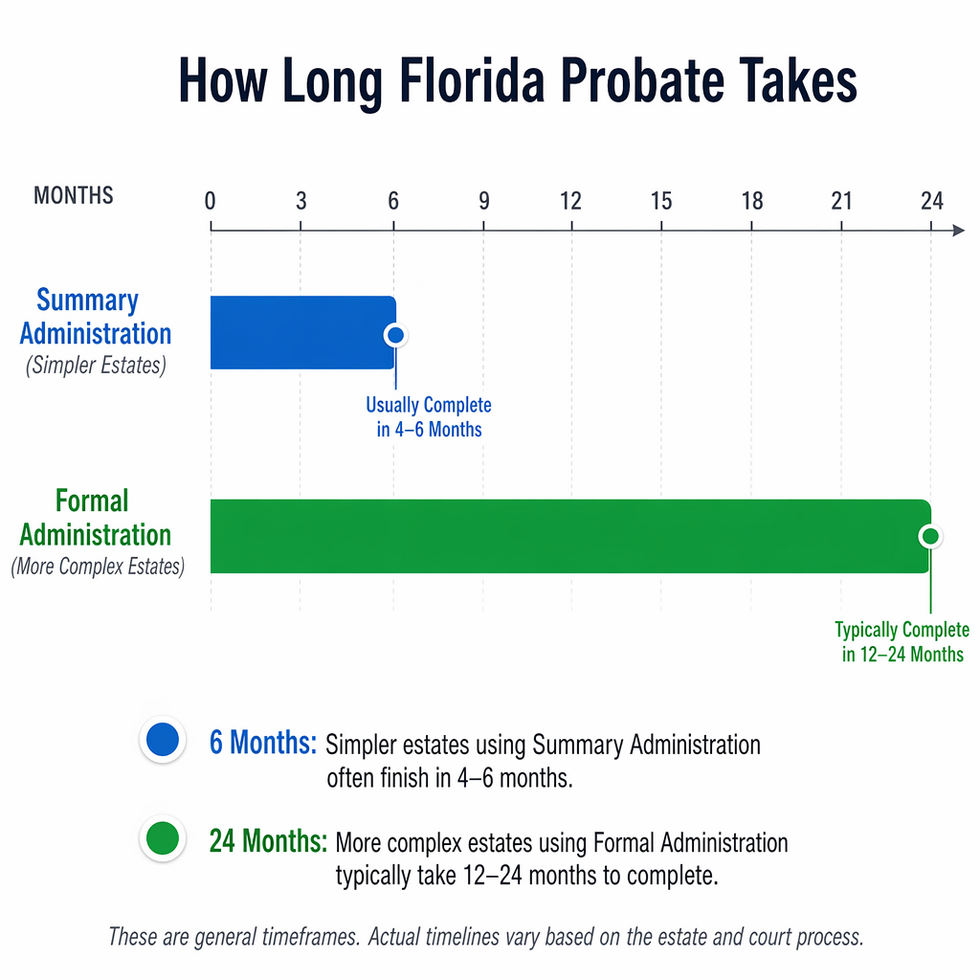
The short answer: Most Florida probate cases take somewhere between a few weeks and about a year, depending on which procedure applies. Summary administration — the small-estate shortcut for estates worth $150,000 or less (or where the person died more than two years ago) — often finishes in four to eight weeks. Formal administration, the full process for larger estates, usually runs about six months to a year for an uncontested estate. The single biggest reason formal probate can't move faster is the creditor claim period: under Fla. Stat. § 733.702, creditors have three months from the first published notice to file claims, and under Fla. Stat. § 733.705, the personal representative can't be forced to pay debts until five months have passed. Those clocks set the floor.
The rest of this guide breaks the timeline down by type of probate, explains what actually drives the clock, and points out the things — a missing will, a contested estate, out-of-state property — that stretch months into years.
How Long Does Probate Take in Florida?
There is no single answer, because Florida has more than one kind of probate. The honest range is a few weeks on the short end to well over a year on the long end. Here is how the common paths compare:
|
Type of proceeding |
Typical timeline |
When it applies |
|---|---|---|
|
Disposition without administration |
1–4 weeks |
Very small estates: only exempt property plus assets under funeral and last-60-days medical bills (§ 735.301) |
|
Summary administration |
4–12 weeks (sometimes longer) |
Estate worth $150,000 or less, or death more than 2 years ago (§ 735.201) |
|
Formal administration (uncontested) |
9–12 months |
The standard full process for most estates |
|
Formal administration (contested or complex) |
1–3 years or more |
Will contests, litigation, tax returns, hard-to-sell real estate |
Think of these as guideposts, not guarantees. A clean summary administration in Naples can close faster than the range suggests; a formal estate with a fought-over homestead in Fort Myers can run much longer.
What Determines How Long Florida Probate Takes?
The first sentence of an honest answer is: it depends on the estate, not on the county. Filings in the Twentieth Judicial Circuit — Lee, Collier, Charlotte, Hendry, and Glades counties — move at a similar pace, because they follow the same Florida Probate Code and the same statewide e-filing portal. What actually moves the needle is the estate itself.
The main drivers are:
-
Which procedure applies — a $60,000 bank account qualifies for a fast small-estate track; a $900,000 estate with real property does not.
-
Whether there is a valid will — a missing or contested will adds court steps before anything else can happen.
-
The creditor claim period — a fixed statutory clock that formal administration can't skip.
-
Real estate — especially Florida homestead, which carries constitutional protections that require extra court determinations.
-
Whether beneficiaries get along — disputes are the most common reason a routine estate turns into a multi-year matter.
-
Assets in more than one state — common for our seasonal residents, and often requiring a second (ancillary) probate.
How Long Does Summary Administration Take in Florida?
Summary administration is the fast lane, and for a straightforward estate it often wraps up in about four to eight weeks after filing. It's available when the probate estate (minus property exempt from creditors) is worth $150,000 or less, or when the decedent has been dead for more than two years, under Fla. Stat. § 735.201.
That $150,000 figure is worth a second look, because it just changed. Effective July 1, 2026, the Legislature doubled the cap from $75,000 to $150,000 (Ch. 2026-57, Laws of Florida). If a family was told even a few months ago that an estate was too big for summary administration, it may qualify now — and the published statute books were still showing the old $75,000 number well after the change took effect, so it's easy to get stale information on this one.
Summary administration is quicker mainly because there's no personal representative appointed to manage a months-long process and no formal creditor period to sit through. The trade-off is that it works only for smaller or older estates, and it still has traps of its own — particularly when homestead real estate is involved.
How Long Does Formal Administration Take in Florida?
For a typical uncontested estate, formal administration runs about six months to a year. It's the standard, full process, and it moves through a defined sequence of steps, each with its own timing.
Month 1: Filing and appointment
The attorney files the petition for administration with the clerk in the county where the decedent lived — Lee County for Fort Myers and Cape Coral, Collier for Naples and Marco Island, Charlotte for Punta Gorda — along with the original will and the death certificate. If everything is in order, the court issues letters of administration, the document that lets the personal representative act for the estate. This stage often takes a few weeks.
Months 1–2: Notice and inventory
The personal representative serves a notice of administration on beneficiaries and publishes a notice to creditors. An inventory of the estate's assets must be filed within 60 days after the letters are issued, under Florida Probate Rule 5.340. Seasonal residents complicate this step — assets scattered across two states mean coordinating valuations in both.
Months 3–5: The creditor claim period
This is the part no one can rush. Creditors have three months from the first publication of the notice to file claims (§ 733.702), and the personal representative cannot be compelled to pay debts until five months have passed since that first publication (§ 733.705). Even a simple estate with one heir and no debts generally can't close before this window runs.
Months 6–12: Distribution and closing
Once the claim period ends and valid debts are paid, the remaining assets are distributed under the will — or under Florida's intestacy law if there's no will. A final accounting and a petition for discharge close the estate and release the personal representative from liability.
Why Can't Formal Probate in Florida Close Faster?
Because the law builds in waiting periods to protect creditors and beneficiaries. The clearest example is the creditor process. Publishing the notice to creditors starts a three-month claim window, and Fla. Stat. § 733.705 says the personal representative can't be forced to pay any debt until five months after first publication. Distributing money before that window closes is one of the fastest ways a personal representative can become personally liable.
There's a second, longer clock in the background. Under Fla. Stat. § 733.710, most claims against an estate are cut off two years after death regardless of whether probate was ever opened. That two-year repose rarely dictates a normal timeline, but it's why estates opened long after a death are sometimes simpler on the creditor side.
How Long Does Probate Take in Florida Without a Will?
Dying without a will (called dying "intestate") doesn't automatically make probate longer, but it adds a layer. Instead of a will naming who inherits and who serves as personal representative, the court applies Florida's intestacy statutes in Chapter 732 to determine both. That means the court may need to identify and confirm legal heirs before it can appoint anyone or distribute anything.
For a small, clear family situation, an intestate estate can move on nearly the same schedule as one with a will. The delay comes when heirs are hard to identify, live out of state, or disagree about who should serve. Blended families and estranged relatives are where intestate estates tend to slow down.
Does Having a Will Make Probate Faster in Florida?
Usually, yes — modestly. A valid will names the personal representative and the beneficiaries, which removes the guesswork the court would otherwise have to resolve under the intestacy rules. It gives everyone a clear roadmap from day one.
What a will does not do is let you skip probate. This is one of the most common misunderstandings we hear: a will is instructions for probate, not a way around it. Assets titled in the decedent's sole name still pass through the court process, will or no will. And a will only speeds things up if it's valid and uncontested — a challenged will can turn into the slowest kind of probate there is. One related deadline catches families off guard: whoever holds the original will must deposit it with the clerk within 10 days of learning of the death, under Fla. Stat. § 732.901.
What Can Make Florida Probate Take Longer?
Most of the estates that run past a year share a handful of features. If your family's situation includes one of these, plan for a longer timeline:
-
A will contest or beneficiary dispute. Litigation is the number-one reason probate drags. Interested parties served with the notice of administration have three months to challenge the will's validity (§ 733.212), and a contest filed within that window can add a year or more.
-
Real estate that has to be sold. A Gulf-access home in Cape Coral or a condo on Sanibel can't always be sold on the estate's schedule, and homestead property carries extra constitutional steps.
-
Federal estate tax returns. Large estates that must file a return typically wait for an IRS closing letter before final distribution, which alone can add many months. Florida itself has no state estate or inheritance tax.
-
Assets in multiple states. Snowbirds who kept a home up north often need a second, ancillary probate there — two court processes running in parallel.
-
A personal representative who lives out of state and is trying to manage a Florida court process from a distance.
-
Missing or incomplete records. Hunting down account statements, deeds, and beneficiary information slows the inventory and everything downstream.
How Long Do You Have to Start Probate in Florida?
Florida doesn't set a strict deadline to open formal probate the way it sets deadlines inside a case, but waiting has consequences. Two timeframes matter most. First, the custodian of the original will must deposit it with the clerk within 10 days of learning of the death (§ 732.901). Second, the two-year claim cutoff under § 733.710 means an estate opened more than two years after death is often treated differently on the creditor side — and, as noted, may even qualify for summary administration on the "dead more than two years" basis.
In practice, families should start sooner rather than later. Assets can't be transferred, sold, or accessed until someone has authority from the court, and property left in limbo — an empty house, a lapsing insurance policy, an unmanaged brokerage account — tends to lose value while everyone waits.
Florida Probate Timeline: A Side-by-Side Look
|
Milestone |
Summary administration |
Formal administration |
|---|---|---|
|
Petition filed |
Week 1 |
Week 1 |
|
Personal representative appointed |
Not applicable |
Weeks 2–4 |
|
Inventory filed |
Not required |
Within 60 days of letters |
|
Creditor claim period |
None |
3 months from published notice |
|
Earliest debts must be paid |
Not applicable |
5 months from published notice |
|
Order / distribution |
Weeks 4–8 |
Months 6–12 |
Four Florida Probate Timing Myths
"Probate always takes years in Florida." Not true for most estates. Multi-year probates are the exception, usually driven by litigation, tax returns, or hard-to-sell property — not by the routine estate.
"Having a will means you skip probate." A will doesn't avoid probate; it directs it. Skipping probate takes trusts, survivorship titling, and beneficiary designations set up during life.
"The estate can be distributed right after the funeral." The creditor period alone runs three months, and a personal representative generally can't be forced to pay debts for five months (§ 733.705). Paying out early creates personal liability.
"No will means the state takes everything." Rare in practice. Without a will, Florida's intestacy statutes (Chapter 732) direct assets to family in a set order; the state inherits only when no legal heirs exist at all.
Talk to a Southwest Florida Probate Attorney
The Nussbickel Law Firm, P.A. handles probate and trust administration exclusively — it's not a sideline for us. From our Fort Myers office we guide personal representatives and families through the process in Lee, Collier, and Charlotte counties, and we regularly help out-of-state families who need someone on the ground in Florida.
If you're trying to estimate how long your family's estate will take, that's one of the first things a short consultation can answer. We'll tell you which procedure fits, what the realistic timeline looks like, and where the potential delays are before they surprise you. Schedule a consultation or call our Fort Myers office.
Frequently Asked Questions
How long does probate take in Florida on average?
Most Florida probate cases take between a few weeks and about a year. Summary administration for smaller estates often finishes in four to eight weeks, while a typical uncontested formal administration runs six months to a year, largely because of the three-month creditor claim period.
How long does probate take in Florida with a will?
A valid, uncontested will doesn't add much time — it usually speeds things up slightly by naming the personal representative and beneficiaries. The estate still goes through the same formal process, so plan on roughly six months to a year unless it qualifies for summary administration.
How long does probate take in Florida without a will?
Without a will, the court applies Florida's intestacy statutes to identify heirs and appoint a personal representative, which can add time if heirs are hard to locate or disagree. A simple intestate estate can still move on a similar schedule to one with a will — commonly six months to a year for formal administration.
What is the fastest type of probate in Florida?
Disposition without administration and summary administration are the fastest. Summary administration is available for estates worth $150,000 or less (or where the death was more than two years ago) and often closes in four to eight weeks because there's no personal representative or formal creditor period.
Why does Florida probate take so long?
The main reason is the creditor claim period. Creditors have three months from the first published notice to file claims, and the personal representative generally can't be compelled to pay debts until five months after that publication, so even a simple formal estate rarely closes before six months.
Can probate be avoided to save time in Florida?
Yes, with planning done during life. A funded revocable living trust, survivorship titling, payable-on-death accounts, and beneficiary designations can pass assets directly to your heirs and leave little or nothing for the court to administer.
How long does an executor have to settle an estate in Florida?
Florida law expects the personal representative to proceed without unnecessary delay and to pay all valid claims within one year of the first publication of notice to creditors (§ 733.705). Most uncontested estates are ready to close within six months to a year.
Gregory J. Nussbickel is the founder of The Nussbickel Law Firm, P.A. in Fort Myers, Florida. His practice is devoted exclusively to estate planning, probate, and trust administration for families throughout Southwest Florida. This article is for general information only and is not legal advice. Reading it does not create an attorney-client relationship. Probate law changes, and every estate is different — speak with a licensed Florida attorney about your specific situation.

Comments
There are no comments for this post. Be the first and Add your Comment below.
Leave a Comment