
If you've just lost a parent or spouse who lived in Florida, someone has probably already told you that you "have to hire a probate lawyer." That's mostly true — but not always. Here's the honest answer, including the situations where you can skip the attorney entirely.
The short answer: In most Florida probate cases, yes — an attorney is required, not just recommended. Florida Probate Rule 5.030 requires the personal representative (Florida's term for the executor) to be represented by a Florida-licensed attorney in a formal administration, unless the personal representative is the only person with an interest in the estate, or is a Florida attorney themselves. Because nearly every estate has more than one beneficiary or at least one creditor, that exception rarely applies. The main paths that don't require a lawyer are the two small-estate shortcuts: disposition without administration (Fla. Stat. § 735.301) and summary administration (Fla. Stat. § 735.201) for estates of $150,000 or less, or where the person died more than two years ago.
The rest of this guide walks through what a probate attorney actually does, what the process looks like here in the Twentieth Judicial Circuit (Lee, Collier, Charlotte, Hendry, and Glades counties), what it costs, and how to tell which category your family's situation falls into.
Is a Probate Attorney Required in Florida?
For formal administration — the standard, full probate process — yes. Florida Probate Rule 5.030(a) says every personal representative must be represented by an attorney admitted to practice in Florida, unless the personal representative "remains the sole interested person" or is himself or herself a Florida attorney.
"Sole interested person" is a narrow door. It means no other beneficiaries, no heirs with a potential claim, and no creditors with an interest in the estate. If your mother's will leaves everything to you alone, but a hospital in Cape Coral has an unpaid bill from her last illness, you are no longer the sole interested person. In practice, this exception almost never applies — most Southwest Florida estates have at least one other beneficiary or creditor in the picture.
The rule exists for a practical reason: the personal representative acts as a fiduciary for everyone with a stake in the estate, and mistakes create personal liability. The courts in Fort Myers and Naples will not let a non-lawyer navigate that risk on behalf of other people.
What Does a Probate Attorney Actually Do?
A common misconception is that the probate lawyer's job is filling out forms. The paperwork is the visible part. The real work is keeping the personal representative out of trouble:
-
Preparing and filing court documents — the petition for administration, oath, notices, inventory, accountings, and the petition for discharge, all under the Florida Probate Rules and the local requirements of the circuit.
-
Guiding the personal representative through each statutory duty and deadline, so nothing is missed and nothing is signed that shouldn't be.
-
Handling creditor claims — publishing and serving the notice to creditors, evaluating which claims are valid, and objecting to those that aren't (more on the deadlines below).
-
Distributing assets correctly — including Florida-specific wrinkles like homestead property, exempt property, and the rights of a surviving spouse.
-
Preventing expensive mistakes — an early misstep, like distributing assets before the creditor period closes, can make the personal representative personally liable to creditors and beneficiaries.
What Are the Personal Representative's Responsibilities?
If you've been named personal representative in a will, you've been handed a job, not a gift. Under Chapter 733 of the Florida Probate Code, you're responsible for:
-
Identifying, securing, and valuing everything the decedent owned — from a Gulf-access home in Cape Coral to a forgotten brokerage account up north
-
Serving a notice of administration on beneficiaries and publishing a notice to creditors
-
Filing an inventory of estate assets with the court
-
Paying valid debts, final expenses, and any taxes owed
-
Distributing what remains to the right people, in the right order
-
Filing a final accounting and closing the estate properly
Do it wrong, and the liability is personal. Beneficiaries can sue a personal representative for breach of fiduciary duty, and creditors can pursue one who distributed assets prematurely. This is why the attorney requirement, inconvenient as it feels, tends to protect the very person it burdens.
What Happens During the Florida Probate Process?
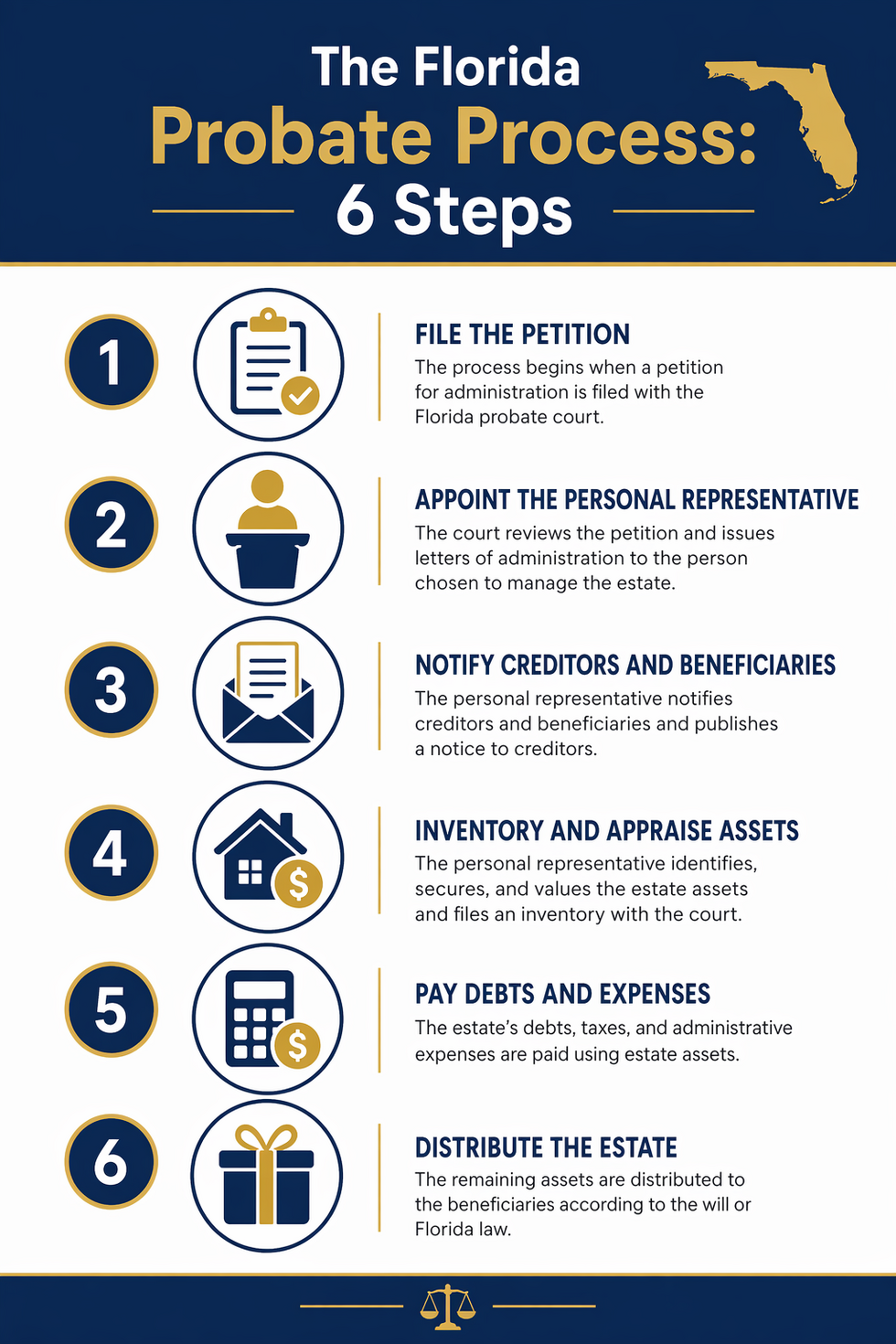
Formal administration in Florida follows six broad steps. In the Twentieth Circuit, everything is e-filed through the Florida Courts E-Filing Portal, and most estates never require anyone to set foot in the Lee County Justice Center in downtown Fort Myers. (For a plain-English overview straight from the source, The Florida Bar publishes a free consumer pamphlet, Probate in Florida.)
1. Filing the petition for administration
The attorney files the petition with the clerk in the county where the decedent lived — Lee County for Fort Myers and Cape Coral, Collier for Naples and Marco Island, Charlotte for Punta Gorda — along with the original will and death certificate.
2. Appointment of the personal representative
The court reviews the petition and, if everything is in order, issues letters of administration — the document banks, brokerages, and title companies will demand before they'll talk to you. Note that Florida limits who may serve: a personal representative who lives outside Florida generally must be a close relative of the decedent, a rule that surprises many out-of-state families.
3. Inventorying estate assets
The personal representative must file an inventory listing the probate assets and their values, generally within 60 days of appointment. Seasonal residents often complicate this step — assets scattered across two states means coordinating with professionals in both.
4. Paying creditors and resolving claims
The attorney publishes a notice to creditors in a local newspaper. Under Fla. Stat. § 733.702, creditors then have 3 months from first publication (or 30 days from being personally served with the notice, if later) to file claims. Invalid or inflated claims can be challenged.
5. Distributing inheritances
Once the claim period closes and debts are resolved, assets are distributed under the will — or under Florida's intestacy statutes in Chapter 732 if there is no will.
6. Closing the estate
A final accounting and petition for discharge wrap up the administration and formally release the personal representative from liability.
When Might You Not Need a Probate Attorney?
Florida law leaves genuine room to proceed without a lawyer in limited situations:
-
Disposition without administration (Fla. Stat. § 735.301). If the decedent left only exempt personal property and nonexempt property worth less than the funeral bill plus the final 60 days of medical expenses, no probate is needed at all. You can request the transfer directly from the clerk — the Lee County Clerk of Courts processes these routinely.
-
Summary administration (Fla. Stat. § 735.201). Available when the probate estate (less exempt property) is worth $150,000 or less, or the decedent has been dead more than two years. That dollar limit just doubled — the Legislature raised it from $75,000 effective July 1, 2026 (Ch. 2026-57, Laws of Florida), so estates that missed the cutoff even a few months ago may now qualify. There's no personal representative appointed, so Rule 5.030's attorney requirement doesn't apply — though many families still hire counsel because the petition has traps of its own, especially where homestead real estate is involved.
-
Everything passes outside probate. If every asset was jointly owned, held in a living trust, or had a valid beneficiary designation, there may be nothing to probate in the first place.
-
You are truly the sole interested person in a formal administration — rare, as explained above.
Does Having a Will Avoid Probate in Florida?
No — and this may be the single most common misunderstanding we hear in initial consultations. A will does not avoid probate; a will is instructions for probate. It tells the court who should serve as personal representative and who inherits, but the will itself must be admitted to probate and proven valid before it controls anything. Assets titled in the decedent's sole name still go through the court process, will or no will.
What a will does do is keep you in charge of the outcome. Without one, Florida's intestacy statutes decide who inherits — and the result frequently surprises blended families, unmarried partners, and anyone who assumed "it all just goes to my spouse."
What Assets Skip Probate in Florida?
Probate only touches assets titled in the decedent's sole name with no beneficiary. These commonly pass outside the process entirely:
-
Jointly owned property with rights of survivorship — including most homes owned by married couples as tenants by the entireties
-
Assets held in a revocable living trust
-
Life insurance with a named living beneficiary
-
Retirement accounts (IRAs, 401(k)s) with beneficiary designations
-
Payable-on-death and transfer-on-death accounts at banks and brokerages
-
Property conveyed by a Lady Bird deed (enhanced life estate deed) — a Florida-specific tool we use regularly for Southwest Florida homesteads
When Is Hiring a Probate Attorney Clearly Worth It?
Even where the law technically permits self-help, experience says hire counsel when:
-
There is no valid will, so intestacy rules and heir determinations apply
-
Beneficiaries disagree — even mild friction gets expensive once positions harden
-
The estate includes real estate, especially Florida homestead, which has constitutional protections that trip up even out-of-state lawyers
-
There are significant debts or aggressive creditors
-
Assets sit in multiple states — common for our seasonal residents, and it may require a second (ancillary) probate
-
The personal representative lives out of state and can't easily manage a Florida court process from afar
DIY Probate vs. Hiring an Attorney: What's the Real Difference?
|
Handling it yourself |
With a probate attorney |
|
|---|---|---|
|
Availability |
Only small-estate procedures (§ 735.201, § 735.301) or sole-interested-person estates |
Any estate, any complexity |
|
Court filings |
You prepare and e-file everything |
Prepared, reviewed, and filed for you |
|
Creditor claims |
You evaluate and respond alone |
Claims screened; invalid claims objected to |
|
Personal liability |
Entirely on you |
Attorney guidance is your primary shield |
|
Timeline |
Delays from rejected filings are common |
Clean filings keep the case moving |
|
Out-of-pocket cost |
Filing fees (a few hundred dollars) |
Filing fees plus attorney fees (below) |
How Much Does a Probate Attorney Cost in Florida?
Florida is unusual: the Probate Code publishes a fee schedule that is presumed reasonable for ordinary services in a formal administration. Under Fla. Stat. § 733.6171, the presumed fee is:
|
Compensable estate value |
Presumed reasonable fee |
|---|---|
|
Up to $40,000 |
$1,500 |
|
$40,000–$70,000 |
$2,250 |
|
$70,000–$100,000 |
$3,000 |
|
$100,000–$1 million |
$3,000 + 3% of the value over $100,000 |
|
$1–3 million |
2.5% on the excess |
|
Above $3 million |
2% and declining |
Two things every family should know. First, the schedule is not mandatory — since a 2021 amendment, any attorney who intends to charge from the schedule must disclose in writing that the fee is negotiable, isn't required to be based on estate size, and that you're free to choose any attorney, not just the one who drafted the will. Second, many Southwest Florida firms (ours included) quote flat fees for straightforward administrations, which is often better value than the percentage. Ask for the fee structure in writing before you sign anything.
How Long Does Probate Take in Florida?
Summary administrations in the Twentieth Circuit often wrap up in a matter of weeks once filed. Formal administration takes longer by design — the creditor period alone runs three months from publication — so most uncontested formal estates finish in roughly six months to a year. Contested estates, estates with tax returns, or estates selling real property run longer.
Four Probate Myths That Cost Florida Families Money
"A will avoids probate." It doesn't — it directs probate. Avoiding probate takes trusts, deeds, and beneficiary designations put in place during life.
"Probate is always expensive." Small-estate procedures cost a few hundred dollars in filing fees. Even formal administration fees are predictable — and negotiable — under § 733.6171.
"The executor can handle everything alone." In a Florida formal administration, the law itself says otherwise (Rule 5.030), and personal liability makes going it alone a bad bargain even when it's allowed.
"Probate always takes years." Multi-year probates are the exception, usually driven by litigation or tax issues — not the rule.
Talk to a Southwest Florida Probate Attorney
The Nussbickel Law Firm, P.A. handles probate and trust administration exclusively — it's not a sideline for us. From our Fort Myers office we represent personal representatives and beneficiaries throughout Lee, Collier, and Charlotte counties, and we regularly work with out-of-state families who need boots on the ground in Florida.
If you're trying to figure out whether your family's situation needs a lawyer at all, that's exactly the question a short consultation answers. We'll tell you plainly if a small-estate shortcut fits — and what it will cost if it doesn't. Schedule a consultation or call our Fort Myers office.
Frequently Asked Questions
Do I legally need a probate attorney in Florida?
For formal administration, yes — Florida Probate Rule 5.030 requires the personal representative to have a Florida attorney unless the personal representative is the estate's only interested person or is a Florida attorney. Summary administration and disposition without administration can be done without counsel.
Can I handle probate myself in Florida?
Only in limited cases: disposition without administration (§ 735.301), summary administration (§ 735.201) for estates of $150,000 or less or deaths more than two years past, or the rare formal administration where you are the sole interested person.
Does a will avoid probate in Florida?
No. A will must be admitted to probate to have effect. It controls who inherits, but the assets it covers still pass through the court process.
What assets bypass probate in Florida?
Jointly owned property with survivorship rights, living trust assets, life insurance and retirement accounts with named beneficiaries, payable-on-death accounts, and property conveyed by a Lady Bird deed.
How much does a probate attorney cost in Florida?
Fla. Stat. § 733.6171 presumes fees of $1,500–$3,000 for estates up to $100,000, plus 3% of value above that. The schedule is negotiable, and many firms offer flat fees for routine estates — get the structure in writing.
How long does probate take in Florida?
Summary administration: often a few weeks to a couple of months. Formal administration: commonly six months to a year, since the creditor claim period alone runs three months from publication of notice.
Can probate be avoided entirely?
Yes, with planning done during life — a funded revocable living trust, beneficiary designations, survivorship titling, and Lady Bird deeds can leave nothing for the court to administer.
Gregory J. Nussbickel is the founder of The Nussbickel Law Firm, P.A. in Fort Myers, Florida. His practice is devoted exclusively to estate planning, probate, and trust administration for families throughout Southwest Florida. This article is for general information only and is not legal advice. Reading it does not create an attorney-client relationship. Probate law changes, and every estate is different — speak with a licensed Florida attorney about your specific situation.

Comments
There are no comments for this post. Be the first and Add your Comment below.
Leave a Comment