

When a parent or spouse dies without leaving a will, the first question most Southwest Florida families ask is some version of "now what?" The good news: Florida law has a clear roadmap for exactly this situation.
The short answer: When someone dies without a valid will in Florida, they die "intestate," and the probate court — not the family — follows the rules of intestate succession written into Chapter 732 of the Florida Statutes. The court appoints a personal representative (Florida's term for an administrator of the estate), creditors are paid, and the remaining assets go to the heirs the statute names — starting with the surviving spouse and children. The estate does not automatically go to the state, and the probate process itself looks much like probate with a will, just with the legislature's distribution plan instead of the decedent's.
Key Highlights
- Dying without a valid will is called dying intestate; Florida's intestacy laws, not the family's wishes, decide who inherits.
- The court appoints a personal representative using the priority list in Fla. Stat. § 733.301: surviving spouse first, then the person chosen by a majority of the heirs.
- A surviving spouse often inherits the entire estate — but not always, especially in blended families.
- Only probate assets (property in the deceased person's own name with no beneficiary) go through the court; jointly owned property and accounts with named beneficiaries pass outside probate.
- Florida's summary administration limit doubled to $150,000 on July 1, 2026 (Ch. 2026-57, Laws of Florida), so more intestate estates now qualify for the faster, cheaper process.
- Most intestate formal administrations in Lee, Collier, and Charlotte counties take roughly six months to a year.
Introduction
Every year, families across Fort Myers, Cape Coral, Naples, and Punta Gorda discover that a loved one never signed even a basic will. It happens to careful people — the estate planning appointment kept getting rescheduled, or everyone assumed the house and bank account would "just go to the spouse."
This guide walks through the intestate probate process in Florida step by step: what happens to the estate, who is put in charge, who inherits under Florida's rules of intestate succession, what it costs, how long it takes, and where families most often run into trouble. Everything here reflects Florida law as of July 2026, including this year's changes to the small-estate thresholds.
What Happens If Someone Dies Without a Will in Florida?
The estate is administered as an intestate estate: probate still happens, but Florida statute — not a will — controls who receives the property. Contrary to a persistent myth, the state government takes nothing unless the deceased person left no legal heirs at all, which is genuinely rare.
Why Probate Is Usually Required
Probate is the legal process that transfers title of assets out of a deceased person's name. If the decedent owned a bank account, real estate, or a vehicle in their own name alone, no bank or title company will hand it over without court authority — will or no will. The Florida Bar's consumer pamphlet Probate in Florida puts it simply: probate exists to identify and gather the decedent's assets, pay debts, and distribute what remains to beneficiaries.
Who Is Responsible for Starting Probate
Usually the closest family member — the surviving spouse or an adult child — takes the first step by contacting a probate attorney, who files a petition for administration with the circuit court in the county where the decedent lived. Any interested party (an heir or even a creditor) has the legal right to start the process if the family delays. In Lee County, filings go through the Lee County Clerk of Court; Collier and Charlotte counties have the same structure.
What Happens to the Estate When There Is No Will
The probate estate passes under Florida's intestacy laws in the order the statutes set: surviving spouse, descendants, parents, siblings, and outward through the family tree. Homestead real estate follows its own constitutional rules, and certain exempt personal property is set aside for the spouse and children before creditors are paid — two Florida-specific wrinkles covered below.
How Does Probate Work in Florida Without a Will?
Mechanically, intestate probate follows the same formal administration process as probate with a will — seven broad stages from opening the case to closing it. In the Twentieth Judicial Circuit (Lee, Collier, Charlotte, Hendry, and Glades counties), everything is e-filed, and most estates never require a courtroom appearance.
Opening the Probate Case
The attorney files a petition for administration with the clerk in the decedent's home county, along with the death certificate. Because there is no will nominating anyone, the petition asks the court to appoint a personal representative under the statutory priority rules.
Appointing a Personal Representative
The judge issues letters of administration — the document every bank, brokerage, and buyer will demand. Courts frequently require a surety bond in intestate cases, since no will exists to waive it. One rule that surprises out-of-state families: under Fla. Stat. § 733.304, a person who lives outside Florida can serve only if they are a close relative — a spouse, child, parent, sibling, or certain other family members of the decedent.
Identifying Estate Assets
The personal representative locates and values everything the decedent owned at the time of death — every bank account, the house, vehicles, and tangible personal property — and files an inventory with the probate court. For seasonal residents with property in two states, this step often means coordinating with professionals in both.
Notifying Creditors
The attorney publishes a notice to creditors in a local newspaper and serves known creditors directly. Under Fla. Stat. § 733.702, creditors have 3 months from first publication — or 30 days from being served, if later — to file claims.
Paying Debts and Estate Expenses
Valid claims, funeral expenses, taxes, and the costs of administration are paid from estate funds before any heir receives a distribution. Distributing too early is the classic mistake that makes a personal representative personally liable.
Distributing Assets to Heirs
Once the claim period closes and debts are resolved, the remaining assets are distributed strictly according to the intestacy statutes — § 732.102 for the spouse's share and § 732.103 for everyone else.
Closing the Estate
A final accounting and petition for discharge wrap up the estate administration, and the court releases the personal representative from further liability.
Who Is in Charge When There Is No Will?
Florida calls the person in charge the personal representative — what other states call the administrator of the estate or executor. With no will to name one, the court fills the job using a statutory priority list.
Who Can Be Appointed
An individual must be 18 or older, mentally and physically able to perform the duties, and never convicted of a felony. Florida residents qualify automatically; nonresidents qualify only as close relatives under § 733.304. A Florida bank or trust company may also serve in such cases.
Florida's Order of Priority
Fla. Stat. § 733.301 sets the priority list for intestate estates:
- The surviving spouse;
- The person selected by a majority in interest of the heirs;
- The heir nearest in degree — and if several apply, the court selects the one best qualified.
What Happens When Family Members Disagree
If the heirs can't agree — common when adult children from a first marriage and a second spouse both want control — the judge holds a hearing and appoints the person best qualified to serve. Disagreement at this stage adds weeks or months, which is one reason intestate estates tend to run longer.
Court Appointment Process
The court reviews the petition, confirms the nominee's qualifications, sets any required surety bond, and issues letters of administration. Only then does anyone have the legal right to act for the estate of the person who died.
Who Inherits Assets Under Florida Intestate Succession Laws?
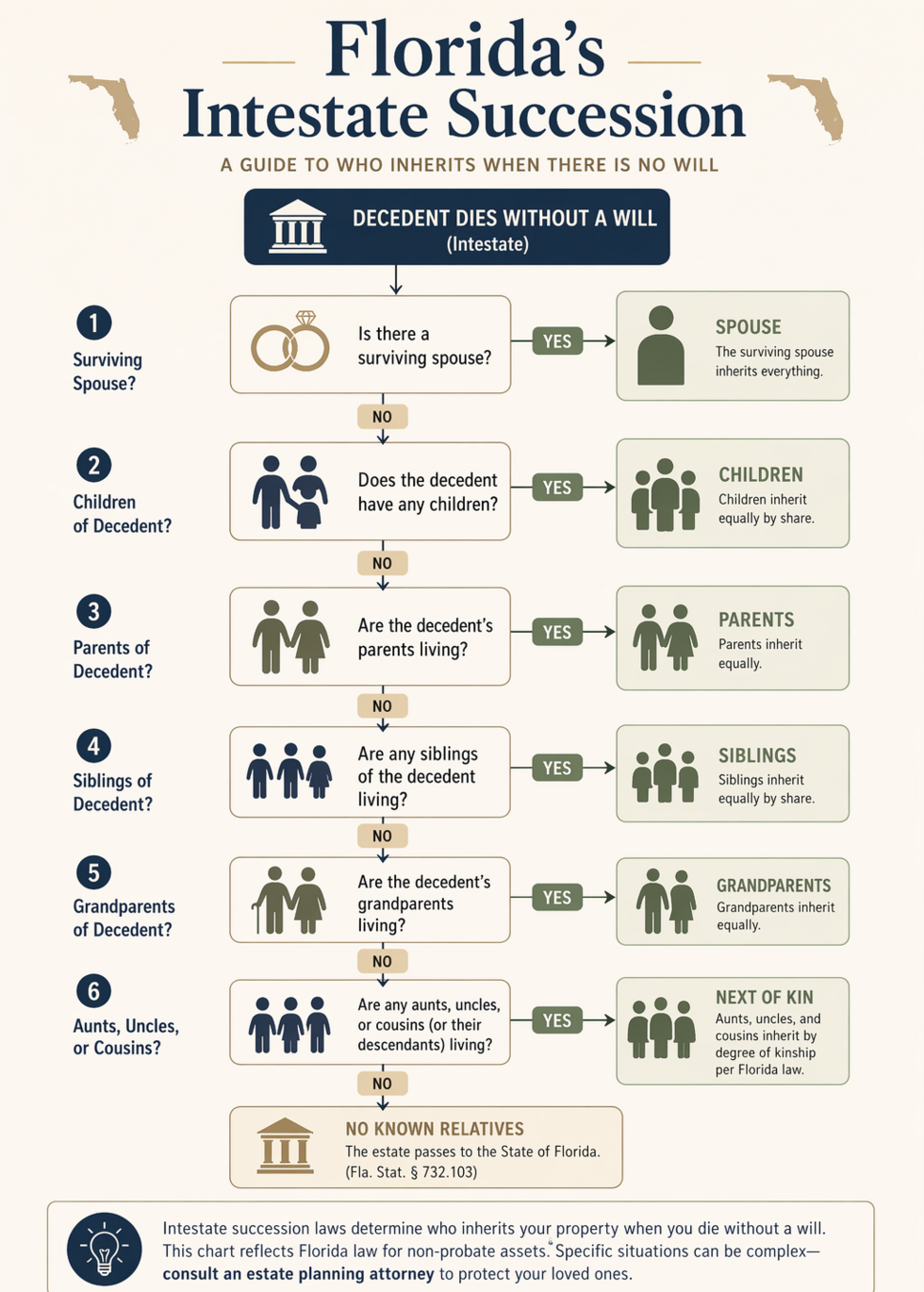
Florida's rules of intestate succession distribute the intestate estate to the closest surviving relatives in a fixed order. Here is the framework at a glance:
| Family situation at the time of death | Who inherits the probate estate |
|---|---|
|
Spouse, no descendants |
Spouse takes the entire estate |
|
Spouse + descendants all shared by both spouses (and spouse has no other descendants) |
Spouse takes the entire estate |
|
Spouse + any descendant from another relationship (either side) |
Spouse takes one-half; decedent's descendants share one-half |
|
Descendants, no spouse |
Descendants take everything |
|
No spouse, no descendants |
Parents, then siblings and their descendants |
|
No close family |
Grandparents, aunts and uncles, then more distant relatives |
|
No legal heirs at all |
Escheat to the state school fund |
If There Is a Surviving Spouse
Under Fla. Stat. § 732.102, the surviving spouse takes the entire estate if the decedent left no descendants, or if every descendant is also the spouse's descendant and the spouse has no children from another relationship. In blended families — one stepchild on either side — the spouse's share of the estate drops to one-half. Two points worth stressing: Florida is a separate-property state, not a community property state like California or Texas, so these rules operate differently from what relocated families may expect from other state laws. And Florida does not recognize legal separation — a legally married but separated spouse still inherits.
If There Are Children
Whatever does not pass to the spouse — or the entire estate in the absence of a spouse — goes to the decedent's descendants. Children share equally, and if a child died first, that child's share passes down to their own children. Adopted children inherit exactly like biological children. Stepchildren and foster children, however, have no inheritance rights unless they were legally adopted — a painful surprise in many blended Southwest Florida families. If minor children inherit, court oversight of their shares can add another layer of process.
If There Is No Spouse or Children
Fla. Stat. § 732.103 continues down the family tree: the decedent's parents inherit first (biological parents or adoptive parents), then brothers and sisters and their descendants, then grandparents, then aunts, uncles, and cousins. If no kindred exist on either side, the estate passes to the family of the decedent's last deceased spouse. Only when there are no surviving relatives at all does the property escheat to the state under Fla. Stat. § 732.107 — deposited in the State School Fund, with a 10-year window for a late-appearing heir to claim it.
If Multiple Family Members Have Inheritance Rights
When several heirs share the estate — five adult children, or a spouse plus stepchildren — each receives the fractional share the statute dictates, and all of them are interested persons entitled to notice throughout the proceeding. Notably absent from the priority list: an unmarried partner. Florida's intestacy statutes give a domestic partner nothing, even a registered domestic partner from a state that recognizes that status — one of the strongest arguments for estate planning documents when couples choose not to marry.
What Assets Go Through Probate and What Assets Avoid Probate?
Only probate assets pass under the intestacy statutes. A surprising amount of property bypasses the court entirely, no will required.
| Goes through probate | Avoids probate |
|---|---|
|
Bank account in the decedent's own name |
Joint account with right of survivorship |
|
Real estate titled solely to the decedent |
Home owned with a spouse as tenants by the entirety |
|
Vehicles, tangible personal property |
Life insurance with a named living beneficiary |
|
Life insurance payable to the estate |
IRA/401(k) with a beneficiary designation |
|
Business interests in the decedent's name |
Payable-on-death and transfer-on-death accounts |
Assets That Usually Go Through Probate
Anything titled in the decedent's name alone with no beneficiary: checking and savings accounts, solely owned real estate, vehicles, and household personal property. These types of property are frozen until the court issues letters of administration.
Jointly Owned Property
Property held with rights of survivorship passes automatically to the surviving co-owner. In Florida, most homes owned by married couples are held as tenants by the entirety, so the house passes to the surviving spouse outside probate — often the single largest asset that never touches the court.
Life Insurance and Retirement Accounts
Life insurance policies and retirement accounts with a named living beneficiary are paid directly to that beneficiary, regardless of intestacy. The exception: if the beneficiary predeceased or the policy names "the estate," the proceeds become probate assets and pass under the intestacy statutes.
Assets With Named Beneficiaries
Payable-on-death bank accounts and transfer-on-death brokerage registrations work the same way — the institution pays the named person on proof of death. These designations quietly function as a substitute for a will for that one asset, which is why reviewing them is a core part of any estate planning engagement.
How Long Does Probate Take in Florida Without a Will?
Plan on six months to a year for a typical intestate formal administration in Southwest Florida, and longer if complications arise.
Typical Probate Timeline
The creditor claim period alone runs three months from publication, so even the simplest formal estate stays open roughly five to six months. Summary administrations — available to smaller estates — often wrap up in a matter of weeks after filing.
Factors That Can Delay Probate
Real estate that must be sold, disputes among heirs, insolvency, tax returns, and assets in multiple states all extend the timeline. Court calendars matter too: filing volumes in fast-growing Lee and Collier counties ebb and flow seasonally.
Why Intestate Estates Often Take Longer
Three reasons come up again and again. First, the court must confirm who the heirs actually are before distributing — sometimes requiring an affidavit of heirs or formal heir determination. Second, no will means no named personal representative, so appointment can be contested. Third, surety bond requirements and family disagreements each add procedural steps that a well-drafted will would have eliminated.
What Challenges Can Complicate Probate Without a Will?
Family Disputes
Without a will stating the decedent's wishes, family members fill the silence with their own assumptions. Disputes over who serves as personal representative and who gets specific items — the house, the boat, grandmother's jewelry — are the most common source of intestate litigation.
Missing Heirs
If an heir can't be located — an estranged sibling, a half-brother from a first marriage — the personal representative must make a diligent search, and the court may require formal notice by publication. Missing heirs can stall distribution for months.
Creditor Claims
Creditors have a legal window to file claims, and disputed claims must be objected to and sometimes litigated. An insolvent estate adds a statutory order of priority for who gets paid first.
Complex Assets
A small business, rental properties, or professional practice in the decedent's own name requires valuation and active management during the administration process — none of which the intestacy statutes make easier.
Out-of-State Property
Florida probate only reaches Florida assets. A cabin in Michigan or a condo in Ohio typically requires a second, ancillary proceeding in that state — a frequent issue for the snowbirds and seasonal residents who make up so much of Southwest Florida.
Unknown or Difficult-to-Locate Assets
With no will and no asset list, families are left searching statements, tax returns, and mail for accounts nobody knew existed. Unclaimed-property databases and old employer benefit plans are common hiding places for remaining assets.
Can You Handle Probate Without a Lawyer?
Sometimes — but less often than families hope. Under Florida Probate Rule 5.030(a), the personal representative in a formal administration must be represented by a Florida attorney unless he or she is the estate's sole interested person. In an intestate estate with multiple heirs and creditors, that exception almost never applies.
Situations Where Probate May Be Straightforward
Two small-estate shortcuts require no personal representative and can be handled without counsel. Summary administration under Fla. Stat. § 735.201 now covers estates up to $150,000 (after exempt property) or any decedent dead more than two years — the limit doubled from $75,000 on July 1, 2026 under Ch. 2026-57, so estates that missed the old cutoff may now qualify. Disposition without administration covers intestate estates with only exempt property and up to $20,000 of other personal property plus final expenses — another threshold the 2026 law doubled.
Risks of Managing Probate Yourself
Rejected filings, blown deadlines, and premature distributions top the list. The personal representative is a fiduciary: mistakes create personal liability to heirs and creditors, and "I didn't know" is not a defense the probate court accepts.
When Legal Help Becomes More Valuable
The more the estate holds — real estate, business interests, debt, or family friction — the more the attorney functions as insurance for the person doing the work. Sound legal advice early is consistently cheaper than litigation later.
When Should You Hire a Probate Attorney?
Estates With Family Conflict
If any heir is unhappy about who is in charge or who inherits, get counsel before positions harden. In intestate estates, conflict is structural: nobody can point to the decedent's written wishes.
Estates With Significant Debt
An attorney screens claims, objects to invalid ones, and sequences payments under the statutory priorities — protecting the personal representative from paying the wrong creditor first.
Estates With Real Estate or Business Assets
Florida homestead has constitutional protections and devise restrictions that confuse even out-of-state lawyers, and a solely owned business needs authority to keep operating. Both are extraordinary-service territory.
First-Time Personal Representatives
Most people serve exactly once in their lives. An experienced probate attorney turns an unfamiliar, liability-laden job into a guided checklist.
How Much Does Probate Cost Without a Will?
For most intestate formal administrations, total costs run from a few hundred dollars in court costs plus attorney fees that scale with the estate.
Court Costs
Expect clerk filing fees of a few hundred dollars, plus the cost of publishing the notice to creditors, certified copies, and a surety bond premium when the court requires one. Current fee schedules are posted by each clerk — for Lee County, see the Clerk's probate pages.
Probate Attorney Fees
Florida publishes a fee schedule that is presumed reasonable for ordinary services in formal administration. Under Fla. Stat. § 733.6171: $1,500 for estates up to $40,000, stepping to $3,000 at $100,000, plus 3% of the value from $100,000 to $1 million, with declining percentages above that. The schedule is not mandatory — attorneys who use it must disclose in writing that fees are negotiable and not required to be based on estate size, and many firms (ours included) quote flat fees for routine estates.
Factors That Affect Probate Expenses
Heir searches, bond premiums, appraisals of unusual assets, ancillary probate in another state, and any contested hearing all add cost. Litigation is the multiplier: a genuine dispute can eclipse every other expense combined.
Does Dying Without a Will Increase Probate Costs?
Usually, yes — modestly in smooth cases, dramatically in contested ones. Intestate estates are more likely to need a surety bond, formal heir determinations, and refereed family disagreements, and the estate pays for all of it. A modest investment in estate planning — even a basic will naming a personal representative and waiving bond, alongside documents like a durable power of attorney — avoids most of these costs outright.
How Do You Choose the Right Probate Attorney?
Look for Florida Probate Experience
Probate is a deadline-driven, court-supervised area of law with its own rules. An attorney who handles Florida probate regularly — not occasionally — will know the Twentieth Circuit's local practices, not just the statutes.
Ask About Similar Probate Cases
Intestate estates raise specific issues: heir determination, bond, blended-family shares. Ask directly whether the attorney has administered estates without a will, and what complications they've handled.
Understand Fee Structures
Ask whether the fee is flat, hourly, or based on the § 733.6171 schedule, and get it in writing before signing. Florida law entitles you to written disclosure that the statutory schedule is negotiable.
Evaluate Communication and Responsiveness
Probate runs for months, and the personal representative needs answers at each stage. How quickly the office responds to your first inquiry is a fair preview of the next year.
Questions to Ask During a Consultation
Who will actually work on the file? What deadlines are already running? Does the estate qualify for summary administration under the new $150,000 limit? What will you need from the family, and by when? An attorney who answers those plainly is an attorney you can work with.
Need Help Navigating Probate Without a Will in Florida?
The Nussbickel Law Firm, P.A. practices probate, trust administration, and estate planning exclusively — it is not a sideline for us. From our Fort Myers office we guide personal representatives and heirs through intestate estates across Lee, Collier, and Charlotte counties, including out-of-state family members handling a Florida estate from afar. We will tell you plainly whether your family qualifies for a small-estate shortcut, what the process will cost, and what to expect at every step. Schedule a consultation or call our Fort Myers office.
Frequently Asked Questions
What happens if someone dies without a will in Florida?
The estate is "intestate": probate proceeds under Chapter 732 of the Florida Statutes, which directs who inherits — surviving spouse and descendants first. The court appoints a personal representative to gather assets, pay creditors, and distribute what remains to the statutory heirs.
Who becomes the executor if there is no will?
Florida calls this person the personal representative. Under § 733.301, the surviving spouse has first priority, then the person selected by a majority in interest of the heirs, then the heir nearest in degree — subject to Florida's residency and qualification rules.
How long does probate take without a will?
Most intestate formal administrations take six months to a year, since the creditor period alone runs three months. Heir determinations, bond requirements, and family disagreements can extend that timeline.
Can probate be completed without a lawyer?
Only in limited situations: summary administration (estates up to $150,000 or deaths more than two years past) and disposition without administration. Formal administration requires a Florida attorney under Probate Rule 5.030 unless the personal representative is the estate's only interested person.
Who inherits if there is no will?
The surviving spouse takes the entire estate in most one-marriage families; where either spouse has children from another relationship, the spouse takes half and the decedent's descendants share half. With no spouse or descendants, the estate passes to parents, then siblings, then more distant relatives.
What assets avoid probate in Florida?
Jointly owned property with rights of survivorship, property held as tenants by the entirety, life insurance and retirement accounts with named beneficiaries, payable-on-death and transfer-on-death accounts, and assets held in a living trust all pass outside probate.
Does Florida require a probate attorney?
For formal administration, yes — Rule 5.030 requires the personal representative to be represented by a Florida-licensed attorney unless the personal representative is the sole interested person. The small-estate procedures have no such requirement.
Can family members challenge inheritance rights?
Yes. Heirs can contest who qualifies as an heir (paternity, adoption, or marriage questions), object to the personal representative's appointment or conduct, and dispute creditor claims. There is no will to contest, but heirship itself can be litigated.
What are the duties of a personal representative?
Identify and safeguard estate assets, file an inventory, notify and pay legitimate creditors, file tax returns, and distribute the remaining assets to the heirs the statute names — all as a fiduciary personally liable for mistakes.
How much does probate cost in Florida?
Court costs typically run a few hundred dollars plus publication and bond. Attorney fees for formal administration are presumed reasonable under § 733.6171 — $3,000 on a $100,000 estate, plus 3% of value above that — but the schedule is negotiable and many firms quote flat fees.
Gregory J. Nussbickel is the founder of The Nussbickel Law Firm, P.A. in Fort Myers, Florida. His practice is devoted exclusively to estate planning, probate, and trust administration for families throughout Southwest Florida.
This article is for general information only and is not legal advice. Reading it does not create an attorney-client relationship. Probate law changes, and every estate is different — speak with a licensed Florida attorney about your specific situation.

Comments
There are no comments for this post. Be the first and Add your Comment below.
Leave a Comment