
Most Florida families come in asking for "a will," and for a good number of them a will is genuinely the right answer. For others, a will alone quietly guarantees the exact outcome they were trying to prevent.
The short answer: You likely need a revocable living trust rather than a will alone if you own Florida real estate, own property in more than one state, have minor children or a beneficiary with special needs, own a business, have a blended family, want to plan for your own incapacity, or want your affairs kept private. A will does not avoid probate — it directs it. A funded living trust does avoid probate, because assets titled in the trust are no longer owned in your individual name when you die, so there is nothing for the probate court to transfer. If your estate is small, your assets already carry beneficiary designations, and your main goal is naming a guardian for your children, a simple will may be all you need.
Key Highlights
- A funded revocable living trust avoids probate; a will does not. The will is instructions for the probate court, not a way around it.
- Florida real estate is the most common reason a Southwest Florida family needs a trust — and property in a second state is the strongest reason of all, because it otherwise triggers a separate ancillary administration under Fla. Stat. § 734.102.
- A trust also works during your lifetime: if you become incapacitated, your successor trustee steps in without a court-supervised guardianship under Chapter 744. A will does nothing until you die.
- A revocable trust is not a lockbox — under Fla. Stat. § 736.0602 you can amend or revoke it at any time while you have capacity.
- Trusts are not only for the wealthy. With the federal estate tax exemption at $15 million per person for 2026 (IRS), almost no Florida family uses a trust for estate tax reasons — they use it to avoid probate and plan for incapacity.
- An unfunded trust accomplishes nothing. Creating the trust document is roughly half the job; retitling assets into it is the other half.
Introduction
The will-versus-trust question gets answered badly in both directions. Some families are sold an expensive trust they will never need. Others are handed a $400 will when their situation — a house, a second property up north, a child from a first marriage — all but guarantees a year in probate court.
The honest answer depends on a short list of facts about your life: what you own, where you own it, who you want to inherit, and whether anyone in the picture needs protecting. This guide walks through that list, explains how a Florida living trust actually changes the probate process, covers what each option costs, and names the mistakes we see most often.
Who Needs a Trust Instead of a Will?
If probate avoidance, incapacity planning, or privacy matters to you, you need a trust. If none of those apply and your assets are simple, a will is enough.
The Short Answer
You need a trust instead of a will alone when your situation includes real estate, out-of-state property, a business, minor children, a blended family, a beneficiary with special needs, or a desire to keep your affairs off the public record. You can use a will alone when your estate is modest, your accounts already name beneficiaries, and nothing in your family situation calls for ongoing management of assets after you are gone.
The Situations Where a Trust Is Usually the Better Choice
A revocable living trust is a legal arrangement in which you transfer ownership of your assets to a trust you control, serving as your own trustee during your lifetime. At death, your successor trustee handles the distribution of assets under the terms of the trust — privately, without a probate case, and without making your family members wait out a court schedule.
Revocable trusts are by far the most common estate planning tool for this purpose, but there are several types of trusts, and they answer very different specific situations. An irrevocable trust gives up control in exchange for asset protection or tax advantages. A special needs trust preserves government benefits. A charitable trust — including charitable remainder trusts and charitable lead trusts — splits benefits between your family and a cause you care about. A testamentary trust is created inside a will and therefore still goes through probate. Which type of trust fits depends entirely on your particular situation.
Why a Will Alone Isn't Enough for Some Florida Families
A last will only controls probate assets, and only after a judge admits it. It does nothing while you are alive, offers no privacy, and cannot hold property for a beneficiary over time without opening a court-supervised proceeding first. For families whose assets or relationships are even moderately complicated, those gaps are the whole problem.
Is Your Situation One Where a Trust Makes Sense?
Work through the list below. If two or more describe you, a trust is probably worth the additional planning.
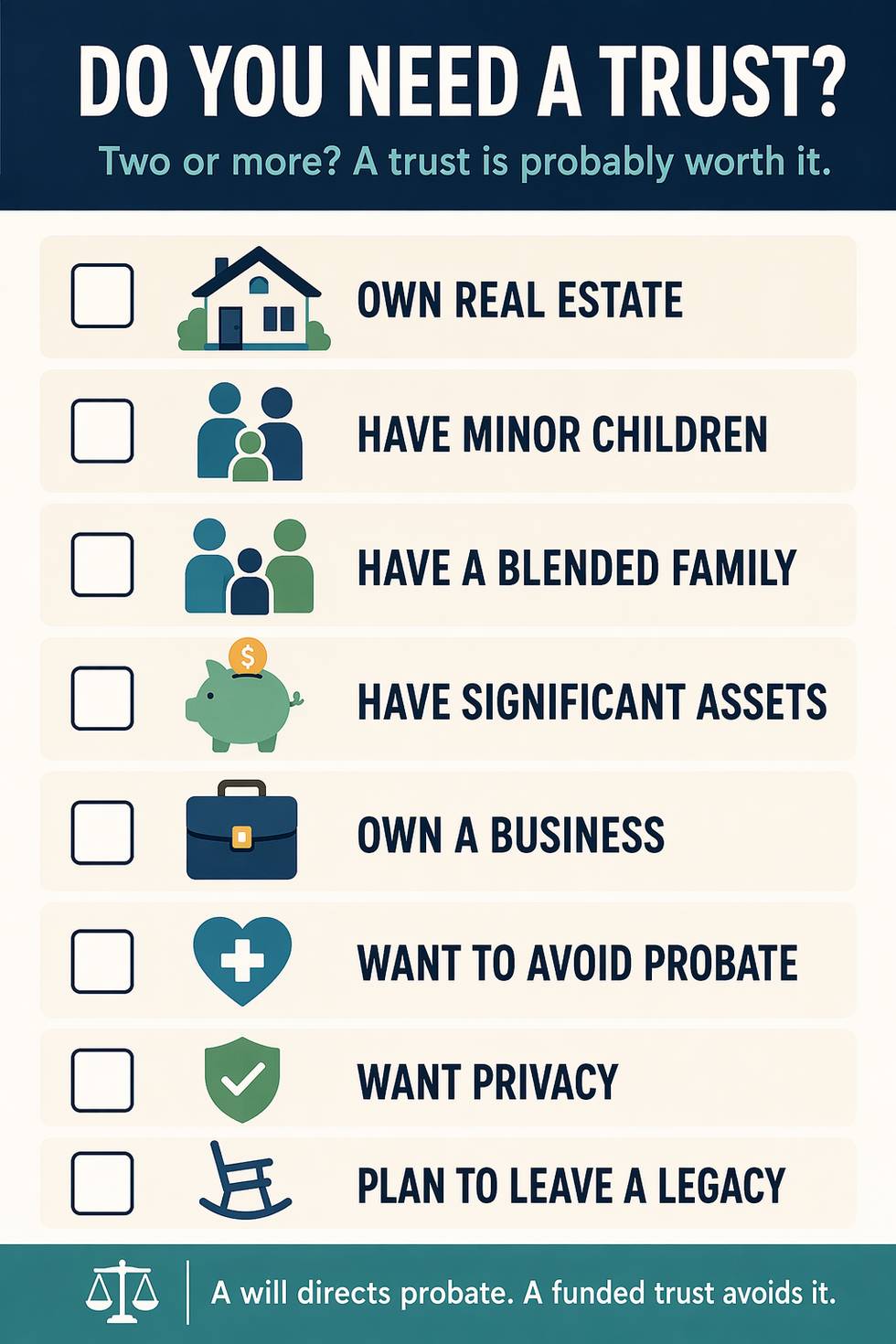
You Own a Home or Other Real Estate
Real estate is the single most common reason a Florida family needs a trust. A home titled in your individual name is a probate asset, full stop — and real property is the slowest, most expensive thing to move through a probate proceeding.
Example
A widow in Estero owns her home outright and has a will leaving it to her two adult children. When she dies, the house cannot be sold or transferred until the court admits the will, appoints a personal representative, and the administration runs its course — commonly six months to a year, while the children pay taxes, insurance, and lawn care on an empty house. Had the home been deeded into her revocable trust, her successor trustee could have listed it within weeks.
Why Real Estate Often Ends Up in Probate
Because titling rarely keeps up with life. A surviving spouse inherits the home and never re-deeds it into the trust. A refinance takes the property out of the trust and nobody puts it back. A couple buys a second property and takes title individually out of habit.
How a Trust Simplifies Property Transfers
Property deeded to the trust is owned by the trust, not by you, so no court order is needed to transfer it. Your successor trustee signs the deed. Title companies handle this routinely, and the transfer of assets happens on your family's timeline instead of the court's.
You Want to Simplify Estate Administration for Your Family
Trust administration is not effortless — there are still notices, tax filings, and a final distribution process — but it is dramatically lighter than formal probate. Your successor trustee does not need letters of administration, does not file an inventory with the clerk, and does not wait out a court-supervised creditor period before making distributions.
You Own Property in More Than One State
This is the strongest single argument for a trust in Southwest Florida. Property in another state generally requires its own probate case in that state, on top of the Florida one.
Avoiding Ancillary Probate
Florida calls the second-state version of this ancillary administration. Two probates means two sets of legal fees, two timelines, and two sets of state laws. Deeding both properties into one revocable trust collapses it into a single administration — often the clearest financial case a trust ever makes.
You Have Minor Children and Want Long-Term Control Over Their Inheritance
If minor children inherit outright, the money goes into a court-supervised guardianship of the property until they turn 18 — and then it is handed to them in a lump sum. A trust lets you set the terms: distributions at 25, 30, and 35, or a trustee with discretion for education, housing, and health. This is also why families with young children who use a trust still need a will, since only a will can nominate a guardian.
You Own a Business or Significant Investments
A solely owned business interest is a probate asset, and a business that stalls during administration loses value fast. Substantial investment accounts and retirement accounts raise coordination questions too — which assets fund the trust, which pass by beneficiary designation, and how the two interact.
Planning for Business Succession
Trust-based planning pairs with a buy-sell agreement and an updated operating agreement so someone has authority over the business interests on day one. If your taxable estate is large enough that estate tax planning matters, this is also where an irrevocable trust and lifetime gifting enter the conversation — worth reviewing with your attorney and your financial advisor together, since tax laws change.
You Have a Blended Family
Second marriages are where a will alone most often fails. Left to Florida's intestacy and homestead rules, or to a simple will drafted without thought, a surviving spouse and children from a prior marriage can end up as reluctant co-owners of a house. A trust lets you provide for your spouse for life and still guarantee that the remaining assets reach your own children.
You Have a Loved One With Special Needs
Leaving assets outright to a beneficiary who receives Medicaid or SSI can disqualify them. A special needs trust holds the inheritance for their benefit without counting as their resource. Federal law recognizes these arrangements, including a trust funded with the beneficiary's own assets before age 65 with a state payback provision (42 U.S.C. § 1396p(d)(4)(A)), and a third party trust funded by parents or grandparents, which carries no payback requirement. Getting this wrong can cost someone their government benefits for years.
You're Concerned About Incapacity During Your Lifetime
A will does nothing if you are alive but unable to manage your affairs. Without planning, your family may have to petition for guardianship — a public, expensive, court-supervised process under Chapter 744. With a funded trust, your successor trustee simply takes over management of assets. Pair it with a durable power of attorney for anything left outside the trust.
Keeping Your Estate Private Matters to You
A will filed for probate becomes part of the public record: who you named, who serves, and the fact of the case. Florida shields documents containing detailed financial information from public inspection, but the case itself is open. A trust document is never filed with the court, though the trustee must file a notice of trust identifying the settlor and trustee after death (Fla. Stat. § 736.05055).
When Is a Will Usually Enough?
When there is little or nothing that would actually pass through probate, and no reason to manage assets after your death.
You Have a Small, Straightforward Estate
If your probate estate is modest, Florida's summary administration is available for estates worth $150,000 or less after exempt property — a threshold that doubled from $75,000 effective July 1, 2026 under Ch. 2026-57, Laws of Florida. Summary administration is quick and inexpensive, which weakens the case for paying more up front for a trust.
Your Assets Already Pass Outside Probate
If your home is held with your spouse as tenants by the entireties, your bank and investment accounts carry payable-on-death or transfer-on-death designations, and your retirement accounts and life insurance policies name living beneficiaries, there may be no probate assets left. In that case a will is a backstop, not the main event.
Your Primary Goal Is Naming Guardians for Minor Children
Only a will can nominate a guardian. Young parents who rent, have modest savings, and carry a term life insurance policy with a named beneficiary often need exactly one legal document — a will — plus current beneficiary forms so the death benefit reaches the right person.
Why Some Families Don't Benefit Enough From a Trust
A trust has real costs: higher drafting fees, the work of funding it, and ongoing maintenance as you buy and sell assets. If your estate would sail through summary administration anyway, that money buys very little. Anyone who tells you every family needs a trust is not looking at your specific circumstances.
How Avoiding Probate Makes a Trust More Valuable
The value of a trust is almost entirely the probate it prevents — so it helps to see what the probate process actually involves.
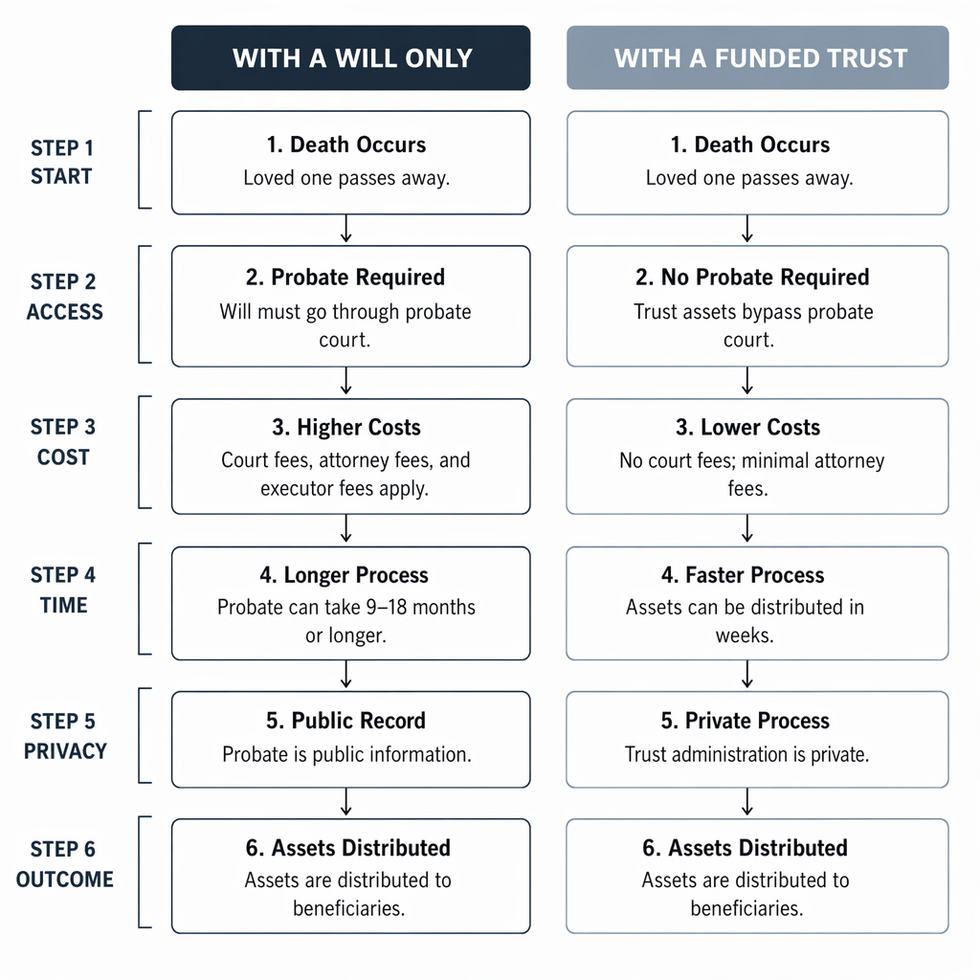
How Probate Works in Florida
Florida probate is a legal process supervised by a circuit judge and governed by Chapters 731 through 735 of the Florida Probate Code. The Florida Bar's consumer pamphlet, Probate in Florida, is a good plain-English overview.
Opening the Estate
The will is deposited with the clerk, a petition for administration is filed, and the court issues letters of administration to the personal representative. Nothing moves until those letters exist.
Paying Creditors
The personal representative publishes a notice to creditors and serves known creditors. Claims must be filed by the later of three months after first publication or 30 days after service (Fla. Stat. § 733.702). This period is why even a simple estate stays open for months.
Distributing Assets
After claims and expenses are paid, the remaining assets go to the beneficiaries, and a final accounting and petition for discharge close the case. Asset distribution is the last step in a probate, not the first — which is why families wait.
Which Assets Usually Go Through Probate?
Anything owned in your sole name without a beneficiary or survivorship provision: individually titled real estate, bank and investment accounts with no POD or TOD designation, vehicles, personal property, and individually held business interests.
Which Assets Can Bypass Probate?
Trust assets, property held as tenants by the entireties or with express survivorship rights, retirement accounts and life insurance with living named beneficiaries, POD and TOD accounts, and Florida real estate conveyed by a Lady Bird deed.
How a Living Trust Changes the Process
It removes the court from the middle. Because the trust — not you — owns the assets at your death, your successor trustee has authority immediately under the trust document. No petition, no letters, no inventory filed with the clerk, no three-month wait before distributions can begin.
When Probate May Still Be Required
If anything was left outside the trust — a forgotten account, a car, a recently purchased property — that asset still needs probate, which is what the pour-over will is for. A trustee may also still owe expenses of administration and claims against the settlor's estate, so a trust is not a way to escape legitimate debts.
Why Most Estate Plans Include Both a Trust and a Will
Because no one funds a trust perfectly, and a will covers what the trust missed.
The Purpose of a Pour-Over Will
A pour-over will directs anything still in your individual name at death into your trust, so it is ultimately distributed under the same terms. It also nominates your personal representative and, if you have young children, their guardian.
What Happens to Assets Left Outside the Trust
They go through probate first, then pour into the trust. If they are small enough, summary administration may handle it quickly. Either way, the family ends up in court for exactly the assets you meant to keep out — which is the argument for funding carefully.
Why Attorneys Rarely Recommend a Trust Alone
Because a trust cannot name a guardian for minor children, and because the pour-over will is a cheap safety net against an incomplete funding job. Skipping it saves almost nothing and risks a great deal.
Why Funding Your Trust Is Just as Important as Creating It
An unfunded trust is an empty box. Funding means deeding real estate to the trust, retitling investment accounts, and updating beneficiary designations where appropriate — though retirement accounts usually should not be retitled into a trust, because that can trigger unwanted income tax consequences. This is the step families skip, and it is the step that determines whether the plan works.
How to Decide Whether a Trust Is Worth It
Count how many rows below describe your situation. One or two, and a will with good beneficiary designations may serve you. Three or more, and a trust almost always pays for itself. The table sets out the key differences that actually drive the decision.
| Is a Trust Worth It for You? | A will may be enough | A trust is likely worth it |
|---|---|---|
|
Florida real estate |
You rent, or your home is held with your spouse as tenants by the entireties |
You own a home or other real estate in your individual name |
|
Out-of-state property |
All property is in Florida |
You own property in a second state (ancillary probate risk) |
|
Probate estate size |
Under $150,000, so summary administration applies |
Well above the summary administration threshold |
|
Beneficiaries |
Adult children, no complications |
Minor children, a beneficiary with special needs, or a spendthrift heir |
|
Family structure |
First marriage, shared children |
Blended family, stepchildren, or an unmarried partner |
|
Business interests |
None |
You own a business or closely held investments |
|
Incapacity planning |
A durable power of attorney is sufficient for you |
You want a successor trustee ready to step in without guardianship |
|
Privacy |
You do not mind a public court file |
You want your plan kept off the public record |
|
Account titling |
Every account already names a beneficiary |
Accounts are scattered and designations are out of date |
How Much Does a Trust Cost Compared With a Will?
A trust-based plan typically costs several times what a will-based plan costs to create, and usually costs the family far less at death. Ask any Florida firm for a flat quote in writing before you engage them.
Typical Cost of Creating a Will
A will-based plan — will, durable power of attorney, health care surrogate, living will, and HIPAA authorization — is the lower-cost option and is often quoted as a flat fee. Simple will pricing varies widely across Florida, so compare what is actually included rather than the headline number.
Typical Cost of Creating a Living Trust
A trust-based plan adds the trust document itself plus the funding work: deeds prepared and recorded, letters to financial institutions, and a review of beneficiary designations. That funding work is a real part of the cost, and a firm that quotes a trust without it is quoting half a plan.
Why Probate Costs Can Make a Trust More Valuable
Compare the up-front difference against what probate costs your family later. In a Florida formal administration, attorney compensation for ordinary services is presumed reasonable at $1,500 to $3,000 for estates up to $100,000, plus 3% of the value above that, under Fla. Stat. § 733.6171. The personal representative is separately entitled to a presumed commission of 3% of the first $1 million (§ 733.617). On a $600,000 Florida estate, that arithmetic usually dwarfs the cost of the trust.
When Is the Higher Cost of a Trust Worth It?
When it prevents a probate you would otherwise have, prevents an ancillary probate in a second state, prevents a guardianship, or protects a beneficiary who needs protecting. When it does none of those things, it is not worth it, and a good attorney will tell you so.
Common Mistakes People Make When Choosing Between a Will and a Trust
Assuming Trusts Are Only for Wealthy Families
This is the most persistent myth in estate planning. With the federal exemption at $15 million per person and no Florida estate tax, estate tax is irrelevant to the overwhelming majority of families. Trusts are used here for probate avoidance, incapacity, and control — reasons that apply at every level of wealth.
Thinking a Will Avoids Probate
It does not. A will is the instruction manual for probate. Families who believe otherwise skip the planning that would actually have kept them out of court.
Creating a Trust but Never Funding It
We see this often, usually from documents bought online or drafted by a firm that did not follow through on funding. The trust is valid and completely empty, and the estate goes through probate anyway.
Using DIY Estate Planning for Complex Situations
Template documents do not know about Florida homestead, the elective share, the nonresident personal representative restriction, or how a special needs trust interacts with benefits eligibility. For simple financial situations they sometimes work. For anything else, the savings are illusory.
Waiting Until It's Too Late to Plan
Capacity is the gate. Once someone can no longer understand what they are signing, the estate planning process is over and the family's only remaining option is guardianship. Life circumstances change faster than people expect.
How to Choose the Right Florida Estate Planning Attorney
Look for a Florida firm that concentrates in this area, quotes flat fees, and treats funding as part of the engagement rather than an afterthought.
Experience With Florida Trust and Probate Law
Florida has features that generic planning misses — constitutional homestead, the elective share, and Chapter 736's trustee duties among them. An experienced estate planning attorney who also handles probate has seen which plans fail and why.
Personalized Estate Planning Instead of Generic Documents
Your plan should reflect your family's unique needs, not a template. Ask how the firm decides between a will and a trust, and whether they ever tell clients a trust is unnecessary. A firm that recommends a trust to everyone is selling, not advising.
Guidance on Trust Funding and Future Updates
Ask directly: who prepares and records the deed, who sends the letters to the banks, and what happens when I buy a new property in three years? Get the answer before you sign.
Transparent Fees and Clear Communication
Flat fees in writing, a clear scope, and a named point of contact. Legal fees for planning should never be a surprise.
Questions to Ask Before Hiring an Attorney
Do I actually need a trust, and why? What is the flat fee, and what does it include? Who handles funding? How often should I come back? What happens to my plan if I move out of Florida? You can verify any Florida lawyer's license through The Florida Bar's member directory.
Why Florida Families Choose The Nussbickel Law Firm
The Nussbickel Law Firm, P.A. is a Fort Myers law firm devoted exclusively to estate planning, probate, and trust administration. We serve families throughout Lee, Collier, and Charlotte counties, and we handle Florida probate for out-of-state families with property or accounts here.
Because we do both sides of this work, we see exactly which plans hold up and which ones send families to the Lee County Justice Center. That shapes how we advise. Sometimes the honest recommendation is a trust; often it is a well-drafted will and an afternoon spent fixing beneficiary designations. Either way, we quote flat fees in writing, we treat trust funding as part of the job rather than a separate project, and we will tell you plainly when you do not need the more expensive option. If you want a clear answer about your own estate planning needs, schedule a consultation or call our Fort Myers office.
Frequently Asked Questions
Who needs a trust instead of a will?
Families who own real estate, own property in more than one state, have minor children or a beneficiary with special needs, own a business, have a blended family, want incapacity protection, or want privacy. Families with small, simple estates whose assets already pass by beneficiary designation usually do not.
Does a trust avoid probate in Florida?
Yes, for assets actually titled in the trust. Because the trust owns them, there is nothing in your individual name for the probate court to transfer. Anything left outside the trust still requires probate.
What assets should be placed in a living trust?
Real estate, bank and brokerage accounts, business interests, and valuable personal property. Retirement accounts generally should not be retitled into a trust because of the income tax consequences — name beneficiaries instead. Life insurance is usually handled by beneficiary designation as well.
Is a trust only for wealthy people?
No. With the 2026 federal exemption at $15 million per person and no Florida estate tax, estate tax is not why Florida families use trusts. They use them to avoid probate, plan for incapacity, and control how and when beneficiaries receive money.
What is the biggest disadvantage of a trust?
Cost and upkeep. A trust costs more to create than a will and requires ongoing maintenance — every new account or property has to be titled correctly, or it falls outside the trust and back into probate.
Can I create a trust after making a will?
Yes. Most people do. Your attorney will typically replace the existing will with a pour-over will that works alongside the new trust, then handle funding.
What happens if I die with only a will?
Your will is deposited with the clerk, admitted to probate, and your solely owned assets are distributed under it through the court process — commonly six months to a year for a formal administration, less if summary administration applies.
Can a trust help if I become incapacitated?
Yes, and this is one of the strongest advantages of a trust. Your successor trustee can manage trust assets immediately without a guardianship proceeding. Pair the trust with a durable power of attorney to cover assets held outside it.
How much does a trust typically cost?
More than a will, and the range across Florida is wide depending on complexity and whether funding is included. Ask for a flat fee in writing that spells out exactly which deeds and retitling work are covered.
How often should I update my estate plan?
Review it every three to five years and after any major change: marriage, divorce, a death in the family, a birth, buying or selling real estate or a business, or moving to or from Florida. Review beneficiary designations at the same time — that is where most plans quietly go out of date.
Gregory J. Nussbickel is the founder of The Nussbickel Law Firm, P.A. in Fort Myers, Florida. His practice is devoted exclusively to estate planning, probate, and trust administration for families throughout Southwest Florida.
This article is for general informational purposes only and is not legal advice. Reading it does not create an attorney-client relationship. Florida law changes, and every family is different — speak with a licensed Florida attorney about your specific situation.

Comments
There are no comments for this post. Be the first and Add your Comment below.
Leave a Comment