

If you've been named executor and you've started Googling "online probate services," you've probably noticed something confusing: half the results are software that helps you settle an estate, and the other half are websites that help you write a will. Those are two completely different things. As a Fort Myers probate firm, we'll give you the straight version — what these services actually do, which ones are worth it, and the Florida rule that changes the answer for everyone here.
The short answer: The best "online probate service" depends on what you actually need. For organizing an estate and DIY guidance, Atticus and similar executor-software tools are the most probate-focused. For creating estate-planning documents, Trust & Will, LegalZoom, Rocket Lawyer, Nolo (WillMaker), and FreeWill are the well-known names — but those are will-making platforms, not probate services. The catch every Florida family needs to know: under Florida Probate Rule 5.030, a personal representative in a formal administration must be represented by a Florida-licensed attorney unless they are the estate's sole interested person. So no online service can run a Florida formal probate for you — it can help you organize, learn, and handle small-estate matters, but the court filing itself still requires a lawyer.
Here's how the options actually stack up, and how to match one to your situation.
What Is an "Online Probate Service," Really?
"Online probate service" is a loose label that covers two very different categories, and mixing them up is the most common source of wasted money.
The first category is estate-settlement software — tools built for executors and personal representatives who are administering an estate after someone has died. These walk you through inventorying assets, tracking deadlines, and generating checklists, sometimes with expert support. Atticus is the best-known example.
The second category is online estate-planning platforms — websites that help you create a will, trust, power of attorney, and health care documents before death. Trust & Will, LegalZoom, Rocket Lawyer, Nolo, and FreeWill live here. They're genuinely useful for planning, but they don't settle an estate, and most of the search traffic for "online probate services" actually lands on these will-makers by accident.
Knowing which one you need — settlement help or planning help — answers most of the question before you spend a dollar.
Who Offers the Best Online Probate Services? A Quick Comparison
Here's the honest at-a-glance view, focused on what each service really is and how it fits a Florida estate:
| Service | What it actually is | Best for | Florida probate fit |
|---|---|---|---|
|
Atticus |
Executor/estate-settlement software with expert access |
Organizing a DIY estate settlement |
Helps you stay organized; does not replace the required attorney in formal probate |
|
Trust & Will |
Online estate planning, with a settlement add-on |
Creating a plan; light settlement guidance |
Planning-focused; not a Florida probate filing service |
|
LegalZoom |
Estate documents + attorney network |
Documents with some attorney access |
Attorney help is general, not a Florida probate representation |
|
Rocket Lawyer |
Subscription legal documents + attorney Q&A |
Ongoing document needs |
Estate work isn't its specialty |
|
Nolo (WillMaker) |
One-time DIY document software |
Self-directed planners |
DIY documents only; no probate administration |
|
FreeWill |
Free, nonprofit-funded will-making |
Simple wills at no cost |
Planning only; no probate service |
|
A Florida probate attorney (e.g., our firm) |
Licensed representation in the actual case |
Any Florida formal administration |
Required for formal probate; often flat-fee |
Service features and pricing change frequently — confirm current details on each provider's site before relying on them.
The Main Online Probate and Estate Platforms, Compared
Atticus (and Similar Executor Software)
Atticus is the most genuinely "probate" of the popular online tools. It's estate-settlement software that gives executors step-by-step task guides tied to local requirements, an asset-inventory tool, and access to an in-house team of tax, legal, and fiduciary professionals. Reported pricing has ranged from roughly $175 up to around $499 depending on the plan. Services in this same lane include EZ-Probate, which markets DIY probate-paperwork help. These tools shine at keeping a personal representative organized — but in Florida they sit alongside, not instead of, the attorney a formal administration requires.
Trust & Will
Trust & Will is primarily an online estate-planning company — state-specific wills and trusts, with payment plans to spread the cost. It has expanded into estate settlement, but its core strength is planning documents created before death, not administering a Florida estate through the courts.
LegalZoom
LegalZoom offers online estate-planning packages (will- or trust-based) that include documents plus access to its attorney network, and it publishes probate and executor guidance. Reported estate-plan pricing has run roughly $300–$1,500 for will-based plans and higher for trust-based plans. The attorney access is general legal guidance, not representation in your Florida probate case.
Rocket Lawyer
Rocket Lawyer is a subscription legal-document service (commonly cited around $20–$40 per month) that bundles estate-planning templates with attorney Q&A across many areas of law. It's a document and membership platform; estate work is not its specialty.
Nolo (WillMaker)
Nolo's WillMaker is one-time-purchase DIY software (reported around $109–$219) that produces a will, power of attorney, health care directive, and more, and Nolo also publishes respected self-help probate guides. It's built for self-directed planners and doesn't include attorney review or probate administration.
FreeWill
FreeWill is a genuinely free will-making platform funded by nonprofit partners hoping you'll leave a charitable gift. It produces basic wills, powers of attorney, and health care directives, offers no legal advice, and is aimed at simple estates. Useful for planning; not a probate service at all.
What Should You Look for in an Online Probate Service?
Whatever you're choosing, weigh the same handful of factors:
- The right category. Are you settling an estate or making a plan? Buy the tool that matches the job.
- State-specific support. Florida's rules — homestead, the attorney requirement, creditor deadlines — are not generic. Generic 50-state software often misses them.
- Real human access. Software checklists are helpful until you hit a judgment call. Can you reach a qualified person?
- Transparent, all-in pricing. Watch for add-ons, "premium" upgrades, and annual renewal fees layered on top of a low headline price.
- Security. You're entering account numbers, Social Security numbers, and family details. Confirm how the provider protects them.
Can Probate Really Be Handled Online in Florida?
Partly — and this is where Florida families need to be careful. Under Florida Probate Rule 5.030, every personal representative in a formal administration must be represented by an attorney admitted to practice in Florida, unless the personal representative is the estate's sole interested person or is themselves a Florida attorney. Because nearly every estate has more than one beneficiary or at least one creditor, that exception rarely applies.
What that means in practice: an online service can help you gather documents, build an asset inventory, understand the steps, and stay on schedule — but it cannot file and manage a Florida formal probate on your behalf. The court process itself runs through a licensed attorney. Everything is still e-filed through the Florida Courts E-Filing Portal, and most estates in the Twentieth Judicial Circuit (Lee, Collier, and Charlotte counties) never require a courtroom appearance — but the representation requirement doesn't go away because you used an app.
The genuine exception is small estates. Summary administration and disposition without administration don't appoint a personal representative, so the attorney requirement doesn't attach in the same way — and that's where DIY tools do the most good.
How Much Do Online Probate Services Cost — vs. a Florida Attorney?
Here's a realistic side-by-side. Online-service figures are recent public ranges and should be re-checked; the attorney column reflects Florida's statutory framework.
| Option | Typical cost | What you get |
|---|---|---|
|
Free will-maker (FreeWill) |
$0 |
Basic planning documents; no probate help |
|
DIY software (Nolo WillMaker) |
~$109–$219 one-time |
Planning documents you complete yourself |
|
Subscription platform (Rocket Lawyer) |
~$20–$40 / month |
Templates plus general attorney Q&A |
|
Estate-plan package (LegalZoom) |
~$300–$1,500+ |
Documents plus limited attorney access |
|
Executor software (Atticus) |
~$175–$499 |
Settlement checklists and expert access |
|
Florida probate attorney |
Often flat-fee; statutory schedule presumed reasonable |
Actual representation in your case |
For attorney fees, Florida publishes a schedule that is presumed reasonable for ordinary formal-administration services under Fla. Stat. § 733.6171 — for example, $1,500 for estates up to $40,000 and $3,000 for estates up to $100,000, then 3% of value above that. Since a 2021 amendment, an attorney charging from the schedule must disclose in writing that the fee is negotiable. Many Southwest Florida firms, ours included, quote flat fees for straightforward administrations — which, once you account for the fact that Florida requires an attorney anyway, is often comparable to stacking up premium online subscriptions.
Are Online Probate Documents Legally Valid in Florida?
A properly completed document from a reputable online service can be perfectly valid — the paper isn't the problem. The risks are execution and fit. Florida has strict execution formalities (a will generally requires two witnesses and specific signing procedures), and homestead property carries constitutional protections that generic software routinely mishandles. A document that's technically "valid" can still fail to accomplish what the family wanted, or trigger a probate dispute, if it wasn't built for Florida law. Online tools produce the form; they don't judge whether it's right for your situation.
Common Mistakes to Avoid When Choosing an Online Probate Service
- Choosing on price alone. The cheapest tool is expensive if it doesn't fit Florida law or your estate.
- Assuming every service includes attorney help. Most don't, and "attorney access" is usually general guidance, not case representation.
- Ignoring state-specific requirements. Homestead, the Rule 5.030 attorney requirement, and creditor deadlines are Florida-specific.
- Underestimating the estate's complexity. Real estate, multiple beneficiaries, business interests, or out-of-state property quickly outgrow DIY tools.
- Waiting too long. Delay complicates creditor notice and asset management no matter which tool you use.
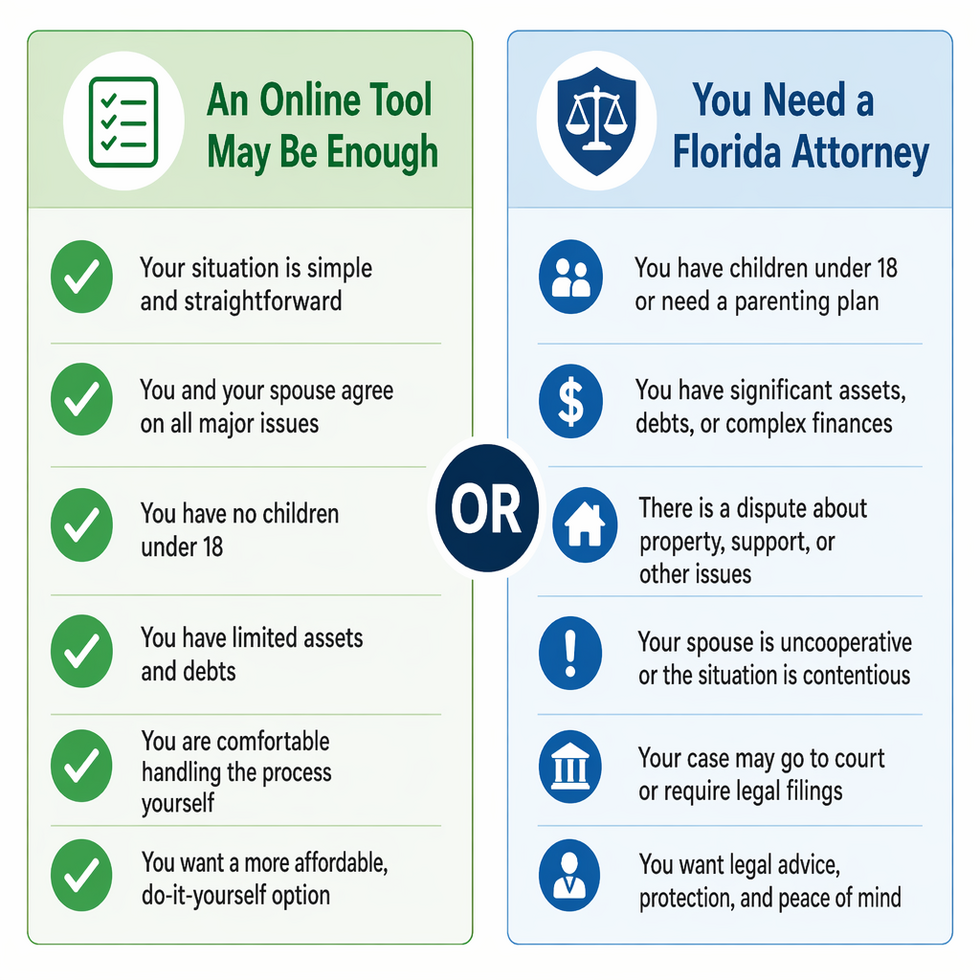
When You're Better Off With a Southwest Florida Probate Attorney
Skip the DIY route entirely when any of these are in play:
- The estate requires formal administration (most do), so Rule 5.030 applies.
- There's real estate, especially Florida homestead, with its constitutional protections.
- Beneficiaries disagree, or a will contest is possible.
- Assets sit in more than one state — common for our seasonal residents, and often requiring a second, ancillary probate.
- There are significant debts or aggressive creditors, and claims must be evaluated under Fla. Stat. § 733.702.
- The personal representative lives out of state and can't easily manage a Florida court process alone.
The Honest Bottom Line for Southwest Florida Families
If your loved one did their planning well — a funded trust, beneficiary designations, survivorship titling — you may have little or no probate, and an organizing tool like Atticus can help you tie up loose ends. If you're planning ahead, a reputable online will-maker can be a reasonable starting point, though a Florida attorney will catch the homestead and execution issues software misses. But if you're facing an actual Florida formal probate, the law itself decides the question: you'll need a Florida-licensed attorney regardless of which app you downloaded.
The Nussbickel Law Firm, P.A. handles probate and trust administration exclusively, from our Fort Myers office, for families throughout Lee, Collier, and Charlotte counties — including out-of-state families who need someone on the ground in Florida. If you're not sure whether your situation is a quick summary administration or a full formal probate, that's exactly what a short conversation clarifies, and we'll tell you plainly if a DIY tool is all you need. Schedule a consultation or call our Fort Myers office.
Frequently Asked Questions
Are online probate services a reliable alternative to a probate attorney?
For organizing an estate and handling simple, small-estate matters, yes — tools like Atticus are reliable and helpful. For a Florida formal administration, no. Florida Probate Rule 5.030 requires a licensed Florida attorney to represent the personal representative unless they are the estate's sole interested person, so software cannot fully replace counsel here.
Can I manage a Florida probate entirely remotely using an online service?
You can do much of the organizing remotely, and probate filings are handled through the Florida Courts E-Filing Portal, so most estates never require a court appearance. But in a formal administration the case must still run through a Florida attorney, so "entirely on your own online" is not an option for most estates.
Which online probate service is best for a first-time executor?
For someone settling an estate for the first time, executor-settlement software such as Atticus is the most probate-oriented, because it's built around tasks and deadlines rather than document templates. Just pair it with a Florida attorney if the estate needs formal administration.
How do I evaluate whether an online probate provider is trustworthy?
Look for clear, all-in pricing, genuine state-specific (not just generic 50-state) guidance, access to qualified human help, and strong data security given the sensitive information involved. Independent reviews and transparency about what is and isn't included matter more than a low headline price.
Can online probate services handle larger or more complex estates?
Generally no. Real estate, multiple beneficiaries, business interests, tax issues, and out-of-state property quickly exceed what DIY software is designed for. Complex estates are where a probate attorney's judgment prevents costly mistakes.
How do online probate companies typically charge?
Models vary: free (FreeWill), one-time software purchase (Nolo, roughly $109–$219), monthly subscription (Rocket Lawyer, roughly $20–$40), flat estate-plan packages (LegalZoom, often $300+), and per-estate settlement pricing (Atticus, roughly $175–$499). Confirm current pricing directly, as it changes often.
Do online probate services work for Florida homestead property?
Be cautious. Florida homestead has constitutional protections and devise restrictions that generic software frequently mishandles. If the estate includes a Florida homestead, have a Florida attorney review the plan or administration before relying on a DIY tool.
Gregory J. Nussbickel is the founder of The Nussbickel Law Firm, P.A. in Fort Myers, Florida. His practice is devoted exclusively to estate planning, probate, and trust administration for families throughout Southwest Florida.
This article is for general information only and is not legal advice. Reading it does not create an attorney-client relationship. Product features and pricing change, and every estate is different — speak with a licensed Florida attorney about your specific situation.

Comments
There are no comments for this post. Be the first and Add your Comment below.
Leave a Comment