

Losing a parent or spouse is hard enough without a stack of legal questions landing on top of the grief. One of the first that families in Fort Myers and across Southwest Florida ask us is simple and practical: if we hire a probate attorney, who pays the bill? The good news is that in most Florida probate cases, the answer is not "you, personally."
The short answer: In Florida, the probate attorney's fees are paid out of the estate's assets — the money and property the deceased person left behind — not out of the personal representative's own pocket. Under Fla. Stat. § 733.6171, the attorney for the personal representative is entitled to reasonable compensation "payable from the estate assets." And under Fla. Stat. § 733.707, those attorney fees and the other expenses of administration are a Class 1 obligation — paid before the decedent's ordinary debts and before anyone inherits. Because the fees come off the top, the people who ultimately bear the cost are the beneficiaries, whose shares are reduced by whatever the estate spends. Only in specific situations — usually litigation — can a court order one person's share to absorb the fees under Fla. Stat. § 733.106.
The rest of this guide explains when you need a Florida probate attorney at all, what the lawyer actually does, how much it costs under Florida's fee statute, and — in plain language — exactly who writes the check.
Key Highlights
- Probate attorney fees in Florida are paid from the estate's assets, not by the personal representative individually.
- Attorney fees are an expense of administration and get paid ahead of the decedent's creditors (§ 733.707, Class 1).
- Florida publishes a presumed-reasonable fee schedule in § 733.6171 — but it is negotiable, and many firms charge flat fees instead.
- Because fees reduce the estate, beneficiaries bear the economic cost — their inheritances are what shrink.
- Extraordinary services (like a will contest) can generate additional fees, and a judge can assess those against a specific person's share.
- Some small estates qualify for a simplified probate process with no attorney required at all.
Introduction
Probate is the court-supervised process of collecting a deceased person's assets, paying valid debts, and distributing what remains to the right people. In Florida, most estates that go through the full process — called formal administration — require the personal representative (Florida's term for the executor) to be represented by an attorney. That requirement raises an understandable worry: legal help costs money, and a family in a difficult time doesn't want a surprise bill. Understanding where probate fees come from, and who is really on the hook, takes a lot of that anxiety off the table.
Do You Need a Probate Attorney for Every Estate?
Not for every estate — but for most. Whether you need a Florida probate attorney depends on how the estate must be administered and how the deceased person's assets were titled.
Situations Where Legal Help Is Often Necessary
Formal administration — the standard, full probate process — almost always requires counsel. Florida Probate Rule 5.030 requires the personal representative to be represented by a Florida-licensed attorney unless the personal representative is the estate's only interested person or is a Florida attorney themselves. Because nearly every estate has more than one beneficiary or at least one creditor, that exception rarely applies. If the deceased person's estate holds real estate, has several beneficiaries, or owes significant debts, legal guidance is not just required — it is genuinely protective.
Situations Where Probate May Be Simpler
If everything the deceased person owned passed automatically — a home held jointly with a spouse, a bank account with a payable-on-death beneficiary, a life insurance policy with a named beneficiary — there may be little or nothing to probate. Assets like these skip the probate estate entirely, which can shrink the process dramatically or eliminate it.
State Laws That May Affect Attorney Requirements
The attorney requirement is set by the Florida Probate Rules, and the type of proceeding drives it. Formal administration triggers the representation requirement; Florida's small-estate shortcuts do not, because no personal representative is appointed. Florida also limits who may serve as personal representative — someone who lives outside Florida generally must be a close relative of the decedent — a rule that surprises many out-of-state families handling a Southwest Florida estate.
When Do You Need a Probate Attorney?
Certain features of an estate make skilled legal help close to essential. Here are the situations where families in Lee, Collier, and Charlotte counties most often need a probate attorney.
Probate Involves Real Estate
Florida homestead property carries constitutional protections that trip up even experienced out-of-state lawyers. A Gulf-access home in Cape Coral or a condo in Naples has to be handled correctly, or title problems can surface years later. Legal advice on homestead status is itself a recognized service under Florida's fee statute.
The Estate Has Multiple Beneficiaries
When several people inherit, the personal representative owes a fiduciary duty to all of them. Coordinating notices, accountings, and distributions among multiple beneficiaries is where mistakes — and hard feelings — tend to appear.
Someone Is Contesting the Will
A will contest turns an ordinary probate into litigation. This is an "extraordinary service" under Florida law, and it changes both the workload and the cost. Having counsel from the start is the best protection.
The Estate Owes Significant Debts
Aggressive or disputed creditor claims require someone who knows how to evaluate, and when appropriate object to, each claim. Handled poorly, valid claims get overpaid and invalid ones go unchallenged.
The Deceased Died Without a Will
When there is no will, Florida's intestacy statutes in Chapter 732 decide who inherits — and the result frequently surprises blended families and unmarried partners. Determining heirs correctly is legal work, not guesswork.
The Estate Includes Business Interests
A closely held business, rental properties, or ongoing commercial activity adds valuation, tax, and management questions. Legal advice on carrying on the decedent's business is another service Florida law treats as extraordinary.
Probate Involves Assets in Multiple States
Our seasonal residents — "snowbirds" with a home up north and one in Florida — often leave property in two states. That can require a second, ancillary probate, coordinated with counsel in both jurisdictions.
How Can a Probate Attorney Help During Probate?
A common misconception is that the lawyer's job is filling out forms. The paperwork is the visible part; the real value is keeping the personal representative out of trouble.
Preventing Costly Filing Errors
Florida probate runs on strict rules and deadlines. A rejected petition or a defective notice can restart a clock and add months. An attorney prepares and e-files the petition, oath, notices, inventory, and accountings correctly the first time.
Keeping Probate on Schedule
Between the creditor period, the inventory deadline, and the final accounting, a formal administration has a rhythm. Counsel keeps the case moving so it doesn't stall on a missed step.
Managing Creditor Claims Properly
The attorney publishes and serves the notice to creditors, evaluates the claims that come in, and objects to those that aren't valid. Getting this wrong exposes the estate — and the personal representative — to unnecessary payouts.
Reducing Family Conflict
A neutral professional who explains the process and the numbers to everyone often defuses tension before it hardens into a dispute. That alone can save an estate far more than the fee.
Protecting the Personal Representative From Liability
This is the big one. A personal representative who distributes assets too early, or pays the wrong claims first, can be personally liable to creditors and beneficiaries. Sound legal advice is the personal representative's primary shield against that risk.
Can You Handle Probate Without a Probate Attorney?
Sometimes — but only in limited circumstances defined by the Florida Statutes.
Situations Where Probate May Be Simpler
If the deceased person's assets all passed outside probate through survivorship, trusts, or beneficiary designations, there may be nothing left for the court to administer, and no lawyer needed.
Small Estates and Simplified Probate Procedures
Florida offers two simplified procedures that don't require a personal representative — and therefore don't trigger the attorney requirement:
- Disposition without administration (Fla. Stat. § 735.301) — for very small estates consisting only of exempt property and modest final expenses.
- Summary administration (Fla. Stat. § 735.201) — available when the probate estate (less exempt property) is worth $150,000 or less, or the decedent has been dead more than two years.
That $150,000 figure is new. Effective July 1, 2026, the Legislature doubled the summary administration limit from $75,000 (Ch. 2026-57, Laws of Florida), so estates that were just over the old cap may now qualify for the faster, cheaper track.
Risks of Handling Probate Yourself
Even where the law allows self-help, the traps are real: misjudging whether homestead property counts toward the cap, missing an exempt-property claim, or filing a petition the clerk kicks back. A mistake in a "simple" case can cost more than counsel would have.
Court Requirements and Deadlines
All Florida probate is e-filed through the state court portal, and each filing has its own requirements. The inventory is generally due within 60 days of appointment; the creditor claim period runs three months from first publication of notice. Deadlines don't bend for a grieving family doing its best.
Common Probate Mistakes
The mistakes we see most often when families go it alone: distributing assets before the creditor period closes, paying debts in the wrong order, overlooking a beneficiary's rights, and undervaluing or omitting an asset from the inventory.
When Professional Legal Guidance Is Recommended
Any time there is real estate, a will contest, significant debt, no valid will, assets in more than one state, or a personal representative living out of state, professional guidance is the sensible choice — even where the law technically permits self-help.
What Problems Can a Probate Attorney Help You Avoid?
Good counsel is cheaper than the problems it prevents. Here are the costly ones.
Probate Delays
Clean, correct filings keep a case on track. Rejected pleadings and re-noticing are the usual culprits behind estates that drag on for a year or more.
Family Disputes
Clear communication and even-handed administration head off many disputes before they start. Litigation is the single fastest way to run up probate expenses.
Executor Liability
A personal representative who breaches a fiduciary duty can be sued personally. Following legal advice at each step is what keeps that exposure in check.
Creditor Claim Issues
Missing the objection window, or paying an invalid claim, drains the estate. An attorney screens claims and preserves the estate's defenses.
Asset Distribution Errors
Distributing to the wrong people, in the wrong shares, or in the wrong order can force a personal representative to make the estate whole out of their own funds. Getting distribution right is the whole point.
How Much Does Hiring a Probate Attorney Cost?
Florida is unusual: the Probate Code publishes a fee schedule that is presumed reasonable for the ordinary services of an attorney in a formal administration. Under Fla. Stat. § 733.6171(3), the presumed reasonable fee — based on the "compensable value" of the estate (the inventory value plus income earned during administration) — is:
| Compensable estate value | Presumed reasonable attorney's fee |
|---|---|
|
Up to $40,000 |
$1,500 |
|
More than $40,000 up to $70,000 |
$2,250 |
|
More than $70,000 up to $100,000 |
$3,000 |
|
More than $100,000 up to $1 million |
$3,000 + 3% of the value over $100,000 |
|
More than $1 million up to $3 million |
+ 2.5% of the excess |
|
More than $3 million up to $5 million |
+ 2% of the excess |
|
More than $5 million up to $10 million |
+ 1.5% of the excess |
|
More than $10 million |
+ 1% of the excess |
Common Probate Attorney Fee Structures
Florida attorneys typically bill probate work one of three ways:
- Percentage of the estate — the § 733.6171 schedule above, presumed reasonable but not mandatory.
- Flat fee — a fixed quote for a straightforward administration. Many Southwest Florida firms (ours included) offer this, and it is often better value than the percentage.
- Hourly — more common for contested matters or unusual complexity.
Whatever the structure, get it in writing before you sign. Since a 2021 amendment, any attorney intending to charge from the statutory schedule must disclose in writing that there is no mandatory fee, that the fee need not be based on the size of the estate, that it is negotiable, and that you are free to choose any attorney — not just the one who drafted the will.
Factors That Affect Probate Costs
Beyond the attorney's fee, the estate value, the number and type of assets, whether real property must be sold, tax filings, and any disputes all move the total. A clean, uncontested estate costs far less than one with litigation or a federal estate tax return.
Who Pays Probate Attorney Fees?
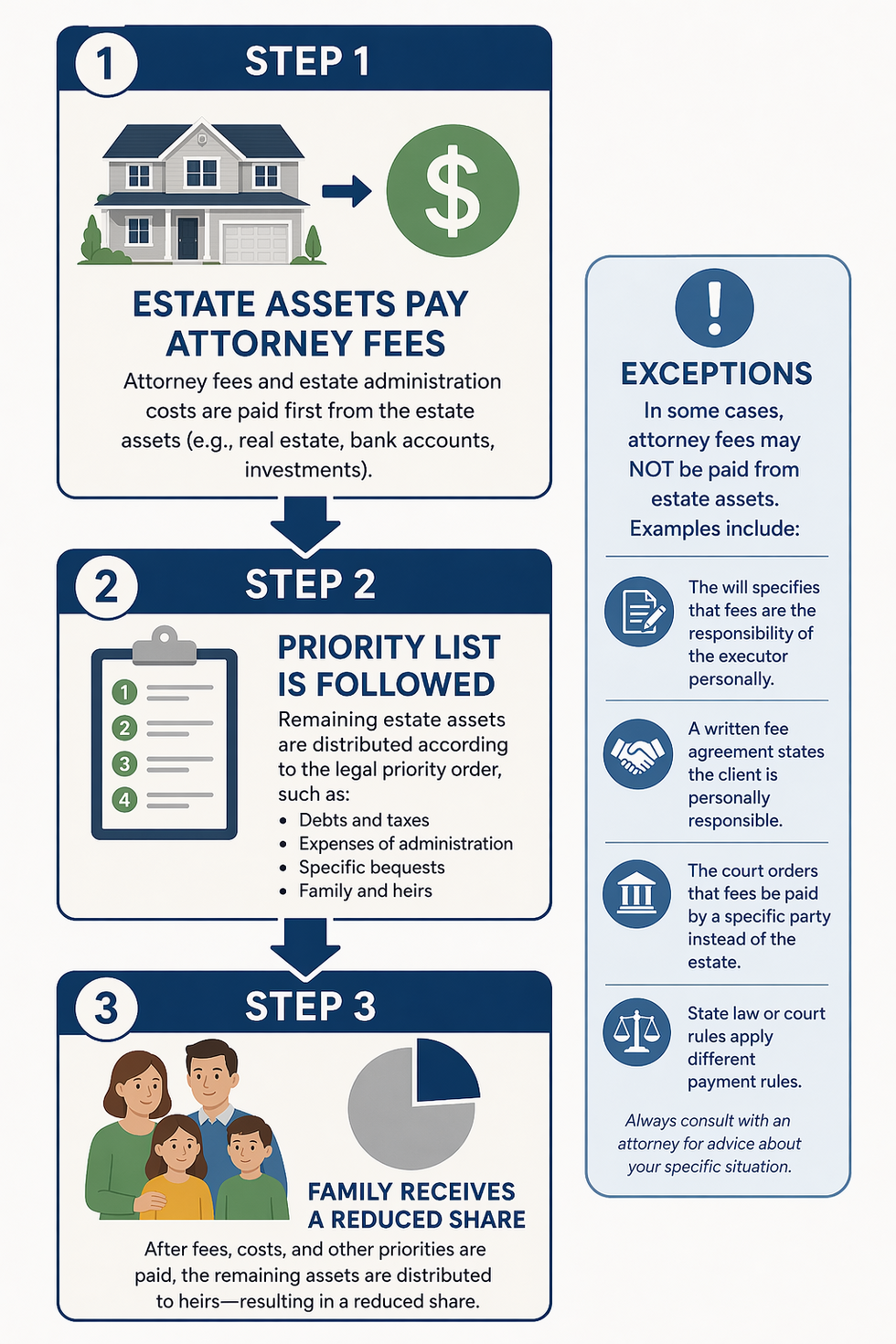
This is the heart of the matter. In a Florida formal administration, the personal representative's attorney fees are paid from the estate's assets, not by the personal representative personally. The attorney is entitled to reasonable compensation payable from estate assets under § 733.6171, and those fees rank as a Class 1 expense of administration under § 733.707 — paid before the decedent's ordinary creditors and before any distributions.
So the estate writes the check. But because every dollar the estate spends is a dollar the beneficiaries don't inherit, the beneficiaries bear the economic cost, in proportion to their shares. There is one important wrinkle: for contested or extraordinary matters, § 733.106 lets a judge direct that fees be paid from a particular person's share of the estate — for example, charging the cost of a losing will contest to the person who brought it, rather than spreading it across everyone.
Why Costs Vary Between Estates
Two estates of the same dollar value can cost very different amounts to administer. Homestead questions, out-of-state assets, business interests, creditor fights, and family disagreements are the variables. Ordinary administration follows the fee schedule; extraordinary services are billed on top of it.
How Do You Choose the Right Probate Attorney?
The fee matters, but fit and competence matter more. Here is what to look for.
Experience Handling Probate Cases
Probate and trust administration is a distinct area of the law. A lawyer who does it regularly will move faster and spot issues a generalist misses.
Knowledge of Local Probate Courts
Each circuit has its own local requirements and clerk practices. In the Twentieth Judicial Circuit — Lee, Collier, Charlotte, Hendry, and Glades counties — familiarity with the Fort Myers, Naples, and Punta Gorda clerks' offices keeps a case smooth.
Communication and Responsiveness
You will have questions throughout. A firm that returns calls and explains things in plain language is worth a great deal during a difficult time.
Understanding Attorney Fees and Costs
A good probate attorney will walk you through the fee structure, the court filing fees, publication fees, and other probate expenses up front — no surprises.
Questions to Ask Before Hiring
Ask how the firm bills (flat, percentage, or hourly), what the total is likely to run, what "extraordinary services" would cost extra, how court fees and publication fees are handled, and who at the firm will actually work your file.
What Should You Expect From a Probate Attorney?
A good working relationship has a few reliable hallmarks.
Clear Communication
You should always understand what stage the case is in and what happens next. Jargon-free updates are the norm at a well-run firm.
Probate-Specific Experience
Look for a practice devoted to estate matters, not a firm that dabbles. The nuances of Florida homestead and creditor law reward focus.
Strategic Guidance
Beyond processing paperwork, your attorney should help you make good decisions — when to sell property, how to handle a questionable claim, whether a small-estate shortcut fits.
Transparent Fees
The fee arrangement should be in writing, with the § 733.6171 disclosures made and signed, so you know exactly what the estate will pay and why.
How The Nussbickel Law Firm Helps Families Navigate Probate
The Nussbickel Law Firm, P.A. handles probate and trust administration exclusively — it is not a sideline for us. From our Fort Myers office, we represent personal representatives and beneficiaries throughout Lee, Collier, and Charlotte counties, and we regularly work with out-of-state families who need boots on the ground in Florida.
If you are trying to figure out whether your family's situation even needs a lawyer — and what it will cost the estate if it does — that is exactly the question a short conversation answers. We will tell you plainly whether a simplified probate process fits, quote the fee in writing, and explain who pays before you commit to anything. Schedule a consultation or call our Fort Myers office.
Four Probate-Fee Myths That Cost Florida Families Money
"The executor has to pay the lawyer out of pocket." No. Probate attorney fees are paid from the estate's assets as an expense of administration, not from the personal representative's own money.
"The fee schedule is mandatory." It isn't. Section 733.6171 fees are presumed reasonable, but they are negotiable, and the attorney must tell you so in writing.
"Probate is always expensive." Small-estate procedures cost only a few hundred dollars in court filing fees. Even formal administration fees are predictable — and negotiable — under the statute.
"Beneficiaries each get a separate bill from the lawyer." Generally no. The estate pays one attorney's fee off the top; beneficiaries feel it only as a reduced inheritance, not as a personal invoice.
Frequently Asked Questions
Can probate be completed without a lawyer?
Only in limited cases. Florida's small-estate procedures — disposition without administration (§ 735.301) and summary administration (§ 735.201, now for estates of $150,000 or less) — don't require an attorney because no personal representative is appointed. A full formal administration almost always does, unless you are the estate's sole interested person.
What does a probate attorney do?
A probate attorney prepares and files court documents, guides the personal representative through each statutory duty and deadline, handles creditor claims, advises on homestead and distribution, and shields the personal representative from personal liability. The paperwork is visible; the risk management is the real service.
Is a probate attorney worth it?
For most formal administrations, yes. Because the fee is paid from the estate and the attorney's guidance prevents costly mistakes — premature distributions, mishandled claims, title defects — the value usually exceeds the cost. For a genuinely tiny estate, a small-estate shortcut may be all you need.
What happens if probate is handled incorrectly?
Mistakes can make the personal representative personally liable to creditors and beneficiaries, delay the estate for months, or create title problems on real estate. Errors in asset distribution or creditor payment order are the most expensive to unwind.
When should an executor hire a probate attorney?
As early as possible in a formal administration — ideally before filing anything. Early counsel prevents the missteps that are hardest and most expensive to fix later, and Florida law requires representation in most formal administrations anyway.
Does hiring a probate attorney make probate easier?
Yes. An attorney handles the filings, tracks the deadlines, manages creditors, and answers the family's questions, which keeps the case on schedule and reduces conflict. For the personal representative, it turns an intimidating legal process into a series of manageable steps.
Who pays probate attorney fees?
The estate does. In Florida, the personal representative's attorney fees are paid from the estate's assets as a Class 1 expense of administration under § 733.707 — ahead of the decedent's ordinary creditors. Because those fees reduce what is left to distribute, the beneficiaries ultimately bear the cost through smaller inheritances. A court can shift extraordinary or litigation fees onto a specific person's share under § 733.106.
How much can a probate attorney save an estate?
It varies, but a knowledgeable attorney can save an estate real money by objecting to invalid creditor claims, avoiding penalties from missed deadlines, preventing personal-liability exposure, and steering an estate into a simpler procedure when one fits. Those savings frequently exceed the fee.
Is probate harder without a will?
Often, yes. Without a will, Florida's intestacy statutes in Chapter 732 govern who inherits, and heirs must be formally determined. That adds steps and can produce results the family did not expect, which is exactly when legal guidance pays off.
Can a probate attorney prevent family disputes?
An attorney cannot guarantee peace, but clear communication, transparent accountings, and even-handed administration prevent many disputes from forming. And because litigation is the fastest way to run up probate expenses, avoiding it protects everyone's inheritance.
Gregory J. Nussbickel is the founder of The Nussbickel Law Firm, P.A. in Fort Myers, Florida. His practice is devoted exclusively to estate planning, probate, and trust administration for families throughout Southwest Florida.
This article is for general information only and is not legal advice. Reading it does not create an attorney-client relationship. Probate law changes, and every estate is different — speak with a licensed Florida attorney about your specific situation.

Comments
There are no comments for this post. Be the first and Add your Comment below.
Leave a Comment