
Key Highlights
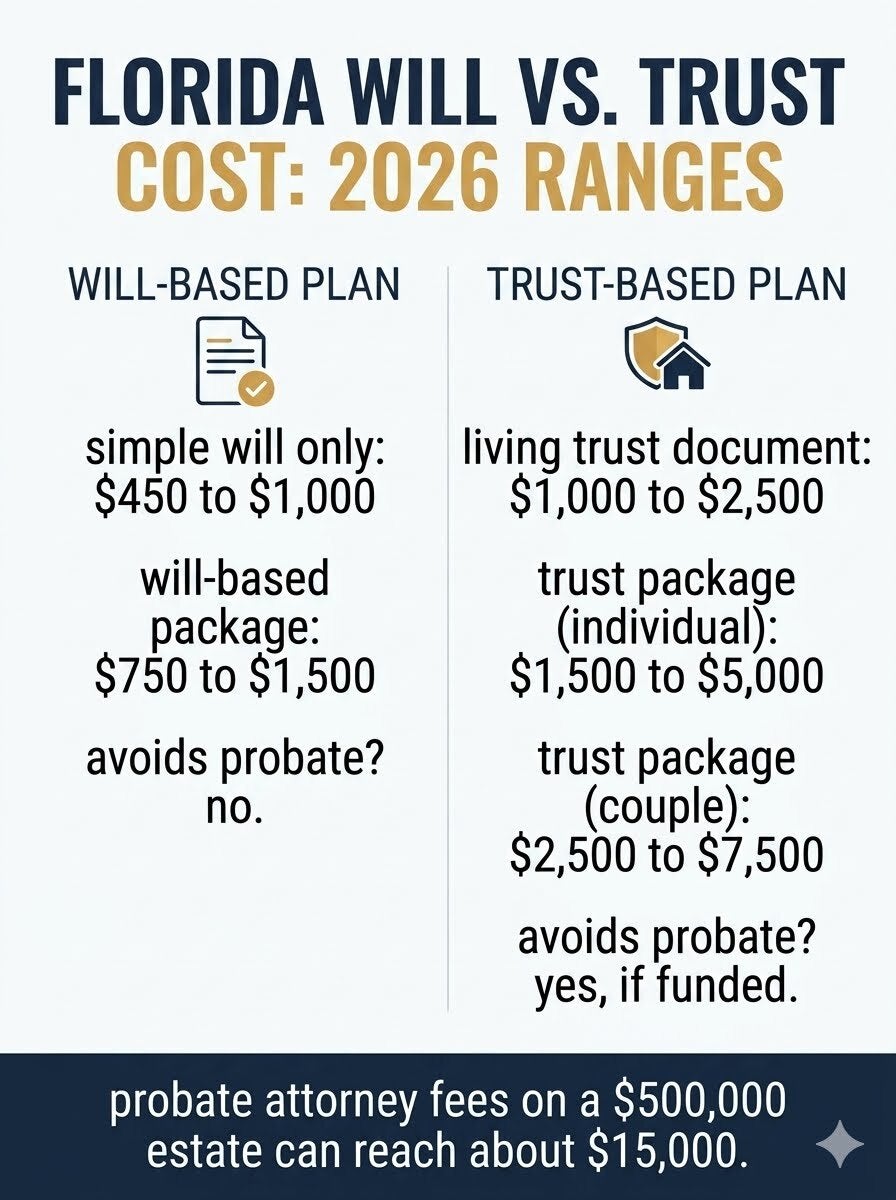
- In Florida, the average cost of a will and trust in Florida ranges from about $450 for a simple will to roughly $1,500 to $5,000 for a complete revocable living trust plan for one person.
- A basic will-based package (will plus powers of attorney and health directives) typically runs $750 to $1,500, while a trust-based estate plan generally runs $1,500 to $5,000 for an individual and $2,500 to $7,500 for a couple.
- Most Southwest Florida estate planning attorneys quote a flat fee for standard plans, so you know the total cost before any work begins.
- The upfront cost of a living trust is higher than a will, but a properly funded trust can spare your family the costly probate process, where statutory attorney fees on a $500,000 estate can reach roughly $15,000.
- Price is driven by the complexity of your estate, not your zip code: real estate, business interests, blended families, and tax planning all raise fees, while a straightforward plan stays affordable.
What Is the Average Cost of a Will and Trust in Florida?
In Florida, a simple will typically runs $450 to $1,000, and a revocable living trust usually costs $1,000 to $2,500. A complete will-based package often lands between $750 and $1,500, while a trust-based plan generally runs $1,500 to $5,000 for one person and more for a couple. These are attorney-drafted figures, not online forms.
Those ranges track closely with a 2026 nationwide study of 909 law firms, which found a national median of $625 for a will and about $2,475 for a revocable living trust. Florida sits comfortably inside that national picture. What moves your number up or down is the complexity of your estate, not whether you live in Naples or Fort Myers.
Families comparing central Florida wills and trusts costs to Southwest Florida quotes will find the ranges are similar statewide, because pricing tracks the complexity of the estate rather than the county line. Searches like "average cost of a will trust Florida" turn up everything from $100 templates to five-figure plans, which is exactly why a plain breakdown helps.
Average Cost of a Simple Will in Florida
A simple will in Florida generally costs $450 to $1,000 when drafted by an attorney. A "simple" will names who inherits, names a personal representative (Florida's word for executor), and, if you have minor children, names a guardian. To be valid, it must be signed and witnessed under Fla. Stat. § 732.502, which requires two witnesses who sign in your presence and each other's.
Most people do not buy a will completely on its own, though. It is usually paired with a durable power of attorney and health care documents, which is where the will-based package price comes in.
Average Cost of a Revocable Living Trust in Florida
The cost of a living trust in Florida usually falls between $1,000 and $2,500 for the trust document alone, and $1,500 to $5,000 for a full trust-based plan that includes the supporting documents. A trust costs more than a will because it does more: it holds title to your assets during life and passes them to your beneficiaries after death without court involvement.
The upfront cost of a living trust also reflects the extra work of setting it up correctly. A trust that is drafted but never funded (more on funding below) does not avoid probate, so the drafting fee is only part of the job.
Average Cost of a Complete Estate Planning Package
A complete estate planning package bundles the core legal documents at a single flat fee. A will-based package (will, powers of attorney, health care surrogate, and living will) typically runs $750 to $1,500. A trust-based package (revocable living trust, pour-over will, powers of attorney, and health directives) generally runs $1,500 to $5,000 for an individual and $2,500 to $7,500 for a couple.
Packages are almost always better value than buying documents one at a time, and they make sure your legal documents work together instead of contradicting each other.
Florida Estate Planning Cost Comparison Table
Here is how the common options compare on price, what each includes, and who each is best for.
| Plan Type | Typical Price Range | Documents Included | Best For |
|---|---|---|---|
|
Simple will only |
$450–$1,000 |
Last will and testament |
Young, single, few assets |
|
Will-based package |
$750–$1,500 |
Will, durable power of attorney, health care surrogate, living will |
Modest estates, no probate-avoidance goal |
|
Trust-based package (individual) |
$1,500–$5,000 |
Revocable living trust, pour-over will, powers of attorney, health directives |
Homeowners, probate avoidance, privacy |
|
Trust-based package (couple) |
$2,500–$7,500 |
Joint or paired trusts plus all ancillary documents |
Married couples with a home or blended family |
|
Complex plan |
$5,000–$15,000+ |
Irrevocable trusts, tax planning, business succession |
High-net-worth, business owners, taxable estates |
|
DIY online service |
$100–$300 |
Template documents, no legal advice |
Rarely a fit for Florida homeowners |
Prices help, but they only mean something once you know what sits inside each package, so let us open them up.
What's Included in a Will or Trust Package?
An estate planning package is a set of legal documents that work together to cover both your death and your incapacity. Whether will-based or trust-based, a proper estate plan usually includes four or five core documents, and the price reflects the whole set rather than any single form.
What's Included in a Basic Will Package?
A basic will package usually includes four documents: a last will and testament, a durable power of attorney, a health care surrogate designation, and a living will. The will directs asset distribution at death, the durable power of attorney lets someone manage your finances if you cannot, the surrogate names who makes medical decisions, and the living will states your end-of-life wishes.
This bundle is the floor for most adults. Even a young family with a modest financial situation benefits from having all four in place, because the power of attorney and health directives matter long before the will ever does.
What's Included in a Trust-Based Estate Plan?
A trust-based plan includes a revocable living trust as its centerpiece, plus a pour-over will, powers of attorney, and health care documents. The pour-over will is a safety net: it catches any asset you did not transfer into the trust during life and directs it into the trust at death.
The trust is what allows for probate avoidance, but only if it is funded. That is why a trust-based package costs more: it involves both the drafting and the guidance to retitle your assets.
Additional Documents That May Be Included
Depending on your family circumstances, an attorney may add a HIPAA authorization (so your agent can access medical records), a declaration of preneed guardian, or a Lady Bird deed to pass Florida homestead outside probate. Business owners may need documents coordinating their business interests with the plan.
These extras are usually modest add-ons rather than separate full-price items, and a good attorney will tell you which ones your specific situation actually calls for. What none of that explains yet is why two families can get very different quotes, which is the next question.
What Factors Affect the Cost of a Will or Trust in Florida?
Pricing varies because estate planning is not one-size-fits-all: the fee reflects how much work your plan requires, not an arbitrary rate. A single renter with a bank account and a homeowner with a blended family, a business, and out-of-state property need very different plans, because each unique situation carries its own work. Here are the factors that move the number.
Estate Size and Complexity
The complexity of your estate is the single biggest driver of cost. More assets, more account types, and more beneficiaries mean more drafting, more coordination, and more chances for something to go wrong, all of which justify higher fees. A plan for a taxable estate with tax planning built in sits at the top of the range.
Florida Real Estate and Homestead Property
Owning a home raises the stakes and often the price. Florida homestead carries special constitutional protections and devise restrictions, so passing a Gulf-access home in Cape Coral through a plan takes more care than passing a bank account. We cover this in depth in our guide to Florida homestead probate, and it is a common reason homeowners choose a trust.
Business Ownership and Investment Assets
If you own a business, rental properties, or a sizable investment portfolio, your plan has to address succession, valuation, and coordination with operating agreements. Folding business interests into a trust and planning for their transfer is skilled work, and it moves a plan into the complex tier.
Minor Children or Blended Families
Minor children mean guardianship provisions and often a trust to hold assets until the children are older. Blended families, second marriages with children from prior relationships, need careful drafting so that everyone the client intends to provide for is protected. Both add complexity, and complexity adds cost.
Attorney Experience and Fee Structure
An experienced Florida estate planning attorney generally charges more than a general practitioner, and that experience is usually worth it for anything beyond the simplest plan. Fee structure matters too. Flat fees are common for estate planning: you know the total upfront, which most families prefer. Hourly rates appear on complex or unpredictable matters, where the work is harder to scope in advance. Ask which one applies before you engage anyone. Complex needs like tax planning, irrevocable trusts for asset protection, or Medicaid planning are where costs climb, because they demand specialized drafting and carry real financial planning consequences.
Will Updating Your Estate Plan Cost Extra?
Yes, updates cost extra, but usually far less than the original plan. Small changes are handled with a codicil (for a will) or a trust amendment, often for a few hundred dollars. Major life changes, the birth of a child, a divorce, a move to Florida, or a large change in assets, may warrant a fuller revision. Some firms offer maintenance programs; ask what future changes will cost before you assume they are free.
Knowing what drives the price still leaves the biggest decision open: is the extra cost of a trust actually worth it for you?
Is a Trust Worth the Extra Cost?
For some families a trust is worth every dollar, and for others a will is plenty. A trust is worth the extra cost when it will save your family more in avoided probate, delay, and stress than it costs to set up, which is common for Florida homeowners but not universal. Here is how to judge your own case.
When a Will Is Usually Enough
A will is usually enough when your estate is modest, most assets already pass by beneficiary designation, and you are not worried about probate delay or privacy. A renter with a bank account, a car, and a retirement plan that names beneficiaries may get everything they need from a solid will-based package. Paying for a trust you do not need is not smart financial planning.
When a Living Trust Makes Financial Sense
A living trust makes financial sense when you own real estate, want to avoid probate, value privacy, or own property in more than one state. Snowbirds who keep a home up north and a condo in Naples are prime candidates, because a trust can avoid a second (ancillary) probate in Florida on top of the one back home. The upfront cost buys real convenience later.
Comparing the Lifetime Cost of a Will vs. a Trust
The will-versus-trust decision is really about when you pay: a little now, or more later. A will costs less today but leaves probate for your family; a trust costs more today but can skip probate entirely. For a fuller side-by-side, see my earlier article, Living Will vs Living Trust Florida: Do You Need Both?
| Will-Based Plan | Trust-Based Plan | |
|---|---|---|
|
Upfront cost |
$750–$1,500 |
$1,500–$7,500 |
|
Avoids probate? |
No |
Yes, if funded |
|
Privacy |
Public court record |
Private |
|
Best for |
Modest estates |
Homeowners, multi-state assets |
|
Cost to family later |
Probate fees and delay |
Minimal if funded |
Situations Where Paying More Today Can Save Money Tomorrow
Paying more today saves money tomorrow when your estate would otherwise face a costly probate process. On a $500,000 estate, statutory probate attorney fees alone can reach roughly $15,000, which often dwarfs the cost of the trust that would have avoided it. For many homeowners, the trust is less an expense than an important investment in their family's future and a genuine source of peace of mind. For families deciding how to structure that protection, our guide to revocable vs. irrevocable trusts explains the trade-offs.
That last point about probate deserves its own look, because it is the hidden cost most people never see coming.
How Does Probate Affect the Cost of a Will?
Probate is the court process that proves a will and transfers assets, and it adds cost that shows up after death rather than in your attorney's quote. A will does not avoid probate; it directs it. Understanding the probate process is the key to understanding why a trust can be worth the extra money.
Why Most Wills Still Go Through Probate
Most wills go through probate because a will only takes effect once a court admits it. Any asset titled in the deceased person's sole name, with no beneficiary and no joint owner, generally must pass through probate for title to transfer, will or no will. The will tells the court who inherits; it does not keep the court out of the picture.
Probate Costs Families Often Don't Expect
Probate carries costs families rarely budget for: court costs and filing fees, publication costs for the notice to creditors, and attorney fees. Under Fla. Stat. § 733.6171, Florida presumes a reasonable attorney fee of $1,500 up to $40,000 of value, $2,250 up to $70,000, $3,000 up to $100,000, and 3% of value between $100,000 and $1 million. Those legal fees are negotiable, but they are real, and they come on top of the plan you already paid for. Our overview of how long Florida probate takes and how much it costs walks through the full picture.
Can a Living Trust Help Avoid Probate?
Yes, a funded living trust is one of the most reliable tools for probate avoidance in Florida. Assets titled in the name of your trust are controlled by the trust's terms at your death, so there is nothing for the court to administer and no court intervention required. For the other main methods, see my earlier article, Top Ways to Avoid Florida Probate: A Quick Guide.
Does Every Florida Estate Need Probate?
No, not every estate needs full probate. Florida offers simplified paths for smaller estates. Summary administration is available when the probate estate (less exempt property) is worth $150,000 or less, or the person died more than two years ago. That limit was recently doubled from $75,000 by Ch. 2026-57, Laws of Florida, effective July 1, 2026, and we explained what the new $150,000 limit means for local families. Full formal administration is still required for larger estates, contested matters, or estates that need a personal representative to act over time. The Florida Bar's consumer guide, Probate in Florida, is a helpful plain-English overview. Where a trust really shines is sparing your family this entire question, which raises the do-it-yourself temptation.
Attorney vs DIY Estate Planning: Which Saves More Money?
DIY estate planning saves money upfront but often costs far more later, because a template that fails Florida's requirements can send the very estate you tried to protect into court. An online service looks cheap next to an attorney, yet the comparison that matters is total lifetime cost, not the sticker price today.
Comparing the Upfront Costs
Upfront, the gap looks dramatic. An online service runs $100 to $300, while an attorney-drafted plan runs several hundred to several thousand dollars. If price were the only factor, DIY would win every time. It is not the only factor.
Risks of DIY Estate Planning
The risk with DIY is that a defective document is usually discovered after death, when it is too late to fix. A will that is not witnessed correctly under Florida law, a trust that is never funded, or a form that ignores homestead rules can be challenged, rejected, or trigger the exact probate you hoped to avoid. Fixing those errors in court costs far more than the plan would have.
When Hiring an Attorney Provides Better Long-Term Value
Hiring an attorney provides better long-term value whenever your situation has any real complexity: a home, a blended family, minor children, a business, or out-of-state property. The attorney's job is not just filling in a template; it is spotting the issues a form cannot, and making sure your documents actually do what you intend. That is a critical step most software skips.
Situations Where Professional Legal Advice Is Worth the Cost
Professional legal advice is clearly worth the cost when you own Florida homestead, have a taxable estate (above the $15 million federal exemption for 2026), run a business, are in a second marriage, or want to be sure the plan holds up. In those situations the downside of getting it wrong is measured in tens of thousands of dollars and family conflict, which makes the attorney fee look small by comparison. Once you have decided to hire a professional, the next task is choosing the right one.
How to Choose the Right Estate Planning Attorney in Florida
Choose an experienced estate planning attorney with transparent flat-fee pricing who handles the whole job, including funding your trust and helping your family later. The cheapest quote is rarely the best value, and the most expensive is not automatically the most qualified. Here is what to look for.
Questions to Ask Before Hiring an Attorney
Ask a qualified estate planning lawyer a few direct questions before you hire anyone: Is the fee a flat fee or hourly? What documents are included? Will you help me fund my trust? Do you handle probate too? What will future updates cost? Clear answers signal a firm that has done this many times. Vague answers are a warning.
What Should Be Included in the Fee?
A good flat fee should include the drafting of all core documents, an initial consultation, the signing appointment with witnesses and a notary, and clear guidance on next steps. Ask whether trust funding, recording fees for any deeds, and minor revisions are inside the quoted price or billed separately.
Does the Attorney Help Fund the Trust?
This question separates thorough firms from form mills. Funding, retitling your assets into the trust, is what makes a trust work, and an attorney who drafts the trust but leaves you to fund it alone has left the most important part undone. Confirm that funding help is part of the engagement.
Experience With Florida Probate Law
An attorney who also handles probate has seen firsthand how estate plans succeed or fail when they are actually used. That perspective produces better plans. Familiarity with Florida state laws, homestead, the elective share, and the probate process, is not optional; it is the core of competent Florida estate planning.
Red Flags to Watch For
A few warning signs are worth taking seriously. Flat-fee transparency should be the norm; an attorney who will not put the fee in writing is a red flag. Ongoing support matters, because a firm that vanishes after the signing leaves you stranded when life changes. Client reviews and reputation round out the picture; consistently poor feedback or no track record at all should give you pause.
Does the Attorney Charge a Flat Fee or Hourly Rate?
Most estate planning is well suited to flat fees, and most Southwest Florida families prefer them because the total cost is known upfront. Hourly billing is normal for genuinely complex or contested work, but for a standard plan, a flat fee protects you from surprise bills and higher fees than you bargained for.
What's Included in an Estate Planning Package?
Confirm exactly which legal documents the package contains and whether ancillary items, HIPAA authorizations, preneed guardian declarations, or deeds, are included. Two firms quoting the same price may be offering very different scopes, so compare what is inside, not just the number.
Should You Choose an Estate Planning Attorney Who Also Handles Probate?
Often, yes. A firm that handles both estate planning and probate can build your plan with the end in mind and can step in to help your family when the time comes. We do both, exclusively, and that continuity is something families across the Sunshine State tell us they value.
What Additional Costs Should You Budget for Beyond Attorney Fees?
Beyond the attorney's fee, budget for a handful of smaller costs: trust funding steps, deed recording, and future updates. These are usually modest, but families are often surprised by them, so it is worth knowing they exist before you sign.
Funding a Living Trust
Trust funding is the process of retitling assets into your trust, and it can carry small third-party costs. Transferring a bank or brokerage account is usually free, but some financial institutions charge minor fees, and coordinating the changes takes time. Skipping this step is the most common way a trust fails.
Recording Property Deeds
Moving your home into a trust requires a new deed, and recording fees apply when it is filed with the county. In Florida these are modest, typically well under $100 plus documentary stamp considerations, but they are a real line item that the attorney's drafting fee may or may not include.
Updating Estate Planning Documents
Plans need occasional updates, and each revision has a cost. A minor amendment is inexpensive; a full restatement after a major life change costs more. Budget for a review every few years, or after any big change in your family circumstances or financial situation.
Transferring Assets Into Your Trust
Beyond the home, fully funding a trust means addressing investment accounts, business interests, and sometimes vehicles. Some transfers are simple, others take paperwork, and a thorough attorney will give you a funding checklist so nothing is missed. Unfunded assets can still land in probate.
Outdated Beneficiary Designations
One overlooked cost is fixing beneficiary designations that conflict with your plan. Life insurance and retirement accounts pass by designation, not by your will or trust, so an old form naming an ex-spouse can override everything else. Reviewing and updating these is cheap and prevents expensive mistakes.
Costly Estate Planning Mistakes That Can Lead to Probate or Family Disputes
The most expensive estate planning mistakes are not overpaying; they are underplanning. A few recurring errors send Florida families into court or conflict, and each is avoidable with a little care.
Choosing Based Only on Price
Choosing the cheapest option without asking what it includes often costs more later. A bargain plan that misses a funding step or ignores homestead can trigger the probate it was supposed to prevent. Value, not price, is the right measure.
Not Funding a Trust
The most common trust mistake is never funding it. An unfunded trust is just paper: assets left in your sole name still go through probate, defeating the entire purpose. Funding is a critical step, not an optional one.
Failing to Update Your Estate Plan
An outdated plan can be worse than none, because it may direct assets to the wrong people. Marriages, divorces, deaths, and the birth of a child all change who should inherit and who should serve. Revisit the plan periodically so it keeps pace with your life.
Ignoring Florida Homestead Rules
Florida homestead has constitutional protections and strict rules on how it can be left, especially when there is a surviving spouse or minor child. Ignoring them can void a devise and force the home through court. Homestead is one area where general online forms routinely get Florida wrong.
Using Generic Online Templates
A generic template written for no particular state is a gamble in Florida, which has its own execution formalities and homestead law. An online service that produces legal documents without accounting for Florida's requirements can leave you with paper that does not hold up when it matters most.
Why Families Across Florida Choose The Nussbickel Law Firm for Wills, Trusts, and Estate Planning
The Nussbickel Law Firm, P.A. focuses exclusively on estate planning, probate, and trust administration. That focus is the point: we are not fitting your plan in between real estate closings and traffic tickets. From our Fort Myers office we help families throughout Lee, Collier, and Charlotte counties, and we regularly work with out-of-state families who own property in Florida.
Because we handle both the planning and the probate, we build plans with the finish line in view, and we are here to help your loved ones when the time comes to use them. We quote flat fees for standard plans so you know the total cost before you commit, and we walk you through funding so your trust actually works. If you are weighing the average cost of will and trust in Florida against what your family needs, an initial consultation is the fastest way to get a clear, honest answer for your specific situation. Schedule a consultation or call our Fort Myers office today.
Frequently Asked Questions
Here are answers to some of the most common questions we hear about the cost of wills and trusts in Florida.
How much does a simple will cost in Florida?
A simple will drafted by a Florida attorney typically costs $450 to $1,000. Most people buy it as part of a will-based package with powers of attorney and health directives, which runs $750 to $1,500. Online templates cost less but are riskier for Florida homeowners.
How much does a living trust cost in Florida?
The cost of a living trust in Florida usually runs $1,000 to $2,500 for the trust document, and $1,500 to $5,000 for a full trust-based plan for an individual. Couples generally pay $2,500 to $7,500. Funding the trust is part of making it work.
Is a trust better than a will in Florida?
Neither is universally better; it depends on your specific situation. A trust avoids probate, adds privacy, and helps with multi-state property, which suits many homeowners. A will costs less and is enough for modest estates. Many families use both, with a pour-over will backing the trust.
Why are trusts more expensive than wills?
Trusts cost more because they do more. A trust holds title to your assets, avoids probate when funded, and requires both careful drafting and the work of retitling assets. A will is a simpler document that only takes effect through the court after death.
What documents are included in an estate plan?
A proper estate plan usually includes a will (or a trust plus a pour-over will), a durable power of attorney, a health care surrogate designation, a living will, and often a HIPAA authorization. Homeowners may also need a deed to fund a trust.
How often should I update my will or trust?
Review your plan every three to five years and after any major life event: marriage, divorce, the birth of a child, a death in the family, a move to Florida, or a large change in assets. Minor updates are inexpensive compared with the original plan.
What happens if I die without a will in Florida?
If you die without a will, Florida's intestacy statutes decide who inherits, which may not match your wishes, and the estate still goes through probate. Blended families and unmarried partners are often surprised by the result. A will keeps you in control of asset distribution.
Can married couples have one trust?
Yes. Married couples can use a single joint revocable trust or two separate trusts, depending on their assets and goals. Joint trusts are common for couples with shared property, while separate trusts can help with tax planning or blended-family situations. An attorney can advise which fits.
Are estate planning attorney fees tax deductible?
Generally, personal estate planning fees are not income-tax deductible for individuals under current federal law. Florida has no state income or estate tax (see our guide to estate and death taxes in Florida), so there is no state deduction either. Fees tied to income-producing property or certain tax planning may be treated differently; ask your tax advisor.
How long does it take to create a will or trust?
For a straightforward plan, expect two to four weeks from the initial consultation to signing: one meeting to gather information, drafting, and a signing appointment with witnesses and a notary. Complex plans take longer. Funding a trust adds a few more weeks of retitling work.
Gregory J. Nussbickel is the founder of The Nussbickel Law Firm, P.A. in Fort Myers, Florida. His practice is devoted exclusively to estate planning, probate, and trust administration for families throughout Southwest Florida.
This article is for general information only and is not legal advice. Reading it does not create an attorney-client relationship. Estate planning law changes, and every estate is different; speak with a licensed Florida attorney about your specific situation.

Comments
There are no comments for this post. Be the first and Add your Comment below.
Leave a Comment