

Key Highlights
- The living will vs living trust Florida question has one answer for most families: these are not alternatives, and a complete estate plan usually includes both.
- A living will is an advance directive under Chapter 765. It speaks only about medical care at the end of life and has nothing to do with your property.
- A living trust is a legal document that holds title to your assets, so it governs money and property and says nothing about your medical treatment.
- A living will needs two witnesses, one of whom is neither your spouse nor a blood relative. A revocable trust needs the formalities of a will for the provisions that take effect at your death.
- Neither document names a guardian for minor children. Only a last will and testament does that.
Introduction
The short answer: a living will and a living trust do completely unrelated jobs, so the living will vs living trust Florida choice is almost never either-or. One tells your doctors what to do when you cannot speak for yourself. The other tells a trustee what to do with your bank accounts, your house, and your investments. Naming them both "living" is an accident of language, not a sign that they overlap.
That accident causes real problems. We regularly meet families in Fort Myers and Naples who believe a trust covers their healthcare decisions, or that a living will protects their home. Neither is true, and the gap only shows up at the worst possible moment.
Living Will vs Living Trust Florida: What Sets Them Apart?
The difference is subject matter. A living will governs your body; a living trust governs your property. They never touch the same decision, which is why comparing them the way you would compare two estate planning tools that do the same job leads people astray.
Below are the five distinctions that matter most.
Purpose: Medical Choices vs. Asset Management
A living will records whether you want life-prolonging procedures if you have a terminal condition, an end-stage condition, or are in a persistent vegetative state. That is its entire scope. It does not move a dollar.
A living trust does the opposite. You transfer ownership of your assets into it, name yourself trustee, and keep complete control during your lifetime. It handles asset distribution, incapacity planning for your financial matters, and the management of the trust after your death. It has no voice in your medical care.
Legal Requirements for Each Document
The signing rules differ, and they trip people up.
A living will must be signed before two subscribing witnesses, one of whom is neither a spouse nor a blood relative, under Fla. Stat. § 765.302. A last will needs two attesting witnesses under § 732.502, with no relationship restriction. A revocable trust has no witness rule of its own for holding property, but its testamentary provisions must be executed like a will.
Get one of these wrong and the legal document may not do what you paid for.
Who Needs Which in Southwest Florida?
Nearly every competent adult should have a living will. It costs nothing to be clear about end-of-life care, and without one the decision falls to whoever Florida ranks first among your family members.
A trust is a closer call. It earns its keep when you own real estate, when you want privacy, or when you want staged distributions to a young beneficiary. If you are sorting out where to start, my earlier article Estate Planning Checklist for Seniors walks through the six documents most plans need.
Impact on Probate and Estate Distribution
Only the trust affects probate. Assets you retitle into it pass to your beneficiaries without court involvement, because the trust already owns them. Assets left in your sole name go through the probate process regardless of what your living will says, and that legal process ends with court approval of the distribution.
Privacy follows the same line. A probate file becomes part of the public record, so anyone can read what you owned and who received it, while transfers under a trust happen without court intervention and never enter the public record.
Plenty of property already escapes probate without any trust at all, including accounts with beneficiary designations and property held with rights of survivorship. A living will has no effect here whatsoever.
Do You Need Both?
Usually yes, plus two more. Framing the living will vs living trust Florida decision as a choice between the two misses that they answer different questions. A working Florida estate plan typically pairs a living will and a health care surrogate designation on the medical side with a trust and a pour-over will on the property side, and adds a durable power of attorney for financial decisions.
Skipping the medical documents because you have a trust is the single most common gap we see. The trust cannot consent to surgery.
What Is a Living Will in Florida?
A living will is a written declaration in which a competent adult directs whether life-prolonging procedures should be provided, withheld, or withdrawn if that person has a terminal condition, an end-stage condition, or is in a persistent vegetative state. It takes effect while you are alive.
For a plain-English walkthrough, see the firm's video What Is a Living Will? Florida End-of-Life Decisions.
What a Living Will Actually Controls
It controls one narrow category: life-prolonging procedures such as ventilator support and artificial nutrition and hydration. It is not a do-not-resuscitate order, and it is not a health care surrogate designation.
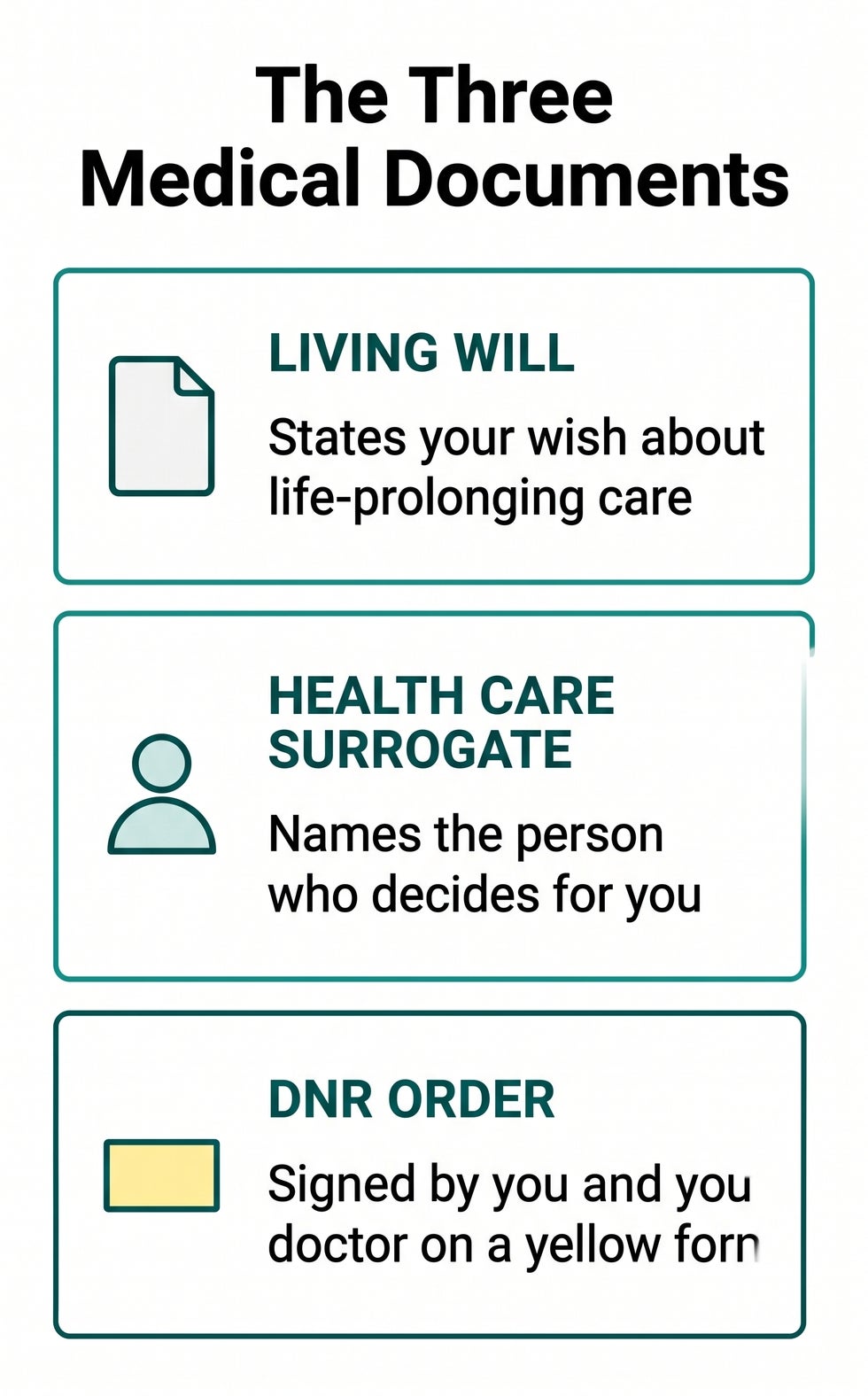
Those three get confused constantly. A pre-hospital DNRO is a specific yellow form from the Florida Department of Health, signed by you and your physician, described in the state's advance directives consumer guide. A surrogate designation names a person. A living will states a wish. Our video What Is a DNR? Florida Do-Not-Resuscitate Orders Explained covers the difference.
When Should You Create One?
Before you need it. Capacity is the requirement, and capacity is what an emergency removes.
Without a directive, § 765.401 supplies a proxy in a fixed order: a court-appointed guardian, then your spouse, then a majority of your adult children, then a parent, then your adult siblings, then another adult relative, then a close friend. That list may not match your wishes, and it gives your family no guidance about what you would have chosen.
Chapter 765: What the Law Requires
Chapter 765 of the florida statutes sets three rules worth knowing. First, the witness rule in § 765.302, described above. Second, § 765.202 lets you make a surrogate's authority effective immediately, without a determination of incapacity, which spares your family a physician's formal finding during a crisis.
Third, § 765.104 lets you revoke an advance directive by signed writing, by destroying it, by a later directive, or by simply saying so out loud. A will cannot be revoked that way. Divorce also revokes a former spouse as your surrogate.
What Is a Living Trust in Florida?
A living trust is a legal arrangement you create and fund while alive. You are the settlor, you serve as your own trustee, and you name a successor trustee to step in at incapacity or death. The revocable trust is the common form, and our video What Is a Revocable Living Trust in Florida? explains the mechanics.
Revocable Living Trust Versus Irrevocable Trust
A revocable trust can be amended or revoked by the settlor at any time, on whatever conditions the terms of the trust set out. An irrevocable trust generally cannot, and that rigidity is the price of the benefits people seek from it, including creditor protection and removing assets from the taxable estate.
Most Southwest Florida families use the revocable version. For a fuller comparison of the two types of trusts, see my earlier article Revocable vs. Irrevocable Trusts in Florida.
Managing Assets During Life and After Death
A trust only governs what you actually put into it. Transferring ownership of assets into it, by retitling bank accounts, brokerage holdings, and real estate, is the step people skip, and an unfunded plan produces exactly the probate it was meant to prevent. A pour-over will catches the remaining assets, though it reaches them through probate. Watch What Is Trust Funding? Why an Unfunded Trust Does Nothing.
Note that retirement accounts and life insurance usually pass by beneficiary designation instead, so they rarely belong in the trust. And a trust is not a way to skip administration: under § 736.05055 the trustee must file a notice of trust when the settlor dies, and the Florida Bar's probate consumer pamphlet notes that trust assets can face a two-year creditor claim window rather than the shorter probate period for outstanding debts.
Chapter 736: Creating a Valid Trust
Here is where the internet gets Florida wrong. A declaration of trust covering land needs only a signed writing under § 689.05. Witnesses are required by § 736.0403(2)(b), and what triggers them is the trust's testamentary aspects, not the fact that it holds a house. The deed moving the property is a separate instrument needing two subscribing witnesses under § 689.01.
Homestead adds its own layer. Section 732.4015 defines "devise" to include a disposition by trust, so a trust does not escape the homestead restrictions that apply when you leave a spouse or minor children. Our guide to Florida homestead probate covers the specific circumstances.
How Is a Last Will Different?
A last will speaks only after death and only through the probate court. It is the instrument that appoints your personal representative, and it remains necessary even when a trust carries most of the estate. If probate avoidance is the goal, see how to avoid probate in Florida for the full set of methods.
What a Last Will Controls
It directs the distribution of assets titled in your sole name, names your personal representative, and, critically, names a guardian for your minor children. No trust and no advance directive can do that last one.
A separate declaration under § 744.3045 lets you name a preneed guardian for yourself, which is a different document again, signed before two attesting witnesses present at the same time.
Chapter 732: Signing a Valid Will
The will must be in writing, you must sign at the end, and two attesting witnesses must sign in your presence and in each other's presence. That is the whole of § 732.502. My earlier article Florida Will Requirements covers the edge cases, including handwritten and out-of-state documents.
Note what the statute does not say: nothing about a notary.
What the Witnesses and Notary Do
The witnesses make the will valid. The notary does something else entirely. Under § 732.503 a notarized self-proving affidavit lets the court accept the will without tracking your witnesses down years later. A will without a notary is still valid; it is just slower to prove.
Florida also permits electronic wills, where witnesses appear by audio-video technology supervised by a notary. Convenience has a cost here, and remote signings draw challenges that a conference room signing does not.
How Do Living Wills, Living Trusts, and Last Wills Compare in Florida?
Side by side, the three separate cleanly by timing, subject matter, and who acts.
All Three Documents, Side by Side
The table below is the whole comparison in one view.
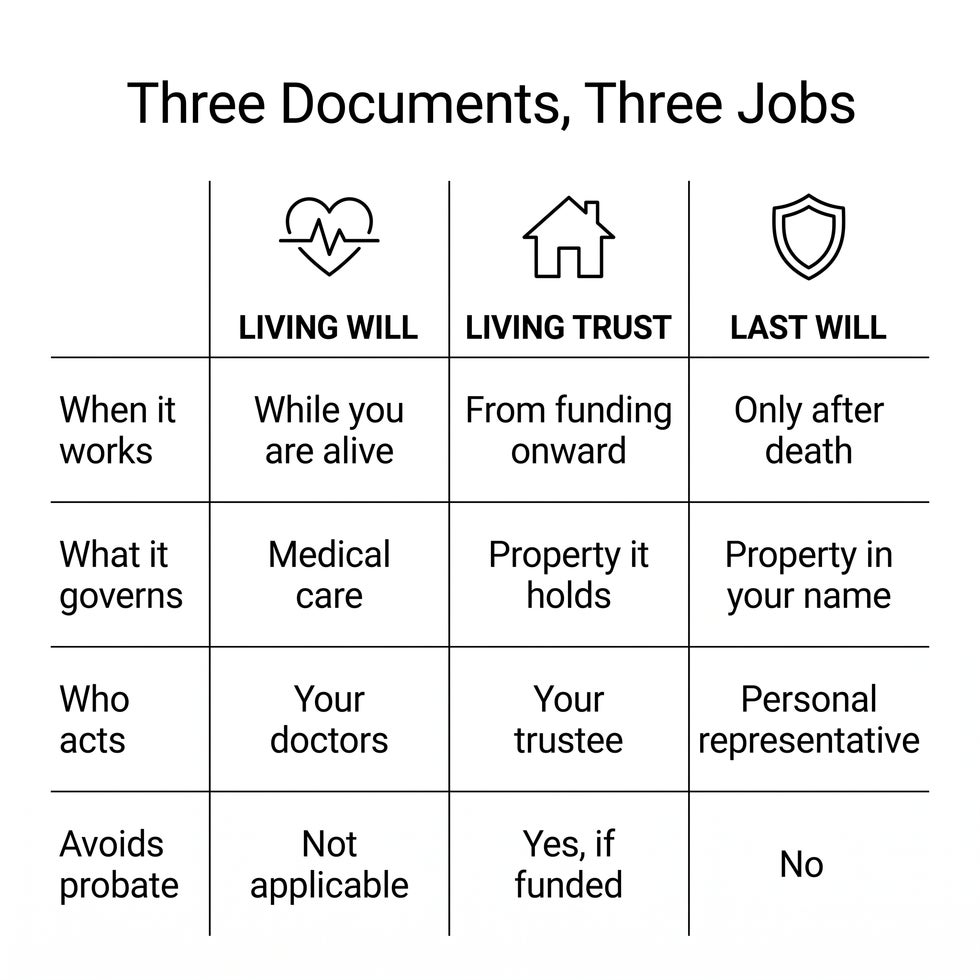
| Living Will | Living Trust | Last Will | |
|---|---|---|---|
|
When it operates |
While alive, once incapacitated |
From funding, through incapacity, after death |
Only after death |
|
What it governs |
Life-prolonging medical care |
Property titled in it |
Property in your sole name |
|
Who acts |
Physicians, guided by your surrogate |
Trustee, then successor trustee |
Personal representative |
|
Avoids probate? |
Not applicable |
Yes, for funded assets |
No |
|
Signing |
2 witnesses, 1 unrelated |
Will formalities for testamentary terms |
2 attesting witnesses |
|
Names a guardian? |
No |
No |
Yes |
Which Document Handles Medical Choices, Asset Transfers, and Probate?
Medical choices belong to the living will and your surrogate. Asset transfers belong to the trust for funded property and to the will for everything else. Probate belongs to the will alone.
One limit applies across the property side. Under § 732.2035, revocable trust property counts in the elective estate, so a trust does not disinherit a surviving spouse. Nor does it change your federal estate tax picture, because revocable trust assets remain in your gross estate. The tax advantages people expect from a revocable arrangement are not there, and no state estate tax applies in Florida anyway. Real tax considerations do arise, but they belong to irrevocable planning, so treat potential tax benefits as a reason to ask questions rather than a reason to sign.
How This Plays Out in Southwest Florida
Two patterns dominate in Lee, Collier, and Charlotte counties.
The first is the seasonal resident who signed documents up north. A directive executed under another state's law is generally honored here, and a will valid where it was signed is usually valid here too, but the property side deserves a fresh look, because state laws on homestead and spousal rights differ sharply.
The second is out-of-state real estate, which can force ancillary probate in that state even when the Florida plan is tidy. Our discussion of international estate planning in Florida covers the cross-border version of the same problem.
How The Nussbickel Law Firm Helps Southwest Florida Families
We are an estate planning and probate firm in Fort Myers, serving families in Lee, Collier, and Charlotte counties for planning work and handling probate matters statewide. Virtual appointments are available.
Choosing the right documents plays a crucial role in whether a plan holds up. What that looks like in practice: we read what you already have, tell you plainly which pieces work, and build the rest around your estate planning needs rather than selling a package. Some families need a trust. Many need a well-drafted will, a living will, a surrogate designation, and a durable power of attorney, and nothing more. Getting straight legal advice about which group you are in is worth more than any single legal document.
Schedule a free consultation or call our Fort Myers office at 239-900-WILL (9455).
Conclusion
Treating a living will and a living trust as competing options is the mistake the names invite. One is an advance directive that governs medical care; the other is a property arrangement that governs your estate. Most Southwest Florida families end up with both, alongside a last will and a durable power of attorney, and the plan works because the pieces cover different ground. That is the practical resolution of the living will vs living trust Florida question, and it buys real peace of mind.
If your documents are more than a few years old, or major life events have changed your financial circumstances, that is the moment to review them rather than assume. Reach out to our office and we will tell you honestly what needs work.
Frequently Asked Questions
Can I use documents created in another state, or do I need new ones for Florida?
Usually they still work, with caveats. Under § 732.502(2) a will executed by a nonresident is valid here if it was valid where signed, though handwritten wills are excluded. Advance directives from other states are generally honored under florida's probate laws and Chapter 765. See Is an Out-of-State Will Valid in Florida? for the details.
What happens if I only have a living will and no trust or last will in Florida?
Your medical wishes are covered and your property is not. Everything in your sole name passes under Florida's intestacy statutes, which follow a fixed order among family members and ignore what you would have preferred. The probate court also appoints your personal representative, since no document nominated one.
Is it more expensive to set up a living trust than a will in Florida?
Yes, upfront. A trust involves more drafting and the funding work of retitling assets, so the attorney's fees are higher than for a simple will. Whether it is more expensive overall depends on your estate's size, your estate's value, and what your family would otherwise spend in probate on attorney and accounting fees. Our page on the cost of a will and trust in Florida breaks it down.
Gregory J. Nussbickel is a Fort Myers attorney practicing trust, estate, and probate law. He graduated cum laude from F.S.U. Law and holds an LL.M. from the University of Miami.
This article is general information about florida law and is not legal advice for your situation. Reading it does not create an attorney-client relationship. Every plan turns on specific circumstances, so please consult a Florida estate planning attorney before acting.

Comments
There are no comments for this post. Be the first and Add your Comment below.
Leave a Comment