

Key Highlights
- There is no Florida inheritance tax and no state estate tax in 2026, so a beneficiary who inherits from a Florida resident owes this state nothing on the inheritance itself.
- An inheritance tax is paid by the person who receives property. An estate tax is paid by the deceased person's estate. Florida imposes neither, and there is no state income tax here either.
- The federal estate tax exemption is $15,000,000 per person for deaths in 2026, and a married couple can shield up to $30,000,000 with a portability election.
- Florida beneficiaries can still owe elsewhere. Five states continue to charge recipients: Kentucky, Maryland, Nebraska, New Jersey, and Pennsylvania.
- What actually reaches most families here arrives later: capital gains on an inherited asset that gets sold, and ordinary income on money withdrawn from inherited retirement accounts.
Introduction
The short answer: there is no Florida inheritance tax, and this state charges no estate tax either. Neither the person inheriting nor the estate owes anything to Florida. What can still apply in 2026 is federal, and it arrives in three ways: on very large estates, on gains when inherited assets are sold, and as income on certain money received after a death.
That distinction is the whole subject. Families in Fort Myers, Cape Coral, Naples, and Punta Gorda ask us about this constantly, usually within a week of a funeral, and usually because someone quoted them a number that came from another state's rules. Out-of-state heirs ask a sharper version, because they are handling Florida property while living somewhere that does charge recipients.
The rest of this guide separates the four levies that get confused with each other, gives the 2026 federal figures, and shows where a Southwest Florida family's real tax burden usually sits. It is not where most people expect.
Does Florida Have an Inheritance Tax or Estate Tax in 2026?
No. Florida has no inheritance tax and no state estate tax in 2026. Nothing is owed to this state by a beneficiary who receives property, and nothing is owed before anything is distributed. What can still reach a Florida inheritance is federal, not state.
These are two different things and the difference decides who writes the check. An inheritance tax is charged to the recipient, and its rate typically turns on the beneficiary's relationship to the person who died, with a child treated more gently than a nephew or a friend. An estate tax is charged to the deceased person's estate before anything is distributed, and the relationship of the heirs is irrelevant to it.
Florida imposes neither one. What remains is a federal question and a timing question, which the next two sections take in turn.
Why Florida Residents Do Not Pay a State Inheritance Tax
If the person who died was a Florida resident, you inherit free of any state inheritance tax, whatever the amount and whatever your relationship to them. There is no return to file and no Florida tax to pay on the receipt itself.
The confusion usually comes from three other rules that are real. Federal income tax applies to distributions from inherited retirement accounts. Capital gains apply if you later sell something for more than its date of death value. And a former state of residence may have its own claim. None of those is a Florida inheritance tax, and blending them together is what produces the wildly wrong numbers people arrive with.
Florida also charges no state income tax, which is a separate point but one that compounds the effect. Money arriving here from an inheritance is not touched by Florida on the way in, and the income it later generates is not touched by Florida either.
The Legal Basis for No Florida Death Tax or State Estate Tax
Florida's result is structural, not a temporary policy. Article VII, Section 5 of the Florida Constitution is titled "Estate, inheritance and income taxes," and it ties any Florida death levy to the credit the federal government allows for state death taxes.
Section 198.02, Florida Statutes does exactly that. It reaches a Florida resident only in the amount of that federal credit, and no further. When Congress replaced the credit with a deduction, the Florida figure computed to zero. The Department of Revenue states the outcome plainly on its estate tax page: none is due for anyone who died on or after January 1, 2005.
One practical footnote for anyone administering an estate here. Because an old lien can still attach in some matters, a personal representative may need to file Form DR-312 or DR-313 with the clerk of court to release it. The Department's page sets out which form goes with which situation.
That is the state picture, and it is short. The longer part of the answer is federal.
What Taxes Can Still Apply to Inheritance in Florida?
Four can still touch a Florida inheritance: federal estate tax on large estates, another state's claim where the decedent had ties there, federal income tax on inherited retirement accounts and on earnings during administration, and capital gains when an inherited asset is sold.
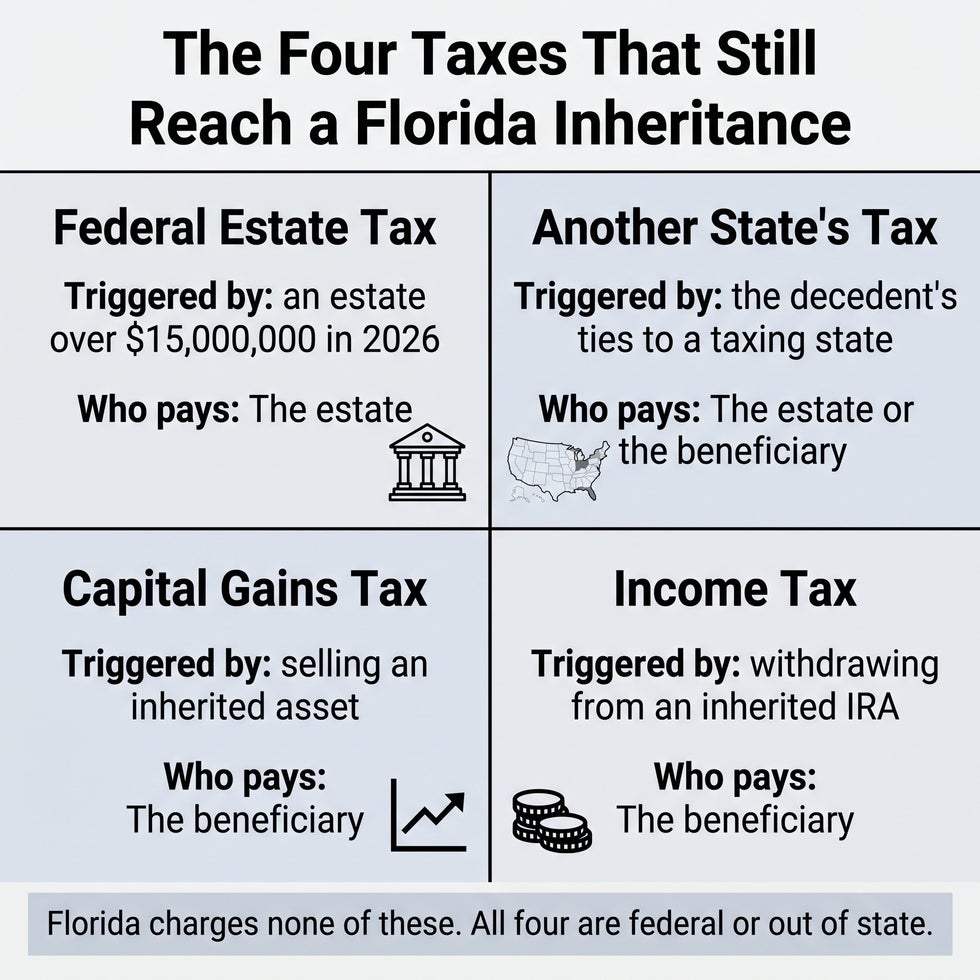
Sorting them by trigger is what makes this manageable. One is triggered by dying with too much. One is triggered by a connection to another state. One is triggered by receiving money that was never taxed. And one is triggered only when you sell. Almost nobody in Southwest Florida hits the first. Nearly everyone eventually meets the last two.
Federal Estate Tax: When Does It Apply to Florida Estates?
Federal estate tax applies only when the taxable estate exceeds the federal exemption, and it comes out of what the decedent left rather than out of the heirs' pockets. Because the burden sits there and not with the recipient, this is never a Florida inheritance tax question, even when a family here owes something.
The trap is what counts. The IRS builds the gross estate from everything the person owned or held certain interests in at the date of death, valued at fair market value. That includes assets in a revocable living trust, business interests, property wherever located, retirement accounts, and life insurance proceeds on a policy the decedent owned. That last one surprises people every time. A death benefit paid directly to a child still counts if the decedent kept incidents of ownership in the policy, such as the right to change the beneficiary or borrow against the cash value. Our guide to life insurance and estate planning walks through ownership versus beneficiary designation, and the firm's video What Is an ILIT? Irrevocable Life Insurance Trusts Explained covers the structure families use to move a policy out of the taxable total.
If something is owed, Florida law decides who bears it internally. Section 733.817 apportions the burden among recipients in proportion to the value of what each received, unless the will or trust expressly directs otherwise. A poorly drafted clause can shift the entire estate tax liability onto one beneficiary's share by accident, which is worth checking in any plan large enough for this to matter.
Other States' Inheritance Taxes and How They Affect Florida Beneficiaries
Yes, a Florida beneficiary can owe another state. Living here does not protect you if the person who died lived elsewhere, owned real estate elsewhere, or never properly changed domicile.
Five states still charge recipients: Kentucky, Maryland, Nebraska, New Jersey, and Pennsylvania. Iowa used to belong on that list and no longer does. Under Iowa Code section 450.98, the levy is repealed for estates of decedents dying on or after January 1, 2025. Separately, about a dozen states reach the estate itself at exemption levels far below the federal one, including Illinois and Massachusetts, and Kiplinger tracks which states still collect at death.
Four situations produce a surprise bill:
- The decedent was domiciled in a state that charges recipients, so it reaches what you receive even though you live in Florida.
- The decedent owned real estate in a state with a state estate tax, which can reach the property sitting inside its borders.
- The beneficiary lives in a state that charges its own residents on inheritances from out-of-state decedents.
- Someone moved to Florida but never finished the move. A family that relocated from New York to Naples and kept the old apartment, the old driver license, and the old voter registration may find the former state still treats the decedent as its resident.
Out-of-state property creates a second problem beyond money, because it usually requires an ancillary administration in that state. The firm's video Florida Estate With Out-of-State Real Estate: A Second Probate explains how that runs alongside the Florida probate process. For families with property or heirs outside the United States, see my earlier article, International Estate Planning Florida: A Lawyer's Guide.
Map every state connected to the decedent, to the real estate, and to each beneficiary before anyone distributes anything.
How Does the Federal Estate Tax Work for Florida Families?
For almost every Florida family, this is a size question with a one-word answer: no. The estate owes nothing unless the taxable estate exceeds the exemption amount, and in 2026 that threshold sits high enough that the overwhelming majority of estates fall well under it.
Where it does matter, the work is in what belongs inside the taxable estate rather than in rates. A revocable living trust is the most common misunderstanding. It keeps assets out of the probate process, but it does not remove them from the taxable total for federal tax purposes, because the grantor kept control. The firm's video What Is a Revocable Living Trust in Florida? explains why. Moving assets out requires giving up control, which is the province of irrevocable trusts, and our overview of the types of trusts for estate planning compares the options.
Lifetime giving interacts with all of this. The federal gift tax and the transfer tax at death share one lifetime exemption, so taxable gifts made during life reduce what remains at death, while gifts within the annual gift tax exclusion do not count against it. We cover that arithmetic for families making transfers to younger generations in our guide to estate planning for grandchildren.
2026 Federal Basic Exclusion Amount and Portability for Spouses
The federal basic exclusion amount is $15,000,000 per person for deaths occurring in 2026, up from $13,990,000 in 2025. The IRS publishes the filing threshold by year of death, and the increase came from the law enacted as Public Law 119-21, summarized in the IRS's 2026 inflation adjustments.
Portability lets a surviving spouse use whatever exclusion the first spouse did not, which is how a married couple reaches a combined $30,000,000. It is not automatic. The election has to be made on a federal return for the first spouse to die, even when that estate owes nothing at all.
| Rule | 2026 figure |
|---|---|
|
Basic exclusion amount, per person |
$15,000,000 |
|
Combined for a married couple with portability |
Up to $30,000,000 |
|
Top federal rate above the exclusion |
40 percent |
|
Basic exclusion amount for 2025 deaths |
$13,990,000 |
|
Future years |
Indexed for inflation |
The expensive mistake is skipping the filing at the first death because nothing was owed. Unused exclusion is not recreated later, and a couple who let it lapse can lose millions of dollars of shelter that cost almost nothing to preserve. For how this fits the rest of a couple's plan, see my earlier article, Estate Planning for Married Couples: A Florida Guide.
Form 706 Filing Requirements for Larger Florida Estates
Form 706 is the federal estate tax return. It is required when the gross estate plus adjusted taxable gifts exceeds the filing threshold for the year of death, and smaller estates file it voluntarily to elect portability for a surviving spouse.
The ordinary deadline is nine months after the date of death, with a six month extension available on request. The Instructions for Form 706 set out the mechanics. For a portability-only filing there is relief: Revenue Procedure 2022-32 lets an estate that was not otherwise required to file make the election as late as the fifth anniversary of the date of death, with no user fee, provided the return carries the required notation.
Practical guidance for a personal representative: do not treat "nothing due" as "no decision to make." Inventory the revocable trust assets, life insurance proceeds, retirement accounts, business interests, and jointly held property first, then decide. Gather the account statements, the deed and any mortgage payoff figure, the policy declarations page, and a current valuation for anything closely held, because those are the numbers the return is built from and they get harder to obtain as months pass. If a surviving spouse exists, calendar the portability question immediately rather than discovering it in year six.
What Happens with Capital Gains Tax on Inherited Assets?
Inheriting property in Florida triggers nothing at all. Selling it might. Capital gains tax applies only on a sale, and only to appreciation above the asset's stepped up basis, which is generally its fair market value at the date of death.
This is where the actual money is for most Southwest Florida families. Nobody in the family will owe federal estate tax, but many of them will eventually sell a house, a brokerage account, or a boat, and the basis rules decide what that costs. The next two sections work through the arithmetic and then the real estate case specifically.
Understanding Stepped Up Basis: Example for Florida Heirs
Stepped up basis resets an inherited asset's basis to its fair market value on the date of death. Appreciation that built up across the years of the original owner's lifetime is simply erased for tax purposes, which is the single largest break in most Florida estates.
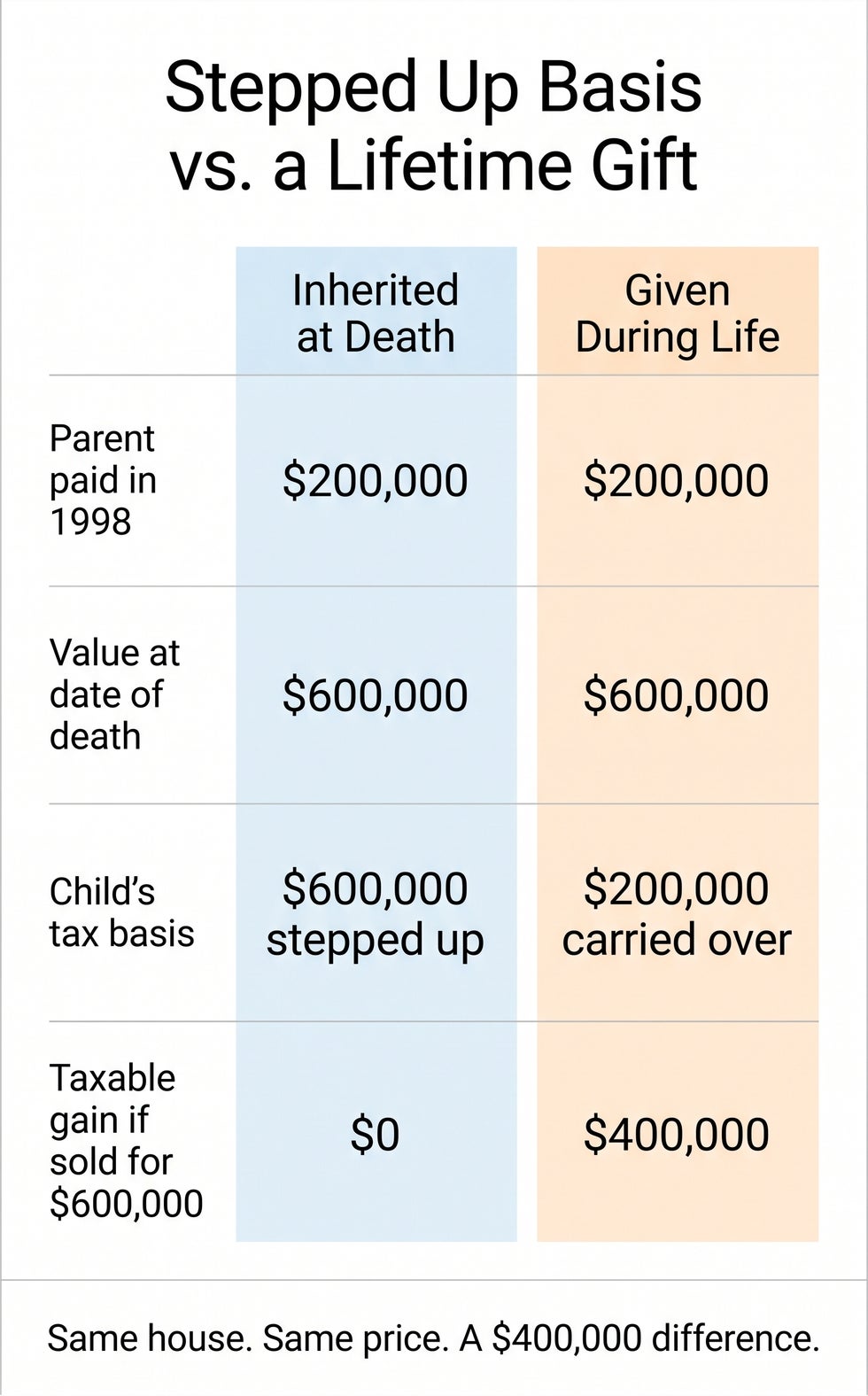
A concrete example, using numbers that are ordinary for a Cape Coral canal home:
- A parent bought the house in 1998 for $200,000.
- The house is worth $600,000 at the date of death.
- The child inherits with a stepped up basis of $600,000.
- The child sells for $600,000 and owes nothing, because there is no gain above basis.
- The $400,000 of appreciation during the parent's lifetime is never charged to anyone.
Compare that to a lifetime gift of the same house. The child would generally take the original owner's cost basis of $200,000 instead of a step up, and a later sale at $600,000 would produce a $400,000 taxable gain. That is why transferring appreciated real estate to children during life, which families often do with good intentions and no advice, can create a bill that dying with the property would have avoided entirely. It is one of the most common and most expensive estate planning errors we correct.
When Selling Inherited Real Estate or Property, What Taxes Apply?
Inheriting Florida real estate creates no state liability. What you do with it afterward determines everything. Sell near the date of death market value and there is usually little or nothing to pay. Hold it while it appreciates and only the post-death gain is reachable. Rent it and the rental income becomes taxable income on your federal return.
| What you do with inherited property | Likely result |
|---|---|
|
Inherit it |
No Florida inheritance tax, no state estate tax, nothing owed on the receipt |
|
Sell at roughly the date of death market value |
Usually no capital gains, because basis equals sale price |
|
Sell later, after further appreciation |
Capital gains on the post-death increase only |
|
Rent it out |
Rental income is taxable income federally |
|
Move in as your primary residence |
Rental income stops; apply for the homestead exemption |
Two Florida-specific points are worth knowing before you decide. First, the homestead exemption is a property tax exemption, not an income one, and it does not transfer automatically to an heir. If you make the inherited house your primary residence, you apply through the county property appraiser, and the Florida Department of Revenue explains the available exemptions. Second, homestead property follows its own descent rules at death that can override what a will says, which our article on Florida homestead probate covers in detail.
Get a date of death appraisal before you do anything else. It sets basis, and reconstructing it years later is far harder and far more expensive than ordering it now. Keep the appraisal, the closing statement from the original purchase if anyone still has it, and receipts for major improvements, all in one place. Whoever eventually sells will need them, and in our experience the person who ends up selling is rarely the person who gathered the paperwork.
Talk With The Nussbickel Law Firm About Your Florida Estate Plan
At The Nussbickel Law Firm, P.A. in Fort Myers, our practice is devoted exclusively to Florida estate planning, probate, and trust administration. We work with families across Lee, Collier, and Charlotte counties, and with out-of-state families who own property here and need someone local handling the Florida side.
On the questions in this article, the work usually looks like one of three things. For a family that has just lost someone, it is sorting out which rules actually apply, whether a portability filing should be made, and what documentation the heirs need before anything is sold. For a couple building or updating an estate plan, it is confirming that the exclusion is not being wasted and that assets are titled the way the plan assumes. And for people who moved here from a state that does collect at death, it is making sure Florida domicile is established cleanly enough to hold up.
Schedule a consultation or call our Fort Myers office, and ask what the first meeting involves so you know before you come in.
Conclusion
There is no Florida inheritance tax, no state estate tax, and no state income tax, which removes an entire layer that families elsewhere have to plan around. That is genuinely good news, and it is also the end of the state analysis.
What remains is federal and mostly deferred. The federal estate tax reaches only estates above $15,000,000 in 2026. Capital gains arrive when someone sells. Ordinary income arrives when someone empties an inherited retirement account. The families who get hurt are not the wealthy ones. They are the ones who gave away appreciated real estate during life, or skipped a portability election, or never finished changing domicile.
Two things are worth doing now: get a date of death appraisal on any inherited real estate, and if a spouse died within the last five years without a Form 706, find out whether portability is still available. Both are cheap today and expensive to fix later.
Frequently Asked Questions
Do Florida heirs pay income tax on inherited IRAs or retirement accounts?
Not on the inheritance itself, but yes on the distributions. Traditional IRAs and employer plans hold money that was never taxed, so withdrawals reach you as ordinary income federally. Under the SECURE Act, most non-spouse beneficiaries must empty the account within ten years of the owner's death, with exceptions for a surviving spouse, a minor child of the owner, a disabled or chronically ill beneficiary, and anyone not more than ten years younger than the owner. IRS Publication 590-B sets out the tax rules. Florida adds nothing, because there is no state income tax here.
Can a Florida beneficiary ever owe death taxes to another state?
Yes. Florida beneficiaries can owe state taxes elsewhere when the deceased person was domiciled in a state that charges recipients, owned real estate in a state that reaches the estate, or never completed a change of domicile to Florida. A beneficiary who lives in a collecting state can also owe on an inheritance from a Florida decedent. Kentucky, Maryland, Nebraska, New Jersey, and Pennsylvania are the five inheritance tax states, and in those states the rate often depends on the beneficiary's relationship to the decedent.
How do Florida's inheritance tax laws affect estate planning for 2026?
Florida estate planning starts from the fact that no Florida inheritance tax exists, so the effort goes elsewhere. In practice that means four things: confirming Florida domicile if you moved here, preserving the federal exclusion through a portability election when a spouse dies, protecting stepped up basis by not gifting appreciated assets during life, and keeping beneficiary designations on life insurance and retirement accounts current. For most Southwest Florida families the tax return that matters is not a federal one at all.
Gregory J. Nussbickel is the founder of The Nussbickel Law Firm, P.A. in Fort Myers, Florida. His practice is devoted exclusively to estate planning, probate, and trust administration for families throughout Southwest Florida.
This article is for general information only. It is not legal advice and it is not tax advice. Reading it does not create an attorney-client relationship. The law changes and every estate is different, so speak with a licensed Florida attorney and a qualified professional about your specific situation.

Comments
There are no comments for this post. Be the first and Add your Comment below.
Leave a Comment