
Key Highlights
- Florida homestead probate is the court process that moves title to a deceased owner's home, and Florida law, not the will, usually decides who receives it.
- Florida uses the word homestead for two unrelated things: a constitutional protection from creditors, and a property tax exemption. They have different rules and different outcomes at death.
- If the owner leaves a surviving spouse or a minor child, the homestead cannot be devised at all, except to the spouse when there is no minor child.
- When a devise is invalid, the surviving spouse takes a life estate and the descendants take a vested remainder, unless the spouse elects a one half interest within 6 months after the date of death.
- Protected homestead is not an asset of the probate estate that the personal representative takes possession of, which is why most creditors cannot reach it.
- The property tax exemption does not simply follow the property to the heirs. A new owner generally has to qualify and apply in his or her own right.
Introduction
The short answer: Florida homestead probate is the court process used to establish that a deceased person's home qualified as homestead and to move clear title to whoever is legally entitled to it. In most cases some form of probate is required, because a deed does not transfer itself. What surprises families is that the will does not control the outcome. When the owner leaves a surviving spouse or a minor child, the Florida Constitution restricts what the owner could have done with the home in the first place, and the court applies those restrictions regardless of what the will says.
That is the part we spend the most time explaining at our Fort Myers office. A daughter arrives holding a will that leaves the house to her, and she is genuinely shocked to learn that her father's second wife has a life estate in it. Nobody did anything wrong. Florida simply decided long ago that the family home gets treated differently from a bank account.
What Should You Know First About Florida Homestead Probate?
Six things trip up almost every family we meet. Read these before the detail below, because each one reverses an assumption people commonly bring in.
Florida homestead means two different things
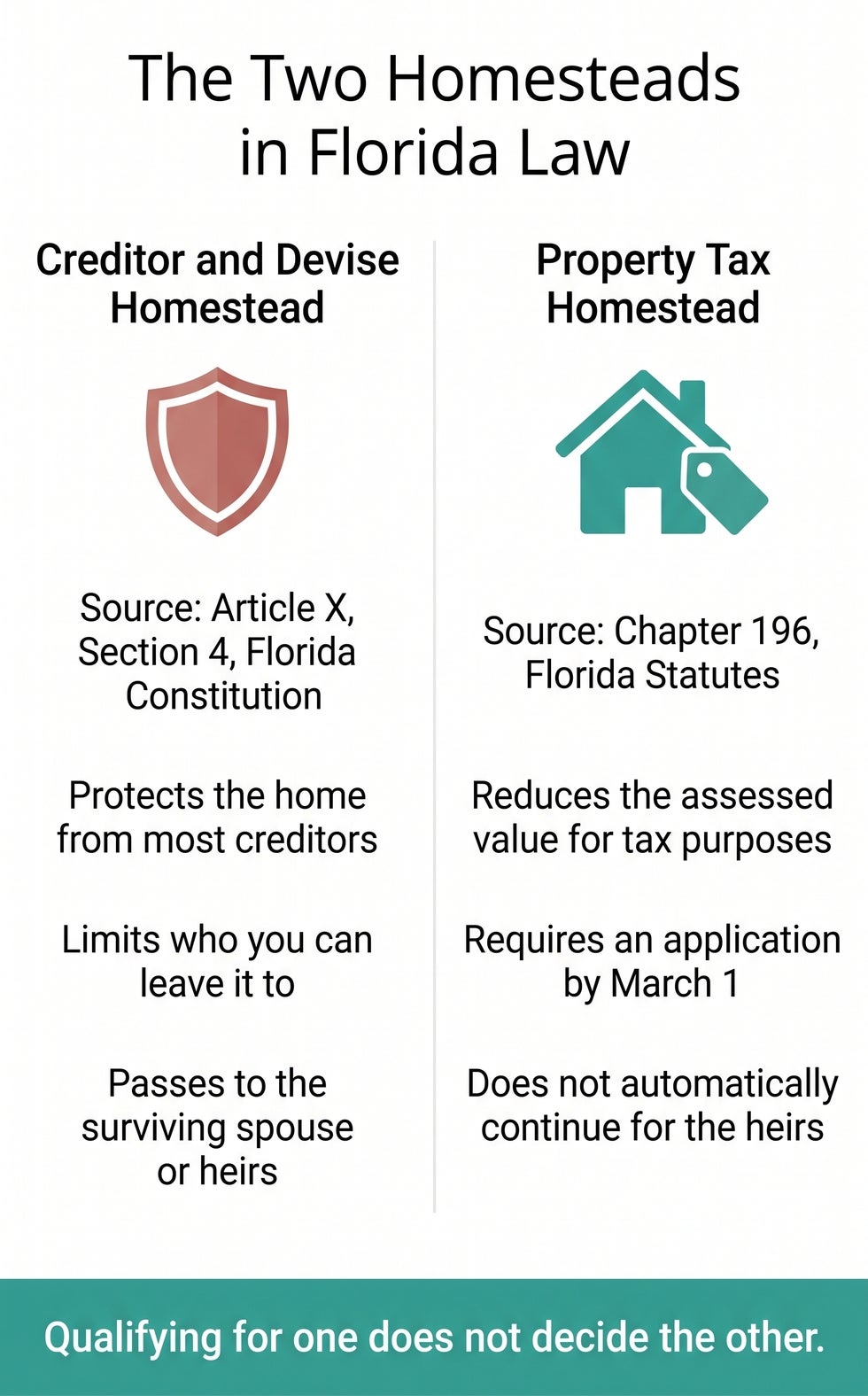
The first is found in Article X, Section 4 of the Florida Constitution. It exempts the home from forced sale by most creditors and restricts who the owner may leave it to. The second lives in Chapter 196 of the Florida Statutes and reduces the property's assessed value for tax purposes. They share a name and almost nothing else. A home can be protected homestead for creditor purposes in a probate case while the property appraiser removes the tax exemption for the following year.
Family structure decides who inherits, not the will
If there is no surviving spouse and no minor child, the owner could leave the home to anyone. If there is either one, the constitution limits the devise, and the probate court will apply the statutory default instead. Family structure at the moment of death is what matters, not what the estate plan intended.
Probate is usually required to transfer title
A home titled in the decedent's sole name almost always needs a court order to clear title, even when everyone agrees who should get it. Title companies and lenders will ask for that order. Property held as tenancy by the entireties, in joint tenancy with rights of survivorship, or through a properly drafted enhanced life estate deed can pass without it.
Surviving spouses and minor children get special protection
These protections exist whether or not the will mentions them, and they cannot be defeated by simply writing a different distribution into the document. A spouse can give them up, but only through a specific kind of written waiver.
Creditor protection is broad but not absolute
Credit card debt, medical bills and most civil judgments cannot force a sale. Mortgages, construction liens for work done on the property, and property taxes are different, because the constitution carves them out by name.
The tax exemption does not automatically continue
This is the single most common misunderstanding we correct. The Save Our Homes assessment cap can carry over in certain family transfers, but the exemption itself is personal to the person who qualified for it.
What Is Florida Homestead Probate and Why Does It Matter?
Florida homestead probate matters because it is the only reliable way to give the next owner marketable title to a home that was in the decedent's sole name. Without a court order, the chain of title has a gap, and that gap surfaces at the worst possible moment: when the family tries to sell or refinance.
For a plain-English overview of the underlying process, the firm's video What Is Probate in Florida? A Plain-English Explanation is a good starting point before the specifics below.
Probate versus non-probate transfers
Probate is the court supervised process for retitling assets that the decedent owned alone with no built in successor. Non-probate transfers happen automatically by contract or by the form of ownership: a payable on death designation on bank accounts, a beneficiary on a retirement plan, survivorship language on a deed. The estate plan you already have determines which category the home falls into. Our guide to assets that transfer outside the probate estate walks through the full list.
Why Florida treats homestead differently
Florida made a policy choice: keep families in their homes. That choice shows up three ways in a probate case. The home is generally beyond the reach of the decedent's unsecured creditors. The owner's power to give it away is limited while a spouse or minor child survives. And the personal representative does not take control of it the way he or she takes control of everything else. Under section 733.607(1), the personal representative takes possession of the decedent's property "except the protected homestead."
That single carve out drives most of what follows.
What Are the Two "Homesteads" in Florida Law?
Florida uses the word homestead for two unrelated protections. One is a constitutional shield that keeps most creditors away from your home and limits who you can leave it to. The other is a property tax break. Qualifying for one does not decide the other.
Because the vocabulary overlaps, families routinely assume that having filed for the tax exemption settles the inheritance question, or that losing the exemption means losing creditor protection. Neither is true, and the two run on separate tracks from the moment of death.
How the constitutional creditor protection works
Article X, Section 4(a) exempts the homestead from forced sale and provides that no judgment or execution is a lien on it, with three carve outs: taxes and assessments on the property, obligations contracted for its purchase, improvement or repair, and obligations for labor performed on the realty. The protection covers up to one half acre inside a municipality, or 160 contiguous acres outside one. For a Cape Coral or Naples homeowner on a standard lot, the acreage limit is rarely the issue.
Section 4(b) is the part that matters at death: the exemptions "shall inure to the surviving spouse or heirs of the owner." The shield does not evaporate when the owner dies. It passes with the property. That is homestead protection at its most practical: the State of Florida keeps the family home beyond the reach of ordinary creditors even after the owner's death.
How the tax exemption works after death
The Florida homestead exemption comes from Chapter 196 of the Florida Statutes. Under section 196.031(1)(a), a person who holds legal or beneficial title on January 1 and in good faith makes the property a permanent residence is entitled to an exemption up to an assessed valuation of $25,000. A second exemption under section 196.031(1)(b) applies to assessed value greater than $50,000, for all levies other than school district levies, and it is adjusted annually for inflation. The Florida Department of Revenue publishes the current figure: for 2026 the maximum additional exemption is $26,411, up from $25,722 in 2025.
Note what the statute requires and what it does not. It requires permanent residence. It says nothing about citizenship. Older articles on this subject often state that an owner must be a United States citizen or permanent resident, and that overstates the statutory test. What the county property appraiser will ask for is documentation of permanent residency, which is a different question.
Florida's homestead exemption is claimed by application to the county property appraiser. In our area that is the Lee County Property Appraiser, the Collier County Property Appraiser, or the Charlotte County Property Appraiser. Under section 196.011(1)(a), the deadline is March 1, and missing it waives the exemption privilege for that year except in narrow circumstances.
The practical point for a family in probate: the decedent's exemption was personal to the decedent. A new owner who moves in generally has to qualify and file. The Save Our Homes assessment limitation is a separate question, addressed below, and the answer there is more favorable.
Does Every Florida Homestead Property Go Through Probate?
No. Florida homestead probate is required only where the title itself leaves a gap, so the answer turns entirely on how the property was titled at the time of death, not on its value and not on whether there is a will. Two homes on the same street can produce completely different answers.
The firm's video Do All Assets Go Through Probate in Florida? covers the general rule; the homestead specifics follow.
Common ownership arrangements: sole ownership, joint tenancy, trusts
A home in the decedent's sole name is the classic probate case. A home held by a married couple as tenancy by the entireties passes to the surviving spouse automatically, and section 731.201(33) expressly excludes entireties and joint tenancy with rights of survivorship property from the definition of protected homestead. A home titled in a revocable trust is discussed later, because the answer there is more nuanced than most people expect.
When probate is needed
Probate is needed whenever nothing in the title itself names a successor. It is not needed where survivorship rights, an enhanced life estate deed, or a properly funded trust already direct the property. If probate is needed, the size of the estate determines the route: under section 735.201, summary administration is available when the estate subject to administration, less property exempt from creditors' claims, does not exceed $150,000, or when the decedent has been dead more than two years. That ceiling doubled effective July 1, 2026, and we wrote about what the new $150,000 summary administration limit means for Lee County families when it passed.
Because protected homestead is subtracted from that calculation, a great many Southwest Florida estates whose main asset is the house qualify for the short form.
What Makes a Home Qualify as Florida Homestead?
A home qualifies as homestead when a natural person owns it and occupies it as a permanent residence, within the constitution's acreage limits. Getting this threshold question right is the starting point of every Florida homestead probate matter. Ownership plus genuine residence is the test. Neither a recorded declaration nor a tax exemption filing is what creates constitutional homestead status.
The legal definition of homestead status
Constitutional homestead attaches to property "owned by a natural person" that serves as the residence of the owner or the owner's family. An entity cannot hold homestead. The status follows use and intent rather than paperwork, which is why homestead determination in a probate case is a factual question the court resolves on evidence.
Qualifying at the time of death
What matters is the situation on the date of death. Was this the decedent's permanent residence? Was it the primary residence in fact on the date of death, and did the decedent treat it as a primary home rather than a seasonal one? For seasonal residents, which is a live issue across Lee, Collier and Charlotte counties, the answer can be genuinely contested, and the evidence a probate court weighs includes voter registration, driver license, vehicle registration, a declaration of domicile, and where the person actually lived.
If the answer is yes, protected homestead status applies and the creditor shield passes to the surviving spouse or heirs by operation of law.
Who Is Legally Entitled to a Florida Homestead When the Owner Dies?
It depends on who survives. If there is no surviving spouse and no minor child, the will controls and the home passes as directed. If there is a surviving spouse or a minor child, the constitution restricts the devise and the statutory default applies instead.
The default rules: spouse, children, no family
Section 732.401(1) supplies the default. If the homestead is not devised as authorized by law and the constitution, it descends in the same manner as other intestate property, except that where the decedent is survived by a spouse and one or more descendants, the surviving spouse takes a life estate with a vested remainder to the descendants living at the time of the decedent's death, per stirpes. Where there is no spouse, intestate descent under section 732.103 sends the property to the decedent's descendants first.
Spousal protections, life estates, and remainder interests
A life estate gives the surviving spouse the right to live in the home for life. The remainder holders own the future interest. Neither side can sell the whole property alone, which is exactly why these arrangements produce friction. Under section 732.401(3), ownership expenses are allocated between the life tenant and the remaindermen under Chapter 738, so the spouse does not automatically bear every cost, and the children do not automatically escape them.
Who inherits the Florida homestead?
| Who survives the owner | Can the home be devised by will? | Who ends up with it by default |
|---|---|---|
|
Spouse only, no descendants |
Yes, to the spouse |
The spouse, outright |
|
Spouse and a minor child |
No, not to anyone |
Life estate to the spouse, vested remainder to the descendants |
|
Spouse and adult children only |
Yes, but only to the spouse |
Life estate to the spouse, vested remainder to the descendants |
|
Minor children, no spouse |
No |
The descendants, per stirpes |
|
No spouse, no minor child |
Yes, to anyone |
As the will directs, or by intestate descent |
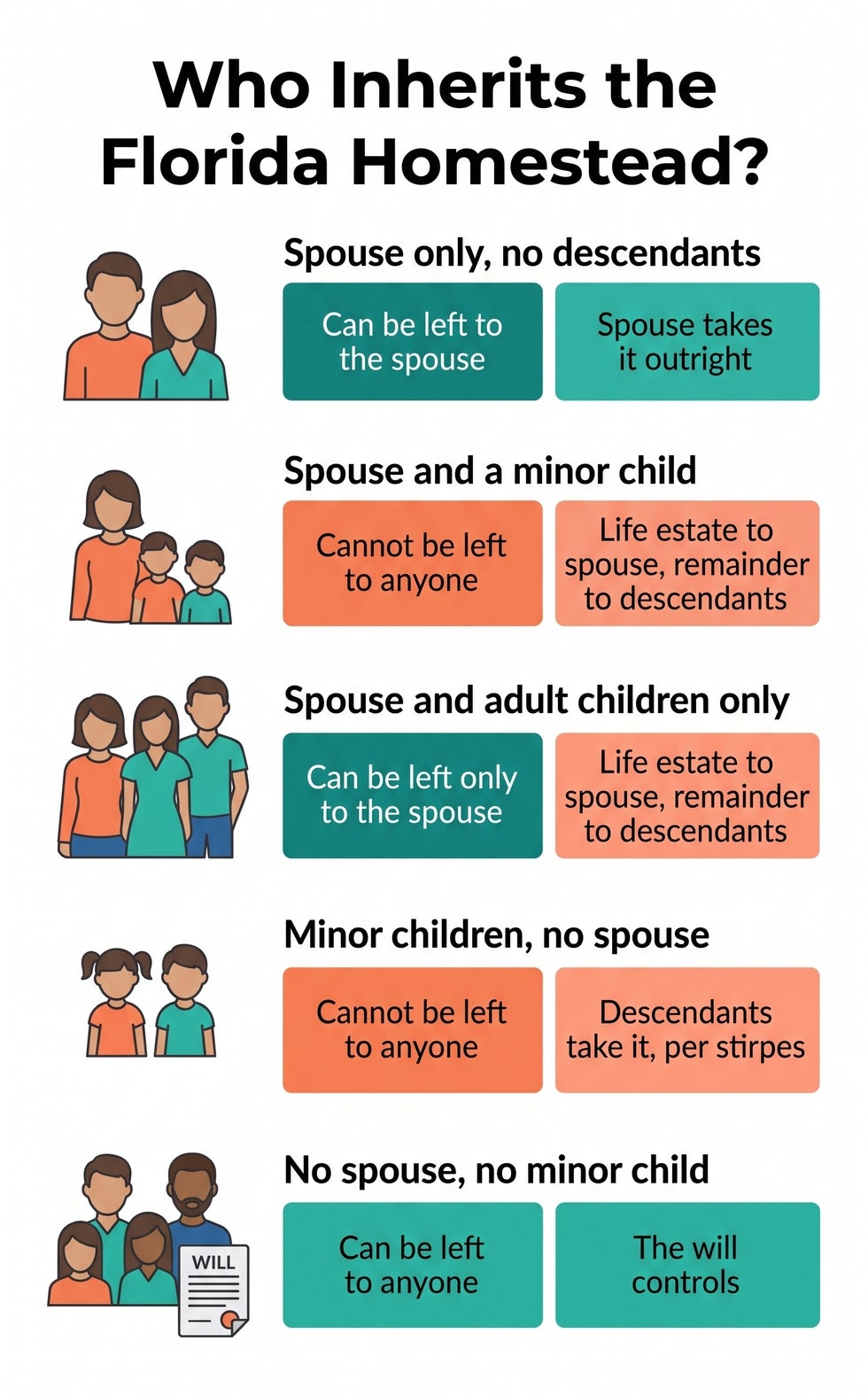
The table answers the ownership question. The next section explains the term the probate court will actually use for the property.
What Is "Protected Homestead" and How Does It Affect Probate?
Protected homestead is a defined term in the Florida Probate Code, and applying that label to the property changes how the entire probate case handles it. Property that is protected homestead sits outside the pool the personal representative gathers to pay claims.
What protected homestead means
Section 731.201(33) defines protected homestead as the property described in Article X, Section 4(a)(1) of the constitution on which, at the death of the owner, the exemption inures to the owner's surviving spouse or heirs under Section 4(b). The same subsection excludes property owned in tenancy by the entireties or in joint tenancy with rights of survivorship. So protected homestead is narrower than "the house." It is the house plus a surviving spouse or heir to whom the protection passes.
How the shield works against creditors
Because section 733.607(1) keeps protected homestead out of the personal representative's hands, and because the constitutional exemption inures to the spouse or heirs, unsecured creditors of the decedent generally cannot reach it. Credit card debt, medical bills and ordinary judgments fall on the other side of that line. The estate's other assets pay those claims, and if there are not enough, the creditors go unpaid rather than reaching the home.
Two cautions. First, the carve outs in Section 4(a) still apply, so a mortgage, a construction lien, or unpaid property taxes can still be enforced against the home. Second, whether homeowner association or condominium assessments fall inside the constitutional phrase "taxes and assessments thereon" is a question Florida courts have addressed through case law rather than by statute, and the answer can turn on the specific declaration. If assessments are in play in your matter, that one needs a lawyer's look at the documents rather than a general rule.
What Are Florida's Devise Restrictions on Homestead Property?
The restriction is blunt: if the owner is survived by a spouse or by a minor child, the homestead may not be devised at all, with one exception. It may be devised to the owner's spouse if there is no minor child. Section 732.4015(1) states the rule, and it tracks Article X, Section 4(c) of the constitution.
When a spouse or minor child survives
A minor child is the harder trigger. With a surviving spouse and no minor child, the owner still has one lawful option: leave the home to the spouse. Add a minor child, and that option closes too. Under section 731.201(25), a minor is a person under 18 whose disabilities have not been removed by marriage or otherwise, so a child who turns 18 before the parent dies is no longer a constraint.
Section 732.4015(2) closes a gap people try to walk through. For this rule, "owner" includes the grantor of a revocable trust, and "devise" includes a disposition by trust. Putting the house into a living trust does not escape the restriction.
What happens if a devise violates Florida law?
Nothing dramatic happens to the will itself. The invalid devise of the homestead simply fails, and the property passes under the statutory default in section 732.401 instead. The rest of the will still operates normally. This is why a plan drafted in another state, or drafted before a second marriage, can produce a result the family never intended without anyone noticing until the owner has died.
What Happens If There's an Invalid Devise of Florida Homestead?
The property descends under section 732.401. Where the decedent left a spouse and one or more descendants, that means a life estate in the spouse and a vested remainder in the descendants living at the time of the decedent's death, per stirpes. Where there is no spouse, it descends as other intestate property would.
Default result: spouse's life estate and descendants' remainder
In practice this splits the home between two sets of people with different interests and different time horizons. The spouse can live there indefinitely. The children own what is left afterward and cannot force a sale during the spouse's lifetime. Neither party can deliver clear title alone, so a sale requires everyone to sign, and where the parties disagree that becomes a long stalemate.
Effects on distribution and property rights
The life tenant is responsible for the ordinary carrying costs of the home while the remaindermen hold the future interest, allocated under Chapter 738 as section 732.401(3) directs. Section 732.401(4) adds that if the spouse disclaims the life estate, the descendants' interests are not divested. And section 732.401(5) confirms the whole section does not apply to entireties or survivorship property, which is why how the deed reads matters so much.
If the default outcome is not what the family wants, Florida gives the surviving spouse one alternative, and it comes with a hard deadline.
Can a Surviving Spouse Elect Half the Homestead Instead of a Life Estate?
Yes. Under section 732.401(2), the surviving spouse may elect to take an undivided one half interest in the homestead as a tenant in common instead of the life estate, with the other undivided half vesting in the decedent's descendants living at the time of death, per stirpes. It is a real choice with real consequences, and it expires.
The 50% election option
The trade is straightforward. A life estate gives the spouse the right to occupy the home for life but no ownership to sell or leave to anyone. A one half tenancy in common gives the spouse a present, transferable ownership interest that can be sold or passed on, but no exclusive right to live there. Which is better depends on the spouse's age, health, finances and relationship with the remaindermen. This is one of the few places in probate where the choice genuinely belongs to the surviving spouse.
Section 732.401(2)(a) also lets an attorney in fact or a guardian of the property make the election with court approval, and the court must first determine that the election is in the spouse's best interests during the spouse's probable lifetime.
The deadline and the process
The election must be made within 6 months after the decedent's death and during the surviving spouse's lifetime, and section 732.401(2)(b) says the time may not be extended except in the narrow situation where an attorney in fact or guardian has timely petitioned for approval. Once made, the election is irrevocable.
The mechanics matter too. Under section 732.401(2)(e), the election is made by filing a notice of election containing the legal description of the property for recording in the official record books of the county where the homestead sits. The statute supplies the form. Missing the six month window is not a technicality that gets forgiven; the spouse simply keeps the life estate.
How Can Homestead Rights Be Waived or Modified?
A spouse can waive homestead rights, but only in writing and only in one of two specific ways. There is no such thing as an informal or verbal waiver, and a spouse who merely knows about the plan and does not object has not waived anything.
Waiving rights by prenuptial or postnuptial agreement
Section 732.702(1) allows a surviving spouse's rights to homestead, along with elective share, intestate share and exempt property, to be waived wholly or partly, before or after marriage, by a written contract, agreement or waiver signed by the waiving party in the presence of two subscribing witnesses. A waiver of "all rights" in the other spouse's property counts as a waiver of homestead.
Timing changes the disclosure requirement. Under section 732.702(2), each spouse must make fair disclosure of his or her estate if the agreement is signed after the marriage. No disclosure is required for an agreement signed before marriage. Section 732.702(3) adds that no consideration beyond signing is needed.
Waiver through deeds or other conveyance
Section 732.7025 provides a second route, and it is narrower than most people assume. Including specific statutory language in a deed waives the spouse's rights as to the devise restrictions under Article X, Section 4(c). That is all it does. Section 732.7025(2) says expressly that the language does not waive the creditor protection during the owner's lifetime or after death, and does not waive the requirement that the spouse join in any mortgage, sale, gift or deed.
That distinction gets missed constantly. A deed waiver frees the owner to leave the home to someone other than the spouse. It does not free the owner to sell it without the spouse's signature.
What Role Does a Spouse Play in Selling or Mortgaging a Homestead During Life?
The spouse has to join. Article X, Section 4(c) provides that the owner of homestead real estate, "joined by the spouse if married," may alienate the homestead by mortgage, sale or gift. This applies even when the spouse's name is nowhere on the deed and the owner acquired the property before the marriage.
Spousal joinder in a deed or mortgage
Florida homeowners who moved here from states with no comparable rule are often surprised. If the property is homestead and the owner is married, the spouse signs. Title companies and closing agents in Lee, Collier and Charlotte counties will require it, which is usually how the issue surfaces.
Consequences if spouse is omitted
A conveyance or mortgage of homestead without the required spousal joinder is generally ineffective, which means the problem does not stay buried. It reappears at the next sale, when a title examiner finds the defect and the closing stops. Fixing it afterward ranges from a corrective deed to litigation, and the cure costs far more than getting it right the first time.
How Is Homestead Status Determined in a Florida Probate?
By court order, on a petition. This is the procedural heart of Florida homestead probate. Any interested person may ask the probate court to determine the protected homestead status of real property, and the court's order describes the property and determines whether it was the decedent's protected homestead. Florida Probate Rule 5.405, "Proceedings to Determine Protected Homestead Status of Real Property," governs the procedure.
The petition to determine homestead status
The petition is filed in the probate case. It identifies the property, the decedent's marital and family situation at death, and the persons claiming an interest, and it asks the court to make the homestead determination. Where a spouse has waived homestead rights, the current version of the rule asks the petition to say how. A personal representative frequently files it, but the rule is not limited to the personal representative; a beneficiary or heir can bring it too.
Summary administration versus formal administration routes
In a summary administration the homestead determination is usually resolved alongside the order of summary administration, which suits estates whose principal asset is the house. In a formal administration the probate proceeding runs longer and the homestead question is litigated separately if contested, which is the right venue when the facts are genuinely in dispute: whether the property really was a permanent residence, whether a creditor's claim falls inside a constitutional exception, or whether the heirs disagree among themselves. The firm's video What Is Summary Administration? Florida's Short-Form Probate explains the short form route in more detail, and our honest timeline for Florida probate sets expectations for the longer one.
Recording the order determining homestead status
The order is recorded in the official records of the county where the property sits, and that recorded order is what clears the chain of title. From a buyer's or lender's point of view, it is what makes the property saleable, so families who intend to sell should treat recording as part of the job. Our guide to selling a house during probate covers what comes next.
How Do Revocable Trusts and Lady Bird Deeds Affect Homestead Probate?
Both can keep the home out of probate court, and neither overrides the devise restrictions. That is the sentence to remember, because it is where most online advice goes wrong.
Placing the home in a revocable living trust
A funded revocable trust avoids probate administration of the home, because the trustee already holds title. What it does not do is expand the owner's power to give the property away. Section 732.4015(2) treats the grantor of the trust as the owner and a trust disposition as a devise, so a surviving spouse or minor child restricts the trust exactly as it would restrict a will.
Whether transferring homestead into a revocable trust affects the constitutional creditor protection is a separate and more contested question, and it rests on Florida case law rather than a statute that answers it cleanly. We are not going to give you a confident one line rule on that here, because there is not one. Anyone planning around creditor exposure should get advice on the specific facts. The firm's video What Is a Revocable Living Trust in Florida? covers the mechanics, and our overview of the types of trusts used in estate planning explains where each one fits.
Lady Bird deeds and their limitations
An enhanced life estate deed, known in practice as a Lady Bird deed, reserves a life estate to the owner along with the power to sell, mortgage or revoke without the remainder holder's consent. On death the property passes to the named remainder beneficiary outside probate. It is a common and useful tool in Southwest Florida.
The limitations are real. The devise restrictions still apply, so a Lady Bird deed naming someone other than a spouse does not solve the problem when a spouse or minor child survives. Spousal joinder is still required if the owner is married. And the deed has to be drafted correctly to preserve both the homestead tax exemption and the Save Our Homes treatment. For a broader look at the alternatives, see our guide on how to avoid probate in Florida.
The tax exemption and Save Our Homes
This is the piece the older articles get wrong, so it is worth stating precisely. The exemption itself does not ride along with the property. A new owner has to qualify and apply. The Save Our Homes assessment limitation is more generous: section 193.155(1) caps the annual increase in assessed value at the lower of 3 percent or the change in the Consumer Price Index, and section 193.155(3)(a)3. provides that a transfer occurring by operation of law to the surviving spouse or minor children under section 732.401 is not a change of ownership. So the capped assessment can survive precisely the transfer this article is about.
Portability is a further benefit. Under section 193.155(8), a person who held a homestead exemption in any of the three immediately preceding years and establishes a new Florida homestead may transfer the accumulated assessment difference, capped at $500,000. The Department of Revenue's property tax exemptions and benefits page and its additional homestead exemption adjustment table are the official sources for the current figures, and the tax savings over time can be substantial.
How The Nussbickel Law Firm Handles Florida Homestead Probate
We are an estate planning and probate law firm in Fort Myers, and homestead questions come through the door constantly, from both directions. Sometimes it is a family that just lost a parent and needs to know who owns the house. Sometimes it is a homeowner in a second marriage who wants to be sure the plan they have will actually do what they think it does.
Gregory J. Nussbickel has practiced trust, estate and probate law for the better part of two decades, is a member of The Florida Bar, graduated cum laude from Florida State University College of Law, and holds an LL.M. from the University of Miami. He handles matters personally.
We serve estate planning clients throughout Lee, Collier and Charlotte counties, including Fort Myers, Cape Coral, Estero, Bonita Springs, Sanibel, Punta Gorda and Naples, and we handle probate matters state-wide. Probate filings for our local clients go to the Twentieth Judicial Circuit, which serves Charlotte, Collier, Glades, Hendry and Lee counties. Virtual appointments are available anywhere in the Sunshine State.
If the family home is the main asset and you are not sure what happens to it, that is the ordinary case, not a complicated one. Schedule a free consultation or call our Fort Myers office at 239-900-WILL (9455), and we will tell you plainly whether probate is needed and which route fits.
Conclusion
Florida homestead probate rewards getting the facts straight early. Who survived the owner, how the deed was titled, and whether the home really was a permanent residence will determine the outcome far more than the language in the will. The two homesteads run on separate tracks, the devise restrictions apply whether or not anyone knew about them, and the surviving spouse's election closes six months after the date of death.
For families settling an estate, the practical next steps are short: pull the deed, confirm how title was held, identify who survived the owner, and calendar the election deadline if a spouse survives. For homeowners still planning, the question worth asking is whether your current documents can legally do what you are asking them to do under Florida homestead law. That is a straightforward thing for a lawyer to check and an expensive thing for a family to discover later.
Frequently Asked Questions
Can Florida homestead property be sold while probate is pending?
Often yes, but everyone with an interest has to join in the deed. If a surviving spouse holds a life estate and the descendants hold the remainder, all of them sign. Most title companies will also want a recorded order determining protected homestead status before closing, so it is usually faster to obtain that order first rather than to negotiate around its absence at the closing table.
What documents are needed to prove homestead status in Florida probate?
The court looks for evidence that the property was the decedent's permanent residence at the time of death. Useful items include the recorded deed, the property appraiser's record showing the homestead exemption, a Florida driver license or identification card, voter registration, vehicle registration, a declaration of domicile, utility bills at the address, and the decedent's last income tax return. No single document decides it; the court weighs the picture as a whole.
How long does the homestead probate process usually take in Florida?
A summary administration that includes a homestead determination often concludes in a few months when the family agrees and the paperwork is clean. A formal administration takes considerably longer, commonly a year or more, and a contested homestead determination can extend it further. The variable that matters most is not the size of the estate; it is whether anyone disagrees.
Does a will override Florida homestead law?
No. If the owner is survived by a spouse or a minor child, the constitutional devise restriction applies and an inconsistent devise of the homestead simply fails. The rest of the will still operates. This is the single most common surprise in Florida homestead probate, and it catches people who moved here with an out-of-state estate plan that was perfectly valid where it was written.
Do creditors get paid from the homestead first?
Generally no. Protected homestead is not an asset the personal representative gathers to satisfy creditor claims, so unsecured debts like credit card balances and medical bills are paid from other estate assets or go unpaid. Secured obligations are different: a mortgage, a construction lien, or delinquent property taxes stay attached to the property and follow it to the new owner.
What if there is no will, spouse, or children?
The homestead descends as other intestate property does under section 732.103, which sends the property to the decedent's descendants first, then to parents, then to siblings and their descendants, and outward from there. The constitutional creditor protection can still inure to the heirs. Our guide to the Florida probate process without a will explains the order of priority in more detail, and if you are weighing whether to put a plan in place at all, our breakdown of what a will and trust cost in Florida is a reasonable next read.
Gregory J. Nussbickel is the attorney at The Nussbickel Law Firm, P.A. in Fort Myers, Florida, practicing trust, estate and probate law.
This article provides general information about Florida homestead law and is not legal advice. Every estate is different, and the outcome in your matter depends on facts this article cannot know. For guidance on your specific situation, please consult a Florida attorney.

Comments
There are no comments for this post. Be the first and Add your Comment below.
Leave a Comment