

Key Highlights
- The way to avoid probate in Florida is to give every asset you own a legal destination at your death: a trust, a survivorship title, a recorded deed, or a named beneficiary.
- A will keeps nothing out of court. It tells the judge who inherits, which means it has to be filed and admitted first.
- The summary administration ceiling rose from $75,000 to $150,000 on July 1, 2026, so more modest estates now qualify for the short-form court process.
- Joint ownership is the most misunderstood shortcut here. Adding a co-owner creates a tenancy in common with no survivorship rights unless the deed says otherwise expressly.
- The usual failure is not picking the wrong tool. It is signing a trust document and never retitling anything into it.
Introduction
The short answer: how to avoid probate in Florida comes down to one rule. Any asset that already knows where to go at your death skips court entirely. Anything held in your sole name, with no beneficiary and no survivorship language, does not.
Clients phrase it a dozen ways. How do I avoid probate in Florida if the house is the only real asset. How do you avoid probate in Florida when the children live out of state. The rule is the same either way, and the same for Florida residents and for snowbirds who own property here.
It explains most of what families get wrong. We meet people in Fort Myers and Naples who paid for good estate planning, then find the Gulf-access house or an old savings account was never brought into the plan. The documents were fine. The titling was not.
How does Probate Work in Florida?
Probate is the court-supervised legal process for collecting a deceased person's assets, paying valid debts, and transferring the remainder to whoever is entitled to it. Florida law puts it in Chapters 731 through 735, filed in the circuit court of the county where the person lived.
The probate process runs in a fixed order. Someone petitions the court and, if a will exists, deposits it with the clerk. The custodian of a will must do that within 10 days of learning of the death, under section 732.901. A judge then appoints a personal representative, who inventories the deceased person's assets, publishes notice to creditors, resolves claims, and finally distributes what is left.
There is a long form and a short form. Formal probate is the full version. Summary administration is the abbreviated one, available under section 735.201 when the value of the estate subject to administration, less property exempt from creditors, sits under the statutory ceiling, or when the person has been gone more than two years. That ceiling doubled to $150,000 on July 1, 2026 under Chapter 2026-57, Laws of Florida. The published statute text still shows the old $75,000 figure, which is worth knowing if you look it up yourself.
Seeing what the court actually does makes it easier to understand why families work so hard to stay out of it.
Why Probate Can Be Expensive and Time-Consuming?
The burden of probate is mostly time and disclosure rather than any single large bill. Even a simple estate stays open for months, because the creditor claim period has to run before anything is distributed. Section 733.702 gives creditors the later of three months from first publication of the notice, or 30 days from service on a creditor entitled to be served.
The costs break down four ways:
- Attorney fees. The presumed reasonable fee under section 733.6171 starts at $1,500 for estates of $40,000 or less, adds $750 up to $70,000 and another $750 up to $100,000, then runs 3 percent on the next $900,000. The statute is explicit that this is not mandatory and is negotiable.
- Court fees. Filing fees, certified copies, and publication of the notice, all payable through the clerk. The Lee County Clerk of Court publishes current figures for Southwest Florida.
- Unnecessary delays in the distribution of assets. Beneficiaries wait out the claim period even when nobody is owed anything.
- A public process. Filings in probate court are public record, so anyone can look up who inherited and who serves as personal representative.
None of that is improper. It is the price of court involvement, and it is avoidable for most of what a family owns. For the timeline in detail, see how long a Florida estate actually takes.
Which Assets Usually Go Through Probate in Florida?
Court administration reaches only what has no other instruction. If an asset sat in the sole name of the deceased person with no automatic transfer built in, a judge has to move it. The Florida Bar's consumer pamphlet on probate draws the same line.
- Assets without automatic transfer instructions, such as a bank account, vehicle, or boat titled in one name.
- Property not protected by probate avoidance tools, including real estate held individually or with someone else as tenants in common, which is the default form of co-ownership here.
- Accounts missing valid beneficiary designations. Investment accounts and retirement plans where the form was never completed, or where the named beneficiary died first and no contingent was listed.
- Individually controlled estate assets: personal property of real value, from jewelry to a collection, that no document ever addressed.
Not one of these is exotic. They are ordinary holdings that never got a destination.
Which Assets Typically Avoid Probate?
The mirror image is a short list. These are the assets that avoid probate in Florida because ownership transfers automatically by contract, by deed, or under a trust, with no court process at all.
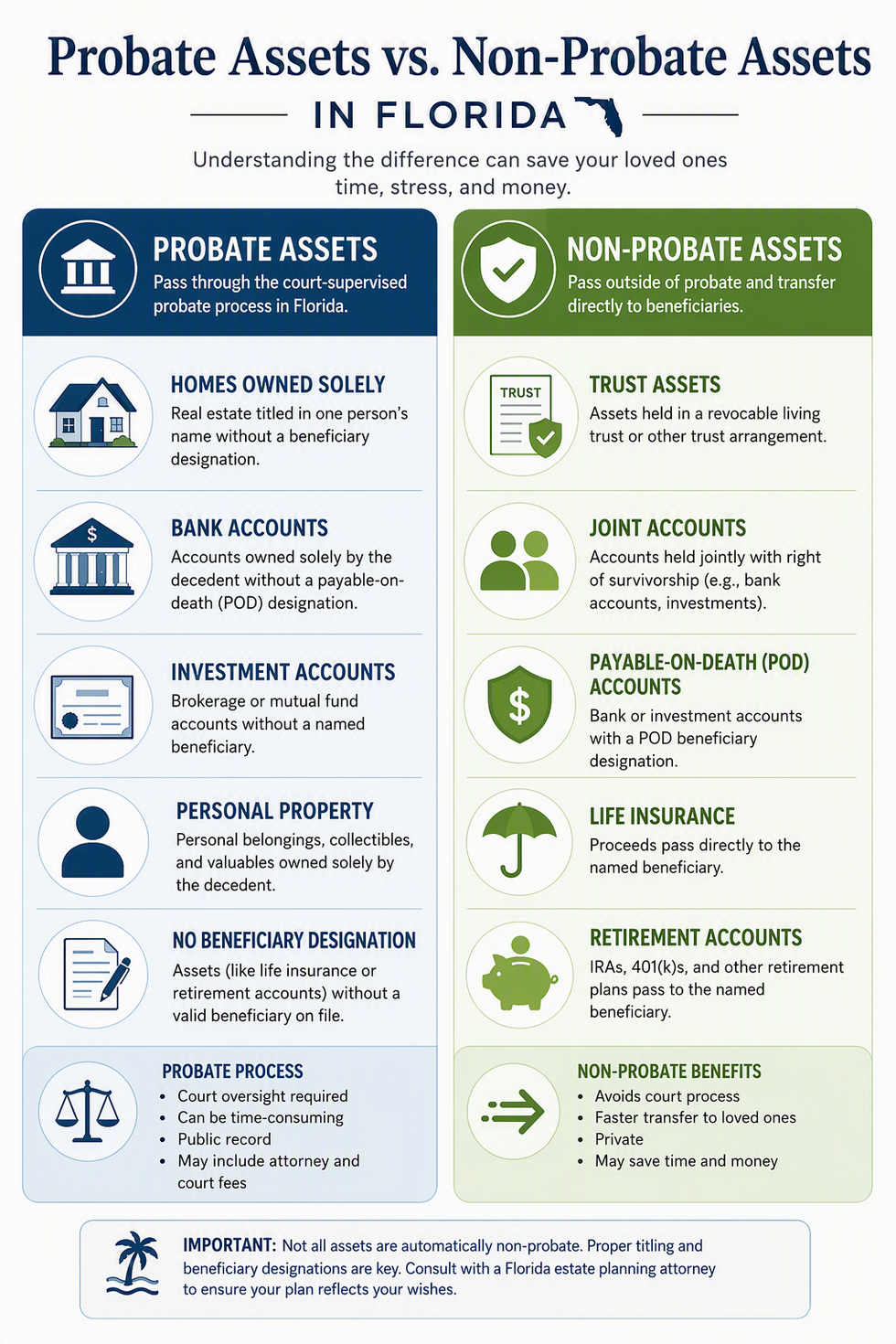
- Trust assets. Anything properly titled in a revocable trust passes under the trust document to the successor trustee.
- Jointly owned property carrying survivorship, including property a married couple holds as tenancy by the entireties, which vests in the surviving spouse automatically.
- POD and TOD accounts: bank and brokerage accounts registered payable on death or transfer on death.
- Retirement accounts with living beneficiaries. IRAs, 401(k)s, and annuities naming someone other than the estate.
- Life insurance proceeds. Insurance policies paid to a named beneficiary rather than to the estate.
For a plain-English walkthrough of that dividing line, the firm's video Do All Assets Go Through Probate in Florida? covers it in a few minutes.
What Are the Best Ways to Avoid Probate in Florida?
Six tools do the real work of how to avoid probate in Florida, and most families use three or four together rather than picking one. The right mix depends on what you own and how much control you want to keep while you are alive.
Revocable Living Trusts
A revocable living trust is the most complete answer, because it can hold nearly anything: the house, financial accounts, a business interest, personal property. You serve as your own trustee while able, and a successor trustee steps in at your death or incapacity and distributes assets under the trust document without court involvement. Section 736.0402 of the Florida Trust Code sets out what a valid trust requires. Our comparison of revocable and irrevocable trusts covers which one fits.
Lady Bird Deeds
A Lady Bird deed, formally an enhanced life estate deed, lets you keep full ownership and control of real estate during your lifetime, including the right to sell, mortgage, or revoke, while naming who receives it at your death. No statute creates this deed by name. It is a creature of common law and title practice, which is why the drafting matters. Section 732.4017 governs when a lifetime transfer of homestead counts as a devise, and homestead carries constitutional restrictions on top.
Payable on Death (POD) Bank Accounts
A POD designation costs nothing and takes ten minutes at the branch. Under section 655.82, the beneficiary has no rights while you are alive, and at your death the funds belong to whoever survives you. One caution sits in the same statute: if no named beneficiary survives, the money reverts to the estate of the last surviving party and lands back in court.
Transfer on Death (TOD) Brokerage Accounts
TOD applies the same idea to securities. The Uniform Transfer-on-Death Security Registration Act makes the transfer nontestamentary, meaning it happens outside the will entirely, under section 711.509. That statute also preserves creditors' rights against what the beneficiary receives, so a TOD registration moves the asset without erasing the debt.
Joint Ownership with Rights of Survivorship
Adding a joint owner is the shortcut most people reach for, and the one most likely to backfire. Section 689.15 abolished automatic survivorship in joint tenancy: a conveyance to two or more people creates a tenancy in common unless the instrument expressly provides for the right of survivorship. Joint tenants take as a surviving owner only when the document says so, the one exception being tenancy by the entireties between spouses.
Direct Beneficiary Designations on Insurance and Retirement
Life insurance policies, IRAs, annuities, and employer plans pass by contract to the named beneficiary. This is the cheapest probate avoidance in existence and the most often neglected. Kiplinger's rundown on keeping an estate out of court makes the same point about POD and TOD forms sitting half-finished for years.
Probate Avoidance Methods Compared
No single method wins on every dimension, so comparing them on cost, complexity, and privacy is what usually helps a family decide where to start.
| Method | Avoids Probate | Best For | Cost | Complexity | Privacy |
|---|---|---|---|---|---|
|
Revocable living trust |
Yes, for funded assets |
Real estate plus accounts, blended families, out-of-state property |
Highest upfront |
High |
Private |
|
Lady Bird deed |
Yes, for that parcel |
One homestead going to simple beneficiaries |
Low |
Moderate |
Recorded, so public |
|
POD bank account |
Yes |
Checking and savings |
None |
Very low |
Private |
|
TOD brokerage account |
Yes |
Investment accounts |
None |
Very low |
Private |
|
Joint ownership with survivorship |
Yes, if expressly stated |
Married couples holding as entireties |
None |
Low but risky |
Private |
|
Beneficiary designation |
Yes |
Retirement and insurance policies |
None |
Very low |
Private |
On control, the trust and the Lady Bird deed win. Both let you change your mind, sell, or revoke at any point, and neither hands a present ownership interest to anyone during your lifetime. Joint ownership does the opposite: it gives away real rights today, exposing the asset to a co-owner's divorce, creditors, or judgment.
For real estate the choice narrows to those same two. A Lady Bird deed is cheaper and faster with one parcel and a clean set of beneficiaries. A trust is better with multiple properties, a blended family, minor beneficiaries, or land in another state that would otherwise trigger a second administration there. Homestead complicates both, and our article on Florida homestead probate explains why.
For larger estates the trust usually wins, though not for the reason people expect. There is no state estate tax here, so the driver is administration rather than tax. A trust consolidates ownership of assets under one instrument, keeps the distribution of assets private, and gives a successor trustee immediate authority. Federal thresholds still apply, and the IRS estate tax guidance has current numbers. We cover the state side in our overview of estate and death taxes.
What Are the Common Mistakes That Still Trigger Probate in Florida?
Most estates that end up in court belong to people who did plan. The plan had a gap, and the gap is almost always in the titling rather than the drafting.
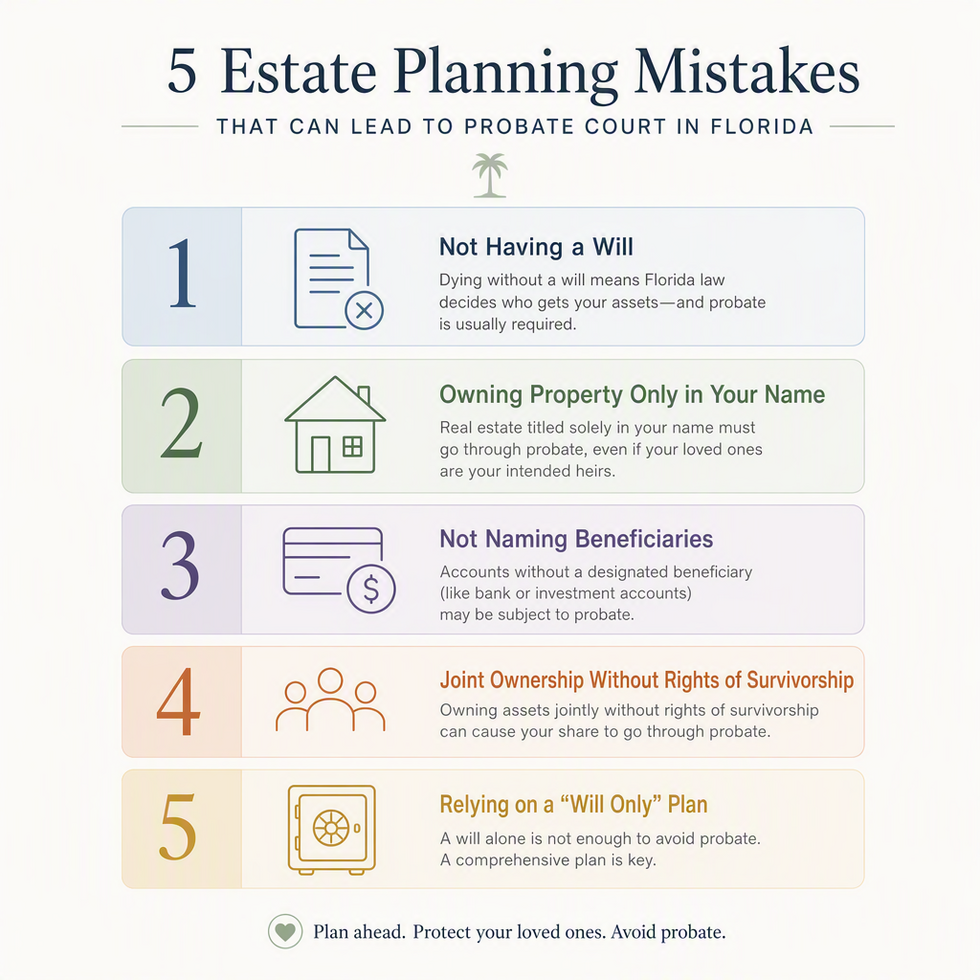
- Assuming a will avoids court. It does not. A will is an instruction to the judge, so using one guarantees the case gets filed rather than preventing it.
- Forgetting to fund a living trust. An unfunded trust is an empty box. If the deed was never recorded into it and the accounts were never retitled, the trust controls nothing.
- Leaving assets titled in one person's name. A forgotten credit union account or a second vehicle is enough to require a court filing on its own.
- Failing to update beneficiary designations. An ex-spouse on a 401(k) from two jobs ago will generally still collect, and a predeceased beneficiary with no contingent sends the account to the estate.
- Relying too heavily on joint ownership. Beyond the survivorship trap in section 689.15, adding an adult child to a deed exposes the property to that child's creditors and can create a taxable gift.
Funding is the one worth dwelling on, and the firm's video What Is Trust Funding? Why an Unfunded Trust Does Nothing is the fastest explanation of why.
Does a Will Avoid Probate in Florida?
No. A will does not avoid probate in Florida. A will is the instruction sheet the court follows, so it has to be filed and admitted before anything moves. Assets titled in your sole name still pass through court administration. See also: Does a Will Avoid Probate in Florida?
What a will does is control the outcome. Without one, intestacy rules decide who inherits, and the result may not match your current wishes at all. A will also names the personal representative and, critically, guardians for minor children, which no trust or beneficiary form can do. That is why a trust-based plan still includes a pour-over will as a backstop.
The firm's video Does a Will Avoid Probate in Florida? No, Here's Why walks through the distinction. If you are weighing the two instruments, see my earlier article, Living Will vs Living Trust Florida: Do You Need Both?. Where the two documents disagree, our piece on whether a will overrides a trust sorts out which controls.
When Probate May Still Be Necessary in Florida?
Sometimes court supervision is the right answer, and a good plan accounts for that instead of pretending otherwise. Families often ask how to avoid probate after death in Florida, once someone has already passed. The options narrow sharply at that point, which is why the planning has to happen first.
- Estates with creditor disputes or legal claims. The court process cuts off creditor claims on a fixed schedule, while assets passing outside court through a revocable trust face a longer two-year exposure.
- Complex family or beneficiary disputes. When family members disagree about a will's validity or a fiduciary's conduct, only a judge can resolve it.
- Ancillary probate for out-of-state property. Real estate in another state generally requires an administration there, whatever happens here.
- Situations requiring formal court supervision, such as minor beneficiaries, an incapacitated heir, or a personal representative who needs the protection of court approval.
Where the estate is modest and undisputed, the short form is often enough. See my earlier article on Florida Doubles the Summary Administration Limit to $150,000, and the firm's video What Is Summary Administration? Florida's Short-Form Probate for how it runs in practice. Where claims are contested, our guide to estate debts and creditor claims covers the mechanics.
Build a Florida Estate Plan Designed to Minimize Probate
At The Nussbickel Law Firm, P.A. in Fort Myers, we build comprehensive estate plans for families across Lee, Collier, and Charlotte counties, and for out-of-state families who own property here. Our practice is devoted exclusively to estate planning, probate, and trust administration, so this dividing line is the work rather than a sideline.
A plan that actually keeps assets out of court has two halves. The first is drafting: the trust, the pour-over will, the durable power of attorney, the health care documents. The second is funding, and it is the half that gets skipped. We prepare and record the deeds, hand you the letters your bank and custodian need, and confirm the retitling happened before we close the file.
We also review plans built elsewhere. If you hold a trust document from another state or from a decade ago, the useful question is not whether it is well drafted but whether anything is actually in it. Schedule a consultation or call our Fort Myers office, and ask what the first meeting costs, since some firms offer a free consultation and others do not.
Conclusion
All of how to avoid probate in Florida comes down to finishing the job on every asset you own. A revocable trust, a Lady Bird deed on the homestead, POD and TOD registrations on financial accounts, and current beneficiary designations will handle the overwhelming majority of what a family holds. The question left is always the same: is anything still sitting in your sole name?
Careful planning here is cheap relative to what it prevents. Review titling and beneficiary forms whenever life circumstances change, and every few years regardless. If you would rather have someone check the work, that is what an estate planning or probate attorney is for.
FAQs
What is the best way to avoid probate in Florida?
A funded revocable trust plus beneficiary designations on retirement and insurance policies. The trust handles real estate and accounts, the designations catch what passes by contract. When people ask how do you avoid probate in Florida with only one house, a Lady Bird deed is often enough on its own.
Can probate be avoided completely in Florida?
Clients ask this two ways: can I avoid probate in Florida, and can you avoid probate in Florida completely. Usually yes to both. If every asset is in a trust, held with express survivorship rights, covered by a recorded deed, or payable to a living beneficiary, nothing is left for a court to transfer.
Is a living trust the most effective probate-avoidance tool?
It is the most complete, because it reaches assets no other tool does and it handles incapacity as well as death. But does a trust avoid probate in Florida on its own? Only if funded. An unfunded trust accomplishes nothing, which is why a simple plan fully executed beats a sophisticated one that is not.
How does a Lady Bird deed help avoid probate?
An enhanced life estate deed transfers the remainder interest in your real estate at death automatically, while you keep the right to sell, mortgage, or revoke during your lifetime. Because the transfer happens by operation of the recorded deed, no court filing is needed for that parcel.
What happens if I forget to transfer assets into my trust?
They stay in your individual name and pass through court, which is exactly what the trust was meant to prevent. The pour-over will catches them and directs them into the trust, but only after a filing. This is the most common reason a well-drafted plan fails.
Are probate-avoidance strategies worth the cost?
Usually, and the comparison is not close for anyone who owns real estate here. Several of these tools, including POD and TOD registrations and beneficiary forms, cost nothing at all. A trust-based plan costs more upfront than a simple will, and less than the presumed fee schedule and delay of administering the same estate in court.
How often should I review my probate-avoidance plan?
Every three to five years, and immediately after a marriage, divorce, death, birth, move in or out of state, or significant purchase or sale. Beneficiary forms drift furthest from current wishes, because nobody thinks about them once the account is open.
Can probate-avoidance planning help prevent family disputes?
Often. Clear designations and a funded trust leave far less to argue about than an estate that arrives in court with ambiguity in it. Planning cannot stop a determined challenge, but it removes the procedural openings most disputes rely on, and it keeps the distribution of assets out of the public record.
Gregory J. Nussbickel is the founder of The Nussbickel Law Firm, P.A. in Fort Myers, Florida. His practice is devoted exclusively to estate planning, probate, and trust administration for families throughout Southwest Florida.
This article is for general information only and is not legal advice. Reading it does not create an attorney-client relationship. Probate law changes, and every estate is different, so speak with a licensed Florida attorney about your specific situation.

Comments
There are no comments for this post. Be the first and Add your Comment below.
Leave a Comment