

Key Highlights
- In the revocable vs irrevocable trust Florida decision, the revocable trust is the right default for most families; the irrevocable trust is a deliberate trade of control for one specific benefit.
- Under Section 736.0602, Florida Statutes, a trust is revocable unless the document expressly says it is irrevocable.
- The parts of a Florida revocable trust that give property away at death must be signed with will formalities, two witnesses, or those parts fail (Section 736.0403(2)(b)).
- A revocable trust gives you no protection from your own creditors while you are alive (Section 736.0505(1)(a)), and its assets remain answerable for your debts after death.
- Both trusts avoid probate only for assets actually retitled into them; the 2026 federal estate tax exemption of $15,000,000 per person means tax is rarely the reason to go irrevocable.
Introduction
The short answer: for most Florida families, the revocable trust is the right choice in the revocable vs irrevocable trust Florida comparison, and the irrevocable trust is a deliberate trade of control for a specific benefit that has to be worth the loss. A revocable trust avoids probate, plans for incapacity, and keeps your affairs private while you keep full control. An irrevocable one can take assets out of your taxable estate, hold life insurance, protect a beneficiary from that beneficiary's creditors, or start the clock for long-term care planning, but only because you have given the assets up for good.
I have practiced estate planning, probate, and trust administration in Fort Myers for twenty years, and the question I hear most from families in Lee, Collier, and Charlotte counties is not "what is a trust" but "which one." This guide answers it with the Florida Trust Code (Chapter 736, Florida Statutes) in hand, because the difference between revocable and irrevocable trust in Florida is statutory, and several of the statutes surprise people.
What Does the Revocable vs Irrevocable Trust Florida Decision Come Down To?
It comes down to control. If you want to keep the power to change your mind, sell the assets, and pull them back into your own name, you want a revocable trust. If you want a legal result that only comes from no longer owning the assets, you are describing an irrevocable one, and the price is that the choice is meant to be permanent.
Five facts frame the decision for Southwest Florida families. First, most families default to a revocable living trust because their goal is probate avoidance and a smooth handoff during incapacity, not tax planning. Second, an irrevocable trust trades control for a named benefit: estate tax reduction, a life insurance policy held outside the estate, creditor protection for a child, or long-term care timing. Third, both types avoid the probate process, but only an irrevocable arrangement for someone other than yourself can put assets beyond your own creditors. Fourth, you keep complete control of a revocable trust and give up control of an irrevocable one; that is the definition, not a side effect. Fifth, Florida law has its own rules on how each is changed and what creditors can reach, and those rules are in Chapter 736, not in a national website's summary.
What Makes a Revocable Trust Different from an Irrevocable Trust in Florida?
A revocable trust is one you can amend or revoke while you are alive and have capacity; an irrevocable trust is one you cannot freely change once it is signed and funded. Under Florida law, the settlor (the person who creates the trust) of a revocable trust usually serves as trustee, keeps every asset in daily use, and treats the trust document as a set of instructions that take over only at incapacity or death.
An irrevocable trust is a different legal arrangement by design. The assets belong to a separate legal entity, the trustee is usually someone other than you, and the terms of the trust control distributions rather than your wishes on a given day. Florida trust law recognizes many types of irrevocable trusts (life insurance trusts, special needs trusts, trusts for children), but all of them share that separation. That separation is what lets an irrevocable trust do things a revocable one cannot, and it is also why the Florida Bar's consumer pamphlet on the irrevocable trust in Florida describes it as a trust "that cannot be revoked or amended by the settlor."
Changing or ending each one follows from that. You revoke or amend a revocable trust yourself. An irrevocable trust can be adjusted only through the specific routes in Chapter 736 covered below, and each route costs consent, a court, or a trustee with the right power. Florida residents choose one over the other for reasons that line up with those facts: revocable for probate avoidance, privacy, and incapacity planning; irrevocable for a beneficiary with special needs, a life insurance policy that should stay out of the taxable estate, a child who needs protection from creditors, or a long-term care plan begun years ahead. The firm's video What Is a Revocable Living Trust in Florida? walks through the first kind in about four minutes. The table that follows puts both kinds side by side.
Revocable vs. Irrevocable Trust in Florida: Side-by-Side Comparison
The short version is that revocable means you keep control and irrevocable means you give up enough of it to gain a legal benefit. Both keep properly funded assets out of probate court, but on creditors, taxes, homestead, and long-term care they behave differently, and each row below cites the Florida statute that decides it.
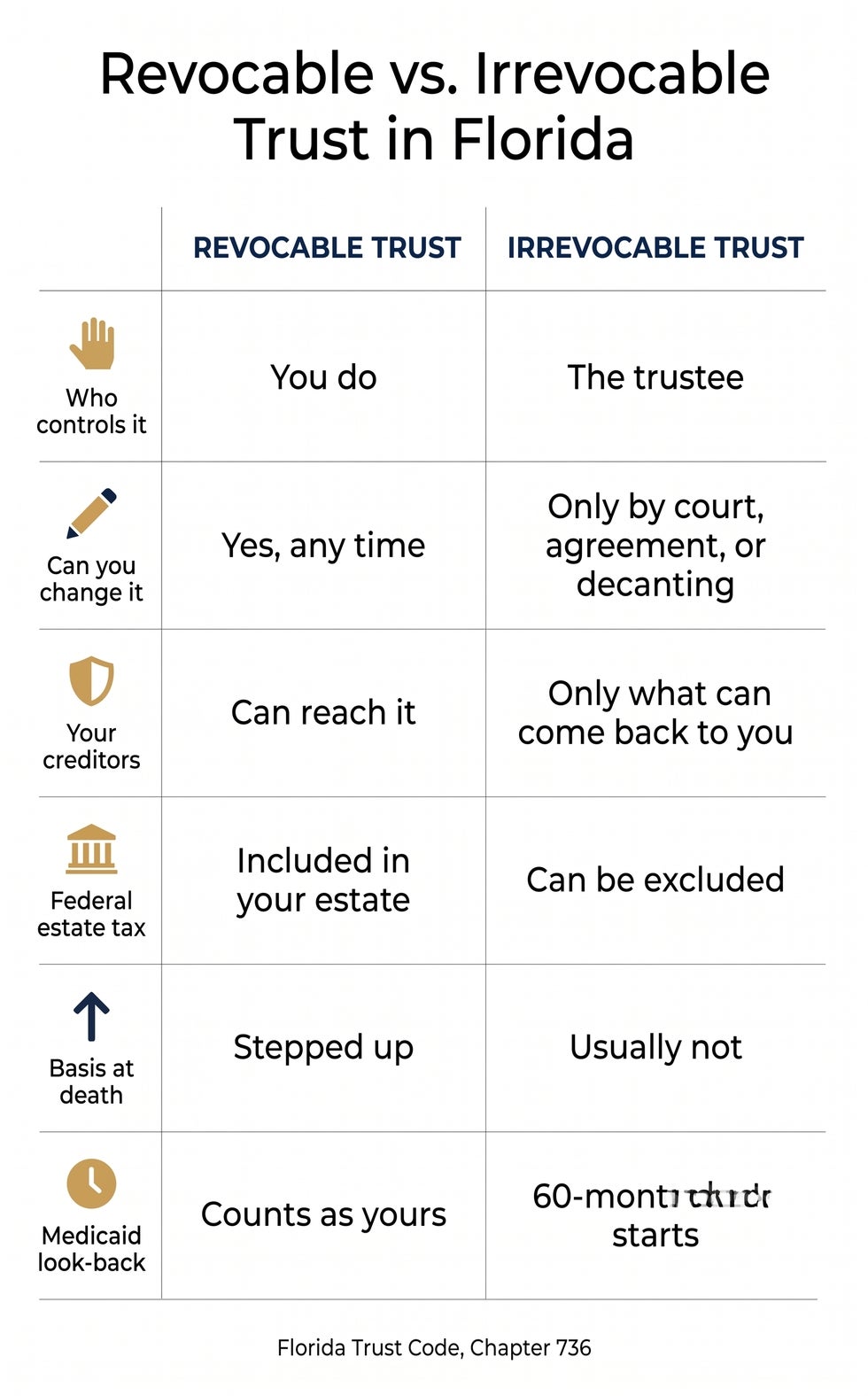
| Issue | Revocable trust | Irrevocable trust |
|---|---|---|
|
Who controls the assets |
The settlor, usually as trustee, with full control |
The trustee, under the terms of the trust; the settlor has given up control |
|
Can it be changed |
Yes, at will while the settlor has capacity (Section 736.0602) |
Not by the settlor alone; only by court order (Sections 736.04113 and 736.04115), agreement after the settlor's death (Section 736.0412), or decanting (Section 736.04117) |
|
Probate avoidance |
Yes, for assets retitled into the trust |
Yes, for assets retitled into the trust |
|
Creditors of the settlor during life |
Reachable (Section 736.0505(1)(a)) |
Reachable only up to what could be paid back to the settlor (Section 736.0505(1)(b)) |
|
Creditors after death |
Trust assets pay the settlor's estate expenses and debts if the probate estate cannot (Sections 733.707(3) and 736.05053) |
Generally not liable for the settlor's debts if the settlor kept no interest |
|
Federal estate tax treatment |
Included in the gross estate (26 U.S.C. Section 2038) |
Excluded if the gift was complete and no powers were retained |
|
Income tax treatment |
Grantor trust; reported on the settlor's own return |
Depends on design; often a separate taxpayer |
|
Step-up in basis at death |
Yes (26 U.S.C. Section 1014(b)(2)) |
Usually no, unless the asset is pulled back into the estate |
|
Florida homestead treatment |
Keeps the tax exemption and stays subject to the devise restrictions (Sections 196.041(2) and 732.4015(2)) |
Fact specific; exemption depends on a retained life interest |
|
Medicaid look-back exposure |
Assets count as yours (42 U.S.C. Section 1396p(d)(3)(A)) |
Transfer starts a 60-month look-back (42 U.S.C. Section 1396p(c)(1)(B)) |
|
Typical use |
Probate avoidance, incapacity, privacy |
Estate tax, life insurance, protecting a beneficiary, long-term care timing |
Two rows deserve emphasis. Control and who benefits are the same question: while a trust is revocable, Section 736.0603(1) says the trustee's duties run only to the settlor, while in an irrevocable trust structure the qualified beneficiaries have enforceable rights from day one. And the tax row is the one most people get backwards: Florida has no estate taxes and no income tax of its own, so every tax difference in that table is federal. The next section starts with the rule that decides which column your own document is in.
Does Florida Treat a Trust as Revocable Unless It Says Otherwise?
Yes. Under Section 736.0602(1) of the Florida Trust Code, the settlor may revoke or amend a trust unless its terms expressly provide that the trust is irrevocable. Florida starts from flexibility, not permanence, which is the opposite of what many families assume about a parent's trust they have never actually read.
The default rule under Section 736.0602
Section 736.0602, Florida Statutes, states the rule in its first sentence: "Unless the terms of a trust expressly provide that the trust is irrevocable, the settlor may revoke or amend the trust." The same section says how. If the trust document provides a method, the settlor follows it in substantial compliance; if it does not, a later will that refers to the trust, or any other method showing clear and convincing evidence of the settlor's intent, will do.
The practical effect is that silence means revocable. If a family tells me a parent "set up an irrevocable trust years ago," I do not take that on faith. I read the trust document. If the trust's terms never say irrevocable, Florida law treats it as revocable, which also means the assets are still the parent's for creditor and Medicaid purposes. The Florida Bar's pamphlet on the revocable trust in Florida makes the mirror-image point: your retained power over the assets is exactly what pulls them back into your taxable estate.
Why the trust document's wording controls
The trust document is the roadmap, and Florida courts read it strictly. It says who controls the assets, who the qualified beneficiaries are, whether the terms can be changed, and what happens at death. A family's memory of what the parent meant is not a substitute.
There is a second Florida signing rule that decides whether a revocable trust works at all. Under Section 736.0403(2)(b), the testamentary aspects of a revocable trust signed by a Florida resident, meaning the provisions that give trust property away at or after death, are invalid unless the settlor signed with the formalities required for a will: two attesting witnesses who sign in the settlor's presence and each other's. In Kelly v. Lindenau, 223 So. 3d 1074 (Fla. 2d DCA 2017), a Florida resident amended his Illinois-drafted trust to leave his Bradenton house to his partner, but only one of the two witnesses signed. The appellate court held the amendment invalid and refused to fix it by reformation or constructive trust, even though nobody disputed what he intended. Online forms and out-of-state documents signed without two witnesses carry the same risk, and I check every instrument brought into the office for it before anything else. Once you know which kind you have, the next question is how, and whether, it can be changed.
How Is Each Trust Changed or Ended Under Florida Law?
A revocable trust is changed or ended by the settlor at will; an irrevocable one can be changed only through the routes the Florida Trust Code provides, and none of them is casual. "Irrevocable" does not mean frozen, but every path costs time, consent, or a judge.
Amending a Florida revocable trust is the easy case. While alive and competent, the settlor can amend individual terms, restate the whole document, or revoke it entirely, and Section 736.0602(4) requires the trustee to hand the property back as the settlor directs. I still want clients to use a clean written amendment signed with two witnesses, because the Kelly case shows what happens when the paperwork is sloppy. Estate planning is rarely one-and-done: a successor trustee moves away, a grandchild is born, a family member develops special needs, and a revocable plan is built for updates without court involvement.
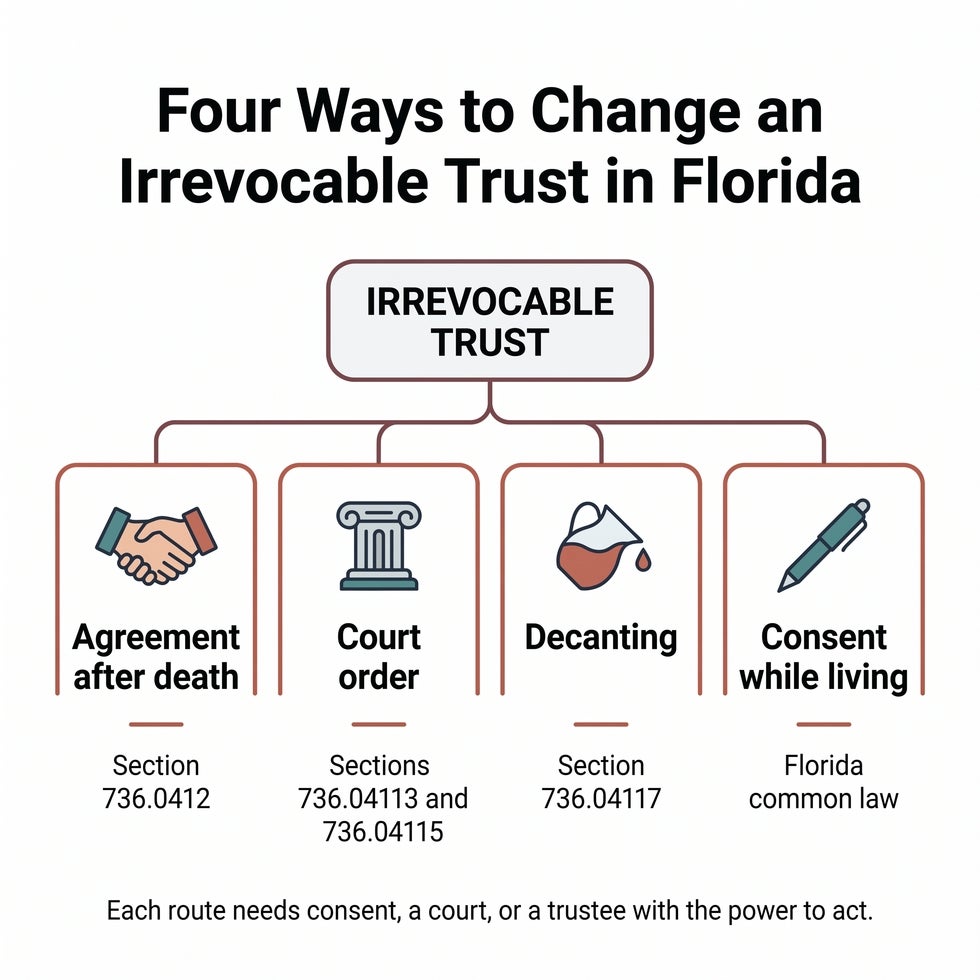
Modifying an irrevocable trust Florida families have already signed takes one of four routes, and the answer to can an irrevocable trust be changed in Florida is always one of them:
- Nonjudicial agreement after the settlor's death. Under Section 736.0412, the trustee and all qualified beneficiaries can agree in writing to modify the trust, with no court, once the settlor has died. It does not apply to trusts created before January 1, 2001, and a spendthrift clause does not block it.
- Judicial modification. A court may modify or terminate an irrevocable trust when its purposes have been fulfilled or become impossible, or when unanticipated circumstances would defeat a material purpose (Section 736.04113), and separately when compliance is simply not in the beneficiaries' best interests (Section 736.04115). Either way, the court involvement is real and the trustee or a qualified beneficiary has to file.
- Decanting. Section 736.04117 lets an authorized trustee with power to invade principal pour the assets into a new trust with better terms, on 60 days' written notice to the qualified beneficiaries, within limits that protect vested interests and tax benefits. The Legislature revised this section as recently as 2025 (ch. 2025-159).
- Consent while the settlor is alive. Chapter 736 has no section that lets a living settlor and the beneficiaries rewrite an irrevocable trust by agreement; Section 736.0412(6) instead preserves whatever rights exist under Florida common law to modify or terminate a trust by consent. That route exists, but it rests on case law rather than a statute, and it should never be assumed.
Each tool has limits. Some need unanimity, some need a judge, and decanting works only within the trustee's existing powers. The firm's video What Is an Irrevocable Trust? And Can It Ever Be Changed? covers the same ground in plain English. The reason people accept those limits is usually creditors, which is the next question.
Does a Revocable Trust Protect Assets From Creditors in Florida?
No. Does a revocable trust protect assets from creditors in Florida? Not from your own creditors, and Section 736.0505 says so in terms. This is where the revocable vs irrevocable trust Florida question stops being academic, because "avoid probate" and "protect from lawsuits" are different goals under Florida law, and a revocable trust accomplishes only the first.
Creditors of the settlor during life under Section 736.0505
Section 736.0505(1)(a) provides that the property of a revocable trust is subject to the claims of the settlor's creditors during the settlor's lifetime, "to the extent the property would not otherwise be exempt by law if owned directly by the settlor." The logic is simple: if you can revoke the trust and take the property back tomorrow, the law treats it as yours today.
The exemption clause is worth reading twice. Assets that Florida already shields when you own them outright, such as homestead under Article X, Section 4 of the Florida Constitution, do not lose that character just because a revocable trust holds title; the statute preserves the exemption the settlor would have had. What the revocable trust does not do is create any new protection. A brokerage account that a judgment creditor could reach in your name is equally reachable in your revocable trust.
Claims against the trust after the settlor dies
After death, the revocable arrangement does not become a shield either. Under Section 733.707(3), any trust the decedent could revoke at death is liable for the expenses of administration and the obligations of the decedent's estate to the extent the probate estate cannot pay them, and Section 736.05053 requires the trustee to pay whatever the personal representative certifies is needed.
That is why the successor trustee has real work to do before distributing anything. The trustee must file a notice of trust with the court under Section 736.05055, notify the qualified beneficiaries within 60 days under Section 736.0813, and deal with valid debts. What it does accomplish is keeping the assets out of the probate process and out of the public record, which are genuine benefits, just not creditor elimination.
What an irrevocable trust changes, and what it does not
An irrevocable trust changes the creditor picture only to the extent you have actually given the assets away. Section 736.0505(1)(b) lets your creditors reach "the maximum amount that can be distributed to or for the settlor's benefit." One you set up for yourself, with a trustee who can pay you, protects nothing from your own creditors, whatever the label says.
What it does change is protection for other people. An irrevocable trust for your children with a spendthrift provision under Section 736.0502 keeps a child's creditors from reaching the trust before distribution, subject to the exceptions in Section 736.0503 for child support, a former spouse's support order, and claims by the state or federal government. It does not let you keep complete control and still expect creditor protection, it does not erase every claim, and it does not fix late long-term care planning. Whether it is worth doing usually comes down to taxes, which is where most families overestimate the benefit.
How Do Federal and Florida Taxes Affect Revocable vs. Irrevocable Trusts?
A revocable trust changes nothing about your taxes during life and nothing about your taxable estate at death; an irrevocable one can remove assets from the taxable estate, but for most Florida families there is no estate tax to remove them from. Florida has no state estate tax and no state income tax, so every tax question here is federal, and the firm's guide to Florida inheritance tax covers the state side in detail.
For income tax purposes, a revocable trust is a grantor trust: you keep using your own Social Security number, and trust income is reported on your personal return as if the trust did not exist. An irrevocable one may be its own taxpayer with its own return, or it may be drafted as a grantor trust on purpose. That design choice is one reason irrevocable planning should be deliberate, and one reason the income tax question is never answered by the label alone.
For estate and gift tax purposes, 26 U.S.C. Section 2038 includes in your gross estate any property over which you kept a power "to alter, amend, revoke, or terminate," which describes every revocable trust. Transfers to an irrevocable trust can be completed gifts that leave the estate, at the cost of using gift tax exemption and giving up the assets. The catch is the number. The IRS's estate and gift tax page puts the 2026 federal estate tax exemption at $15,000,000 per person under Public Law 119-21, so estate tax savings are a reason to go irrevocable only for a small number of households. As Kiplinger put it in reviewing the same change, fewer families now feel pushed into irrevocable trusts purely for tax reasons.
The trade-off most families miss is cost basis. Under 26 U.S.C. Section 1014, assets in a revocable trust get a new basis equal to fair market value at death, so a Cape Coral home bought for $180,000 and worth $650,000 passes to the children with the gain erased. Assets given away irrevocably years earlier generally keep the old basis, and the children inherit the capital gains bill along with the house. Saving estate tax you were never going to owe, at the price of a real income tax bill for your heirs, is the single most common way irrevocable planning hurts a Florida family. The home itself raises one more set of rules.
How Do Revocable and Irrevocable Trusts Handle Your Florida Home?
A revocable trust can hold your Florida homestead without losing the homestead tax exemption, and for most families it is the cleaner answer; an irrevocable one can hold it too, but the exemption, the creditor protection, and the long-term care consequences all become fact specific. Homestead property does not behave like ordinary real estate in Florida, and the trust choice has to respect that.
For the tax exemption, Section 196.041(2) treats a beneficial interest for life as "equitable title to real estate," so a homeowner who keeps that interest through a revocable trust keeps the exemption. For the constitutional devise restrictions, Section 732.4015(2) treats the grantor of a revocable trust as the "owner," which means a trust cannot leave the homestead away from a surviving spouse or minor child any more than a will can. The firm's article on Florida homestead in probate walks through what happens when a plan ignores that rule.
Irrevocable ownership of the home is a different exercise. If the settlor keeps a life interest, the tax exemption can survive; if not, it may be lost, and the deed itself may be a completed gift with basis consequences. Whether the constitutional creditor protection follows the home into an irrevocable trust is a question of case law, not statute, and it needs attorney review for the specific situation rather than a rule of thumb. Common planning strategies for Florida real estate are less exotic than that: deed the home into the revocable trust during life, match the deed to the trust document, keep beneficiary designations on other assets consistent with the plan, and recheck title after any refinance or move. Most trust problems with real estate are funding problems, not drafting problems. Which brings us to the reason families ask about irrevocable trusts most often: nursing home costs.
How Are Trusts Used for Medicaid Planning in Florida?
A revocable trust does nothing for Medicaid eligibility, because federal law counts its assets as yours; an irrevocable one can help only if it is created and funded at least five years before the application. Medicaid planning is a separate discipline from estate planning, and this section states the rule and the trade-off so you can decide whether that conversation is worth having.
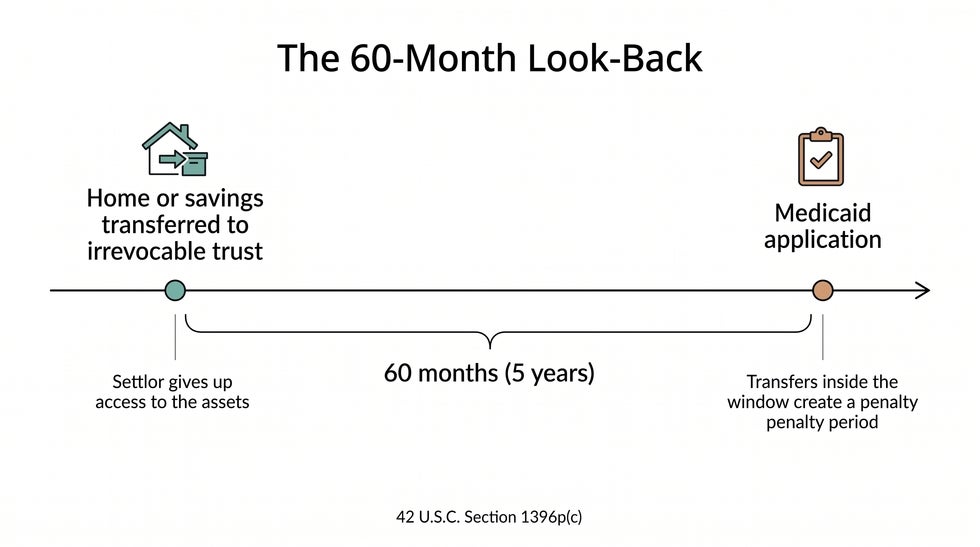
The look-back period is federal and it is five years. 42 U.S.C. Section 1396p(c)(1)(B) sets a look-back date 60 months before the application, and transfers for less than fair value inside that window create a penalty period of ineligibility. The same statute, at subsection (d)(3), says the corpus of a revocable trust "shall be considered resources available to the individual," and that an irrevocable trust is counted too if there are any circumstances under which payment could be made to the applicant. The Kiplinger piece linked above frames it the same way: control on one side, government benefits on the other.
So when an adult child in Ohio asks whether an irrevocable trust can shelter a parent's Naples condo from nursing home costs, the answer is yes, sometimes, with three conditions. The transfer has to happen more than 60 months before the application. The parent has to give up real access to the assets, not just the title. And the family has to accept the basis and control consequences described above. When gifting or transferring the home makes sense is a question of timing and family dynamics as much as law; a parent who is already in a health crisis is usually past the point where the classic approach works. What the firm does in these cases is draft the trust instrument and the deed; eligibility advice and the application itself belong with a practitioner who does that work every day. That division of labor is part of deciding who needs which trust.
Who Should Consider a Revocable Trust and Who Needs an Irrevocable Trust in Florida?
Most Southwest Florida families should start with a revocable trust; the irrevocable kind is for the narrower group with a specific target that justifies giving up control. The key to the revocable vs irrevocable trust Florida choice is not wealth. It is whether there is a problem beyond ordinary estate planning that only permanence can solve.
Typical profiles I see in Fort Myers, Cape Coral, Naples, and Punta Gorda look like this. The retiree with a homestead, a brokerage account, an IRA, and adult children wants a revocable trust, a pour-over will, and a durable power of attorney; the firm's guide to types of trusts for estate planning covers the variations. The family with a child who receives government benefits needs a special needs trust, which is irrevocable by nature. Business owners with liability exposure, and families whose estates approach the federal exemption, may need an irrevocable trust for creditor or tax reasons. A parent who wants a life insurance policy outside the taxable estate needs an irrevocable life insurance trust, and the firm's article on life insurance and estate planning explains when that is worth the trouble. Families planning early for long-term care are the fourth group, with the five-year condition above.
Before choosing a type of trust, the questions to discuss with your estate planning attorney expose the real objective: What control are you willing to give up, if any? Is creditor protection for a beneficiary an actual priority, or a worry you read about? Is your Florida home part of the problem? Is the trust meant to help you, your spouse, or a third party? And if your only goal is to avoid probate and keep things private, is there any reason not to use the revocable trust and stop there? Good legal advice starts with those answers, because trust planning fails when families buy a document before they identify the job the document is supposed to do. The failure modes are worth naming directly.
What Are the Risks and Downsides of Revocable and Irrevocable Trusts in Florida?
The risk of an irrevocable trust is permanence you later regret; the risk of a revocable one is expecting protection it never offered. Both are avoidable, and both show up in the office regularly.
Loss of control and flexibility with an irrevocable trust is the obvious downside, and it is worse than it sounds on paper. The settlor cannot take the assets back if a spouse needs care, a market falls, or a child turns out to be a poor choice of beneficiary, and the trust terms cannot be rewritten without agreement, a court, or a trustee with decanting power. The basis cost described in the tax section is the quiet second downside: heirs pay capital gains on appreciation that a revocable plan would have wiped out at death.
When a revocable trust fails to protect assets, the failure is almost always a mismatch between what the client expected and what Section 736.0505 provides. It keeps assets out of probate and out of the public record; it does not keep them from a judgment creditor, and after death the trustee must still pay the estate's obligations before the remaining assets go to the family. The other common failure is an unfunded trust. A revocable trust controls only the assets actually retitled into it, and an account left in your own name goes through probate as if the document did not exist; the firm's guide on how to avoid probate in Florida starts with funding for that reason, and the video What Is Trust Funding? Why an Unfunded Trust Does Nothing makes the same point in five minutes. Several of the most expensive versions of these mistakes appear in the firm's list of Florida estate planning mistakes, and the FAQs below cover the ones families ask about first.
Frequently Asked Questions
Can you change an irrevocable trust in Florida once it's created?
Can an irrevocable trust be changed in Florida? Yes, but not by the settlor alone. After the settlor's death the trustee and all qualified beneficiaries can modify it by agreement under Section 736.0412; at any time a court can modify it under Sections 736.04113 or 736.04115; and an authorized trustee can decant it into a new trust under Section 736.04117. Each route has conditions and none is quick.
What assets should not go into an irrevocable trust Florida families set up?
Generally, assets you may need back, assets with large built-in gains, and retirement accounts. Cash and investments you might need for your own care should stay out because you cannot reach them again. Highly appreciated property loses the step-up in basis at death. IRAs and 401(k)s cannot be retitled to a trust during life without a taxable distribution, so they pass by beneficiary designations instead.
Do Florida trusts need two witnesses, or are they invalid?
A Florida revocable trust needs two witnesses for its testamentary aspects, the provisions that give property away at death. Under Section 736.0403(2)(b), those provisions are invalid unless the settlor signed with will formalities, and a court will not reform or rescue a trust or amendment that was signed with only one witness. The rest of the trust, and an irrevocable trust, can be valid without them, but two witnesses and a notary is the safe practice for every Florida trust.
Which trust is right for me if my only goal is avoiding probate?
Which trust is right for me is an easy question when probate avoidance is the whole goal: the revocable living trust. It keeps every asset under your control, avoids probate for everything retitled into it, lets a successor trustee step in if you become incapacitated, and costs less to set up and maintain than an irrevocable one, which adds nothing to probate avoidance that a revocable trust does not already provide.
Does a revocable living trust in Florida still need a will?
Yes. A revocable living trust Florida families sign should always be paired with a pour-over will under Section 732.513, which sends any asset left outside the trust at death into it. Everything the pour-over will catches goes through probate first, so the will is a safety net, not a substitute for funding the trust. The firm's video If I Have a Trust, Do I Still Need a Will in Florida? covers the reasons.
How do revocable trust vs irrevocable trust taxes differ at death?
The revocable trust vs irrevocable trust taxes question at death comes down to two federal rules. Revocable trust assets are included in the gross estate under 26 U.S.C. Section 2038 and receive a stepped-up basis under Section 1014. Assets given to an irrevocable trust as completed gifts are excluded from the estate but keep the settlor's old basis, so heirs may owe capital gains tax. Florida imposes no estate or inheritance tax of its own.
The Nussbickel Law Firm: Our Approach and Commitment to Florida Families
The Nussbickel Law Firm, P.A. practices exclusively in estate planning, probate, and trust administration from our office at 12487 Brantley Commons Court in Fort Myers, serving families in Lee, Collier, and Charlotte counties. We draft revocable trusts, pour-over wills, powers of attorney, and advance directives as a package, and when a family's facts call for an irrevocable trust, we say so and explain what it will cost them in control before they sign. When the facts do not call for one, we say that too.
Every trust we prepare is signed with Florida will formalities, funded with a written plan, and reviewed against the homestead and creditor rules in this article. The revocable vs irrevocable trust Florida question is one we answer at the first meeting, in plain English, with the statutes on the table. Consultations are free and can be held by phone, video, or at our office. Schedule a free consultation or call 239-900-WILL (9455) to start.
Conclusion
For most Florida families the revocable trust is the right answer: it avoids probate, plans for incapacity, keeps your affairs private, and leaves you in full control while you are alive. The irrevocable kind earns its place only when a specific problem, estate tax exposure, a life insurance policy, a beneficiary who needs protection, or a long-term care plan started five years early, is worth the permanent loss of control and the loss of a stepped-up basis. Florida law decides the details: Section 736.0602 makes revocable the default, Section 736.0403(2)(b) requires two witnesses, and Section 736.0505 makes clear that a revocable trust protects nothing from your own creditors. Read your trust document, confirm which kind it is, and if the answer does not match the job you need done, talk to us before anything else changes.
Gregory J. Nussbickel is the founder of The Nussbickel Law Firm, P.A. in Fort Myers, Florida. His practice is devoted exclusively to estate planning, probate, and trust administration for families throughout Southwest Florida.
This article is for general information only and is not legal advice. Reading it does not create an attorney-client relationship. Florida trust, tax, and Medicaid rules change and depend on individual facts; consult a Florida attorney about your own situation.

Comments
There are no comments for this post. Be the first and Add your Comment below.
Leave a Comment