
Key Highlights
- A Florida vehicle title transfer after death often requires no probate at all, because section 319.28, Florida Statutes allows an heir to apply by affidavit instead of a court order.
- A surviving spouse can usually get a free replacement title using HSMV form 82152, with no probate case and no filing fee.
- Whether the word between two names on a certificate of title is "or" rather than "and" often decides whether probate is needed at all.
- Florida law treats up to two motor vehicles under 15,000 pounds as exempt property, protected from most creditor claims against the estate.
- A vehicle inherited without payment is not subject to Florida sales tax, but assuming the deceased owner's loan can change that answer.
- Since 2024, an affidavit signed by a Florida attorney can establish a presumption of ownership without filing a copy of the will.
Introduction
The short answer: a Florida vehicle title transfer after death does not always require probate. If you are a surviving spouse, or an heir of someone who died without debts and whose family agrees on who gets what, you can usually walk into a county tax collector office with a certified copy of the death certificate and the right form and walk out with a new title. Probate becomes necessary when the estate owes money, when the heirs disagree, when the title wording blocks automatic survivorship, or when a court case is already open.
Losing a parent or a spouse is hard enough without a trip to a service center that ends in being turned away. The rules here are more forgiving than most people expect, and the older articles you will find on this topic are frequently out of date. Two of them still quote a summary administration threshold that changed in 2026, and almost none of them mention the free transfer available to a surviving spouse.
Below we walk through which route fits your situation, which documents to bring, what the word "or" on a certificate of title actually does, and where to go in Lee, Collier, and Charlotte counties.
How Do You Transfer a Florida Vehicle Title After Death?
You transfer a Florida vehicle title after death by applying to a county tax collector for a new certificate of title, supported by proof that the previous owner died and proof that you are entitled to the vehicle. Under Florida law that proof is often a sworn affidavit rather than a probate court order, which is why many families never see a courtroom.
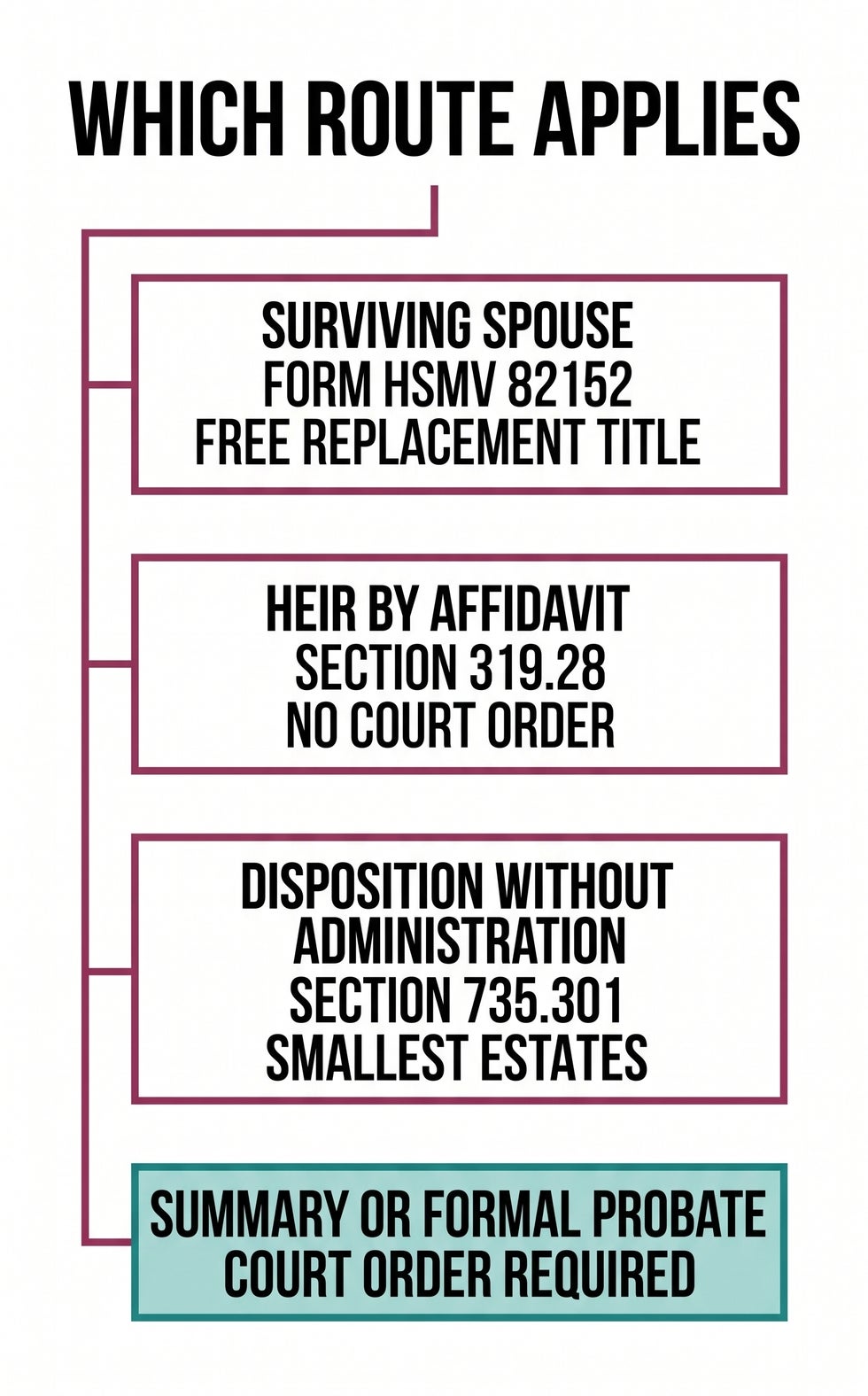
A Florida vehicle title transfer without probate is the norm here rather than the exception. There are four common routes, and only the last two involve a judge. A surviving spouse whose name is already on the title, or whose deceased spouse held it alone, can request a free replacement. An heir of someone who died intestate can file an affidavit that the estate is not indebted. A very small estate may qualify for disposition without administration. Everything else runs through summary or formal probate.
Deciding Whether Probate Is Needed
Start with three questions. Whose name is on the certificate of title, and is there a second name joined by "or" or by "and"? Did the deceased owner leave debts that the estate cannot cover? Do the heirs agree among themselves about who takes the vehicle?
If the answers are favorable, the transfer of title is an administrative errand, and the steps to transfer car title after death Florida families follow are the same in every county. If any answer is unfavorable, expect court involvement. For a plain-English overview of what does and does not require a case, see the firm's video Do All Assets Go Through Probate in Florida?.
Does Your Title Say "Or" or "And"?
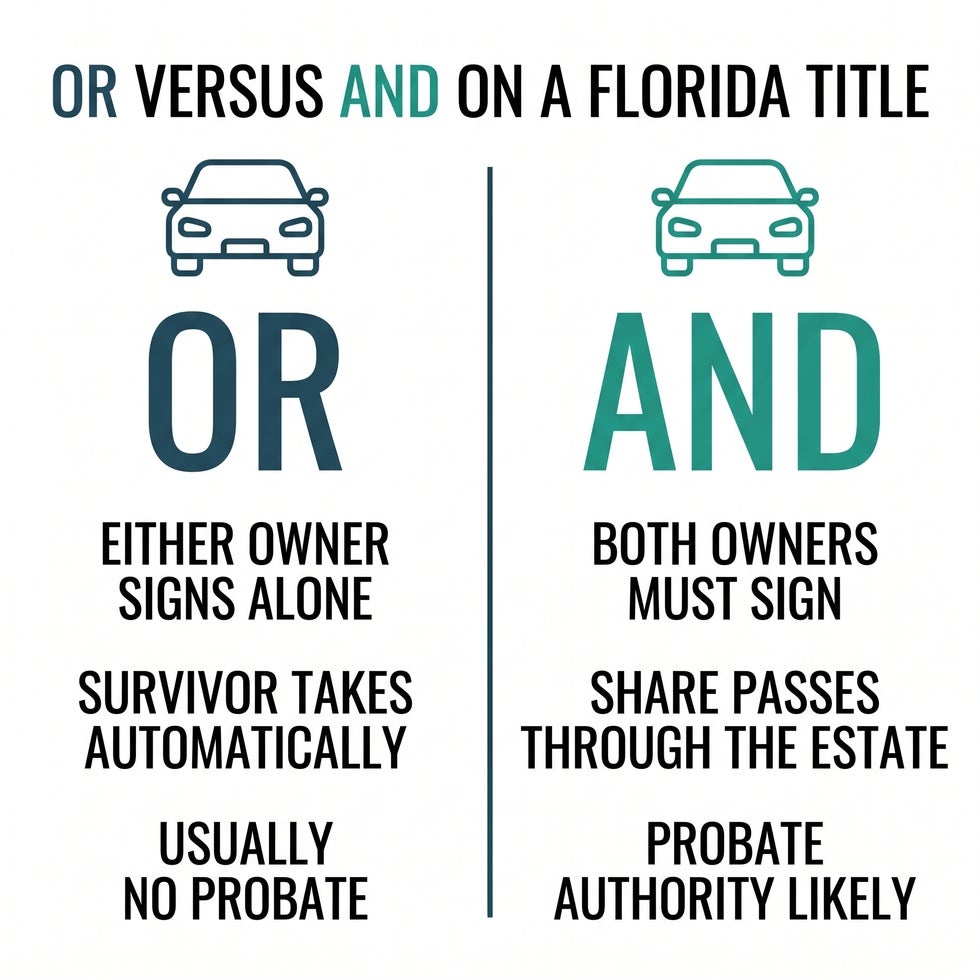
One small word on a Florida certificate of title decides more than almost anything else on this page. When two owners are joined by "or," either owner can act alone, and the surviving owner generally becomes the sole owner automatically when the other dies. When they are joined by "and," both signatures were required during life, so after a death the deceased person's share usually needs estate authority before the vehicle can move.
This is worth checking before you do anything else. Pull the paper title out of the drawer, or look at the electronic title record, and read the ownership line. The word sits between the two names. It was chosen when the title was issued, and it cannot be changed after someone has died, which is exactly why it matters so much now.
Joint ownership is not the same thing as a beneficiary designation, and Florida does not offer a transfer-on-death registration for vehicles the way it does for some bank accounts. If you are thinking about how to spare your own family this step later, our guide on avoiding probate in Florida covers the planning options that actually work for titled property.
Survivorship Rights for Spouses and Heirs
A surviving co-owner on an "or" title usually takes the vehicle automatically, which is how a right of survivorship works in practice even though that phrase does not appear on the form. A surviving spouse may also have rights under section 319.28 and under Florida's exempt property rule, discussed below. Adult children do not outrank a surviving spouse. Where the title says "and," survivorship does not operate the same way, and where an estate is already open, the personal representative is normally the one who signs.
Does Florida Require Probate for a Car Title?
Not always, and that is the single most useful thing to know here. Most of the time a vehicle transfer at death is paperwork rather than litigation. A Florida car title transfer after owner dies runs on the same statute that governs any other transfer by operation of law. Florida law expressly allows the department to issue a new certificate of title on proof of ownership and right of possession, and an affidavit can be that proof. Probate becomes necessary when the affidavit could not honestly be signed, when the estate is insolvent, or when someone contests the outcome.
Statutory Authority Under Section 319.28
Section 319.28 governs transfer of ownership by operation of law, which includes inheritance. It gives several paths that avoid a probate court order:
- Intestate heirs. No court order is required if the applicant files an affidavit that the estate is not indebted and that the surviving spouse and heirs have amicably agreed among themselves on a division of the estate.
- Testate estates. The application is accompanied by a certified copy of the will if it is being probated, plus an affidavit that the estate is solvent with sufficient assets to pay all just claims. If the will is not being probated, a sworn copy of the will and an affidavit that the estate is not indebted will do.
- Attorney affidavit. Where the previous owner died testate, an affidavit attested by a Florida-licensed attorney in good standing with The Florida Bar establishes a presumption of ownership and right of possession, and the application does not need to include a copy of the will at all. This paragraph was added to the statute in 2024 by chapter 2024-272, Laws of Florida, and it is not yet reflected in most published guidance. You can compare the 2023 version of the statute with the 2024 version and see the paragraph appear.
- Surviving spouse selling rather than keeping. A surviving spouse who wants to sell instead of keeping the vehicle does not have to take title in their own name first. They may assign the certificate of title issued to the deceased spouse directly to the buyer.
That last route saves a step and a fee, and families routinely miss it.
When Probate Is Required
Court authority becomes necessary when the estate has debts it cannot pay, when heirs do not agree, when the title wording blocks automatic survivorship, or when an estate administration is already open. In that case letters of administration or probate court orders will be needed before the personal representative can sign for the probate estate. A formal probate proceeding takes considerably longer than the affidavit process, but it is the only safe route when the facts do not fit.
Florida's short-form probate is summary administration, available when the value of the entire estate subject to administration in this state, less exempt property, does not exceed $150,000, or when the decedent has been dead for more than two years. That figure doubled from $75,000 effective July 1, 2026, and we wrote about what the new $150,000 limit means for Lee County families when it passed. Anything larger runs as formal probate. The firm's video What Is Summary Administration? Florida's Short-Form Probate walks through how the short form works.
Disposition Without Administration
Disposition without administration is a separate and much smaller route, and it is commonly described incorrectly. It is not a dollar threshold. Under section 735.301, it applies where the decedent left only personal property exempt under section 732.402, personal property exempt from creditor claims under the State Constitution, and nonexempt personal property worth no more than preferred funeral expenses plus reasonable and necessary medical and hospital expenses of the last 60 days of the last illness.
Because an exempt vehicle falls squarely into the first category, a car is often exactly the kind of asset this route was written for. The firm's video Florida Disposition Without Administration: The Smallest Estates covers who qualifies.
Which Documents Do You Need?
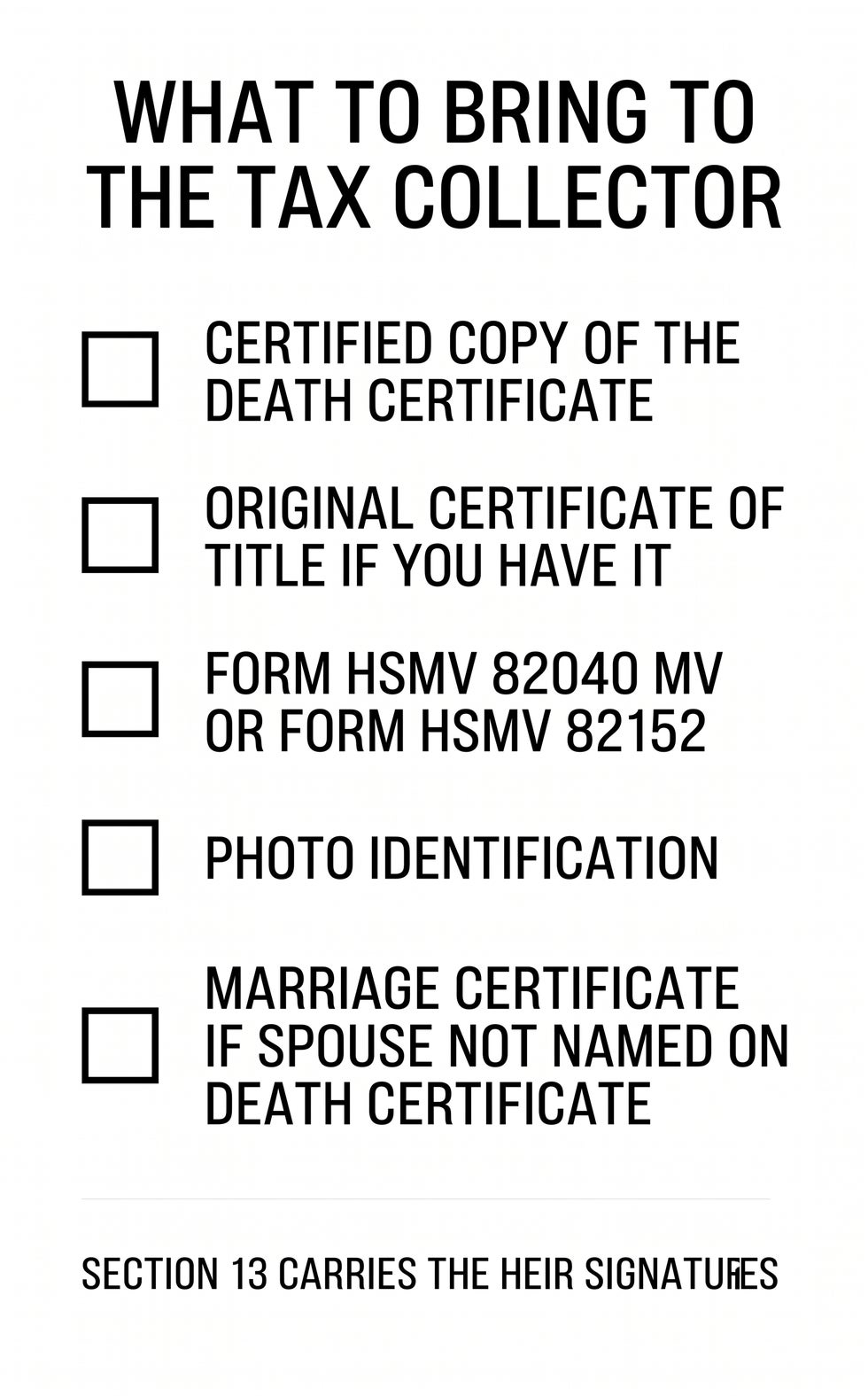
Bring the original certificate of title if you can find it, a certified copy of the death certificate, the completed HSMV 82040 form, and proof of who you are. The deceased owner car title Florida families find in a drawer is usually all the department needs (but remember to take down the vehicle's odometer mileage too). Gathering these before you go is the difference between one visit and three.
Required Forms and Proof of Death
A photocopy of the death certificate is not enough for most transactions. You need a certified copy of the death certificate, which is what establishes that the previous owner has died.
As of July 1, 2023, the old all-purpose HSMV 82040 was split into three forms, and using the wrong one is a common reason applications get bounced back:
| Form | Use it for |
|---|---|
|
Motor vehicle title |
|
|
Vessel title |
|
|
HSMV 82040 MH |
Mobile home title |
|
Surviving spouse transfer |
Florida vehicle titles are issued electronically by default now, so many families never held a paper copy at all. On the motor vehicle form, the death information goes in Section 13, Release of Spouse or Heirs Interest. That is the release of heirs section people refer to, and it asks for the name of the deceased, the date of death, whether the person died testate or intestate, and the signatures of the spouse, co-owner, or heirs. Section 11 of form HSMV 82040 MV is where the heirs certify that the certificate of title is lost or destroyed, so a missing paper copy does not stop the process. You request a duplicate title in the same transaction.
The surviving spouse car title Florida route deserves its own paragraph, because it is both the most common situation and the cheapest. Since July 1, 2017, where a title carries both spouses' names, the surviving spouse may request a free title replacement removing the deceased spouse's name. Since July 1, 2022, that free replacement is also available where the title was in the deceased spouse's name alone, as long as the only change is moving ownership to the surviving spouse. You submit HSMV form 82152 with a certified copy of the death certificate and proof of identity, and a marriage certificate is required unless the surviving spouse's name appears on the death certificate. FLHSMV sets this out in its liens and titles FAQ.
Which Vehicles Qualify as Exempt Property?
Some vehicles pass to the family as exempt property, outside the reach of most estate creditors. Under section 732.402, if the decedent was domiciled in Florida, the surviving spouse, or the children if there is no surviving spouse, have a right to exempt property.
The Florida exempt property motor vehicles rule has four parts, and most articles state only the first:
- Up to two motor vehicles qualify.
- Neither vehicle may individually have a gross vehicle weight above 15,000 pounds.
- Each must have been held in the decedent's name.
- Each must have been regularly used by the decedent or members of the immediate family as personal vehicles.
Three further points matter in practice. Property specifically devised to a named person in the will is not included in exempt property. Exempt property is protected from all claims against the estate except perfected security interests, so a car loan still has to be dealt with. And exempt property is in addition to whatever passes under the will or by intestate succession, not instead of it.
There is a deadline. The right is waived unless a petition to determine exempt property is filed by the later of four months after service of the notice of administration, or 40 days after termination of any proceeding involving construction, admission to probate, or validity of the will. If an estate is open, calendar that date. Our overview of assets exempt from probate in Florida puts vehicles in context with the other categories.
What If the Vehicle Has a Loan or Lien?
Outstanding loans have to be resolved before clear title can pass. Under section 319.27, each lien on a vehicle titled in Florida is noted on the face of the certificate of title, so you can see it by reading the title itself.
Call the lender first and ask for the payoff balance. Once the debt is satisfied, the lienholder records the satisfaction, and Florida runs an electronic titling program under which lienholders transmit liens and lien satisfactions to the department electronically. Some lenders still issue a paper lien satisfaction letter as well. Either way, the department will not issue a clean certificate of title while the lien is outstanding.
If an heir wants to keep a financed vehicle, they generally need to pay the balance or refinance it into their own name. If the estate cannot service the loan, selling the vehicle and paying the lender from the proceeds is often the cleaner answer. Our article on Florida probate debts and expenses explains how secured debts fit alongside other creditor claims.
Is There Sales Tax on an Inherited Vehicle?
No, a vehicle received by inheritance is not subject to Florida sales and use tax, because nothing was paid for it. The HSMV 82040 MV form makes this explicit: Section 9, Sales Tax Exemption Certification, includes a checkbox labeled Inheritance among the reasons ownership is not subject to Florida sales and use tax.
There is one trap. The Florida Department of Revenue conditions the no-tax treatment on a transfer where no payment is made and no outstanding lien is assumed by the new owner. If you take the car and take over the loan, you have arguably given consideration, and the analysis changes. The Department addresses the principle in its FAQ on transferring a car title received as a gift. If a loan is involved, raise it at the counter rather than guessing.
Selling the vehicle afterward is different again. If the new owner sells it, the buyer pays sales tax on the purchase price in the ordinary way.
How Does Boat and Vessel Title Transfer Work?
A Florida vehicle title transfer after death and a Florida vessel title transfer after death follow the same logic, under different chapters. Vessels are titled under chapter 328, the Uniform Certificate of Title for Vessels Act, and section 328.24 governs transfer by operation of law. That section expressly defines "by operation of law" to include a transfer because of death.
The mechanism is a transfer-by-law statement, which must identify the owner of record and the transferee and include documentation sufficient to establish the transferee's ownership interest. Helpfully, the notice requirement that applies to other transfers, telling everyone with a recorded interest that the statement is being filed, does not apply to a transfer because of death. Once the statement is accepted, the department has 30 days to amend its files, cancel the old certificate, and issue a new one.
This matters here more than in most of Florida. A Florida boat title transfer after death is an ordinary event in Lee, Charlotte, and Collier counties, where a vessel is often the second most valuable titled asset a family owns. Note that a boat is not a motor vehicle for the exempt property rule, so the two-vehicle exemption does not shelter it.
What About Out-of-State and Snowbird Vehicles?
If the deceased owner was a Florida resident but the car is titled in another state, the estate generally works through the titling state first, then brings the vehicle into Florida if an heir here is keeping it. If the owner was a seasonal resident titled elsewhere, that state's law controls the transfer.
Bringing a used vehicle into Florida that is not currently titled here triggers a VIN verification. Section 8 of the HSMV 82040 MV requires a physical inspection of the vehicle identification number, and the inspection can be certified by law enforcement, a Florida dealer, an FLHSMV or tax collector employee, or a Florida notary public. For families splitting time between two states, our guide to international and cross-border estate planning in Florida covers the wider version of this problem.
Where Do You Go in Lee, Collier, and Charlotte?
You go to your local tax collector's office. The Florida Department of Highway Safety and Motor Vehicles sets the rules for vehicle transfers across the State of Florida, but the counter work happens at a tax collector's office or a license plate agency, which is why the HSMV 82040 MV instructs applicants to submit the form there. FLHSMV maintains an office locator covering the entire state. Bring the tag number too if a license plate is moving with the vehicle.
A Florida tax collector title transfer takes a single visit when the paperwork is right, so call ahead and confirm what the office wants to see. Requirements are statewide, but appointment availability and document preferences vary between the Lee, Collier, and Charlotte county offices, and a two-minute phone call is cheaper than a second trip.
Who Needs to Sign?
It depends on who has authority. Where probate is open, the personal representative signs for estate property. Where no probate is required, the surviving spouse or the heirs sign, and where there are several heirs, all of them generally must sign and complete the release of heirs section of the form.
A surviving spouse may sign as seller on behalf of the deceased owner, and as buyer if they are keeping the vehicle. A surviving co-owner on an "or" title signs alone. If you are unsure who holds authority, that uncertainty is itself a reason to get advice before anyone signs anything.
What Should a Family Not Do First?
Do not keep driving the vehicle as though nothing changed. Insurance follows the named insured, and a policy in a deceased person's name may not cover a relative who is now driving the car daily. Confirm coverage before the keys move.
Do not sell the vehicle before you have authority to transfer title. Handing a buyer a title signed by someone who has died, or signing the deceased owner's name, is not a shortcut, and it creates a title problem that outlives the sale. Do not treat the vehicle as settled while creditors are unpaid and no exemption has been determined. Legal disputes among heirs are far easier to prevent at this stage than to unwind later.
When Is Probate Required, and When Is It Not?
Whether a vehicle transfer needs a judge comes down to a handful of facts. Here is the comparison in one place, so read down the column that matches yours.
| Probate not required | Probate required | |
|---|---|---|
|
Typical facts |
Surviving spouse; or "or" title; or no estate debts and heirs agree |
Estate debts; heirs disagree; "and" title with no agreement; case already open |
|
Authority to sign |
Surviving spouse, co-owner, or heirs |
Personal representative under letters of administration |
|
Core paperwork |
HSMV 82152, or HSMV 82040 MV with affidavit |
Probate court order plus HSMV 82040 MV |
|
Court involvement |
None |
Summary or formal administration |
|
Typical timing |
Same visit to same week |
Weeks to months |
|
Cost to the family |
Title fee, or free for the spouse route |
Court costs and professional fees |
If your facts sit on the boundary, the safest move is to confirm before filing rather than after. An affidavit is sworn under penalty of perjury, and signing one that is not accurate is a serious matter.
How The Nussbickel Law Firm Helps
We are an estate planning and probate firm in Fort Myers, and vehicle and vessel transfers come up constantly in the estates we administer. Sometimes the answer is that you do not need us at all, and we will tell you that: if you are a surviving spouse with a certified death certificate and a clean title, form 82152 and a trip to the tax collector is the whole job.
When probate is required, we handle the administration and the paperwork that comes with it, including the petition to determine exempt property where a vehicle qualifies. And where a testate estate needs a faster answer, the attorney affidavit under section 319.28 is a tool we can use directly, which can move a title without filing the will.
The firm serves estate planning clients throughout Lee, Collier, and Charlotte counties, including Fort Myers, Cape Coral, Estero, Bonita Springs, Sanibel, Punta Gorda, and Naples, and handles probate matters statewide. Consultations happen by phone, by video, or at our office, whichever suits you. Schedule a free consultation or call 239-900-WILL (9455).
Conclusion
A Florida vehicle title transfer after death is usually smaller than it looks. Read the title first and find out whether it says "or" or "and." Order certified copies of the death certificate. Identify which of the four routes fits, and if you are a surviving spouse, start with the free replacement rather than assuming you need a court. Where debts, disagreements, or a lien complicate the picture, get an answer before you sign an affidavit rather than afterward.
Frequently Asked Questions
What if I lost the original vehicle title and need a duplicate?
You do not need the original title. On the HSMV 82040 MV, Section 11 lets the applicant certify that the certificate of title is lost or destroyed, and Section 13 carries the same certification for heirs. You can apply for a duplicate title and complete the transfer in the same transaction at the tax collector office.
Is it illegal to drive a deceased owner's car before probate or title transfer is completed?
Driving is not automatically illegal, but it is risky. Registration and insurance are the real exposure: a policy written for the deceased owner may not cover a relative driving the vehicle regularly, and a claim can be denied. Confirm coverage with the insurer before anyone uses the car.
How long does it take to process a Florida vehicle title transfer after death?
A Florida vehicle title transfer after death moves quickly when no probate is needed. If your paperwork is complete, a tax collector office can often issue a new title the same day, with an expedited fee for same-day printing. If the transfer waits on a probate court order or letters of administration, expect weeks to months depending on the type of administration.
Are there any fees associated with transferring a vehicle title after death in Florida?
Yes, though they are modest. Standard state title and registration fees apply to a Florida vehicle title transfer after death whenever ownership changes. The surviving spouse replacement is the exception: FLHSMV states that replacement title fees are exempt on that route, although registration fees resulting from the title change still apply, and same-day printing costs $10. Probate matters add court costs and professional fees. For planning costs rather than transfer costs, see our guide to the average cost of a will and trust in Florida.
Gregory J. Nussbickel is the attorney at The Nussbickel Law Firm, P.A. in Fort Myers, Florida. He graduated cum laude from F.S.U. Law and holds a Master of Laws (LL.M.) from the University of Miami.
This article is general information about Florida law and is not legal advice. Reading it does not create an attorney-client relationship. Statutes and agency procedures change, and how they apply depends on the facts of your situation. Consult a Florida attorney about your own circumstances.

Comments
There are no comments for this post. Be the first and Add your Comment below.
Leave a Comment