
Key Highlights
- Florida probate creditor claims are paid from the probate estate, not by the family, and only in the eight-class order set by Section 733.707.
- The personal representative must publish a notice to creditors and serve it directly on every reasonably ascertainable creditor after a diligent search (Section 733.2121).
- A creditor must file a written statement of claim within three months of first publication or 30 days of direct service, whichever is later (Section 733.702), and never later than two years after death (Section 733.710).
- Protected homestead, up to $20,000 of household furnishings, two vehicles, and an $18,000 family allowance are beyond the reach of ordinary creditors.
- Children are not liable for a parent's debt in Florida, but a beneficiary who received a distribution before valid claims were paid can be required to return it (Section 733.812).
Introduction
The short answer: Florida probate creditor claims are paid by the estate, from probate assets, in a fixed statutory order, and only if the creditor files a written claim on time. Family members do not inherit debt. The personal representative publishes and serves a notice to creditors, waits out the claim window, objects to claims that are wrong, and pays the valid ones by class before anyone receives an inheritance.
If you are reading this, one of two things has probably happened. You were appointed personal representative of a parent's or spouse's estate in Lee, Collier, or Charlotte County and a Statement of Claim just arrived from the clerk, or a collection agency has started calling you about a credit card that was never yours. Both situations turn on the same handful of statutes, and this guide takes them in the order the questions usually come up.
What Are the Rules for Florida Probate Creditor Claims?
The rules for Florida probate creditor claims sit in Part VII of Chapter 733 of the Florida Probate Code. They answer five questions: who must be told about the death, how long a creditor has to act, what a creditor must file, what the estate does with a claim it disputes, and what order the estate pays in when it cannot pay everyone.
Five Essential Facts About Who Pays and When
Before the detail, here are the five facts we want every reader to leave with:
- The personal representative, not the family, handles every claim against the estate, using estate money.
- A creditor who misses the deadline is barred, usually for good.
- The estate pays by class, and a lower class receives nothing until every higher class is paid in full.
- Only probate assets pay claims. Homestead property, exempt property, and most beneficiary-designated accounts are outside the pool.
- Paying anyone too early, including an heir, creates personal liability for the personal representative.
Those five facts prevent the two opposite mistakes we see most often: assuming every bill must be paid in full, and assuming none of them do. If the process itself is new to you, the firm's video What Is Probate in Florida? A Plain-English Explanation is the place to start. The truth depends on the deadlines, the classes, and the assets, starting with what happens to a debt at the moment of death.
What Happens to Debts When Someone Dies in Florida?
Debts do not disappear at the decedent's death, and they do not pass to the family. They become claims against the decedent's estate, and the estate pays the valid ones from probate assets after the personal representative has given proper notice and the claim window has closed.
The Consumer Financial Protection Bureau states the general rule the same way for every state: a surviving relative is not responsible unless the debt was shared or state law says otherwise. Florida law does not make a child or spouse responsible merely because of the relationship. The question of who pays debts after death in Florida is answered by the estate, not the family tree.
Only probate assets pay estate debts. Probate assets are the property of the decedent titled in the decedent's name alone with no beneficiary designation and no survivorship feature: a checking account in one name, a brokerage account with no transfer-on-death registration, a rental property held individually, personal property, and any vehicle that is not exempt. A life insurance policy payable to a named beneficiary, an IRA with a designated beneficiary, a joint account with right of survivorship, and a home held by a married couple as tenants by the entirety are not estate assets and never enter the probate process. The firm's video Do All Assets Go Through Probate in Florida? walks through the distinction in a few minutes. The next question is how creditors learn that a claim window has opened.
How Does the Personal Representative Notify Creditors?
The personal representative gives notice two ways: by publishing a notice to creditors in a local newspaper, and by serving a copy directly on every creditor who is known or reasonably ascertainable after a diligent search. Both steps are mandatory under Section 733.2121, and the claim deadlines run from them.
The notice to creditors Florida probate law requires must state the decedent's name, the estate's file number, the court's designation and address, the names and addresses of the personal representative and the personal representative's attorney, and the date of first publication. It tells creditors they must file claims within the time periods in Section 733.702 or be forever barred. Publication runs once a week for two consecutive weeks in a newspaper published in the county where the estate is administered, and the date of first publication starts the three-month clock. Florida Probate Rule 5.241 adds two housekeeping duties: proof of publication is filed within 45 days, and within four months the personal representative files a verified statement that a diligent search was made. The whole sequence, from petition to discharge, is laid out in our guide to formal administration in Florida.
Direct Service vs. Publication Requirements
Publication alone is not enough for a reasonably ascertainable creditor. Section 733.2121(3)(a) requires the personal representative to promptly make a diligent search for creditors who are reasonably ascertainable, even if their claims are unmatured, contingent, or unliquidated, and to promptly serve a copy of the notice on each of them. Impracticable and extended searches are not required.
In practice the search means reading the decedent's mail, bank statements, tax returns, and files for anyone who was sending bills. A hospital that treated the decedent last month is reasonably ascertainable. So is a roofer whose unpaid invoice is sitting on the kitchen counter. Publication gives unknown creditors a fair opportunity to come forward; direct service of the notice is what satisfies due process for the known ones, and skipping it has a severe consequence explained in the deadline section: the three-month period never starts for that creditor at all.
Who Counts as a “Creditor” in Florida Probate?
A creditor is anyone with a claim or demand against the decedent that arose before death, including claims that are unmatured, contingent, or unliquidated. Section 733.702 sweeps in claims for funeral expenses, claims for personal property in the personal representative's possession, and claims for damages, including any cause of action founded on fraud or another wrongful act of the decedent.
Florida probate then divides creditors into two groups, and the division decides which deadline applies. A known creditor, or an ascertainable creditor, is one the personal representative knows about or could identify through a reasonable review of the decedent's records. Unknown creditors are everyone else, and they are bound by publication alone. The Florida Supreme Court settled in Jones v. Golden, 176 So. 3d 242 (Fla. 2015), that a known or reasonably ascertainable creditor who was never served is not cut off by the publication deadline at all.
The debts that become valid creditor claims are broad: credit card balances, personal loans, medical bills from the final illness and from earlier care, unpaid income taxes, business obligations, a judgment entered against the decedent during life, and the balance on secured debts such as a mortgage or car loan. A collection letter is not a claim, and neither is a phone call. What counts is the written filing described two sections down. First, the deadlines.
How Long Do Creditors Have to File a Claim in Florida Probate?
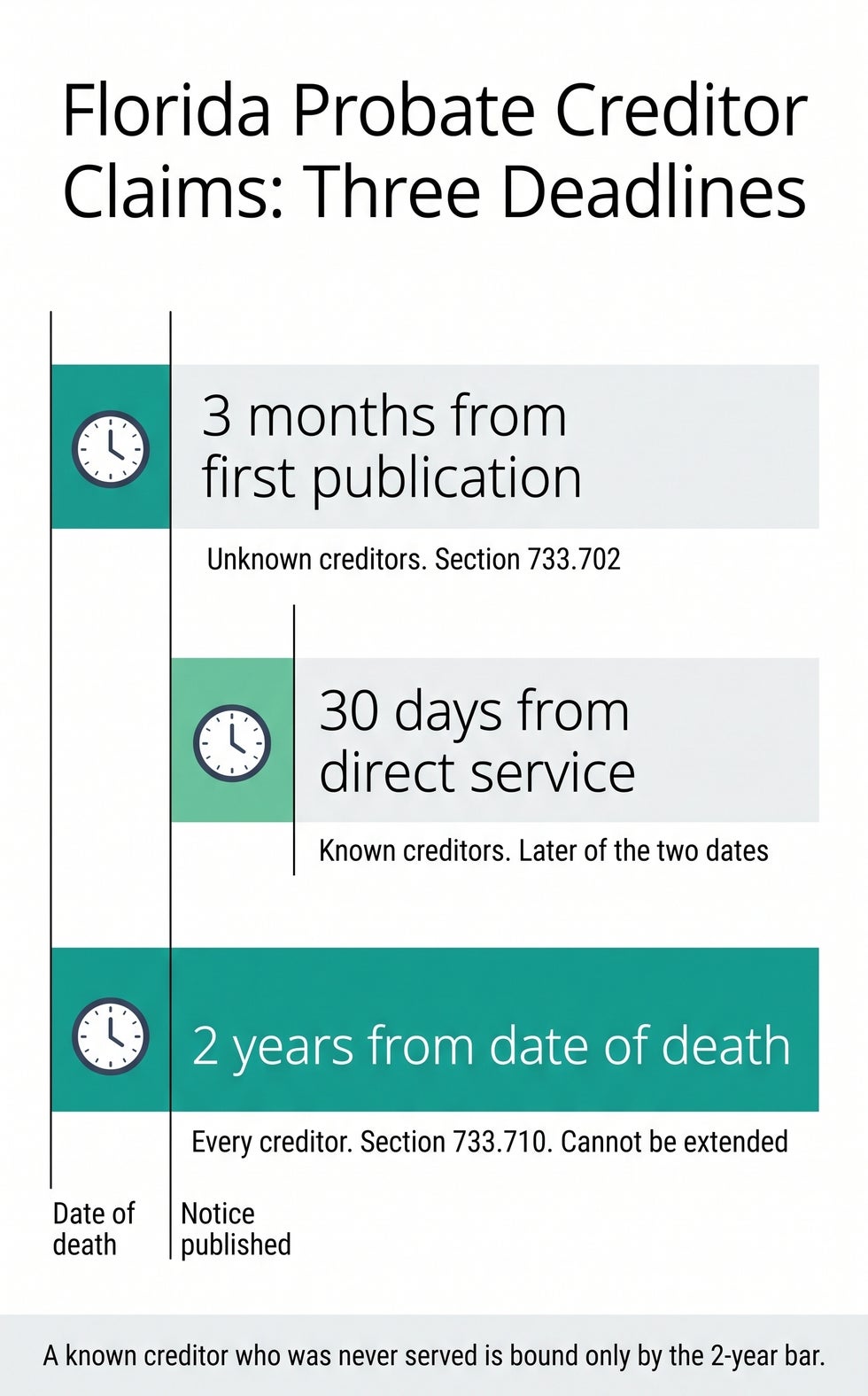
Under Section 733.702, a creditor must file on or before the later of three months after the first publication of the notice to creditors or, for a creditor required to be served, 30 days after the date of service. Section 733.710 then closes every claim two years after the date of death, no matter what.
Those three clocks are the Florida probate claim deadline system, and they interact in ways that surprise both creditors and families.
The Three-Month Deadline After First Publication
Three months after the date of first publication is the deadline for unknown creditors, meaning creditors who were not reasonably ascertainable and therefore were not entitled to direct service. Once the local newspaper runs the notice, those creditors have three months to file with the clerk of court or be barred.
Section 733.702(3) lets the probate court extend the time only for fraud, estoppel, or insufficient notice of the claims period. A creditor who simply did not read the newspaper does not qualify, and the bar is automatic: a late filing is barred even if no one objects to it.
The Thirty-Day Window After Direct Service
A creditor who was served has until the later of the three-month publication deadline or 30 days after the date of service. Serve a hospital on the last day of the third month and it still gets a full 30 days.
Now the trap. If a reasonably ascertainable creditor is never served, the 30-day window never opens and, under Jones v. Golden, the three-month limitations period does not apply to that creditor either. The debt stays collectible until the two-year bar. Service costs a stamp; skipping it can keep the estate open for two years.
The Two-Year Absolute Bar for Creditor Claims
Two years after the decedent's death, neither the estate, the personal representative, nor the beneficiaries are liable for any claim against the decedent, whether or not letters of administration were ever issued. That is Section 733.710, and the Florida Supreme Court described it in Jones v. Golden as a jurisdictional statute of nonclaim that cannot be waived or extended.
Two exceptions survive the two-year mark: a timely filed claim that has not yet been paid or disposed of, and the lien of a recorded mortgage or security interest, together with the right to foreclose it. For a family fielding collection calls three years after a death, this section is often the cleanest answer. Whether the creditor ever filed is a matter of public record, which is the next topic.
What Must a Creditor File, and How?
A creditor must file a written statement of claim with the clerk of court in the probate proceeding. Section 733.703 says so in one sentence and adds that a claimant may not tack a filing charge onto the claim. A demand letter to the family or a bill mailed to the decedent's old address is not a presentation of claims and does not stop the clock.
The statement of claim Florida probate rules require is short. Under Florida Probate Rule 5.490, the creditor files a verified statement giving the basis for the claim, the amount, the creditor's name and address, any security for the claim, and whether the claim is currently due or is unmatured, contingent, or unliquidated. The clerk serves a copy on the personal representative's attorney. A defective filing that still gave fair notice of its substance can be amended with the court's permission, so a technical flaw is rarely fatal. The personal representative has a mirror-image tool: a proof of claim listing every claim the estate has paid or intends to pay, and a creditor named in it is treated as if it had filed.
Once docketed, a claim belongs to the estate administration and preserves the creditor's place in line, nothing more. Section 733.705(1) provides that no personal representative can be compelled to pay the decedent's debts until five months after first publication, which gives the estate time to see every claim before paying any of them. A creditor who sues inside that window without an objection pending recovers no costs or attorney's fees, and a judgment does not move the debt into a higher class. What happens to a claim the estate disputes is next.
What Is the Process for Objecting to a Creditor Claim?
The personal representative or any other interested person may file a written objection to a claim, and the objection must then be served on the claimant. Section 733.705 sets the deadlines on both sides, and they are among the shortest in Florida probate.
An objection to creditor claim Florida law allows must be filed on or before the later of four months from first publication or 30 days from the timely filing or amendment of the claim. Common grounds: the filing is late, the amount is wrong, the debt was already paid, or the decedent had a defense to it during life. Filing claims and objecting to them are mirror images, and filing is only half the step. Section 733.705(2) states that failure to serve a copy of the objection on the claimant constitutes an abandonment of the objection, and the creditor's filing then stands as if no objection existed. Serve the claimant the same day the objection is filed and keep proof of service in the file.
Deadlines and Consequences After an Objection
After service of the objection, the creditor has 30 days to bring an independent action on the claim in the appropriate court, or a declaratory action for an unmatured or contingent claim. Under Section 733.705(5), a creditor who does nothing within that period is barred without further court order, unless the personal representative agreed in writing to an extension before the deadline ran. A lawsuit already pending at death satisfies the requirement if the creditor moves to substitute the personal representative within 30 days.
This is the point where a routine creditor claim becomes estate litigation. Our office handles probate administration, not contested litigation; when a claim heads to an independent action, we coordinate with litigation counsel. Either way, a judgment the creditor eventually wins gives it no priority over others in its class. That class system is the next question.
What Is the Order of Payment for Creditor Claims Under Florida Law?
Section 733.707 requires the personal representative to pay the expenses of administration and the obligations of the decedent's estate in eight classes, in order. The order of payment of debts in Florida probate does not depend on who called first, who sued, or who is most persistent.
When the estate has sufficient assets, the classes barely matter because everyone is paid. When it does not, they decide everything: after a class is paid in full, if the estate cannot pay all of the next class, the creditors in that class are paid ratably in proportion to their respective claims, and every class below receives nothing.
The Eight Classes Under Section 733.707
| Class | What falls in it | Plain-English example |
|---|---|---|
|
1 |
Costs, expenses of administration, and compensation of the personal representative and the attorneys |
Filing fees, the newspaper publication charge, the personal representative's fee, the probate attorney's fee |
|
2 |
Reasonable funeral, interment, and grave marker expenses, capped at $6,000 in aggregate |
The funeral home bill up to $6,000; anything above drops to Class 8 |
|
3 |
Debts and taxes with preference under federal law, Medicaid estate recovery under Section 409.9101, public assistance recovery under Section 414.28, and state claims for unpaid court costs, fees, or fines |
An IRS balance; the AHCA claim for nursing home Medicaid paid after age 55 |
|
4 |
Reasonable and necessary medical and hospital expenses of the last 60 days of the last illness |
The final hospital stay and hospice bills; older medical bills fall to Class 8 |
|
5 |
Family allowance |
Support for a surviving spouse and dependent lineal heirs during administration, up to $18,000 |
|
6 |
Arrearage from court-ordered child support |
Past-due support the decedent owed at death |
|
7 |
Debts acquired after death by continuing the decedent's business, only to the extent of that business's assets |
Payroll for a Cape Coral landscaping company the estate kept running |
|
8 |
All other claims, including judgments rendered against the decedent during life and the excess over the Class 2 and Class 4 caps |
Credit cards, personal loans, medical bills from before the last 60 days, the $3,000 of a $9,000 funeral bill above the cap |
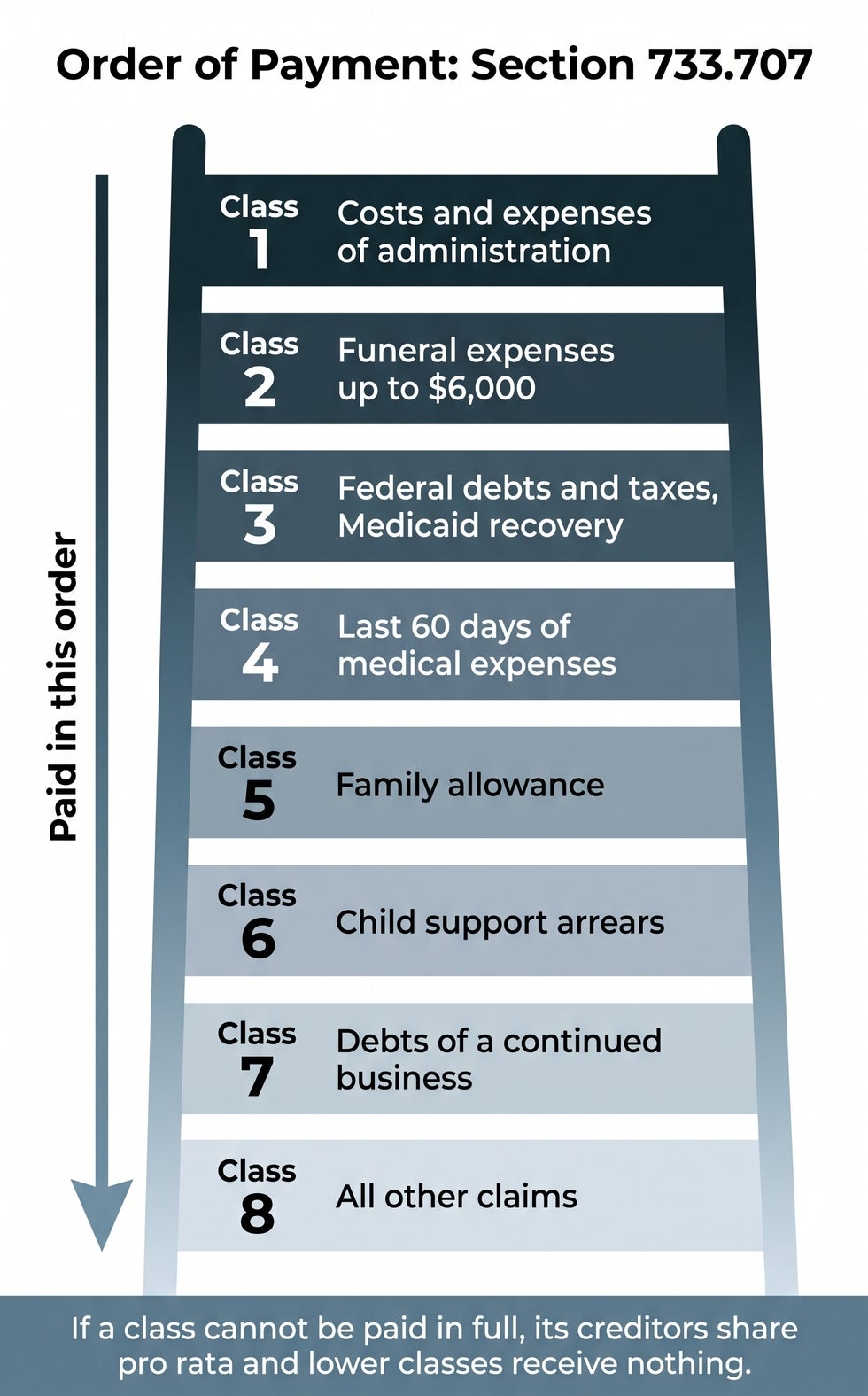
The caps are where families get caught. A $9,000 funeral is a Class 2 claim for $6,000 and a Class 8 claim for $3,000, and in an insolvent estate the $3,000 may never be paid. A hospital bill from a stay four months before death is Class 8, not Class 4. Federal claims, including income tax, outrank everything except administration expenses and the funeral cap, and the Medicaid claim shares Class 3 with them. Family allowance at Class 5 means a surviving spouse's support is paid before the credit card companies but after the IRS and the final hospital bill. Most of what a typical Southwest Florida retiree owed at death is Class 8.
What Happens When There Isn't Enough Money: Insolvent Estate Florida
When valid claims exceed probate assets, the estate is insolvent, and the personal representative pays by class until the money runs out. An insolvent estate Florida law treats no differently in procedure: the notice, the claim window, and the objection process are the same. Only the outcome changes.
The personal representative pays Class 1 in full, then Class 2, and so on until a class cannot be paid in full; that class shares ratably. Suppose after administration expenses, the funeral, and the last hospital bill, $10,000 remains and Class 8 holds $40,000 of credit card and personal loan claims. Each Class 8 creditor receives 25 cents on the dollar, the estate closes, and nothing about that outcome is wrongful. The wrongful version is next.
Personal Representative Liability for Premature Payments
Personal representative liability for debts Florida law imposes is not liability for the decedent's debts as such; it is liability for paying the wrong people or paying in the wrong order. Under Section 733.609, a personal representative's fiduciary duty is the same as a trustee's, and the personal representative is liable to interested persons for damage or loss from a breach, with attorney's fees awarded against the one who breached.
The most common breach is distributing to heirs before the claim period closes, then discovering a valid Class 3 or Class 4 creditor with no money left in the decedent's probate estate. A federal rule is worse: under 31 U.S.C. § 3713(b), a representative who pays any part of a debt of the estate before paying a claim of the United States is personally liable to the extent of that payment. A personal representative who pays the credit cards while an IRS balance sits unpaid has written the government a personal check. Which assets sit outside all of this is the next question.
Which Assets Are Protected From Creditors in Florida Probate?
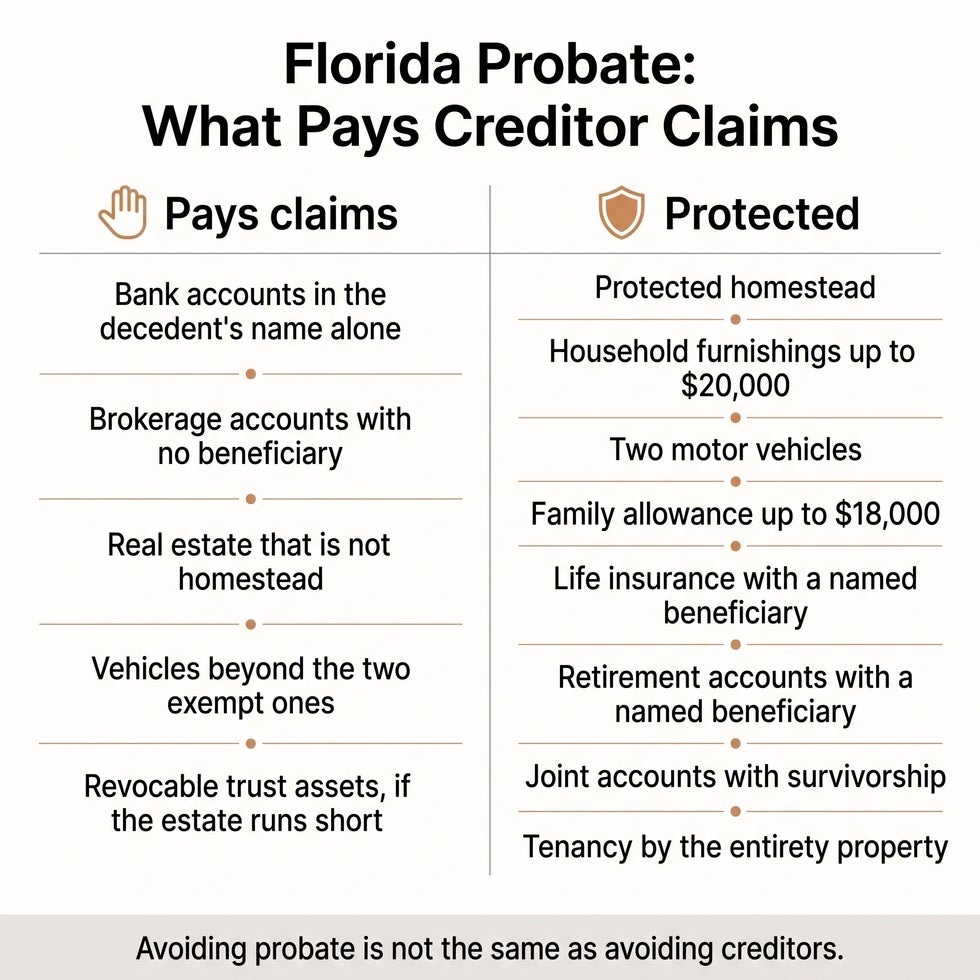
Protected homestead, exempt property, the family allowance, and assets that pass by beneficiary designation or survivorship are beyond the reach of the decedent's general creditors. Those protections come from the Florida Constitution and Chapter 732, and they apply even when the estate is insolvent.
There is a trap inside the good news: avoiding probate is not the same as avoiding creditors, and a revocable trust in particular remains liable for the estate's obligations when the probate estate cannot pay them.
Homestead, Exempt Property, Vehicles, and Family Allowance
Article X, Section 4 of the Florida Constitution exempts the homestead from forced sale for the owner's debts, with three exceptions: taxes and assessments on the property, obligations contracted for its purchase, improvement, or repair, and obligations for labor performed on it. Section 4(b) carries the exemption to the surviving spouse or heirs, so a Fort Myers homestead that descends to the decedent's children passes to them free of the credit card claims; the descent rules are in our post on Florida homestead in probate, and Section 733.607 keeps the personal representative from even taking possession of it.
Section 732.402 adds exempt property for the surviving spouse or, if none, the children: household furniture, furnishings, and appliances in the decedent's usual place of abode up to a net value of $20,000, two motor vehicles under 15,000 pounds regularly used by the decedent or immediate family, Florida Prepaid College and other 529 plans, and the death benefit paid under Section 112.1915 for a teacher or school administrator killed on the job. Exempt property is exempt from all claims against the estate except a perfected security interest on it, so a financed car stays subject to its loan. The right is waived unless a petition to determine exempt property is filed within four months after service of the notice of administration. The two vehicles are why transferring a vehicle title after death so often happens outside the creditor process.
Section 732.403 completes the family protections with the family allowance: a reasonable allowance in money, up to $18,000, for the maintenance of the surviving spouse and the lineal heirs the decedent was supporting, paid during administration and ranked at Class 5. Beyond these, life insurance payable to a named beneficiary, an IRA or 401(k) with a designated beneficiary, a joint account with right of survivorship, a payable-on-death account, and real estate held as tenants by the entirety never enter the probate estate, so the general creditors have no claim process to reach them. The daughter who receives her mother's $150,000 life insurance policy does not hand it to the hospital, even if the estate is insolvent. Our post on assets exempt from probate in Florida lists these categories in detail. One non-probate asset does not enjoy this protection.
The Trap: Revocable Trusts and Non-Probate Assets
A revocable trust does not shield its assets from the settlor's creditors after death. Section 733.707(3) makes any trust the decedent could revoke at death liable for the expenses of administration and the obligations of the estate to the extent the probate estate is insufficient, and Section 736.05053 obligates the trustee to pay the personal representative whatever amount the personal representative certifies in writing is needed.
Creditors still file in the probate proceeding and the personal representative still runs the claim process; the trust is a payor of last resort, not a second target. But a family that moved everything into a living trust to skip probate has not moved it away from the decedent's debts. The trade-offs are covered in our comparison of revocable and irrevocable trusts in Florida. For most readers, though, the real question is about themselves.
Are Family Members Responsible for a Deceased Person's Debts in Florida?
No. In Florida, a family member is not responsible for a deceased person's debts because of the relationship alone. The debts belong to the estate and are paid from probate assets. A relative becomes liable only through a separate legal connection: co-signing the loan, holding the account jointly, or receiving estate property that should have gone to creditors.
The Federal Trade Commission applies the same rule to debt collectors: under the Fair Debt Collection Practices Act a collector may discuss the decedent's debt only with the spouse, the personal representative, or a parent of a minor decedent, and may contact other relatives only to locate one of those people.
Are Children Responsible for a Parent's Debt?
No. The question we hear most, usually typed into a search box as "am I responsible for my parents debt in Florida," has a one-word answer for the child who never signed anything. The creditor's remedy is a claim against the parent's probate estate, on the deadlines above, and if the estate has no reachable assets the creditor recovers nothing.
The exceptions are about the child's own conduct. A child who co-signed a parent's loan owes it as a borrower. A child who was a joint account holder on a credit card owes that account. A child who served as personal representative and distributed assets before paying valid claims can be surcharged under Section 733.609. None of those is inheritance of debt; each is a debt the child took on directly.
Is a Surviving Spouse Responsible?
Usually no. Florida is not a community property state, and a surviving spouse is not liable for the decedent's separate debts by marriage. A spouse who co-signed a mortgage or car loan remains liable on that contract, and a spouse who wants to keep a house or car with a lien on it has to keep paying, but that is the lien, not the marriage.
The spouse also holds the strongest protections in the estate: the homestead passes free of the decedent's general creditors, the exempt property belongs to the spouse first, and the family allowance is paid to the spouse during administration. A widow in Punta Gorda being called about her late husband's credit cards is in a very different position from the one the collector describes.
When a Beneficiary Can Be Made to Give Money Back
A beneficiary can be required to return a distribution that was paid before valid claims and expenses were satisfied. Section 733.812 provides that a distributee who was paid improperly must return the assets or funds received, plus income or interest since the distribution, unless the payment can no longer be questioned because of adjudication, estoppel, or limitations.
Summary administration has its own version. Under Section 735.206, recipients of property under an order of summary administration are personally liable for a pro rata share of all lawful claims against the estate, but only up to the value each actually received, excluding exempt property, and only for two years after death. Because summary administration has no personal representative, the petitioner must search for known creditors and provide for them, and may publish a notice under Section 735.2063 to cut unknown creditors off after three months. See my earlier article, Florida Doubles the Summary Administration Limit to $150,000: What It Means for Lee County Families, for the current threshold. The firm's video What Is Summary Administration? Florida's Short-Form Probate explains when the shortcut fits.
How Are Secured vs. Unsecured Debts Handled in Florida Probate?
A secured creditor keeps its lien on the specific property regardless of the claim process; an unsecured creditor has only the claim process. Section 733.702(4)(a) states that nothing in the claim statute affects a proceeding to enforce a mortgage, security interest, or other lien on property of the decedent, and Section 733.710(3) carries the lien through the two-year bar.
So the mortgage lender on a Cape Coral canal home can foreclose during probate if payments stop, and the credit union with a lien on the truck can repossess it, whether or not either ever files a claim. The estate has three choices with encumbered property: keep paying and keep the asset, sell it and pay the lien from the proceeds, or surrender it. A house with $200,000 of equity gets sold or refinanced; a car worth less than its loan gets surrendered. Families sometimes assume that because no one personally owes the mortgage, the house can be kept without paying it. It cannot.
Distinguishing Claim Priority From Lien Rights
Claim priority and lien rights answer different questions. The order of priority under Section 733.707 decides how the estate's unencumbered assets are divided among claimants. A lien decides who owns a specific asset until a specific debt is paid.
When a family asks whether the mortgage outranks the funeral bill, the honest answer is that they are not in the same contest. The mortgage is paid from the house, or the house goes to the lender. The funeral bill is paid from whatever else the estate holds, at Class 2 up to the cap. A secured creditor whose collateral is worth less than the debt can file for the shortfall, and that shortfall is an ordinary Class 8 claim. One creditor in Class 3 deserves its own section, because it surprises more personal representatives than any other.
How Does Medicaid Estate Recovery Work in Florida?
If the decedent received Medicaid benefits at age 55 or older, the State of Florida has a Class 3 claim against the probate estate for what it paid, and the personal representative must serve the Agency for Health Care Administration with the notice to creditors and a copy of the death certificate within three months after first publication. That is Section 733.2121(3)(d); the claim itself is created by the Medicaid Estate Recovery Act, Section 409.9101.
The Medicaid estate recovery Florida operates is required by federal law, and it produces some of the largest Florida probate creditor claims we see in estates that had a nursing home stay. 42 U.S.C. § 1396p(b) directs every state to seek recovery from the estate of a recipient who was 55 or older when the benefits were paid. AHCA files a statement of claim like any other creditor, and its Florida Medicaid Estate Recovery Program page gives the mailing address for service. Two things make the AHCA filing different: it ranks above the final medical bills and the family allowance, and it arrives late, often after the family assumed the claim period was quiet.
What Assets Are Subject to Medicaid Estate Recovery?
Only probate assets, and not all of them. Section 409.9101(7) provides that the Medicaid debt cannot be enforced against property exempt from creditors' claims under the Florida Constitution or statutes, which keeps protected homestead and exempt property outside its reach. Subsection (6) goes further than the rule for any other creditor: the debt is not enforced at all if the recipient is survived by a spouse, a child under 21, or a child who is blind or permanently and totally disabled.
Subsection (8) adds a hardship waiver the personal representative or an heir can request, for example where an heir lived in the decedent's residence for the 12 months before death and owns no other home, or provided full-time care that delayed a nursing home admission. Where none of those applies and the estate has no cash, subsection (10) requires non-exempt property to be sold to pay the claim. A personal representative who sees any long-term care history should serve AHCA on day one rather than wait for its letter.
What Should the Personal Representative Do in an Insolvent Estate Florida?
Serve everyone, pay no one until the claim window closes, classify every claim, and then pay by class. In an insolvent estate Florida procedure rewards patience and punishes speed, because every early payment may have belonged to a higher class.
The sequence: publish and serve the notice to creditors, including AHCA if the decedent was 55 or older. Calendar the three-month, four-month, and five-month dates from first publication. Review each statement of claim as it arrives, object where there are grounds, and serve every objection. After the window closes, sort the surviving claims into classes, compare the total against the probate assets after exempt property and the family allowance, and prepare a schedule showing what each class receives. Confirm the decedent's federal income tax position and reserve for it first, because 31 U.S.C. § 3713 makes the personal representative personally liable for paying anything ahead of the United States. Only then pay, and only then distribute. A personal representative cannot do most of this without counsel; Florida requires an attorney in nearly every formal administration.
Managing Cents-on-the-Dollar Payments for Class 8 Claims
Class 8 is where the arithmetic gets done. Total the allowed Class 8 claims, divide the remaining assets by that total, and pay each creditor that percentage. Section 733.707(2) requires the ratable split, so paying the most aggressive collector in full and the quiet ones nothing is a breach even if the total paid out is the same.
Document the calculation in the final accounting so every interested person can see it. Class 8 creditors sometimes accept a court-approved compromise under Section 733.708 rather than wait, though no claim can be compromised until the objection period has run. A personal representative who cannot get the numbers to close should not guess; this is where a Florida probate attorney earns the fee, which, as a Class 1 expense, is paid before any of the claims being sorted.
How The Nussbickel Law Firm Handles Creditor Claims
Our office in Fort Myers handles probate administration for families in Lee, Collier, and Charlotte counties, and probate matters statewide. The creditor process is one of the two places where a personal representative's mistakes become personal, so we run it deliberately: a diligent search we can document, direct service on every creditor it turns up, the AHCA notice when the decedent was 55 or older, a calendar of the three-, four-, and five-month dates, an objection served the same day it is filed, and a class-by-class payment schedule before a dollar leaves the estate account. If the estate has not been opened yet, our guide to letters of administration in Florida explains the first step.
We also spend time with the family on the other side of these questions. If you are a child or spouse being contacted about a debt that was never yours, we can tell you in one conversation whether the creditor has a claim against the Florida estate, whether it filed on time, and whether any asset you received is exposed. Consultations are free and can be held by phone, by video, or at our office. Schedule a consultation or call 239-900-WILL (9455).
Conclusion
Florida probate creditor claims follow a fixed sequence: notice, a claim window, an objection window, and payment by class. Creditors who file on time and rank high enough are paid from probate assets; those who file late, or rank too low in an insolvent estate, are not. Every Florida probate creditor claims dispute we see comes back to one of those two facts. Family members who never signed for the debt owe nothing, and the homestead, exempt property, and beneficiary-designated accounts stay outside the process. For a personal representative, the whole job reduces to two disciplines: serve everyone the diligent search finds, and pay no one until the classes are known. If you are handling an estate in Southwest Florida and a claim has arrived, reach out for a free consultation before you write the first check.
Frequently Asked Questions
What happens if a creditor misses the deadline for filing a claim?
The claim is barred. Under Section 733.702(3), a claim not filed on time is barred even if no one objects to it, and the court may extend the deadline only for fraud, estoppel, or insufficient notice of the claims period. A known or reasonably ascertainable creditor who was never served is the exception: that creditor's claim stays alive until two years after the date of death under Section 733.710.
Can secured creditors foreclose or repossess property during probate?
Yes. Section 733.702(4)(a) provides that the claim statute does not affect a proceeding to enforce a mortgage, security interest, or other lien on property of the decedent, and Section 733.710(3) preserves the lien through the two-year bar. A mortgage lender or car lender may foreclose or repossess during probate if payments stop, whether or not it files a claim, and the estate's choices are to pay, sell, or surrender the collateral.
Are any debts automatically forgiven after death in Florida?
No debt is forgiven by the death itself. A debt becomes uncollectible only when the creditor fails to file a timely claim, when the estate has no probate assets reachable by that creditor's class, or when two years pass from the date of death without a claim. Assets that pass outside probate, such as protected homestead, exempt property, and life insurance payable to a named beneficiary, are not used to pay general creditors, which is what makes many debts uncollectible in practice.
Where can I find the official Florida statutes about probate creditor claims?
The creditor provisions governing Florida probate creditor claims are Part VII of Chapter 733, Sections 733.701 through 733.710, published by the Florida Legislature on its Online Sunshine site at leg.state.fl.us. The notice requirements are in Section 733.2121, exempt property and family allowance in Sections 732.402 and 732.403, and the Medicaid claim in Section 409.9101. The Florida Probate Rules, including Rules 5.241 and 5.490 on notice and claims, are published by the Florida Supreme Court.
Who pays the funeral bill in Florida probate?
The estate pays reasonable funeral, interment, and grave marker expenses up to $6,000 as a Class 2 expense under Section 733.707, ahead of every debt except the costs of administration, whether the bill was advanced by the personal representative, a guardian, or a family member. Any amount above $6,000 falls to Class 8, which in an insolvent estate may be paid only in part.
Does the personal representative have to pay claims right away?
No. Section 733.705(1) provides that no personal representative can be compelled to pay the decedent's debts until five months have passed from the first publication of the notice to creditors, and all claims are to be paid within one year of first publication unless the court extends the time or the claim is in litigation, unmatured, or contingent. Waiting until the claim window closes is not delay; it is the procedure.
Gregory J. Nussbickel is the attorney at The Nussbickel Law Firm, P.A., in Fort Myers, Florida, where his practice is limited to estate planning and probate and trust administration.
This article is general information about Florida law and is not legal advice for any particular situation. Statutes and thresholds change; verify current law or speak with a Florida probate attorney before acting.

Comments
There are no comments for this post. Be the first and Add your Comment below.
Leave a Comment