

Key Highlights
- International estate planning Florida families need begins with one rule: the state where property sits controls how that property transfers at death, no matter what a foreign will says.
- A nonresident who dies owning a Cape Coral condo generally triggers ancillary administration under Chapter 734 of the Florida Statutes, and the heirs cannot sign a deed until the court acts.
- Under Fla. Stat. § 732.502(2), a will signed abroad is honored if it was valid where executed, but holographic and nuncupative wills are expressly carved out.
- A person who is not a U.S. citizen or domiciliary is exposed to federal estate tax on U.S. assets above $60,000, against $15,000,000 for a citizen in 2026.
- The unlimited marital deduction is unavailable when the surviving spouse is not a U.S. citizen unless the property passes through a qualified domestic trust under IRC § 2056A.
Introduction
The short answer: International estate planning Florida residents need starts with a hard fact. Florida law, not your home country's law, decides what happens to your Florida real estate when you die, and federal tax law decides what it costs. Coordinating those two systems with the rules of wherever else you or your family live is the whole job.
If you own a home in Cape Coral and a flat in Manchester, or you are a green card holder in Naples with a brother inheriting in São Paulo, a single set of documents drafted for one country will not carry you. Neither will a Florida will that ignores what happens abroad. This guide walks through the specific places where cross-border families get caught here, and what to do about each one.
What Are the Key Considerations for International Estate Planning in Florida?
Cross-border families face a set of unique challenges that purely domestic families never encounter, and six of them drive almost every international estate planning Florida matter that comes through our Fort Myers office: which court has jurisdiction, whether the will is valid here, how much federal estate tax the estate owes, whether the marital deduction survives, how homestead applies, and whether the foreign documents contradict the Florida ones. Get those six right and the rest usually follows.
The families affected are the ordinary ones here: second-home owners from abroad, green card holders with assets back home, couples where one spouse never naturalized, and parents whose children settled overseas. The goal in each case is a plan that works in every place the family actually touches, with as little court involvement as possible.
Common Pitfalls for Florida Owners with International Ties
The recurring failures are mismatched documents, avoidable probate delays, tax exposure nobody modeled, and confident assumptions about foreign law that turn out to be wrong here. We see the same four in rotation:
- Assuming the children can list and sell the Florida house once a death certificate is in hand
- Assuming a will drawn up by a notary in Munich or Milan automatically controls Florida real property
- Naming an executor who is legally incapable of serving under Florida law
- Treating estate tax and treaty questions as something to handle later, when later means after death
Any one of these can add months and real money to an estate administration. Two or three together can defeat the plan entirely, which is why it helps to be precise about what this planning actually covers.
What Is International Estate Planning and Who Needs It in Florida?
International estate planning Florida clients need is the coordination of state law, federal tax rules, and foreign inheritance systems so that one estate plan produces the intended result in every jurisdiction where your assets and family members sit. The practical work is inventorying assets on both sides of the border, pinning down citizenship, residency, and domicile, and then matching wills, trusts, deeds, powers of attorney, and beneficiary designations across those systems.
Domicile deserves a moment, because it drives the tax analysis and people routinely misjudge it. Citizenship is your legal nationality. Residence is where you live. Domicile is the one place you treat as your true home with no present intention of leaving, and for federal estate tax purposes it is domicile, not a visa category, that determines whether a deceased individual is taxed on worldwide assets or only on U.S. ones. Nearly all cross-border tax planning starts by settling that question.
Profiles of Foreign Nationals and Global Families in Lee and Collier County
Southwest Florida draws a particular kind of owner. Seasonal residents from Ontario and Quebec with a canal home in Cape Coral. German and British buyers in Naples and Bonita Springs holding a second home that doubles as rental property in the off season. Buyers from South America who purchased through an entity on someone's advice years ago. And longtime Fort Myers residents who still own the family apartment in Europe, or business interests there, and have never told anyone about it.
What they get wrong tends to be structural rather than exotic. No Florida documents at all, on the theory that the home-country will covers everything. No thought given to who will actually be appointed here. No analysis of what a surviving non-citizen spouse inherits, or at what cost. The first of those shows up the moment somebody dies owning real property in this state.
How Does Florida Ancillary Administration Work When a Nonresident Dies Owning Florida Property?
When someone who lived outside this state dies owning Florida real estate, a Florida court almost always has to be involved before title can move, even if a full estate administration is already running in Toronto or London. Fla. Stat. § 734.102 calls this ancillary administration, often shortened to ancillary probate, and it applies to any nonresident who dies leaving assets, credits due from residents, or liens on property here. The probate process is the same one Florida families go through, run for a decedent who lived somewhere else.
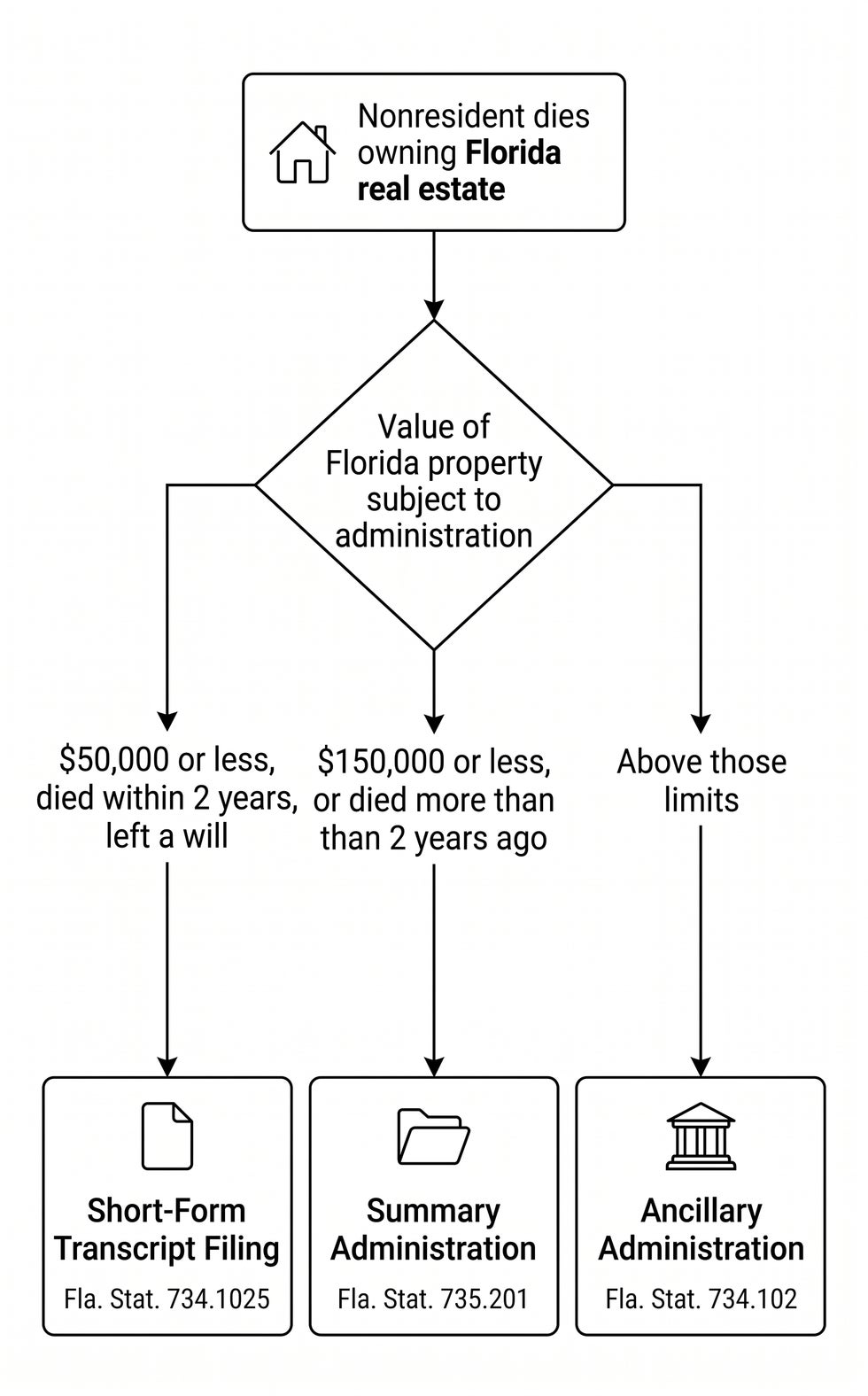
The statute sets an order of preference for who gets ancillary letters. A personal representative named in the will specifically to administer the Florida property comes first, if that person is qualified to act here. Otherwise the foreign personal representative may serve, again only if qualified. If neither works, an alternate named in the will may be appointed, and failing that, the beneficiaries holding a majority interest in the Florida property can select someone. The ancillary personal representative then has the same authority as any other personal representative in this state to sell, lease, or mortgage the local property, and must serve and publish a notice to creditors under Chapter 733.
Two shorter routes exist and are worth checking before anyone files a full administration. Summary administration under Fla. Stat. § 735.201 is available for a resident or nonresident decedent when the estate subject to administration here, less exempt property, does not exceed $150,000, a figure the Legislature doubled from $75,000 effective July 1, 2026. Separately, Fla. Stat. § 734.1025 lets a foreign personal representative of a nonresident who died with a will file an authenticated transcript of the foreign proceedings, within two years of the death, when the Florida property is worth no more than $50,000. Note the mismatch: the summary administration ceiling doubled in 2026, while the nonresident short-form threshold has sat at $50,000 since 2003.
Why Families Cannot Simply Sell Florida Real Estate and the Role of Chapter 734 Procedures
Title does not pass in a way that lets heirs sell, because nobody living has authority to sign the deed. A deceased person cannot sign one. The children are not on title. A Florida title company will not insure a transfer without a court-recognized source of authority, which in practice means an open probate administration, and no reputable buyer closes without title insurance.
That is the entire function of the Chapter 734 process: it produces letters from the probate court that a title company will accept. Families who skip it discover the problem at the worst moment, usually with a signed contract, a closing date, and a buyer who walks. If the estate also has to sell rather than distribute, remember that the buyer of a U.S. real property interest from a foreign seller must generally withhold 15% of the amount realized under the FIRPTA rules the IRS describes here, reported on Form 8288 within 20 days of the transfer. For a walkthrough of how a second administration works in practice, see the firm's video What Is Ancillary Administration in Florida Probate?.
Whether any of this is needed at all depends first on whether the will works here.
Will My Foreign Will Be Valid and Enforceable in Florida?
Often yes, but there is a significant exception that catches European and Canadian families constantly. Under Fla. Stat. § 732.502(2), a will executed by a nonresident of this state is valid here if it was valid under the law of the state or country where it was signed. That is a generous rule, and it saves most properly executed foreign wills.
The exception is the problem. The statute excludes holographic and nuncupative wills from that saving rule. A holographic will is one written and signed entirely in the testator's own hand without the witnessing formalities. An oral, or nuncupative, will is spoken. Both are recognized in a number of civil law jurisdictions and neither is rescued by Florida's foreign-will provision, however valid it may be at home. Our own execution requirements are covered in more detail in my earlier article, Florida Will Requirements.
Special Issues with Handwritten and Holographic Wills from Civil Law Countries
A handwritten will that a German, French, or Quebec court would admit without hesitation can fail completely as to Florida assets. That is not a technicality; it is the difference between your children inheriting the Fort Myers house under your will and inheriting it under Florida's intestacy statutes, which may distribute it to people you did not choose.
One nuance matters and is easy to miss. Section 732.502(2) also provides that a will in the testator's own handwriting which was executed with the formalities required by subsection (1), meaning signed at the end in the presence of two attesting witnesses who signed in the presence of the testator and of each other, is not treated as a holographic will. Handwriting alone does not doom the document. The absence of the two witnesses does.
The practical fix is usually a short Florida will covering only the Florida assets, drafted so it does not revoke the home-country will. Coordination is essential, because a poorly drafted revocation clause in either document can wipe out the other. The firm's video Is an Out-of-State Will Valid in Florida? covers the same ground for readers who prefer to watch. Once you know the will works, the next question is who the court will let serve.
Who Is Permitted to Serve as Personal Representative for an International Florida Estate?
Not everyone you name can serve, and the restriction is about domicile rather than citizenship. Fla. Stat. § 733.304 provides that a person not domiciled in this state cannot qualify as personal representative unless that person is an adopted child or adoptive parent of the decedent, related by lineal consanguinity, a spouse, brother, sister, uncle, aunt, nephew or niece of the decedent or someone related by lineal consanguinity to one of those people, or the spouse of a person otherwise qualified.
Read that list closely, because the common assumption runs in the wrong direction. A brother in Munich or a sister in Toronto is expressly qualified. A lifelong best friend in Munich is not. Neither is a business partner, a stepchild who was never adopted, an unmarried partner, a cousin, or a foreign bank. Families are often surprised in both directions, naming a sibling they assumed was barred while relying on a trusted friend who cannot serve.
Citizenship is a separate question and, on this point, a non-issue. Fla. Stat. § 733.303 lists who is disqualified: a person convicted of a felony, a person convicted of abuse, neglect, or exploitation of an elderly person or disabled adult, a person mentally or physically unable to perform the duties, and anyone under 18. Citizenship appears nowhere. A non-citizen domiciled in Fort Myers can serve.
Whoever ends up appointed will also need counsel in most cases, a point worth reading about separately if you are weighing whether a probate attorney is required. The firm's video Who Can Be Personal Representative in Florida? The Rules walks through the eligibility rules in plain English.
Practical Solutions When Your Executor Lives Abroad
When the person you want is disqualified, there are three workable answers. Name a qualified Florida resident as personal representative and let your overseas choice hold a different role, such as trust protector or a beneficiary with consent rights. Name a qualified relative from the statutory list who happens to live abroad, which the statute permits. Or move the assets out of probate altogether so that a successor trustee, who faces no residency restriction at all, does the work instead.
That third option tends to be the strongest for cross-border families, and it solves several other problems at the same time. Before getting there, though, the tax picture has to be on the table.
What Tax Rules Apply to Nonresident Aliens and U.S. Citizens with Foreign Assets in Florida?
The answer turns almost entirely on one question: was the person a U.S. citizen or domiciliary, or not. A citizen or domiciliary is taxed on worldwide assets with a large exclusion. A nonresident who is not a citizen is taxed only on U.S.-situated assets, but with an exclusion so small that ordinary Southwest Florida real estate clears it easily.
Florida itself imposes no state estate tax and no inheritance tax, which is one reason people move here in the first place. So everything in this section is federal.
The $60,000 Estate Tax Exemption Trap for Nonresident Aliens
For 2026 the federal estate tax exemption for a U.S. citizen or domiciliary is $15,000,000, raised by Public Law 119-21 and published by the IRS here. A nonresident who is not a citizen gets a unified credit of $13,000 under IRC § 2102(b)(1), which shelters roughly $60,000 of U.S.-situated assets. Above that threshold, Form 706-NA is required and the amount of estate tax owed runs as high as 40%.
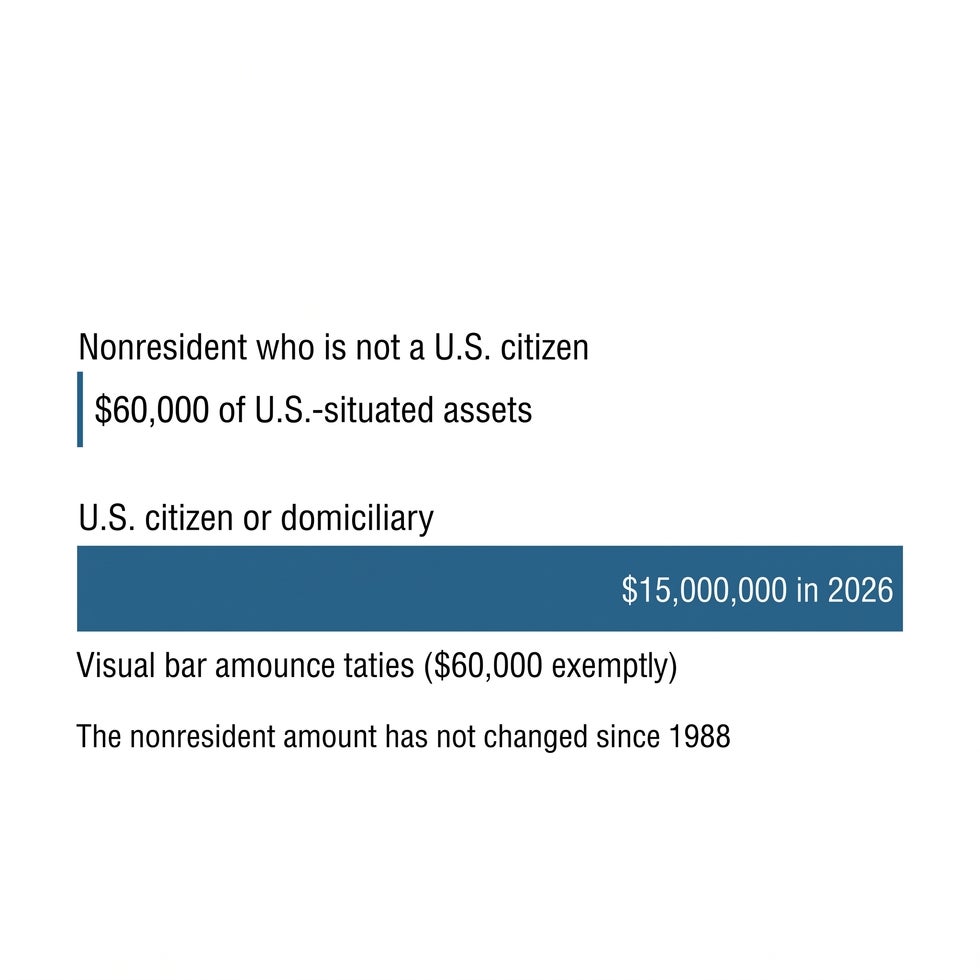
Two features make this worse than the headline number suggests. First, the $13,000 credit is not indexed for inflation and has not changed since 1988, so it erodes every year while property values rise. Second, a nonresident who is not a citizen cannot make a portability election, so there is no way to capture a deceased spouse's unused amount. A Naples condo bought at $700,000 is already more than ten times over the line, and the family often learns this only when the estate cannot close.
Planning here is done in advance or not at all. Depending on the facts that can mean an irrevocable trust established before the purchase, a structure that changes the property's situs, qualified debt against the property, or life insurance to fund the liability rather than avoid it. Each carries income tax and capital gains consequences that need modeling alongside the estate tax result.
U.S. Situs Assets and Florida Real Estate: A Side-by-Side Comparison Table
Situs is what decides whether an asset falls inside the U.S. taxable estate for a nonresident who is not a citizen, and the categories are not intuitive. The IRS guidance on the U.S.-situated gross estate sets out which assets count, valued at their fair market value at the time of death. Real property, tangible assets physically located here, and certain intangibles all fall inside the net.
| Asset | Nonresident who is not a U.S. citizen | U.S. citizen or domiciliary |
|---|---|---|
|
Florida real estate |
U.S. situs, fully includible |
Includible in the worldwide taxable estate |
|
U.S. corporate stock |
U.S. situs, includible even if held abroad |
Includible |
|
Tangible property located in Florida |
U.S. situs, includible |
Includible |
|
U.S. bank account not tied to a U.S. trade or business |
Generally excluded |
Includible |
|
Foreign real property and foreign accounts |
Generally outside the U.S. taxable estate |
Includible |
|
Exclusion available |
$60,000 of U.S.-situated assets |
$15,000,000 in 2026 |
|
Portability of a spouse's unused exclusion |
Not available |
Available by timely election |
The line that surprises people most is the third from the bottom. A foreign national's uninvested cash at a Fort Myers bank generally sits outside the U.S. taxable estate, while the same money in U.S. corporate stock sits squarely inside it. Where the client's home country enters a treaty with the United States, though, these defaults can shift.
How Do Estate Tax Treaties Affect Florida International Estate Plans?
A treaty can change the outcome substantially. Depending on its terms it may substitute a pro-rata share of the full unified credit for the flat $13,000, reallocate taxing rights between the two countries, or exempt particular assets from U.S. estate tax altogether. Treaty positions are claimed on Form 706-NA with a Form 8833 disclosure attached, and the estate generally must also supply a copy of the return filed with the treaty partner.
Which Countries Have Treaties with the United States?
Only fifteen. The IRS list of estate and gift tax treaties covers Australia, Austria, Canada, Denmark, Finland, France, Germany, Greece, Ireland, Italy, Japan, the Netherlands, South Africa, Switzerland, and the United Kingdom. Canada is a special case: its estate tax provisions live in Article XXIX B of the United States and Canada income tax treaty rather than in a standalone estate tax treaty.
For Southwest Florida that list is unusually favorable, since Canadian, German, and British buyers make up a large share of the foreign ownership in Lee and Collier counties. It is also incomplete in ways that matter. Mexico and Brazil are not on it. Neither are most countries in South America or Asia. Do not assume coverage because your country has an income tax treaty with the United States, and do not assume the two systems line up: many countries impose an inheritance tax on the recipient rather than an estate tax on the estate, so a foreign tax credit may not offset cleanly and double taxation is a live risk.
What Happens to a Non-Citizen Spouse and the Unlimited Marital Deduction?
The unlimited marital deduction is not available when the surviving spouse is not a U.S. citizen. IRC § 2056(d) states it plainly: if the surviving spouse is not a citizen, no marital deduction is allowed, and the favorable rule in section 2040(b) that treats spousal joint property as half-owned by each spouse also does not apply.
That second consequence deserves attention in this market, because so many couples here hold the home jointly. Without section 2040(b), the full value of jointly held property is pulled into the first spouse's estate unless the survivor can actually document their own contribution to the purchase. For a couple who bought a Bonita Springs house together but paid from one account, that proof can be hard to produce years later, and it interacts with the spousal rights every married couple in this state has.
The QDOT Solution Explained for Florida Estates
Congress supplied a fix. Property that passes to a qualified domestic trust qualifies for the marital deduction even though the surviving spouse is not a citizen. IRC § 2056A sets the requirements: the trust instrument must require at least one trustee to be an individual U.S. citizen or a domestic corporation, and must provide that no distribution other than income may be made unless that trustee has the right to withhold the tax on it.
What the trust actually does is defer, not forgive. The surviving spouse can receive all the income for life with no estate tax on those distributions, and hardship distributions of principal are also untaxed. But other distributions of principal during the spouse's life, and whatever remains in the trust when the spouse dies, are subject to estate tax computed as though the property had stayed in the first spouse's estate. Each trustee is personally liable for that tax, which is why the U.S. trustee requirement is not a formality.
Three practical points close the loop. The election is made by the executor on the estate tax return, it is irrevocable, and it cannot be made on a return filed more than one year after the due date including extensions. Property can also be moved into a qualifying trust after death, so long as it is transferred or irrevocably assigned before the return is filed. And under section 2056(d), if the surviving spouse becomes a U.S. citizen before the return is filed and was a U.S. resident at all times from the date of death until naturalization, the ordinary marital deduction applies and no trust is needed at all. For couples already on that path, timing the naturalization against the return deadline is worth real money.
Can Non-Citizens Qualify for Florida Homestead Protection and Tax Exemptions?
Sometimes yes and sometimes no, because homestead in this state means two different things and a foreign owner can easily qualify for one and not the other. One is a constitutional protection that runs with the property. The other is a property tax break that runs with the owner's residency.
Creditor Protections vs. Homestead Tax Exemptions for Foreign Buyers
Constitutional homestead under Article X, Section 4 of the Florida Constitution does two jobs: it shields the residence from most creditors, which is the asset protection side of homestead, and it restricts how the owner may leave it. Fla. Stat. § 732.4015 carries out the second part, providing that homestead may not be devised at all if the owner is survived by a spouse or a minor child, except that it may go to the spouse when there is no minor child. Importantly, the statute defines "owner" to include the grantor of a revocable trust and "devise" to include a disposition by trust, so routing the house through a trust does not sidestep the restriction.
The property tax exemption is a different animal. Fla. Stat. § 196.031 grants it to a person who, on January 1, holds legal or beneficial title and in good faith makes the property their permanent residence, worth $25,000 plus an additional $25,000 on assessed value above $50,000 for non-school levies. The statute says nothing about citizenship. It says a great deal about permanence, and subsection (6) disqualifies anyone claiming a residency-based tax benefit in another state.
| Constitutional homestead | Property tax exemption | |
|---|---|---|
|
Source |
Art. X, § 4, Fla. Const.; § 732.4015 |
§ 196.031 |
|
Turns on |
The property being the owner's residence |
Permanent residence as of January 1 |
|
Citizenship required |
No |
No |
|
Effect |
Creditor protection plus limits on who may inherit |
Reduces assessed value for tax purposes |
|
Typical snowbird result |
Often available |
Usually not available |
For a Canadian couple who spend four months a year in Cape Coral and claim a residency-based benefit back home, the tax exemption is almost certainly out of reach while the devise restriction may still bind them. Our fuller treatment of the subject is in the article on Florida homestead probate.
How Do Forced Heirship Laws in Civil Law Countries Affect Florida Estate Planning?
A Florida will does not reliably control property located in a civil law country, because many of those countries reserve a fixed share of an estate for particular relatives regardless of what the document says. These compulsory-share or forced heirship rules commonly protect children and a surviving spouse, and they typically apply to real property situated within that country no matter where the owner lived or what their Florida plan directs.
The result is a plan that reads as coherent on paper and splits in two at death. A Fort Myers resident who leaves everything to a second spouse may find the apartment in Spain passing partly to children from a first marriage by operation of local law. Nothing in Florida law changes that outcome, because the foreign court is applying its own rules to property inside its own borders.
Using Situs-Specific Wills to Minimize Conflict and Double Probate
The standard answer is a set of situs-specific documents: one will or trust plan governing Florida and other U.S. assets, and a separate instrument prepared under local law for each country where you own real property. Each document is drafted to the formalities of its own jurisdiction, which sidesteps the recognition problem entirely.
The discipline this requires is in the drafting, not the concept. Each instrument must be expressly limited to the assets in its jurisdiction, and each revocation clause must be narrowed so it does not cancel the others. A boilerplate "I revoke all prior wills" in a document signed in Madrid can quietly destroy the Florida will signed two years earlier. Use local counsel in each country, and have someone read all the documents together before anyone signs.
How Can Florida Residents Avoid Double Probate on International Estates?
The most reliable tool is a funded revocable living trust holding the Florida real estate, because trust property is not part of the probate estate and passes to the successor trustee without a court order. That single move eliminates the ancillary administration described earlier, removes the section 733.304 residency restriction on who can act, and keeps the transfer private.
Funding is what makes it work, and it is where plans most often fail. A trust that exists on paper but never took title to the Cape Coral house accomplishes nothing at all. The deed has to be recorded into the trust, and beneficiary designations on life insurance, retirement accounts, and bank accounts have to be reviewed so they agree with the plan rather than quietly overriding it. The firm's video What Is a Revocable Living Trust in Florida? explains how the mechanism works.
For the broader menu of methods, see my earlier article, How to Avoid Probate in Florida.
The Role of Revocable Trusts and Entity Ownership
For a U.S. citizen or domiciliary, a revocable trust is usually the clean answer, and the assets that already pass outside probate can carry much of the rest. For a foreign national, the analysis is different, because a revocable trust does nothing to reduce the U.S. taxable estate. The property is still U.S. situs, still counted, still over the $60,000 line.
That is why some foreign buyers hold U.S. real estate through a foreign corporation or a layered structure. Sometimes that genuinely changes the situs result. Often the tax implications run the other way, creating income tax, capital gains, and reporting burdens that cost more than the estate tax the structure was meant to avoid, and arrangements set up a decade ago under different rules may no longer do what the owner thinks. If you own Florida property through an entity, have it reviewed rather than assumed, and expect the review to reach into business law as well as estate planning. Where an irrevocable structure is on the table, the tradeoffs between revocable vs. irrevocable trusts are the place to start.
What happens when none of this is done is illustrated in the firm's video Florida Estate With Out-of-State Real Estate: A Second Probate.
Whatever structure you choose, the documents have to agree with each other. Deeds and ownership records, the Florida will and trust, powers of attorney, beneficiary designations, foreign property records, and identity documents all need to tell one story. Good titling is what turns an estate plan into a result.
Conclusion
International estate planning Florida families rely on is less about exotic structures than about making sure four systems agree: Florida probate law, federal transfer tax, your home country's inheritance rules, and the way your assets are actually titled today. The recurring failures are ordinary. A holographic will that cannot be admitted here. An executor the court will not appoint. A $60,000 exemption nobody mentioned. A jointly titled house that loses its favorable treatment because one spouse never naturalized.
Every one of those is fixable with proper planning and expensive to fix afterward. If you own property in more than one country, or your spouse or children hold a different passport than you do, the plan you have is worth a second look.
Talk to a Southwest Florida Estate Planning Attorney
The Nussbickel Law Firm, P.A. practices estate planning, probate, and trust administration exclusively. From our Fort Myers office we work with families throughout Lee, Collier, and Charlotte counties, including Cape Coral, Estero, Bonita Springs, Sanibel, Punta Gorda, and Naples, and we handle probate matters state-wide. Virtual appointments are available for clients anywhere, which matters when half the family is in another time zone.
International estate planning Florida families need is a regular part of that work: foreign wills tested against this state's execution requirements, ancillary administrations for owners who never lived here, trusts built so a Cape Coral house never sees a courtroom, and plans for couples holding different passports. Where a matter needs foreign counsel or a cross-border tax specialist, we say so and coordinate rather than guess. What an experienced estate planning attorney adds here is mostly judgment about which of these problems your situation actually has.
Schedule a free consultation or call our Fort Myers office at 239-900-WILL. Bring whatever you have, including documents in another language, and we will tell you plainly what works here and what does not. If you are comparing law firms, a useful question to ask any of them is whether they have actually handled a Florida ancillary administration for a decedent who lived abroad.
Frequently Asked Questions
Do I need a specialized attorney for international estate planning in Florida?
In most cross-border situations, yes. Your plan has to satisfy Florida probate law, federal transfer tax rules, and the inheritance law of at least one other country at the same time. Foreign will recognition, homestead, personal representative eligibility, QDOT planning, and treaty analysis each turn on details that general estate planning does not reach. Expect your Florida attorney to coordinate with counsel in the other country rather than opine on foreign law alone.
What documents are required to plan my international estate in Florida?
Usually a Florida will, a revocable living trust where probate avoidance is the goal, a durable power of attorney, health care documents, deeds reflecting the intended titling, and current beneficiary designations. Add a situs-specific will for each foreign country where you own real property. What matters is coordination, not volume: a small set of documents that agree with one another beats a thick binder that contradicts itself.
Are there ways to preserve wealth and minimize taxes for cross-border families in Florida?
Yes, though nearly all of them require action while everyone is living. The usual levers are checking treaty coverage before assuming the default rules apply, reducing exposure to U.S. situs assets where that is feasible, QDOT planning for a non-citizen spouse, timing naturalization when it is already in progress, funding a trust so the estate never reaches probate, and using life insurance to pay a liability that cannot be eliminated. Which combination fits depends on domicile, citizenship, and where the assets sit.
Gregory J. Nussbickel is the founder of The Nussbickel Law Firm, P.A. in Fort Myers, Florida. His practice is devoted exclusively to estate planning, probate, and trust administration for families throughout Southwest Florida.
This article is provided for general informational purposes only and is not legal advice, tax advice, or a substitute for either. Reading it does not create an attorney-client relationship. Tax laws and inheritance laws change, cross-border rules vary by country, and every estate is different; speak with a licensed Florida attorney about your specific situation.

Comments
There are no comments for this post. Be the first and Add your Comment below.
Leave a Comment