

Losing a parent or spouse is hard enough without also wondering which of their accounts and belongings your family can reach right away, and which sit frozen until a court signs off.
The short answer: The assets that are exempt from probate in Florida fall into two overlapping groups. First are non-probate assets that pass automatically at the time of death by title or contract — jointly owned property with survivorship rights, accounts with a named beneficiary or payable-on-death designation, life insurance and retirement funds, and property held in a revocable living trust. Second is statutory exempt property under Fla. Stat. § 732.402 — household furniture up to a set net value, two motor vehicles, and certain college-savings and death benefits — which passes to the surviving spouse or children shielded from most creditor claims. Anything titled in the decedent's name alone, with no beneficiary and no survivorship, is what actually lands in probate.
Key Highlights
- Non-probate assets pass outside court entirely. Jointly owned property, payable-on-death and transfer-on-death accounts, life insurance, retirement funds, and revocable living trust assets transfer to the surviving owner or named beneficiary automatically, without probate proceedings.
- Florida homestead property generally is not part of the probate estate. A protected primary residence passes to the surviving spouse or heirs under the Florida Constitution and Fla. Stat. § 732.401, outside the reach of most claims of creditors.
- Statutory exempt property is protected for the family. Under § 732.402, household furniture up to a $20,000 net value, two personal motor vehicles, qualified tuition programs, and certain death benefits pass to the surviving spouse or children ahead of creditors.
- A will does not make assets exempt from probate in Florida. A valid will directs that court process; it does not avoid it. Only titling, beneficiary designations, or a funded trust keep an asset out of the court process.
- The family allowance offers immediate relief. Florida's family allowance statutes let the court award up to $18,000 to the surviving spouse and the decedent's lineal heirs during the period of administration of the estate.
Introduction
When someone dies owning assets in the State of Florida, not everything they owned has to pass through the courthouse. In this blog post we walk through exactly which assets are exempt from probate in Florida, which ones still go through the court process, and the common mistakes that accidentally pull an otherwise-protected asset back into the court process. The goal is peace of mind: understanding how title and beneficiary choices decide what your family can reach quickly, and what has to wait.
Everything below reflects the Florida Probate Code and related Florida statutes. It is written for families across Southwest Florida — Fort Myers, Cape Coral, Naples, and beyond — and for the many out-of-state families who own a second home or accounts here, from the Gulf Coast to Palm Beach. During the administration of an estate, these rules decide what reaches members of the decedent's family quickly and what waits on the court.
What Is Probate in Florida?
Probate is the court-supervised process for settling a deceased person's affairs — proving any valid will, appointing a personal representative, paying valid debts, and transferring what remains to the right people. It only reaches assets titled in the decedent's name alone, with no beneficiary and no surviving co-owner.
Florida law offers more than one path. A full formal administration applies to larger estates. Summary administration is a faster track for smaller estates — available up to a $150,000 probate estate after a 2026 change — and disposition without administration under Fla. Stat. § 735.301 skips court entirely when a decedent leaves only exempt property plus enough to cover the funeral and last illness. Which path fits depends on what the decedent owned and how it was titled.
Probate Assets vs Non-Probate Assets: What's the Difference?
The difference comes down to one question: does the asset carry its own instructions for who inherits at the date of death? If it does — a beneficiary form, a survivorship deed, a trust — it is a non-probate asset and moves automatically. If it does not, it is a probate asset and needs a court order or letters of administration to move title out of the name of the decedent.
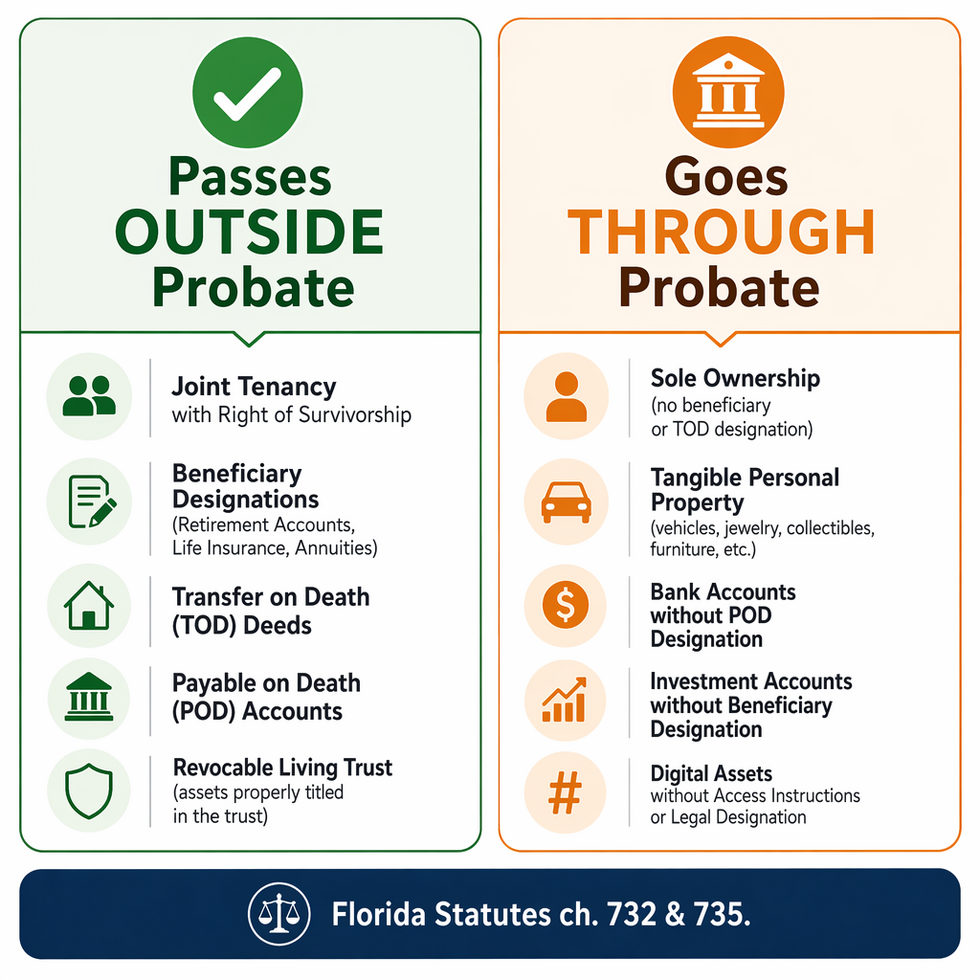
| Passes outside probate (non-probate) | Goes through court |
|---|---|
|
Accounts with a payable-on-death or transfer-on-death designation |
Bank or investment accounts in the decedent's sole name |
|
Life insurance and retirement funds with a living named beneficiary |
Life insurance payable to the estate |
|
Jointly owned property with right of survivorship |
Real estate titled to the decedent alone or as tenants in common |
|
Property owned by spouses as tenants by the entireties |
Personal property with no beneficiary or survivorship |
|
Assets held in a revocable living trust |
A solely owned vehicle with no joint owner |
The Florida Bar's consumer pamphlet, Probate in Florida, draws the same line: assets that carry a survivorship or beneficiary feature transfer automatically, making court administration unnecessary for them.
What Assets Are Exempt From Probate in Florida?
The assets that are exempt from probate in Florida generally break into the categories below. Most are exempt because they pass by title or contract; one category — statutory exempt property — is protected by the Florida statutes for the surviving family members even when it would otherwise be a court-administered asset.
1. Assets With Named Beneficiaries
Any asset with a valid beneficiary designation pays directly to that person and skips the probate process. The most common examples:
- Life insurance policies with a living named beneficiary (not the estate)
- Retirement accounts such as IRAs, 401(k)s, and pensions
- Payable-on-Death (POD) bank accounts
- Transfer-on-Death (TOD) investment accounts
Because a beneficiary form is a contract, it overrides the will for that asset. As Kiplinger explains, a transfer-on-death registration lets a brokerage account pass directly to your heirs and bypass probate. The catch is that the form only works if it is current — more on that below.
2. Jointly Owned Property
Property held with a right of survivorship passes to the surviving owner the instant the other owner dies, with nothing for the court to administer.
- Joint tenancy with right of survivorship (JTWROS)
- Tenancy by the entireties for married couples, which also carries creditor protection during life
- Common examples include real estate, bank accounts, and vehicles held this way
One caution: how the deed or account is worded controls everything. "Joint tenants with right of survivorship" survives; plain "tenants in common" does not.
3. Florida Homestead Property
Florida homestead property — a decedent's primary residence within the constitutional acreage limits — generally is not a court-administered asset and enjoys strong homestead exemption protection from the claims of creditors. Under Fla. Stat. § 732.401 and Article X, Section 4 of the Florida Constitution:
- The homestead passes to a surviving spouse or qualified heirs, often by a short court order confirming its status rather than a full administration
- A surviving spouse who inherits a homestead may take a life estate, or elect an undivided one-half interest as a tenant in common
- The homestead is shielded from most creditor claims, preserving the family's financial stability
Homestead has its own quirks, especially for blended families. Our related guide on Florida homestead probate walks through them.
4. Statutory Exempt Personal Property
Even when property would otherwise be court-administered, § 732.402 sets aside certain exempt property for the surviving spouse or children, protected from most claims of creditors. The statute — amended through 2016 and unchanged since — lists:
| Exempt property under § 732.402 | Limit / detail |
|---|---|
|
Household furniture, furnishings, and appliances in the decedent's usual place of abode |
Up to a $20,000 net value as of the date of death |
|
Two motor vehicles |
Each held in the decedent's name and regularly used as personal motor vehicles by the decedent or immediate family; not over 15,000 pounds gross vehicle weight |
|
Qualified tuition programs |
All 529 college-savings and prepaid plans authorized under s. 529 of the Internal Revenue Code |
|
Death benefits for educators |
Benefits paid for teachers and school administrators killed in the line of duty |
This exempt property passes ahead of general creditors, and it is what makes a Florida Prepaid College Plan or 529 savings plan set aside for a child's college tuition, or a family car, reachable quickly — part of the decedent's assets the law steers to the family first. For the vehicles themselves, our guide on transferring a vehicle title in Florida probate covers the clerk process. The law builds in such safeguards so a grieving household is not stripped of its basics; each such motor vehicle and the household furniture move to the family, not the creditors.
5. Assets Held in a Revocable Living Trust
Assets you transfer into a revocable trust during life are owned by the trust, not by you individually, so they never enter your probate estate. At death, the successor trustee distributes them under the trust terms — privately, without probate proceedings, and usually far faster than a court administration. This is why a funded revocable living trust is the centerpiece of most probate-avoidance plans. The key word is funded: a trust only helps with assets actually retitled into it.
6. Situations Where Probate May Still Be Required
Exempt categories are not automatic in every case. Court administration may still be required when:
- A beneficiary designation is missing or the named person has died
- Property is titled incorrectly — sole name instead of joint, or a trust that was signed but never funded
- Blended-family or homestead complications cloud who inherits and require a court to confirm the status of the homestead
What Assets May Still Go Through Probate in Florida?
If an asset has no beneficiary, no surviving joint owner, and no trust behind it, it is a court-administered asset. These are the usual reasons an estate ends up in court.
1. Solely Owned Assets Without Beneficiaries
Anything in the decedent's name alone, with no transfer instructions, must pass through court:
- Individual bank accounts
- Real estate owned in one person's name
- Personal property without transfer designations
2. Why Tenants in Common Often Trigger Probate
When two people own real property as tenants in common, there is no right of survivorship. The deceased owner's share does not transfer automatically to the co-owner; instead, that share becomes part of the probate estate and usually requires a court proceeding to move it to the heirs. This surprises many co-owners who assumed joint ownership always avoids court.
3. Assets With Missing or Invalid Beneficiary Designations
A beneficiary form only works if it is valid and current. Assets fall back into court when there are:
- Outdated beneficiaries (an ex-spouse, or someone who has died)
- No contingent beneficiary listed
- The estate named as the beneficiary
4. Assets Not Properly Transferred Into a Trust
A revocable trust protects only what it owns. Property left outside a revocable living trust, or untitled and forgotten assets that were never moved in, remain part of the probate estate. We see this often: a well-drafted trust, and a house or brokerage account that never made it into the decedent's name as trustee.
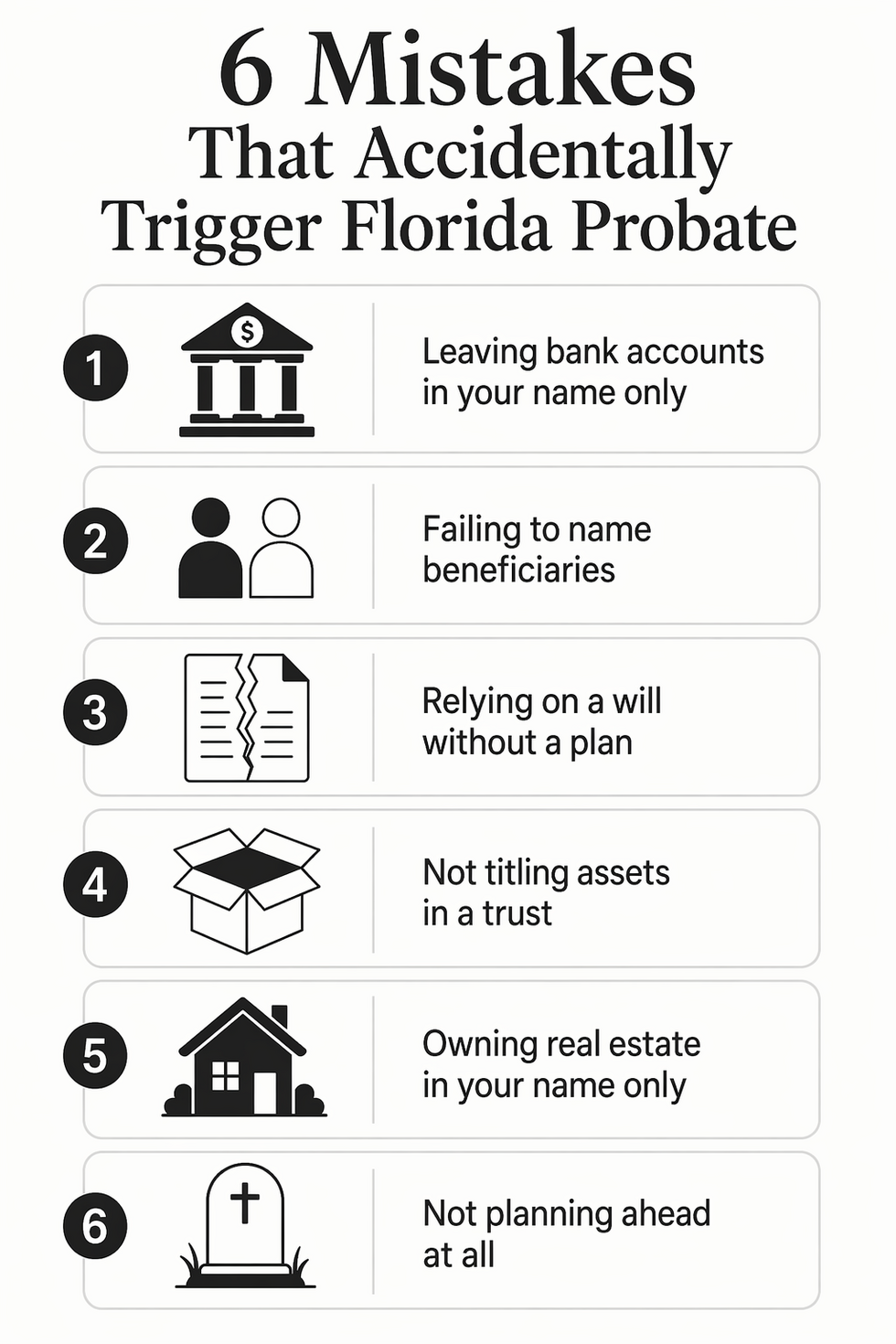
What Are The Common Mistakes That Accidentally Trigger Probate in Florida?
Most court administration that could have been avoided traces back to a handful of ordinary mistakes. Each one quietly converts a non-probate asset into a probate asset.
1. Forgetting to Add Payable-on-Death (POD) or Transfer-on-Death (TOD) Beneficiaries
A bank account or brokerage account with no POD or TOD beneficiary is court-administered by default. Adding one takes a short online form or a branch visit, and it converts the account into a non-probate asset that pays the decedent's beneficiaries directly.
2. Using Convenience Accounts or Adding Co-Owners Incorrectly
Adding an adult child as a joint owner "for convenience" can backfire — exposing the account to that child's creditors during life, and sometimes defeating the estate plan when the funds pass by survivorship instead of under the will. A POD designation usually accomplishes the goal without the risk.
3. Common Problems With DIY Estate Planning Documents in Florida
A will or trust downloaded from an online form and signed without Florida-specific witnessing can be worthless. Florida law has strict execution rules, and a document that fails them is treated as if it never existed.
How Invalid Estate Documents Can Trigger Probate Delays
If a will's validity is challenged and it cannot be proven, the estate passes under intestacy instead — often to different people, after months of extra litigation over the validity of the will. A trust that is signed but not properly funded leaves its assets in court. What looked like a bargain becomes the most expensive part of the estate.
4. Failing to Properly Fund a Revocable Living Trust
The single most common trust mistake is never retitling assets into it. An unfunded trust controls nothing, and the assets it was meant to hold pass through court anyway.
5. Retitling Real Estate Incorrectly
A deed with the wrong wording — or a homestead deeded in a way that violates Florida's restrictions on devising homestead — can pull real property into court or trigger a dispute. Real estate is the asset where titling mistakes cost the most.
6. Failing to Plan
Probate is a given if you don't plan at all...or if your planning documents get lost or destroyed. Florida presumes a will that cannot be found was revoked. If only a copy survives, the family must overcome that presumption in court — a real fight. Our guide to proving a lost will in Florida explains the process. Store the signed original somewhere safe and tell your personal representative where it is.
How to Avoid Probate in Florida?
You avoid probate by making sure every asset either passes by title, passes by beneficiary, or sits inside a funded trust — before death, not after. Our overview of the top ways to avoid Florida probate covers the full toolkit; the essentials are below.
1. Use Payable-on-Death (POD) and Transfer-on-Death (TOD) Designations
Add a POD designation to bank accounts and a TOD registration to investment accounts. It is free, reversible, and keeps the money out of court.
2. Create a Revocable Living Trust
A revocable trust lets a successor trustee distribute your assets privately, and it handles real estate and out-of-state property cleanly. Weigh it against a simple will using our guide on revocable versus irrevocable trusts — but note a revocable trust only works once it is funded.
3. Review and Update Beneficiary Designations Regularly
Beneficiary forms are the most-overlooked part of a plan. Kiplinger catalogs the beneficiary-designation mistakes that quietly derail estates — outdated names, no contingent beneficiary, or naming the estate. Review yours after every marriage, divorce, birth, or death.
4. Use Joint Ownership Carefully
Survivorship titling avoids court, but joint ownership with the wrong person creates gift, creditor, and control problems. Use it deliberately — most often between spouses as tenants by the entireties — not as a shortcut.
5. Consider Florida Homestead and Lady Bird Deed Planning
A Lady Bird deed (enhanced life estate deed) lets a Florida homeowner keep full control during life and pass the primary residence to heirs at death without court administration. It is a favorite tool for Southwest Florida homesteads and pairs naturally with the homestead protections already in Florida law.
6. Keep Estate Planning Documents Properly Stored and Updated
The best plan fails if no one can find it. Keep signed originals secure, keep a simple list of accounts and beneficiaries, and refresh the plan as the laws of Florida and your family change.
7. Work With a Florida Estate Planning or Probate Attorney
Titling, homestead, and trust funding are where do-it-yourself plans break. A Florida attorney makes sure each asset actually lands where you intend — and that a document meant to avoid probate does not accidentally trigger it. For broader context, Kiplinger's overview of keeping assets out of probate tracks closely with how we plan in Florida.
How The Nussbickel Law Firm Helps Families Protect Assets From Unnecessary Probate
The Nussbickel Law Firm, P.A. handles estate planning, probate, and trust administration exclusively — it is the whole practice, not a sideline. From our Fort Myers office we help families across Lee, Collier, and Charlotte counties structure ownership so the right assets stay exempt from probate, and we guide personal representatives through administration when the court process is unavoidable.
In planning, that means getting titling, beneficiary designations, homestead, and trust funding right so your family is not surprised later. In administration, it means sorting probate assets from non-probate assets, claiming exempt property and the family allowance where they apply, and moving the estate through the court efficiently. If a small-estate shortcut like summary administration fits, we will tell you plainly. Schedule a consultation or call our Fort Myers office.
Conclusion
Whether an asset is exempt from probate in Florida is decided long before anyone reaches the courthouse — by how it is titled and who is named on it. Non-probate assets and statutory exempt property go to your family quickly; solely owned assets with no beneficiary do not. A little planning now, reviewed as circumstances change, is what spares your family the cost and delay of probate during an already difficult time. If you are unsure where your assets stand, a short review with a Florida attorney will tell you exactly what would pass outside court and what would not.
FAQs
What assets are exempt from probate in Florida?
Non-probate assets — jointly owned property with survivorship, accounts with a payable-on-death or beneficiary designation, life insurance, retirement funds, and revocable living trust assets — pass outside probate. So does statutory exempt property under § 732.402 and, generally, Florida homestead property.
Do life insurance policies go through probate?
Life insurance with a living named beneficiary pays directly to that person and does not go through probate. A policy only becomes a court matter when the named beneficiary has died with no contingent listed, or when the estate itself is named as the beneficiary on the policy.
Are retirement accounts subject to probate in Florida?
Usually not. IRAs, 401(k)s, and pensions pass by beneficiary designation directly to the named person, outside the probate estate. They fall into court only if the beneficiary designation is missing, outdated, or names the estate.
Does jointly owned property automatically avoid probate?
Only if it carries a right of survivorship. Joint tenancy with right of survivorship and tenancy by the entireties pass to the surviving owner automatically. Property held as tenants in common has no survivorship, so the decedent's share still goes through the court process.
Can Florida homestead property pass to heirs without probate?
Generally yes. Florida homestead property usually passes to the surviving spouse or heirs outside the general probate estate and protected from most creditor claims, though a short court proceeding is often used to confirm the status of the homestead and clear title.
What happens if a beneficiary designation is outdated?
An outdated form controls anyway. The asset pays the person listed — even an ex-spouse — or, if that person has died with no contingent named, it may default into court administration. Reviewing beneficiary designations regularly is the fix.
Do assets in a living trust avoid probate?
Yes, if the trust is funded. Assets retitled into a revocable living trust are distributed by the successor trustee without probate. Assets you intended for the trust but never retitled remain part of the estate.
What mistakes can accidentally cause assets to go through probate?
Forgetting POD or TOD beneficiaries, naming the estate as beneficiary, letting designations go stale, titling real estate incorrectly, signing a trust but never funding it, and losing the original will are the mistakes that most often pull assets back into court.
Gregory J. Nussbickel is the founder of The Nussbickel Law Firm, P.A. in Fort Myers, Florida. His practice is devoted exclusively to estate planning, probate, and trust administration for families throughout Southwest Florida.
This article is provided for general informational purposes only and is not legal advice. Reading it does not create an attorney-client relationship. Estate law changes, and every estate is different — speak with a licensed Florida attorney about your specific situation.

Comments
There are no comments for this post. Be the first and Add your Comment below.
Leave a Comment