
Key Highlights
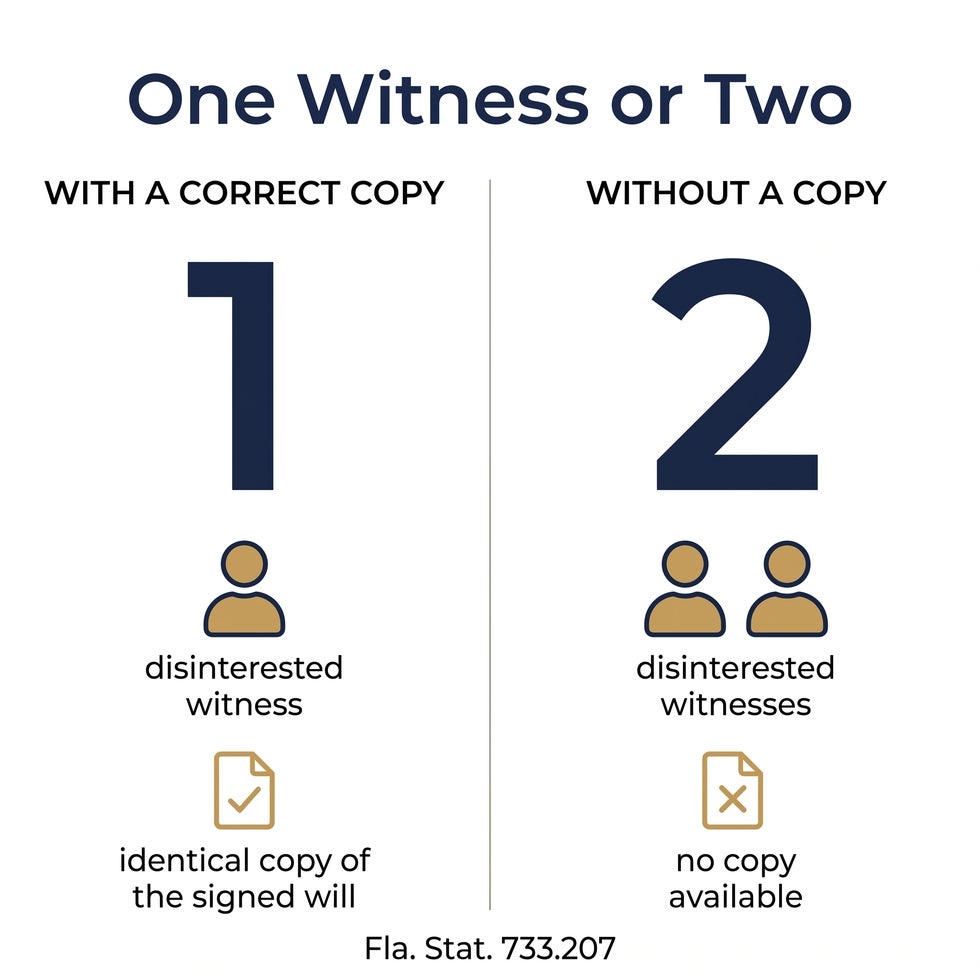
- A lost will Florida courts will still admit is one whose contents are proved under Fla. Stat. § 733.207: two disinterested witnesses, or one disinterested witness plus a correct copy.
- When an original will cannot be found after death and was last in the testator's hands, Florida courts presume it was destroyed with the intent to revoke it. The presumption is rebuttable.
- The standard for rebutting that presumption is competent substantial evidence, restated by the Fifth District Court of Appeal in February 2026.
- A photocopy alone never opens a probate. The custodian must deposit the original with the clerk within 10 days of learning of the death (§ 732.901).
- If the petition fails, the estate passes under Florida's intestate succession rules as though no will had ever been signed.
Introduction
The short answer: yes, a lost will can still be probated in Florida. Under the lost will Florida statute, if the original cannot be found, an interested person may file a petition to establish lost will terms and offer the will for probate under Fla. Stat. § 733.207. You must prove the specific content of the will through the testimony of two disinterested witnesses, or through one disinterested witness if you can hand the court a correct copy. You must also overcome a presumption that a will last seen in the testator's possession was destroyed on purpose.
Why Is the Original Will So Important in Florida Probate?
The original matters because Florida law treats the signed paper itself as the last will and testament, and everything else as evidence about it. Under Fla. Stat. § 732.901, whoever holds the original must deposit it with the clerk of the circuit court where the estate will be administered within 10 days after learning of the death, along with the date of death or the last four digits of the testator's Social Security number. There is no fee to deposit, and the clerk must preserve the original for at least 20 years.
A copy of a will Florida clerks receive without an original does not start a probate. The clerk cannot admit it, a judge cannot sign an order on it, and a bank will not release an account on the strength of it. This is where the probate process for a lost original will diverges from an ordinary estate: before anyone is appointed personal representative, the court has to decide whether there is a will at all. For a plain-English overview of the ordinary path, see the firm's video What Is Probate in Florida? A Plain-English Explanation.
Before filing anything, search. In our experience the original turns up more often than families expect, and every place on this list is checked routinely in Lee, Collier and Charlotte counties:
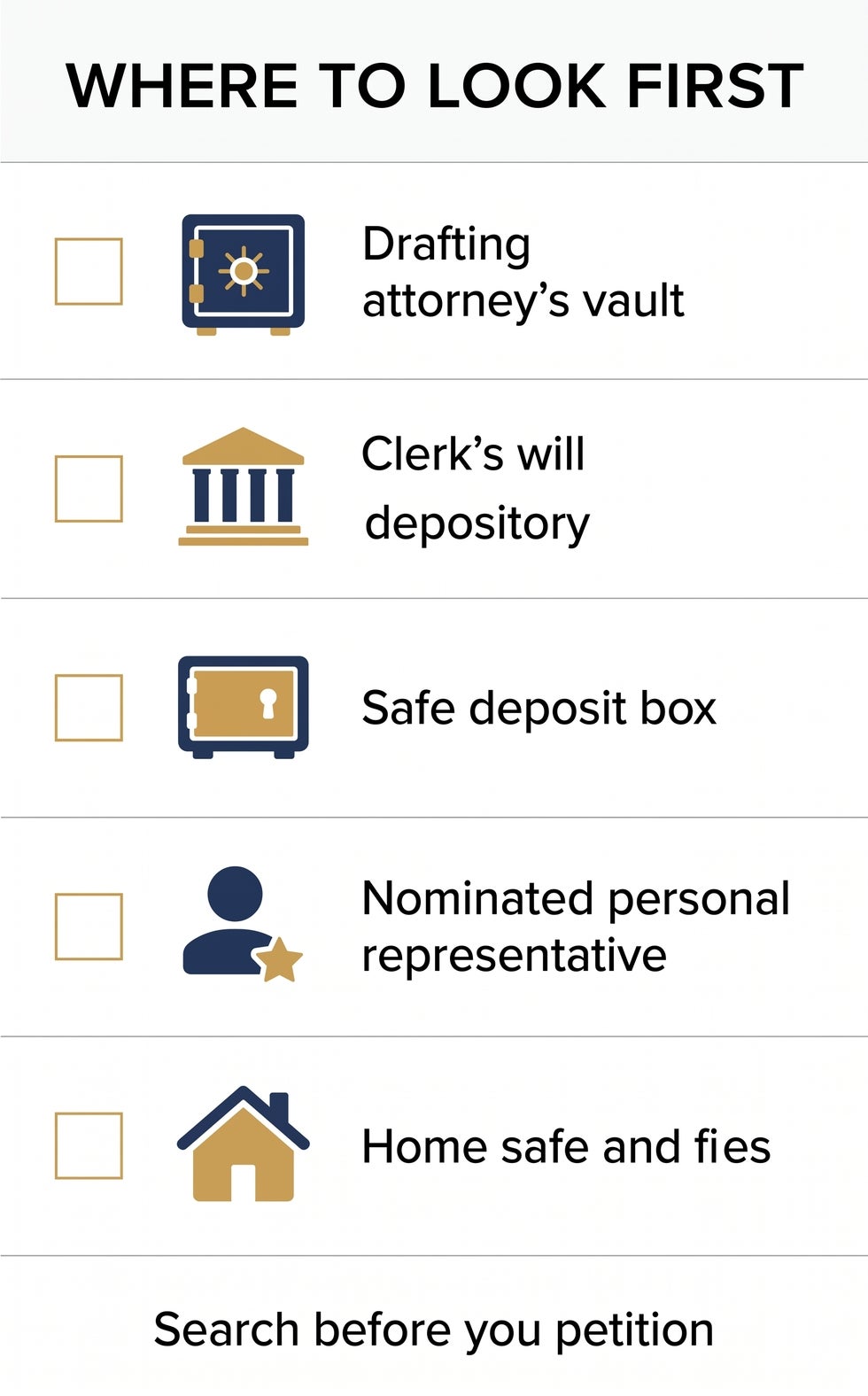
- The drafting attorney's file. Many Florida firms keep original wills in a vault. If the attorney has retired or died, The Florida Bar can often identify who took over the files.
- The clerk's will depository. Some testators deposit a will for safekeeping during life. Under § 732.901(4) the clerk keeps it in original form for 20 years, so ask the Lee County Clerk's probate department (or the Collier or Charlotte clerk) whether one is on file.
- A safe deposit box. Fla. Stat. § 655.935 lets a spouse, parent, adult descendant, or the person named as personal representative in a copy of a purported will open the box with a bank officer present. Any writing that looks like a will goes straight to the probate court in the county where the bank sits.
- The nominated personal representative and close family members. The person the copy names often holds the original without realizing its significance.
- The home itself, including fire safes, filing cabinets, and the pockets of family Bibles. Real estate that has changed hands since the death is worth a call to the new owner.
If the search comes up empty, the law shifts from "where is it" to "why is it missing," which is the presumption discussed next.
What Is the Presumption of Revocation for a Lost Will in Florida?
The presumption of revocation Florida courts apply is this: when a will known to have existed cannot be found after death, and it was last in the testator's possession, the law presumes the testator destroyed it intending to revoke it. The Fifth District Court of Appeal restated the rule in Pilak v. Reigel, No. 5D2025-0269 (Fla. 5th DCA Feb. 6, 2026), tracing it back through Brennan v. Honsberger (2012), In re Estate of Hatten (2004), In re Parker's Estate (1980) and In re Washington's Estate (1952).
The logic is simple. People who change their minds about a will often tear it up rather than write a new one, so a missing original is treated as a deliberate act until someone proves otherwise. Some Florida courts, including the Fourth District in Balboni v. LaRocque (2008), have emphasized that the presumption depends on evidence the will was actually in the testator's possession before death. Pilak treated that factor as beside the point: even where the presumption never arises, the proponent still has to satisfy the Florida lost will statute. In other words, the presumption is the first hurdle a lost will Florida courts see, not the only one.
Two things follow for a family holding a copy. First, the burden is on you, not on the relatives who would inherit without the will. Second, the burden is met with competent substantial evidence, the standard the Fifth District applied in both Brennan and Pilak. That is a lower bar than the clear and convincing evidence standard the Legislature reserved for proving that an electronic will was revoked by act. Evidence that has carried the day in reported cases includes proof the testator did not have custody of the original, proof a person with an adverse interest had access to it, and statements the testator made shortly before death treating the will as current. How that evidence is presented is governed by the statute itself.
How Can You Prove a Lost Will in Florida Probate Court?
You prove a lost will in Florida probate court by establishing its "full and precise terms" through disinterested testimony, exactly as § 733.207 prescribes. Families asking how to probate a lost will in Florida usually expect a form; the statute gives them a witness requirement instead. The Florida statute is one sentence long, and every word of it is load-bearing: any interested person may establish the terms of a lost or destroyed will and offer it for probate, and the specific content of the will must be proved by two disinterested witnesses, or by one disinterested witness if a correct copy of the will is provided.
Those are the only two routes. There is no third path built on affidavits from people who watched the signing but never read the document; the Fifth District rejected exactly that in Brennan v. Estate of Brennan (2010) and again in Pilak, where the sole witness was a beneficiary who admitted he knew nothing about the contents of the will. The lost or destroyed will Florida courts admit is one whose text a qualified witness can actually vouch for.
Proving the contents is also separate from proving execution. A self-proved will carries its own proof of signing under Fla. Stat. § 732.503, and § 733.201 allows the oath of an attesting witness, or of the nominated personal representative or a disinterested person when the witnesses cannot be found. A copy of a self-proving affidavit helps with that half of the case; it does not excuse the § 733.207 witness requirement. The execution formalities themselves are covered in our earlier article, Florida Will Requirements, and in the firm's video What Is a Will? Florida Will Requirements Explained.
The Two Ways to Prove a Lost Will
| With a correct copy | Without a copy | |
|---|---|---|
|
Witnesses required |
One disinterested witness |
Two disinterested witnesses |
|
What "copy" means |
An identical copy, such as a photocopy, carbon, or scan of the signed original (In re Estate of Kero, Fla. 4th DCA 1992) |
None available; an unsigned draft is not a correct copy |
|
What the witness must know |
That the copy is a correct copy of the will the testator signed |
The specific content of the will, from personal knowledge |
|
Typical witness |
The drafting attorney or paralegal who kept the file copy |
The drafting attorney plus a second person who read the executed will |
|
Common failure |
Witness saw the signing but cannot vouch for the text |
Only one knowledgeable witness can be found |
Either route also has to clear the revocation presumption, so the witness list usually includes someone who can explain why the original is gone.
What Evidence and Steps Are Needed to Establish a Lost Will?
A lost will Florida petition needs three kinds of evidence: proof of the terms of the will, proof it was validly executed, and proof it was not revoked. The first comes from your § 733.207 witnesses. The second comes from the self-proving affidavit or an attesting witness under § 733.201. The third is whatever rebuts the presumption: the testator's statements, the chain of custody, or the event that destroyed the paper.
Assemble the copy first. Confirm it is an identical copy of the signed instrument, not an earlier draft or a conformed copy with typed names in the signature blocks. Then identify who can testify, keeping in mind that Fla. Stat. § 733.107 places the initial burden of proving formal execution on the person offering the will in any contest.
Who Is a Disinterested Witness?
A disinterested witness is someone with no stake in the outcome, the definition the Second District gave in Smith v. DeParry (2012) and the Fifth District applied in Pilak. A beneficiary under the will is interested. So are the heirs who would take under intestacy if the will fails, which is why in Pilak the decedent's niece and nephews could not supply the missing testimony. The drafting attorney, the attorney's staff, and a neighbor who read the will at the testator's request are the classic disinterested witnesses. A witness also has to know the contents of the will; a disinterested stranger who saw only the signature page adds nothing.
Once the witnesses are lined up, the petition itself is governed by a court rule rather than the statute.
What Does the Petition Process Involve Under Florida Probate Rule 5.510?
Florida Probate Rule 5.510 requires the establishment and probate of a lost or destroyed will to happen in one proceeding, and it sets out what the petition, the testimony, the notice and the order must contain. In practice this means the petition to establish lost will terms is filed with, or as part of, the petition for administration, not after the estate is already open.
The petition must recite everything an ordinary petition for administration recites, plus a statement of the facts constituting the grounds for relief (how the will was lost or destroyed, and why it was not revoked) and either a statement of the contents of the will or, if available, a copy attached. The testimony of each witness must be reduced to writing and filed, so it survives if the witness later dies or leaves the state.
Formal notice is the step families most often underestimate. Rule 5.510(d) forbids admitting a lost will unless formal notice has been given to everyone who would inherit the property if the will did not exist. That means the intestate heirs, who are frequently the very people the will disinherited, receive formal service and a chance to object. If they do object, the matter becomes a contested evidentiary hearing; if they consent, the hearing is usually short. Consents that were never filed with the court, or that were withdrawn before the petition was filed, do not substitute for the statutory proof, as the trial court in Pilak learned on reversal.
Finally, the order admitting the will must state its terms and provisions in full. Since there is no original to attach, the order becomes the will for every later purpose, and the court will not sign it unless the terms are proven with precision. With the order entered, letters of administration issue and the estate proceeds like any other. What counts as a good reason for the original being missing is the next question.
Can Events Like Hurricanes, Floods, or Fire Rebut the Missing Will Presumption?
Yes. Evidence that the original was destroyed by an event rather than by the testator's hand is exactly the kind of proof that rebuts the presumption, because the presumption rests on the inference of an intentional destruction of a will. A hurricane, a house fire, or a burst pipe supplies a competing explanation that a court can weigh.
Southwest Florida has a recent and painful example. Hurricane Ian made landfall near Cayo Costa in Lee County at 3:05 p.m. on September 28, 2022, as a Category 4 storm with sustained winds near 150 miles per hour, about 20 miles from both Fort Myers and Punta Gorda. Ground-floor rooms from Fort Myers Beach to Bonita Springs took storm surge, and the papers kept in them were lost along with everything else. A will that was in a flooded home safe on Estero Island that afternoon was not revoked; it was destroyed.
Proving that requires more than saying "the storm took it." Useful evidence includes the testator's statements about where the will was kept, photographs of the damaged room or safe, insurance claims or FEMA records that document the loss of contents, and testimony from whoever cleaned out the property. The same approach applies to a fire, a flood, or a moving company that lost a box. The goal is to give the judge specific facts that make accidental loss more likely than a deliberate act, which is the line the statute on revocation draws.
What Does "Revocation by Act" Mean Under Florida Law?
Revocation by act means the testator, or someone acting in the testator's presence and at the testator's direction, physically destroyed the will intending to revoke it. Fla. Stat. § 732.506 names six acts: burning, tearing, canceling, defacing, obliterating, or destroying the will with revocatory intent.
Intent is the whole test. A will torn in half by a grieving spouse looking for the deed is not revoked. A will that dissolved in floodwater is not revoked. A will the testator fed into a shredder after a falling-out with a child is revoked, even if a perfect copy sits in the attorney's file. This is why the presumption exists at all: when the original vanishes from the testator's own possession, the law infers the shredder rather than the flood, and the family must supply evidence of the flood.
For electronic wills the statute is stricter. An electronic will is revoked by deleting, canceling, rendering unreadable, or obliterating it with revocatory intent, and the revocation must be proved by clear and convincing evidence. That is the only place in the lost-will framework where the Legislature wrote the higher standard, which matters when you decide which kind of administration to open.
Is a Lost Will Always Admitted Through Formal Administration?
Not by the letter of any statute, but formal administration is the vehicle the Rule 5.510 procedure is built for, and it is how a lost will Florida judges admit is nearly always presented. The rule requires a petition with a statement of the facts, formal notice to the intestate heirs, live testimony reduced to writing, and an order reciting the will's terms. That is an evidentiary proceeding, and formal administration under Chapter 733 gives it a personal representative, a case number, and a judge to hear it.
The two small-estate shortcuts fit poorly. Disposition without administration under Fla. Stat. § 735.301 never admits a will at all, so it cannot establish one. Summary administration under Fla. Stat. § 735.201 is available for estates of $150,000 or less, or where the decedent has been dead more than two years, and in a testate estate only when the will does not direct otherwise. Nothing in § 735.201 forbids pairing it with a lost-will petition, but whether a particular judge will hear a § 733.207 petition inside a summary proceeding depends on the county and the specific facts. Ask that question before filing, not after.
What makes a lost-will probate different from a standard case is the front end. A standard formal administration opens on the strength of a self-proved original; a lost-will case opens with an evidentiary burden and a set of formally noticed adversaries. Because Florida Probate Rule 5.030 requires a personal representative in formal administration to have a Florida attorney, this is not a proceeding a family member handles alone; our earlier article explains when a probate attorney is required in Florida. Electronic wills add one more wrinkle to the "original" question.
How Are Electronic Wills and Qualified Custodians Handled in Florida?
Florida has allowed electronic wills since 2020, and the statutes redefine what counts as the "original" in a way that mostly eliminates the lost-will problem for wills held by a qualified custodian. Under Fla. Stat. § 732.526, an electronic will filed through the Florida Courts E-Filing Portal is deemed deposited as an original, and a paper copy certified by a notary public to be a true and correct copy of the electronic will is itself an original that may be admitted to probate.
The qualified custodian carries the duty of keeping that record safe. Under § 732.524 the custodian must be domiciled or organized in the state of Florida, must store the will in a secure system, must give the nominated personal representative access after death, must deposit the will with the court under § 732.901 when it learns of the death, and is liable for negligent loss of the record without any ability to limit that liability. An electronic will is self-proved only if it designates a qualified custodian and stays in a qualified custodian's hands at all times before it is offered for probate (§ 732.523).
If the custodian ceases business, § 732.524(4) requires it either to deliver the will to the living testator or, after death, to file it with the court, or to hand the record to a successor custodian the testator has approved in writing, together with an affidavit tracing the unbroken chain of custody. If a custodian is closing without making those arrangements, § 732.525 authorizes the Attorney General to seek a receiver to protect the records. Every qualified custodian must also carry a $250,000 bond or insurance policy for the benefit of testators and their estates.
The practical effect is that a properly custodied electronic will is very hard to "lose," and a lost electronic will is far more likely to be treated as revoked, because the statute demands clear and convincing evidence of a deliberate act to revoke one. Whichever kind of will is at issue, the question families ultimately ask is what happens if the court says no.
Conclusion
A lost will Florida families can still probate is one whose terms can be proved by the right witnesses, whose execution can be established, and whose disappearance has an innocent explanation. Section 733.207 supplies the proof requirement, Rule 5.510 supplies the procedure, and the case law supplies the presumption you must overcome. The February 2026 decision in Pilak v. Reigel is a reminder that shortcuts fail: consents, affidavits from execution witnesses, and beneficiaries' recollections do not substitute for a disinterested witness who knows the contents of the will.
Start with a thorough search, including the clerk's depository and any safe deposit box, because the validity of a will is never in question when the signed original turns up. Then gather the copy, the witnesses, and the evidence of how the original was lost, and file the lost-will petition together with the petition for administration so the estate is not delayed twice. If the plan is to avoid this problem for your own family, the estate planning answer is simple: keep the original with your attorney or the clerk, tell your nominated personal representative where it is, and keep a copy at home.
How The Nussbickel Law Firm Handles a Lost Will
The Nussbickel Law Firm, P.A. practices estate planning, probate, and trust administration and nothing else. From our office at 12487 Brantley Commons Court in Fort Myers, we represent personal representatives and beneficiaries in Lee, Collier and Charlotte counties, and we handle probate matters throughout the state of Florida for families who live elsewhere.
When a client arrives with a copy and no original, we begin with the search, because a found original ends the problem. If the search fails, we evaluate the copy, identify disinterested witnesses, gather the evidence of how the will was lost, and prepare the Rule 5.510 petition alongside the petition for administration so the court hears both together. We tell you at the outset whether the evidence looks sufficient under § 733.207, and what the estate would look like under intestate succession if it is not, so you can decide with the specific facts in front of you.
A free consultation is the right first step. Schedule a consultation online or call 239-900-WILL (9455). Phone, video, and in-office meetings are available, and out-of-state family members are welcome.
Frequently Asked Questions
What Happens If the Lost-Will Petition Fails in Florida?
The estate passes by intestate succession under Part I of Chapter 732, exactly as if the decedent had never signed a will. Under Florida's intestate succession rules a surviving spouse and descendants take first, then parents, then siblings. Anyone the lost will named who is not an heir, such as a stepchild, a partner, a friend, or a charity, receives nothing from the probate estate.
How Long Does It Take to Prove a Lost Will in Florida?
Longer than an ordinary probate, because the court must give formal notice to the intestate heirs and hold an evidentiary hearing before the will is admitted and letters issue. If no heir objects, the hearing adds weeks to the timeline; a contested hearing can add months. Our Florida probate timeline article explains the baseline the lost-will steps are added to.
Who Can Testify About the Contents of a Lost Will in Florida?
A disinterested witness with personal knowledge of the contents of the will: typically the drafting attorney, a paralegal who prepared and kept the file copy, or a family friend who read the executed will at the testator's request. Beneficiaries and intestate heirs are not disinterested. A witness who saw the signing but never read the document cannot supply the proof § 733.207 requires.
Can You Probate a Copy of a Will in Florida?
Yes. A lost will Florida law recognizes can be probated from a copy, but only through a petition to establish a lost or destroyed will under § 733.207 and Rule 5.510. To probate a copy of a will in Florida you need a correct copy, one disinterested witness who can vouch for its content, and evidence rebutting the presumption that the missing original was revoked. The copy is admitted by court order, and the order recites the will's terms in full.
What If the Original Will Was Never in the Testator's Possession?
The presumption of revocation may not arise, because it depends on the will having been in the testator's hands before death. The Fifth District said in Pilak v. Reigel that this does not relieve the proponent of proving the specific content of the will under § 733.207, so the disinterested-witness requirement still applies. Ask whoever last held the original, usually the drafting law firm, to explain in writing how it was lost.
Gregory J. Nussbickel is the founder of The Nussbickel Law Firm, P.A. in Fort Myers, Florida. His practice is devoted exclusively to estate planning, probate, and trust administration for families throughout Southwest Florida.
This article is for general information and educational purposes only and is not legal advice. Reading it does not create an attorney-client relationship. Probate law changes, and every estate is different; speak with a licensed Florida attorney about your specific situation.

Comments
There are no comments for this post. Be the first and Add your Comment below.
Leave a Comment