

Key Highlights
- The letters of administration Florida courts issue are the court's written grant of authority to a personal representative, defined in Fla. Stat. § 731.201(24), and they are what a bank, brokerage, or title company will ask to see before releasing a decedent's assets.
- Florida issues Letters of Administration in both testate and intestate estates. The statute says all letters "shall be designated 'letters of administration,'" so Florida does not issue letters testamentary.
- Letters issue only after a petition for administration, an oath, a designation of resident agent, and any bond the court requires, under Florida Probate Rule 5.235.
- A person who lives outside Florida can serve only if related to the decedent in one of the ways listed in Fla. Stat. § 733.304. An adult child in Michigan qualifies; a lifelong friend in Michigan does not.
- Summary administration appoints no personal representative and issues no letters. Banks receive an Order of Summary Administration instead.
Introduction
The short answer: letters of administration Florida probate courts issue are the official proof that a personal representative has been appointed and has authority to act for a decedent's estate. They are issued by the clerk of the circuit court after the judge signs an order appointing the personal representative, and only in formal administration. If a bank in Fort Myers, a brokerage in Naples, or a title company in Punta Gorda has told you it needs "letters," this is the document it means.
Most families meet the term the hard way: an account is frozen, a closing stalls, or a pension administrator refuses to talk to anyone. This guide explains what the letters are, who qualifies to receive them, how the court issues them in Lee, Collier, and Charlotte counties, what to do when summary administration is the better fit, and how ancillary letters work for a decedent who lived somewhere else.
What Confuses Families About Letters of Administration Florida Courts Issue?
Five things confuse families most, and each is worth a minute before the details. The name of the document is different from the name used in other states. Third parties need it before they will act. It exists whether or not there was a will. It is separate from the judge's order. And an out-of-state relative can often receive it, but not always.
Florida Issues Letters of Administration, Not Letters Testamentary
Florida uses one name for the document in every estate. Under Fla. Stat. § 731.201(24), "letters" means the authority granted by the court to the personal representative, refers to what has been known as letters testamentary and letters of administration, and "all letters shall be designated 'letters of administration.'"
The same section, in subsection (28), makes "personal representative" the single title for what other states call an executor, an administrator, or an ancillary administrator. So when a relative in Ohio or a bank officer in New York asks whether the Florida estate has letters testamentary, the honest answer is that Florida letters testamentary do not exist, and the Florida document that does the same job is called Letters of Administration.
Required by Banks, Title Companies, and Brokerages
Third parties rely on the letters because releasing property to the wrong person creates liability for them. A family relationship, a death certificate, and a copy of the will together do not give anyone authority to sign for the estate; the letters are the legal document that does. In our experience, the request for letters usually surfaces within days of a death, when someone tries to close a sole-name checking account or a title company asks who will sign the deed on a house in Cape Coral.
Issued in Both Testate and Intestate Estates
A common misunderstanding is that letters exist only when there is no will. In probate here, the court appoints a personal representative in a testate estate and in an intestate estate alike, and issues the same document in each. What changes is who has priority to be appointed, which is covered below.
The Order Appointing Versus the Letters
These are two papers, not one. The judge enters an order admitting the will, if any, and appointing the personal representative. The clerk then issues the letters, which are the document third parties ask for. The order proves the court made the appointment; the letters are the credential the personal representative carries into the bank. Families are sometimes handed the order and told it is enough. Usually it is not, and a certified copy of the letters is what the institution wants.
Out-of-State Heirs May Qualify, With Limits
Living outside Florida does not automatically block appointment, but the nonresident rule is strict. Under Fla. Stat. § 733.304, a person not domiciled in Florida can qualify only through a listed family relationship to the decedent. An adult child in Michigan qualifies as a lineal descendant; a lifelong friend in Michigan cannot serve even if the will names them. The full list, and the people it leaves out, is in the qualifications section below.
What Are Letters of Administration in Florida?
Letters of administration in Florida are the court-issued proof that a named person has been appointed personal representative and may collect, manage, and distribute the assets of the estate. In plain terms, letters of administration grant one person the power to act for the probate estate. They do not create the appointment; the judge's order does that. They evidence it to everyone the personal representative must deal with, from a credit union in Lehigh Acres to the Social Security Administration.
Legal Definition Under the Florida Probate Code
The Florida Probate Code defines the term in one sentence: letters are the "authority granted by the court to the personal representative to act on behalf of the estate of the decedent." That definition does two jobs. It ties the letters to a court appointment, so no private document can substitute for them, and it fixes the name, so a Florida letter of administration is the same instrument whether a will exists or not.
The definition of "personal representative" in § 731.201(28) completes the picture: the fiduciary appointed by the court to administer the estate. Families asking what is a personal representative in Florida get the same answer, and that person carries a legal duty to the estate under Florida probate law and the Florida Statutes. The person holding letters owes a fiduciary duty to the beneficiaries and creditors, must act in the best interests of the estate, and answers to the circuit court for how the decedent's assets are handled.
When and Why the Court Issues Letters
The court issues letters when a formal administration is opened and the proposed personal representative qualifies. Under Florida Probate Rule 5.235, the sequence is fixed: the petition for administration is filed, the will (if any) is admitted, the court appoints the person entitled and qualified to serve, the court sets any bond, the oath and designation of resident agent are filed, and then "letters shall be issued."
The reason is practical. The estate needs one legally recognized decision-maker who can collect estate assets, pay valid claims and outstanding debts, and distribute the remaining assets. Until letters issue, no one has that power, and under Fla. Stat. § 733.601 the personal representative's powers relate back to cover beneficial acts taken before appointment, which is why a family member who paid the electric bill on an empty Estero house can usually be reimbursed.
How Florida's Letters Differ From Other States
Many states split the document in two: letters testamentary when there is a will, letters of administration when there is not. The Legislature abolished that split when it enacted the Probate Code in 1974, and the definition has read the same way since. The practical consequence is that advice from a relative who settled an estate in Pennsylvania or Ontario will use words that do not map onto a probate case here. The authority is the same under state law; the paper has one name in this state.
That difference matters most for out-of-state financial institutions. A national brokerage's back office may have a form that asks for "letters testamentary." The letters satisfy it, and a short cover letter from the probate attorney usually resolves the question. Whether you need the letters at all depends on what the decedent owned, which is the next question.
Why Might You Need Letters of Administration in Florida?
You need letters when an asset is titled in the decedent's sole name with no beneficiary designation, no joint owner, and no trust. Those assets are frozen until someone holds authority from the probate court. Assets with a surviving joint owner, a payable-on-death designation, or a living trust pass without letters, as our article on assets exempt from probate in Florida explains.
Common Situations: Bank Accounts and Real Estate
The trigger is nearly always one blocked task. The most common in Southwest Florida are these:
- Bank accounts and brokerage accounts in the decedent's name alone, with no payable-on-death or transfer-on-death designation.
- Real estate titled solely to the decedent, including a Cape Coral canal home that must be sold or deeded to the heirs. Homestead property has its own rules under the Florida Constitution, covered in our Florida homestead in probate article.
- Life insurance or annuity proceeds payable to "the estate" rather than to a named person, and insurance policies whose named beneficiary died first.
- A retirement account with no living beneficiary, which by default pays to the estate.
- Vehicles, vessels, and other personal property that a dealer or the tax collector will not retitle without proof of authority.
- Final wages, refunds, and lawsuit or insurance claims that belong to the estate of a decedent.
If everything the decedent owned was jointly titled, in trust, or carried a beneficiary designation, there may be nothing to probate and no letters to obtain. The firm's video Do All Assets Go Through Probate in Florida? walks through the sorting.
What Financial Institutions and Title Companies Ask For
Financial institutions and title companies usually ask for three things: a certified copy of the letters, a certified death certificate, and the estate's taxpayer identification number. The certified copy comes from the clerk, which charges a small per-instrument fee under Fla. Stat. § 28.24; order several at once, because most institutions keep the copy they are given. Many banks also want the certification dated within the last 60 or 90 days, so a copy certified in March may be refused in September. That is an institutional policy, not a Florida law, but it is common enough to plan around.
The estate needs its own employer identification number from the IRS before an estate account can be opened; the online application is free and issues the number immediately. A photocopy or scan of the letters is routinely rejected, and a title company handling a closing in Naples will want the certified copy in the file before it prepares the personal representative's deed to the real property. Gathering those three items at the outset is the fastest way to turn the letters into usable authority.
How Do You Obtain Letters of Administration in Florida?
You obtain letters by opening a formal administration in the circuit court for the county where the decedent lived, establishing that the proposed personal representative has priority and is qualified, filing the oath and resident-agent designation, posting any bond, and waiting for the judge's order. The clerk then issues the letters. That is how to get letters of administration in Florida in one sentence; the pieces are below.
The Filing Sequence in Probate Court
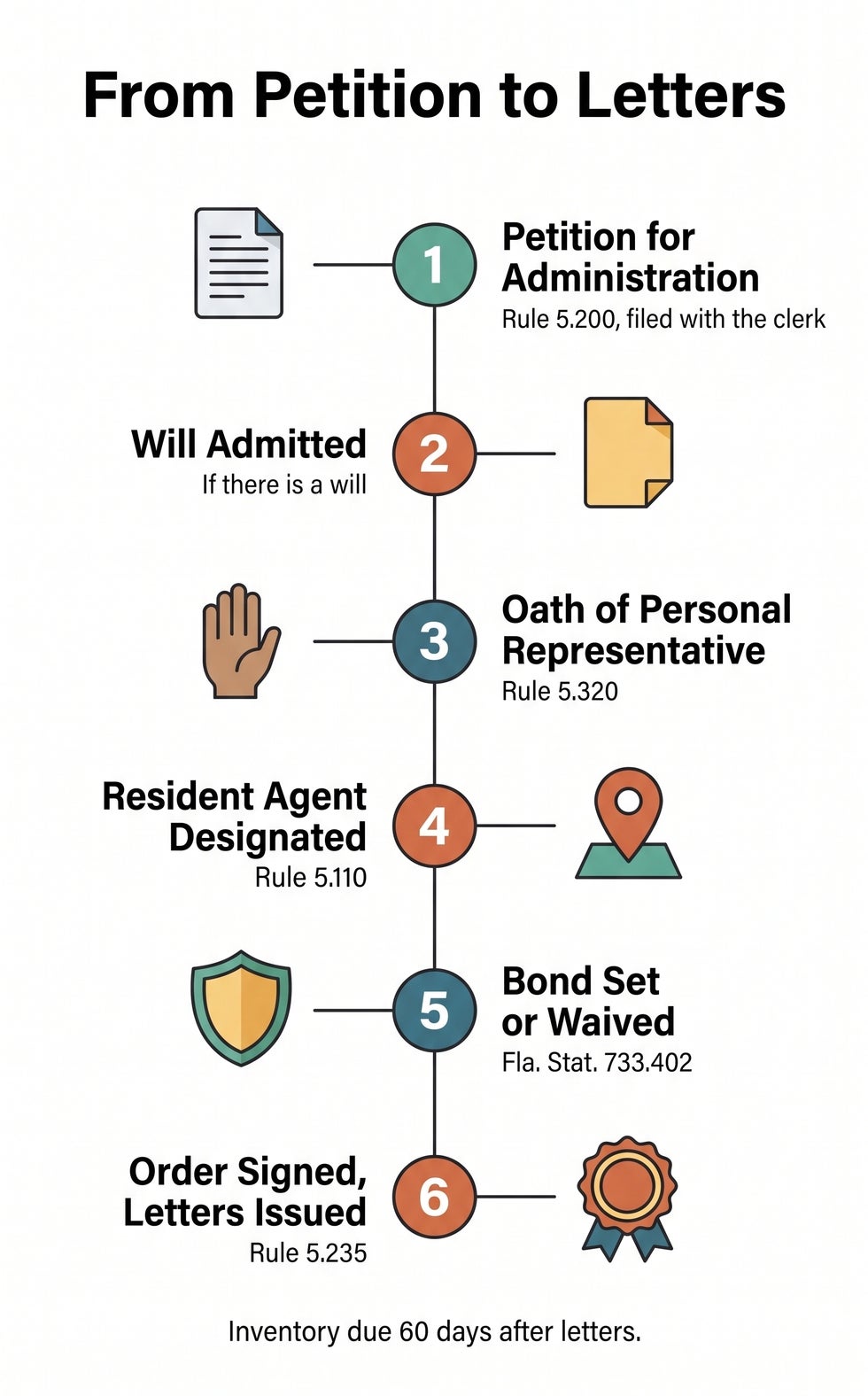
The formal administration process is document-driven, and the Probate Rules dictate the order of the probate court process in every probate administration.
- Petition for administration under Rule 5.200, verified by the petitioner. It must state the petitioner's priority under § 733.301, name anyone with equal or higher preference and whether they will be served, describe the approximate value and nature of the assets, and state the specific facts showing the person is qualified, including the nonresident relationship if the person lives outside Florida.
- Admission of the will, if there is one. A self-proved original usually goes in without testimony.
- Oath of personal representative under Rule 5.320, swearing that the person is qualified under §§ 733.302 through 733.304 and will faithfully administer the estate. The Florida Supreme Court amended the oath form on June 18, 2026, effective October 1, 2026, in SC2025-1462, so the version filed after that date will carry updated statutory references.
- Designation of resident agent under Rule 5.110: someone in the county where the case is pending who accepts service for the personal representative. An attorney who lives and has an office in the state may serve, which is why the estate's lawyer is usually named.
- Bond, unless the will or the court waives it, under Fla. Stat. § 733.402. The judge sets the amount after considering the gross value of the estate, the relationship of the personal representative to the beneficiaries, and known creditors (§ 733.403). The premium is an expense of administration under § 733.406, so the estate pays it, not the family member personally.
- Order appointing the personal representative, signed by the judge, followed by the letters from the clerk.
Every step is e-filed through the Florida Courts E-Filing Portal, and most Twentieth Circuit estates never require an in-person hearing. Formal administration also requires a licensed attorney under Probate Rule 5.030, a rule our earlier article, Do You Really Need a Probate Attorney in Florida?, explains in detail.
Key Documents to File
Gather these before the petition is drafted, because missing records are the most common reason a filing stalls:
- The original will and any codicils. Whoever holds the original must deposit it with the clerk within 10 days of learning of the death. If the original cannot be found, see our article on proving a lost will in Florida; a lost-will petition is filed with the petition for administration, not after it.
- A certified death certificate, ideally without the cause of death, which is the version the clerk and most institutions accept.
- Names, addresses, and relationships of the surviving spouse, beneficiaries, and any heirs with equal or higher priority, plus the year of birth of any minor.
- A short list of the decedent's assets with approximate values and how each is titled. This drives venue, the bond amount, and the choice between formal and summary administration.
- The proposed personal representative's residence address and, for a nonresident, the family relationship that qualifies them.
The clerk's statutory filing fee for opening a formal administration is capped at $395 plus a $4 education surcharge under Fla. Stat. § 28.2401. Attorney fees are a separate question; the Florida fee statute is explained in the probate attorney article linked above.
Timeline to Issuance in Lee, Collier, and Charlotte Counties
In an uncontested formal administration with complete paperwork, letters commonly issue within a few weeks of filing; in our published probate timeline that stage is weeks two to four of the case. Letters are the starting gun for the rest of the administration: the inventory, listing each asset at its value on the date of death, is due within 60 days after they issue, and the notice to creditors is published and served promptly after appointment, opening the three-month claim period under Fla. Stat. § 733.702. Our Florida probate timeline article lays out the clocks that follow.
What slows issuance is predictable: a will that is not self-proved and needs a witness, a proposed personal representative whose priority is contested or whose nonresident status is unclear, a bond that has to be underwritten, or a person with higher preference who must be served with formal notice and given a chance to object. Fix those before filing and probate proceedings in Lee, Collier, and Charlotte counties all move at a similar pace. Who can be appointed at all is the question that decides most of that.
Who Can Be Appointed Personal Representative in Florida?
Who can be a personal representative in Florida depends on two separate tests: priority, which decides who goes first among the people who want the job, and qualification, which decides whether that person is legally allowed to serve at all. Fla. Stat. § 733.301 sets the priority; §§ 733.302 through 733.305 set the qualifications.
Families often assume the closest relative automatically gets control. Not always. The statute follows the decedent's written choice first, then a majority of the people who inherit, and it checks residency, age, capacity, and criminal history before letters issue. The firm's video Who Can Be Personal Representative in Florida? The Rules covers the same ground in five minutes.
Priority With a Valid Will
When there is a valid will, § 733.301(1)(a) gives preference in this order:
- The personal representative, or his or her successor, nominated by the will or under a power the will confers.
- The person selected by a majority in interest of the persons entitled to the estate.
- A devisee under the will. If more than one devisee applies, the court may select the one best qualified.
A named nominee is not automatically appointed. If the nominee is disqualified, § 733.303(2) sends the appointment back down this list. And if a later will is admitted after letters have already issued, § 733.301(5) requires the court to revoke the letters and grant new ones, which is one reason the terms of the will matter even after the estate is open.
Priority When There Is No Will
When there is no will, § 733.301(1)(b) gives preference to:
- The surviving spouse.
- The person selected by a majority in interest of the heirs.
- The heir nearest in degree. If more than one applies, the court may select the one best qualified.
Notice what is not on the list. There is no separate tier for "adult children" and no "public administrator." If nobody with preference applies, § 733.301(3) lets the court appoint any capable person, other than someone who works for the court. Who counts as an heir, and in what order, is the subject of the intestate succession rules, explained in our article on what happens in Florida probate without a will.
The Nonresident Rule and Who Is Disqualified
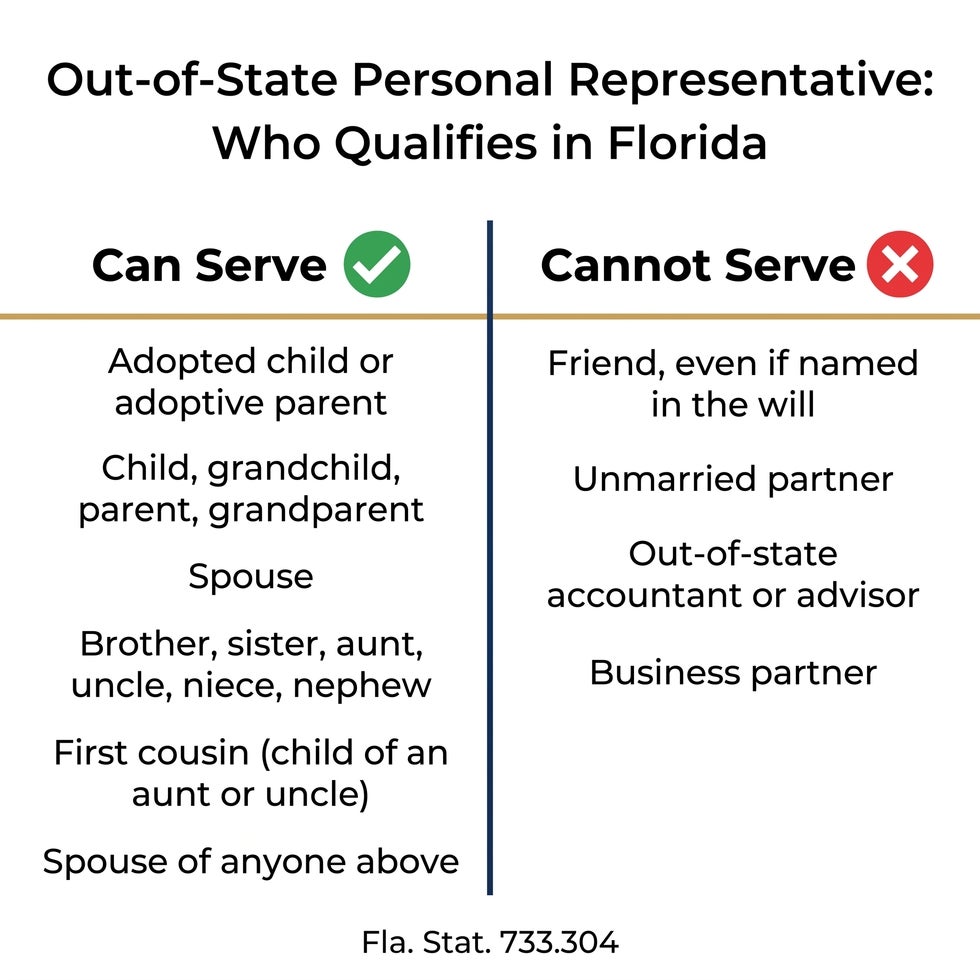
The nonresident personal representative Florida rule is the one that catches the most Southwest Florida families, because so many decedents here have children up north. Under § 733.304, a person who is not domiciled in Florida cannot qualify unless the person is:
- a legally adopted child or adoptive parent of the decedent;
- related by lineal consanguinity to the decedent (a child, grandchild, parent, or grandparent);
- a spouse, brother, sister, uncle, aunt, nephew, or niece of the decedent, or someone related by lineal consanguinity to any such person; or
- the spouse of a person otherwise qualified under the section.
The practical consequence is that an adult child in Michigan can serve, and a lifelong friend in Michigan cannot, even if the will names the friend. An unmarried partner who lives in Toronto cannot serve. A trusted accountant in Chicago cannot serve. A first cousin, on the other hand, usually does qualify: a cousin is a child of the decedent's aunt or uncle, and the statute reaches anyone related by lineal consanguinity to an aunt or uncle. When the person the decedent wanted is not eligible, the usual fix is a qualified relative, a co-personal representative who lives here, or a Florida trust company.
What Are the Basic Qualifications and Disqualifications to Serve?
The basic Florida personal representative requirements are that the person be sui juris (legally competent to handle their own affairs), be a Florida resident at the decedent's death unless the nonresident rule applies, be at least 18, be physically and mentally able to do the job, and have no disqualifying conviction. Priority gets you to the front of the line; qualification decides whether you can stand in it.
Florida Residency and the Sui Juris Requirement
Fla. Stat. § 733.302 is the starting point: any person who is sui juris and a Florida resident at the time of the decedent's death is qualified, subject to the limits in the rest of the part. Residency is measured at the time of death, not at the date of filing, so a daughter who moves from Ohio to Bonita Springs after her mother dies still needs to qualify under the nonresident rule.
Entities can serve too. Under Fla. Stat. § 733.305, Florida trust companies and banks authorized to exercise fiduciary powers here may act as personal representatives, and they are exempt from the bond requirement. An out-of-state bank or trust company without Florida fiduciary powers generally cannot, which surprises families whose parent named a hometown bank in a will drafted elsewhere.
Felony, Elder Abuse, Age, and Infirmity Disqualifiers
Fla. Stat. § 733.303 lists four disqualifiers. A person is not qualified if the person has been convicted of a felony; has been convicted in any state or foreign jurisdiction of abuse, neglect, or exploitation of an elderly person or disabled adult; is mentally or physically unable to perform the duties; or is under 18. The elder-abuse ground was added in 2021, and the Rule 5.200 petition now requires a statement on it.
Two points from practice. A felony conviction disqualifies regardless of how old it is or whether civil rights were restored, so ask the question early and privately. And the oath is signed under penalty of perjury, so a person who signs it knowing of a disqualifying conviction has created a second problem larger than the first. Whether the person is a resident or a permitted nonresident, the court must be satisfied on every item before letters issue.
Removing or Replacing a Personal Representative
An appointment is not permanent. Under Fla. Stat. § 733.504, a personal representative "shall be removed and the letters revoked" if the person was not qualified at the time of appointment, and may be removed for twelve listed causes, including wasting or maladministration of the estate, failure to give bond, conviction of a felony, holding an adverse interest against the estate, and moving out of Florida when residence was a requirement of the appointment. Under § 733.3101, a personal representative who learns of a disqualifying fact must resign or file and serve a notice on interested persons, and one who does not is personally liable for the costs of the removal proceeding.
Timing matters, but not the way older articles describe it. The Florida Supreme Court held in Hill v. Davis, 70 So. 3d 572 (Fla. 2011), that an objection to a personal representative's qualifications was barred unless raised within three months after service of the notice of administration. The Legislature then removed qualifications from that three-month bar in 2015 (Ch. 2015-27, Laws of Florida, amending § 733.212(3)). Today the three-month deadline still applies to objections to the validity of the will, venue and jurisdiction, but a personal representative who was never qualified must resign immediately under § 733.3101, and one who becomes disqualified after appointment must file and serve a notice, after which any interested person has 30 days to petition for removal. Where an estate has no one holding letters at all, and property is at risk, Fla. Stat. § 733.501 lets the court appoint a curator to take charge until letters issue; the Legislature added court-review and reporting requirements for curators in 2026. Whether letters are the right goal at all depends on the size of the estate, which brings up summary administration.
Does Summary Administration Give You Letters of Administration in Florida?
No. Summary administration does not give you letters of administration in Florida, because no personal representative is appointed. The court instead enters an Order of Summary Administration directing distribution of the assets to the beneficiaries, and that order is what a bank or title company receives.
No Personal Representative Is Appointed
Under Fla. Stat. § 735.201, summary administration is available when the value of the estate subject to administration in Florida, less exempt property, does not exceed $150,000, or when the decedent has been dead for more than two years. The cap doubled from $75,000 on July 1, 2026, a change our article on the new $150,000 summary administration limit covers in detail. The petition is signed by the surviving spouse and the beneficiaries, the judge reviews it, and the order issues. Nobody takes an oath, nobody posts a bond, and nobody holds letters.
Formal Versus Summary Administration
The core distinction between the two main types of probate administration is an active fiduciary, and the probate process follows from it. Formal administration appoints one, gives that person letters, and runs a structured creditor process. Summary administration does neither, and under § 735.206 the people who receive the property stay personally liable for the decedent's lawful debts, up to the value each received, until the claims are barred. The firm's videos What Is Formal Administration in Florida Probate? and What Is Summary Administration? Florida's Short-Form Probate explain each in plain English.
What Third Parties Receive in Each Proceeding
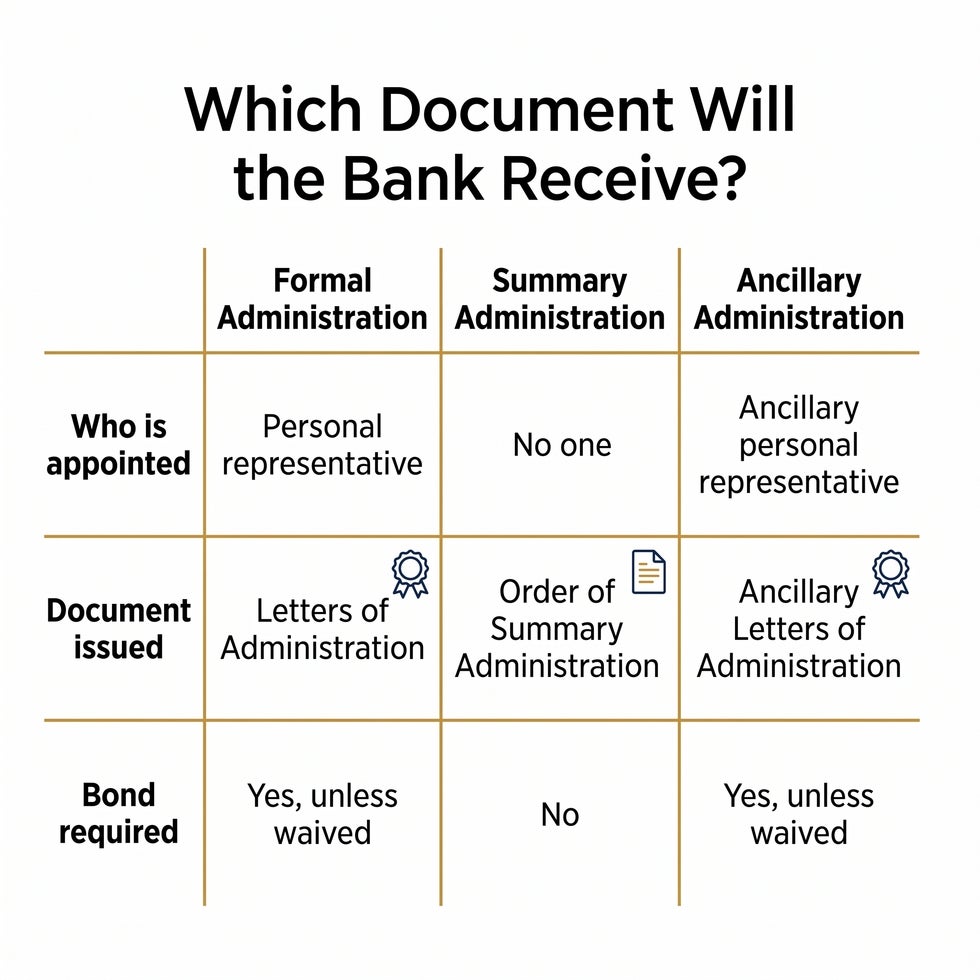
In a formal case, the institution receives certified Letters of Administration naming the person who may sign. In a summary case, it receives a certified Order of Summary Administration listing the property and the person entitled to each item. Most banks here handle both routinely. The friction comes from out-of-state institutions and from situations the order did not anticipate: an account discovered after the order was entered, a lawsuit that needs a plaintiff, a contract that needs a signature. When the estate needs someone with ongoing authority, formal administration is often the better path even when the estate would qualify for the shortcut, and the letters are the reason.
How Do Letters of Administration, Summary Orders, and Ancillary Letters Compare?
Three different documents come out of three different proceedings, only one of them the letters of administration Florida courts issue in formal administration, and knowing which one an estate needs is the fastest way to a clean opening filing. Ancillary letters of administration Florida courts issue are the third category: letters for the Florida property of someone who was domiciled in another state or country.
| Feature | Letters of Administration (formal administration) | Order of Summary Administration | Ancillary Letters of Administration |
|---|---|---|---|
|
Who is appointed |
A personal representative under §§ 733.301 through 733.305 |
No one; the court orders distribution directly |
An ancillary personal representative under § 734.102 |
|
What document the bank receives |
Certified Letters of Administration |
Certified Order of Summary Administration |
Certified Ancillary Letters of Administration |
|
When it is available |
Any estate; required for a resident decedent above the summary cap |
Non-exempt Florida estate of $150,000 or less, or death more than two years ago |
A nonresident decedent who left assets, credits, or liens in Florida |
|
Typical time to issue |
A few weeks after filing in an uncontested case |
Often four to eight weeks to the order in a clean case |
Similar to formal administration, plus time to obtain authenticated copies from the home-state court |
|
Whether a bond is required |
Yes, unless waived by the will or the court (§ 733.402) |
No |
Yes, "as do personal representatives generally" (§ 734.102(4)) |
Ancillary administration deserves a closer look because Southwest Florida has so many seasonal residents. Under Fla. Stat. § 734.102, a nonresident who dies leaving Florida property triggers a proceeding here, and the statute sets its own preference: a personal representative named in the will specifically for the Florida property, then the domiciliary personal representative if qualified in Florida, then an alternate named in the will, then a person selected by those holding a majority interest in the Florida property. If the decedent died intestate and the home-state representative is not qualified here, the ordinary § 733.301 order applies. The nonresident rule in § 733.304 applies in every case, which is why an Ontario executor who is the decedent's daughter can hold ancillary letters and an Ontario executor who is the decedent's business partner cannot.
For a testate nonresident whose Florida property is worth $50,000 or less, Fla. Stat. § 734.1025 offers a short form: the foreign personal representative files an authenticated transcript of the home-state proceeding, and no personal representative is appointed here unless a creditor files a claim. Which of the three routes fits a given family is a judgment call, and the firm's video What Is Ancillary Administration in Florida Probate? and our article on international estate planning for Florida property are the places to start.
Conclusion
The letters of administration Florida courts issue are a court credential, not a form. They come only from formal administration, only after the petition, oath, resident-agent designation, and bond are in order, and only to a person who has priority under § 733.301 and is qualified under §§ 733.302 through 733.305. The nonresident rule decides more Southwest Florida cases than any other provision, and it turns on family relationship, not on how trustworthy or well-organized the person is.
Before filing, settle three things: whether the estate needs letters at all or can use summary administration, who has priority and whether that person is qualified, and what the banks and title companies involved will actually accept. Get those right and the letters usually issue within a few weeks; get them wrong and the estate loses months.
How The Nussbickel Law Firm Obtains Letters of Administration
The Nussbickel Law Firm, P.A. practices estate planning, probate, and trust administration and nothing else. From our office at 12487 Brantley Commons Court in Fort Myers, we represent personal representatives and beneficiaries in Lee, Collier, and Charlotte counties, and we handle probate matters throughout the state of Florida for families who live elsewhere, including the out-of-state children and Canadian relatives who make up a large share of the personal representatives we work with.
When a family calls because a bank has asked for letters, we start with the two questions that decide everything: does this estate need formal administration, and is the person the family has in mind qualified to serve? We confirm priority and the nonresident relationship before anything is filed, prepare the petition, oath, and resident-agent designation together so the court can act on them at once, arrange the bond when one is required, and order the certified copies the institutions will need. If a relative who was expected to serve turns out to be ineligible, we tell you before the filing, not after a rejection. An experienced attorney can usually tell you in one call which route fits; contact the firm today and we will map the next step and the letters of administration Florida institutions will accept.
A free consultation is the right first step. Schedule a consultation online or call 239-900-WILL (9455). Phone, video, and in-office meetings are available, and out-of-state family members are welcome.
Frequently Asked Questions
How long does it take to get letters of administration in Florida?
In an uncontested formal administration with complete paperwork, the letters of administration Florida clerks issue commonly come within a few weeks of filing in Lee, Collier, and Charlotte counties. How long does it take to get letters of administration in Florida when something is missing? Longer: a will that needs a witness, a bond that must be underwritten, or a person with higher preference who must be served with formal notice can each add weeks.
Can a non-Florida resident serve as a personal representative?
Only if related to the decedent in one of the ways listed in Fla. Stat. § 733.304: an adopted child or adoptive parent, a lineal descendant or ancestor, a spouse, sibling, aunt, uncle, niece, or nephew (or someone descended from any of them), or the spouse of a person who qualifies. Friends, unmarried partners, and out-of-state professionals cannot serve, regardless of what the will says.
Do I need an attorney to obtain letters of administration in Florida?
For formal administration, yes. Florida Probate Rule 5.030 requires the personal representative to be represented by counsel admitted here unless the personal representative is the estate's sole interested person or is a Florida attorney. Because letters issue only in formal administration, obtaining them without counsel is rarely possible, and the oath, bond, and resident-agent filings are where self-prepared petitions most often fail.
What is the difference between letters testamentary vs letters of administration?
In many states, letters testamentary issue when there is a will and letters of administration when there is not. Florida does not make that distinction. Under Fla. Stat. § 731.201(24), every grant of authority to a personal representative is designated "letters of administration," whether the estate is testate or intestate, so a bank form asking for letters testamentary is satisfied by Florida letters.
Who pays for the personal representative bond Florida courts require?
The estate does. Under Fla. Stat. § 733.406, the reasonable premium on a personal representative bond Florida courts require is an expense of administration, paid from estate funds rather than by the personal representative personally. A will can waive the bond, and the court can waive, require, increase, or reduce it on its own motion or on a petition by any interested person under § 733.402(4).
What if the original will cannot be found?
Letters can still issue, but only after the court establishes the lost will's terms under Fla. Stat. § 733.207 and Probate Rule 5.510, which requires disinterested witnesses and formal notice to the people who would inherit without the will. The lost-will petition is filed with the petition for administration, and letters issue once the order admitting the will is entered. Our lost-will article explains the proof required.
Gregory J. Nussbickel is the founder of The Nussbickel Law Firm, P.A. in Fort Myers, Florida. His practice is devoted exclusively to estate planning, probate, and trust administration for families throughout Southwest Florida.
This article is for general information and educational purposes only and is not legal advice. Reading it does not create an attorney-client relationship. Probate law changes, and every estate is different; speak with a licensed Florida attorney about your specific situation.

Comments
There are no comments for this post. Be the first and Add your Comment below.
Leave a Comment