
Key Highlights
- What makes a will valid in Florida is set by statute, not by how careful or sincere the document looks: it must be written, signed at the end, and witnessed by two people.
- The signer must be of sound mind and either 18 or older or an emancipated minor, under section 732.501.
- Notarization is not a validity requirement. A notary matters only for the self-proving affidavit, which makes probate easier rather than making the will legal.
- Florida rejects unwitnessed handwritten wills and oral wills outright, even when they arrive from a state that allowed them, and it accepts electronic wills only through a supervised online notarization session under section 117.285.
- A will held invalid is treated as though it never existed, and the estate passes under Florida's intestacy formula instead.
Introduction
The short answer: what makes a will valid in Florida is writing, a signature at the end, and two witnesses. Everything else in this article is detail hanging off those three requirements. Get them right and the document works. Miss one and a probate judge cannot fix it later, no matter how obvious the signer's intentions were.
That is the part families find hardest to accept. We see wills every year that say exactly what the person wanted and still fail, because the second witness signed in the kitchen after everyone else had gone home. Sincerity is not one of the legal requirements. Execution is.
This guide takes each requirement in the order a Florida probate court applies it, from who may sign to what happens to your family if the document fails.
Who Can Make a Valid Will in Florida?
You can make a valid will in Florida if you are of sound mind and either 18 or older or an emancipated minor. Section 732.501 of the Florida Statutes sets both conditions, and both are measured on the day you sign.
That second category gets left out of almost every summary written about this subject, including The Florida Bar's own consumer pamphlet, which says only that the testator must be at least 18. The statute is broader. An emancipated minor may make a last will in this state, and for a young person who has been emancipated through marriage or court order, that distinction is the whole answer.
Age and Capacity Requirements Under Florida Will Laws
Capacity is the requirement that generates litigation, and Florida will laws set a lower bar for it than most people assume. Being of sound mind does not mean sharp memory, good health, or freedom from a diagnosis. It means that at the moment of signing, the person understood three things: that the document was a will, roughly what he or she owned, and who the natural objects of bounty were, meaning the people who would ordinarily inherit.
Timing is everything here. A probate court looks at mental capacity at the time of its execution, not at general decline in the months before or the years after. Someone with an early dementia diagnosis can still sign on a good morning, and someone who seemed fine to the family can still have lacked capacity that day.
Capacity is not the only ground for attack. Under section 732.5165, a will is void if the execution of a will was procured by fraud, duress, mistake, or undue influence, and a revocation procured that way is void too. If only part was tainted, the rest can stand. Undue influence claims turn on who arranged the appointment, who drove the signer there, and who was in the room.
Practical step: if capacity may be questioned later, sign in a lawyer's office, use disinterested witnesses, and let the attorney document the circumstances that day. That record beats testimony reconstructed years afterward.
What Are the Required Formalities for Executing a Will in Florida?
The formalities live in section 732.502, and they are strict requirements, not guidelines. The will must be in writing. The testator must sign at the end of the document, or direct someone else to sign the testator's name there, in the testator's presence. The signing or the acknowledgment of an earlier signature must happen in front of two attesting witnesses. Those witnesses must then sign in the presence of the testator and in the presence of each other.
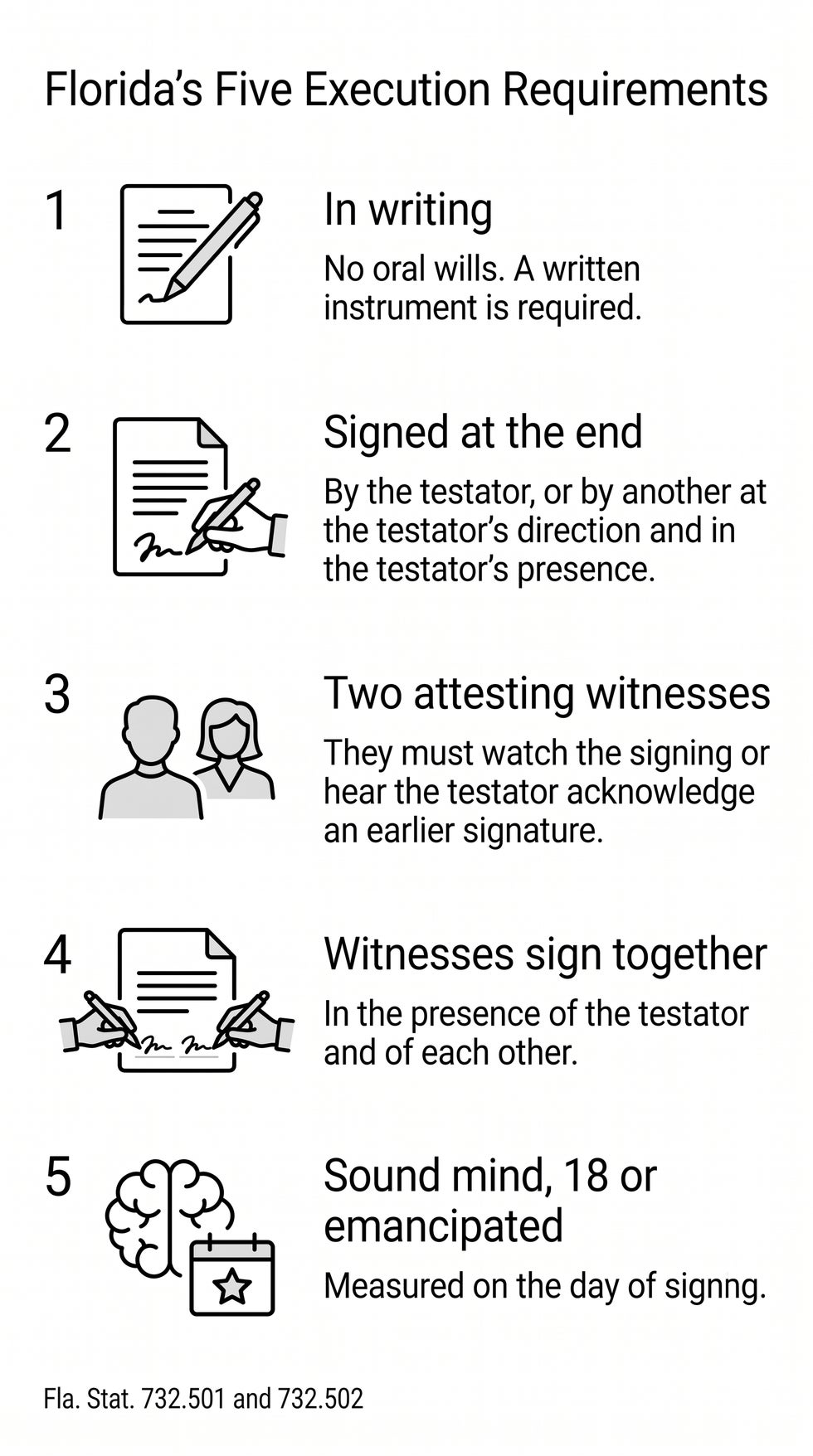
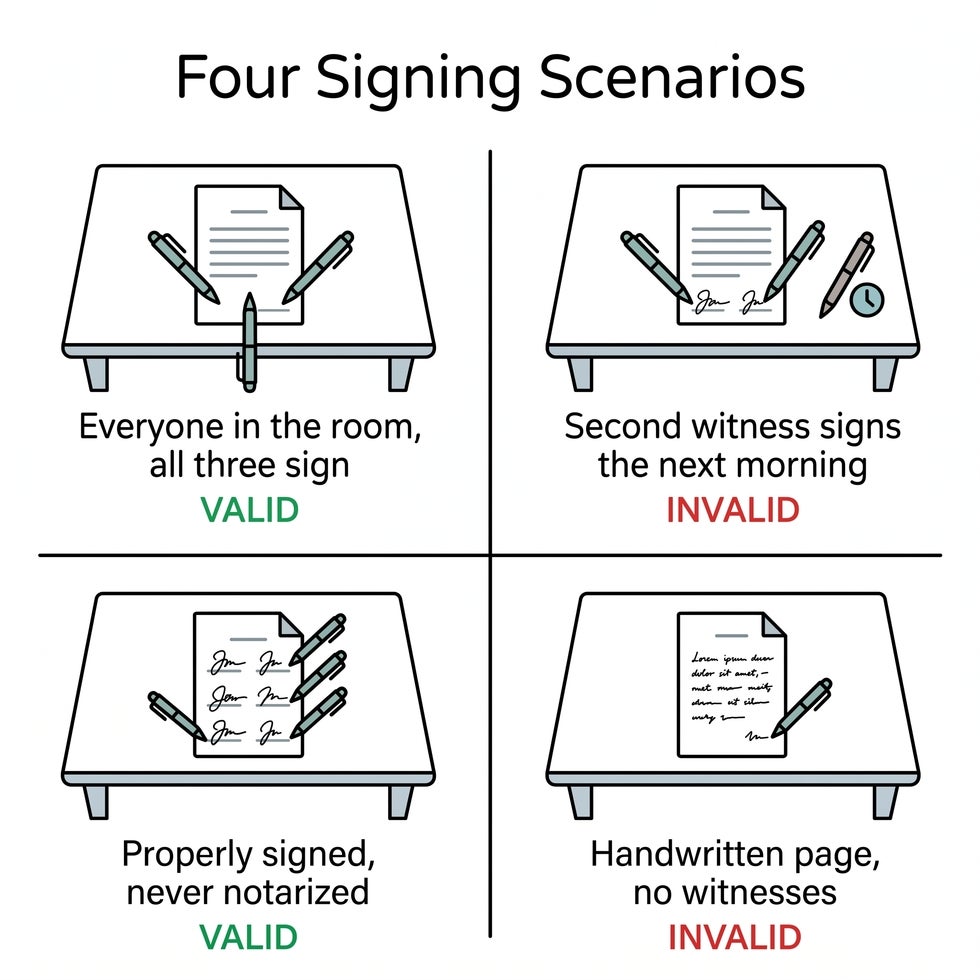
Read that last requirement again, because it is where most home-made documents come apart, and it is the source of the two most common mistakes we see. Everyone has to be together, and the signature has to sit at the end of the will rather than partway down a page with gifts added below it. A witness who signs the next morning, or in the next room, has not witnessed the will the way Florida requires. What makes a will valid in Florida is that this ceremony is a single continuous event.
Two smaller points close common gaps. Under section 732.504, any person competent to be a witness may act as one, and a will is not invalid merely because an interested witness signed it. Disinterested witnesses are still better practice, since they remove an argument. And no particular wording is required.
For a plain-English walkthrough of the document itself, see the firm's video What Is a Will? Florida Will Requirements Explained.
Does a Will Need to Be Notarized in Florida?
No. Notarization is not a requirement for a valid will in Florida, and this is probably the single most common misunderstanding about the subject. A will signed by a competent testator in front of two qualified witnesses, all of them together, is valid whether or not a notary was ever in the building.
The confusion is understandable, because The Florida Bar's consumer pamphlet on wills states that a will "must be witnessed and notarized in the special manner provided by law," which reads as though notarization went to the validity of a will. What the notary actually serves is the separate self-proving affidavit described in the next section. Skip the notary and your will still works. Skip the notary and your family may have to go find a witness years later.
What Is a Self-Proving Will in Florida and Why Does It Matter?
A self-proving will is an ordinary will with a sworn affidavit attached, signed by the testator and both witnesses before an officer authorized to administer oaths. It changes nothing about validity and everything about convenience. Under section 733.201, a self-proved will may be admitted to probate without further proof.
Without that affidavit, the will generally has to be proved by the oath of one of the subscribing witnesses, taken before a circuit judge, a clerk, or a court-appointed commissioner. If they cannot be found or have become incapacitated, the nominated personal representative or a disinterested person may swear to it instead. Workable, and an unpleasant errand to run during the week after a funeral.
Section 732.503 supplies the statutory form, which is why the certificate asks for the testator's name, the print name of first witness, the print name of second witness, and the state type of identification when the officer is not relying on personal knowledge. The affidavit can be executed with the will or at a subsequent date, so an existing will without one can usually be fixed without redoing the document. A will made self-proved under another state's law counts as self-proved here.
| Issue | Self-proving will | Will with no affidavit |
|---|---|---|
|
Basic validity |
Valid if executed correctly |
Valid if executed correctly |
|
Notary involved |
Yes, for the affidavit |
Not required |
|
Proof needed at probate |
Usually none |
Witness oath or statutory substitute |
|
Burden on the family |
Low |
Higher, and worse as years pass |
The officer completes the certificate and affixes an official seal, and that is the whole procedure. Getting a self-proving will Florida clerks can accept is the cheapest important step available to anyone who already has a will, and it shortens the probate process at exactly the moment a family has the least patience for it. If yours came from another state, have it checked.
Are Handwritten and Holographic Wills Accepted in Florida?
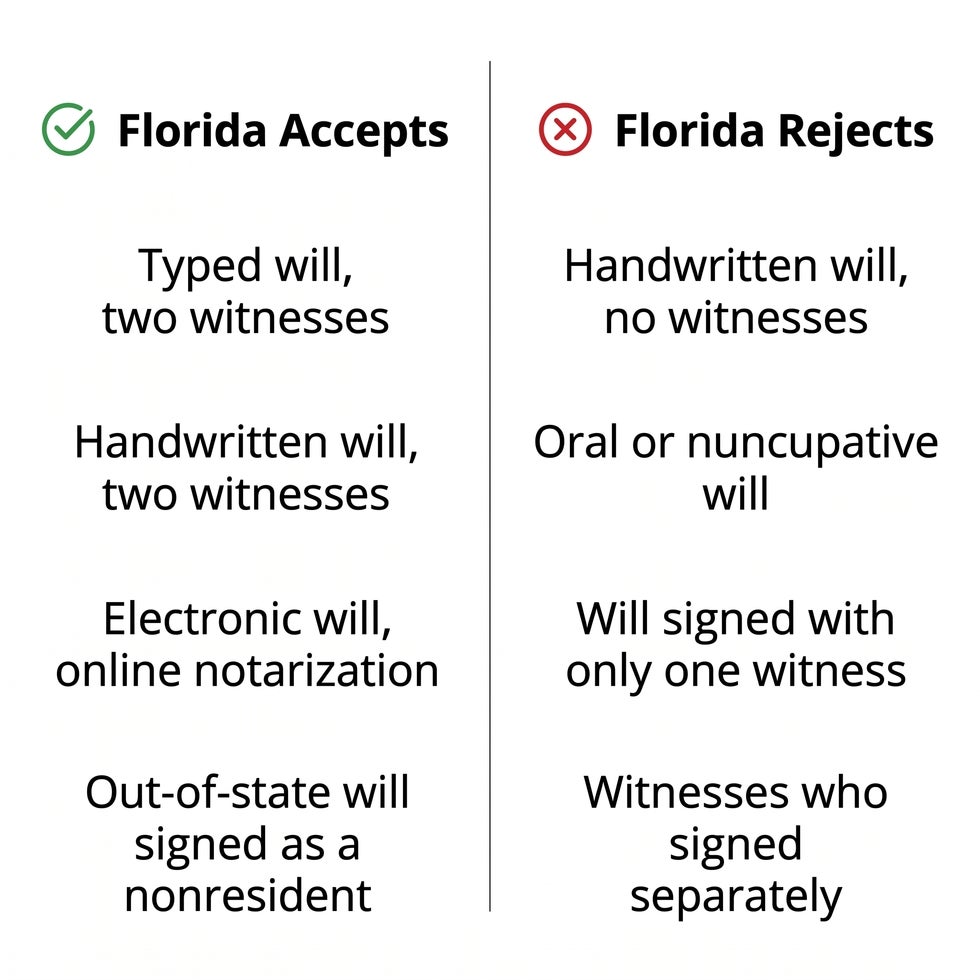
Sometimes, and the distinction is precise. Florida has no objection to handwriting itself. It objects to the absence of witnesses. A handwritten will Florida probate courts will admit is one that also satisfies section 732.502, and section 732.502(2) says so directly: a will in the testator's own handwriting that was executed with the required formalities is not treated as a holographic will at all.
A holographic will Florida law will not accept is the unwitnessed kind, the page found in a desk drawer entirely in the decedent's hand and signed by nobody else. That document fails here regardless of how clearly it expresses intent and regardless of whether the state it was written in would have honored it. On this point what makes a will valid in Florida is the witnessing, nothing else.
The practical consequence is blunt. If the handwritten page is the only will, the estate is administered as though there were no will at all, and the property goes to whoever the intestacy statutes name. Kiplinger's guide to saving money on estate planning makes the same point about do-it-yourself documents: the savings vanish the moment execution goes wrong.
Oral and Electronic Wills: What Is and Isn't Allowed in Florida?
Florida does not recognize oral wills for any ordinary purpose, and it does recognize electronic wills when the technical requirements are met. What makes a will valid in Florida does not bend for either format. These two get grouped together in conversation and they deserve to be separated, because one is a dead end and the other is a working option with real conditions attached.
A nuncupative will, meaning spoken instructions, has no effect in this state. It does not matter how many people heard it, how consistent the accounts are, or how obviously it reflected what the person wanted. Section 732.502 requires a written instrument, and deathbed statements to family members do not qualify.
An electronic will Florida law recognizes is a different matter. Section 732.522 permits electronic signatures and permits witnesses to appear by audio-video technology, but only inside an online notarization session run under part II of chapter 117. Emailing a PDF, typing your name into a form, or using a consumer e-signature app does not create an electronic will. It creates nothing.
Section 117.285 adds guardrails that surprise people:
- A remote witness must verbally confirm being a resident of and physically located within the United States or a United States territory. Contrary to a claim that circulates widely, Florida is not the required location, and section 117.285(8) says Florida law governs the witnessing regardless of where the witness sat.
- Before witnessing a will remotely, the provider must ask the signer three screening questions about impairment, disability, and needing help with daily care. If any answer is yes, the will can only be witnessed by people physically present.
- The notary must ask the signer five questions on the recording, including who is in the room and who helped prepare the documents.
- Remote witnessing is ineffective for a vulnerable adult as defined in section 415.102.
- None of subsection (5) applies if two witnesses are physically present anyway.
There is a sting in the tail at probate. Under section 733.201(1), a purportedly self-proved electronic will can be admitted only through the ordinary proof routes if the online notarization involved a substantial failure to comply with section 117.265. The technology does not lower the standard. It relocates it.
Can You Use a Will from Another State in Florida?
Often yes. Section 732.502(2) makes an out of state will valid in Florida if it was executed by a nonresident of Florida and was valid under the laws of the state or country where it was signed. Those state laws control that question, not Florida's. That saves a great many documents belonging to people who retired to Fort Myers, Naples, or Punta Gorda and never rewrote anything.
The exception has two hard edges. First, it applies only to wills executed by a nonresident, so anything signed after you became a resident of the State of Florida is judged by Florida's requirements, not your former state's. Second, the statute carves out holographic and nuncupative wills by name. A handwritten unwitnessed will that was perfectly good in Pennsylvania does not become good by crossing a state line.
| Situation | Likely Florida treatment |
|---|---|
|
Written will, valid where signed, signed while a nonresident |
Generally accepted |
|
Same will, but no self-proving affidavit |
Accepted, though proof is harder |
|
Unwitnessed handwritten will from a state that allowed it |
Not saved by the exception |
|
Oral instructions, any state |
No effect |
|
Will signed after establishing Florida residency |
Judged under Florida law only |
Even a will that survives the test can create significant problems for new Florida residents. Out-of-state documents routinely name a personal representative who cannot qualify here, ignore the descent rules that govern homestead property regardless of what the will says, and leave witnesses scattered across the country. The firm's video Is an Out-of-State Will Valid in Florida? covers this in a few minutes, and a review after a move is far cheaper than litigation after a death.
How Can a Will Be Revoked or Changed Under Florida Law?
Florida allows revocation two ways, by writing and by act, and both are narrower than people expect. Section 732.505 revokes a will through a later inconsistent will or codicil, but only to the extent of the inconsistency, or through a later writing executed with full will formalities that declares the revocation.
Section 732.506 covers revocation by act: burning, tearing, canceling, defacing, obliterating, or destroying the will with intent to revoke, done by the testator or by someone else in the testator's presence and at the testator's direction. Electronic wills have their own rule in the same section, revoked by deleting, canceling, or rendering the file unreadable with intent to revoke, proved by clear and convincing evidence.
What does not work is the thing everyone tries. Crossing out a paragraph, writing a new name in the margin, or clipping a page changes nothing reliably and can invalidate part or all of the instrument. A power of attorney does not authorize an agent to rewrite your will either. If life changed through marriage, divorce, a birth, a death, or a move, sign a new will or a properly executed codicil, and review the whole estate plan rather than one clause. Where a trust is also in the picture, see my earlier article, Does a Will Override a Trust? What Really Happens If They Conflict. Married couples in particular should look at both documents together, since spousal rights can override what either will says.
What Happens If a Will Is Found Invalid in Florida Probate Court?
The estate is administered as though no will existed. The document's instructions drop out entirely, and the intestate succession laws in chapter 732 of the Florida Probate Code decide who inherits. The court does not attempt to approximate what the decedent probably wanted.
The results are often nothing like the plan. Under section 732.102, a surviving spouse takes the entire intestate estate when all of the decedent's descendants are also the spouse's and the spouse has no others, but only one-half when either spouse has a child from another relationship. Blended families in Southwest Florida discover that split constantly. An unmarried partner, an unadopted stepchild, or a close friend receives nothing, including nothing of the personal property they were promised, and the court appoints a personal representative under the statutory priority list rather than the one the will named.
There is a procedural cost on top of the distribution result. A contested execution turns an administration into a fight over the validity of the will itself, with witness testimony, document examination, and real exposure to probate litigation over a defect that cost nothing to avoid. A self-proving affidavit cannot rescue a will that was never properly executed. Note too that even a valid will does not keep an estate out of court, a point the firm's video What Is Probate in Florida? A Plain-English Explanation and our article on whether a will avoids probate both address.
| Scenario | Likely result in Florida |
|---|---|
|
Written, signed at the end, two witnesses signing together |
Valid |
|
Written and signed, only one witness |
Invalid |
|
Witnesses signed on different days or in another room |
Invalid |
|
Handwritten, no witnesses |
Invalid as a holographic will |
|
Spoken instructions from a hospital bed |
No effect |
|
Properly executed, never notarized |
Valid, harder to prove |
|
Properly executed with a self-proving affidavit |
Valid, admitted without further proof |
|
Out-of-state written will, signed as a nonresident, valid there |
Generally valid here |
|
Out-of-state handwritten unwitnessed will |
Invalid |
Talk With The Nussbickel Law Firm
Our practice at The Nussbickel Law Firm, P.A. in Fort Myers is devoted exclusively to estate planning, probate, and trust administration. We prepare wills and the documents around them for families across Lee, Collier, and Charlotte counties, and we handle probate matters state-wide.
On the questions in this article the work takes one of three shapes. For someone writing a first will, it is running the signing ceremony correctly so the document is self-proved from day one. For a new Florida resident, it is reviewing what you brought with you, since a will that survives the nonresident exception can still name a personal representative who cannot serve here. For a family holding a document they are unsure about, it is telling you plainly whether it will pass.
That is what experienced estate planning is for on this subject: not clever drafting, but legal guidance that makes the document hold. A will you know was signed correctly is worth real peace of mind, and it is the least expensive thing you can do for your family's future.
We offer a free consultation. Schedule a consultation through the contact form or call our Fort Myers office to talk through your own legal needs. If you are still deciding whom to hire, our guide to choosing an estate planning attorney sets out the questions worth asking anyone.
Conclusion
What makes a will valid in Florida is a short list the state applies without much sympathy: writing, a signature at the end of the will, two witnesses who watch it happen and sign in front of the testator and each other, and a signer of sound mind who is either an adult or an emancipated minor. Add a self-proving affidavit and you have also spared your family the job of proving it.
The failures we see in a Florida estate are almost never about wording. They are about a witness who stepped out, a handwritten page nobody witnessed, a spoken promise, or a will from another state that nobody looked at after the move. All four are cheap to fix while you are alive and impossible to fix afterward.
So here is the next step. Find your original will and confirm it carries a self-proving affidavit with two witness signatures and a notary block. If it came from another state, or if anything has been crossed out on it, have it reviewed before it becomes your family's problem. Florida wills are unforgiving on execution and easy to get right in advance.
Frequently Asked Questions
Can a will be challenged for validity in Florida probate court?
Yes. The usual grounds are that the testator lacked testamentary capacity, that the execution requirements in section 732.502 were not met, or that the will was procured by fraud, duress, mistake, or undue influence under section 732.5165. A successful challenge voids the will or the tainted part of it, and the estate then passes under Florida's intestacy rules unless an earlier valid will controls.
Are handwritten wills accepted as valid in Florida?
Only if witnessed. Handwriting is not the problem; the missing witnesses are. A handwritten document signed at the end in front of two attesting witnesses who sign in the testator's presence and in each other's presence is a valid Florida will, and section 732.502(2) confirms it is not treated as a holographic will. An unwitnessed handwritten page is not admissible here.
Is a will valid in Florida if it was signed electronically?
It can be. What makes a will valid in Florida when signed electronically is compliance with section 732.522, which requires the signing and remote witnessing to occur within an online notarization session meeting the requirements of chapter 117, part II. A casual e-signature or an emailed PDF does not qualify. If the online notarization substantially failed to follow section 117.265, the will loses its self-proved status and must be proved the ordinary way.
Gregory J. Nussbickel is the founder of The Nussbickel Law Firm, P.A. in Fort Myers, Florida. His practice is devoted exclusively to estate planning, probate, and trust administration for families throughout Southwest Florida.
This article is for general information only. It is not legal advice, and reading it does not create an attorney-client relationship. The law changes and every situation is different, so speak with a licensed Florida attorney about your own circumstances.

Comments
There are no comments for this post. Be the first and Add your Comment below.
Leave a Comment