

Key Highlights
- Florida formal administration is the full, court-supervised probate under Chapter 733, required whenever an estate does not fit summary administration under § 735.201 or disposition without administration under § 735.301.
- Summary administration is available only if the non-exempt estate is $150,000 or less (doubled from $75,000 on July 1, 2026 by Ch. 2026-57) or the person has been dead more than two years.
- Florida Probate Rule 5.030 requires the personal representative to be represented by a Florida attorney unless the personal representative is the only interested person.
- The Clerk's statutory filing fee for formal administration is $395 plus a $4 service charge under § 28.2401.
- Creditors have three months from first publication of the notice to creditors to file claims (§ 733.702), and the inventory is due 60 days after letters issue (Rule 5.340).
- Nobody can force the personal representative to distribute before five months have passed from the date letters were granted (§ 733.801).
Introduction
The short answer: Florida formal administration is the standard probate proceeding under Chapter 733 of the Florida Probate Code. A circuit court appoints a personal representative, issues letters of administration, supervises notice to beneficiaries and creditors, and enters an order of discharge when everything has been paid and distributed. It is required whenever the estate does not qualify for one of the two shorter routes: summary administration under § 735.201 (non-exempt estate of $150,000 or less, or death more than two years ago) or disposition without administration under § 735.301. For an uncontested Southwest Florida estate, it usually runs six months to a year.
If you have just been told by a bank in Cape Coral, the Clerk in Fort Myers, or an article about summary administration that the estate is "too big for the short form," this is the process you are now in. The sections below walk through it in the order it actually happens: who may serve, how the estate is opened, the notice and creditor period, the inventory, paying claims and taxes, distribution, the things a personal representative must never do, and the final discharge. Every deadline is tied to the statute or rule that sets it.
What Does Florida Formal Administration Require?
Florida formal administration requires six things in a fixed order: a qualified personal representative, a petition and oath filed in the right circuit court, letters of administration, published and served notice, an inventory, and a final accounting with a petition for discharge. Among the types of probate administration Florida offers, it is the one with the most court involvement: the Florida Probate Rules and the Florida Statutes set every step of the formal administration process. Each step has its own clock, and most of the delays families experience come from one of those clocks being missed.
Three numbers frame everything else. The summary administration ceiling is $150,000 of non-exempt estate value, so an estate above it (or one that holds real property the family cannot otherwise transfer) goes to formal administration. The Clerk's filing fee for a formal administration is $395 plus a $4 service charge under § 28.2401. And Florida Probate Rule 5.030 requires that the personal representative "be represented by an attorney admitted to practice in Florida" unless the personal representative remains the sole interested person. That last rule is a rule of court, not a sales pitch; if you want the plain-language version of why it exists, see my earlier article, Do I Need a Probate Attorney in Florida? What the Law Says.
How long until the court actually appoints someone? In Lee, Collier and Charlotte County the appointment stage often takes a few weeks once a complete package is filed, and a typical uncontested estate closes in six months to a year. My earlier article, How Long Does Probate Take in Florida? A SWFL Attorney's Honest Timeline, lays that calendar out month by month. The rest of this guide explains what happens inside each of those months.
When Is Florida Formal Administration Required?
Florida formal administration is the probate process in which a circuit court appoints a personal representative, gives that person legal authority through letters of administration, and supervises the administration of the estate until discharge. It is required whenever the decedent's assets that need a court order to transfer do not fit the tests in Chapter 735, which is the case for most estates that hold a house, a brokerage account, or bank accounts titled in the decedent's name alone.
Chapter 733 of the Florida Probate Code is the rulebook. Under it, the personal representative acts on behalf of the estate: gathering estate assets, serving proper notice, dealing with creditor claims, paying expenses in the order Florida law sets, and distributing what remains under the will or the intestacy statutes. The court's involvement is what distinguishes formal probate from the shorter routes, and it is also what protects the person doing the work, because every major act is documented and approved. The firm's video What Is Formal Administration in Florida Probate? covers the same ground in about four minutes.
The trigger is rarely a choice. Common formal-administration facts in Southwest Florida: a home in the decedent's name alone, accounts with no payable-on-death beneficiary, a recent death where the non-exempt estate value exceeds $150,000, or a will that itself directs administration under Chapter 733, which under § 735.201(1) takes summary administration off the table even for a small estate. What does not trigger it is a general feeling that the estate is "complicated." Florida uses statutory tests, not impressions, and the next section lays them side by side.
Summary Administration vs Formal Administration: Which Applies?
Summary administration vs formal administration comes down to one dollar test and one timing test. Summary administration under § 735.201 is available if the value of the estate subject to administration in Florida, less property exempt from creditors' claims, does not exceed $150,000, or if the decedent has been dead more than two years. Disposition without administration under § 735.301 is narrower still. Smaller estates use those two routes in limited circumstances; complex estates, and nearly every estate holding real property, get the greater court oversight of formal administration.
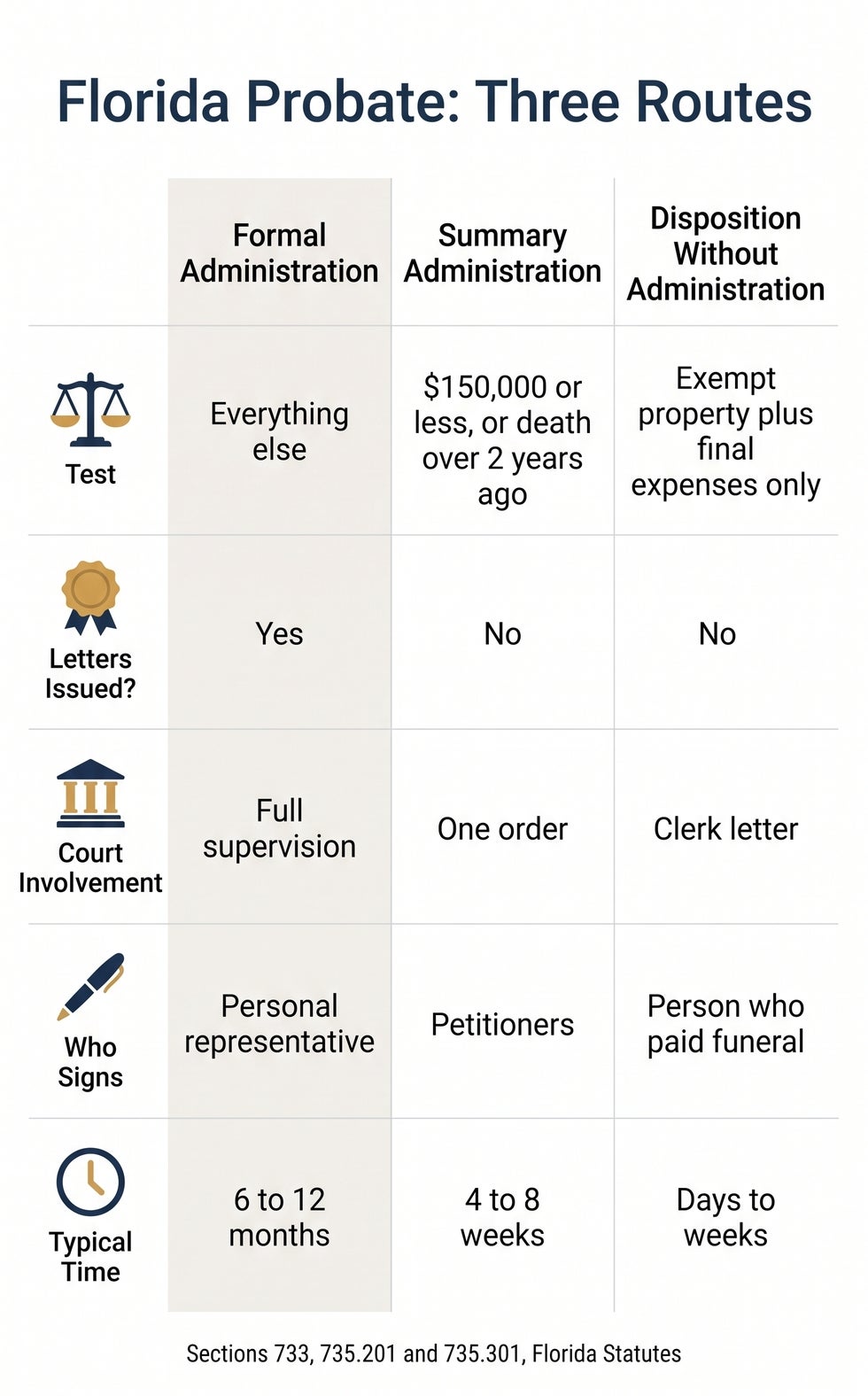
| Formal administration | Summary administration | Disposition without administration | |
|---|---|---|---|
|
Who qualifies |
Any estate; required when the other two do not fit |
Estates meeting § 735.201 |
Estates meeting § 735.301 |
|
Dollar or composition test |
None; Chapter 733 applies |
Non-exempt estate of $150,000 or less, or death more than two years ago |
Only exempt property, constitutionally exempt personal property, and non-exempt personal property worth no more than preferred funeral expenses plus the last 60 days of medical bills |
|
Letters of administration issued? |
Yes |
No; the court enters an order of summary administration |
No; the court authorizes a disposition of personal property by letter |
|
Typical filings |
Petition for administration, oath, designation of resident agent, notice of administration, notice to creditors, inventory, accounting, petition for discharge |
Petition for summary administration and proposed order |
Informal application by affidavit or letter, with the paid funeral bill |
|
Who signs |
The personal representative, through counsel under Rule 5.030 |
The petitioners, usually the surviving spouse and beneficiaries |
The person who paid the final expenses |
|
Typical duration |
Six months to a year if uncontested; longer with litigation or a tax return |
About four to eight weeks for a straightforward estate |
Days to weeks |
The $150,000 figure is new. Effective July 1, 2026, Chapter 2026-57, Laws of Florida doubled the ceiling from $75,000, and the official Sunshine text of § 735.201 now carries the higher number. Several public sources still quote $75,000, including The Florida Bar's consumer pamphlet and the Lee County Clerk's New Probate page as of this writing, so read those for the procedure and trust the statute for the number. Estates that missed the old cap by a little may now qualify; I explain who benefits in Florida's new $150,000 summary administration limit.
Disposition without administration is not a small-dollar shortcut. Section 735.301 is a composition test: the estate may hold only exempt property under § 732.402, personal property exempt under the Florida Constitution, and non-exempt personal property worth no more than the preferred funeral expenses and the reasonable medical bills of the last 60 days. A $9,000 checking account fails it if the funeral cost $6,000. Real property of any kind takes it off the table. The firm's short video Florida Disposition Without Administration: The Smallest Estates shows the kind of estate it actually fits. If neither shorter route fits, the next question is who will serve.
Who Can Serve as Personal Representative in Florida?
The person named in a valid will has first preference, and if there is no will the surviving spouse does, but preference is only half the test. Florida also disqualifies certain people outright, and it limits who may serve from outside the state. The court checks both before issuing letters.
The appointment of a personal representative starts with preference, which comes from § 733.301. In a testate estate: the person nominated in the will, then the person chosen by a majority in interest of the beneficiaries, then a devisee. In an intestate estate: the surviving spouse, then the person chosen by a majority in interest of the heirs, then the nearest heir. Disqualification comes from § 733.303: a person convicted of a felony, a person convicted anywhere of abuse, neglect or exploitation of an elderly or disabled adult, a person mentally or physically unable to do the job, or anyone under 18 cannot serve, and any of the interested parties may point that out to the court. The oath every personal representative signs under Rule 5.320 now recites each of those four items under penalty of perjury.
Can a Nonresident Serve?
Yes, if related to the decedent in one of the ways § 733.304 lists: an adopted child or adoptive parent, anyone related by lineal consanguinity, a spouse, brother, sister, uncle, aunt, nephew or niece, anyone descended from one of those people (which is how a first cousin qualifies), or the spouse of anyone otherwise qualified. A daughter in Ohio, a brother in Toronto and a niece in Munich all qualify. A lifelong friend in Naples does not have to worry, because a Florida resident may serve without any family tie; a lifelong friend in Atlanta cannot serve at all. For most Southwest Florida families this is the first real issue, because the parent moved here and the children did not. The firm's video Who Can Be Personal Representative in Florida? The Rules runs through the common family trees.
One more rule surprises people. An objection to the personal representative's qualifications is not subject to the three-month deadline that applies to will contests. The Legislature removed qualifications from that deadline in 2015 (Ch. 2015-27, amending § 733.212), and § 733.3101 now requires a personal representative who learns of a disqualification to resign immediately or, if it arose after appointment, to file and serve a notice so any interested person can petition for removal within 30 days. Sorting out who serves is the first task in a formal administration; opening the estate is the second, and it needs its own set of documents. For the fuller treatment of what the court is actually issuing, see letters of administration in Florida.
How Is the Estate Opened?
A Florida probate estate is opened by filing a verified petition for administration in the circuit court of the county where the decedent lived, along with the original will, a death certificate, the proposed personal representative's oath, and a designation of resident agent. The court then admits the will, decides whether a bond is required, and issues letters of administration under Rule 5.235.
Petition for Administration in Florida
The petition for administration in Florida is governed by Probate Rule 5.200. It identifies the decedent, the date and place of death, the beneficiaries or heirs with their addresses, the approximate value and nature of the estate assets, and the facts that give the petitioner preference and qualification to serve. Under § 732.901, the custodian of the original will must deposit it with the Clerk within 10 days after learning of the death, and an original will submitted with the petition counts as deposited. A certified death certificate is filed with it. If the original will cannot be found, the petition changes shape entirely, because a lost or destroyed will has to be established through its own petition before the estate can be treated as testate.
The oath under Rule 5.320 is the personal representative's sworn statement of qualification and a promise to administer the estate according to law. It also contains two continuing duties that outlast the signing: to file and serve a notice if a disqualifying event ever occurs, and to notify all interested persons within 20 days of any change of address. The designation of resident agent names a Florida resident (usually the attorney) who can accept service for the personal representative, which matters when the personal representative lives in Michigan or Ontario.
Bond under § 733.402 is required unless the will waives it or the court does. Most attorney-drafted Florida wills waive bond, and a court in the Twentieth Judicial Circuit will often waive it for an in-state personal representative on an uncontested estate, but it can also require bond on its own motion or on the petition of any interested person. Once the petition is accepted, the will admitted, the bond question resolved, and the oath and designation on file, Rule 5.235 directs that letters "shall be issued." Everything is e-filed through the Florida Courts E-Filing Portal, and no one has to appear at the Lee County Justice Center in downtown Fort Myers for a routine opening. The Florida Supreme Court amended Rules 5.200 and 5.320 on June 18, 2026 (case SC2025-1462, effective October 1, 2026), but the changes update cross-references and grammar; they do not alter any of the steps above. With letters in hand, the personal representative's first job is notice.
Florida Probate Steps: Notice and Creditors
The Florida probate steps after appointment are two notices, each with its own clock. The notice of administration under § 733.212 goes to the surviving spouse, beneficiaries and certain others and starts a three-month window for objections to the will. The notice to creditors under § 733.2121 is published and served and starts the creditor claims period.
Under § 733.212, the personal representative must promptly serve the notice of administration on the surviving spouse, the beneficiaries, the trustee of a revocable trust described in § 733.707(3) when that trustee is also the personal representative, and anyone who may be entitled to exempt property. The notice tells each recipient that any objection to the validity of the will, the venue, or the court's jurisdiction must be filed within three months of service, and that the deadline cannot be extended except for a misstatement by the personal representative about the deadline itself. It also announces two other clocks: a petition to determine exempt property is due within four months of service (§ 732.402(6)), and a surviving spouse's election to take an elective share is due within six months of service or two years after death, whichever is earlier (§ 732.2135).
Notice to Creditors in Florida
Notice to creditors in Florida is published once a week for two consecutive weeks in a local newspaper in the county where the estate is being administered, under § 733.2121. Publication alone is not enough. The personal representative must also make a diligent search for creditors who are reasonably ascertainable and serve each of them directly, and if the decedent was 55 or older, must serve the Agency for Health Care Administration with the notice and a copy of the death certificate within three months of first publication, because Medicaid is a creditor of many Florida estates.
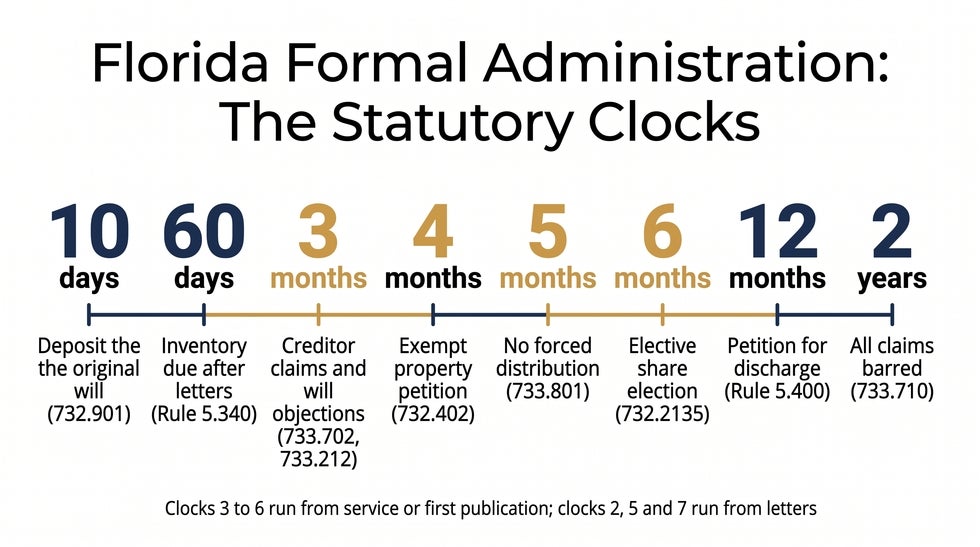
The claim deadline under § 733.702 is the later of three months after first publication or, for a creditor who had to be served, 30 days after service. Claims filed late are barred unless the court extends the time for fraud, estoppel or insufficient notice. Behind all of that sits § 733.710: two years after death, no claim against the decedent survives at all, whether or not an estate was ever opened. That two-year bar is why an old estate can use summary administration regardless of value, and it is why a family that waits will sometimes find the creditor problem has solved itself. What the family cannot skip while the clocks run is the inventory.
When Is the Florida Probate Inventory Due?
The Florida probate inventory is due within 60 days after letters of administration issue, under Probate Rule 5.340. It lists every probate asset with its estimated fair market value at the time of death, designates homestead property separately, and is served on the surviving spouse, the heirs in an intestate estate, and the residuary beneficiaries in a testate estate.
Under § 733.604, the inventory is verified, it is confidential (exempt from Florida's public records law and available only to interested persons or by court order), and it must be amended whenever the personal representative learns of an omitted asset or a wrong value. A beneficiary who asks in writing is entitled to a written explanation of how each value was determined, or a copy of the appraisal. In practice this step is where the personal representative discovers what is actually in the probate estate: bank accounts titled to the decedent alone go on the inventory; life insurance, retirement accounts and joint accounts with a named beneficiary usually do not, because they pass outside probate. The firm's video Do All Assets Go Through Probate in Florida? sorts the common ones, and assets exempt from probate in Florida gives the full list.
Homestead and Exempt Property
Homestead property is inventoried but treated separately, because if the decedent left a spouse or minor child it is not a probate asset at all and passes under § 732.401: a life estate to the spouse with a remainder to the descendants, or, at the spouse's election, an undivided half interest. The personal representative usually files a petition to determine homestead status so the title record is clean. That subject has its own article, Florida homestead in probate, and it is worth reading before anyone lists a Bonita Springs house for sale.
Exempt assets under § 732.402 belong to the surviving spouse or, if none, the children, free of creditor claims: household furniture and appliances up to $20,000, two motor vehicles under 15,000 pounds that the family used personally, Florida Prepaid and other 529 plans, and the death benefits paid under § 112.1915 to the survivors of a teacher or school administrator killed on the job. It has to be claimed by petition within four months of service of the notice of administration or it is waived. Separately, § 732.403 allows a family allowance of up to $18,000 for the support of a spouse and dependent lineal heirs during administration. Once the inventory is filed and the creditor period has closed, the estate can start paying what it owes.
Paying Claims and Taxes in Formal Probate in Florida
Claims in formal probate in Florida are paid only after the personal representative has reviewed each one, objected to any that are invalid, and confirmed that the estate can pay in the statutory order. An objection must be filed by the later of four months after first publication or 30 days after the claim was filed (§ 733.705), and a creditor who is objected to has 30 days after service of the objection to sue or lose the claim.
Section 733.705 also gives the personal representative a shield: no one can compel payment of the decedent's debts until five months after first publication, and a creditor who sues during that window recovers no fees or costs. When the estate cannot pay everything, § 733.707 sets eight classes, paid in order: costs and expenses of administration including the attorney's fee (Class 1), funeral expenses up to $6,000 (Class 2), federal-priority debts and Medicaid claims (Class 3), medical bills from the last 60 days (Class 4), the family allowance (Class 5), child support arrears (Class 6), debts of a continued business (Class 7), and everything else (Class 8). Within a class, creditors share pro rata. Selling the house to raise cash is common; if the will grants a power of sale, § 733.613 lets the personal representative sell real estate without a court order, and if it does not, no title passes until the court authorizes or confirms the sale. The mechanics are in selling a house in Florida probate.
Compensation is a Class 1 expense too. Under § 733.6171, Florida presumes a fee for the attorney's ordinary services of $1,500 for an estate up to $40,000, $2,250 up to $70,000, $3,000 up to $100,000, and $3,000 plus 3 percent of the value over $100,000 up to $1 million, with lower percentages above that. The statute says in the same breath that there is no mandatory fee, that it need not be based on estate size, and that it is negotiable, and it requires the attorney to disclose all of that in writing and obtain the personal representative's signature. The personal representative's own commission under § 733.617 is presumed reasonable at 3 percent of the first $1 million. Who ultimately bears those costs, and when a judge can shift them, is the subject of my earlier article, Who Pays Probate Attorney Fees in Florida?
Taxes are simpler than most families fear. Florida has no estate tax on anyone who died after December 31, 2004, and since July 1, 2023 the Department of Revenue no longer requires personal representatives to file the old Affidavit of No Florida Estate Tax Due (Form DR-312). The personal representative still files the decedent's final Form 1040, obtains an employer identification number for the estate, and files Form 1041, the estate's own income tax return, for income the estate earns during administration. A federal estate tax return is due only if the gross estate exceeds the basic exclusion amount, which the IRS puts at $15,000,000 for deaths in 2026 under Public Law 119-21. Property taxes keep accruing on any home the estate holds, and the homestead exemption question after death is addressed in the homestead article linked above. With claims and taxes handled, the beneficiaries' question finally gets an answer.
When Can Estate Assets Be Distributed?
Estate assets can be distributed in Florida probate once the creditor period has closed, valid claims and expenses are paid or reserved for, and the personal representative is confident the accounting will balance. No beneficiary can force a distribution of assets before five months have passed from the granting of letters, under § 733.801, and in most estates the practical date is later than that.
Partial distributions are possible and often sensible: a specific bequest of a car or a piece of jewelry, or a partial cash distribution once the claims picture is clear and a reserve is set aside for taxes, fees and the last bills. The personal representative who makes one should keep enough back to cover every Class 1 through Class 8 obligation that could still surface, because a distribution that later leaves the estate short becomes the personal representative's personal problem. Final distribution follows the plan of distribution in the petition for discharge, discussed below, and each beneficiary signs a receipt.
Delays come from a short list. A homestead determination that has to be litigated, a creditor who sues on an objected claim, a will contest filed inside the three-month window, real property in another state that needs an ancillary administration under § 734.102, or a federal estate tax return whose closing letter the personal representative reasonably waits for. Each is a reason the firm's timeline article gives a range rather than a date, and each is a reason to keep the estate affairs documented as they happen. The way to keep an estate out of that list is to avoid the mistakes in the next section.
What Must the Personal Representative NOT Do During Florida Formal Administration?
During Florida formal administration the personal representative must not self-deal, must not distribute early, must not commingle estate funds with personal funds, and must not neglect notice or creditor handling. Each of these breaches the fiduciary duty Chapter 733 imposes, and each can make the personal representative personally liable for the resulting loss, with no excuse for good intentions.
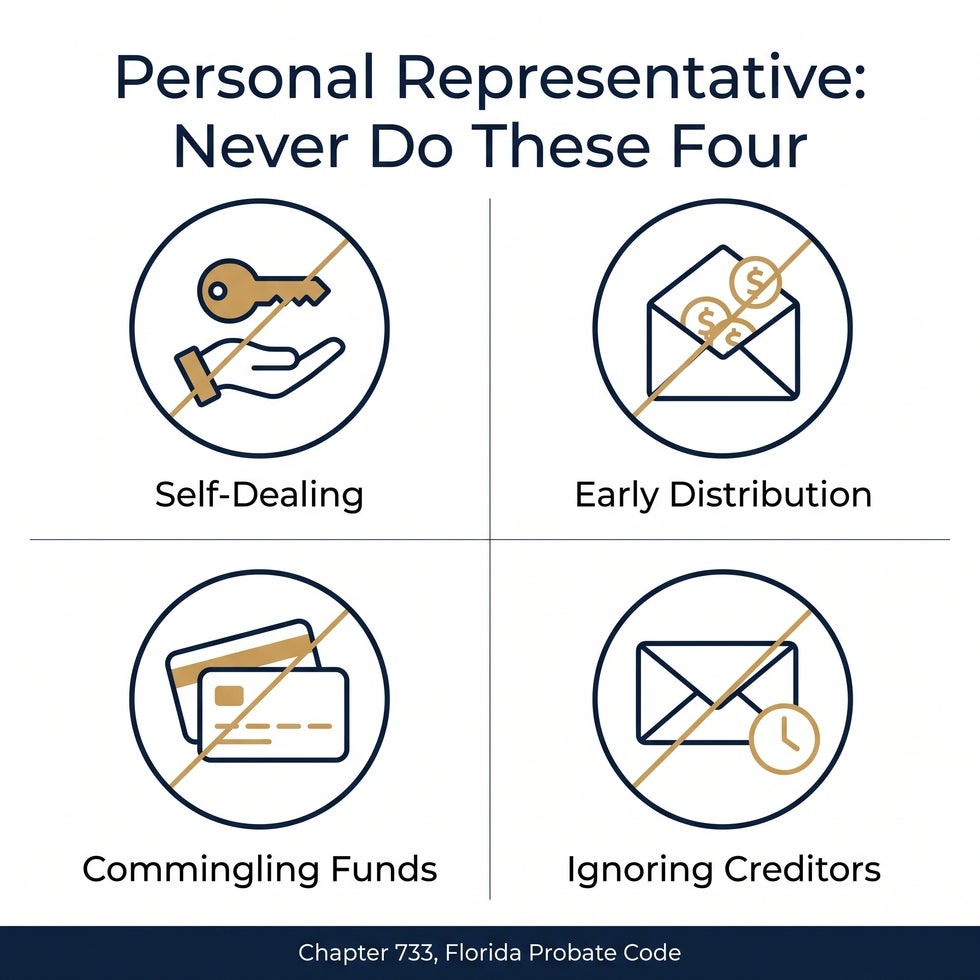
Self-dealing and conflicts. The personal representative cannot buy estate property, lend estate money to a family member, move into the house rent-free, or favor one beneficiary over another without a legal basis. If the personal representative is also a beneficiary, which is common, every transaction that touches the personal representative's own share should be documented and, where there is any doubt, submitted for court approval.
Early distribution. Distributing before the creditor period ends, or before the estate knows whether the Agency for Health Care Administration will file a Medicaid claim, is the single most expensive mistake in Florida probate cases. If a valid claim surfaces after the money is gone, the personal representative who paid it out is the one the creditor pursues.
Commingling. Estate money goes in an estate account opened under the estate's own EIN, never through the personal representative's checking account, and never into a joint account with anyone. The final accounting has to trace every dollar, and a blended account makes that impossible to do and easy to attack.
Ignoring notice and creditors. Skipping the diligent search for creditors, forgetting the AHCA notice, or paying claims in the wrong class exposes the estate to late claims and the personal representative to surcharge. Probate rewards order; personal representative duties in Florida are mostly a matter of doing the next required thing on time and writing it down. The reward for doing so is a clean discharge.
How Is the Estate Closed?
The estate is closed by filing a final accounting and a petition for discharge in Florida under Probate Rule 5.400, serving both on every interested person, waiting out a 30-day objection period, making the distributions in the plan, filing the beneficiaries' receipts, and obtaining an order of discharge under § 733.901.
The petition for discharge in Florida states that administration is complete, that all timely claims have been paid, settled or otherwise disposed of, what the personal representative and the professionals were paid, and the plan of distribution: what has already gone out, what remains, who gets what, and how much is being held back for final expenses. The final accounting shows every receipt and disbursement since letters issued. Rule 5.400 expects both to be filed within 12 months after letters, or within 12 months after a federal estate tax return was due, unless the court extends the time. Interested persons may waive the accounting and consent to discharge, which is routine when the beneficiaries are a few family members who trust each other and have seen the numbers.
After the 30 days pass with no objection, the personal representative distributes under the plan, collects a signed receipt from each beneficiary, files the receipts, and submits the proposed order. The discharge under § 733.901 releases the personal representative from further liability and releases the surety on any bond. Out-of-state property is the usual reason a closing runs long; the firm's video Florida Estate With Out-of-State Real Estate: A Second Probate explains why a Michigan cottage cannot be closed out through a Lee County file. An uncontested formal administration in the Twentieth Circuit closes in six months to a year; one with a will contest, a tax return or property in two states can run one to three years.
Conclusion
Florida formal administration is a sequence, not a mystery: qualify, open, notify, inventory, pay, distribute, discharge. The deadlines are set by statute, from the 10-day deposit of the original will to the two-year bar on creditor claims, and most of them are set in motion by two dates, the issuance of letters and the first publication of the notice to creditors. Keep those two dates on a calendar and the rest of the Florida probate process follows. What the process asks of the personal representative is patience, records, and a refusal to hand out money before the law says the estate is ready.
How The Nussbickel Law Firm Helps
The Nussbickel Law Firm, P.A. practices estate planning and probate and trust administration exclusively, from an office at 12487 Brantley Commons Court in Fort Myers. Gregory J. Nussbickel, the firm's founder and probate lawyer, represents personal representatives in formal administrations throughout Lee, Collier and Charlotte County, handles estate administration matters state-wide in all Florida counties, and regularly serves as Florida counsel for a son or daughter in another state who has just learned that a parent's estate here needs a court file. Consultations are free and can be by phone, by video, or at the office.
What to Bring to the First Meeting
Bring the original will if you have it (or tell us where it is), a certified death certificate, the deed to any Florida real estate, the most recent statement for each bank account, brokerage account and retirement account, any life insurance policy, a list of the outstanding debts you know about, and the names and addresses of the surviving spouse, children and anyone named in the will. With those in hand we can usually tell you in one conversation whether the estate qualifies for summary administration or needs a formal administration, roughly what the court costs and the fee will be, and when the first filing can go in. Schedule a consultation or call our Fort Myers office at 239-900-WILL (9455).
Frequently Asked Questions
How long does formal probate take in Florida?
An uncontested formal administration in Southwest Florida usually takes six months to a year. The floor is set by statute: creditors have three months from first publication to file claims, the personal representative cannot be forced to pay debts until five months after publication, and Rule 5.400 expects the petition for discharge within 12 months of letters. Will contests, litigation over a claim, a federal estate tax return, or property in another state can extend that to one to three years.
What are the costs and fees in Florida formal administration?
The Clerk's filing fee is $395 plus a $4 service charge under § 28.2401, and publication of the notice to creditors is a separate newspaper charge. The attorney's fee for ordinary services is presumed reasonable under § 733.6171 on a schedule that starts at $1,500 for an estate up to $40,000 and reaches $3,000 plus 3 percent of value over $100,000, but the statute makes the fee negotiable and requires written disclosure of that fact. The personal representative may take a commission under § 733.617, presumed reasonable at 3 percent of the first $1 million, and many family members waive it.
Do you need an attorney for Florida probate administration?
For formal administration, yes in almost every case. Florida Probate Rule 5.030 requires the personal representative to be represented by an attorney admitted in Florida unless the personal representative remains the sole interested person, meaning no other beneficiary, heir or creditor has any stake in the estate. Summary administration and disposition without administration do not appoint a personal representative and therefore do not trigger the rule, although many families use counsel for those too.
How does probate work in Florida without a will?
The same formal administration steps apply, with two differences. Preference to serve goes first to the surviving spouse, then to the person chosen by a majority of the heirs, then to the nearest heir under § 733.301, and the heirs are determined by Florida's intestacy statutes rather than by a will. The personal representative still publishes notice to creditors, files the inventory within 60 days, pays claims in statutory order, and closes with a petition for discharge.
What if the personal representative distributes too early?
The personal representative can be held personally liable. Under § 733.801 no beneficiary can demand a distribution before five months from the granting of letters, and a personal representative who pays out before the creditor period has closed and a valid claim later appears may have to make the estate whole from personal funds. The safe practice is to distribute only after the claims period ends, objections are resolved, and a reserve is set for remaining expenses.
Can the personal representative sell the house during probate?
Yes. If the will gives a power of sale, § 733.613 allows the personal representative to sell real property without a court order, and the buyer takes title free of estate creditors' claims. If there is no will or no power of sale, the personal representative may still contract to sell, but no title passes until the court authorizes or confirms the sale. Homestead property that passes to a spouse or minor child under § 732.401 is not an estate asset and cannot be sold by the personal representative at all.
Gregory J. Nussbickel is the founder of The Nussbickel Law Firm, P.A. in Fort Myers, Florida. His practice is devoted exclusively to estate planning, probate, and trust administration for families throughout Southwest Florida.
This article is for general information only and is not legal advice. Reading it does not create an attorney-client relationship. Probate law changes, and every estate is different; speak with a licensed Florida attorney about your specific situation.

Comments
There are no comments for this post. Be the first and Add your Comment below.
Leave a Comment