

Key Highlights
- The main types of trusts for estate planning fall into two groups: revocable trusts, which you can change, and irrevocable trusts, which you generally cannot.
- Revocable living trusts are the workhorse of most Florida plans. They keep property out of the probate process and off the public record, but they do not shield you from creditors or cut your tax liability.
- Florida does not allow self-settled asset protection trusts. Under Fla. Stat. 736.0505, a creditor can reach whatever the trustee could pay back to you.
- Specialty vehicles solve specific problems: special needs trusts preserve government benefits, ILITs keep life insurance proceeds out of the taxable estate, and QTIP marital trusts protect children of a first marriage.
- Funding is what makes any of this work. An unfunded document controls nothing, and the assets you leave outside it still land in probate court.
Introduction
The short answer: The types of trusts for estate planning divide into two main categories, revocable and irrevocable, and everything else is a variation on one of them. Florida families use a revocable living trust to avoid probate and keep matters private, and an irrevocable one when the goal is creditor protection, benefit eligibility, or removing assets from the taxable estate.
Most people arrive at our Fort Myers office having heard four or five names and no clear sense of which one fits. That is the useful question, and it has a practical answer. Below we compare the main types of trusts in estate planning and wealth transfer, what each one actually does, what belongs inside, what it costs, and the Florida rules that change the analysis here.
What Is a Trust in Estate Planning?
It is a legal arrangement in which one person (the grantor) hands property to a trustee, who holds and manages it for named beneficiaries under written rules. Those rules, the terms of the trust, control who gets what and when, without a judge deciding.
How Does a Trust Work?
Three roles drive it: the grantor who creates and funds it, the trustee who manages the property, and the beneficiaries who receive it. In a revocable plan, one person often fills all three roles while alive, then a named successor takes over at incapacity or death. Retitling assets into the name of the trustee is the step people skip, and it is the step that matters. A deed signed but never recorded, or an account never retitled, leaves that asset in probate no matter what the document says.
What Can a Trust Accomplish?
Used properly, this kind of legal arrangement can:
- Avoid probate on every asset retitled into it
- Protect assets from a beneficiary's creditors and divorces
- Preserve privacy, since the document is never filed as a public record
- Manage incapacity, because the successor trustee steps in without a guardianship
- Reduce estate taxes, where the estate is large enough for that to matter
- Control inheritance distributions by age, milestone, or trustee discretion
Trust vs. Will: What's the Difference?
A will speaks only at death and only through the courthouse. It names a personal representative, nominates guardians for minor children, and then must be admitted to probate before it moves anything. A funded plan operates immediately and continues through incapacity and death without court supervision. Most Florida plans use both, which is why a pour-over will accompanies nearly every one we draft. My earlier article, Living Will vs Living Trust Florida: Do You Need Both?, walks through the comparison in detail.
How Do the Most Common Types of Trusts Compare?
They compare on four points: whether you can change the document, whether it takes effect during life or at death, whether it shelters assets from creditors, and whether it saves tax. Almost every choice among types of trusts for estate planning turns on those four.
Comparison Table
Here are the key differences among the arrangements Florida families use most:
| Type | Changeable? | Avoids probate | Creditor protection | Typically used for |
|---|---|---|---|---|
|
Revocable living |
Yes |
Yes, if funded |
No, for the grantor |
Probate avoidance, privacy, incapacity |
|
Irrevocable |
Rarely |
Yes |
Yes, from the grantor's future creditors |
Tax and benefit planning |
|
Testamentary |
Until death |
No |
Yes, for beneficiaries |
Minor children, staged inheritances |
|
Special needs |
Varies |
Yes |
Yes |
Preserving government benefits |
|
Life insurance (ILIT) |
No |
Yes |
Yes |
Keeping policy proceeds out of the estate |
|
Marital (QTIP) |
No, after death |
Yes |
Yes |
Blended families, spousal income |
Each of those deserves a closer look, because the labels hide real differences in control.
Types of Trusts for Estate Planning
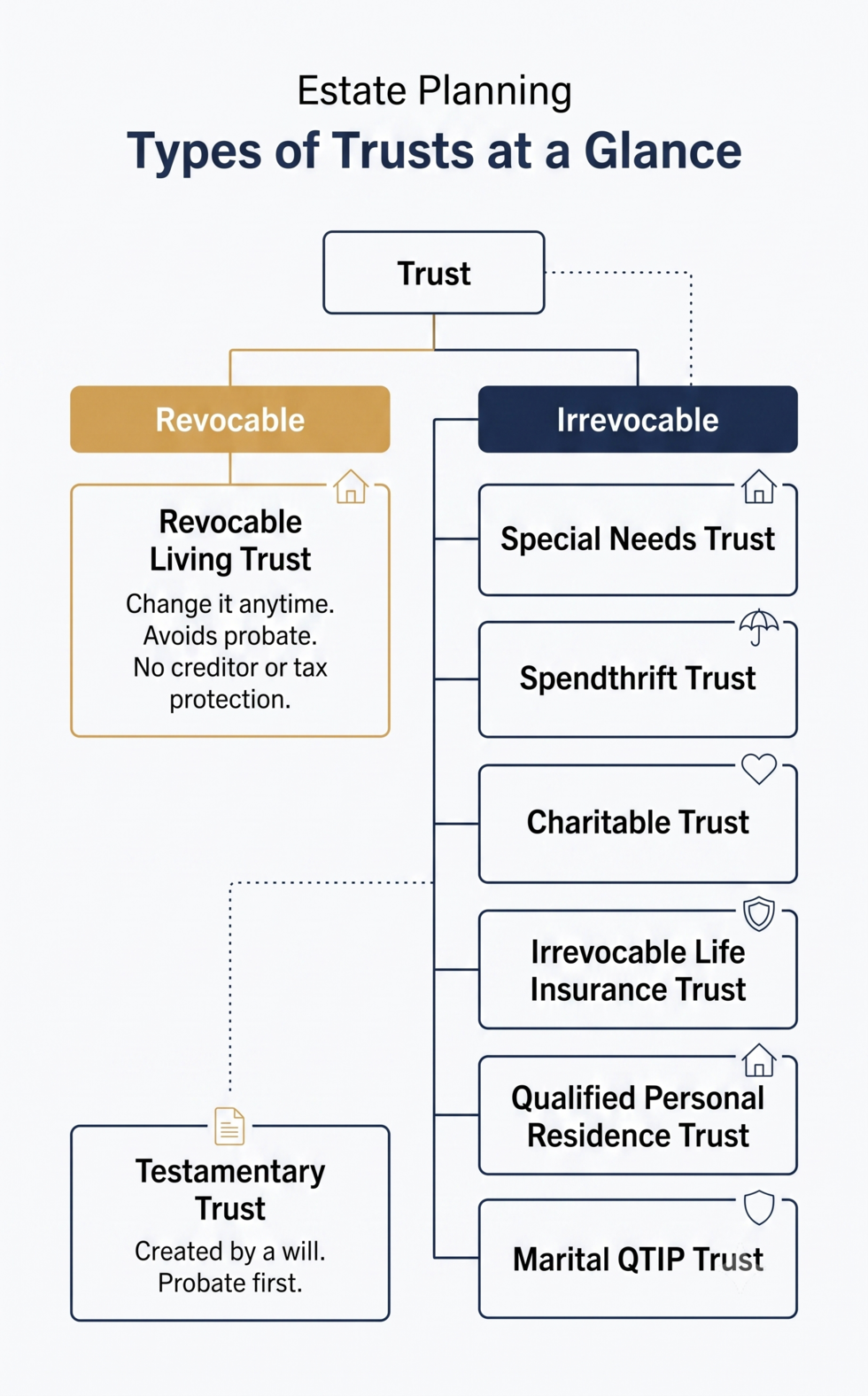
Below are the different types of trusts for estate planning we see most often in Southwest Florida, in rough order of how commonly they appear in a plan.
Revocable Living Trust
The most common type of trust used in estate planning. You keep full control, amend or revoke it at will, and serve as your own trustee. Under Fla. Stat. 736.0602, a Florida document is presumed revocable unless it says otherwise. The trade-off: no asset protection, no tax benefits, and under Fla. Stat. 733.707(3) the assets remain reachable for your final debts if the estate cannot cover them.
Irrevocable Trust
You give up the right to amend, and in exchange the property leaves your balance sheet for creditor and tax purposes. Every type of irrevocable trust below is a specialized version of this idea. Because the transfer of assets is permanent, we model the numbers with your financial advisor before signing anything.
Testamentary Trust
This one is written inside a will and springs into existence only at death, so the will still goes through probate first. It is the standard answer for parents who want a child's inheritance held to age 25 or 30 rather than handed over at 18.
Special Needs Trust
Holds funds for a disabled beneficiary without disqualifying them from Medicaid or supplemental security income, which cuts off at $2,000 in countable resources for an individual (SSA). A first-party version funded with the beneficiary's own money must comply with 42 U.S.C. 1396p(d)(4)(A): beneficiary under 65, disabled, and a Medicaid payback at death.
Spendthrift Trust
Not a separate document so much as a clause. Fla. Stat. 736.0502 makes a spendthrift provision valid only if it restrains both voluntary and involuntary transfers, and we include one in nearly every family trust so the trust's assets stay beyond a beneficiary's creditors.
Asset Protection Trust
Here Florida departs from the states that advertise these. Under Fla. Stat. 736.0505, a creditor may reach the maximum amount the trustee could distribute back to the grantor, so a self-settled version does not work here. Real protection comes from irrevocable transfers for others, homestead, and Florida's exemptions.
Charitable Trust
Two shapes. A charitable remainder trust pays you or your family an income stream first, then the remaining assets go to charity; a charitable remainder annuity trust must pay between 5% and 50% annually with at least a 10% projected charitable remainder (26 U.S.C. 664). A charitable lead trust reverses the order, paying the charity first.
Irrevocable Life Insurance Trust (ILIT)
Owns a life insurance policy so the life insurance proceeds are not part of your estate for federal tax. Because 26 U.S.C. 2042 pulls in policies you hold incidents of ownership over, and transfers within three years of death are clawed back, the cleanest path is to have the trustee buy the policy new.
Qualified Personal Residence Trust (QPRT)
Moves a home out of your estate at a discounted gift value while you keep living in it for a set term during the grantor's lifetime. It works because 26 U.S.C. 2702 carves out personal residence trusts from its zero-valuation rule. Outlive the term or the tax benefit is lost.
Marital (QTIP) Trust
A qualified terminable interest property trust pays your surviving spouse all income for life while you fix who inherits the principal afterward. That combination, defined in 26 U.S.C. 2056(b)(7), is why qualified terminable interest property is the standard tool for second marriages with children from a first.
Advanced Wealth Transfer Strategies
For larger balance sheets: a credit shelter trust captures the first spouse's estate tax exemption, a dynasty trust runs up to 1,000 years under Fla. Stat. 689.225 and holds wealth for future generations, and grantor-retained annuity trusts shift appreciation. These pair with financial gifts made under the $19,000 annual exclusion.
Other Specialized Trusts
A totten trust is simply a payable-on-death bank account under Fla. Stat. 655.82, not a document at all. Florida also recognizes pet trusts (Fla. Stat. 736.0408) and community property trusts for couples who moved here from a community property state. Knowing the menu is only half the work; the harder question is which item on it fits your family.
Which Type of Trust Is Right for You?
Match the tool to the problem, not to the brochure. Different types of trust for estate planning solve different problems, so here is how we sort the types of estate planning trusts by the goal a family names first.
Best Trust to Avoid Probate
A funded revocable living plan, every time. Nothing else keeps the whole estate out of court while leaving you free to change your mind.
Best Trust for Asset Protection
An irrevocable one funded for someone other than yourself, paired with spendthrift language. For your own assets, Florida's homestead and exemption statutes usually do more than any document can.
Best Trust for Parents
Parents of minor children need a revocable plan with staged distributions inside it, plus a will that nominates guardians. The will is what names who raises them.
Best Trust for Married Couples and Blended Families
A joint revocable plan for first marriages. For blended families, a marital trust of the QTIP variety, so the surviving spouse is supported and your children still inherit.
Best Trust for Business Owners
An irrevocable arrangement holding non-voting interests, coordinated with the operating agreement and a buy-sell. Keep voting control outside it until succession is settled.
Best Trust for Real Estate Investors and High-Net-Worth Individuals
Layer an LLC under a revocable plan for rentals. Above the federal exclusion, add a QPRT for the residence and a dynasty structure for the rest.
Best Trust for Charitable Giving and Families With Special Needs
The charitable remainder version converts appreciated property into income plus a deduction. For a disabled family member, a properly drafted special needs vehicle is the only safe answer.
How Trusts Help Avoid Probate
Probate reaches only assets titled in your sole name with no beneficiary. Retitle those into a trustee's name and there is nothing left for the court to administer, which is the entire mechanism. Trust assets pass under the terms of the document instead. That matters in Florida because summary administration is capped at $150,000 (Ch. 2026-57), and estates above it face formal administration with fees set by Fla. Stat. 733.6171. Avoiding the legal process also keeps the inventory off the public record. For the other methods, see my earlier article, Top Ways to Avoid Florida Probate: A Quick Guide. Which assets you move is the next decision.
What Assets Should You Put Into a Trust?
Funding decides whether the plan works. These are the types of assets we retitle, and the ones we deliberately leave alone.
Real Estate
Florida homes, rentals, and out-of-state property. A deed into the trustee's name is the single highest-value funding step for avoiding probate.
Bank Accounts
Operating and savings accounts get retitled. Keep one small account in your own name for convenience.
Brokerage Accounts
Taxable investment accounts transfer cleanly and are usually the easiest call in the whole funding process.
Business Interests
LLC and closely held corporate interests, subject to the operating agreement's transfer restrictions and any S corporation eligibility limits.
Personal Property
Furniture, jewelry, and household goods pass by a general assignment signed with the plan.
Collectibles
Art, coins, and boats belong in it when values are meaningful, because each would otherwise need its own probate transfer.
Life Insurance
Name the trustee as beneficiary rather than retitling ownership, unless an ILIT owns the policy outright.
Retirement Accounts
Leave IRAs and 401(k)s in your own name. Retitling one triggers immediate income tax; name beneficiaries instead, and get tax advice before naming a trustee.
Assets That Should Not Be Placed in a Trust
Retirement accounts, health savings accounts, vehicles used daily, and, in many plans, the homestead where a Lady Bird deed does the job more cheaply. Once you know what goes inside, the next fair question is what the whole package costs.
How Much Does It Cost to Set Up a Trust?
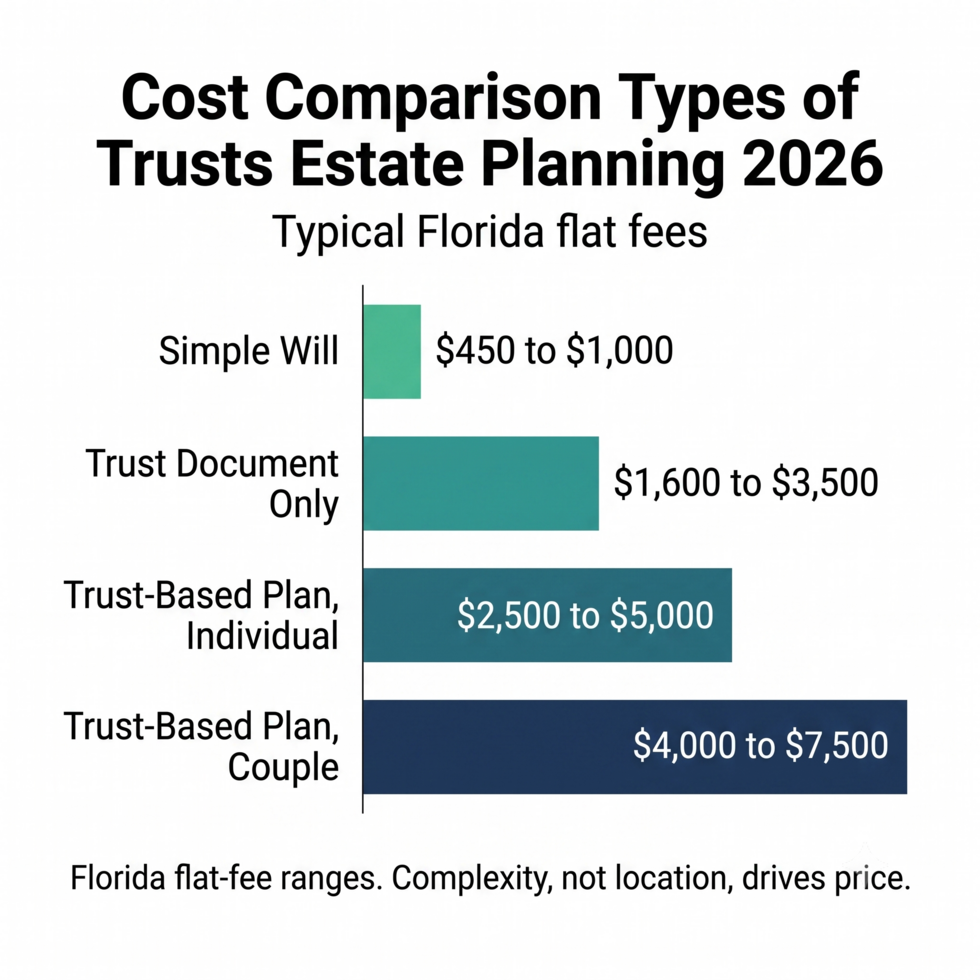
Across Florida, the document alone commonly runs $1,600 to $3,500, and a complete trust-based plan $2,500 to $5,000 for an individual or $4,000 to $7,500 for a couple. A simple will runs $450 to $1,000. We publish current statewide figures in Average Cost of Will and Trust in Florida.
| Deliverable | Typical Florida flat fee |
|---|---|
|
Simple will |
$450 to $1,000 |
|
Trust document only |
$1,600 to $3,500 |
|
Trust-based plan, individual |
$2,500 to $5,000 |
|
Trust-based plan, couple |
$4,000 to $7,500 |
Those are statewide averages, not our price list. Our own flat fees for a trust-based plan frequently land below these ranges, and we quote the number in writing before you commit to anything.
Factors That Affect Pricing
Complexity drives price: the number of properties, business interests, a blended family, special needs planning, or out-of-state assets. Deed preparation and funding letters are usually quoted separately.
Is a Trust Worth the Investment?
Weigh it against formal administration, where statutory attorney fees on a $600,000 estate approach $18,000 before costs, plus months of delay. Kiplinger's overview of living trusts makes the same point about court time and expense. For a Cape Coral couple with a home and two accounts, the arithmetic is usually straightforward. For a modest estate that already passes by beneficiary designation, it may not be.
Common Mistakes When Creating a Trust
We fix the same handful of problems over and over, and every one of them is cheaper to prevent than to repair.
Choosing the Wrong Trust
Buying an irrevocable product for a probate problem. The remedy for probate is a revocable document you can still change.
Naming the Wrong Trustee
The most organized child, not the oldest. A corporate trustee is worth the fee when family friction is likely.
Not Funding the Trust
The single most common failure. Signed but empty, the document governs nothing and every asset still goes through probate court.
Failing to Update the Trust
A death, divorce, sale, or move should trigger a review. Plans older than five years often name people who are gone.
Ignoring Tax Implications
Retitling a retirement account or transferring appreciated property without modeling the result can create a tax liability that dwarfs the drafting fee.
Assuming a Trust Replaces Every Estate Planning Document
It does not replace a pour-over will, a durable power of attorney, a health care surrogate, or a living will. Those cover what happens while you are alive.
Using DIY Documents for Complex Estates
Online forms cannot see your specific situation. Florida's homestead and elective share rules routinely defeat generic templates, and those rules are the reason a plan drafted out of state so often needs redoing here.
What Should Florida Residents Consider When Creating a Trust?
Three Florida rules change the analysis: how our courts treat administration, how homestead works, and the fact that no state death tax applies here.
Florida Probate Laws and Trust Administration
Chapter 736 governs administration, and a trustee owes beneficiaries notice and accountings. Under Fla. Stat. 736.05053, the trustee must pay estate expenses the personal representative certifies, so a revocable plan does not defeat legitimate creditors.
Florida Homestead Rules
Homestead cannot be devised at all if you are survived by a spouse or minor child (Fla. Stat. 732.4015). Transferring it to a revocable arrangement is not a devise under Fla. Stat. 732.4017, but the protections travel with it only if drafted correctly. See Florida homestead probate.
Estate Planning Considerations for Florida Families
Florida imposes no state estate or inheritance taxes; Fla. Stat. 198.02 measures our tax by a federal credit that no longer exists. Federally, the 2026 exclusion is $15 million per person (IRS), so most families plan for probate and privacy, not tax. Our guide to Florida estate and death taxes covers the rest.
Why The Nussbickel Law Firm Can Help With Your Estate Planning Needs
Choosing among the types of trusts used in estate planning is a judgment call about your family, not a product selection. We do this work exclusively, and we do it in Florida.
Personalised Trust Planning
We start with the goal you name first, then recommend the narrowest tool that reaches it. Every plan is drafted for your financial situation rather than assembled from a template.
Probate and Estate Administration Guidance
Because we also handle probate and estate administration, we draft knowing how these documents behave in the Twentieth Judicial Circuit when they are actually used.
Florida-Focused Legal Experience
Homestead, the elective share, and Chapter 736 are Florida-specific, and they are where out-of-state forms fail. The Florida Bar's consumer pamphlet Do You Have a Will? is a useful starting point.
Tailored Strategies for Families, Business Owners, and Retirees
Young families need guardians and staged distributions. Business owners need succession language. Retirees and snowbirds need coordination across two states.
Schedule a Consultation With an Estate Planning Attorney
We will tell you plainly whether a will-based plan is enough or a trust-based one earns its keep, and quote a flat fee before you commit. Schedule a consultation or call our Fort Myers office.
Frequently Asked Questions
What is the best type of trust for estate planning?
For most Florida families, a funded revocable living plan. It avoids probate, handles incapacity, and stays private. Larger or more complicated situations add an irrevocable layer on top of it, such as an ILIT or a special needs share.
Which trust protects assets from creditors?
Not all types of trusts protect assets from creditors and legal claims. Only irrevocable arrangements do, and in Florida only when funded for someone other than yourself. A revocable plan offers the grantor no protection at all.
What is the difference between a revocable and irrevocable trust?
Control. You can amend or revoke the first at any time, which is why creditors and the tax code still treat the property as yours. Giving up that control is what buys protection. See Revocable vs. Irrevocable Trusts in Florida.
Do I need both a will and a trust?
Yes. A pour-over will catches anything left outside and nominates guardians for minor children. A will does not override a funded plan as to assets already retitled.
Can I have more than one trust?
Yes, and many plans use several: a revocable one for probate avoidance, an ILIT for insurance, a special needs share for one child.
Which trust is best for married couples?
A joint revocable plan in a first marriage. Where one spouse has children from a prior relationship, a QTIP arrangement protects both sides.
Which trust is best for parents with young children?
A revocable plan with distributions staged by age, or a testamentary version inside a will if the budget is tight.
Which trust is best for blended families?
A QTIP marital arrangement. Your spouse receives income for life; your children receive the principal.
Can a trust reduce estate taxes?
Only irrevocable ones can. With a $15 million federal exclusion, the tax benefits matter to a small share of Florida families.
What assets should not be placed in a trust?
Retirement accounts, health savings accounts, and daily-driver vehicles. Homestead sometimes belongs outside as well.
Can a trust own real estate?
Yes, and it should. A deed to the trustee is how Florida real property avoids probate.
Can a trust own an LLC?
Yes, subject to the operating agreement. Membership interests are commonly assigned to a revocable plan, and this is a good question for your financial plan review.
How much does it cost to create a trust?
Statewide, commonly $2,500 to $5,000 for a complete individual plan, more for complex estates. Our office frequently quotes below that range. Ask for a flat fee in writing.
Gregory J. Nussbickel is the founder of The Nussbickel Law Firm, P.A. in Fort Myers, Florida. His practice is devoted exclusively to estate planning, probate, and trust administration for families throughout Southwest Florida.
This article is for general information only and is not legal advice. Reading it does not create an attorney-client relationship. Law changes and every family is different; speak with a licensed Florida attorney about your specific situation.

Comments
There are no comments for this post. Be the first and Add your Comment below.
Leave a Comment