
Key Highlights
- Estate planning for grandchildren means naming them deliberately in a will, a trust, or a beneficiary designation, and controlling the age and terms on which they receive anything.
- In Florida, a minor cannot legally own an inheritance. A natural guardian can collect only up to $15,000 on a child's behalf under Fla. Stat. 744.301(2); above that, someone has to open a court guardianship.
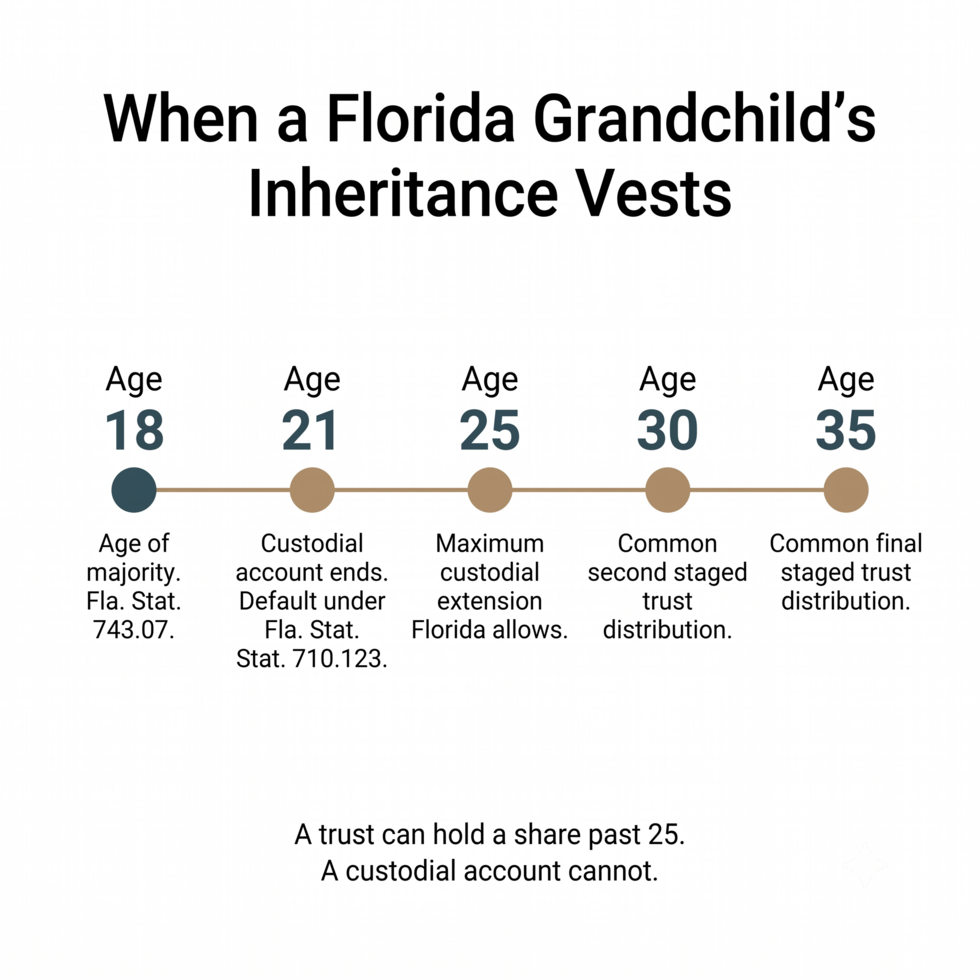
- A custodial account under the Florida Uniform Transfers to Minors Act hands the money over at 21 unless you extend it, and 25 is the maximum Florida allows under Fla. Stat. 710.123.
- A trust is the only tool that lets you set staged ages, add spendthrift and divorce protection, and cover grandchildren who are not born yet.
- Florida charges no state estate tax, no inheritance tax, and no state income taxes on individuals, so the tax questions here are almost entirely federal.
- The 2026 federal numbers are a $19,000 annual gift exclusion per recipient and a $15,000,000 estate, gift, and generation-skipping exemption per person.
Introduction
The short answer: estate planning for grandchildren is the process of deciding what each grandchild receives, when they receive it, and who manages it in the meantime, then writing those decisions into a will, a trust, and your beneficiary designations so Florida law does not decide for you. For most Southwest Florida families, that means a trust holding each grandchild's share until an age you choose, rather than a lump sum at 18 or 21.
Grandparents come to our Fort Myers office with a version of the same worry. They have worked for decades, they want the next generation to be better off, and they are uneasy about handing a young person a large check. That instinct is right. A grandchild who inherits at 18 gets full control of the money the day the account transfers, with no obligation to spend it on college tuition, a first home, or anything else you had in mind.
The good news is that Florida gives you a lot of room to be specific. You can fund education directly, protect a share from a future divorce, treat grandchildren with different individual needs differently, and still keep family harmony intact. This guide walks through how estate planning for grandchildren actually works in Florida, which legal structures fit which goals, what the taxes look like in 2026, and the mistakes we see most often.
Why Should You Include Grandchildren in Your Estate Plan?
Making grandchildren an explicit part of your estate planning gives you control that a default plan cannot. If you leave everything to your children and say nothing about grandchildren, whatever your children do not spend becomes part of their estates, subject to their creditors, their spouses, and their own planning choices. Including grandchildren makes your intent explicit and enforceable.
Preserving Your Legacy Across Generations
A plan that names grandchildren keeps assets moving through the generations of your family on your terms rather than by accident. That matters most with property that carries meaning: a Sanibel cottage, a family boat, a business interest, or shares that have been held for decades. Naming future generations in the trust document is how you keep those things from being sold in a hurry to settle someone else's affairs.
Protecting Assets and Reducing Family Conflict
Written terms prevent arguments. When a trust says exactly what each grandchild receives and when, there is far less room for a family member to claim a different understanding. Asset protection works the same way: money held in a properly drafted trust is generally beyond the reach of a beneficiary's creditors under Fla. Stat. 736.0502, which is protection an outright gift never provides.
Supporting Education and Future Financial Needs
Education is the most common reason grandparents plan for grandchildren, and it is also the easiest to fund cleanly. Tuition paid directly to a school is not a taxable gift at all, and a 529 plan lets you cover qualified education expenses with tax-free growth. Beyond school, a trust can pay medical expenses, seed a business, or help with a down payment, which gives real financial support and lasting financial security at the moments it matters.
Understanding why to include grandchildren is one thing; knowing whether your particular family situation calls for it is another.
Who Should Include Grandchildren in Their Estate Plan?
Almost any grandparent with meaningful financial assets should at least address grandchildren, but four situations make it close to essential. Each involves either young beneficiaries, competing family interests, or assets that do not divide easily.
Grandparents With Young Grandchildren
If your grandchildren are minors, you have no choice but to plan, because Florida will not let a minor hold an inheritance outright. The age of majority in Florida is 18 under Fla. Stat. 743.07, and until then a court guardianship or a custodial arrangement has to stand in. Planning ahead lets you pick the mechanism instead of leaving it to a judge.
Blended Families and Multi-Generational Households
Second marriages and stepchildren make default rules unreliable. Family dynamics in a blended household often mean that some grandchildren are related by blood, some by marriage, and Florida's intestacy rules treat those groups very differently. If you want a step-grandchild included, the document has to say so by name.
Business Owners and High-Net-Worth Individuals
Closely held companies and rental portfolios need succession terms, not just a percentage. Our guide to estate planning for business owners covers the buy-sell and voting-control issues in more depth. For larger estates, generation-skipping planning can also remove a layer of future estate tax.
Families Raising or Supporting Grandchildren
Grandparents who are already raising a grandchild carry a different set of financial challenges. If you provide housing or day-to-day support, your plan should name a guardian, fund that guardian, and make the transition immediate rather than waiting on probate.
Once you know grandchildren belong in your plan, the next question is what the process actually involves.
How Estate Planning for Grandchildren Works
Estate planning for grandchildren follows six steps, and they run in order for a reason: goals drive asset selection, asset selection drives the choice of document, and the document sets the timing. Skipping ahead to "which trust" before you have named the goal is the most common way plans go sideways.
Identify your estate planning goals
Start with what you want the money to do. Fund education, provide a safety net, buy time for a career change, keep the family home in the family, or simply give each grandchild an equal start. Write the goal in plain words first, because that sentence becomes the standard the trustee applies later.
Decide which assets to transfer
Not every asset suits every purpose. Retirement accounts carry income tax consequences that taxable brokerage accounts do not. Real estate needs a plan for expenses and insurance. Life insurance delivers cash exactly when the estate needs liquidity, which makes it a natural fit for a grandchild's share.
Select beneficiaries
Name grandchildren specifically, and then decide what happens to a share if a grandchild does not survive you. Florida's antilapse statute, Fla. Stat. 732.603, sends a deceased beneficiary's gift to that person's own descendants when the beneficiary was a grandparent or a descendant of a grandparent of the person making the will, but you can and usually should override the default with your own language.
Choose the right legal documents
A will alone moves assets through probate. A revocable trust avoids it. A custodial account under the minors act is simple but ends early. Most plans use a combination, and picking the right choice depends on the size of the share and how long you want oversight to last.
Determine when grandchildren receive their inheritance
This is the decision grandparents think hardest about. Staged distributions at 25, 30, and 35 are common because they give a beneficiary a chance to make an early mistake with a smaller sum and to build financial responsibility before the rest arrives. Others prefer a trustee who keeps discretion for life, which gives the strongest asset protection.
Review your plan regularly
The best time to revisit estate planning for grandchildren is right after something changes. New grandchildren arrive, marriages end, and account custodians change their forms. Review it after every major life event and at least every three to five years so the plan still matches reality.
With the process in view, the practical question is which tool holds each grandchild's share.
What Are the Best Ways to Leave Assets to Grandchildren?
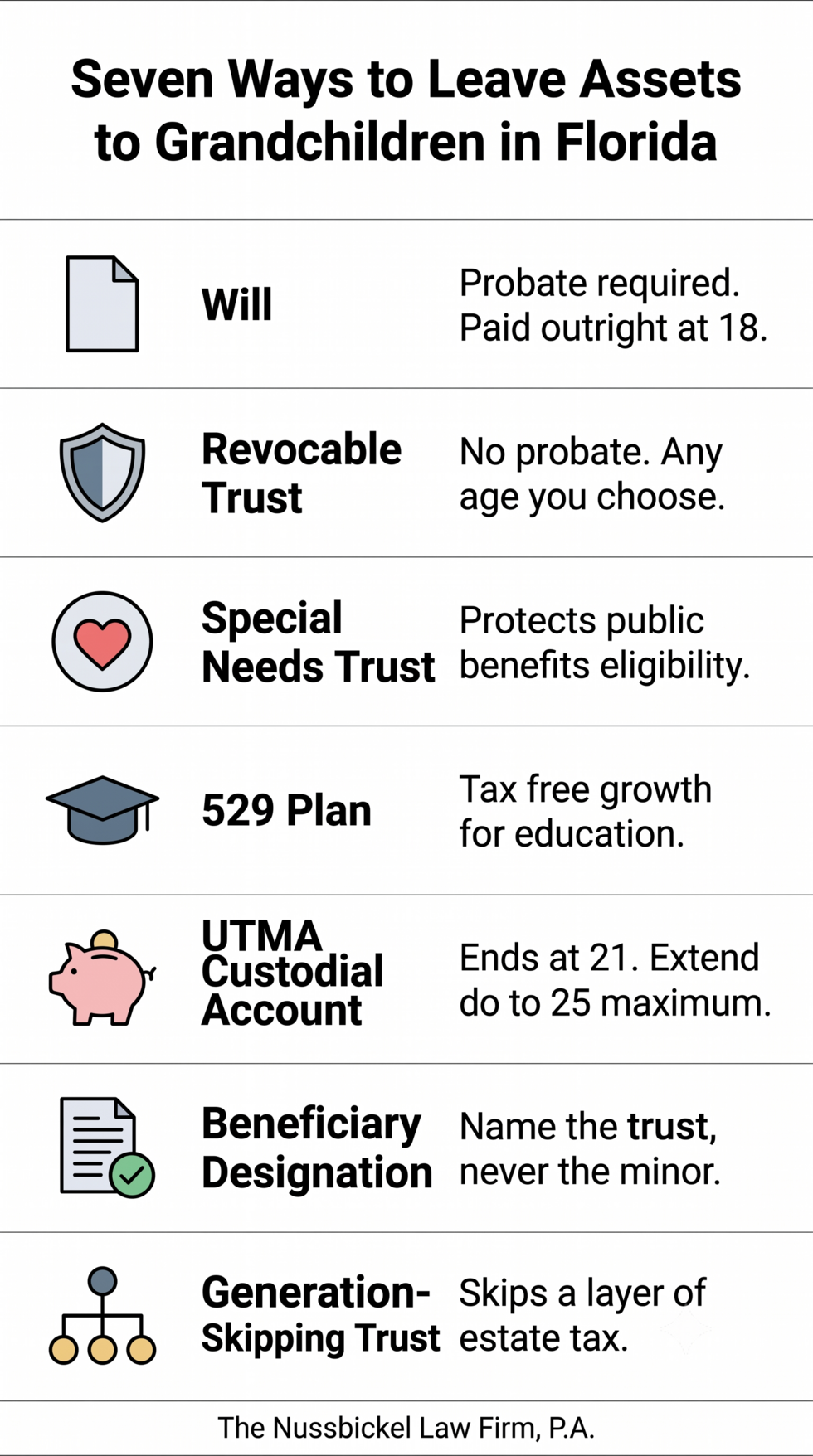
There are seven common tools, and the best one depends on the amount, the grandchild's age, and how much control you want to keep. In our experience the most effective way to plan is to match each goal to a single tool rather than forcing everything through one document.
Will
A will names grandchildren and directs what each receives, but it only takes effect at death and everything it controls goes through probate. It is the simplest option and a reasonable one for modest gifts, sentimental items, or a share that will pass to an adult child of your own who is already financially settled.
Revocable or Testamentary Trust
A trust is the workhorse. A revocable living trust holds assets during your life, avoids probate at death, and then continues as each grandchild's individual trust on the terms you set. A testamentary trust does the same job but is created inside your will, so probate still applies. For a plain-English walkthrough, see the firm's video What Is a Trust? Florida Trusts Explained in Plain English.
Special Needs Trust
A grandchild who receives means-tested public benefits should never inherit outright. A third-party special needs trust holds the share, pays for things benefits do not cover, and preserves eligibility. This is one place where the wrong document does real damage, so the language deserves a specialist's attention.
529 College Savings Plan
A 529 plan grows tax-free and pays qualified education expenses, and Florida families have two state options through the Florida Prepaid College Board: a prepaid tuition plan and an investment plan. A dormitory add-on buys an enhanced experience beyond tuition alone, and the investment options inside the savings plan range from age-based portfolios to fixed allocations. Grandparent-owned 529 accounts also keep the asset out of the student's aid calculation in most cases.
UTMA/UGMA Custodial Account
Custodial accounts are the easiest to open and the least flexible afterward. Florida's version of the Uniform Gifts to Minors Act was replaced by the Uniform Transfers to Minors Act, and under it a custodian manages the grandchild's funds until the account terminates. The default age is 21 in Florida, not 18, and a transferor can stretch it to 25, but not past that.
Beneficiary Designations
Retirement accounts, annuities, and life insurance pass by designation form, not by your will. The rule here is simple: name the trust, never the minor. A minor named directly on an IRA triggers a guardianship, and the custodian will not release funds without court paperwork.
Generation-Skipping Trust for Larger Estates
A generation-skipping trust holds assets for grandchildren while allocating your generation-skipping transfer tax exemption, so the property is not taxed again in your child's estate. It is an irrevocable trust, and it makes sense mainly for families whose taxable estate approaches the federal exemption.
Knowing the tools is only half of it. The right pick depends on which goal you are chasing.
Which Estate Planning Strategy Is Best for Your Family?
Match the strategy to the objective. Below are the seven goals grandparents raise most often and the tool that fits each one, so you can find your situation quickly instead of comparing every option at once.
If your goal is funding college
Use a 529 plan, and pay tuition directly to the school for anything above what the plan holds. Direct tuition payments are excluded from gift tax entirely, so they do not consume your annual gift tax exclusions.
If your goal is protecting inherited wealth
Use a trust with spendthrift protection and a trustee who is not the beneficiary. That combination keeps a grandchild's share away from creditors and out of a divorce settlement in most circumstances.
If your goal is avoiding probate
Use a funded revocable trust plus coordinated beneficiary designations. Our guide to assets that pass outside probate explains which accounts already avoid it and which need attention.
If your goal is reducing estate taxes
Use lifetime gifting and, for larger estates, a generation-skipping trust. Annual exclusion gifts move money out of your taxable estate every year with no filing and no tax burden.
If your goal is passing down a family business
Use a trust that holds the ownership interest with clear voting and buy-sell terms. Splitting a company into equal amounts of money among grandchildren who do not work in it is usually the fastest route to a forced sale.
If your goal is preserving real estate
Use a trust that holds the property and a funding source for taxes, insurance, and maintenance. Florida homestead adds a wrinkle worth reading about in our post on Florida homestead probate.
If your goal is supporting grandchildren with disabilities
Use a third-party special needs trust funded at your death, and tell the rest of the family not to name that grandchild in their own documents. A well-meaning aunt's outright gift can disqualify benefits overnight.
Two of these tools come up more than any other, and comparing them side by side clears up most of the confusion.
Will vs. Trust for Grandchildren: Which Option Is Better?
For most grandparents leaving a meaningful share to a grandchild, a trust is better, because a will cannot hold money past the age of majority and cannot keep a court out of the picture while a grandchild is a minor. A will is adequate only when the gift is small or the beneficiary is already an adult you trust with a lump sum.
Will vs. Trust Comparison Table
| Feature | Will | Revocable Trust |
|---|---|---|
|
Probate required |
Yes |
No, if funded |
|
Controls timing of distributions |
No, outright at majority |
Yes, any age or standard you choose |
|
Works during your lifetime |
No |
Yes |
|
Covers grandchildren born later |
Only by class gift |
Yes, by class with full terms |
|
Creditor and divorce protection for the beneficiary |
None |
Yes, with spendthrift language |
|
Privacy |
Public court record |
Private |
|
Names a guardian for minor children |
Yes |
No, the will still does this |
|
Typical cost to prepare |
Lower |
Higher |
Which Option Is Right for Your Family?
If every grandchild is an adult and each share is modest, a will with clear language may be all you need. If any grandchild is a minor, if a share is large, or if you want oversight past 21, a trust is the right choice. Many families use both, since a pour-over will backs up the trust and still names guardians. My earlier article, Living Will vs Living Trust Florida: Do You Need Both?, compares the two in more detail.
There is a related question that often matters more than the choice of document: who should be receiving the money in the first place.
Should You Leave Assets to Your Children, Grandchildren, or Both?
Most Florida families do both, giving children the majority and carving out a defined share or a specific purpose for grandchildren. Going all one way or all the other tends to create either a tax problem or a family problem, and sometimes both.
Benefits of leaving assets directly to grandchildren
Direct gifts skip a generation of exposure. The money is not part of your child's taxable estate, not reachable by your child's creditors, and not redirected by your child's later planning. For education in particular, direct funding is a clean and effective way to make sure the money is spent as intended.
Understanding generation-skipping planning
Generation-skipping planning uses a separate federal exemption to move assets to grandchildren without a second layer of transfer tax. It is not only for the very wealthy, but the machinery only pays off when the estate is large enough that a second round of estate tax is realistic.
Equal vs. unequal inheritances
Equal is simpler; fair is sometimes different. If one grandchild already received four years of private college tuition and another did not, dividing the remainder in equal amounts of money may not feel equal to anyone. Some grandparents equalize by adjusting shares, others by adding a specific gift, and either works if it is explained.
Avoiding family disagreements
Most disputes trace back to surprise, not to the dollars. Frank family conversations while you are alive do more to protect family harmony than any clause a lawyer can draft. You control how much information you share, but sharing the shape of the plan is usually enough.
Balancing fairness with financial need
A grandchild with a disability, a grandchild carrying medical expenses, and a grandchild with a stable career do not have the same individual needs. A discretionary trust lets one trustee weigh those differences over time rather than freezing a judgment you make today.
However you divide the shares, the next job is making sure what you leave actually reaches them intact.
How Can You Protect Your Grandchildren's Inheritance?
Protection comes from three things: a trust rather than an outright gift, a trustee who is genuinely independent, and terms that anticipate divorce, creditors, and immaturity. Those three together are what turn a gift into a lasting benefit rather than a windfall that disappears in a few years.
Planning for One or Multiple Grandchildren
With several grandchildren, use a separate trust for each grandchild rather than one pooled fund. Separate shares prevent one beneficiary's spending from reducing another's, make accounting simple, and let you set different terms without anyone comparing notes.
Protecting Minor and Adult Grandchildren
Minors need a custodian or trustee by law. Adults need protection from different risks: lawsuits, business failures, and divorce. A lifetime trust addresses both, and the same trust document can hold a five-year-old's share and a thirty-year-old's share on different terms.
Planning for Blended Families and Special Needs
Name step-grandchildren expressly if you want them included, because Florida state laws will not assume it. For a grandchild on benefits, keep the share in a special needs trust and tell other relatives to direct their gifts there too.
Addressing Multi-State and Estranged Family Situations
Grandchildren who live outside Florida are governed by Florida law for what your trust says, but their own state laws affect income taxation and, sometimes, a divorce court's view of inherited property. If a relationship is estranged, say so in the document rather than leaving a blank that invites a contest.
Strategies to Protect an Inheritance
The practical checklist is short: spendthrift language, an independent trustee, discretionary rather than mandatory distributions, staged ages, and a clear statement of purpose. If you have a language preference between "may distribute" and "shall distribute," say so, because that single word decides how much discretion the trustee actually holds. Ask yourself whether an individual trustee such as a sibling can really say no to a family member, or whether a corporate trustee would hold the line better.
Protection handled, the last technical piece is tax.
What Tax Considerations Apply When Leaving Assets to Grandchildren?
For the overwhelming majority of Florida families, there is no transfer tax at all. Florida imposes no state estate tax, no inheritance tax, and no state income taxes on individuals, so the only tax implications that matter here are federal, and the federal thresholds are high.
Federal estate tax
The 2026 federal basic exclusion amount is $15,000,000 per person, and a married couple can shelter twice that with portability. Anything above the exclusion is taxed at 40 percent. Confirmed figures are in IRS Revenue Procedure 2025-32.
Gift tax rules
You may give $19,000 per recipient in 2026 without filing anything, and a married couple can double that. Kiplinger's 2026 gift tax summary lays out the mechanics. Tuition and medical bills paid directly to the provider are excluded on top of that, which is one of the quiet tax advantages of funding education yourself.
Generation-skipping transfer tax
The generation-skipping transfer tax applies to gifts that skip a generation, and the 2026 exemption is also $15,000,000. Allocating it correctly is a drafting job, not a form-filing job, so a generation-skipping trust should be reviewed whenever the tax law changes.
Income tax considerations
Trusts reach the top federal income tax bracket at a very low threshold, so income accumulated inside a trust is taxed harder than income distributed to a beneficiary. Good investment management inside the trust, and thoughtful distribution timing, are how a trustee keeps that cost down.
Capital gains implications
Assets you own at death generally receive a stepped-up basis, which can erase decades of gain. That is why giving appreciated stock during life is often worse for the family than leaving it at death, and it is one of the clearest tax benefits of waiting.
Coordinating tax and estate planning
Retirement accounts deserve their own conversation. Under the SECURE Act rules described in IRS Publication 590-B, a grandchild is not an eligible designated beneficiary and must empty an inherited IRA within ten years, which can bunch taxable income into a grandchild's early earning years. Our overview of estate and death taxes in Florida covers the state picture in full.
Taxes are usually the easy part. The recurring problems are simpler and more human.
Common Estate Planning Mistakes Grandparents Make
The mistakes we correct most often are not exotic. They are ordinary oversights in beneficiary forms, trustee choices, and documents that were never updated, and each one is cheap to fix now and expensive to fix later.
Naming minors as direct beneficiaries
This is the single most common error. A minor named on a policy or account cannot receive the funds, so the family opens a guardianship, pays for it, and the money is released outright at 18 anyway. Name a trust or a custodian instead.
Failing to update beneficiary designations
Designations override your will. An ex-spouse or a deceased relative sitting on an old 401(k) form defeats an otherwise perfect plan, so pull every form and confirm it every few years.
Choosing the wrong trustee
Picking the closest relative is not always the right choice. A trustee needs judgment, availability, and the willingness to be unpopular. A lack of financial literacy in an otherwise loving family member is a real reason to consider a professional or a co-trustee.
Ignoring future grandchildren
Naming grandchildren individually leaves out anyone born later. Use class language such as "my grandchildren living at my death" so the plan covers future generations automatically.
Overlooking tax planning
Most families owe nothing, but retirement accounts, business interests, and out-of-state real estate can create avoidable costs. A short review at the outset is cheaper than a fix during administration.
Assuming a will avoids probate
A will is the ticket into probate, not around it. See my earlier article, Types of Trusts for Estate Planning, for how the different legal structures compare on this point, and the firm's video What Is Trust Funding? Why an Unfunded Trust Does Nothing for the step people skip most.
Not reviewing the estate plan after major life events
Births, deaths, divorces, moves, and sales all change the picture. A plan written when your grandchildren were toddlers rarely fits once they are adults with jobs and mortgages.
Avoiding those mistakes is easier with a written list to work from.
What Should Grandparents Include in Their Estate Planning Checklist?
A good checklist keeps estate planning for grandchildren concrete and finishes the work in a few weeks rather than a few years. Work through these seven items in order, and bring what you gather to your first meeting.
- Inventory your assets.
- Identify beneficiaries, including grandchildren.
- Select fiduciaries (executor, trustee, and guardians if needed).
- Prepare the appropriate estate planning documents.
- Review and coordinate beneficiary designations.
- Communicate your wishes with your family.
- Review and update your estate plan regularly.
If that list feels manageable, a simple plan may be all you need. If several items raise questions, it is worth bringing in help.
When Should You Work With an Estate Planning Attorney?
Bring in a lawyer for estate planning for grandchildren whenever a grandchild is a minor, a share is large enough to need oversight, or the family situation is anything other than simple. Software handles a straightforward will; it does not handle trust terms, Florida homestead, or the interaction between an IRA and a trust.
When Professional Guidance Is Recommended
- Complex or high-value estates
- Business ownership or real estate
- Blended families
- Tax planning
- Probate avoidance goals
How to Choose the Right Estate Planning Attorney
Look for someone who does this work daily and who explains it in words you can repeat to your family. Our guide on how to find an estate planning attorney goes deeper, but these five criteria cover most of it.
- Estate planning and trust experience
- Probate knowledge
- State-specific expertise
- Transparent fees and communication
- Reviews and reputation
Questions to Ask Before Hiring
Ask these in the first call. The answers tell you quickly whether the attorney handles multi-generational work regularly or occasionally.
- What experience do you have with multi-generational estate planning?
- What trust strategies do you recommend?
- How do you help minimise probate?
- What are your fees?
- How often should my estate plan be reviewed?
- Will you work with my financial advisor or CPA?
If those questions describe the conversation you want to have, here is how we approach it.
Why Families Choose Will.Estate
The Nussbickel Law Firm, P.A. is an estate planning and probate practice in Fort Myers serving families throughout Southwest Florida, including Cape Coral, Naples, Bonita Springs, Estero, and Punta Gorda. We draft wills, revocable and irrevocable trusts, powers of attorney, and health care documents, and we handle Florida probate and trust administration statewide.
Personalized estate planning tailored to your family's goals
We start with your family's goals, not a form. That means asking what you want each grandchild to be able to do with the money, and then choosing the most appropriate terms to get there.
Comprehensive wills, trusts, and probate services
One firm handles the planning and, later, the administration. That continuity matters, because the lawyer who wrote the trust document already knows why each provision is there.
Florida-focused estate planning guidance
We practice Florida law only. Homestead, elective share, and the Florida Trust Code have quirks that a national template does not account for, and getting them right is a large part of the work.
Strategies for preserving wealth across generations
Wealth planning for grandchildren is about durability more than yield. We build in spendthrift terms, staged ages, and trustee succession so the plan still functions decades from now.
Compassionate legal support through every stage of planning
These conversations touch on aging, illness, and family friction. We take the time they need, and we put the answers in writing so nobody has to rely on memory.
Helping families minimize probate and future legal disputes
Careful funding and coordinated beneficiary designations keep most assets out of court. Clear drafting keeps them out of dispute. Schedule a consultation or call our Fort Myers office to talk through your own plan.
Frequently Asked Questions
Can I leave everything to my grandchildren instead of my children?
Yes. Florida does not require you to leave anything to an adult child, so you can name grandchildren as your sole beneficiaries. Two limits apply: a surviving spouse has elective share rights, and under Fla. Stat. 732.4015 homestead cannot be devised to a grandchild if you are survived by a spouse or a minor child, though it may pass to the spouse when there is no minor child.
What is the best trust for grandchildren?
For most families, a revocable living trust that splits into a separate share for each grandchild at your death. It avoids probate, sets the ages you choose, and adds creditor protection. Larger estates may add a generation-skipping trust, which is a different type of trust built around the federal exemption.
Is a trust better than a will for grandchildren?
Usually, yes, when a grandchild is a minor or the share is substantial. A will distributes outright at 18 and runs through probate. A trust holds the share as long as you want, protects it from creditors and divorce, and stays private.
Can grandchildren inherit before their parents?
Yes. You can name grandchildren directly and leave your own children out of that portion entirely. Note that Florida's antilapse rule in Fla. Stat. 732.603 already redirects a deceased child's devise to that child's own descendants, so name grandchildren directly only when you intend them to inherit alongside their parents rather than in place of them.
How old should grandchildren be before receiving an inheritance?
There is no legal answer, but staged distributions at 25, 30, and 35 are the most common pattern we draft. Splitting the share gives a young adult room to learn money management with a smaller sum before the rest arrives.
Can I leave different amounts to different grandchildren?
Yes, and there is no requirement to explain why. Some grandparents give one grandchild help toward a new car and another the entire car, or adjust for tuition already paid. Unequal gifts are legal; explaining them is what preserves family harmony.
How do I protect my grandchild's inheritance from divorce?
Keep it in a trust rather than giving it outright, and instruct the trustee to distribute for needs rather than on a fixed schedule. Inherited property is non-marital under Fla. Stat. 61.075(6)(b), but that protection evaporates once a beneficiary deposits the funds into a joint account.
Can I protect inherited assets from creditors?
Yes, with spendthrift language in the trust. Under Fla. Stat. 736.0502 a creditor generally cannot reach a beneficiary's interest before the trustee actually distributes it, which is why the timing of distributions is a protection tool and not just a preference.
What is a generation-skipping trust?
An irrevocable trust that holds assets for grandchildren while using your generation-skipping transfer tax exemption, so the property is not taxed again in your child's estate. In 2026 that exemption is $15,000,000 per person.
Can I pay for my grandchild's education through my estate plan?
Yes, in three ways: fund a 529 plan, direct the trustee to pay qualified education expenses, or pay tuition directly to the institution during your lifetime. Direct tuition payments are not taxable gifts at all, no matter how much money is involved.
Do grandchildren have to go through probate?
Only if the asset passes under a will or has no beneficiary. Assets in a funded trust, or with a valid beneficiary designation, reach a grandchild without probate. The firm's video Choosing a Guardian for Your Minor Child in Florida covers the related guardianship question.
What happens if another grandchild is born after I create my estate plan?
Nothing, if your documents use class language such as "my grandchildren living at my death." If you named each grandchild individually, a later-born grandchild is left out until you amend, which is why we draft by class and review after every birth. Family time at a holiday table is often when families notice the gap.
Gregory J. Nussbickel is the attorney at The Nussbickel Law Firm, P.A. in Fort Myers, Florida, where his practice is limited to estate planning, probate, and trust administration.
This article is general information about Florida law and is not legal advice. Reading it does not create an attorney-client relationship. Your situation depends on facts this article cannot know, so please consult a Florida attorney about your own plan.

Comments
There are no comments for this post. Be the first and Add your Comment below.
Leave a Comment