

Key Highlights
- Estate planning for married couples in Florida means two coordinated sets of documents, not one shared document: each spouse signs a separate will, a separate durable power of attorney, and a separate health care directive.
- Florida gives a surviving spouse rights a will cannot quietly write around, including a 30 percent elective share under Fla. Stat. § 732.2065 and constitutional homestead protection.
- Without a will, § 732.102 gives the survivor everything only when every child is also the survivor's child. In a blended family, the survivor takes half and the decedent's children take the rest.
- Federal law is generous to spouses: an unlimited marital deduction, a $15,000,000 exclusion per person in 2026, and portability of a deceased spouse's unused amount, which is available only if Form 706 is filed.
- Beneficiary designations and jointly titled bank accounts pass outside the will entirely, so a plan that is not matched to your account paperwork will not do what you think it does.
Introduction
The short answer: Estate planning for married couples is the work of building two coordinated sets of documents so that either spouse can act for the other during life, and the survivor inherits without a fight or a court case after death. In Florida, that means each spouse signs a last will (or a pour-over will paired with a trust), a durable power of attorney, a health care surrogate designation, a living will, and a HIPAA release, and then the couple's deeds, bank accounts, and beneficiary designations are retitled to match. If you are married your estate planning involves your spouse's legal rights whether you plan for them or not, because Florida law already grants a surviving spouse homestead protection and a 30 percent elective share.
Most couples we meet in Fort Myers have some version of a plan in mind. One spouse handles the finances, the other handles the doctors, and the assumption is that the survivor will simply keep going. That assumption holds up until a bank asks for a court order, or a life insurance policy still lists a former fiancé, or a house cannot be sold because a minor child now owns a remainder interest in it. This guide walks through what the two of you should sign, how your property should be titled, what Florida law does on its own, and when it is time to bring in a lawyer.
Why Is Estate Planning Essential for Married Couples?
Because marriage creates legal rights that outlive the marriage, and because the two of you own things together that only one of you can sign for. A plan built for one person leaves gaps at exactly the moments a couple needs coverage most: sudden incapacity, a hospital decision, or the death of the spouse who handled everything.
How Marriage Changes Your Legal and Financial Responsibilities
Marriage in Florida creates a form of co-ownership that single people do not have (tenancy by the entireties), gives each spouse rights in the other's homestead, and makes each of you the default decision-maker in the eyes of most hospitals but not most banks. That last gap surprises people. Signing authority over money is a document question, not a marriage question.
What Happens if One Spouse Dies Without an Estate Plan?
The survivor does not automatically get everything. Under Fla. Stat. § 732.102, a surviving spouse takes the entire intestate estate only when the couple's descendants are all shared. If either spouse has a child from a prior relationship, the survivor takes half and the decedent's descendants take the other half. I walk through the full sequence in my earlier article, Probate Process in Florida Without a Will: What Happens Next?
Why Estate Planning Isn't Just for Wealthy Couples
Only a tiny fraction of families will ever owe federal transfer tax. The problems that actually cost money are procedural: a probate court proceeding to retitle a car, a guardianship because nobody signed a power of attorney, a homestead that cannot be sold because minor children hold a remainder. None of those depend on net worth.
Benefits of Planning Together as Spouses
Planning together lets you match the documents to each other. Trustees and agents line up, guardians are consistent, and the survivor is not left arguing with a sibling about what the deceased spouse "would have wanted." It also forces one useful conversation about the financial information neither of you has written down: where the accounts are, who the advisors are, and what the passwords open.
What Documents Should Every Married Couple Have?
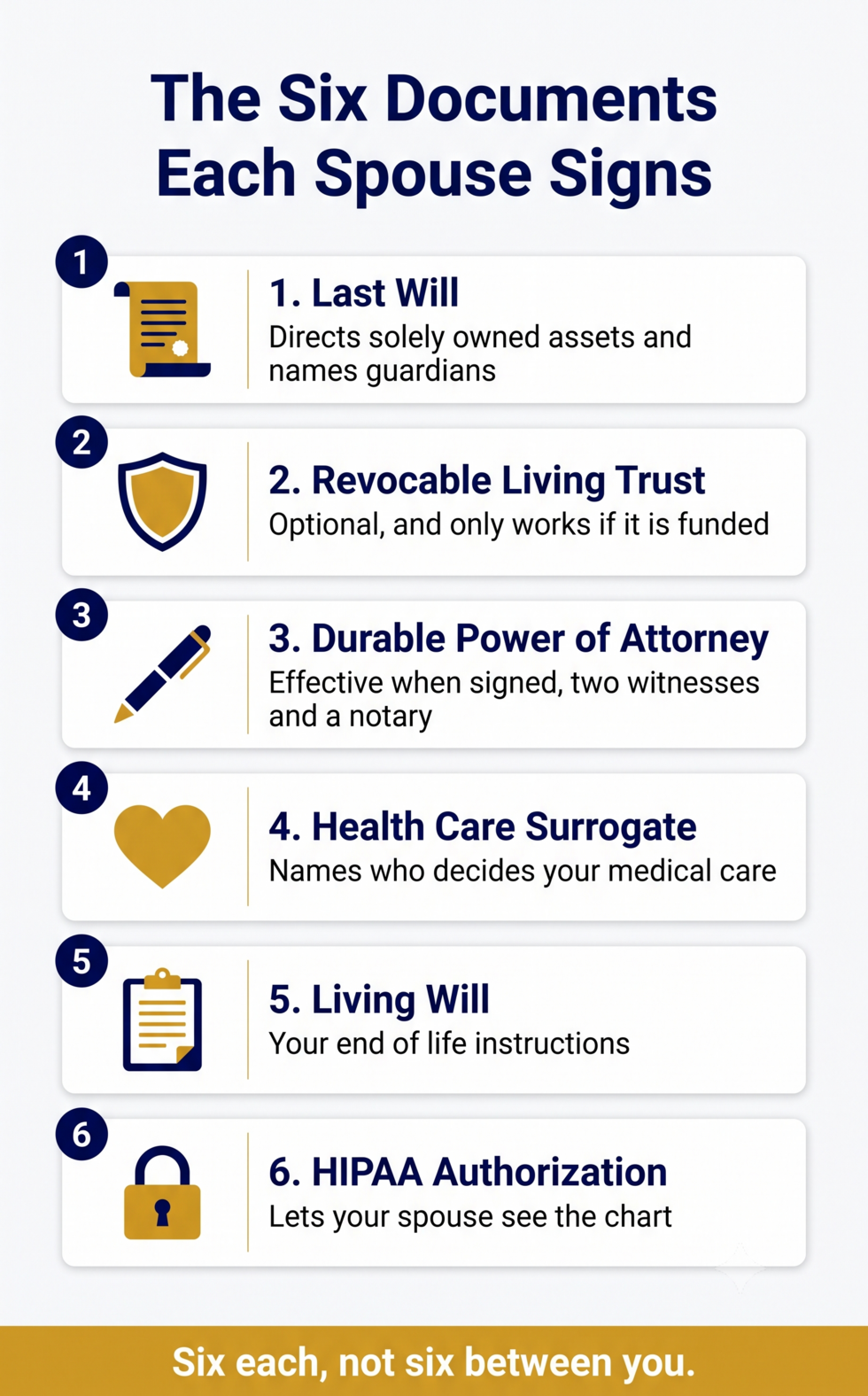
Estate planning for married couples starts with six documents per spouse, which cover the great majority of Florida families. They are not exotic, and none of them require you to be wealthy. What matters is that both spouses sign their own set and that the set is consistent.
Wills and Trusts
A will directs what happens to assets titled in your sole name, names your personal representative, and nominates guardians for dependent children. A revocable living trust does the same job while avoiding a court proceeding, provided you actually move assets into it. For a plain-English primer, see the firm's video What Is a Trust? Florida Trusts Explained in Plain English.
Financial Power of Attorney
Florida's durable power of attorney is effective the moment it is signed, not on a later finding of incapacity. Under Fla. Stat. § 709.2105, it must be signed by the principal and two witnesses and acknowledged before a notary. Certain powers, including making gifts and changing survivorship rights, only work if they are separately initialed.
Healthcare and Advance Directive Documents
A health care surrogate designation names who speaks for you on medical decisions; a living will states what you want when there is no reasonable expectation of recovery; a HIPAA release lets your spouse actually see the chart. Under § 765.202, the designation needs two adult witnesses and one of them cannot be your spouse or a blood relative.
Beneficiary Designations
Retirement accounts, annuities, and life insurance policies pass by contract to whoever is named on the form. The will never touches them. This is the single most common place a couple's paperwork drifts out of alignment with their intentions.
Guardianship Planning for Minor Children
Your will nominates a guardian, and both parents may also file a written preneed guardian declaration for a minor under § 744.3046 with the clerk of court, which creates a rebuttable presumption in that person's favor. The firm's video Choosing a Guardian for Your Minor Child in Florida covers how to choose.
What Is the Essential Estate Planning Checklist for Married Couples?
This is the checklist we work through for estate planning for married couples in Southwest Florida. Do it together in one sitting. Most couples find two or three items already out of date, and the fixes are usually paperwork rather than litigation.
Essential Legal Documents
Confirm that each spouse has signed all six essential documents: will (or pour-over will), revocable trust if you are using one, durable power of attorney, health care surrogate designation, living will, and HIPAA authorization. Six each, not six between you.
Financial Accounts to Review
List every institution, then check how each account is titled and who is named on it. Joint bank accounts between spouses are presumed to be held as tenancy by the entireties under Fla. Stat. § 655.79 unless the signature card says otherwise.
Property Ownership Updates
Check the deed to your home and to any rental or vacant lot. Property bought before the marriage often still sits in one spouse's name alone, which is a different result at death than the couple assumes. See my earlier article, Florida homestead probate, for how homestead changes the math.
Insurance and Retirement Beneficiary Reviews
Pull the actual beneficiary form from each carrier and custodian rather than trusting memory. Confirm both a primary and a contingent beneficiary, and remember that naming a trust as the beneficiary of a retirement account has income tax consequences worth discussing first.
Digital Asset Planning
Chapter 740, the Florida Fiduciary Access to Digital Assets Act, lets you give your agent, trustee, or personal representative authority over email, cloud storage, photos, and online accounts. Without that language, a custodian's terms of service can shut your spouse out.
Business Ownership Considerations
If either spouse owns an interest in a company, the operating agreement or shareholder agreement usually controls what happens at death, and it can override your will. My guide to estate planning for business owners covers buy-sell funding and succession in more detail.
Family Communication Checklist
Tell your named agents that you named them. Tell your children where the documents are kept. You do not have to disclose numbers, but the people who will act should not be learning their role from a lawyer's voicemail.
Should Married Couples Choose a Will or a Trust?
Either can work, and the honest answer depends on what you own and where. A will is simpler and cheaper to sign; a trust costs more up front and saves a court proceeding later. Here is how the two compare for a typical Southwest Florida couple:
| Will-based plan | Trust-based plan | |
|---|---|---|
|
What it accomplishes |
Directs solely owned assets, names a personal representative, nominates guardians |
Holds title during life, distributes privately at death, manages assets during incapacity |
|
Court involvement |
Probate required for solely owned assets |
Avoided for assets actually retitled into the trust |
|
Best when |
Modest solely owned assets; most property is joint or has beneficiaries |
Real property in more than one state, a blended family, privacy concerns, or a child who needs oversight |
|
Ongoing work |
None after signing |
Funding and periodic review are mandatory, not optional |
The most common estate planning for married couples in Florida is still a matched pair of wills backed by powers of attorney and advance directives, with a trust added when the assets or the family call for one. Can married couples have separate trusts? Yes. A couple may sign one joint revocable trust or two separate estate plans built around individual trusts. The most common estate planning trust for married couples in Florida is a single joint revocable trust, which is simple for a long first marriage where everything is already shared. Two individual trusts are usually better for a blended family, for a couple with meaningfully different beneficiaries, or where one spouse has creditor exposure from a business or a professional practice. Note that under Fla. Stat. § 736.0602, each settlor of a joint trust can generally revoke as to their own contribution, which is not always what a couple expects.
Many couples end up with both: a trust for the house and the investment accounts, and a pour-over will to catch anything left out. To decide which fits, see the firm's video Do I Need a Trust in Florida? How to Decide, or my earlier comparison of when a trust makes more sense than a will. Whichever you choose, titling is what makes it work.
How Property Ownership Affects Your Estate Plan?
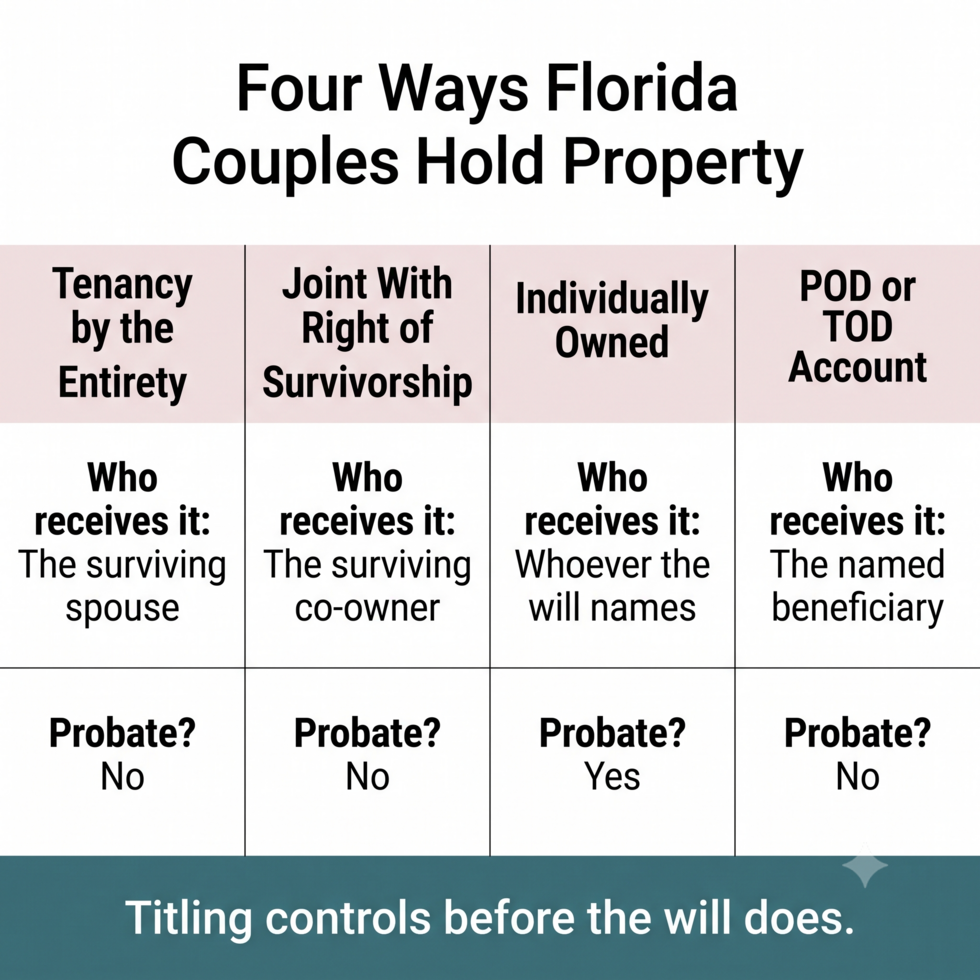
Titling beats documents. How an asset is owned determines who receives it, and a will only reaches what is left over after survivorship rights and beneficiary contracts have done their work.
Joint Tenancy With Right of Survivorship
The survivor takes the whole asset immediately, outside probate. It is efficient and it is blunt: the asset goes to the surviving joint owner regardless of what your will says, and adding an adult child as a joint owner can create gift and creditor problems.
Tenancy by the Entirety
This is the form reserved for married couples, and Florida applies it to both real estate and, under § 655.79, joint deposit accounts. It carries survivorship plus creditor protection: a judgment against one spouse alone generally cannot reach entireties property. It ends at divorce, when the ownership converts to a tenancy in common.
Individually Owned Property
Anything titled in one name with no beneficiary is what probate exists for. That includes inherited accounts, personal property such as a boat or a vehicle, and premarital real estate. It is also the category that homestead and elective share rules act on most forcefully.
Transfer-on-Death (TOD) and Payable-on-Death (POD) Accounts
A POD or TOD designation converts a solely owned account into a non-probate asset for the named person. These are useful and easy to get wrong, because they are invisible to a will, rarely reviewed, and often name someone from a different decade of your life.
Why Proper Asset Titling Matters
A funded trust with an unfunded brokerage account is a filing cabinet, not a plan. Retitling is the step couples skip, and it is the step that decides whether the survivor spends an afternoon at the bank or six months in probate court. The same discipline protects your children.
How Can Estate Planning Protect Your Children?
By deciding three things in advance: who raises them, who manages their money, and at what ages they receive it. Florida gives you all three levers, but only in writing and only if the paperwork matches.
Protecting Your Children and Beneficiaries Through Estate Planning
Outright gifts to a young adult are the default outcome and rarely the best one. A trust share lets a trustee pay for tuition, housing, and health care while shielding the balance from a beneficiary's divorce, creditors, or inexperience.
Naming Legal Guardians for Minor Children
Name a first choice and at least one alternate, and consider naming different people as guardian of the person and as trustee of the money. Splitting those jobs is common when the most loving caregiver is not the strongest money manager.
Creating Trusts for Minor Children
A minor cannot inherit directly. Without a trust, a court-supervised guardianship of the property holds the funds until age 18 and then hands over the balance in one check. A trust replaces that with terms you write.
Planning for Children With Special Needs
A direct inheritance can disqualify a child from Medicaid and SSI. A properly drafted special needs trust supplements government benefits without replacing them, and it should be named as the beneficiary anywhere that child would otherwise appear.
Managing Inheritances Responsibly
Staged distributions (a share at 25, a share at 30, the rest at 35) are common, but a lifetime discretionary trust with an independent trustee often protects better. The point is not distrust; it is durability across a life event you cannot forecast.
Reviewing Beneficiary Designations
Every account with a named beneficiary should be reviewed as part of the estate planning process, not after it. Minor children should almost never be named directly, because an insurer will not pay a minor and a guardianship proceeding results.
When Beneficiary Designations Override Your Will
Almost always. A retirement account, annuity, or policy pays the named person even if your will says the opposite. One exception worth knowing: under Fla. Stat. § 732.703, a designation naming a spouse is generally void as to that former spouse after a Florida divorce, with several exceptions including plans governed by federal law.
Planning for Future Education Expenses (Optional)
A 529 plan sits outside the trust and needs its own successor owner named, or it can end up controlled by someone you did not choose. Trust language can also direct that education comes off the top before shares are divided among family members.
What Happens to Your Estate Plan If You Become Incapacitated?
Nothing happens automatically. Marriage does not give your spouse authority over accounts in your name, and without signed documents the alternative is a guardianship proceeding in circuit court, which is public, slow, and expensive.
Can My Spouse Automatically Make Financial Decisions if I Become Incapacitated?
No. This is the most expensive misconception in this article. A bank will not let your spouse refinance a mortgage, sell a car, or move funds from an account in your sole name without a valid power of attorney or a court-appointed guardian, no matter how long you have been married.
Financial Decision-Making Through a Durable Power of Attorney
The durable power of attorney is the fix. Under Fla. Stat. § 709.2108, a Florida power of attorney that is written to spring into effect on a future date or event is ineffective, so the document is live from the day it is signed, which is a good reason to name your spouse and choose a successor you trust. See the firm's video What Is a Durable Power of Attorney in Florida?
Healthcare Decision-Making Through a Healthcare Surrogate
Your health care directive names a surrogate to consent to or refuse medical treatment when you cannot. You can make it effective immediately or only on a determination of incapacity, and you should name an alternate in case your spouse is injured in the same accident.
Living Wills and End-of-Life Preferences
A living will is a separate document. Under Fla. Stat. § 765.302 it must be signed before two witnesses, one of whom is neither your spouse nor a blood relative, and it sets out what life-prolonging medical care you do and do not want.
Planning for Long-Term Care
Assisted living and skilled nursing in Lee and Collier counties routinely run five figures a month. Couples with long horizons should at least price long-term care insurance and understand how Medicaid treats the well spouse before assets are moved anywhere.
Protecting Your Spouse During Incapacity
The goal is that the healthy spouse can keep paying bills, keep the house insured, and keep the household running without asking a judge. A power of attorney with the right authority does that; a joint account alone often does not.
What Estate Tax Issues Should Married Couples Understand?
For most Florida couples, none that cost money. Florida imposes no state estate or inheritance tax, and federal law lets spouses transfer unlimited amounts to each other. The planning question is preserving exclusion, not paying tax.
Marital Deduction
The tax benefits of marriage begin here. The unlimited marital deduction lets one spouse leave any amount to a surviving U.S. citizen spouse with no federal tax at the first death. It defers rather than eliminates: the assets are then counted in the survivor's taxable estate, which is why the next two items matter.
Federal Estate Tax Exemption
The IRS set the basic exclusion at $15,000,000 per person for deaths in 2026, up from $13,990,000 in 2025 (Rev. Proc. 2025-32). The same guidance keeps the annual gift tax exclusion at $19,000 per recipient, which a married couple can double to $38,000 by splitting gifts.
Portability Between Spouses
Portability lets the survivor add the deceased spouse's unused exclusion to their own, but only if the estate files Form 706 to elect it, even when no tax is due. Clients often ask how portability affects concentrated equity estate planning for married couples whose net worth sits in one business, one block of stock, or one waterfront parcel. The answer is that portability alone does not capture future appreciation, so a credit shelter or bypass structure may still earn its keep. Florida's own treatment of these questions is covered in my guide to estate and death taxes in Florida.
What Are the Most Common Estate Planning Mistakes Married Couples Make?
The recurring five below account for most of the damage we see. Every one of them is cheaper to fix now than to litigate later.
Assuming Everything Automatically Goes to Your Spouse
It does for jointly held and beneficiary-designated assets. It does not for solely owned property in a blended family, where § 732.102 splits the intestate share, and it does not for homestead, which descends under § 732.401 with a life estate to the spouse and a remainder to descendants unless the survivor timely elects a one-half interest as tenant in common.
Failing to Update Beneficiary Designations
Old employer plans, a policy from a first marriage, an IRA that still names a parent. These are the errors that surface at the worst possible moment and cannot be corrected after death.
Delaying Estate Planning Until It's Too Late
Capacity is a legal requirement for signing. Once a spouse has a diagnosis affecting cognition, the window for signing a will, a trust, or a power of attorney may already be closed, and guardianship becomes the only path.
Not Funding or Updating Your Trust
An unfunded trust accomplishes nothing at all. Deeds must be recorded and accounts must be retitled. The firm's video What Is Trust Funding? Why an Unfunded Trust Does Nothing explains what funding actually involves.
Failing to Review Your Estate Plan After Major Life Changes
An existing plan written in another decade often names a deceased trustee, an ex-spouse, or a guardian for children who now have children. Which raises the obvious question of timing.
When Should Married Couples Update Their Estate Plan?
Review the documents every three to five years and immediately after anything on this list. Estate planning for married couples is not a one-time errand; it is a plan that has to keep pace with your life. In estate planning if you are married, a change in one spouse's circumstances almost always changes the other spouse's documents too.
- After marriage, so that a premarital will does not leave your spouse to statutory default rules
- Birth or adoption of a child, which adds guardian nominations and trust shares
- Purchasing real estate, especially a homestead or an out-of-state property
- Starting or selling a business, which changes both value and succession
- Receiving an inheritance, which may need to be kept separate to stay protected
- Retirement, when accounts consolidate and beneficiary forms change hands
- Relocation to another state, including couples arriving from New York or another state with its own state estate tax
- Divorce or remarriage, which triggers § 732.507(2) and § 732.703 revocation rules
- Death of a beneficiary or fiduciary, which can leave a plan with no one named to act
When Should You Hire an Estate Planning Attorney?
Whenever the cost of a mistake exceeds the cost of advice, which is most of the time once real property or children are involved. Software is competent at producing documents and useless at spotting the Florida-specific traps that void them.
When Is a DIY Estate Plan Enough?
Rarely, and mostly in narrow cases: a young couple with no children, no real estate, modest joint accounts, and no expectation of an inheritance. Even then, the health care and power of attorney documents matter more than the will.
When Do You Need Professional Legal Guidance?
Any blended family, any homestead, any business interest, any child with special needs, any property in a second state, any second marriage with children from the first, and any situation where the two of you want different things. Each of those has a Florida-specific answer. Couples without children need advice for a different reason: the best estate planning tips for childless married couples start with naming a successor agent, trustee, and beneficiary outside the marriage, because there is no adult child waiting in the wings to step in.
What Are the Risks of DIY Estate Planning?
Improper execution voids documents outright. The recurring failures we see are missing witnesses, a notary problem, a homestead devise that violates § 732.4015, a power of attorney missing the initialed authority a bank demands, and a trust that was signed but never funded.
How Do You Choose the Right Estate Planning Attorney?
Look for a Florida lawyer who does this work primarily rather than occasionally, who explains funding as part of the engagement, and who quotes a flat fee in writing. My guide on how to find an estate planning attorney walks through the vetting process.
Questions to Ask Before Hiring an Estate Planning Attorney
Ask what the flat fee includes, who retitles the assets, how homestead will be handled, what happens if one of you becomes incapacitated first, and how the plan gets reviewed later. An experienced estate planning lawyer should answer all five without hedging.
What Florida Estate Planning Laws Should Married Couples Know?
Five bodies of Florida state law shape every married couple's plan here, and they are the reason national templates fail. The estate planning for married couples differences that matter most are set by these rules, not by generic advice written for another state.
- Homestead protections. Article X, section 4 of the Florida Constitution shields the homestead from most creditors, and § 732.4015 restricts devising it when there is a spouse or minor child. A spouse can waive those rights in a deed using the statutory language in § 732.7025.
- Elective share rights. § 732.2065 entitles a surviving spouse to 30 percent of the elective estate, which sweeps in trusts, POD accounts, and other non-probate transfers. It can be waived by written agreement signed before two witnesses under § 732.702.
- Probate rules in Florida. Formal administration, summary administration for estates of $150,000 or less, and disposition without administration each have their own thresholds and paperwork.
- Florida trust laws. Chapter 736 governs trustee duties, notice to qualified beneficiaries, and revocation. Florida is not a community property state, though § 732.216 preserves community property rights for couples who move here, and § 736.1503 allows spouses to opt into an elective community property trust.
- Durable power of attorney requirements. Chapter 709 sets execution formalities and requires separate initialing for the most sensitive powers.
- Why state-specific guidance matters. A perfectly valid joint estate plan drafted in another state can still collide with Florida homestead and elective share rules the day one of you dies here.
Why Work With an Estate Planning Attorney Instead of Waiting?
Because estate planning for married couples is cheapest and most flexible while both of you are healthy and have options. Waiting converts a planning problem into a court problem, and courts are slower and more expensive than lawyers.
Avoid Costly Probate Mistakes
A funded trust, correct titling, and current beneficiary forms can keep a surviving spouse out of court entirely. That is measured in months of the survivor's time, not just filing fees.
Protect Your Spouse From Legal Complications
Homestead, the elective share, and creditor claims all have deadlines. A survivor who is grieving should not be the person discovering a six-month election period for the first time.
Ensure Your Wishes Are Legally Enforceable
Florida's execution formalities are unforgiving. Documents that are properly signed, witnessed, and notarized are admitted without argument; documents that are not become the argument.
Keep Your Estate Plan Current as Life Changes
Plans are perishable. A short review every few years, keyed to your unique situation, keeps the documents matched to the people and property you actually have now.
Gain Peace of Mind Through Personalized Legal Guidance
The real deliverable is not a binder. It is knowing that if one of you is in the hospital tomorrow, the other can sign, decide, pay, and act without asking permission from a judge, and that your financial future does not depend on a form nobody has read since 2014.
Why Choose The Nussbickel Law Firm for Estate Planning?
The Nussbickel Law Firm, P.A. is devoted exclusively to estate planning, probate, and trust administration. We handle estate planning for married couples from our Fort Myers office, serving Lee, Collier, and Charlotte counties, including seasonal residents who kept property up north and families who arrived here from states with very different rules.
We quote flat fees in writing before you commit to anything, and funding is part of the engagement rather than an afterthought, because a plan that is signed but not implemented is the most common failure in this field. Across Florida, attorney-drafted documents commonly run $450 to $1,000 for a simple will and $2,500 to $5,000 for a trust-based plan, and a 2026 nationwide study of 909 firms put the national median at $625 for a will and $2,475 for a revocable living trust. Those are market averages, not our price list, and our flat fees for couples are often well below these industry averages. My full breakdown of the average cost of a will and trust in Florida shows how the packages compare.
If the two of you are ready to get this settled, that is a short conversation. Schedule a consultation or call our Fort Myers office, and we will tell you plainly what your unique situation needs and what it will cost.
Frequently Asked Questions
Is a Trust Better Than a Will for Married Couples?
Better for some, unnecessary for others. A trust avoids probate, works during incapacity, and keeps distributions private, which matters most when you own real property, have a blended family, or want oversight for a young beneficiary. A will-based plan is enough for many couples whose assets are already joint or beneficiary-designated.
Does Everything Automatically Pass to My Spouse?
No. Jointly titled assets and beneficiary-designated accounts pass to the survivor automatically. Solely owned property does not, and in a blended family without a will, § 732.102 gives the survivor only half.
What Happens if My Spouse Dies Without a Will?
Florida's intestacy statutes decide who inherits, homestead descends under § 732.401, and someone must open a probate court proceeding to transfer solely owned assets. The survivor is usually first in line to serve as personal representative but is not guaranteed to inherit everything.
Can Married Couples Have a Joint Will?
Florida permits joint and mutual wills, and we almost never recommend them. A joint will can bind the survivor's hands for decades and invite contract litigation later. Two mirror-image wills accomplish the same goal with none of the rigidity.
What Is the Difference Between a Joint Trust and Separate Trusts?
A joint trust holds both spouses' assets in one instrument and is simpler to administer during life. Separate trusts keep each spouse's assets distinct, which helps blended families, creditor-exposed professionals, and couples with different beneficiaries.
How Often Should Married Couples Update Their Estate Plans?
Every three to five years, and immediately after a marriage, birth, death, divorce, business sale, inheritance, or move to another state.
Can Beneficiary Designations Override a Will?
Yes, and they usually do. The beneficiary form is a contract with the institution and controls regardless of your will, subject to narrow exceptions such as the post-divorce rule in § 732.703.
How Can Married Couples Avoid Probate?
Fund a revocable trust, hold real property as tenants by the entireties or through a Lady Bird deed, keep beneficiary designations current, and use POD or TOD registrations on accounts. My overview of assets exempt from probate in Florida lists what passes outside the court process.
How Much Does Estate Planning Cost for Married Couples?
Most firms quote estate planning for married couples as a flat fee for a package rather than an hourly rate. Statewide, a will-based package commonly runs $750 to $1,500 and a trust-based package for a couple runs roughly $4,000 to $7,500. Ask for the number in writing before you sign an engagement letter.
Gregory J. Nussbickel is the founder of The Nussbickel Law Firm, P.A. in Fort Myers, Florida. His practice is devoted exclusively to estate planning, probate, and trust administration for families throughout Southwest Florida.
This article is for general information only and is not legal advice. Reading it does not create an attorney-client relationship. The law changes, and every family is different; speak with a licensed Florida attorney about your specific situation.

Comments
There are no comments for this post. Be the first and Add your Comment below.
Leave a Comment