

Key Highlights
- Life insurance and estate planning work as a pair: the plan decides who inherits and who has authority, and the policy supplies the cash that makes those decisions possible.
- A death benefit paid to a living named beneficiary passes outside probate and is exempt from the creditors of the insured under Fla. Stat. 222.13. Name your estate instead and both protections disappear.
- Proceeds are generally income-tax-free under IRC 101(a), but they are still counted in your gross estate under IRC 2042 if you hold any incidents of ownership.
- Florida law voids most beneficiary designations in favor of a former spouse on divorce under Fla. Stat. 732.703, though the exceptions are broad enough that you should never rely on it.
- Never name a minor child directly. A natural guardian can receive only $15,000 in the aggregate without a court-appointed guardian of the property under Fla. Stat. 744.301(2).
- With a $15 million federal exclusion for 2026, most Florida families need a policy for liquidity and income replacement, not for estate tax.
Introduction
The short answer: Life insurance and estate planning are two halves of one job. Your will, trust, and beneficiary forms decide who receives what and who has authority to act. A policy provides the cash those documents will need on day one, before any asset can be sold and before probate finishes. Coordinated well, the two produce a fast, private transfer. Coordinated badly, the policy pays into the very court process it was meant to avoid.
Most of the families we meet in Fort Myers already own coverage. What they usually do not have is a designation that matches the rest of their plan. A form filled out at a new job in 2009 still names a parent who has since died. A policy bought for a first marriage still names a first spouse. The money is there; the plumbing is wrong.
This guide explains how a policy actually fits into a Florida plan, when the proceeds stay out of probate and out of the federal tax base, who should own the contract, and how to choose beneficiaries without creating a problem you cannot see from the kitchen table.
What Is the Relationship Between Life Insurance and Estate Planning?
Life insurance and estate planning are separate tools that solve one shared problem: getting money to the right people at the right time. Your plan decides who inherits and who decides. A policy supplies the cash that makes those decisions workable.
The role of life insurance in estate planning is narrow but decisive: it funds what the documents direct. The relationship is complementary, not substitutable. One is a set of legal instruments; the other is a contract with a carrier. They only work together when the contract's beneficiary designation and the legal instruments say the same thing.
What is estate planning?
Estate planning is the set of legal documents that direct your property and your care: a will, often a revocable trust, a durable power of attorney, a health care surrogate designation, and a living will. Together they say who inherits, who manages, and who decides for you if you cannot decide for yourself.
An overall estate plan also includes the non-probate layer that most people forget: beneficiary designations, joint titling, and payable-on-death accounts. Those control more wealth than the will does for many Florida families.
What is life insurance?
A life insurance policy is a contract. You (or someone else) pay premiums, and the carrier pays a death benefit to whoever is named when the insured dies. The main types of life insurance fall into two families.
Term life insurance provides coverage for a set period of time, usually 10, 20, or 30 years, at the lowest cost per dollar of protection. A term policy builds no cash value and expires at the end of the period. Permanent life insurance, which includes whole life insurance and universal life insurance, provides lifetime coverage plus a savings component. A whole life contract has level premium payments and guaranteed cash value; universal life offers flexible premiums and an adjustable death benefit. A permanent life policy costs considerably more per dollar of protection, which is the tradeoff for the lifetime guarantee. The National Association of Insurance Commissioners publishes a plain-language comparison worth reading before you talk to an insurance agent.
Which type of policy fits depends on why you are buying. Term insurance is usually right for replacing lost income during working years. A permanent life insurance policy is usually right when the need is permanent: estate settlement costs, a special needs beneficiary, or equalizing an inheritance among family members.
Why life insurance is an important estate planning tool
Because it creates cash exactly when a family has none. Almost everything else a family owns is illiquid at the moment of death. A house cannot be sold in a week, a brokerage account may be frozen pending letters, and a closely held company cannot be liquidated without destroying its value.
A death benefit arrives in weeks, tax-free, directly to the named beneficiary. Adequate life insurance coverage converts an illiquid balance sheet into financial security for the people you leave behind, without reducing the value of your estate. That immediate liquidity pays the mortgage, the funeral, the outstanding debts, and the professional fees, and it removes the financial burden that otherwise forces a rushed sale of real estate. That is the vital role coverage plays, and it is why estate planning with life insurance is standard practice rather than an upsell.
Why life insurance alone is not an estate plan
A policy names a beneficiary. It does not appoint a personal representative, it does not say who raises your children, it does not authorize anyone to pay your bills while you are alive but incapacitated, and it does not control the house, the car, or the retirement account.
We meet people who believe a large death benefit has covered everything. It has not. Coverage without documents leaves the rest of what you own to Florida's default rules, and the probate process for someone who dies without a will rarely matches what the family expected.
How Does Life Insurance Fit Into an Estate Plan?
It fits as the funding mechanism. The documents decide the destination of your property; the policy provides the money that lets the plan be carried out without selling anything at a discount. Understanding that division of labor is what keeps families from over-relying on either half of life insurance and estate planning.
What Role Can Life Insurance Play?
How can life insurance be used in estate planning? In four roles, in rough order of how often we see them. Income replacement for a surviving spouse and children. Liquidity for estate settlement costs and taxes. Equalization, so a child who does not receive the house or the company still receives a fair share. And funding a buyout, so business owners' families get paid and the surviving partners keep the company.
How much coverage you need follows from which of those roles apply. A workable method: add up income replacement (annual income times the number of years your family would need it), plus remaining mortgage and other debts, plus education costs, plus an allowance for final expenses and administration, then subtract liquid assets and existing coverage already in force. The difference is your gap. Revisit the number whenever your financial situation changes, because a figure set at 40 rarely fits at 55.
How Life Insurance Can Provide Liquidity and Financial Support
Florida estates pay expenses in a statutory order under Fla. Stat. 733.707, starting with administration costs and attorney fees, then funeral expenses, then taxes and certain medical bills. Every one of those needs cash within months.
A death benefit paid outside probate can supply that cash indirectly: the beneficiary can lend money to the administration or buy an asset from it at fair value, rather than the personal representative fire-selling property to raise funds. For a family whose wealth is a homestead and a retirement account, that flexibility is often the whole benefit.
Why Life Insurance Doesn't Replace a Will or Trust
Because a designation form has no capacity to handle contingencies. It cannot stagger distributions to a young adult, protect a beneficiary from a divorce or a creditor, provide for a disabled child without disqualifying them from government benefits, or name a guardian.
A trust can do all of those things, and a payout directed into a trust inherits every protection the trust document provides. That is why the answer to "will or trust?" is not replaced by "I have coverage." If you are weighing the underlying choice, living trust versus will in Florida covers the differences.
Why Policy Ownership and Beneficiaries Matter
Most life insurance estate planning comes down to these two fields. If you are wondering how to use life insurance for estate planning, start here. Ownership of the policy determines whether the proceeds land in your taxable estate. The beneficiary designation determines whether they pass outside probate and whether they are protected from creditors.
Get both right and the money moves quickly, privately, and tax-efficiently. Get either wrong and you have converted a clean transfer into a court file. The rest of this article is mostly about those two fields.
How Life Insurance Works Within an Estate Plan
Clients ask how life insurance policies fit into estate plan documents more often than any other question, and the answer starts with the five roles that appear on every contract. Confusing them is the most common source of expensive mistakes. Here is what each one does and where it interacts with your documents.
Policy owner
The owner controls the contract: paying premiums, changing beneficiaries, borrowing against cash value, surrendering the policy. The owner may be you, your spouse, a trust, or a company.
Ownership is a tax question as much as a control question. Whoever holds those rights holds what the Internal Revenue Code calls incidents of ownership, and that is what pulls proceeds into a gross estate.
Insured individual
The insured is the person whose death triggers payment. Usually the insured and the owner are the same person, which is convenient and, for large estates, exactly the problem.
A survivorship life insurance policy, sometimes called second-to-die, insures two lives and pays only when the second person dies. Survivorship life insurance policies are helpful in estate planning because that is precisely when a married couple's combined estate tax bill comes due, and because the premium for two lives is lower than for one.
Primary and contingent beneficiaries
The primary beneficiary receives the death benefit. The contingent beneficiary receives it only if no primary beneficiary survives. Both should be named, always, and both should be reviewed whenever your family changes.
You can name more than one person and set percentages. You can also specify whether a deceased beneficiary's share passes to their children or is divided among the surviving beneficiaries, which is a choice most forms let you make and most people never make deliberately.
Death benefit distribution
The standard life insurance payout is a lump sum, usually within a few weeks of the carrier receiving a certified death certificate and a claim form. Most companies also offer installment or annuity settlement options that spread payments over years.
Annuity options are where coverage and annuities intersect in a plan. A settlement annuity converts a death benefit into a guaranteed income stream for a surviving spouse who would rather not manage a large sum, and a deferred annuity you own during life can be paired with a policy so that the annuity funds retirement while the policy replaces what the annuity spends down. Note that Florida exempts both the cash surrender value of policies and the proceeds of annuity contracts from legal process under Fla. Stat. 222.14, which makes the pairing attractive here for asset protection as well.
Ownership vs beneficiary designation
These two fields answer different questions, and people routinely assume one controls the other. Ownership answers "whose asset is this for tax purposes?" The designation answers "who gets paid?"
| Question | Determined by | What it controls |
|---|---|---|
|
Is the payout in my taxable estate? |
Policy ownership |
Federal estate tax inclusion under IRC 2042 |
|
Does the payout avoid probate? |
Beneficiary designation |
Whether proceeds bypass the court process |
|
Are proceeds safe from my creditors? |
Beneficiary designation |
Fla. Stat. 222.13 exemption |
|
Is the payout income-taxable? |
Neither, generally |
IRC 101(a) exclusion applies either way |
|
Who can change the policy? |
Policy ownership |
Premiums, loans, surrender, new beneficiaries |
Why coordination with legal documents matters
Because a beneficiary form overrides your will. Every time. A will that leaves everything equally to three children does nothing to a policy that still names one of them as sole beneficiary.
Coordination means reading the designation forms alongside the plan documents and making them agree, then re-reading them after every marriage, divorce, birth, death, and job change. It is unglamorous work and it prevents more litigation than any drafting we do.
Does Life Insurance Go Through Probate?
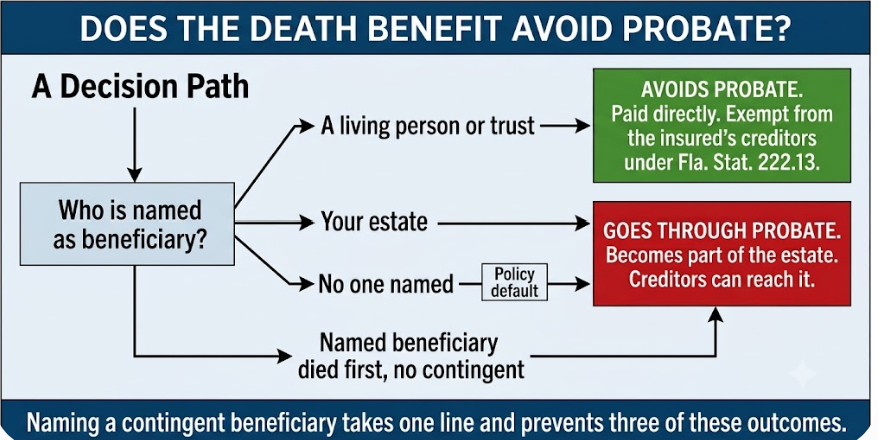
Usually not. When a living, competent beneficiary is named, the carrier pays that person directly and the money never enters the probate estate. The exceptions are narrow but they are exactly the situations people fall into by accident.
When Life Insurance Usually Avoids Probate
Whenever a named beneficiary other than the estate survives the insured. The contract governs, the personal representative has no role, and the payout is not part of your probate file for administration purposes.
That is why designations are among the most powerful documents most people own. For the broader picture of what does and does not run through court here, see which assets are exempt from probate in Florida.
When Life Insurance Can Become Part of the Probate Estate
Three situations do it. First, naming your estate as the beneficiary, which Fla. Stat. 222.13(1) says makes the proceeds part of the insured's estate. Second, naming no beneficiary at all, in which case most policies default to the estate under their own terms. Third, every named beneficiary predeceases the insured and no contingent beneficiary was named.
Any of the three converts a private, protected, fast transfer into a public court file that creditors can reach. It also delays payment by months.
Why Beneficiary Designations Matter
Because they are the difference between the two outcomes above, and they are usually a single line on a form nobody has looked at in a decade. A designation naming "my wife, Susan" after a divorce and remarriage is a fight waiting to happen.
Florida provides a partial safety net: under Fla. Stat. 732.703, a designation in favor of a former spouse is generally void on dissolution of the marriage. The exceptions are broad, though, including designations governed by federal law such as most employer plans, so treat the statute as a backstop and not a plan. For the practical takeaway, review your forms yourself rather than relying on a statute to fix them.
Is Life Insurance Taxable as Part of an Estate?
Two different taxes, two different answers. The death benefit is almost always free of income tax, and it is almost always counted for federal estate tax. Most Florida families are unaffected by the second answer, but the ones who are affected are affected badly.
Income Tax vs Estate Tax
Under IRC 101(a)(1), amounts received under a policy by reason of the insured's death are excluded from the beneficiary's gross income. A beneficiary receiving a $750,000 payout reports nothing. The exception is the transfer-for-value rule in IRC 101(a)(2): if a policy was sold or assigned for consideration, part of the benefit can become taxable unless the transfer fits one of the statutory exceptions.
Transfer tax is separate. Florida imposes no income tax on individuals and no separate estate or inheritance tax; the state-level tax under Fla. Stat. 198.02 is measured by a federal credit that federal law no longer allows. Federal estate taxes apply above the exclusion, which is $15 million per person for 2026 under Rev. Proc. 2025-32, effectively $30 million for a married couple using portability. Our post on Florida estate and death taxes covers the state side in more detail.
When Life Insurance May Be Included in the Gross Estate
Under IRC 2042, proceeds are included in two circumstances: the amount receivable by the executor, and the amount receivable by any other beneficiary where the decedent held any incidents of ownership at death.
Incidents of ownership is a broad phrase. It includes the right to change the beneficiary, to surrender or cancel the policy, to borrow against it, or to assign it. Holding any one of them is enough. A person can own no other significant asset and still push a large estate past the line purely with a policy they thought was "outside" their estate.
How Policy Ownership Can Affect Estate Taxes
If you own the contract on your own life, the full death benefit is in your gross estate for estate tax purposes. If someone else owns it, and you retained nothing, it is not.
That is the entire mechanism, and it is why ownership is the lever advisers pull first. One caution: transferring an existing policy out of your name starts a clock. Under IRC 2035(a), a transfer of a policy within three years of death pulls the proceeds back into the gross estate. New policies bought directly by a trust avoid the problem, which is why the trust should generally apply for and own the coverage from the start.
When an ILIT May Be Considered
An irrevocable life insurance trust owns the policy and receives the payout, keeping it out of your taxable estate while making the cash available to your family. You fund premium payments with annual gifts to the trust, typically structured with withdrawal rights so they qualify for the $19,000 per-recipient annual exclusion. Whole life insurance estate planning usually centers on this structure, because a permanent contract is what a trust needs to hold for decades.
An ILIT is worth its complexity when net worth is likely to exceed the federal exclusion, when a large estate is illiquid, or when you want the proceeds protected from a beneficiary's creditors and divorce. It is not worth the cost for a family well under the exclusion who simply wants a fast, protected payout, since a named beneficiary already achieves that.
Should a Trust Own Your Life Insurance Policy?
Sometimes, and the honest answer depends on how much you have and what you are trying to protect against. Here are the three ownership structures we actually use, and what each one buys.
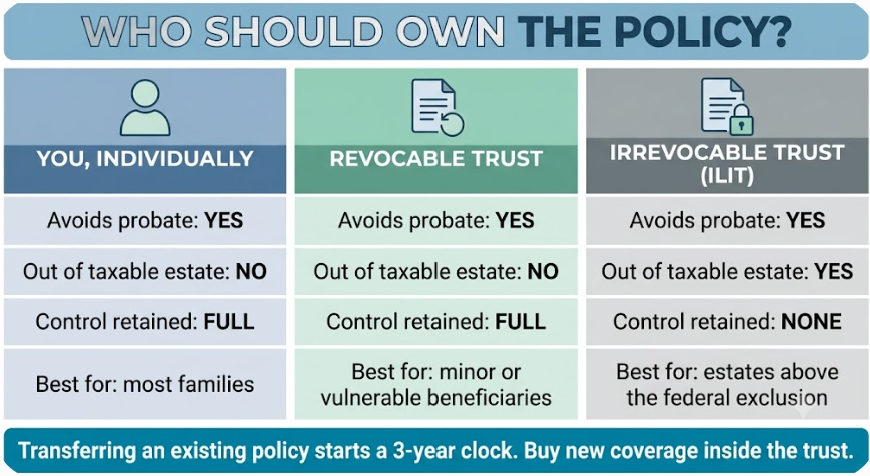
Individual ownership. You own the contract and name people directly. Simple, free, fully revocable, and adequate for most Florida families. The payout avoids probate and creditors of the insured, but it sits in your gross estate.
Revocable Living Trust ownership. The trust owns the policy or is named as beneficiary. You keep full control, the payout avoids probate, and the trust's terms govern distribution, which lets you stagger payments to young beneficiaries or protect a vulnerable one. Because a revocable trust is still yours, this does nothing for estate tax.
Irrevocable Life Insurance Trust (ILIT) ownership. An irrevocable trust applies for, owns, and is the beneficiary of the policy. Proceeds stay out of your gross estate and are protected from beneficiaries' creditors. The cost is permanence: you give up the right to change the terms or take the policy back. Florida makes the trust route mechanically easy, since Fla. Stat. 733.808 expressly allows death benefits to be made payable to a trustee.
Quick comparison:
| Individual | Revocable trust | ILIT | |
|---|---|---|---|
|
Avoids probate |
Yes |
Yes |
Yes |
|
Out of taxable estate |
No |
No |
Yes |
|
Control retained |
Full |
Full |
None |
|
Protects beneficiary from creditors |
No |
Limited |
Yes |
|
Cost and complexity |
None |
Low |
Moderate to high |
|
Best for |
Most families |
Young or vulnerable beneficiaries |
Estates above the exclusion |
Which option may be right for you? If your total net worth is comfortably under the federal exclusion and your beneficiaries are capable adults, individual ownership with good contingent designations is usually enough. If your beneficiaries are minors, are receiving government benefits, or have creditor exposure, use a trust as the recipient. If you are likely to face federal estate taxes, look hard at an ILIT, and buy the new policy inside it rather than transferring an existing one. Our comparison of revocable and irrevocable trusts in Florida explains the underlying trade-off.
Choosing the Right Beneficiary for Your Life Insurance
The designation is where good plans go wrong, because the form is short and the consequences are not. Work through the options below with your specific family in mind rather than defaulting to the first name that comes to you.
Naming a spouse
The most common choice and usually a sound one. A surviving spouse receives the payout quickly, tax-free, and outside probate, and can use it for whatever the household actually needs.
The considerations are second marriages and blended families. Leaving everything to a current spouse with an understanding that they will pass it to your children is a promise, not a plan. If your goal is to provide for a spouse and preserve principal for children from a prior marriage, a trust beneficiary does that; a direct designation does not.
Naming children
Naming adult children directly is straightforward and works well when they are financially capable and the amounts are moderate. Specify percentages, and specify what happens if one predeceases you.
Where it goes wrong is a young adult receiving a large lump sum with no structure, or a child in a shaky marriage or with creditor problems receiving money that is immediately exposed. In either case, direct the share into a trust instead.
Naming minor beneficiaries
Do not name a minor directly. An insurer will not pay a child, and Florida limits what a parent can receive on the child's behalf: under Fla. Stat. 744.301(2), a natural guardian may collect amounts totaling no more than $15,000 without a court-appointed guardian of the property.
Above that figure, the family must open a guardianship of the property, with court supervision, annual accountings, a bond, and the child receiving everything outright at 18. Naming a trust for the child's benefit avoids all of it and lets you set the age and terms. Where a beneficiary has a disability and receives needs-based government benefits, use a properly drafted special needs trust rather than any outright gift, since a direct payout can disqualify them.
Naming a trust
Naming a trust as the life insurance beneficiary is the most flexible option available. The trustee receives the payout and distributes it under your written terms: staged distributions, education and health standards, protection from creditors and divorcing spouses, and continuing management for a beneficiary who cannot manage money.
The requirement is precision. The designation must identify the trust exactly, by name and date, and the trust must exist and be current. A designation pointing at a trust that was never signed is a designation pointing at nothing.
Naming multiple beneficiaries
You can split a benefit among several people by percentage. Two details matter. First, use percentages rather than dollar amounts, because the death benefit may change and dollar allocations can leave a remainder with nowhere to go.
Second, decide what happens if one beneficiary dies first: does that share pass to their children, or is it redistributed among the survivors? Most forms let you elect "per stirpes" for the first outcome. If you leave it blank, the carrier applies its default, which may not be yours.
Charitable beneficiaries
Naming a charity is efficient. The charity receives the payout tax-free, and if the policy is owned by your revocable trust the administration receives a charitable deduction, so charitable giving through a policy often costs the family less than giving the same amount in cash.
A common structure: leave retirement accounts to charity, since a charity pays no income tax on them, and leave the policy to family, since the death benefit is already income-tax-free. That single swap can meaningfully reduce the family's tax bill.
Why contingent beneficiaries are essential
Because primary beneficiaries die, sometimes in the same accident. If no primary beneficiary survives and no contingent beneficiary was named, the proceeds usually default to the estate, which means probate, creditor exposure, and delay.
Naming a contingent costs nothing and takes one line. It is the single highest-value five minutes in this entire article.
Common Estate Planning Mistakes With Life Insurance
These five come up in nearly every plan review we do, and each one is cheap to fix now and expensive to fix later.
Assuming life insurance replaces an estate plan
Coverage moves money. It does not name a guardian for your children, appoint anyone to act for you during incapacity, or direct your home, your vehicles, or your retirement accounts. A policy is one instrument in an overall estate plan, not the plan itself.
Naming your estate as beneficiary
This is the most damaging single mistake. It makes the proceeds part of your estate under Fla. Stat. 222.13(1), which means probate, creditor claims, delay, and public disclosure of the amount. There is almost never a reason to do it deliberately.
Forgetting contingent beneficiaries
A blank contingent line produces the same result as naming your estate whenever the primary beneficiary does not survive. Fill it in, and review it when a named person dies.
Failing to update beneficiaries after life events
Designations are set once and forgotten for decades. Divorce, remarriage, births, deaths, and job changes all change who should be named, and a new employer's group policy starts with a blank form that defaults to nobody.
Florida's divorce statute voids many former-spouse designations, but its exceptions are wide and it does not reach most federally governed employer plans. Update the forms yourself.
Not coordinating life insurance with your trust
Families create a trust and never change the designation, so the payout goes outright to an individual and every protection the trust was drafted to provide is bypassed. Funding a trust means moving assets and updating designations, not just signing the document. For the wider set of tools that keep property out of court, see my earlier article, Top Ways to Avoid Florida Probate: A Quick Guide.
How an Estate Planning Attorney Can Help
The Nussbickel Law Firm, P.A. is a Fort Myers firm devoted exclusively to estate planning, probate, and trust administration, serving families throughout Lee, Collier, and Charlotte counties. Coordinating coverage with the documents is routine work for us, and it is the step most often skipped elsewhere.
When Professional Guidance Matters
Some situations reward professional drafting immediately:
- Complex estates or high-value assets, where federal estate taxes are genuinely in play and ownership structure changes the outcome.
- Trust and policy planning, including ILITs, Crummey withdrawal rights, and getting the designation language exactly right.
- Blended families or special needs planning, where an outright payout can defeat your intent or disqualify a beneficiary from government benefits.
- Probate and estate administration, where a payout has already landed in a court file and the family needs to know what happens next.
- Major life or financial changes: divorce, remarriage, a new child, a business sale, or a substantial increase in assets.
DIY vs. Working With an Estate Planning Attorney
Do-it-yourself is defensible for a narrow set of facts: a modest estate, a first marriage, adult children who get along, and a simple designation naming a spouse with the children as contingents. Filling in a carrier's form correctly is genuinely something you can do yourself.
Professional guidance is recommended once a trust, a minor, a blended family, a disability, a business, or a taxable estate enters the picture. The benefit of legal review in those cases is not the drafting; it is the cross-check. We read the designation forms against the will, the trust, the deed, and the retirement account, and we find the contradiction before it becomes a claim. Whether a will avoids probate in Florida is a good example of the assumption a review catches.
Choosing the Right Estate Planning Attorney
Look for relevant experience across all three areas this topic touches: trusts, probate, and beneficiary and policy coordination. An attorney who handles probate every week knows exactly which designation defects cause problems, because they clean them up.
Ask about state-specific expertise, since Florida's homestead rules, elective share, guardianship thresholds, and creditor exemptions differ meaningfully from other states. Good consultation questions include: what happens to my death benefit under my current forms, should the policy be owned by me or a trust, and what would you change first? On fee transparency, ask for a flat fee in writing and ask whether updating the designation forms is included or billed separately. For more on the search itself, see my earlier article, How to Find an Estate Planning Attorney for Your Needs.
When Should You Update Your Life Insurance and Estate Plan?
Estate planning and life insurance reviews belong on the same calendar. Review both at least every three years, and immediately after any of the events below. Life insurance and estate planning drift out of alignment quietly, and the drift is only discovered when it is too late to correct.
Major Family Changes
Marriage means adding a spouse and reconsidering who holds authority. Divorce means updating every designation yourself rather than trusting Fla. Stat. 732.703 to catch them all. The birth or adoption of a child means adding a contingent structure and, usually, a trust so the child never receives a lump sum outright. The death of a beneficiary or a named personal representative means promoting your alternates and naming new ones.
Financial and Career Changes
Purchasing a home changes the amount of coverage you need, because the mortgage is now a debt your family would carry. Starting or selling a business changes both the amount and the purpose, since business owners often need a policy to fund a buyout. A significant increase in assets can move you toward an ILIT. Retirement often means term coverage is expiring, and it is worth deciding deliberately whether to convert, replace, or let it lapse.
Changes in Estate Planning Laws
Tax law changes matter most. The federal exclusion has moved substantially in recent years, and a plan built around a lower figure may now be more complicated than it needs to be. Florida law updates matter too, including the 2023 change raising the natural-guardian threshold and the 2026 probate amendments.
Schedule a periodic review with your attorney and your financial planner or tax advisor on the same calendar, so the legal documents and the financial products get looked at together. Clients tell us the peace of mind comes from knowing the forms and the documents finally say the same thing. If you want to know what your current forms actually do, that is a short conversation. Schedule a consultation or call our Fort Myers office.
Frequently Asked Questions
Does life insurance go through probate?
Usually not. When a living named beneficiary other than your estate survives you, the carrier pays that person directly and the proceeds never enter the probate estate. Proceeds do go through probate if the estate is named, no beneficiary is named, or every named beneficiary predeceases you.
Is life insurance part of my estate?
It depends which estate you mean. A payout to a named beneficiary is not part of your probate estate. It is still part of your taxable estate for federal purposes if you held any incidents of ownership at death under IRC 2042.
Does life insurance avoid estate taxes?
Not by itself. Proceeds are income-tax-free but are counted in your gross estate if you owned the policy. To keep them out, the policy must be owned by someone else, typically an irrevocable trust, and a transfer of an existing policy is subject to a three-year lookback.
Should I name my trust as my beneficiary?
Name a trust when your beneficiaries are minors, are receiving needs-based government benefits, are financially vulnerable, or when you want staged distributions or creditor protection. Name individuals directly when they are capable adults and the amount is manageable. Identify the trust exactly, by name and date.
What is an Irrevocable Life Insurance Trust (ILIT)?
An irrevocable trust that applies for, owns, and is the beneficiary of a policy on your life. Because you own nothing, the death benefit stays out of your taxable estate. You fund premiums with annual gifts to the trust, and you give up the ability to change the terms.
Can creditors claim life insurance proceeds?
Generally no. Under Fla. Stat. 222.13, proceeds payable to a named beneficiary are exempt from the creditors of the insured. That protection is lost if the estate is the beneficiary. Florida also exempts the cash surrender value of policies and annuity contracts under Fla. Stat. 222.14.
What happens if I don't name a beneficiary?
Most policies default to the insured's estate. The proceeds become part of your estate under Fla. Stat. 222.13(1), pass through probate, become reachable by creditors, and are distributed under your will or Florida intestacy law. Payment is delayed by months.
Can I change my beneficiary after creating my estate plan?
Yes, as long as the designation is revocable, which nearly all are. You change it with the insurance company, not with your attorney, using the carrier's form. Tell your attorney afterward so the plan and the designation stay aligned.
Does life insurance replace a will?
No. A policy directs one asset to one set of people. A will directs everything else, names your personal representative, and names guardians for minor children. Coverage funds a plan; it is not a plan. Life insurance and estate planning have to be done together.
How do annuities and life insurance work together in an estate plan?
They solve opposite risks. An annuity protects against living too long by converting savings into guaranteed income; a policy protects against dying too soon by replacing income. Pairing them lets a retiree spend down assets confidently while the death benefit restores what was spent for the next generation. Florida exempts both from legal process under Fla. Stat. 222.14.
How do I decide how much life insurance I need for effective estate planning?
Add income replacement (annual income times the years your family would need it), remaining mortgage and outstanding debts, education costs, and estate settlement costs. Subtract liquid assets and coverage already in force. The remainder is your gap. Recalculate after any major change in your financial situation.
What strategies use life insurance to maximize estate transfer to beneficiaries?
Four are standard: own the policy in an ILIT so proceeds escape federal estate taxes; use a survivorship policy timed to a couple's combined estate tax bill; direct the payout into a trust for creditor and divorce protection; and leave retirement accounts to charity while leaving the income-tax-free death benefit to family.
Gregory J. Nussbickel is the founder of The Nussbickel Law Firm, P.A. in Fort Myers, Florida. His practice is devoted exclusively to estate planning, probate, and trust administration for families throughout Southwest Florida.
This article is for general information only and is not legal advice. Reading it does not create an attorney-client relationship. Tax and estate laws change, and every family is different; speak with a licensed Florida attorney about your specific situation.

Comments
There are no comments for this post. Be the first and Add your Comment below.
Leave a Comment