
Key Highlights
- An out of state heir Florida probate involves can usually finish the case without moving here or making repeated trips.
- Under section 733.304, a nonresident may serve as personal representative only if related to the decedent, or to the decedent's spouse, in one of the ways the statute lists; a friend cannot.
- Signatures can be notarized where you live (section 92.50) or by a Florida online notary while you sit at home (section 117.209).
- The notice of administration starts a 3-month clock to object to the will, venue or jurisdiction (section 733.212).
- Protected homestead passes outside the personal representative's general control (section 733.608), and the homestead tax exemption does not carry over to heirs who live elsewhere.
- Florida imposes no state inheritance tax and no state estate tax.
Introduction
The short answer: an out of state heir Florida law treats the same as a local one. You can usually handle a Florida estate from home, a close relative can often serve as personal representative while living elsewhere, and the real work is protecting the house and meeting the deadlines from a distance.
I hear the same call every month: "Dad died in Cape Coral. My brother and I live in Ohio. Do we have to come down there?" Inheriting a house in Florida from out of state raises the same handful of questions in nearly every family. This guide walks through the entire process in the order families face it, from who can serve to what happens to the inherited Florida property.
Where Did the Decedent Live, and Why Does It Matter?
Domicile decides which proceeding you need, and it is the first Florida probate out of state heir question I ask. If your parent's permanent home was in Florida, the main estate is probated in the Florida county where they lived, wherever the heirs happen to live. That is the situation this guide covers.
If the decedent lived in New York or Michigan and only owned a Florida vacation condo, the main estate stays in the decedent's home state. Florida then opens a secondary probate proceeding, called Florida ancillary administration (or ancillary probate), and the domiciliary personal representative or another qualified person receives ancillary letters for the Florida property. Our guide to ancillary administration covers that route, and the firm's video What Is Ancillary Administration in Florida Probate? explains it in a few minutes. The reverse also happens: a Florida resident who owned a cabin up north may need a second case there, which the video Florida Estate With Out-of-State Real Estate: A Second Probate walks through. Getting this right first keeps the case out of the wrong probate court and under the right state laws.
What Steps Should Out-of-State Heirs Follow in Florida Probate?
Florida probate from another state follows the same Florida probate process as a local case: confirm domicile, find the will, list the Florida assets, and decide whether the estate fits formal administration or summary administration. Then protect the house. For an out of state heir Florida courts and insurers move on separate clocks, and the house cannot wait for the paperwork.
Take an illustration. A widow in Cape Coral dies with a will naming her son in Ohio as personal representative; her daughter lives in Arizona. He qualifies as her child, signs his papers in Columbus, and his Florida probate attorney files the case in Lee County. His sister receives the notice by mail. Neither of them flies down until the house sells, and then only because they want to.
Initial Checklist for Remote Heirs
The first week sets the pace. Sort the legal track from the house track at once, because both move on their own clocks.
- Confirm where the decedent lived at death and which county has venue.
- Locate the original will, or a copy and where the original is kept.
- List the assets here, including real estate and financial accounts.
- Gather every heir's name, address and email.
- Find out who has keys and whether anyone has entered the house.
Then pick one point person. That may be the nominated personal representative or the most organized sibling. One family member speaking to the lawyer, the insurer and the HOA prevents crossed wires across different states.
Documents You'll Need to Provide
Most remote cases stall because the papers are scattered across three states. Pull them together early:
- Certified copies of the death certificate.
- The original will, and any codicils or trust.
- The recorded deed and the latest property tax bill.
- Statements for each bank account, investment account and retirement account.
- Insurance declarations pages and HOA or condominium contacts.
Whoever holds the original will must deposit it with the clerk of the court having venue within 10 days after learning of the death under section 732.901, so an out-of-state child keeping it in a drawer should send it by tracked delivery. In formal administration, the court then issues letters of administration, the document banks and insurers will ask to see. With the file assembled, the next question is who can sign for the estate.
Can an Out-of-State Heir Be the Personal Representative?
Yes, if you are close family. The legal requirements limit who may serve from another state, but a child, grandchild, parent, spouse, sibling, aunt, uncle, niece or nephew of the decedent can serve while living elsewhere.
So can a nonresident be executor in Florida? Adult Florida residents generally can; for everyone else, the answer turns on relationship, not state lines. An out of state personal representative Florida courts appoint must fit one of four categories in section 733.304, a section unchanged since 1979. My earlier article, Letters of Administration in Florida: Who Can Obtain Them?, covers the rest of what makes a qualified personal representative.
Which Relatives Qualify from Another State
The statute lets these nonresidents serve:
| Relationship to the decedent | Can serve from another state? | Statute |
|---|---|---|
|
Child, grandchild or other descendant |
Yes |
733.304(2) |
|
Parent or grandparent |
Yes |
733.304(2) |
|
Adopted child or adoptive parent |
Yes |
733.304(1) |
|
Spouse, brother, sister, uncle, aunt, nephew or niece |
Yes |
733.304(3) |
|
A direct-line blood relative of anyone in the row above, such as a first cousin, a grandniece, or the spouse's own children |
Yes |
733.304(3) |
|
The spouse of anyone listed, such as a son-in-law |
Yes |
733.304(4) |
That means a stepchild who lives out of state can usually serve, because the stepchild is a lineal descendant of the decedent's spouse. The firm's video Who Can Be Personal Representative in Florida? The Rules walks through the same list.
Who Cannot Serve from Another State
Being named in the will is not enough. A nonresident who falls outside the list cannot qualify, however trusted:
- A close friend or an unmarried partner.
- A brother, sister, nephew or niece of the decedent's spouse, unless married to someone who qualifies.
- A professional adviser who lives out of state.
The second point comes from case law. In In re Estate of Angeleri, 575 So. 2d 794 (Fla. 4th DCA 1991), the decedent's will named the nephew of his late wives, who lived out of state; the court held that "nephew" means a blood relative, so he could not serve. When the named person fails the test, the alternate named in the will, or another qualified person chosen under Florida's preference rules, serves instead.
The Resident Agent and Bond Requirement
Two more requirements of probate administration apply to every personal representative, and they matter more from a distance. Florida Probate Rule 5.110 requires the personal representative to designate a resident agent who accepts service of papers, and for an heir in another state that is usually the estate's Florida attorney. Only a Florida Bar member who lives and keeps an office here, or a bank or trust company with a Florida office, is excused, and an agent who is not a Florida lawyer must live in the county where the case is pending.
Bond is a separate question. Under section 733.402, every personal representative other than a bank or trust company must post a bond with surety unless the will or the court waives it, and the court may waive, require, raise or lower it. Living elsewhere does not change that test. Florida Probate Rule 5.030 also requires the personal representative to be represented by a Florida attorney unless he or she is the only interested person or is a Florida lawyer. Once you are appointed, the next worry is usually travel.
Do You Have to Travel to Florida for Probate?
Usually not. For an out of state heir Florida probate runs mostly on signed papers, email and the attorney's appearances in court, so an heir in another state can finish an uncontested estate without coming here at all.
Families often ask me, "Do I have to go to Florida for probate?" The legal process and the practical one differ: the court rarely needs you, but the house sometimes does. Here is how signing, hearings and trips work.
Signing and Notarizing Documents from Home
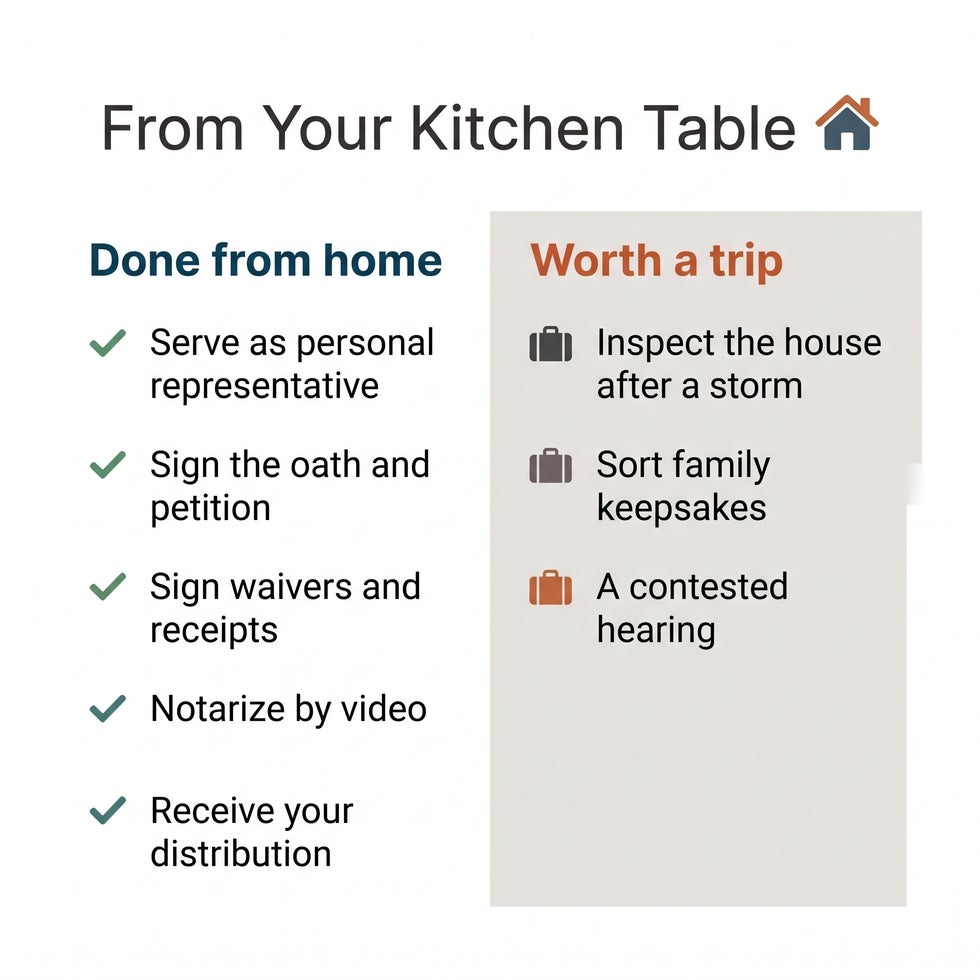
You can sign from home. Under section 92.50, an oath or affidavit required by state law here may be taken before a notary public with an official seal in any other state. A deed works the same way under section 695.03(2), so a deed signed before two witnesses and notarized in Ohio can be recorded in Lee County.
Remote online notarization probate signers use is a second route. Under section 117.209, a Florida online notary physically in Florida may notarize your signature over a video connection wherever you are. Typical remote signatures include:
- The oath and the petition for administration.
- Waivers, consents and receipts.
- Summary administration papers.
- A deed or closing papers for estate real estate.
Florida probate courts follow specific procedures for each filing, so use the exact form your attorney sends. A notarial defect gets a filing rejected, and remote signing does not replace the original will, which must still reach the clerk.
Attending Hearings Remotely
Many uncontested estates have no hearing at all. Your probate lawyer files the papers and the judge often signs orders on the papers alone, and when a hearing is set, many judges allow remote appearance.
Contested Florida probate proceedings are different. A will challenge or a removal fight may require live testimony, and the judge controls how it happens. For an uncontested estate, many out-of-state families never set foot in a courtroom, and that is normal.
When a Trip to Florida Is Worthwhile
Travel for a problem, an inspection or a goodbye, not for the court. A short visit makes sense to:
- Inspect a vacant house after a storm.
- Meet real estate agents or local professionals in person.
- Sort family photographs and sentimental items.
- Attend a closing, if the family wants to.
The hard problems at a distance are practical: a roof leak, an insurance question, an unpaid HOA balance. A well-timed visit solves those faster, and the next section covers how to manage them from home.
How Do You Protect an Empty House From Another State?
Treat the house as urgent on day one. A vacant home can lose insurance coverage, take on water or storm damage, or run up HOA charges before the estate is even opened.
Managing an inherited Florida house from out of state starts with authority. Under section 733.608(2), when a house that reasonably appears to be protected homestead is not occupied by someone with an interest in it, the personal representative may, but need not, take possession to preserve, insure and protect it, and gets a lien for what that costs. Other Florida real estate, meaning real property that was not homestead, is an estate asset the personal representative may possess and manage, although selling it usually requires a power in the will or a court order.
Insurance and Vacancy Clause Considerations
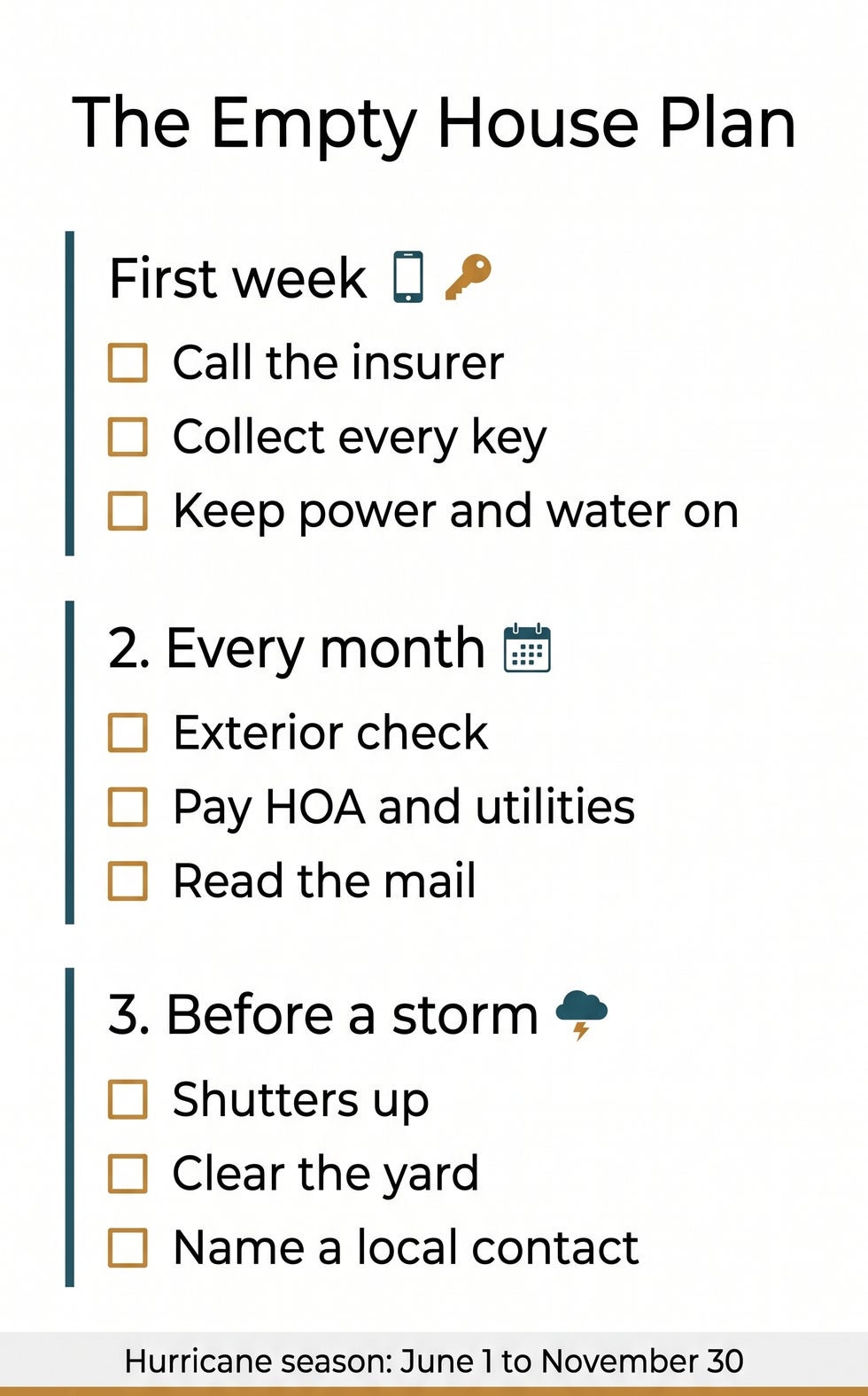
Call the insurer first. Many homeowners policies limit coverage once a house has sat vacant for a stated period, so notify the carrier of the death and read the vacancy terms.
- Report the death and ask whether the house is now treated as vacant.
- Confirm windstorm and flood coverage, which are often separate policies.
- Ask what inspections the carrier expects.
- Keep updated declarations pages in the estate file.
Water, mold and theft move fast in an empty house. One phone call early prevents a much larger loss later.
Preparing for Hurricane Season
The Atlantic hurricane season runs from June 1 to November 30. If the house sits in one of the Southwest Florida counties during those months, storm preparation belongs on the probate checklist.
- Arrange regular exterior checks by a local professional.
- Install shutters or panels and secure doors.
- Clear loose furniture and debris from the yard.
- Know who will look at the house the day after a storm.
The personal representative's duty to protect estate assets applies whether he or she lives in Naples or New Jersey.
Utilities, HOA, Property Tax, and Who Has Keys
After insurance, deal with the bills and the keys. One written plan prevents two siblings from making conflicting promises to a buyer or a neighbor.
| Task | Why it matters | First step |
|---|---|---|
|
Utilities |
Power runs the air conditioning that holds off mold |
Keep power and water on, in the estate's name if possible |
|
HOA or condominium |
Dues and rules keep running |
Send management the death notice and a new mailing address |
|
Property tax bill |
It keeps arriving in the decedent's name |
Update the mailing address with the tax collector |
|
Keys and alarm codes |
Unclear access is a security risk |
Keep one key list and change locks only with the personal representative's approval |
With the house secure, the homestead question decides who will own it.
What Happens to a Florida Homestead When the Heirs Live Elsewhere?
Under the probate laws, a resident's home is usually protected homestead, and it passes to the heirs or devisees outside the personal representative's general control. Section 733.608(1) excludes protected homestead from the assets the personal representative administers.
That surprises families who expect the house to be handled like a bank account. Homestead property out of state heirs inherit usually needs a court order determining homestead status before a title company will insure a sale, and the tax treatment changes at death.
Homestead Protection and How It Passes
The state constitution protects certain inheritance rights in a homestead. Under Article X, Section 4(c), the owner cannot devise the homestead if survived by a spouse or minor child, except to the spouse when there is no minor child. When a spouse and descendants survive and the home passes by law, section 732.401 gives the spouse a life estate with the remainder to the descendants, or a one-half interest if the spouse elects it.
When neither a spouse nor a minor child survives, the will, or the intestacy statute if there is no will, controls who receives the house. Either way, title passes to the heirs or devisees, so they, not the personal representative, sign the deed when they sell. Selling an inherited Florida house from out of state then follows our guide to selling inherited property, and our guide to Florida homestead in probate covers the court order that confirms homestead status. If the house still carries a loan, read our guide to keeping an inherited house with a mortgage before anyone moves in or rents it out.
Homestead Exemption Ending and Reassessment
The decedent's homestead tax exemption does not carry over to heirs who live elsewhere. Under section 196.031, the exemption belongs to an owner who makes the property a permanent residence on January 1.
The Save Our Homes cap ends too. Section 193.155(3)(a) reassesses property at just value as of January 1 of the year after a change of ownership, with exceptions that mostly help a surviving spouse or minor child. Heirs who keep the house as a Florida vacation home or an investment property should budget for larger tax obligations.
Conclusion
Handling an estate from another state is mostly a matter of order: confirm domicile, check who qualifies, sign from home, and protect the house before anything else. Each Florida statute below is one an out of state heir Florida probate touches often.
| Statute or rule | What it does for an out-of-state heir |
|---|---|
|
§ 733.304 |
Lists the relatives who may serve as personal representative while living elsewhere |
|
Rule 5.110 |
Requires the personal representative to name a resident agent to accept service in Florida |
|
§ 733.402 |
Requires a bond unless the will or the court waives it |
|
§ 92.50 and § 117.209 |
Let you sign before a notary where you live or a Florida online notary |
|
§ 732.901 |
Requires the original will to reach the clerk within 10 days |
|
§ 733.212 |
Starts the 3-month objection clock when the notice of administration is served |
|
§ 733.608 |
Excludes protected homestead and lets the personal representative secure a vacant home |
|
§ 193.155 |
Reassesses the house the January 1 after ownership changes |
A smaller estate may qualify for a lighter administration process: summary administration is available when the estate subject to administration, not counting exempt property, is worth $150,000 or less, or the decedent died more than two years ago, under section 735.201, as our article on the summary administration limit explains, and the firm's video What Is Summary Administration? shows how it works. Its petition must be signed by the surviving spouse and the beneficiaries, except a beneficiary receiving a full share (section 735.203), and out-of-state heirs can sign from home.
How The Nussbickel Law Firm Helps
The Nussbickel Law Firm, P.A. practices estate planning, probate and trust administration and nothing else. From our office at 12487 Brantley Commons Court in Fort Myers, we serve estate planning clients throughout Lee, Collier and Charlotte counties and handle probate matters throughout the Sunshine State.
When the out of state heir Florida law lets serve lives across the country, we act as the estate's Florida probate lawyer and resident agent, prepare every paper for remote signature, keep each heir copied on the inventory and accountings, and coordinate with the people protecting the house. When a full administration is needed, our guide to formal administration in Florida lays out each step. We do not handle a home-state probate case, will contests or real estate closings, and we will tell you when you need someone who does.
Schedule a free consultation or call 239-900-WILL (9455). We meet by phone, by video or at our office, so the first phone call can happen from wherever you live.
Frequently Asked Questions
Does my state tax an inheritance from Florida?
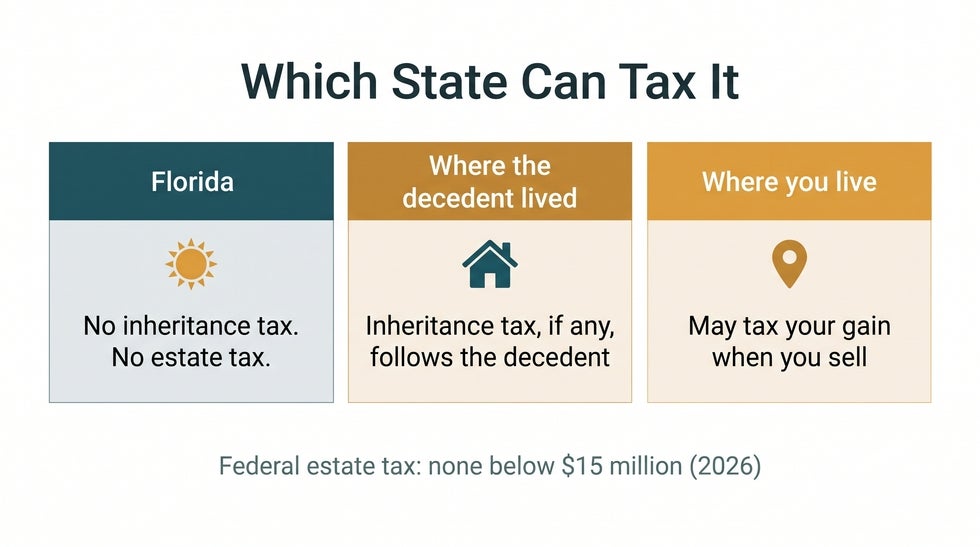
Usually not. Florida imposes no inheritance tax or state estate tax, the federal estate tax reaches only estates above the $15,000,000 basic exclusion for 2026 deaths (less large lifetime gifts), and a state inheritance tax generally follows where the decedent lived or the property sits, not where the heir lives; New Jersey's is an example. Your own state may tax the gain if you later sell, though the basis generally steps up to value at death under 26 U.S.C. § 1014. Confirm with your tax adviser.
How does Florida probate work for an heir who lives abroad?
The same way. Section 733.304 asks about domicile and family ties, not citizenship, so a child living outside the United States can still serve. Section 695.03(3) lets a foreign notary with a seal or a U.S. consul acknowledge your signature on a deed, and if an heir who is not a U.S. citizen or U.S. tax resident later sells the house, the buyer generally must withhold 15% of the price, subject to exceptions, under the IRS FIRPTA rules.
Gregory J. Nussbickel is the founder of The Nussbickel Law Firm, P.A. in Fort Myers, Florida. His practice is devoted exclusively to estate planning, probate, and trust administration for families throughout Southwest Florida.
This article is for general information only and is not legal advice. Reading it does not create an attorney-client relationship. Tax rules in your own state may differ, and every family is different; speak with a licensed Florida attorney about your specific situation.

Comments
There are no comments for this post. Be the first and Add your Comment below.
Leave a Comment