
Key Highlights
- A second court case. The ancillary administration Florida law requires is a probate proceeding here for the property of someone domiciled in another state or country (section 734.102).
- Home-state letters stop at the state line. A title company will not insure a sale until a court here has acted.
- The $150,000 figure is not an ancillary rule. It is the summary administration ceiling under section 735.201, open to nonresidents, and it doubled on July 1, 2026.
- The short form still stops at $50,000. Section 734.1025 has not changed since 2003.
- Full ancillary administration has no ceiling. It runs like an ordinary probate, with letters, a bond, and a notice to creditors.
- Not every relative can serve. Section 733.304 admits a nonresident child, sibling, niece, or nephew, but not a friend.
- Most of it is avoidable with a funded trust, a Lady Bird deed, or survivorship titling.
Introduction
The short answer: the ancillary administration Florida courts handle is required when someone domiciled outside Florida dies owning real estate or other property here in his or her sole name. Even if probate is already open in the home state, a court here must act before that property can be sold or transferred. There are three routes, and the right one turns on the size of the Florida estate and whether there was a will.
If your father lived in Ohio and owned a condo in Cape Coral, or your aunt in New Jersey left a vacant lot in Lehigh Acres, you probably learned this from a realtor or title company. This guide covers what the proceeding is, which route fits, who can serve, the steps from the home-state court to the closing table, the snowbird domicile question, and how owners keep their families out of it.
What Is Ancillary Administration in Florida?
It is a secondary probate case for property located here. Families asking what is ancillary administration in Florida usually want to know why a probate open back home is not enough. Every state controls the transfer of land inside its borders, so a court here must authorize whoever deals with the real property of a deceased person who lived elsewhere.
Section 734.102 creates the proceeding when a nonresident dies leaving assets here, credits due from residents here, or liens on property here. The court appoints an ancillary personal representative and issues ancillary letters, and subsection (4) of this part of the Probate Code directs that the case run as much like an original administration as possible. In short, the ancillary administration Florida provides is ordinary probate with a narrower reach.
How Does Ancillary Probate Florida Differ from Regular Probate?
The difference is reach, not procedure. The ancillary probate Florida courts run covers only the Florida estate. The domiciliary probate in the decedent's home state handles everything else and sets the overall plan of distribution; practitioners call it the primary probate or main estate.
The mechanics are familiar: a petition, an order admitting any will, letters, a bond, a published notice to creditors, an inventory, and a discharge. The extra burden is paperwork from the other state's court, which must be authenticated before a judge here will rely on it. Otherwise the probate process is the one any resident's family would follow, in the same Florida probate court.
When Is Ancillary Probate Initiated in Florida?
It begins with a petition in the circuit court of a county where the property sits. Under section 733.101(1)(b), a decedent with no domicile here is probated in any county where his or her property is located, which for our clients usually means Lee, Collier, or Charlotte.
Section 734.102(2) says the case is commenced as the Florida Probate Rules provide, and Rule 5.470 supplies the requirements. No statute sets a deadline to start, but delay costs money: taxes, condominium dues, insurance, and mortgage payments keep coming, and no one can pay them from estate funds, rent the unit, or sell it until letters or an order issue.
Probate in Two States: Why Is It Needed?
Because a court in Ohio or New York cannot pass title to land here. Probate in two states is the normal result when a person owns real estate in a state where he or she did not live and dies with it titled in his or her own name.
The home-state personal representative is the right person for the domiciliary estate, but those letters do not satisfy a title insurer here. The ancillary case fills that gap with a local order and, usually, local letters. Once it is complete, the court may send the remaining property to the home-state representative or distribute it directly to the beneficiaries.
What Triggers Ancillary Administration Under Section 734.102?
Three things trigger it: assets in this state, credits due from residents here, or liens on property here, each belonging to a decedent who was not domiciled in Florida. The asset must also lack a survivor, beneficiary, or trust that would carry it outside probate.
The language is broader than most people expect. It is not limited to real estate or to large estates. A small bank account, a promissory note from a local buyer, or a mortgage the decedent held can each support a case. Whether one is actually needed depends on the asset, its value, and whether a shortcut applies.
Which Florida Assets Require Ancillary Probate Florida?
Sole-name real property is the usual trigger: a vacation condo, a Cape Coral house, a vacant lot, a deeded timeshare week, or Florida land bought decades ago as an investment. In a typical file, the nonresident decedent Florida property is a single condo with no survivorship language on the deed.
Tangible personal property located here, a boat at a marina, or an account at a local branch with no beneficiary can also count. A car titled here can often be retitled without a court, by affidavit. Property held with right of survivorship, in a trust, or under a Lady Bird deed does not trigger a case.
Credits and Liens That Activate Ancillary Administration
A debt or lien the decedent held here can trigger it. The classic example is a Michigan couple who sold their Fort Myers house with owner financing and kept the mortgage. When the surviving spouse dies, someone must collect the payments and sign the satisfaction.
Section 734.101(3) offers a shortcut families rarely hear about. A debtor whose property secures a debt held by the foreign personal representative may pay that representative 90 days after the foreign appointment, if no personal representative appointed here has made written demand. The foreign representative's recorded satisfaction, with authenticated letters attached, discharges the mortgage, which can make a case here unnecessary.
Does Real Estate Always Require Ancillary Proceedings?
No. Real estate needs a proceeding here only if it was in the decedent's sole name, with no survivorship or trust arrangement, and even then the case may be small.
One route skips administration entirely. Under section 734.104, an authenticated copy of a nonresident's will devising real property here may be admitted to record two years after death, or after the domiciliary personal representative is discharged, if no estate was opened here. The will must have been executed as Chapter 732 requires and probated at home. Once recorded, it passes title as if probated here. It is slow by design, but for a family in no hurry to sell, it can be the simplest path.
Which Type of Ancillary Proceeding Does the Estate Need?
The answer turns on value and whether there was a will. Full ancillary administration fits any estate. Summary administration fits a Florida estate of $150,000 or less after exempt property, or a death more than two years ago. The short form fits testate estates with Florida property worth $50,000 or less.
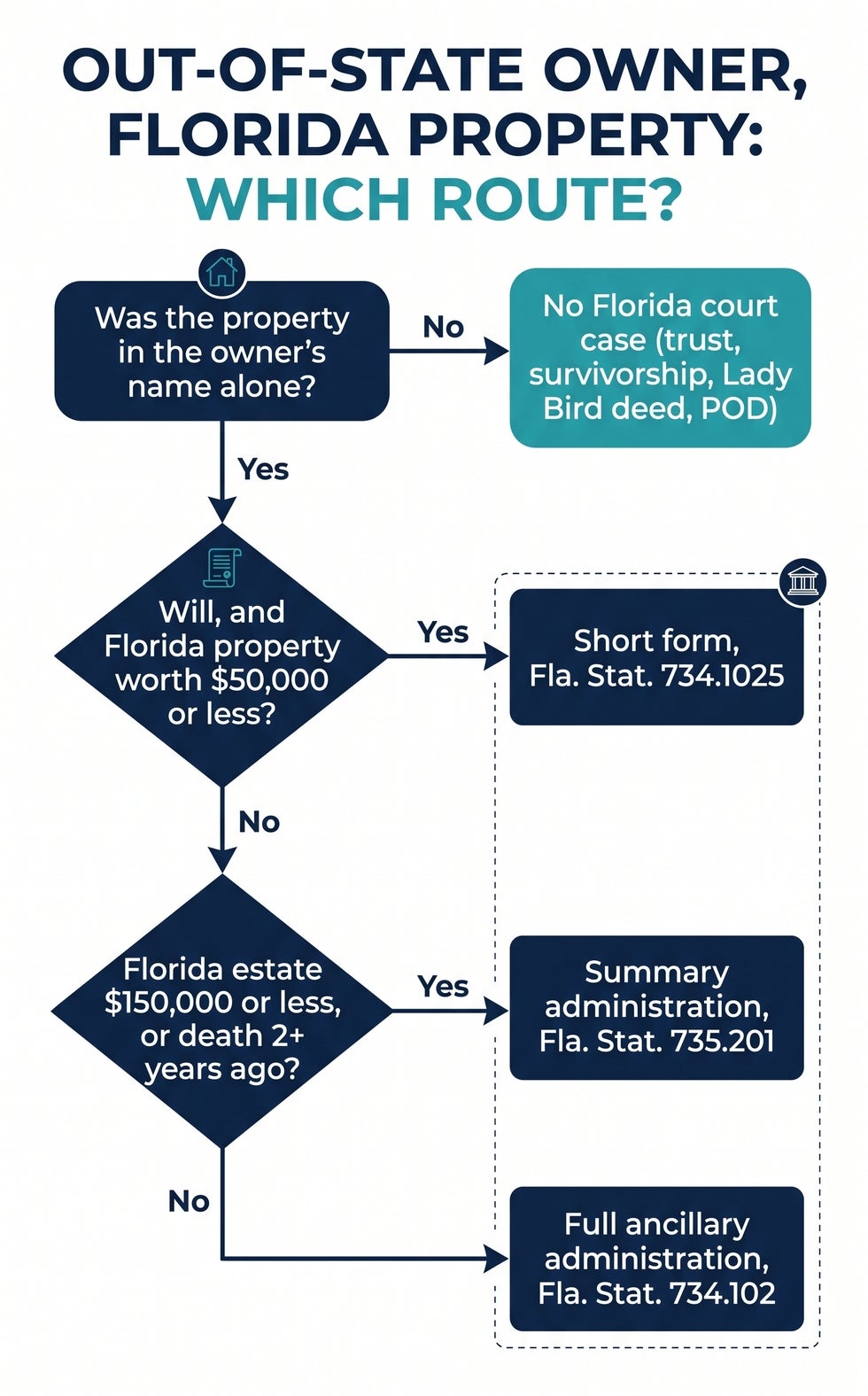
Most Florida ancillary administration requirements trace back to those two facts. A third, the presence of creditors, decides whether the smaller routes are worth the risk, or whether the full ancillary administration Florida provides is the safer course.
Full Ancillary Administration
Formal ancillary administration is ordinary probate opened for a nonresident. It has no value limit, and the ancillary personal representative receives the powers section 734.102(7) grants: to settle the estate, to sell, lease, or mortgage local property, and to raise funds for debts and devises in the domiciliary jurisdiction.
This route fits a $400,000 Naples condo, an estate with creditors, a property needing repairs or a tenant, or a family that disagrees. The appointee posts bond under subsection (4) unless the will or court waives it, and publishes a notice to creditors under subsection (5). Probate Rule 5.030 generally requires a Florida probate attorney. Our video What Is Ancillary Administration in Florida Probate? gives the overview.
Summary Administration for a Nonresident Decedent
Summary administration is open to nonresidents by its own terms. Section 735.201 allows it for "either a resident or nonresident decedent's estate" when the will does not direct formal administration and the estate here, less exempt property, is $150,000 or less, or the decedent has been dead more than two years.
Chapter 2026-57 doubled the ceiling from $75,000 on July 1, 2026. Some lawyers call this summary ancillary administration. No one is appointed; the court's order directs who receives each asset. Under section 735.206, the petitioner must search for creditors first, and recipients stay liable for their share of valid claims for two years after the death. See our article on the new $150,000 summary administration limit.
The $50,000 Short-Form Transcript
A small testate estate can often skip appointment here. Under section 734.1025, when a nonresident dies with a will and the Florida property's gross value is $50,000 or less, the foreign personal representative may file an authenticated transcript of the foreign proceedings showing the will and beneficiaries.
The filing must come within two years of death, in a county where any property is located. The foreign representative may publish a notice to creditors; if no claim is filed, the court enters an order under Rule 5.475, and if one is, a local representative is appointed. Note two limits: the test is gross value, not equity, and the $50,000 figure has not moved since chapter 2003-154.
When No Proceeding Is Needed
None is needed when nothing here was titled to the decedent alone. Survivorship deeds, tenancy by the entirety, a revocable trust, a Lady Bird deed, and payable-on-death accounts all pass outside probate.
Two statutes help even without planning. Section 734.101(4) authorizes anyone owing the estate money or holding its personal property to pay or deliver it to the foreign personal representative 90 days after that appointment, absent written demand from a representative here. Under section 655.936(2), a bank may release safe-deposit contents to an out-of-state representative three months after letters issue, on an affidavit of foreign domicile and no unpaid local creditors. Both permit payment; neither requires it.
How Do the Florida Ancillary Routes Compare?
The routes differ in who is appointed, what is filed, and how much value they carry. The record-only route under section 734.104 is described above.
| Route | When it is available | Who is appointed | What the family files | Florida statute |
|---|---|---|---|---|
|
Full ancillary administration |
Any nonresident estate; no value limit |
Ancillary personal representative, with ancillary letters |
Petition with authenticated home-state will, petition, order, and letters; oath; resident agent; bond |
§ 734.102; Rule 5.470 |
|
Summary administration for a nonresident |
Estate here, less exempt property, $150,000 or less, or death 2+ years ago |
No one; the court orders distribution |
Summary petition, any will, creditor search, proposed order |
§§ 735.201, 735.206 |
|
Short-form authenticated transcript |
Testate; gross value here $50,000 or less; filed within 2 years |
No one unless a creditor files a claim |
Authenticated transcript showing will and beneficiaries; optional creditor notice |
§ 734.1025; Rule 5.475 |
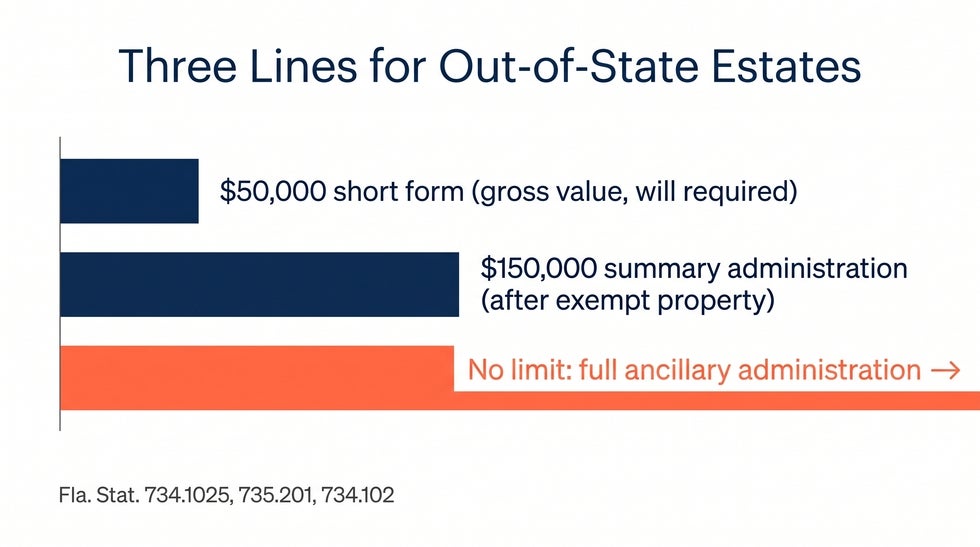
Full Ancillary Administration Compared
Full administration is the most work and the most certain. It is the only route that produces a fiduciary with ongoing power to sign, rent, repair, or handle a hurricane claim, a code lien, or a disagreement nobody anticipated.
The price of that full probate administration is a bond, a three-month creditor window, an inventory, and a discharge. For property worth several hundred thousand dollars, or an estate with debts, the structure usually pays for itself. It also protects the person in charge, because discharge under section 733.901 releases the personal representative and the surety.
Summary Administration Route Compared
Summary administration is faster but shifts risk to recipients. There is no bond, inventory, or fiduciary. The order itself transfers the assets, and under section 735.206(4)(c) a good-faith buyer from the recipients takes free of the decedent's creditors.
The recipients carry the debt exposure for two years. That suits a $120,000 condo owned free and clear by a decedent with no local creditors. It suits less well where there is a final-illness bill here, an association balance, or heirs who will not all sign.
Short-Form Authenticated Transcript Compared
The short form is the lightest touch for narrow facts. There must be a will, gross value here of $50,000 or less, and a filing within two years. An intestate estate cannot use it, and neither can a $55,000 lot.
When it fits, the out-of-state executor files the home-state record and no one here is appointed unless a creditor appears. It suits a platted Charlotte County lot or a modest timeshare. If a claim is filed, Rule 5.475 brings in a local representative, who has at least 30 days to object.
What Are the Steps in a Florida Ancillary Administration?
The sequence runs from the home-state court to the closing table. For the ancillary administration Florida courts supervise, that means authenticated copies, the petition, notice, bond and qualification, letters, the creditor notice, sale or distribution, and discharge.
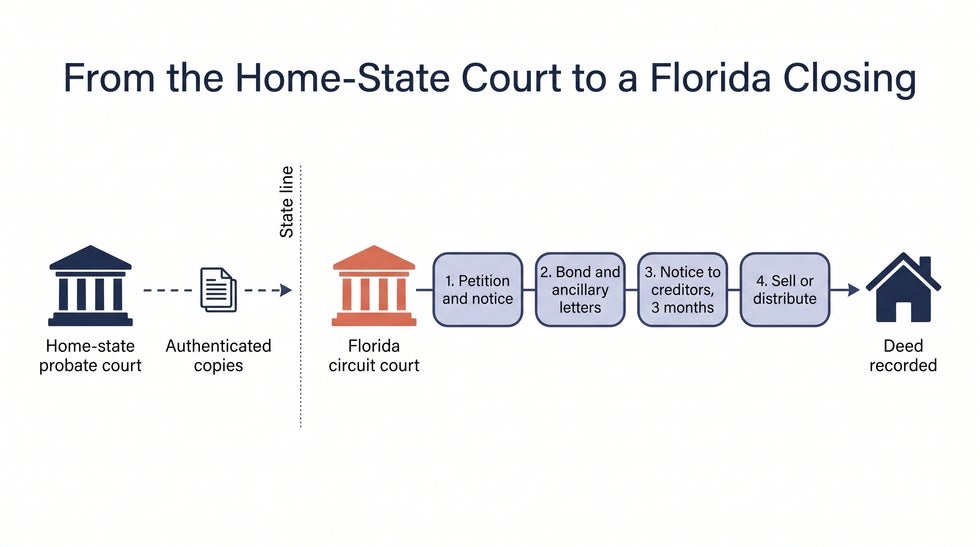
Where no probate is open in the home state, the order changes, as noted below.
What the Home-State Court Must Send
The court here needs authenticated copies of the domiciliary record. Under Rule 5.470(a), a testate estate supplies the will, the petition for administration, the order admitting the will, and proof of the representative's authority; an intestate estate supplies the petition and the authority.
Section 731.201(1) defines "authenticated" as a certified copy or one authenticated under the Federal Rules of Civil Procedure. A scan or docket printout will not do. Rule 5.470 was revised effective October 1, 2026, in SC2025-1462, to say "petition for administration" instead of "petition for probate"; the substance is unchanged.
Required Documents and Certified Copies
Beyond the home-state record, expect the usual pieces: a certified death certificate, the legal description from the recorded deed, a list of assets here with values, beneficiaries' names and addresses, and the proposed representative's relationship to the decedent.
The court wants an authenticated copy of will, petition, and order, not merely copies of the will from the family's files; originals usually stay with the home court. The petition must meet Rule 5.200 and be verified, and the appointee files an oath and designates a resident agent, usually the estate's local attorney.
Sequence of Filing in Florida Courts
The usual order is petition, notice, qualification, letters. Rule 5.470(b) requires formal notice, before ancillary letters issue, to every known person with equal or greater preference and to every domiciliary personal representative who has not waived or joined. Section 734.102(1) separately requires prior notice to the domiciliary representative when someone else applies.
Then the court admits the will, sets bond, and the clerk issues letters. Section 28.2401 caps the filing fee at $395 plus a $4 surcharge. When no home-state probate exists, the record Rule 5.470 assumes is missing; venue still lies where the property sits, and the right petition is a judgment call we make case by case.
Publishing Notice to Creditors and Potential Claims
The ancillary personal representative must publish and serve a notice to creditors under Chapter 733, unless claims are already barred by section 733.710's two-year limit.
Known creditors are served, and the notice runs once a week for two consecutive weeks. Under section 733.702, claims are barred unless filed within three months after first publication or, for a served creditor, 30 days after service if later. That window drives the timeline. Our article on probate creditor claims explains payment and objections.
Selling or Transferring the Florida Property
The appointee sells like any personal representative. Under section 733.613, a will with a power of sale allows a sale without court approval; otherwise, title passes only after the court authorizes or confirms it.
The representative signs a personal representative's deed, and the insurer issues marketable title on the certified letters and any order of sale. A buyer under a power of sale or order takes free of estate creditors, though existing mortgages remain. The family can instead take the property by distribution deed. The listing-to-closing mechanics match any other probate sale.
Order of Discharge and Completing the Process
The case closes with a discharge. Section 734.102(6) lets the court, after expenses and claims are paid, send the remaining property to the foreign personal representative or distribute it directly to the beneficiaries.
If the home estate still has debts or a complex plan, sending the net proceeds home keeps one set of books. If the beneficiaries are clear, direct distribution saves a step. The representative then files the final accounting or waivers and the petition for discharge.
Who Can Serve as Ancillary Personal Representative?
Section 734.102(1) sets the order: the person the will names for the Florida property, then the foreign personal representative, then a named alternate, then a person chosen by the majority in interest. Each must be qualified to act here, and the ancillary administration Florida courts open will not issue letters to anyone who is not.
If there is no will and the foreign representative does not qualify, the ordinary intestate preference applies. The qualification rules are covered in depth in our guide to letters of administration.
Requirements for Out-of-State Executors and Personal Representatives
An out-of-state executor qualifies only through family. Under section 733.304, a person not domiciled here must be an adopted child or adoptive parent of the decedent; related by lineal consanguinity; a spouse, brother, sister, uncle, aunt, nephew, or niece, or a lineal relative of one of them; or the spouse of a qualified person.
For an out-of-state executor Florida property usually involves, that list is generous: a son in Illinois, a daughter in New York, or a niece in New Jersey qualifies. The person must also be an adult, able, and free of a disqualifying conviction. Home-state letters prove authority to petition, but the court here still makes the appointment.
Who Cannot Serve as Ancillary Personal Representative?
A nonresident friend, partner, accountant, or unadopted stepchild cannot serve, even if named in the will and appointed back home.
Section 733.303 adds four disqualifiers for everyone: a felony conviction, a conviction for abuse, neglect, or exploitation of an elderly or disabled adult, inability to perform the duties, and being under 18. When the home-state representative is disqualified here, the statute moves to a named alternate and then to the majority-in-interest selection, so the family is not stuck.
When Co-Executors or Family Members Serve
Co-representatives can serve if each qualifies. Wills often name two adult children; here, each must satisfy section 733.304 or live in this state.
If one qualifies and one does not, the qualifying sibling can serve alone, or the majority in interest can choose someone. A common arrangement pairs a child who runs the home estate with a sibling or cousin who serves here. Under section 733.615, joint representatives act by majority unless the will says otherwise, so with two, both must agree.
Can a Bank or Trust Company Serve?
A bank must hold fiduciary powers here to serve. Section 733.305 lets in-state trust companies and banks or savings associations qualified to exercise fiduciary powers here act as personal representatives.
A hometown bank in Pennsylvania named as executor may be unable to act in this case. It can remain the domiciliary representative while a qualified relative or an authorized institution handles the property here. A corporate fiduciary makes most sense for valuable property or a divided family.
Special Concerns for Nonresident Estates in Florida
A few rules work differently when the owner lived elsewhere. Homestead, timeshares, vehicles, and title clearance raise questions a resident's probate rarely does.
A nonresident's estate here is usually dominated by one asset, so the whole case often exists to deliver one marketable deed. These issues most often slow that delivery.
Homestead Concerns for Out-of-State Owners
A nonresident's vacation home is ordinarily not protected homestead. Article X, section 4 of the Florida Constitution protects property that is the residence of the owner or the owner's family, and section 731.201(33) builds the probate definition on it. A vacation condo used a few months a year by an Ohio domiciliary usually fails that test.
The homestead tax exemption under section 196.031 requires a permanent residence as of January 1, so a nonresident should not hold it. If the decedent did claim it, that points toward domicile here, discussed below. Where a family member lives in the home, the answer depends on case law; compare the rules for residents in our homestead in probate guide.
Timeshares, Vehicles, and Bank Accounts
Smaller assets often have their own exits. A deeded timeshare week is real property and needs the same authority as any deed, though many resorts layer their own transfer procedures on top. A right-to-use timeshare is governed by its contract, so read it before assuming a court case.
A car titled in the home state is retitled there. A bank account with a payable-on-death beneficiary passes to that person. A sole account with no beneficiary may be paid to the foreign representative under section 734.101(4) after 90 days if the bank is willing; if it insists on local authority, the account joins the ancillary estate.
Clearing Title to Florida Real Property
Title is why most ancillary cases exist. Florida real estate cannot close without it. The underwriter will want certified letters or the order, the recorded death certificate, proof that creditor claims are barred or paid, and a deed from the right person with the correct legal description.
Problems usually surface from the public records rather than the probate: an unreleased old mortgage, a misspelled name, or a code enforcement lien. Order a title search while the case is opening. If an enhanced life estate deed was recorded, confirm it was valid, because a valid one takes the property outside the estate.
Was the Decedent Really a Nonresident?
Not always, and the answer changes which court leads. If the decedent was domiciled here, the case here is the domiciliary probate. Section 731.201(13) defines domicile as a person's "usual place of dwelling," synonymous with residence.
Snowbirds split the year, so their records often point both ways, and the answer decides whether the ancillary administration Florida offers is even the right case. A wrong assumption can mean the wrong petition in the wrong county.
The Snowbird Domicile Trap Explained
The trap is a decedent whose records say Florida while the family assumes otherwise. Many seasonal residents file a declaration of domicile under section 222.17, claim the homestead exemption, get a local driver's license, or register to vote here, then keep living much of the year up north.
If the family opens probate in Michigan assuming this state is secondary, but the facts show domicile here, venue lies in the county of domicile under section 733.101(1)(a), and the home court may have the narrower role. The reverse trap is a Florida resident in fact who never did the paperwork.
Factors Determining Florida Residency or Nonresidency
Courts weigh the totality of the circumstances, starting with a presumption that domicile continues. In Fernandes de Oliveira v. Palagi Fernandes de Oliveira, No. 3D25-0855 (Fla. 3d DCA May 13, 2026), adult children asked to convert a domiciliary case into an ancillary one, arguing their father had moved back to Brazil. After a multi-day hearing, the trial court found domicile here, and the Third District affirmed.
The party claiming abandonment carried the burden. The facts that mattered were familiar: a local driver's license, immigration status, auto insurance, belongings in storage, tax filings, and a stated plan to return. For a domestic snowbird, the same questions apply: where the person voted, filed taxes, registered cars, saw doctors, and kept belongings.
What Happens If Residency Is Contested?
The court decides on evidence, and a jurisdictional challenge gets a hearing. In Ramos De Souza v. Estate of Ferreira de Oliveira, No. 3D25-1344 (Fla. 3d DCA June 24, 2026), the Third District reversed orders opening an ancillary administration because the trial court ruled on a challenge to its section 734.102(1) jurisdiction without an evidentiary hearing.
Gather domicile evidence before filing. Section 222.17(4) also lets someone domiciled elsewhere record a sworn statement here that the home domicile continues. Both opinions involved foreign domicile, and neither has been checked for later history in a commercial citator, but their reasoning applies to a snowbird from New York.
Avoiding Common Ancillary Pitfalls
Most delays come from paperwork, timing, and nonconforming wills. Each can be headed off with a checklist at the start.
The Third District put it plainly in Adenin v. Estate of Adenin, No. 3D21-1761 (Fla. 3d DCA Sept. 14, 2022): ancillary administration "is strictly circumscribed by statute and rule." A widow there petitioned as if her husband had been domiciled here, then orally asked for ancillary jurisdiction; dismissal was affirmed, without prejudice to a proper petition.
Missing Documents and Home-State Court Orders
The most common delay is the other state's clerk. Certified or exemplified copies can take weeks, and some courts will not issue them until the representative qualifies there. Order extra sets; title companies keep copies.
Some states probate wills informally, with no separate order admitting the will, or issue letters in an unfamiliar form. When the record is thin, the petition must explain what the home procedure produced, sometimes with a clerk's certificate. Spotting that early avoids a rejected filing.
Timing Mistakes and the 90-Day Rule
Several clocks run from the death or the foreign appointment. The 90-day rule in section 734.101(3) and (4) lets debtors and holders of the decedent's property here pay or deliver to the foreign representative 90 days after that appointment, absent written demand from a representative here.
Longer clocks matter too. The short form must be filed within two years of death. Summary administration opens regardless of value after two years. Section 733.710 bars most claims two years after death, and section 734.104 opens the record-only route at the same point. Knowing which clock helps and which hurts often decides the cost.
Out-of-State and Holographic Wills
A will valid where signed is usually valid here, with one exception. Under section 732.502(2), a nonresident's will valid where executed is valid here, except a holographic or nuncupative will. The issue is witnesses, not notarization: a handwritten will signed before two attesting witnesses is not treated as holographic.
Some states accept unwitnessed handwritten wills. Such a will may govern the home estate but cannot pass real estate here, which then passes by intestacy. See Florida will requirements and our video Is an Out-of-State Will Valid in Florida?.
How to Avoid Ancillary Probate in Florida
Retitle the property during life. For owners asking how to avoid ancillary probate, the tools are the usual probate-avoidance tools, best drafted alongside the home-state plan, and they remove the need for the ancillary administration Florida would otherwise require.
The goal is to leave nothing here titled to the owner alone with no beneficiary. Our guide to avoiding probate covers the full menu; three choices matter most for nonresidents.
Using Revocable Trusts to Avoid Two Probates
A funded revocable living trust is the most complete answer. Once the condo is deeded to the trustee, the successor trustee transfers it at death with no court here or at home, because the trust owns it.
A trust that never took title does nothing; the deed must be recorded. A trust also covers incapacity, which matters for a seasonal owner managing a unit from a distance, and one trust can hold property in several states. Our video What Is a Revocable Living Trust in Florida? explains how it works within an estate plan.
Lady Bird Deeds and Joint Ownership Solutions
A Lady Bird deed is often the lightest tool for one property. It names beneficiaries while the owner keeps a life estate and full power to sell, mortgage, or change course without their consent; at death, they take title without probate. No statute here authorizes a transfer-on-death deed for real property, so this deed fills that role.
Survivorship titling, or tenancy by the entirety for a surviving spouse, avoids probate at the first death but not the second, and exposes the property to a co-owner's creditors and choices. Adding a child is a gift with tax consequences. Our Lady Bird deed guide compares the options.
TOD/POD Designations for Bank and Brokerage Accounts
Name a beneficiary on every account here. Payable-on-death designations under section 655.82, and transfer-on-death registration for brokerage accounts, move funds to the named person with a death certificate and a claim form.
A designation overrides the will, so it must match the plan in both states, and it needs review after a death, marriage, or divorce, because a beneficiary who dies first can send the account back into the estate. A short annual review is one of the cheapest ways to avoid ancillary probate for out-of-state property.
What Should Families Bring to a Consultation?
Bring the home-state record, the title, and a list of everything here. With those, a first meeting, by phone or video if the family is out of state, can usually identify the route and the likely problems.
If probate is not yet open back home, bring what exists: the will, the death certificate, and the deed. Knowing both states' facts lets a lawyer choose between waiting for the home appointment, using a shortcut, or filing here first.
Essential Documents to Gather
Gather the certified death certificate, the will and codicils, and any home-state letters and order admitting the will. Add the deed or a recent tax bill showing the legal description, plus mortgage, association, or timeshare statements.
For other assets, bring the latest statement for each local account showing its title, and any vehicle or boat titles. Then list the beneficiaries' or heirs' names, addresses, and relationships. With those papers, a Florida probate attorney can usually name the route in the first meeting.
Information the Attorney Will Need
The attorney needs the facts that decide domicile, value, and debts: where the decedent voted, filed taxes, registered cars, and spent the year; whether he or she claimed the homestead exemption or filed a declaration of domicile; and what the property is worth.
Debts matter too: local creditors, final-illness bills, association balances, and any lawsuit. Letters are sometimes sought for other reasons; under section 768.20, a wrongful death action is brought by the personal representative. That is litigation, which this firm does not handle, but it affects who should be appointed. Federal estate tax is a separate question for larger estates.
Conclusion
An ancillary case is manageable when the route fits the facts. Full administration fits any estate; summary administration fits estates up to $150,000 or deaths more than two years old; the short form fits small testate estates up to $50,000; and some families need no case at all.
The time savers come first: confirm domicile, order authenticated copies early, confirm the representative qualifies, and test the will against the execution rules. For owners, the better answer is to retitle now; our video Florida Estate With Out-of-State Real Estate: A Second Probate shows what happens otherwise. Florida property owned by a nonresident should never be left to chance.
How The Nussbickel Law Firm Helps
The Nussbickel Law Firm, P.A. practices estate planning, probate, and trust administration and nothing else. From our office at 12487 Brantley Commons Court in Fort Myers, we handle probate matters statewide and serve estate planning clients throughout Lee, Collier, and Charlotte counties. Many of the families we serve live elsewhere: children in Ohio and Illinois, executors in New York and New Jersey, and Canadian relatives settling a parent's condo.
When a family calls about the ancillary administration Florida law requires, we start with the threshold questions: was the decedent really a nonresident, what is the property worth, was there a will, and who qualifies to serve. Then we pick the smallest route that fits, coordinate with the home-state attorney on the authenticated record, and work with the title company from the first week. We also help nonresident owners set up trusts and deeds so their families never need a second case. For owners with ties abroad, our guide to international estate planning covers the foreign-will and estate tax issues this article leaves out.
Schedule a free consultation or call 239-900-WILL (9455). We meet by phone, by video, or at our office, whichever you prefer.
Frequently Asked Questions
Ancillary Probate Florida: What Is It and Why Might My Family Need It?
It is the ancillary administration Florida courts open for property here owned by someone who lived in another state or country. Your family needs it when the decedent owned real estate or other assets here in his or her sole name, with no beneficiary, survivor, or trust, because home-state letters cannot transfer that property.
How Long Does Ancillary Probate Take in Florida?
It depends on the route. Full ancillary administration cannot close before the three-month creditor window runs from first publication, and gathering authenticated home-state copies adds time before that. Summary administration and the $50,000 short form are usually faster because no personal representative serves, though a published creditor notice still runs its course.
Can the Executor from Another State Sell the Florida Property?
Not on home-state letters alone. The executor must first be appointed here as ancillary personal representative, which requires qualifying under section 733.304 as a close relative. Once appointed, the executor can sell under the will's power of sale or with court approval, and the title company can insure the closing.
What Is the $150,000 Rule in Florida Ancillary Probate?
It is the summary administration ceiling under section 735.201, not a separate ancillary rule. Since July 1, 2026, a nonresident's estate qualifies when the property here, less exempt property, is $150,000 or less, or the death was more than two years ago. The separate short form for testate estates still stops at $50,000.
Can a Foreign Will Be Recorded in Florida Without Probate?
Yes, after a wait. Under section 734.104, an authenticated copy of a nonresident's will that devises real property here may be admitted to record two years after death, or after the home-state personal representative is discharged, if no estate was opened here. The will must have been probated where the decedent lived.
Gregory J. Nussbickel is the founder of The Nussbickel Law Firm, P.A. in Fort Myers, Florida. His practice is devoted exclusively to estate planning, probate, and trust administration for families throughout Southwest Florida.
This article is for general information only and is not legal advice. Reading it does not create an attorney-client relationship. Probate law changes, and every estate is different; speak with a licensed Florida attorney about your specific situation.

Comments
There are no comments for this post. Be the first and Add your Comment below.
Leave a Comment