

Key Highlights
- An inherited house with mortgage Florida heirs receive usually can be kept: federal law bars most lenders from calling the loan because the home passed at death to a spouse or relative who lives there.
- The heir does not owe the debt personally, but the mortgage stays on the house and follows it to the new owner.
- Someone has to keep the monthly payments, property taxes and homeowners insurance current while the estate is sorted out.
- A servicer must respond to a written request from a potential successor in interest and, once it confirms that person, treat them as a borrower for servicing.
- Under section 733.803, a beneficiary left the house gets the loan paid from the rest of the estate only if the will shows that intent.
- Reverse mortgages and home equity lines follow different rules.
Introduction
The short answer: if you hold an inherited house with mortgage Florida law and federal law usually let you keep it on the existing loan. The lender generally cannot call the loan just because the home passed at death to a spouse or relative who lives there. You do not owe the debt personally, but the lien stays, and the payments must continue.
Inheriting a house with a mortgage raises the same questions in most families: can the bank demand the whole balance, why will the servicer not talk to me, and does the estate pay it off? This guide answers each in order, then covers the two loan types that work differently.
What Happens First After Inheriting a House With a Mortgage in Florida?
The first job is to protect the house and gather the paperwork. Find out who now owns the home, whether the loan is current, and whether the probate process is needed, then tell the mortgage servicer about the borrower's death.
For an inherited house with mortgage Florida rules sort out who has authority before family members decide to keep or sell. Keep the insurance in force, especially in hurricane season, and check on a vacant house often.
Finding the Paperwork
Start with how title was held. A home owned in joint tenancy with right of survivorship or as tenants by the entirety passes to the survivor automatically. A home deeded to a living trust passes under the trust, and a Lady Bird deed passes it to the named beneficiaries. A home in the deceased person's name alone usually needs probate.
Then collect:
- A certified death certificate
- The recorded deed
- The latest mortgage statement and any letters from the mortgage company
- The property tax bill and the homeowners insurance declarations page
- Any condominium or HOA statements
Note any second lien, and whether the loan is a reverse mortgage or a home equity line.
Who Owns the Home During Probate?
If the home is in the probate estate, the probate court appoints a personal representative to manage estate assets during probate administration; our guide to letters of administration explains how that authority is granted. The person living in the house, the person inheriting it and the person with authority to act are not always the same.
The firm's video Do All Assets Go Through Probate in Florida? explains which homes skip probate. A small estate may qualify for summary administration, which appoints no personal representative. A surviving borrower or co-signer on the note stays personally liable either way. With ownership settled, the lender's first question is whether it can demand payment in full.
Can the Bank Call the Loan When the Owner Dies?
Usually not. For most homes with fewer than five units, federal law bars the lender from enforcing its due-on-sale clause just because the home passed at death to a surviving joint owner, a spouse or child, or a relative. The loan continues, so long as someone keeps paying it.
The protection stops a demand for the full balance based only on the transfer. It does not stop the lender from enforcing the loan if payments stop.
The Due-on-Sale Clause
Most home loan contracts let the lender demand the entire mortgage balance if the property is transferred without its consent. Heirs worry that a death counts as a transfer, and in a sense it does. Congress limited that clause in the Garn-St Germain Act, so a due-on-sale clause after death usually cannot be used against family, and inheriting the house does not by itself require refinancing.
The Garn-St Germain Act Exemptions
The statute, 12 U.S.C. § 1701j-3(d), lists transfers on which a lender may not exercise a due-on-sale clause. For a loan on residential property with fewer than five dwelling units, three apply at death:
- A transfer by devise, descent or operation of law on the death of a joint tenant or tenant by the entirety
- A transfer to a relative resulting from the borrower's death
- A transfer where the borrower's spouse or children become owners
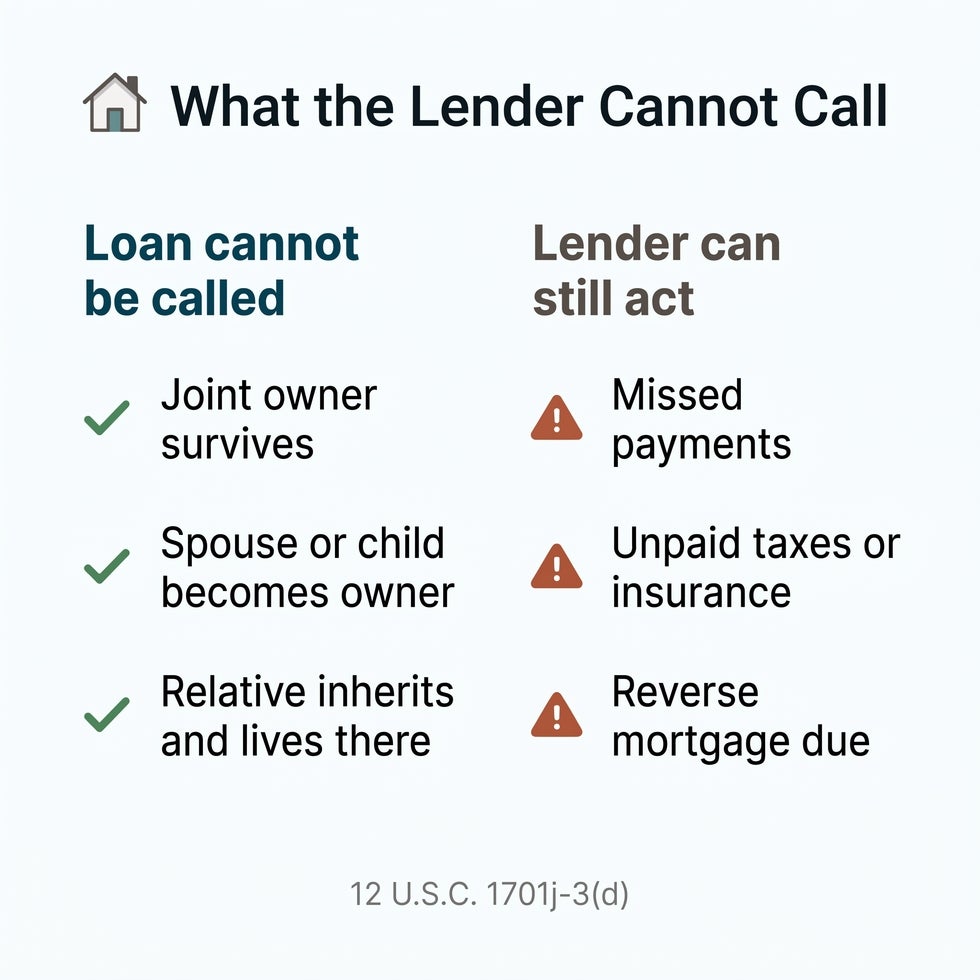
The implementing regulation adds a condition many families miss. Under 12 C.F.R. § 191.5(b), the relative and spouse-or-children exemptions apply when the new owner occupies or will occupy the home. The joint-owner exemption has no occupancy test for the new owner, though the regulation as a whole covers only loans on a home the borrower occupied. If a later event disqualifies the transfer, such as an heir who moves out and rents the house, the lender may be able to enforce the clause then.
Limits of the Exemption
The exemption does not stop foreclosure for missed payments. Who pays the mortgage after death? Until the house is sold or retitled, whoever wants to keep it: the personal representative from estate funds if the house is a probate asset, or the heirs directly. For protected homestead, which the personal representative does not administer, the heirs usually carry the payments.
Missed payments bring late fees, then default, and unpaid taxes or a lapsed policy can do the same. Florida forecloses through the courts under section 702.01, and under section 733.702(4)(a) the lender need not file a probate claim to foreclose its lien on the house, though it must file a timely claim to collect any shortfall from other estate assets. Our guide to creditor claims covers the process for the decedent's outstanding debts. To manage the risk of foreclosure, you need the servicer to deal with you.
How Do You Get the Mortgage Servicer to Talk to You?
Ask in writing to be recognized as a successor in interest. Federal servicing rules require the servicer to tell you which documents it needs to confirm your identity and ownership, and once it confirms you, to treat you as a borrower for servicing purposes.
Becoming a Successor in Interest
Regulation X, the federal mortgage servicing rule, defines a successor in interest in 12 C.F.R. § 1024.31 to include anyone who received the home through the same death transfers Garn-St Germain protects, plus a transfer into a living trust in which the borrower remained a beneficiary. A surviving spouse or a child who inherits usually qualifies.
Recognition is not the same as owing the debt. Unless you assume the loan under state law, you are not personally liable for the mortgage debt, though the lender keeps its right to foreclose; servicers often confirm this in the notice described in 12 C.F.R. § 1024.32(c). That is the core of successor in interest mortgage rights: access to the account without personal liability.
What to Send the Servicer
Your written request should name the deceased borrower and identify the loan. Under 12 C.F.R. § 1024.36(i), the servicer must then describe the documents it reasonably requires, acknowledge the request within five business days, and generally respond within 30 business days. Expect it to ask for:
- A certified death certificate
- The recorded deed, will, trust or letters of administration showing your interest
- The loan number or a recent statement
The Consumer Financial Protection Bureau's page on getting mortgage information about a home you inherited likewise advises telling the servicer and supplying proof such as the will and death certificate. Keep copies of everything and the date you sent it.
What the Servicer Must Do
A confirmed successor in interest is treated as a borrower under 12 C.F.R. § 1024.30(d). You can get the loan balance, payment history, escrow figures and repayment terms, and, if the house is your principal residence, you can apply for loss mitigation such as a loan modification. Small servicers are exempt from some of these duties, though not from answering a written information request. With the servicer engaged, the next question is whether the estate should pay the loan off.
Does the Estate Have to Pay Off the Mortgage?
No, not usually. Under Florida law, a beneficiary who is left mortgaged property takes it subject to the mortgage, and the estate pays it off only when the will shows that intent. A general instruction to pay debts is not enough.
Taking Property Subject to the Loan
Section 733.803 provides that the specific devisee of encumbered property is entitled to have the encumbrance paid from the residue only when the will shows that intent. So an inherited house with mortgage Florida heirs receive arrives with the loan still attached.
The lien and personal liability are separate. The mortgage debt is an obligation of the estate and of any surviving borrower, not of the heirs personally, unless an heir co-signed or later assumes it.
Why “Pay My Debts” Falls Short
Section 733.803 is explicit: “A general direction in the will to pay debts does not show that intent.” Many wills open with exactly that sentence. If a parent wanted one child to receive the house free and clear, the will must say so directly, and when the language is unclear, ask a Florida probate attorney before the personal representative pays anything.
What Are Your Options for an Inherited House With a Mortgage?
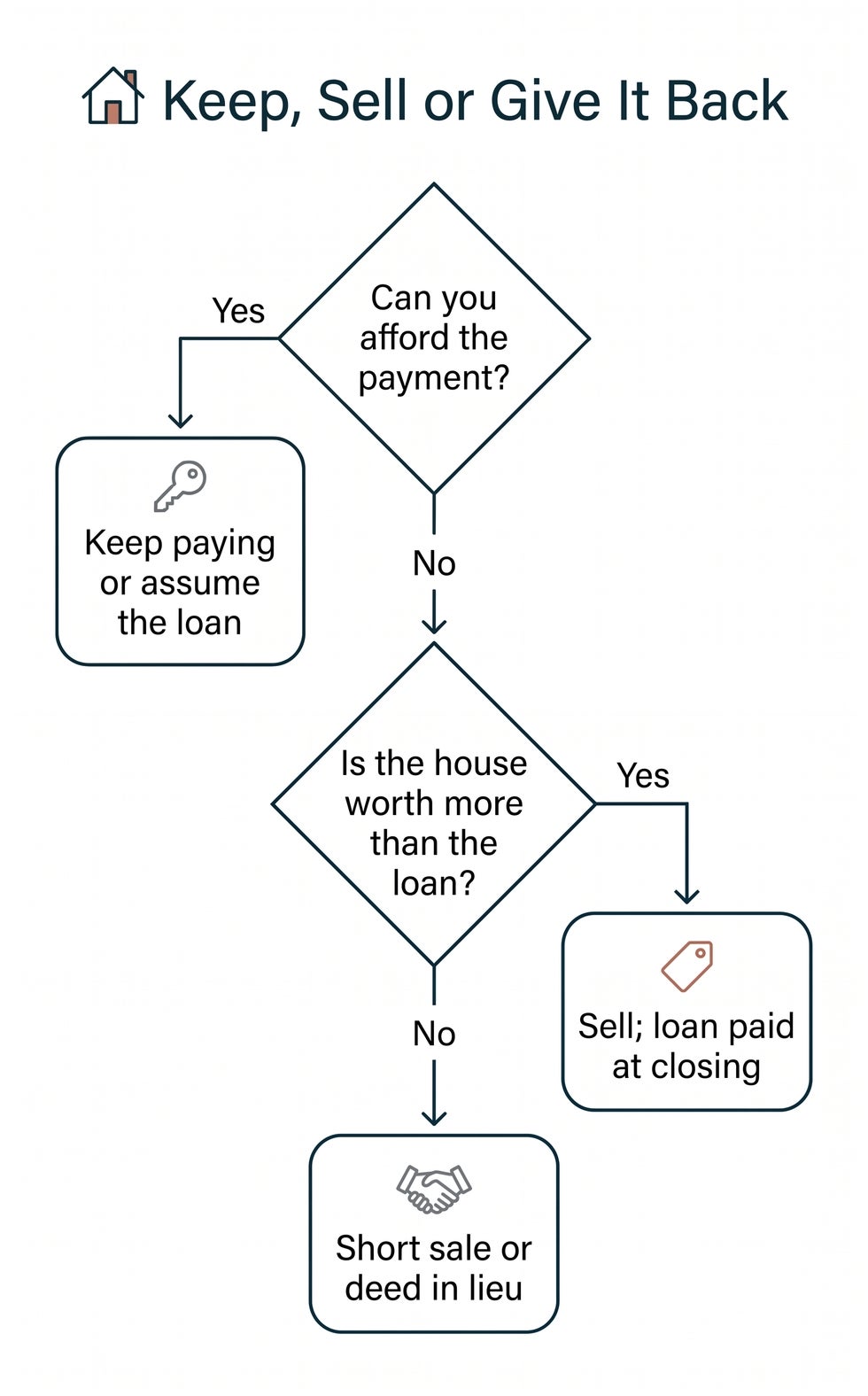
For an inherited house with mortgage Florida heirs have five realistic paths: keep paying the existing loan, assume it formally, refinance, sell, or give the house back through a short sale or deed in lieu of foreclosure. The choice turns on the home's fair market value, the loan terms and your financial situation.
Keeping the House and the Payments
Many heirs simply keep making the monthly mortgage payments on the existing mortgage. This works best when the payment fits your budget and the rate beats today's. Budget for more than principal and interest: taxes, insurance and association dues continue, and the escrow share may rise after a reassessment.
Assuming or Refinancing
Assuming a mortgage after death and refinancing are different. A Consumer Financial Protection Bureau interpretive rule from July 2014 says adding a successor who already owns the home to the loan is not an assumption under the federal rule, so the ability-to-repay rule does not apply. Refinancing an inherited house is a new loan, with full underwriting and proof of income.
| Option | Who must qualify with the lender | What happens to the interest rate | What it costs up front | Best fit |
|---|---|---|---|---|
|
Keep the existing loan as a successor in interest |
No new loan; the servicer confirms your identity and ownership |
Stays the same |
Mostly paperwork |
Payment is affordable |
|
Formally assume the loan |
Depends on the lender's policy |
Usually stays the same |
Possible assumption fees |
Low rate worth keeping, your name on the note |
|
Refinance into your own name |
Full credit review and proof of income |
Today's market rate |
Standard closing costs |
Need a new term, cash out, or a sibling buyout |
|
Sell the home |
The buyer qualifies, not you |
Ends at closing |
Commissions and closing costs |
No one wants or can afford the house |
Selling or Surrendering the Home
Selling an inherited house with a mortgage is often cleanest when no one wants to live there. The outstanding mortgage balance is paid at closing; section 733.613(3) leaves existing mortgages unaffected by a probate sale. See our guides to selling a house in probate and to selling inherited property when several heirs disagree.
If the loan exceeds what the house will bring, ask the servicer about a short sale or deed in lieu, and weigh the financial repercussions with an estate attorney first. An heir who wants no part of the house can also refuse it; see our guide to disclaiming an inheritance. Two kinds of loan follow their own rules.
What About Reverse Mortgages and HELOCs?
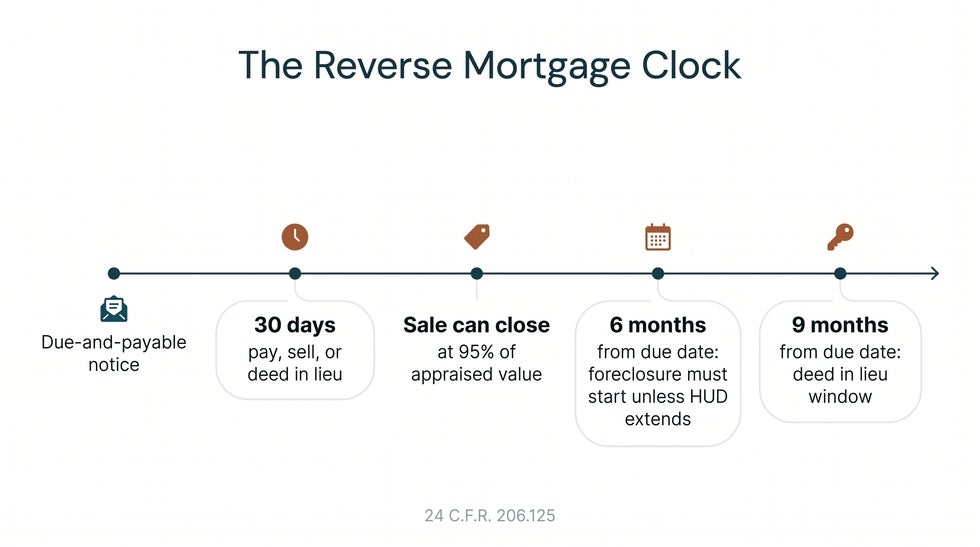
A reverse mortgage after death usually becomes due and payable once no surviving borrower keeps the home as a primary residence, so the family must repay it, sell, or hand over the house. A home equity line of credit after death remains a lien, but Regulation X's successor protections do not cover it.
For a federally insured reverse mortgage (a HECM), 24 C.F.R. § 206.125 gives the estate or heirs 30 days from the lender's due-and-payable notice to pay the balance, sell, or offer a deed in lieu. A sale may close for 95 percent of the appraised value even if the balance is higher, and an eligible non-borrowing spouse may be able to stay. The CFPB's answer on whether heirs can keep or sell a home with a reverse mortgage notes that the timeline can be extended, up to six months. Under the same regulation, the lender must generally begin foreclosure within six months of the due date unless HUD approves more time, and must accept a deed in lieu filed for recording within nine months of the due date if title is clear.
A home equity line is usually a second lien. Regulation X's definition of a mortgage loan excludes open-end lines of credit, so read the agreement and call that lender early.
Conclusion
The rules on a mortgage after death Florida families face are more forgiving than most heirs expect. The lender usually cannot call the loan, you do not owe it personally, and you can keep the house if someone keeps paying. Trouble comes from silence: missed payments, a lapsed policy, or a servicer no one has written to. An inherited house with mortgage Florida families plan for is far easier to manage.
How The Nussbickel Law Firm Helps
The Nussbickel Law Firm, P.A. practices estate planning, probate and trust administration and nothing else. From our office at 12487 Brantley Commons Court in Fort Myers, we serve estate planning clients throughout Lee, Collier and Charlotte counties and handle probate matters statewide.
When a family inherits a mortgaged home, we sort out the ownership of the property, open probate when it is needed, and prepare the letters and deeds a servicer will ask for, applying the law that fits the circumstances of the estate. Homestead property follows its own inheritance rules when there is a surviving spouse or minor children; see my earlier article, Florida Homestead in Probate: What Happens After Death?. If the home passed by trust or deed instead, our guides to trust administration after death and the Lady Bird deed explain the next steps. The firm's video What Is a Revocable Living Trust in Florida? shows how a revocable living trust keeps a home out of probate. We do not handle foreclosure defense, loan modification negotiations or real estate closings, and we will tell you if you need someone who does.
Schedule a free consultation or call 239-900-WILL (9455). We meet by phone, by video or at our office. Bring the death certificate, the will or trust, the deed, the latest mortgage statement and any servicer letters, so we can match the advice to your specific situation and your other financial obligations.
Frequently Asked Questions
Can I keep my parent's mortgage at the same interest rate?
Usually, yes. A relative who inherits and lives in the home generally can keep paying the existing loan at its current rate, because federal law bars the lender from calling it over the death transfer alone. Write to the servicer to be confirmed as a successor in interest so you can manage the account.
Are there tax implications for inheriting a mortgaged house?
Florida has no estate or inheritance tax. Under 26 U.S.C. § 1014, inherited property generally takes a basis equal to its fair market value at death (only the decedent's share, for a surviving joint owner), which can shrink capital gains taxes on a later sale; an unpaid mortgage does not lower it. Property taxes usually reset at market value the next January 1, with exceptions for a surviving spouse and certain minor children and dependents.
What should young families know about an inherited mortgage?
A minor cannot sign for the house. A parent may manage a child's inheritance of up to $15,000 without court involvement under section 744.301(2); above that, a guardianship is usually needed to sell or mortgage the child's share. Life insurance and a trust in your own estate plan can avoid that problem; the firm's video Choosing a Guardian for Your Minor Child in Florida is a good start.
Gregory J. Nussbickel is the founder of The Nussbickel Law Firm, P.A. in Fort Myers, Florida. His practice is devoted exclusively to estate planning, probate, and trust administration for families throughout Southwest Florida.
This article is for general information only and is not legal advice. Reading it does not create an attorney-client relationship. Mortgage servicing rules, loan terms and the applicable law vary, and every family is different; speak with a licensed Florida attorney about your specific situation.

Comments
There are no comments for this post. Be the first and Add your Comment below.
Leave a Comment