
Key Highlights
- When heirs own a Florida home together, selling inherited property in Florida takes every co-owner's signature on the deed, and one missing signature stops the closing.
- Protected homestead is not an estate asset. Under section 733.608, it passes to the heirs at death, so the personal representative does not sell it.
- Title insurers usually want an order determining homestead status, obtained in a probate proceeding, before they will insure a buyer of inherited homestead.
- A surviving spouse with a life estate cannot sell the whole title alone; the descendants who hold the remainder must join.
- A minor heir cannot sign a deed. If the child's share is worth more than $15,000, a court-appointed guardian and court approval are required.
- No heir can force the others to sell by majority vote. The remedies are a buyout or a partition action under Chapter 64, which since July 1, 2020 includes the Uniform Partition of Heirs Property Act.
Introduction
The short answer: selling inherited property in Florida depends on who owns it today. If the home was the decedent's protected homestead, it passed to the heirs the moment the owner died, so every heir signs the deed and the personal representative usually has nothing to sell. If the home was ordinary estate property, the personal representative sells it during probate and does not need the heirs' consent. Either way, the title company will not close until the people who actually hold title, or the person the probate court has authorized, have all signed.
That is a different question from the one families usually ask first, which is who inherits. I covered inheritance in my earlier article, Florida Homestead in Probate: Who Inherits the Home. This article starts where that one ends: the family owns the house now, one of them lives in Ohio, one is fourteen, and one is not returning calls. What follows is what selling a house after death in Florida takes when the family looks like that, from there to a closing table in Lee, Collier or Charlotte County.
What Does Selling Inherited Property in Florida Actually Require?
It requires three things, in this order: certainty about who holds title, a signature from every one of those people, and the paperwork a title company needs to insure the buyer. Price, repairs and the real estate agent come after that, not before it.
Families skip the first step because it feels obvious. It is not. Inheriting a house in Florida can happen by four different routes, and the type of property matters as much as the route: a homestead descent by operation of law, a personal representative's deed, a trustee's deed from a revocable living trust, or a Lady Bird deed that took effect at death. Each path changes who signs.
Who Must Sign When Selling Inherited Property
The record owners sign, all of them. For protected homestead, the heirs took title at death under section 732.401, so the heirs are the sellers. If the decedent left a surviving spouse and children, the spouse holds a life estate and the children hold a vested remainder, and both the life tenant and every remainderman sign.
One more signature catches families off guard. If an heir has moved into the inherited house and made it his or her own primary residence, that heir's spouse must join the deed, because the Florida Constitution requires the owner of homestead real estate to be "joined by the spouse if married" to sell it. Title underwriters check for this, and family agreement does not substitute for it.
For non-homestead property still in the estate, the personal representative signs on behalf of the estate under section 733.613, either under a power of sale in the will or with a court order. The heirs do not sign that deed at all.
What Title Companies Require for Closing
A title insurer wants an unbroken chain from the deceased person to the buyer, on paper it can rely on, and it wants to know which probate procedures produced it. For a Cape Coral canal home passing to three adult children, that usually means:
- A certified death certificate for the decedent.
- The deed showing how the decedent held title, and whether anyone else was on it with a right of survivorship.
- An order determining homestead status if the home was protected homestead, or letters of administration and any order authorizing sale if the personal representative is the seller.
- Identification and current addresses for every heir, and the marital status of any heir living in the home.
- A payoff statement for any mortgage, plus the homeowners insurance and property tax status so the closing statement can prorate them.
If any of those is missing, the underwriter stops the file until it is fixed. That is why the legal steps run ahead of the listing, which brings us to the consent question itself.
Who Has to Agree When Selling an Inherited Home in Florida?
Every current owner has to agree, and every one of them signs. When siblings inherited a house together, no one of them can sell the whole property, a majority cannot outvote the rest, and a buyer cannot close on the share of an heir who did not sign. If the property is still an estate asset, the personal representative sells it instead, and the heirs' consent is not required.
The rest of this section is what that looks like when the heirs are scattered, silent or too young to sign.
All Heirs' Consent and Signature Requirements
An inherited house with siblings in Florida is the classic case. Suppose three adult children inherited a Punta Gorda lot as tenants in common. Each owns an undivided one-third. A contract signed by two of them binds only two-thirds of the title, which no buyer wants and no title company will insure. The deed needs all three signatures, and the listing agreement should have them too, so that the agent is not marketing a property that cannot legally close.
Ownership by another route changes the cast. With joint tenancy or another right of survivorship, the surviving owner already holds the whole title and signs alone. If the home sat in a revocable living trust, the successor trustee signs under the trust instrument (the firm's video What Is a Revocable Living Trust in Florida? explains that role). If the decedent recorded a Lady Bird deed, the remainder beneficiaries became the owners at death and sell as record owners after recording the death certificate.
Two situations put a court between the heirs and the closing. A minor child cannot convey real property. Parents, as natural guardians, may receive and dispose of property distributed from an estate only when the amounts in the aggregate do not exceed $15,000; above that, section 744.441 requires a court-appointed guardian of the property to obtain court approval before selling the ward's real property, homestead included. An incapacitated adult heir is in the same position unless he or she signed a durable power of attorney that covers real estate, which the firm explains in What Is a Durable Power of Attorney in Florida?.
Selling with Out-of-State, Missing, or Uncooperative Heirs
Distance is the easy problem. An heir in Michigan signs the same deed everyone else signs, and Florida's remote online notarization law lets an online notary physically located in Florida notarize for a signer anywhere, so nobody has to fly down. Coordinate the signing through the title company, which will insist on its own notary procedure.
A missing heir is harder. Search first: the county property appraiser's records, the probate file, relatives, and a skip-trace through the closing agent. If the heir still cannot be found, the remaining owners cannot sign around the missing share; the realistic path is a court proceeding, usually a partition action, in which the court can address a co-owner who cannot be located after a search and published notice. That legal process adds months, and legal assistance stops being optional.
An uncooperative heir is the most common problem and gets its own section below. First, though, confirm which house the personal representative can actually sell, because families are often wrong about that.
Can the Personal Representative Sell Inherited Homestead Property in Florida?
Usually not. When the decedent's primary residence was protected homestead, it is excluded from the assets in the personal representative's hands, and the sale belongs to the heirs. The personal representative's role is limited to preserving the property and, when the family asks, obtaining the court order that lets the heirs sell it with insurable title.
Can a personal representative sell homestead property in Florida when the family simply asks? No; the heirs are the sellers. Families hear "not a probate asset" and conclude that no probate process is needed. In practice the opposite is often true: the order that a title insurer wants comes out of a probate proceeding, so a formal or summary administration is opened partly to get it, and the rest of the probate administration runs alongside. The firm's video on Florida homestead law after a death covers why the home is treated so differently from everything else.
Protected Homestead Vests in Heirs, Not the Estate
Section 733.608(1) says it directly: all of the decedent's real and personal property, "except the protected homestead," is an asset in the hands of the personal representative. The homestead is carved out. Under Article X, Section 4(b) of the Florida Constitution, the exemption "shall inure to the surviving spouse or heirs of the owner," and section 732.401 supplies the shares: a surviving spouse with descendants takes a life estate, the descendants take a vested remainder, and a spouse may instead elect an undivided one-half interest by filing the election within six months of the date of death.
The Second District Court of Appeal applied that rule on May 29, 2026, in Schiro v. Elliott, No. 2D2025-2366. Judgment creditors argued that a home held in the decedent's revocable trust should be sold to pay estate debts because the will gave the personal representative a power to sell "any real or personal property belonging to my estate." The court disagreed: the home was protected homestead, the heirs' rights attached at death, and the property cannot be sold to satisfy the claims of the estate's creditors. A general power of sale in a will does not reach the homestead. (The opinion was issued subject to revision before official publication; confirm its status before relying on it.)
The personal representative is not shut out entirely. Under section 733.608(2) and (3), a personal representative may take possession of a vacant protected homestead to insure and protect it, and claim a lien on it for what that costs; subsection (12) lets the court move that lien to the sale proceeds "to accommodate a sale," so a vacant Bonita Springs home still closes cleanly.
The Order Determining Homestead Status and Title Insurance
The order determining homestead status is a probate court order, entered under Florida Probate Rule 5.405, that describes the real property, determines whether it was protected homestead, and names the person or persons entitled to it and the interest of each. Any interested person may file the verified petition, and it is served on interested persons by formal notice. The rule's subdivision (d) was revised in 2025 to track the statutory definition of protected homestead in section 731.201(33).
Why a buyer's title insurer cares when it comes to selling inherited homestead property in Florida: without the order, the underwriter is being asked to insure that the right people signed, that no surviving spouse or minor child holds an interest, and that estate creditors have no claim on the house. The recorded order answers all three. The Florida homestead heir consent question and the title question are really the same question, and this order is the document that settles both.
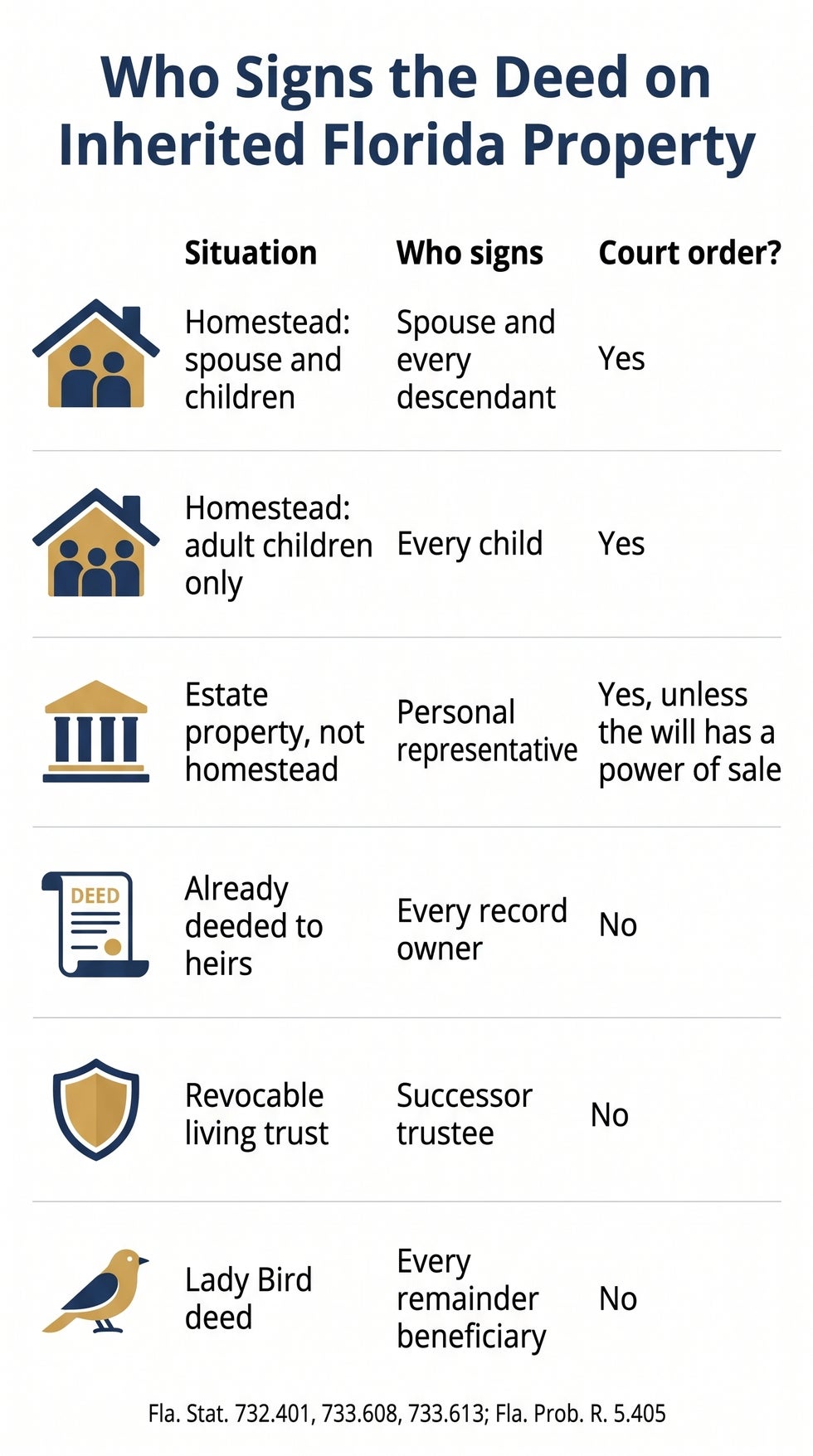
| Ownership situation | Who signs the deed | Court order needed? | Document proving authority |
|---|---|---|---|
|
Protected homestead, surviving spouse and descendants |
Spouse (life tenant) and every descendant holding the remainder |
Usually yes, to insure title |
Recorded order determining homestead status |
|
Protected homestead, adult children only |
Every child who took title at death |
Usually yes, to insure title |
Recorded order determining homestead status |
|
Non-homestead property still in the estate |
Personal representative alone |
Yes, unless the will confers a power of sale |
Letters of administration; order authorizing or confirming sale, or the will's power of sale |
|
Property already deeded out of the estate to the heirs |
Every record owner |
No |
Recorded personal representative's deed |
|
Property held in a revocable living trust |
Successor trustee |
No |
Trust instrument or certification of trust |
|
Property conveyed by a Lady Bird deed |
Every remainder beneficiary |
No |
Recorded enhanced life estate deed plus death certificate |
The non-homestead row is the one to compare against. For a rental duplex the decedent owned in Lehigh Acres, the personal representative sells under section 733.613, with a court order unless the will conferred a power of sale, and the buyer takes title free of estate creditors' claims. That process is covered in my earlier article, Can You Sell a House in Probate in Florida?; it is a different sale, by a different seller, from the heirs' sale of the homestead.
What Happens If One Heir Refuses to Sell Inherited Property in Florida?
A refusing heir stops a voluntary sale, and the other owners cannot outvote him. Their options are to buy his share, to wait him out, or to file a partition action asking the circuit court to divide or sell the property. Since July 1, 2020, when the property qualifies as "heirs property," that partition action runs under the Uniform Partition of Heirs Property Act, which gives the other relatives a right to buy out the share of whoever is forcing the sale.
The economics of waiting deserve a sentence. While the heirs argue, the decedent's homestead exemption and Save Our Homes cap are ending. Under section 193.155(3), the property is reassessed at just value on the January 1 after a change of ownership; a transfer by operation of law to a surviving spouse or minor child under section 732.401 is excepted, but a transfer to adult children is not. A family home the parents bought in 2004 can see its assessed value, and its property tax bill, climb sharply while the siblings stalemate, because the exemption amount and the capped assessment both disappear. Homeowners insurance on a vacant house is not cheap either, and every month of delay comes out of the property's value to the family.
Buyout Options, Partition Actions, and Uniform Partition of Heirs Property Act
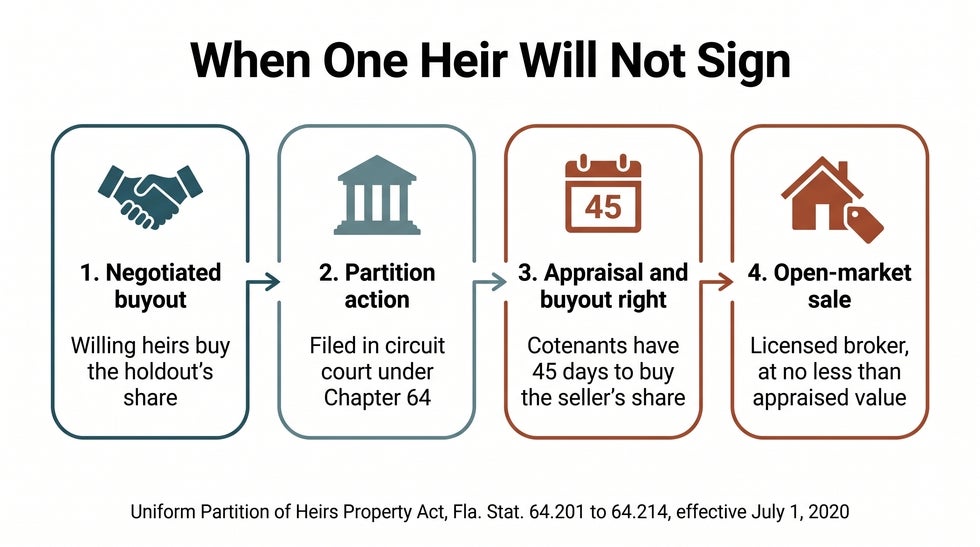
Start with the buyout, because it is the only fast path. The willing heirs purchase the holdout's undivided interest at an agreed price, usually a fraction of an appraisal, and record a deed. Nothing requires a court, and the family keeps control of the sale price and timing.
If that fails, section 64.031 lets any one tenant in common file a partition action against the others. The court divides the land if it practicably can and orders a sale if it cannot, which for a single-family house is nearly always. That traditional remedy is the one the Legislature reshaped for family property in chapter 2020-55, Laws of Florida.
The Uniform Partition of Heirs Property Act, sections 64.201 through 64.214, governs partition of heirs property in Florida when the property is held as tenants in common with no written partition agreement, at least one cotenant acquired title from a relative, and relatives hold at least twenty percent of the interests. Three siblings who inherited from a parent qualify. When it applies:
- The court first determines fair market value, ordinarily by a court-appointed licensed appraiser, and notifies the parties.
- Under section 64.207, any cotenant who did not request the sale then has 45 days to elect to buy the interests of the cotenants who did, at the appraised value multiplied by their fractional share, with at least 60 days to pay the money into court.
- A court-ordered sale must be an open-market sale through a licensed broker at no less than the determined value, unless the court finds sealed bids or an auction would do better for the cotenants as a group.
The Act does not make partition quick or cheap, and it does not let the holdout keep the house for free. What it prevents is the old result, a courthouse-steps auction at a fraction of fair market value, that punished every heir for one heir's refusal. Partition is litigation, and our office does not litigate; when a family reaches that point we refer the case to counsel who does and stay involved on the probate side.
How The Nussbickel Law Firm Helps Families Sell Inherited Property
The Nussbickel Law Firm, P.A. handles estate planning, probate and trust administration for families in Lee, Collier and Charlotte Counties, and Florida estate matters statewide. On an inherited-property sale, a probate attorney's part is the title side, whatever the estate's value: opening the summary or formal administration the sale needs, petitioning for the order determining homestead status, obtaining letters of administration and any order authorizing a personal representative's sale, and coordinating with the closing agent so that the heirs sign once, correctly.
We also handle the pieces that keep a sale on track when a family is spread out: remote signings for out-of-state heirs, guardianship filings when a minor or incapacitated heir holds a share, and the ancillary probate required when the decedent lived in another state but owned Florida property. If you are wondering whether the house needs probate at all, the firm's video Do All Assets Go Through Probate in Florida? is a five-minute place to start. To talk through your family's situation, schedule a free consultation or call our Fort Myers office today at 239-900-WILL (9455).
Conclusion
Selling inherited property in Florida is a title problem before it is a real estate problem. Find out how the home passed, get every owner's signature, obtain the court order that lets a title insurer say yes, and understand the tax consequences before you price it. Protected homestead belongs to the heirs, not the estate, and a personal representative's power of sale does not reach it. When one heir will not sign, the law gives the rest a buyout and, failing that, a partition process that since 2020 protects family property from a fire-sale result.
Frequently Asked Questions
Can I sell inherited property in Florida without a real estate agent?
Yes. Nothing in Florida law requires a real estate agent to sell an inherited home, and a sale between family members or to a neighbor is common. The legal requirements do not change: every record owner signs, the title company still needs the death certificate and the homestead order or letters, and the buyer still records a deed and pays documentary stamp tax.
What documents do I need to sell inherited property in Florida?
A certified death certificate, the deed the decedent held, a recorded order determining homestead status for protected homestead or letters of administration for estate property, identification for every heir, and a mortgage payoff statement. If an heir signs through an agent under a durable power of attorney, the title company will want the recorded power as well.
Are there tax implications when selling inherited property in Florida?
Florida has no inheritance tax or state estate tax, and the federal estate tax reaches only very large estates. Income tax is the usual concern. Under 26 U.S.C. § 1014, inherited property takes a basis equal to its fair market value at the date of death, so capital gains on inherited property in Florida arise only from appreciation after that date, and capital gains taxes after a prompt sale are often small or zero; the IRS confirms the date-of-death rule. Property tax is the sleeper: the decedent's homestead exemption ends and the assessed value resets after a change of ownership.
Do all heirs have to agree to sell property in Florida?
If the heirs own the property, yes: every co-owner signs the deed, and there is no majority vote. If the property is still in the estate, the personal representative sells it and the heirs' agreement is not required. A refusing co-owner can be bought out or, as a last resort, brought into a partition action under Chapter 64.
Gregory J. Nussbickel is the founder of The Nussbickel Law Firm, P.A. in Fort Myers, Florida. His practice is devoted exclusively to estate planning, probate, and trust administration for families throughout Southwest Florida.
This article is for general informational purposes only and is not legal advice. Reading it does not create an attorney-client relationship. Probate law changes, and every estate is different, so speak with a licensed Florida attorney about your specific situation.

Comments
There are no comments for this post. Be the first and Add your Comment below.
Leave a Comment