
Key Highlights
- The most common Florida estate planning mistakes are Florida-specific: devising the homestead to the wrong person, signing documents that miss Florida's execution rules, leaving a revocable trust unfunded, and letting beneficiary forms override the plan.
- Under Article X, Section 4(c) of the Florida Constitution and § 732.4015, a homestead cannot be devised at all if the owner leaves a minor child, and only to the spouse if the owner leaves a spouse and no minor child.
- A will needs two attesting witnesses who sign in the presence of the testator and each other (§ 732.502); without a self-proving affidavit under § 732.503, the witnesses have to be found at probate.
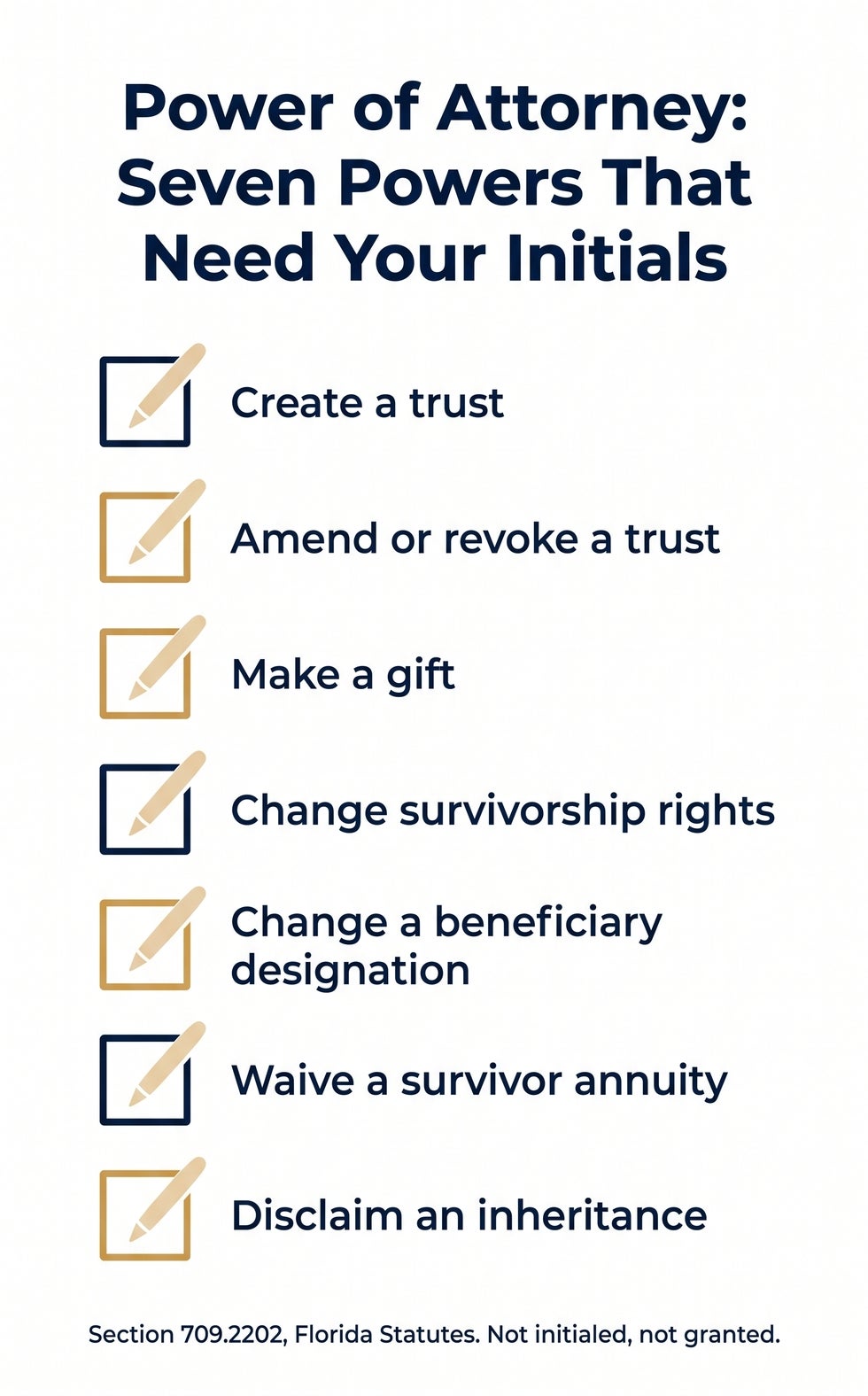
- A durable power of attorney signed after October 1, 2011 cannot be "springing," and the powers to make gifts, change beneficiaries or amend a trust work only if the principal initialed each one (§ 709.2202).
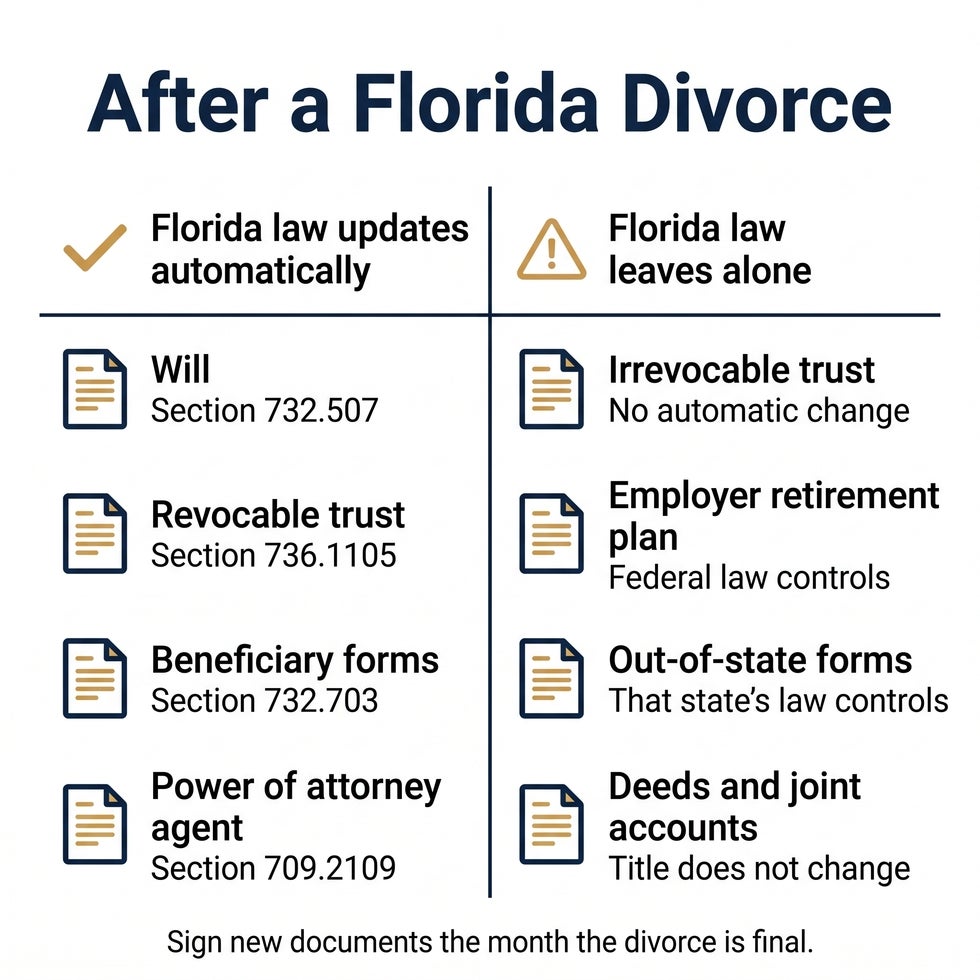
- Divorce voids a former spouse's gifts under a will (§ 732.507), a revocable trust (§ 736.1105) and most beneficiary designations (§ 732.703), but not an irrevocable trust or a plan governed by federal law.
Introduction
The short answer: The most common Florida estate planning mistakes are leaving the homestead to someone the Florida Constitution will not allow, signing a will or trust that does not meet Florida's execution formalities, creating a revocable trust and never retitling assets into it, and forgetting that a beneficiary designation on a retirement account or life insurance policy overrides the will. Each one is a Florida rule, not a national one, which is why a plan drafted in Ohio or Ontario so often fails after a move to Fort Myers, and why the common estate planning mistakes on a national checklist are not the estate planning mistakes to avoid here.
This guide takes the four mistakes Southwest Florida families make most, explains what goes wrong in each and the fix, then covers the seven smaller traps that ride along with them: the durable power of attorney, health care documents, divorce, joint ownership, blended families, a beneficiary with a disability, and digital assets. It closes with the life events that should send you back to your lawyer.
What Are the Most Common Florida Estate Planning Mistakes?
The most common Florida estate planning mistakes are the homestead devise, improper execution, the unfunded trust and the uncoordinated beneficiary designation, and each gets its own section below. Seven more are worth naming here, because a plan review in Cape Coral or Naples turns up at least one of them more often than not.
The old durable power of attorney. Durable power of attorney mistakes are the easiest to make and the hardest to see. A Florida power of attorney must be signed before two witnesses and a notary under § 709.2105, a document signed after October 1, 2011 takes effect when signed rather than on a later finding of incapacity (§ 709.2108), and the powers that matter most in a crisis, creating or amending a trust, making gifts, changing survivorship or beneficiary designations, can be exercised only if the principal signed or initialed next to each one under § 709.2202. A pre-2011 form with no initials leaves the agent unable to do the very things the family hired a lawyer to plan for.
Stale health care documents. A health care surrogate designation under Chapter 765 can now be written to take effect immediately, without a finding of incapacity, under § 765.202(6), and an out-of-state directive is honored under § 765.112. The mistake is a form that predates HIPAA or names a surrogate who has died.
Divorce without a new plan. Florida law voids a former spouse's provisions under a will (§ 732.507(2)), a revocable trust (§ 736.1105) and most beneficiary designations (§ 732.703), and filing for dissolution ends a spouse's authority as agent under a power of attorney (§ 709.2109(2)(b)). None of those statutes reach an irrevocable trust, an employer plan governed by federal law, or a form governed by another state's law. Sign new documents the month the divorce is final.
Joint ownership as a plan. Adding an adult child to a deed or bank account exposes the asset to that child's creditors and divorce, gives the whole asset to one child by survivorship, and can cost part of the homestead exemption on the value of the homestead. Tenancy by the entireties is for married couples only. A Lady Bird deed (an enhanced life estate deed) or a funded trust does the same job without the exposure.
Estate planning for blended families in Florida fails most often when everything goes to the new spouse outright on the assumption that the spouse will take care of the first-marriage children. A surviving spouse's elective share of 30 percent of the elective estate under § 732.2065 and the homestead rules override any plan that tries to leave a spouse out, and nothing obliges a second spouse to provide for stepchildren. A marital trust plus a nuptial agreement under § 732.702 is the fix; see estate planning for married couples.
A beneficiary with a disability who inherits outright can lose SSI and Medicaid eligibility. A third-party supplemental needs trust keeps the inheritance available for the beneficiary's benefit without counting against those programs.
Digital assets in a Florida estate plan are governed by the Florida Fiduciary Access to Digital Assets Act, Chapter 740, in force since 2016. If the will, trust or power of attorney does not grant the fiduciary access, the provider's online tool or terms of service decide who can reach the email, photos and accounts. Most DIY estate planning in Florida omits the clause entirely.
Those seven are worth a paragraph each. The homestead deserves a section, because it is where Florida differs most from everywhere else.
Why Is Incorrectly Devising Florida Homestead Property the Most Frequent Error?
Devising the Florida homestead is the most frequent error because the Florida Constitution, not the will, decides who may receive it, and most people have never heard the rule until a spouse or a minor child is standing in the way of the gift. A will that worked in Michigan can be void as to the house the day its owner becomes a Florida resident.
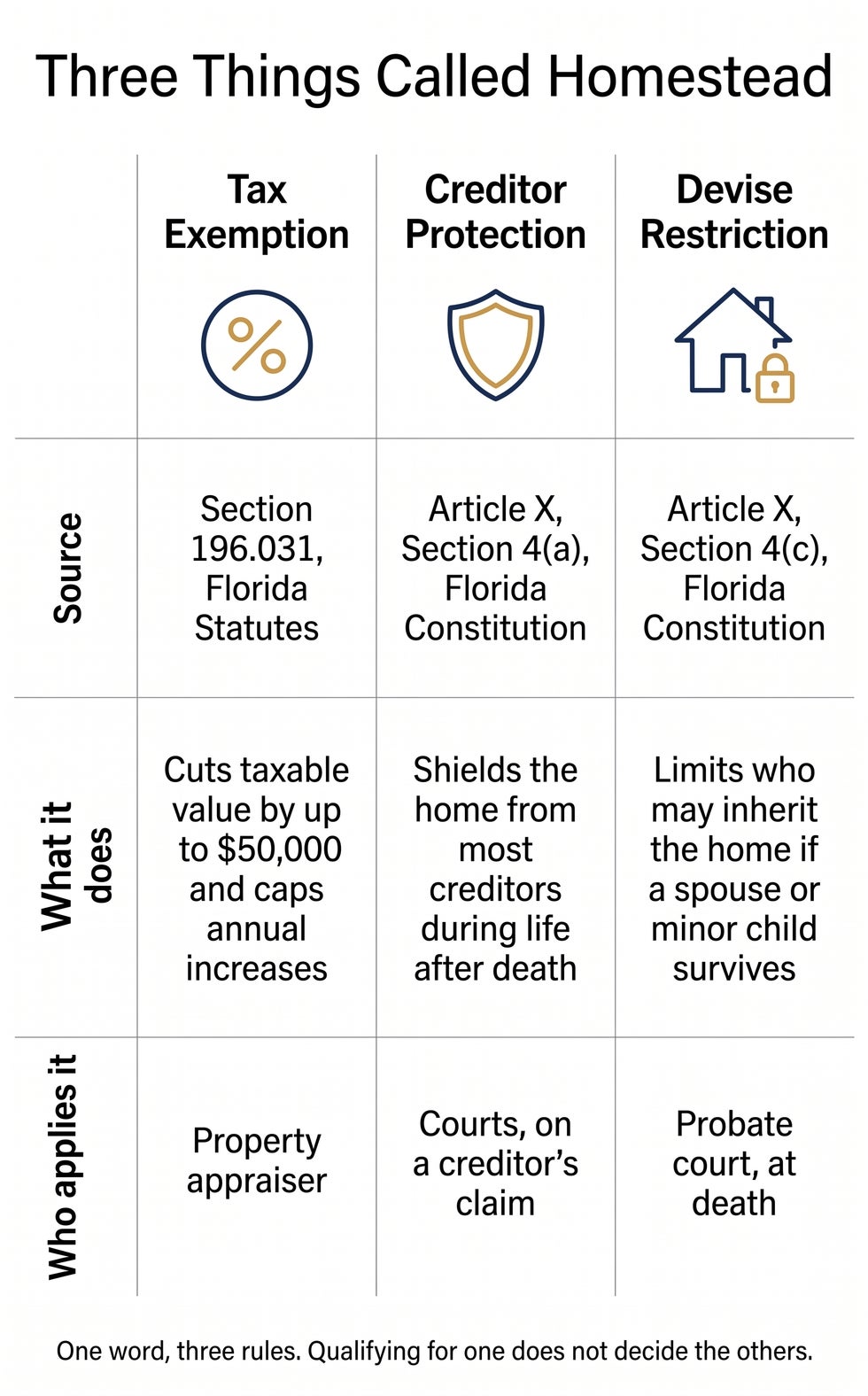
Part of the confusion is that "homestead" names three different rules in Florida's homestead laws, and qualifying for one says nothing about the others. The property tax exemption under § 196.031 is what the local property appraiser grants to a homestead owner who applies at the property appraiser's office: $25,000 off the assessed value of a permanent residence, an additional exemption of up to $25,000 on value above $50,000 for non-school levies, and the Save Our Homes cap under § 193.155, which limits annual increases in assessed value to 3 percent or the rate of inflation measured by the Consumer Price Index, whichever is lower. Those property tax benefits track the value of the property and the local tax rate, and unpaid property taxes are one of the few debts that can reach the home. The homestead protection from creditors in Article X, Section 4(a) shields homestead property owned by a natural person from forced sale, with exceptions for taxes and assessments, purchase-money and improvement obligations, and labor on the property. The Florida homestead devise restrictions in Article X, Section 4(c) of the state constitution are the third rule, and they are the one that breaks estate plans. Florida residents hear "Florida homestead exemption" and assume one application at the property appraiser's office covers all three. It does not.
What goes wrong
The owner's will leaves the Cape Coral house to the children of a first marriage, or to one child who lives nearby, or to a trust for everyone. At the owner's death the devise is void, because Section 4(c) and § 732.4015 provide that a homestead "shall not be subject to devise if the owner is survived by spouse or minor child," with one exception: it may be devised to the spouse if there is no minor child. Since 2010 the statute treats the grantor of a revocable trust as the owner of the homestead and a disposition by trust as a devise, so moving the house into a trust does not escape the rule.
When the devise fails, § 732.401 decides instead. If the decedent leaves a spouse and descendants, the surviving spouse takes a life estate and the descendants take a vested remainder interest, per stirpes; or, in lieu of the life estate, the spouse may elect an undivided half interest as a tenant in common. In a second marriage that means a widow who is a life tenant and cannot sell without the stepchildren, stepchildren who own a remainder they cannot use, and a house nobody can refinance. The half-interest election is available only where all the descendants of the surviving spouse are also the decedent's, which is rarely true in a second marriage. A minor child anywhere triggers the restriction at the death of the owner; the child does not have to live in the home, and the owner's spouse cannot consent around it. The Florida Supreme Court has applied these rules for decades, and the case law treats the restriction as public policy of the State of Florida that a will cannot override.
The fix
The fix depends on who is likely to survive you. If there is a spouse and no minor child, a devise of the homestead to the spouse outright is valid. If a spouse is to receive less than the whole, the spouse can waive homestead rights in a nuptial agreement or a separate waiver signed before two witnesses under § 732.702. If the goal is to pass the house to children directly, a Lady Bird deed recorded during life is a transfer, not a devise: under § 732.4017 a lifetime transfer of a homestead interest, including one in trust, is outside the devise restriction so long as the owner does not keep a power to revoke it, and an enhanced life estate deed is drafted with that section in mind. The probate-side consequences, including the spouse's election and the tax exemption after death, are in Florida homestead in probate. Whichever route fits, the document that carries it has to be signed correctly, which is the next mistake.
How Can Improper Will or Trust Execution Cost Your Heirs in Florida?
Improper execution costs heirs a will contest, a search for witnesses, or the intestacy statutes deciding who inherits. Under § 732.502 every Florida will must be signed at the end by the testator in the presence of two attesting witnesses, who then sign in the presence of the testator and of each other. Florida statutes do not recognize an unwitnessed handwritten will at all.
What goes wrong
The usual pattern is an online form signed with one neighbor as witness, or a document from another state that its owner assumes travels. A nonresident's will that was valid where signed is valid here under § 732.502(2), but a holographic will is not. An electronic will is valid only under the § 732.522 procedure for electronic signatures, remote witnesses and online notarization; a PDF signed on a tablet does not qualify. The firm's video Is an Out-of-State Will Valid in Florida? covers the moving-day version of this problem.
A will can also be valid and still lack a self-proving affidavit under § 732.503, in which case the personal representative has to locate a witness to prove the will at probate, twenty years after the witness moved away.
The fix
Sign a Florida will, supervised, with two witnesses and a notary, and attach the self-proving affidavit the same day. A trust needs the same care plus a deed and account paperwork, which is the subject of the next section. If your documents came from another state, have them reviewed rather than trusted; the rules for what makes a will valid here are set out in Florida will requirements. A signing that meets Florida law is the floor. The trust still has to own something.
Why Does an Unfunded Trust in Florida Lead to Probate Problems?
An unfunded trust in Florida leads to probate because a trust controls only the assets titled in it. If the deed to the primary residence, the Naples condo, was never recorded in the trustee's name and the brokerage account still reads in the owner's individual name, those assets are probate assets, and the family that paid for a trust gets a formal administration anyway.
What goes wrong
The trust is signed and placed in a drawer. The deed was never prepared, or never recorded, or the accounts opened after signing were titled the old way. At death the pour-over will under § 732.513 sends the assets into the trust, but only at the end of a full probate. A second version of the same mistake is the sale of one home and the purchase of another with the new deed taken individually, which pulls the new homestead out of the trust.
The fix
Fund the trust at signing: a recorded deed for every parcel of Florida real property, a funding letter for each account, and a beneficiary designation that names the trust where a trust should be the payee. Then review funding every few years and after every purchase, sale or refinance. The firm's video What Is Trust Funding? Why an Unfunded Trust Does Nothing is a four-minute version of this section, and the broader list of tools is in how to avoid probate in Florida. Funding fixes what the trust owns. Beneficiary forms decide what the trust never sees.
Are Beneficiary Designations Causing Unintended Estate Planning Errors?
Yes. Beneficiary designation mistakes cause more estate planning errors than any drafting flaw, because retirement accounts, life insurance and payable-on-death accounts pass by contract to the person named on the form, whatever the will or trust says. One old form can move a six-figure IRA outside the plan.
What goes wrong
Three patterns account for most of it. The former spouse still named on an account: § 732.703 treats that designation as void for a Florida resident who divorced after naming the spouse, but not for an account governed by federal law, not where a court order requires the designation, and not where the couple remarried, so relying on the statute is a gamble. The minor child named directly: a life insurance payout to a child triggers a guardianship of the property under Chapter 744 once the amount exceeds the $15,000 that natural guardians may handle without court appointment under § 744.301(2), and hands the child whatever is left at 18. The account with no beneficiary at all, which pays to the estate and goes through probate.
The fix
Pull every retirement, insurance, annuity and payable-on-death form and match it to the plan. Name the trust, or a custodian under the Florida Uniform Transfers to Minors Act, for any share that could reach a minor. Update the forms in the same month as any marriage, divorce or death in the family. The interaction between life insurance and the rest of the plan has its own article, life insurance and estate planning. With the four big mistakes covered, the last question is when to look at the plan again.
When Should You Review Your Florida Estate Plan?
Review your Florida estate plan after any event that changes who you are married to, who depends on you, what you own, or where you live, and every few years without one. How often to update an estate plan has no statutory answer; the table below lists the events that change the legal result in Florida and the document each one touches first.
| Life event | What the event changes under Florida law | Which document to update |
|---|---|---|
|
Move to Florida from another state |
Your permanent residence becomes homestead subject to Article X, Section 4; a nonresident personal representative may serve only if related to you under § 733.304 |
Will, trust, deed, fiduciary appointments |
|
Marriage or remarriage |
A surviving spouse acquires homestead rights and a 30 percent elective share that override the plan |
Will, trust, nuptial agreement or waiver under § 732.702 |
|
Divorce |
Provisions for the former spouse are void under §§ 732.507, 736.1105 and 732.703; an irrevocable trust, a federally governed plan and out-of-state forms are not affected |
Beneficiary forms, will, trust, power of attorney, health care surrogate |
|
Birth or adoption of a child or grandchild |
A minor child blocks any devise of the homestead; a pretermitted child takes a share under § 732.302 |
Will, trust, homestead plan, guardian nomination |
|
Death of a named beneficiary or fiduciary |
The gift lapses or passes under the anti-lapse rule; the successor fiduciary steps up, if one was named |
Will, trust, beneficiary forms, power of attorney |
|
Purchase or sale of Florida real estate |
A new deed taken individually pulls the property out of the trust and resets the homestead exemption |
Deed, trust funding, homestead exemption application |
|
A beneficiary develops a disability |
An outright gift can end SSI and Medicaid eligibility |
Trust terms, beneficiary forms |
|
A change in the federal estate tax exemption |
Formula clauses tied to the exemption amount can misfire; the federal government's 2026 basic exclusion is $15,000,000 |
Trust tax provisions |
Two rows deserve a sentence more. The snowbird who winters in Estero and summers in Michigan has property ownership in two states and a plan that must work under both, including the ancillary administration the Michigan cottage will need under § 734.102; international estate planning in Florida works through that problem for a Canadian owner, and the same rules apply to a Michigander. And a plan signed before July 1, 2026 may have been built around the old $75,000 summary administration ceiling, which Chapter 2026-57 doubled to $150,000. The dollar amounts a review costs are in the firm's cost guide for wills and trusts.
Conclusion
Every mistake in this guide is a Florida rule meeting a plan that was not written for it: the homestead that cannot be devised, the two witnesses who must sign together, the trust that owns nothing, the beneficiary form that outranks the will. The fixes are ordinary documents, signed correctly and reviewed when life changes, and the time to find out whether yours needs them is at a review rather than at a probate.
How The Nussbickel Law Firm Helps
The Nussbickel Law Firm, P.A. practices estate planning and probate and trust administration exclusively, from an office at 12487 Brantley Commons Court in Fort Myers, and serves estate planning clients throughout Lee, Collier and Charlotte counties, including Cape Coral, Estero, Bonita Springs, Sanibel, Punta Gorda and Naples. A plan review with us starts with the documents you have, the deeds and account statements that show what they actually control, and the dates of any move, marriage, divorce or death since they were signed. We tell you which of the Florida estate planning mistakes above apply, which can be fixed with a single document, and which need a new plan. Consultations are free and can be by phone, by video, or at the office. Schedule a consultation or call 239-900-WILL (9455).
Frequently Asked Questions
Is my out-of-state will valid in Florida?
Usually, but not always. Under § 732.502(2) a will executed by a nonresident is valid in Florida if it was valid under the law of the state where it was signed, except a holographic (unwitnessed handwritten) will or a nuncupative (oral) will. Validity is only half the question: an out-of-state will that leaves the Florida homestead to children while a spouse survives is void as to the house, and one without a self-proving affidavit will need a witness located at probate.
What happens if my homestead is left to minor children?
If you are survived by a minor child, the homestead cannot be devised to anyone, so the will clause fails and § 732.401 controls. With a surviving spouse, the spouse takes a life estate and the children take the remainder, or the spouse elects a half interest; with no spouse, the homestead descends to your descendants under the intestacy rules. Leaving the house to the children directly does not avoid this; a minor child anywhere in the United States triggers the restriction.
How often should I update my estate planning documents in Florida?
Review the documents after any move, marriage, divorce, birth, adoption or death that changes the people or property in the plan, after buying or selling Florida real estate, and every three to five years without an event. Florida law changes too: the durable power of attorney rules changed in 2011, the digital assets act arrived in 2016, and the summary administration ceiling doubled on July 1, 2026, so a plan older than any of those dates deserves a look.
Can a Florida homeowner leave homestead to anyone in a will?
No. Article X, Section 4(c) of Florida's constitution bars any devise of the homestead when the owner is survived by a spouse or a minor child, with one exception: a devise to the spouse when there is no minor child. An owner with no spouse and no minor child may devise the homestead freely. The restriction has been criticized for decades; a 1997 Florida Bar Journal article argued for repeal on the ground that families now depend on life insurance rather than land, but the constitutional text is unchanged.
Have Florida homestead devise laws changed recently?
Not since 2010 in any way that changes the answer. The constitutional restriction was last revised in 1998. Chapter 2010-132 added the surviving spouse's option under § 732.401 to take a half interest in lieu of the life estate, extended the devise restriction to homestead held in a revocable trust under § 732.4015, and created § 732.4017, which confirms that a lifetime transfer of a homestead interest is not a devise. The § 732.401 history line shows later technical amendments in 2012 and 2021, but the rule a Southwest Florida family plans around today is the 2010 rule.
Gregory J. Nussbickel is the founder of The Nussbickel Law Firm, P.A. in Fort Myers, Florida. His practice is devoted exclusively to estate planning, probate, and trust administration for families throughout Southwest Florida.
This article is for general information only and is not legal advice. Reading it does not create an attorney-client relationship. Estate planning law changes, and every family is different; speak with a licensed Florida attorney about your specific situation.

Comments
There are no comments for this post. Be the first and Add your Comment below.
Leave a Comment