
Key Highlights
- A lady bird deed Florida homeowners sign is an enhanced life estate deed: you keep the home for life with the power to sell, mortgage, or revoke without anyone's consent, and it passes to the people you name at your death without probate.
- Florida has no Lady Bird deed statute. The instrument works under Florida common law, and the Department of Revenue, the Department of Children and Families, and Florida title underwriters treat it as valid.
- The homestead tax exemption continues during your life under section 196.041(2), and the Save Our Homes cap is not reset because signing is not a change of ownership under section 193.155(3)(a) of the Florida Statutes.
- A gift of unencumbered property by Lady Bird deed owes at most the 70-cent minimum documentary stamp (Rule 12B-4.014 and Technical Assistance Advisement 20B4-004), and recording costs $10 for the first page and $8.50 for each additional page under section 28.24.
- Signing is not a completed gift for federal gift tax purposes and not a Medicaid transfer, and the beneficiaries receive a stepped-up basis under Internal Revenue Code section 1014.
- If you are married, Article X, Section 4 of the Florida Constitution requires your spouse to join a Lady Bird deed of the homestead, and if you have a minor child, whether the remainder can pass under the instrument at all is unsettled.
Introduction
The short answer: A lady bird deed Florida attorneys prepare lets you keep your home for the rest of your life, with the full right to sell it, mortgage it, or cancel the arrangement without asking anyone, while naming the people who receive the home automatically at your death. During your life nothing changes: you own the home, you keep the homestead exemption, and your beneficiaries own nothing they can use. At your death the home passes to them outside probate. Full control now and no court later is why Southwest Florida homeowners choose it.
It is also easy to get wrong. The situations where it is the wrong tool are specific: a beneficiary who dies first, a beneficiary who is a minor, several children who may not agree, a spouse who did not sign, a mortgage, property in another state, and your own incapacity. This guide covers what the instrument does, what it costs, how it fits with Florida homestead law, and where it fails.
What Does a Lady Bird Deed Florida Homeowners Sign Do?
It does three things at once: it keeps you in complete control of the property, it names who takes it at your death, and it moves that transfer out of the probate court. Every benefit and every drawback in this article traces back to one of those three features.
Full control: sell, mortgage, or revoke alone
You remain the owner in every practical sense. The instrument reserves to you a life estate plus the retained powers to sell, convey, mortgage, lease, or give away the property, and to revoke the whole arrangement, without the joinder or consent of the remainder beneficiaries. The Third District Court of Appeal put it plainly in Hirschenson v. Compu-Link Corp. of MI, 389 So. 3d 574 (Fla. 3d DCA 2023): "the enhanced life estate gives the holder or grantee exclusive power to mortgage the property without the joinder of the remainder person." If you change your mind about who inherits, you record a new deed. If you need to sell to move into assisted living, you sign the contract and close without anyone else's signature. The beneficiaries have no say, and they do not have to be told.
Passes outside probate at death
When you die, the life estate ends and the remainder beneficiaries hold the property outright by operation of law. No personal representative is appointed for the house, no letters of administration issue, and no formal administration is opened to move the title. The beneficiaries record a certified death certificate in the official records of the county where the land sits, which completes the chain of title. Compare a will, which must be admitted to probate before it transfers anything, or no plan at all, in which case the home passes under the Florida homestead descent rules and usually needs a court order before a buyer's title company will insure a sale.
What Is a Lady Bird Deed in Florida?
A Lady Bird deed in Florida is an enhanced life estate deed: a conveyance in which the grantor keeps a life estate enhanced by the powers described above, with a remainder interest in named beneficiaries that takes effect at the grantor's death. The word "enhanced" is the whole difference between it and a standard life estate deed.
An enhanced life estate deed Florida has no statute for
Florida has never enacted a Lady Bird deed statute, and it has no transfer-on-death deed statute of the kind many other states have adopted. The 2026 index of Chapter 689, the chapter on conveyances of land, contains no section on it. The form rests on Florida common law, which has long allowed a grantor to reserve a life estate and a power of sale.
That does not make the enhanced life estate deed Florida lawyers draft an experiment. The Department of Revenue analyzed one in Technical Assistance Advisement 20B4-004 and concluded it transfers no present beneficial interest. The Department of Children and Families addresses it by name in its Medicaid manual. Title underwriters insure titles that pass through it. And in Varano v. Varano, No. 4D2024-1571 (Fla. 4th DCA June 11, 2025), the Fourth District treated it as the settled fix for the problem before it: "In the absence of a 'Lady Bird Deed,' a life tenant cannot convey the property without the joinder of the remainderman."
Retained powers, five states, and the Lady Bird Johnson myth
Three things define the form: its retained-powers paragraph, its short list of recognizing states, and its misleading name. The retained powers are the drafting heart of the document. A properly drafted Lady Bird deed says, in specific language, that the grantor reserves the right to sell, convey, mortgage, lease, or otherwise dispose of the property in fee simple, with or without consideration and without the joinder of the remainder beneficiaries, and that any such conveyance cuts off the remainder. Leave that paragraph out and you have signed a standard life estate and given away control of your home.
Only Florida, Texas, Michigan, Vermont, and West Virginia are usually listed as recognizing the form, per a SmartAsset survey. The name has nothing to do with any document the Johnsons signed: a Florida attorney, Jerome Ira Solkoff, drafted the form around 1982 and used the Johnson family's first names for the fictional characters in his teaching examples, and the nickname stuck.
How Does a Lady Bird Deed Differ from a Traditional Life Estate Deed?
The difference is control. Under a traditional life estate deed you give the remainder away the day you sign, and from then on you cannot sell or mortgage the whole property without the remainder beneficiaries' signatures. Under a Lady Bird deed you keep the power to undo everything, and that one reserved power changes the gift tax result, the Medicaid result, and the creditor result.
Retained control vs. surrendered control
Varano shows what surrendering control costs. A husband and wife conveyed their marital home to themselves for life, with the remainder split between her children and a trust for his son, and reserved no powers. After the husband died, the widow contracted to sell and learned she could not: "The widow did not have a fee simple interest to sell. All that she had was a life estate. No more. No less." The remainder holders took their share of the proceeds. With a Lady Bird deed the result is the opposite: the remainder has been described as "at best, vested and subject to defeasance, but arguably contingent" (Hirschenson, quoting a Florida Bar treatise), which is a lawyer's way of saying the owner can wipe it out at any time.
Medicaid and gift tax consequences compared
Signing a standard life estate deed is a completed gift of the remainder for federal gift tax purposes and a transfer of assets for Medicaid purposes, because you have given up the power to take it back. Signing a Lady Bird deed is neither. Under Treasury Regulation section 25.2511-2(c), "a gift is incomplete in every instance in which a donor reserves the power to revest the beneficial title to the property in himself," so no gift tax return is due, and the Department of Children and Families counts the property as still yours.
| Traditional life estate deed | Lady Bird deed | |
|---|---|---|
|
Owner can sell or mortgage alone |
No; remainder holders must join |
Yes |
|
Owner can change the beneficiaries |
No |
Yes, by recording a new deed |
|
Completed gift when signed |
Yes, the remainder |
No (Treas. Reg. § 25.2511-2) |
|
Medicaid transfer when signed |
Yes |
No (DCF ESS Manual 1640.0305.03) |
|
Avoids probate at death |
Yes |
Yes |
|
Stepped-up basis at death |
Generally yes |
Yes (IRC §§ 2036 and 1014) |
That table is why few Southwest Florida homeowners have a reason to sign a standard life estate deed anymore, and why the retained-powers paragraph must be checked word by word.
Lady Bird Deed Florida Requirements: How Is One Made?
The lady bird deed Florida requirements are the same as for any conveyance of Florida land, plus the retained-powers language that makes it enhanced: a correct legal description, two subscribing witnesses, a notarial acknowledgment, the recording details section 695.26 demands, and delivery and recording in the county's official records during the owner's life. Recording is not an element of validity, but a signed instrument found in a drawer after death raises the question whether it was ever delivered, and a title company will not guess.
Drafting: legal description and retained powers
Start with the legal description from your current recorded deed, not from the property tax bill, which uses an abbreviated version title examiners will not accept. Name the grantor exactly as title is held. If the home is titled in your revocable trust, the trustee must sign, not you individually. That mistake produced Johnson v. Johnson, No. 1D2024-1139 (Fla. 1st DCA May 7, 2025), where an attorney "prepared enhanced life estate deeds, also known as Lady Bird deeds," for a widower who signed individually while both parcels were titled in his trust; the grandchildren kept the property only after litigation to reform the documents. Then name the remainder beneficiaries by full legal name, state how they take, name contingent beneficiaries in case one dies first, and include the reservation of enhanced powers. A document that says "reserving a life estate" and stops there is a standard life estate deed.
Witnesses, notary, and recording
Section 689.01 requires every conveyance of Florida real estate to be signed in the presence of two subscribing witnesses, and the signature is acknowledged before a notary public so the clerk will record it. Section 695.26 sets the recording requirements. Each signer's name and post-office address must be printed beneath the signature, along with the name and post-office address of the person who prepared the instrument. Each witness's name and post-office address must appear (the witness address requirement was added by chapter 2023-238), and so must the notary's printed name. A three-inch square is left blank at the top right of the first page, with a one-by-three-inch space on each later page, and the name and post-office address of each grantee must be stated.
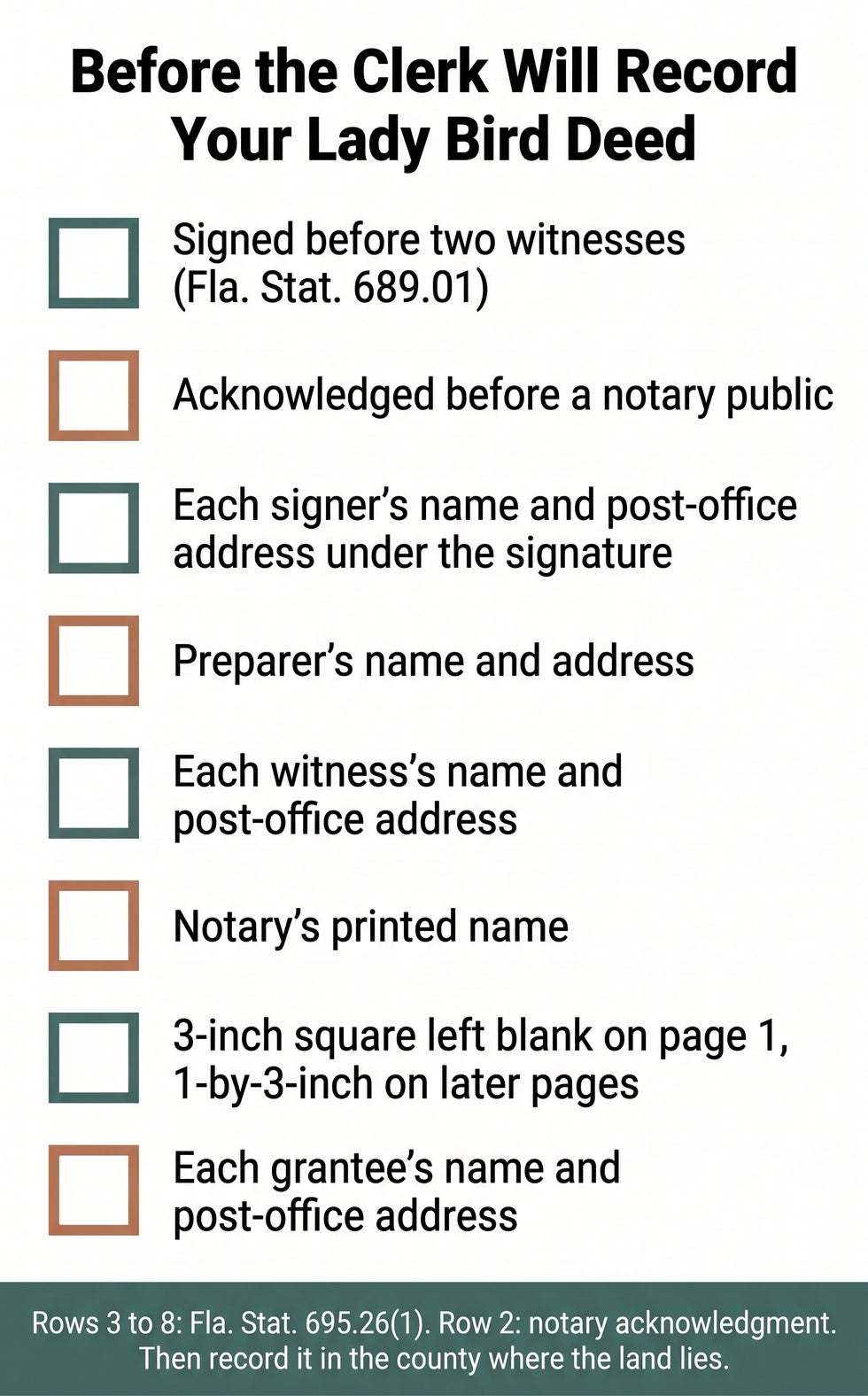
Record it with the Clerk of Court in the county where the land lies: the Lee County Clerk for a Cape Coral home, the Collier County Clerk for a Naples condo. An unrecorded Lady Bird deed found in a drawer after death is one of the most common failures we see, and it invites the title fight it was meant to prevent.
Naming and changing beneficiaries
Beneficiaries do not sign and do not need to know, though telling them avoids surprises. Because you keep the power to revoke, you change beneficiaries by recording a new deed whenever your family situation changes: a child's divorce, a beneficiary's death, a grandchild you want to add. Each new deed replaces the last. What you cannot do is fix it after your death, which is why the contingent-beneficiary clause and a review every few years matter more here than with a will.
Lady Bird Deed Florida After Death: What Happens?
At the owner's death the remainder beneficiaries become the owners immediately, and the practical work is documentary: record the death certificate, satisfy the title company, and deal with the property tax reassessment. There is no petition, no notice to creditors, and no personal representative for the house.
Record the death certificate, skip probate
The beneficiaries obtain a certified death certificate without the cause of death and record it in the official records of the county; title companies commonly also ask for a short affidavit identifying the decedent as the grantor. That completes the transfer of title. If the owner lived out of state and owned only a Florida vacation home, the family is also spared a second, ancillary administration under section 734.102; the firm's video Florida Estate With Out-of-State Real Estate: A Second Probate explains why that proceeding otherwise exists.
Two things do change at death. The property appraiser reassesses the home at just value on the next January 1 unless the transfer falls within an exception in section 193.155(3)(a), which covers a surviving spouse, a transfer to a spouse or minor child under section 732.401, or a dependent permanent resident; adult children should expect the Save Our Homes cap to reset. And the beneficiaries' income tax basis becomes the fair market value at death under Internal Revenue Code section 1014, so a prompt sale usually produces little or no capital gains tax.
Title insurance and the transfer process
A buyer's title underwriter will examine the recorded conveyance, the death certificate, and any affidavit, and will ask two questions: was the grantor married when the document was signed, and did the spouse join? Was any beneficiary a minor? If the answers are clean, the beneficiaries can sell or refinance right away. If a married owner signed alone, expect the underwriter to require a probate proceeding or a spousal release before insuring. The firm's video Do All Assets Go Through Probate in Florida? covers where deeded real estate fits among the assets that pass outside court.
Pros and Benefits of a Lady Bird Deed in Florida
The benefits are probate avoidance, an undisturbed homestead exemption, no gift tax and no Medicaid transfer, a stepped-up basis for the beneficiaries, and continued creditor protection during your life, all for the cost of recording one document. Each depends on the retained powers and on correct drafting and recording.
Probate avoidance and the homestead exemption
Probate avoidance is the headline. Florida homestead is not even an asset of the probate estate; section 733.608(1) excludes protected homestead from the property the personal representative controls. But a family still usually needs a court order determining homestead status, and any non-homestead parcel, such as a rental condo in Bonita Springs, goes through full administration. The Lady Bird form keeps both out of court. For the other tools that do the same job, see my earlier article, How to Avoid Probate in Florida.
During your life the Florida homestead exemption continues. Section 196.041(2) declares that a person whose possessory right rests on "an instrument granting to him or her a beneficial interest for life" holds equitable title for exemption purposes. You are still the person on the exemption.
Lady Bird deed and Medicaid in Florida
The lady bird deed and Medicaid in Florida question comes up in almost every consultation, and the answer is that signing is not a transfer. The Department of Children and Families says so in its ESS Policy Manual at section 1640.0305.03: "the owner of an enhanced life estate (also known as a lady bird deed or life estate with powers) has the same rights as complete ownership, including the right to sell without the consent of the remainderman." Such arrangements "are counted the same as other real property an individual may own and it may be excluded if it qualifies as the individual's homestead." The manual chapter is public.
Because signing is not a transfer, it does not trigger the 60-month look-back under 42 U.S.C. section 1396p(c)(1)(B), and the home stays an excluded asset as your homestead property. The instrument does not create Medicaid eligibility; the home was already excluded. What it does is keep the home out of the probate estate at death, which is where the estate recovery discussion below comes in. People searching for "Medicaid planning" should read this as a fact about the instrument, not a strategy. Eligibility has income, asset, and residency rules this article does not cover, and Medicaid planning is not a service this firm offers.
Stepped-up basis, creditors, and Save Our Homes
Because you keep possession and control for life, the home is included in your gross estate under Internal Revenue Code section 2036. For almost every Southwest Florida family that costs nothing, since Florida has no estate tax and the federal exclusion is measured in millions, and it earns the beneficiaries a tax basis equal to the date-of-death value under section 1014(b)(9). A child who inherits a Cape Coral home bought for $90,000 in 1998 and worth $450,000 at death can sell it for $450,000 and owe no capital gains tax; give the same home away outright during life and the child takes your $90,000 basis.
The constitutional creditor protection of Article X, Section 4(a) also continues during your life, because you are still the property owner living in the homestead. And the Save Our Homes cap keeps working: section 193.155(3)(a)1.c says a transfer "by means of an instrument in which the owner is listed as both grantor and grantee of the real property and one or more other individuals are additionally named as grantee" is not a change of ownership. The one trap: if a remainder beneficiary applies for a homestead exemption on the property during your life, the statute treats that application as a change of ownership.
Florida Lady Bird Deed Homestead Rules: What Changes?
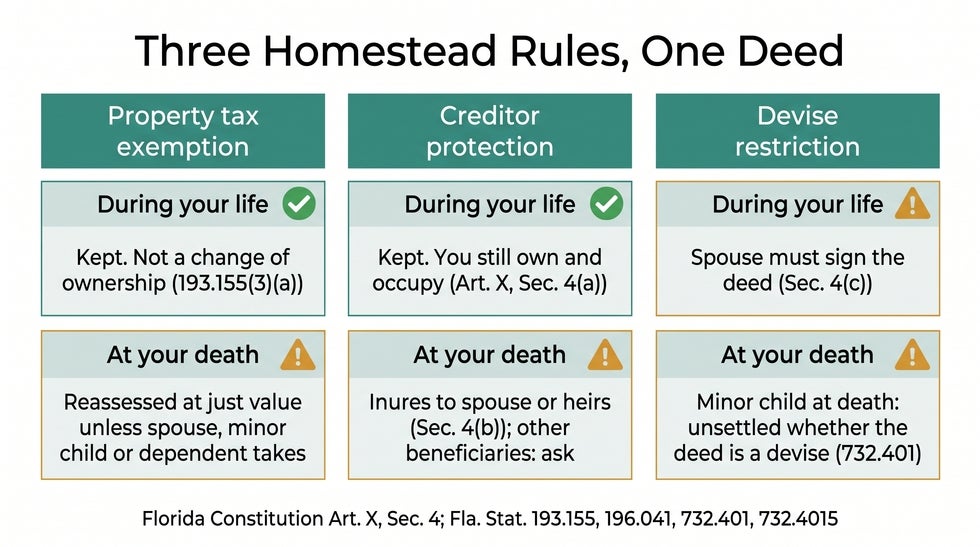
Three separate rules go by the name "homestead" in Florida, and a Florida Lady Bird deed homestead analysis has to run through all three: the property tax exemption, the creditor protection, and the devise restriction. The first two are undisturbed during your life. The third can make the whole plan ineffective, and it is the one most online forms ignore.
Creditor protection during life and after death
Article X, Section 4(a) exempts a homestead of up to one-half acre inside a municipality, or 160 acres outside one, from forced sale by creditors, with exceptions for taxes and assessments on the property, obligations contracted for its purchase, improvement, or repair, and obligations for labor performed on it. Nothing about the Lady Bird form disturbs that during your life, because the exemption belongs to the natural person who owns and occupies the home, and that is still you. The firm's video on Florida homestead law, creditor protection, taxes, and probate walks through the three rules side by side.
After your death it is less clean. Section 4(b) says the exemption inures "to the surviving spouse or heirs of the owner." Your children are heirs; a friend or a charity is not. Whether a remainder beneficiary who is not an heir takes free of your creditors is a question of case law with no one-line rule I can give you here. If your beneficiaries are not your spouse or descendants, raise it in the consultation.
Devise restrictions: spouse or minor child
Section 4(c) of Article X provides that "the homestead shall not be subject to devise if the owner is survived by spouse or minor child, except the homestead may be devised to the owner's spouse if there be no minor child," and that the owner, "joined by the spouse if married, may alienate the homestead by mortgage, sale or gift." Section 732.4015 repeats the devise rule in the Probate Code.
For the Lady Bird form that means two things. A married owner cannot sign alone; the spouse must join, because the conveyance is an alienation by gift in the constitutional sense, even though it is not a completed gift for tax purposes. The minor-child rule is harder. Section 4(c) restricts a devise, and no Florida statute or reported appellate decision says whether the remainder under a Lady Bird deed counts as one. If it does, the descent rules in section 732.401 take over, with a life estate to the surviving spouse (or an elected half interest) and the remainder to the descendants. The same rule, seen from the will side, is one of the Florida estate planning mistakes I see most often. A married owner with a minor child should not rely on a Lady Bird deed of the homestead.
Lady Bird Deed Florida Cost: What Will You Pay?
The lady bird deed Florida cost has two government components, both small: documentary stamp tax, which on a gift of unencumbered property is zero or the 70-cent minimum, and the clerk's recording fees, $10 for the first page and $8.50 for each additional page. The larger cost is the advice around the document, and that depends on whether the homestead, mortgage, and beneficiary questions in this article need work.
Lady Bird deed Florida documentary stamp tax and recording fees
Florida taxes deed transfers at 70 cents per $100 of consideration under section 201.02(1)(a), and the statute counts an existing mortgage as consideration. The lady bird deed Florida documentary stamp tax question therefore has two layers. Under Rule 12B-4.014(2)(a) of the Florida Administrative Code, "a conveyance of unencumbered realty as a gift is not taxable," and under paragraph (2)(b) a document reciting only nominal consideration, such as "$10 and love and affection," owes the minimum stamp of 70 cents, which is what most clerks collect on a Lady Bird deed. Beyond that, the Department of Revenue ruled in Technical Assistance Advisement 20B4-004 that an enhanced life estate deed "does not transfer any present beneficial interests in real property," so it "is not subject to documentary stamp tax regardless of any consideration." The property in that ruling was unencumbered; if your home carries a mortgage, have the preparer confirm the clerk's treatment before recording rather than assuming the ruling extends to your facts.
Recording fees are set statewide by section 28.24: $10 for the first page, $8.50 for each additional page, and $1 for each name indexed beyond four. A typical two-page Lady Bird deed records for $18.50.
DIY forms, and the cost compared to probate
Downloaded forms fail in predictable ways: a legal description copied from the tax bill, retained-powers language that is missing or names the wrong party, no contingent beneficiary, a married grantor with no spousal joinder, a grantor who signs individually when the trust holds title, one witness instead of two, and a signed document that never reaches the county clerk. Hirschenson involved a recorded instrument whose retained-powers paragraph gave the powers to the "grantor" when the parties meant the "grantee," and it took a foreclosure trial and an appeal to reform one word. Neither that family nor the Johnson family saved money.
Measured against the alternative, the instrument is inexpensive. A Florida probate that includes real estate carries a $400 filing fee in Lee County, a published notice to creditors, attorney fees that section 733.6171 presumes reasonable at $3,000 plus 3% of the value between $100,000 and $1 million, and months of waiting; the full accounting of how much probate costs in Florida is on the site, and the planning-side figures are in the firm's cost guide for wills and trusts. What I will not do here is quote a fee for the document itself, because the right answer depends on your family and title facts, and we give that number in writing at the consultation.
What Are the Disadvantages of a Lady Bird Deed in Florida?
The disadvantages of a Lady Bird deed in Florida are structural: it covers only the parcel described in it, it hands property outright to whoever is named with no protection for a minor or a person with special needs, it does nothing for your own incapacity, and it multiplies problems when several beneficiaries take together. It also does not make Medicaid estate recovery disappear in every case.
Only the property named in the deed
The conveyance transfers exactly one thing: the parcel whose legal description appears in it. It does nothing for bank accounts, a brokerage account, a car, a second parcel you buy later, or a home in North Carolina; each needs its own plan, whether a beneficiary designation, survivorship title, or a trust. For a family with a single Florida home and a few accounts with named beneficiaries, that limit is harmless. For a family with several parcels, or property transfers to plan in two states, it is the reason a trust usually wins.
No protection for minor or special-needs beneficiaries
The property is delivered outright at the moment of death. A minor cannot sign a contract or a listing agreement, so a guardian of the property must be appointed, and under section 744.441(12) the guardian needs a court order to sell, mortgage, or lease the child's real property, including homestead. Parents' informal authority under section 744.301(2) stops at $15,000, which no house satisfies. A beneficiary receiving needs-based public benefits can lose them the day a home lands in his or her name. In both cases the answer is a trust; the firm's video What Is a Revocable Living Trust in Florida? explains how a trust holds property for someone who should not hold it outright.
Medicaid estate recovery: what it does and does not avoid
Florida's Medicaid Estate Recovery Act, section 409.9101, directs the Agency for Health Care Administration to recover benefits "by the agency filing a statement of claim against the estate of a deceased Medicaid recipient as provided in part VII of chapter 733." That is a claim in probate, against the probate estate. Federal law lets a state reach further, into property "conveyed to a survivor, heir, or assign ... through joint tenancy, tenancy in common, survivorship, life estate, living trust, or other arrangement" (42 U.S.C. section 1396p(b)(4)(B)), but Florida's statute does not adopt that expanded definition, and it separately bars enforcement against property exempt from creditors under the Florida Constitution.
So the honest statement is narrower than "estate recovery is not avoided" and narrower than "the deed defeats Medicaid." The Medicaid estate recovery program's claim exists only for benefits paid at age 55 or older, it is not enforced at all if the recipient leaves a spouse, a child under 21, or a blind or permanently disabled child, and it is collected through the probate estate, which the home stays out of. If the agency believes a transfer was made to defeat recovery, or if the law changes, the analysis changes with it. This is general information about the instrument, not Medicaid planning advice, which is outside this firm's practice.
Is a Lady Bird deed right for every Florida homeowner?
No. It fits an owner with one Florida parcel, adult beneficiaries who can take property outright, a spouse who will sign, no minor children, and a separate durable power of attorney for incapacity. It does not fit a family with a minor child, special-needs beneficiaries, several parcels, out-of-state land, or children who will not agree on a sale.
When Is a Lady Bird Deed the Wrong Choice in Florida?
It is the wrong choice when the facts include a beneficiary who may die first, a minor or incapacitated beneficiary, several beneficiaries who may disagree, a spouse who did not sign, a mortgage held by a lender who may object, property in another state, or an owner who has not planned for incapacity. Each has a fix, and in most of them the fix is a different document.
Remainder beneficiary dies before owner
If a named beneficiary dies before you and no contingent beneficiary is named, that share does not pass to the beneficiary's children automatically. Depending on the wording, the share may fall back into your estate and need probate, the outcome the plan existed to prevent. Every Lady Bird deed should say what happens if a beneficiary predeceases you, and every owner should record a new one when a beneficiary dies.
Minor or incapacitated remainder beneficiary
A minor takes title but cannot deal with it, and a court-supervised guardianship follows, as described above. An adult beneficiary who is incapacitated is in the same position. A revocable trust with a trustee holding the home for that person solves this.
Several remainder beneficiaries who may not agree
Three children who take a Naples home together become tenants in common, and any one of them can force a sale by partition under section 64.031. Since 2020 the Uniform Partition of Heirs Property Act gives the other co-owners a buyout right under section 64.207 before an open-market sale, but that is a lawsuit, not a plan. My earlier article on selling inherited property in Florida walks through what happens when one co-owner will not sign. If your children are unlikely to agree, a trust with one trustee and instructions to sell avoids the problem.
Spouse who did not sign
Florida is not a community property state, but the homestead joinder rule reaches the same place: a married owner's conveyance of the homestead is ineffective without the spouse's joinder under Article X, Section 4(c), even if the home is titled in one spouse's name alone and was bought before the marriage. A title underwriter will spot the missing signature after death and will not insure the beneficiaries' title without a probate proceeding or a release. Get the spouse's signature, or use a different tool.
Mortgage on the property
Nearly every residential mortgage contains a due-on-sale clause. The federal Garn-St Germain Act, 12 U.S.C. section 1701j-3(d), bars a lender from enforcing that clause on "a transfer where the spouse or children of the borrower become an owner of the property" and on "a transfer to a relative resulting from the death of a borrower." A Lady Bird deed to your children therefore should not trigger the loan during your life or at death. A conveyance to a friend, an unmarried partner, or a charity is not on that list, and the lender may treat it as a default. The beneficiaries also inherit the mortgage along with the house; the loan does not disappear at death.
Property in another state
A Florida instrument conveys Florida land. A cabin in Georgia or a condo in Ohio needs whatever that state allows, and several states do not recognize enhanced life estate deeds at all. Families with property in two states usually end up with a revocable trust that holds both, because a trust travels across state lines.
Owner's own incapacity during life
Nothing in the document lets anyone act for you while you are alive and unable to act for yourself. If you develop dementia and the home must be sold to pay for care, the retained power to sell belongs to you, and you can no longer exercise it. Without a durable power of attorney under Chapter 709, your family faces a guardianship, and the guardian needs a court order under section 744.441(12) to sell your homestead. Two drafting details matter: under section 709.2202(1)(c) the agent can make a gift, which a new Lady Bird deed is, only if you signed or initialed next to that specific power, and under section 689.111 a power of attorney may convey homestead but does not dispense with spousal joinder.
Lady Bird Deed vs Revocable Trust Florida: Which Fits?
The lady bird deed vs revocable trust Florida question usually answers itself once you count parcels and beneficiaries. One Florida parcel and one or two adult beneficiaries: the deed does the job for the price of recording. Several parcels, property in another state, a minor or special-needs beneficiary, distributions you want staggered, or a real concern about your own incapacity: the revocable living trust does the job and the deed does not. Adding a child to your title as a joint owner, the third option people ask about, is usually the weakest of the three.
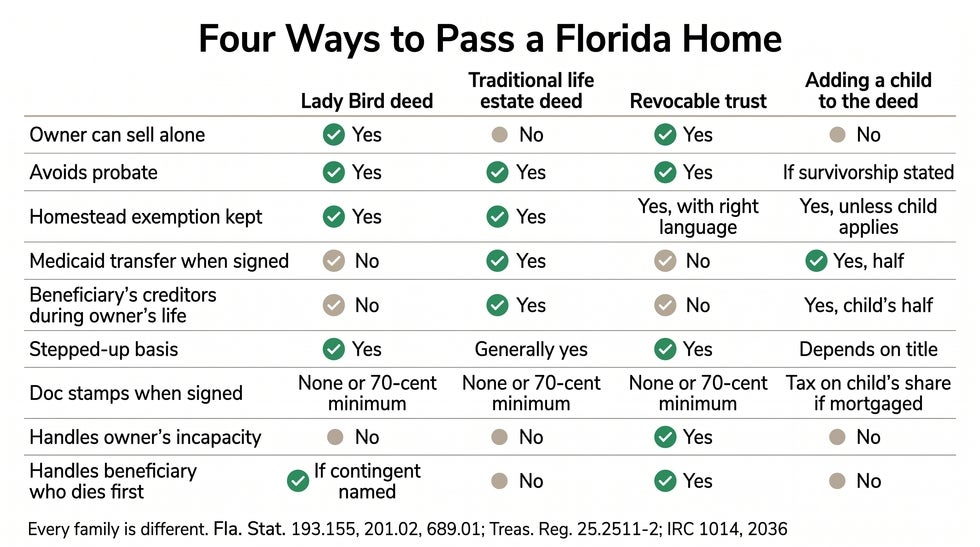
How the four options compare
| Feature | Lady Bird deed | Traditional life estate deed | Revocable trust | Adding a child to the deed |
|---|---|---|---|---|
|
Owner keeps the right to sell without the beneficiary's consent |
Yes |
No |
Yes |
No |
|
Probate avoided at death |
Yes |
Yes |
Yes, for assets titled in the trust |
Yes, if survivorship is stated |
|
Homestead exemption and Save Our Homes cap kept |
Yes |
Yes |
Yes, with the right trust language |
Yes, unless the child applies for the exemption |
|
Medicaid look-back transfer when signed |
No |
Yes |
No |
Yes, half the home |
|
Beneficiary's creditors can reach the property during the owner's life |
No, only a defeasible future interest |
Yes, the vested remainder |
No |
Yes, the child's half |
|
Stepped-up basis at death |
Yes |
Generally yes |
Yes |
Depends on how title was taken |
|
Documentary stamp tax when signed |
None, or the 70-cent minimum |
None, or the 70-cent minimum |
None, or the 70-cent minimum |
Tax on the child's share if there is a mortgage |
|
Handles the owner's incapacity |
No |
No |
Yes |
No |
|
Handles a beneficiary who dies first |
Only if a contingent beneficiary is named |
No |
Yes |
No |
The revocable trust column is why we recommend a trust for many families who first asked about a deed. The firm's guide to revocable vs irrevocable trusts in Florida explains what the trust adds.
Incapacity and beneficiary changes
A trust names a successor trustee who steps in the day you cannot manage the home, without a court; the Lady Bird form names nobody for that job. A trust lets you change beneficiaries by amendment, while the Lady Bird form requires a new recorded instrument each time, which is cheap but public. And a trust can hold a home for a beneficiary who should not own it outright. Whichever tool you choose, keep the durable power of attorney and health care documents current; both tools assume someone can act for you.
Frequently Asked Questions
What is a Lady Bird deed in Florida and how does it work?
A Lady Bird deed in Florida is an enhanced life estate deed. The owner keeps the property for life with the retained powers to sell, mortgage, or revoke without the beneficiaries' consent, and the property passes to the named beneficiaries at death by recording a death certificate. Florida has no statute for it; it works under common law and is accepted by the Department of Revenue, the Department of Children and Families, and title insurers.
Does a Lady Bird deed avoid probate in Florida?
Yes. Avoiding probate for the parcel is what the instrument was built to do. The remainder beneficiaries take title at the owner's death by operation of law and record a certified death certificate; no personal representative, letters of administration, or court order is needed for that parcel. Other assets still need their own plan, and a married owner or an owner with a minor child faces the homestead limits in Article X, Section 4 of the Florida Constitution.
What does it cost to create a Lady Bird deed in Florida?
The government charges are small: no documentary stamp tax, or the 70-cent minimum, on a gift of unencumbered property under Rule 12B-4.014 and Technical Assistance Advisement 20B4-004, and a recording fee of $10 for the first page and $8.50 for each additional page under section 28.24. The cost of preparing the document depends on your title, homestead, and family facts, and we quote it in writing before you commit to anything.
Can a Lady Bird deed be revoked or changed in Florida?
Yes, at any time during the owner's life and without the beneficiaries' consent. The owner records a new deed, which can name different beneficiaries, convey the property to a buyer, or simply cancel the enhanced life estate. That power is what makes it an incomplete gift for federal gift tax purposes and keeps it from being a transfer for Medicaid purposes.
Does a Lady Bird deed affect the homestead exemption or Save Our Homes cap?
Not during the owner's life. Section 196.041(2) treats a life interest as equitable title for the exemption, and section 193.155(3)(a) says an instrument naming the owner as both grantor and grantee with other grantees added is not a change of ownership. At death the property is reassessed at just value unless the transfer is to a surviving spouse, a minor child, or a dependent permanent resident.
What if a beneficiary on a Lady Bird deed dies before the owner?
If a contingent beneficiary is named, that person takes the share. If not, the share may fall back into the owner's estate and require probate, which defeats the purpose. Every Lady Bird deed should name contingent beneficiaries, and the owner should record a new one whenever a beneficiary dies.
Preparing for Your Estate Planning Consultation
A Lady Bird deed consultation goes quickly when the title facts and the family facts are on the table. We need to know how the property is titled today, whether you are married, whether any beneficiary is a minor or receives public benefits, whether there is a mortgage, and whether you own real estate anywhere else. With those answers we can usually tell you in one meeting whether this tool fits, whether a trust fits better, or whether both belong in the estate plan.
What to bring: deed, tax bill, mortgage statement
Bring the most recent recorded deed, which gives us the legal description and shows who holds title, including whether it is already in a trust. Bring the latest property tax bill, which shows the homestead exemption and the assessed value the Save Our Homes cap is protecting. If there is a mortgage, bring a recent statement so we can review the due-on-sale clause and the balance. If you already have a will, trust, or durable power of attorney, bring those too, because the new document has to fit with them.
Describing your beneficiaries and family situation
Write down each intended beneficiary's full legal name, age, and relationship to you, and whether he or she is married, receives government benefits, or has creditor trouble. Tell us if your children are likely to disagree about keeping or selling the home, if any of them lives in it now, and if you want anyone to receive it in stages rather than outright. Those facts decide whether the answer is a Lady Bird deed, a trust, or both, and they are the facts the online forms rarely ask.
How The Nussbickel Law Firm handles Lady Bird deeds
The Nussbickel Law Firm, P.A. practices Florida estate planning and probate exclusively, from our office in Fort Myers, for families throughout Lee, Collier, and Charlotte counties, and we handle probate matters statewide. We prepare Lady Bird deeds as part of an estate plan, not as a stand-alone form: an estate planning attorney confirms title, checks the homestead rules against your marital and family facts, drafts the retained-powers language and contingent beneficiaries, records the instrument, and makes sure the durable power of attorney and the rest of the plan work with it. Consultations are free and can be by phone, by video, or in our office. Schedule a free consultation or call 239-900-WILL (9455).
Conclusion
A Lady Bird deed lets a Florida homeowner keep complete control of the home for life and pass it to named beneficiaries at death without probate, without a gift tax return, without a Medicaid transfer, and without losing the homestead exemption, for the cost of recording two pages. For a widow or widower with one Florida home and adult children, it is often the whole answer. The lady bird deed Florida families should avoid is the one signed without the spouse, the one naming a minor, the one with no contingent beneficiary, or the one downloaded and never recorded. Bring the current deed, the tax bill, and the family facts, and we can tell you which tool fits.
Gregory J. Nussbickel is the founder of The Nussbickel Law Firm, P.A. in Fort Myers, Florida. His practice is devoted exclusively to estate planning, probate, and trust administration for families throughout Southwest Florida.
This article is for general information only and is not legal advice. Reading it does not create an attorney-client relationship. Florida real property, tax, and Medicaid law change, and every family is different; speak with a licensed Florida attorney about your specific situation.

Comments
There are no comments for this post. Be the first and Add your Comment below.
Leave a Comment