

Key Highlights
- Title decides. A deceased bank account Florida families inherit goes to whoever the title names: a payable-on-death beneficiary, a surviving joint owner, a surviving spouse, a trust, or the estate.
- POD and joint accounts skip probate. Under sections 655.82 and 655.79, Florida Statutes, the money belongs to the named beneficiary or surviving owner at death.
- Florida has a small affidavit route. Since July 1, 2026, a family member can collect up to $2,000 in sole-name deposits without court, six months after the death (section 735.303).
- A signer is not an owner. Convenience account money belongs to the estate, and a power of attorney ends at death.
- Larger sole accounts need a court order: disposition without administration, summary administration (up to $150,000), or formal administration with letters.
Introduction
The short answer: a deceased bank account Florida law treats as the owner's property goes wherever its title sends it. Payable-on-death accounts and joint accounts with a surviving owner pass outside probate with a certified death certificate. An individual account with no beneficiary needs legal authority to release it, though often not a full probate.
If your parent died in Southwest Florida, you have probably heard the bank's answer already: the funds are frozen and they need paperwork. If you are a surviving spouse or joint owner, you may wonder whether the money is already yours. This guide answers both, title by title, then walks through the routes Florida probate law offers for money that names no one, and the traps we see after a death.
Who Owns the Money in a Deceased Person's Bank Account in Florida?
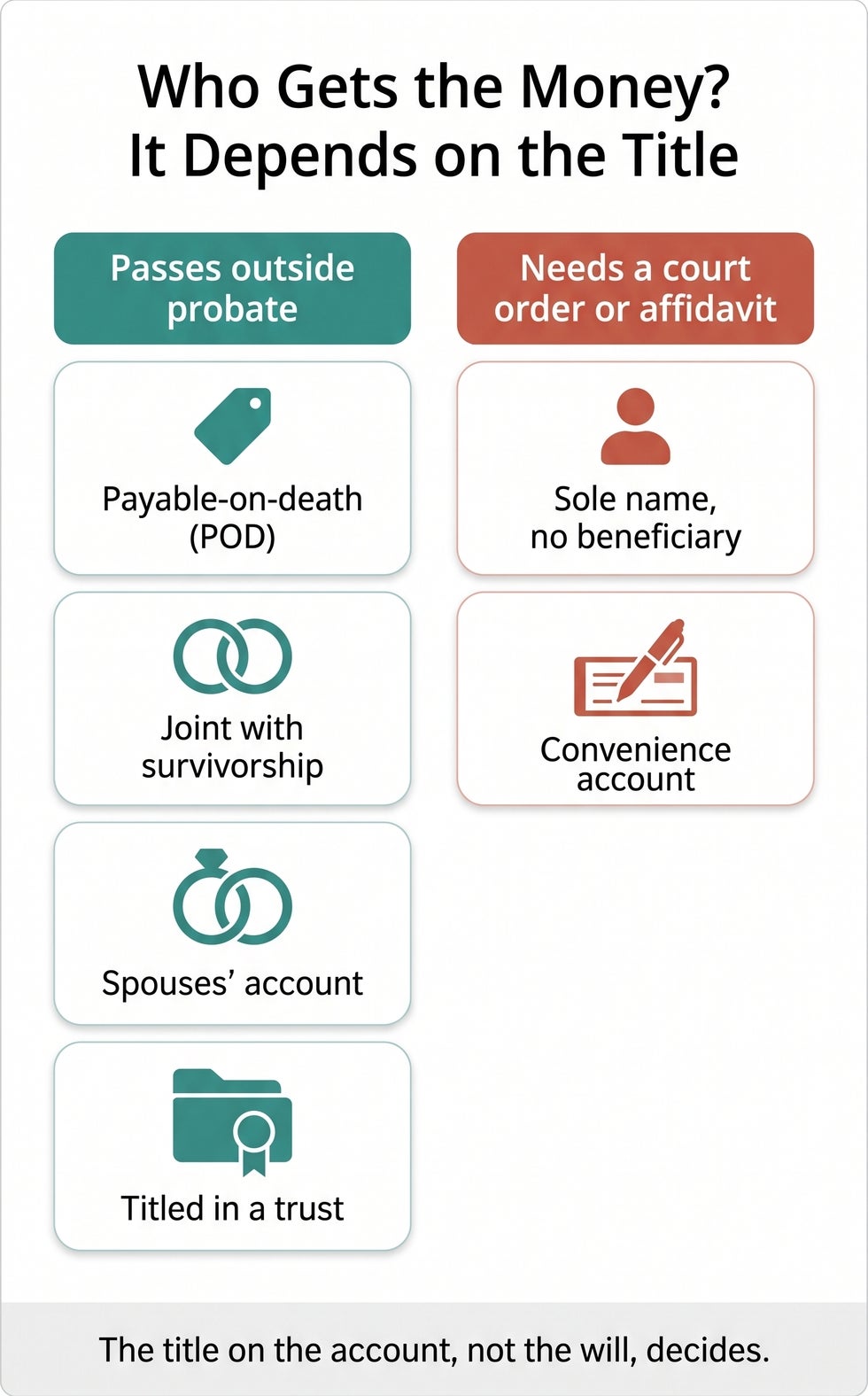
Ownership turns on the title at the date of death. Florida law passes payable-on-death, joint survivorship, entireties, and trust-titled deposits directly to the beneficiary, survivor, or trustee. Only an individual account with no beneficiary designation becomes one of the probate assets a court must handle.
That answers the question families search most, who gets the money in a dead person's bank account: the person the bank's records name, not necessarily the person the will names. A will controls only probate assets. A designation on bank accounts and other financial accounts, like those on life insurance and retirement accounts, overrides the will for that money.
| Account title | Who gets the money | Probate needed? | What the bank usually asks for | Florida statute |
|---|---|---|---|---|
|
Individual, no beneficiary |
The estate, then heirs or devisees |
A court route, unless $2,000 or less |
Death certificate plus letters, a court order, or the affidavit |
§§ 735.303, 735.301, 735.201 |
|
Payable-on-death or “in trust for” |
The named beneficiary; equal shares if several |
No |
Death certificate, ID, claim form |
§ 655.82 |
|
Joint with right of survivorship |
The surviving owner |
No |
Death certificate, ID |
§ 655.79 |
|
Convenience account |
The estate; the signer owns nothing |
Yes, a court route |
Letters or a court order |
§ 655.80 |
|
Spouses' entireties account |
The surviving spouse |
No |
Death certificate, ID |
§ 655.79(1) |
|
Titled in a revocable trust |
The trust, run by the successor trustee |
No |
Death certificate, certification of trust |
§ 736.1017 |
Individual Account, No Beneficiary
An account in the decedent's name alone, where the decedent was the sole owner with no beneficiary, is a probate asset. The money is collected under court authority and distributed under the will, or under Florida's intestacy laws if there is no will, after debts and expenses are provided for.
So, does a bank account go through probate in Florida? This kind does, though the legal process can be small. If you are asking how to access a deceased person's bank account in Florida when it is titled this way, the answer is one of the four routes in the next section.
Payable-on-Death or “In Trust For” Account
A payable-on-death beneficiary owns the money at the owner's death. Under section 655.82, the sums on deposit belong to the surviving beneficiaries, and the statute's sample form says ownership passes and “is not part of the party's estate.” An “in trust for” designation works the same way.
Three rules govern any payable on death account Florida banks hold. A designated beneficiary has no rights while the owner is alive. Listed beneficiaries who survive take equal shares. If none survives, the funds fall back into the last owner's estate. The beneficiary usually needs only a certified death certificate, ID, and a claim form.
Joint Account With Survivorship
A joint bank account after death Florida law presumes belongs to the survivor. Section 655.79 presumes joint owners intended rights of survivorship, and the presumption yields only to proof of fraud, undue influence, or clear and convincing proof of a contrary intent.
That high bar is why adding one child to a parent's deposit “just to pay bills” can leave siblings out. In Pascalides v. Artico, No. 3D24-1052 (Fla. 3d DCA Dec. 31, 2025), an estate argued a $2.3 million joint survivorship account was really a convenience account; the Third District affirmed judgment for the surviving account holder because nothing in the record overcame the survivorship title.
Convenience Account
A convenience signer never owns the money. Section 655.80 defines a convenience account as one in a single person's name with agents who may deposit and write checks, and it gives every right in the funds to the principal only. At death, a convenience account Florida banks hold is estate property.
The statute directs the balance to the personal representative or to a person named in a summary administration order or a section 735.301 court letter. Certificates of deposit cannot be convenience accounts. Agents under a power of attorney are in the same position: under section 709.2109, the power terminates when the principal dies. The firm's video What Is a Durable Power of Attorney in Florida? explains what it does during life.
Spouses' Entireties Account
A married couple's account passes to the surviving spouse. Section 655.79(1) states that any deposit made in the names of a husband and wife is a tenancy by the entirety unless otherwise specified in writing. At the deceased spouse's death, the survivor owns it all, with no probate.
The survivor brings a death certificate and ID, and the bank retitles the funds. If the signature card chose a different form of joint ownership in writing, the card controls. Our guide to estate planning for married couples shows how this fits a couple's plan.
Trust-Titled Account
A trust-titled account belongs to the trust, so the successor trustee takes control without probate. The bank deals with the trustee and asks for a death certificate and a certification of trust under section 736.1017 instead of the whole living trust.
This works only if the account was retitled before death; an unfunded one follows the probate routes below. The trustee's next steps are in our guide to trust administration after death in Florida. Money that names no one takes more work, which is the next question.
How Do You Get the Money Out If the Account Has No Beneficiary?
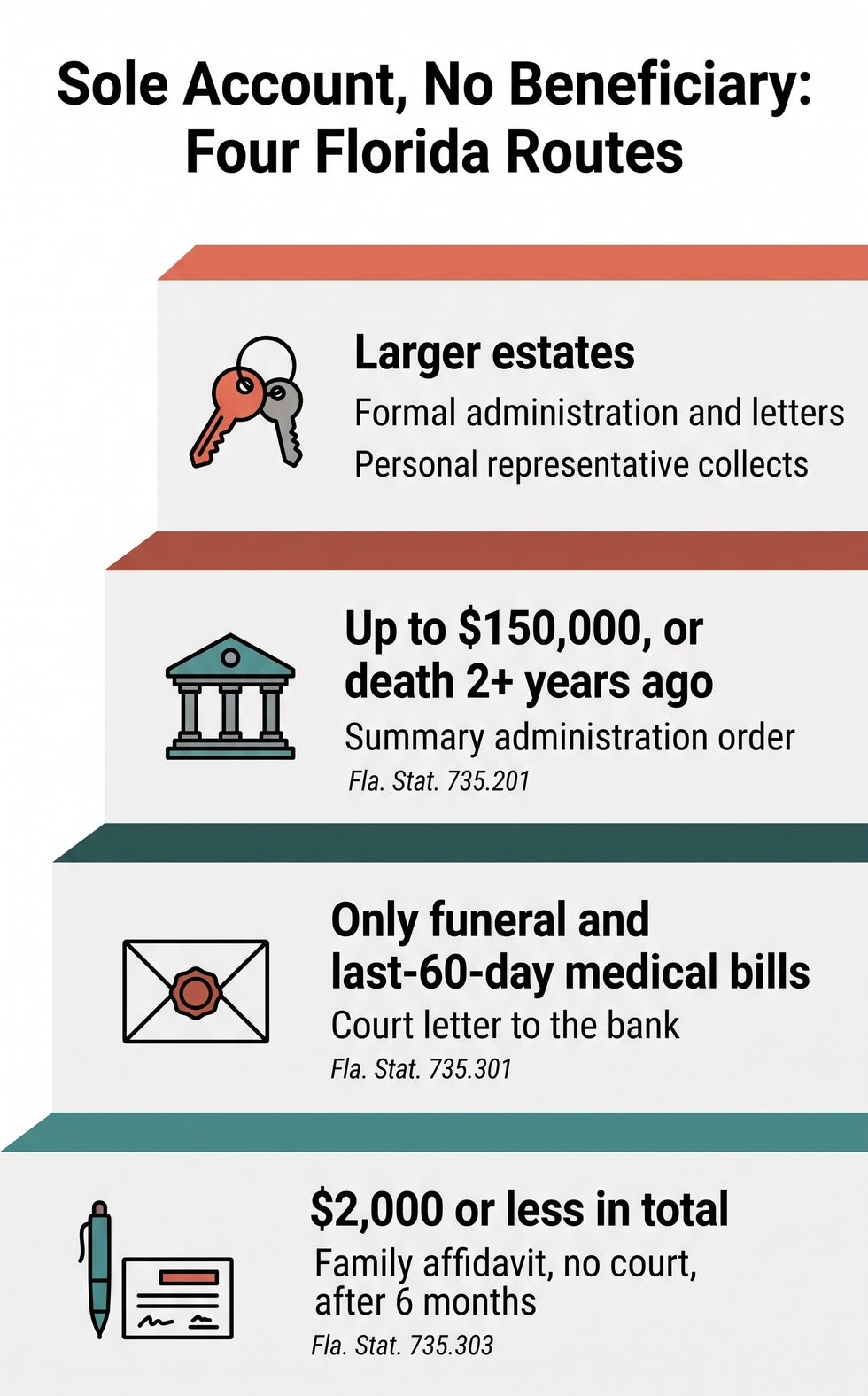
You need authority the bank can rely on, and Florida offers four routes sized to the estate: a sworn affidavit with no court, a court letter, summary administration, or formal probate. The right one depends on the amount, what else the decedent owned, such as real estate, and how long ago the death occurred.
Disposition Without Administration
This route is a composition test, not a dollar ceiling. Under section 735.301, no administration is required when the decedent left only exempt property and non-exempt personal property worth no more than preferred funeral costs plus medical bills from the last 60 days of the last illness.
On an informal application, the court may authorize the bank by a letter under seal to pay the funeral home or whoever paid those bills, and the bank is discharged. It fits a modest checking account and a funeral bill, not savings left over for heirs. The firm's video Florida Disposition Without Administration: The Smallest Estates walks through it.
Summary Administration
Summary administration fits when the probate estate, less exempt property, is $150,000 or less, or the decedent died more than two years ago. The limit doubled from $75,000 on July 1, 2026. The court enters an order naming who receives each account, and the bank pays them.
There is no personal representative and no letters. The petitioner must search for creditors and provide for them, and recipients stay liable for their share of valid claims for two years. See our article on the $150,000 summary administration limit and the video What Is Summary Administration? Florida's Short-Form Probate.
Formal Administration and Letters
Larger estates go through formal administration in the Florida probate court, which appoints a personal representative and issues letters of administration, the legal authority banks require. The personal representative gets a tax ID, opens an estate account, moves the decedent's individual deposits into it, and pays claims in the order section 733.707 sets.
That order puts funeral expenses (up to $6,000) and last-illness medical bills ahead of most debts. If the decedent received Medicaid after age 55, the state may claim against the estate, but the debt is not enforced if a spouse, a child under 21, or a blind or disabled child survives. Our posts on letters of administration, the formal administration process, and creditor claims cover the Florida probate process in depth, and the video What Is Formal Administration in Florida Probate? gives the overview.
Does Florida Have a Small-Estate Affidavit?
Yes, but it is small. Section 735.303 lets a bank pay a family member, with no court, the funds in the decedent's sole-name deposits that carry no payable-on-death designation, if they total $2,000 or less. Chapter 2026-57 raised that limit from $1,000 effective July 1, 2026.
The family member is the surviving spouse; if none, an adult child; then an adult descendant; then a parent. Payment cannot come until six months after death. The affiant gives the bank a certified copy of the death certificate and a sworn statement that all such deposits known to the affiant total $2,000 or less, that no probate is open, and that the affiant knows of no will. The affiant is personally liable to creditors and rightful heirs, and a false affidavit is theft.
So, can a bank release funds without probate in Florida? For a small sole account, yes. Example: a Cape Coral widow with no will leaves checking joint with her daughter, savings payable on death to her two sons, and a $1,800 certificate of deposit in her own name. The daughter keeps the checking, the sons split the savings, and after six months the CD is paid by affidavit. A $40,000 balance would point to summary administration.
What Happens to a Bank Account When Someone Dies in Florida?
The bank freezes the deceased owner's interest, stops honoring checks and debit transactions, and waits for paperwork that matches the title. Banks set their own procedures, so details vary; what follows is what state law requires and what financial institutions commonly ask for.
How Banks Freeze Deceased Bank Account Florida Balances
Once notified, a bank typically freezes individual accounts as of the account holder's death. Families often search “bank froze account after death” at this point. The freeze protects the estate and the bank, which is discharged only when it pays the person Florida law entitles.
Joint, payable-on-death, and entireties deposits usually go to the bank's death-claim team and move quickly. Passwords and a debit card give no authority after the time of death, and a convenience signer's checks may clear only until the bank has notice; the money still belongs to the estate. A safe deposit box is separate: under section 655.935, a spouse, parent, adult descendant, or person named as personal representative in a copy of the will may search it, with a bank officer present, for a will, burial instructions, or a life insurance policy, as our lost will guide explains.
Typical Documents Banks Request
Closing a bank account after death takes a different packet for a beneficiary, a survivor, a trustee, and an estate.
| Situation | Usual documents | Who signs | Court involvement |
|---|---|---|---|
|
POD or ITF account |
Certified death certificate, ID, claim form |
Named beneficiary |
None |
|
Joint or entireties account |
Certified death certificate, ID |
Surviving owner or spouse |
None |
|
Trust account |
Death certificate, certification of trust |
Successor trustee |
None |
|
Sole account, $2,000 or less total |
Death certificate, § 735.303 affidavit |
Family member, after 6 months |
None |
|
Sole account, larger |
Death certificate plus letters or court order |
Personal representative or person named in the order |
Yes |
Order several certified death certificates at the start, because many institutions keep one.
Deposits, Checks, and Debit Cards After Death
Stop activity on individual accounts at once. Checks the decedent wrote may bounce, and under section 655.82(5) a surviving owner or beneficiary can owe the payee of an unpaid pre-death check, up to a proportionate share of what they received.
Social Security causes the most trouble. Under 20 C.F.R. § 404.311, entitlement ends with the month before the month of death, so the payment that arrives after death is not owed, and the Treasury reclaims it from the bank under 31 C.F.R. part 210, subpart B. Leave it untouched, and cancel autopay drafts once someone has authority.
Unclaimed money does not vanish. Under section 717.106, a dormant deposit is presumed abandoned after five years and reported to the Department of Financial Services, where heirs can claim it free at Claim Your Cash FL.
How The Nussbickel Law Firm Helps
The Nussbickel Law Firm, P.A. handles Florida estate planning, probate, and estate administration for families in Lee, Collier, and Charlotte counties, and Florida estate and probate matters statewide. When a family calls about a deceased bank account Florida banks have frozen, we start with the titles, because they decide whether you need a Florida probate attorney at all. Often the answer is a death certificate and a claim form, and we will say so.
When a court route is needed, we choose the smallest that fits, and we work with out-of-state children by phone or video. Proper estate planning prevents most of this: proper beneficiary designations and titles mean nobody has to unlock a deceased person's account for your family, and our guide to avoiding probate covers the options. Bring death certificates, a recent statement showing each title, any will or trust, and the funeral bill. Schedule a free consultation or call our Fort Myers office at 239-900-WILL (9455).
Frequently Asked Questions
What is a deceased bank account Florida and how is it handled?
It is an account whose owner has died. Florida law sends the money where the title points: a payable-on-death beneficiary, a surviving joint owner or spouse, or a trust takes it without probate, while a sole account with no beneficiary needs the section 735.303 affidavit or a court route.
Can a bank release funds without probate in Florida?
Yes, in several cases. Payable-on-death, joint survivorship, entireties, and trust accounts are released on a death certificate. Sole accounts totaling $2,000 or less can be paid to a family member by affidavit six months after death. Larger sole accounts require a court letter, order, or letters of administration.
Can I use my power of attorney after my parent dies?
No. Section 709.2109 terminates a power of attorney when the principal dies, so the agent has no authority over the accounts afterward. The money belongs to the beneficiaries, joint owners, or estate, and a personal representative or court order is needed for estate accounts.
Gregory J. Nussbickel is the founder of The Nussbickel Law Firm, P.A. in Fort Myers, Florida. His practice is devoted exclusively to estate planning, probate, and trust administration for families throughout Southwest Florida.
This article is for general information only and is not legal advice. Reading it does not create an attorney-client relationship. Probate law changes, and every estate is different; speak with a licensed Florida attorney about your specific situation.

Comments
There are no comments for this post. Be the first and Add your Comment below.
Leave a Comment