

Key Highlights
- Trust administration after death Florida families face begins the moment the settlor dies: the revocable living trust becomes irrevocable and the successor trustee takes over under Chapter 736, the Florida Trust Code.
- The trustee must file a notice of trust with the court in the settlor's county under section 736.05055, a filing most families have never heard of.
- Two 60-day clocks run under section 736.0813: notice of the trustee's acceptance, and notice that the instrument is now irrevocable, that beneficiaries may request a copy, and that they are entitled to accountings.
- The assets remain liable for the settlor's debts under sections 733.707(3) and 736.05053, and only a probate proceeding can start the three-month creditor deadline.
- A beneficiary who receives a proper accounting with a limitation notice has six months to object under section 736.1008; without one, the window stays open for years.
- On November 12, 2025, Florida's Fourth District Court of Appeal held that bank statements and ledgers are not a trust accounting, and that a decade without accountings was a per se breach.
Introduction
The short answer: trust administration after death Florida law requires is a real job with statutory deadlines, not a formality. When the person who created a revocable living trust dies, the instrument can no longer be changed, the named successor trustee steps in, and nothing passes to anyone until that trustee gives the required notices, deals with creditors and taxes, and distributes what is left according to the terms of the trust. The single mistake I see most often is a family that hears "the trust avoids probate" and concludes there is nothing to do.
I wrote this for two readers. The first is an adult child, often living in another state, who has just learned that a parent named them successor trustee and has no idea what the role involves or whether they can be held personally liable for getting it wrong. The second is a beneficiary, usually that child's sibling, who wants to know what the trustee owes them: a copy of the trust document, an accounting, a timeline, and eventually a check. Both need the rule, the Florida statute section behind it, and the order of operations, which is what follows.
What Happens to a Trust When the Grantor Dies in Florida?
What happens to a trust when the grantor dies in Florida is that it becomes irrevocable, the successor trustee takes control of the trust property, and a set of duties under the Florida Trust Code switches on. During the settlor's life, section 736.0603 says the trustee's duties are owed to the settlor alone; at death they shift to the beneficiaries. That shift is the whole event.
Contrast this with a will, which does nothing until a court admits it to probate and the probate process appoints a personal representative. A funded revocable living trust needs no court order to operate: a revocable trust becomes irrevocable at death and keeps working without a judge, and my earlier article on revocable versus irrevocable trusts in Florida explains what that change means for creditors and taxes. What "avoids probate" does not mean is that the trustee can skip notices, ignore creditors, or hand out money in the first month. The firm's video What Is a Revocable Living Trust in Florida? covers the planning side; the rest of this article covers what happens after.
Key Legal Concepts and Terms in Florida Trust Law
Five terms carry most of the Florida law on trust administration after death Florida trustees must follow. The settlor (also called the grantor or trustmaker) is the person who created the instrument and has now died. The trustee holds legal title to the trust assets and owes a fiduciary duty to the people who benefit. A qualified beneficiary, defined in section 736.0103(19), is a living beneficiary who currently may receive distributions or would receive them if the current interests ended today; those are the people the notice and accounting rules protect. The terms of the trust are the instrument plus every amendment, and Florida statutes fill the gaps where the document is silent. And initial trust administration, a phrase from section 736.1007(8), is the period from the settlor's death to the final distribution.
The table below shows where this kind of administration sits between the two probate proceedings most families have heard of. The differences are structural, not a matter of degree.
| Feature | Formal probate administration | Trust administration | Summary administration |
|---|---|---|---|
|
Court supervision |
Yes, throughout |
None unless a dispute arises |
A single order, then closed |
|
Who is in charge |
Personal representative under letters of administration |
Successor trustee under the instrument |
The petitioners; no fiduciary is appointed |
|
Notice to creditors and claims period |
Published; 3 months from first publication (section 733.702) |
No procedure of its own; assets stay liable for 2 years (section 733.710) unless a probate is opened to publish |
No publication; petitioners remain liable for 2 years (section 735.206) |
|
Inventory filed with the court |
Yes, within 60 days of letters (Rule 5.340) |
No; the trustee inventories privately |
No |
|
Accountings |
Filed with the court |
Given to qualified beneficiaries under section 736.0813 |
None |
|
How long it usually takes |
Six months at a minimum, often longer |
Commonly under a year when simple; longer with real estate, a creditor probate, or an estate tax return |
A few months |
|
Public record |
Yes |
No |
Yes |
|
Cost drivers |
Section 733.6171 attorney schedule, personal representative commission, bond, publication |
Trustee compensation and the section 736.1007 schedule, appraisals, tax returns |
Filing fee and an agreed attorney fee |
Notice of Trust in Florida: What It Means and When to File
A notice of trust Florida law requires is a one-page filing that tells the court, and anyone searching the court's records, that the deceased person had a revocable trust and who is administering it. Section 736.05055(1) says that upon the death of the settlor, the trustee must file it with the court of the county of the settlor's domicile. The notice must state the settlor's name, the date of death, the title of the instrument if it has one, its date, and the trustee's name and address. It does not attach the instrument itself and it discloses nothing about who inherits.
The clerk indexes the notice like a caveat, or files it in the probate case if one exists and sends a copy to the personal representative. Its purpose is to let creditors and interested persons find the trustee. The Lee County Clerk charges $41 to file one, the same fee it charges for a caveat. This filing is routinely missed by trustees who believe the instrument "avoids court," and section 736.05055(7) says the failure does not excuse the trustee from paying the settlor's debts. File it in the first weeks, before the notices to beneficiaries go out.
What Are a Successor Trustee's Duties in Florida?
Successor trustee duties Florida imposes fall into four groups: take control and protect the property, tell the beneficiaries what the law requires them to be told, pay what the settlor and the administration owe, and distribute the rest according to the trust terms. Every one of those groups has a section of Chapter 736 behind it, and the fiduciary duty runs through all of them: good faith under section 736.0801, loyalty under section 736.0802, impartiality among beneficiaries under section 736.0803, and prudence under section 736.0804.
The role begins with acceptance. Under section 736.0701, a person named as trustee accepts by following the method the instrument provides or, if it provides none, by taking delivery of the property, exercising powers, or otherwise indicating acceptance. A person who does not want the job may decline it, and someone who does nothing for a reasonable time is deemed to have declined. Acceptance matters because the first 60-day clock starts on that date, so accept in writing and keep a copy.
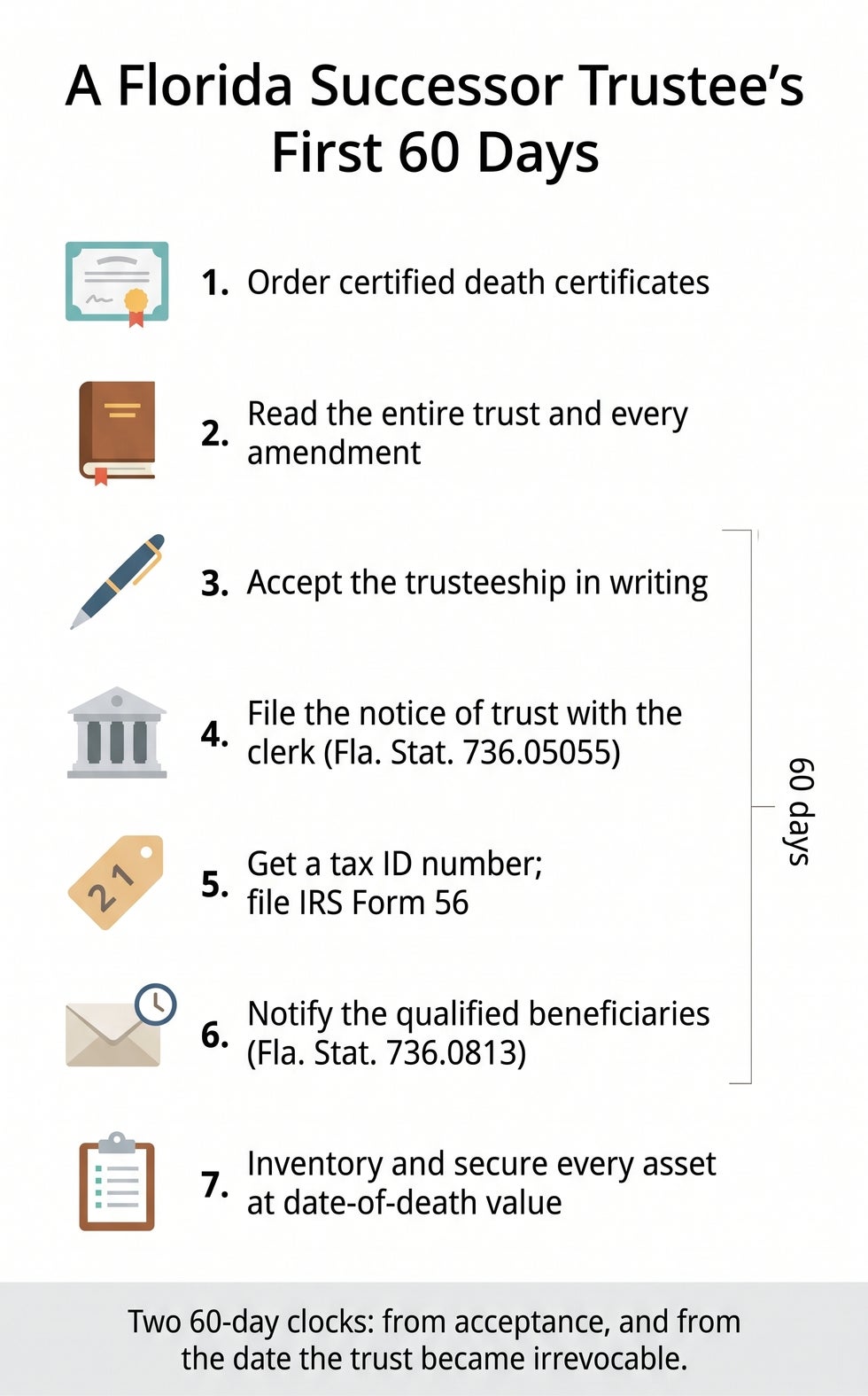
Immediate Steps After the Grantor's Death
These seven successor trustee steps open every trust administration after death Florida families bring to me, in this order:
- Obtain certified death certificates. Banks, brokerage houses, government agencies such as the property appraiser and the Social Security Administration, and the clerk each want an original. Order ten.
- Locate and read the entire trust and every amendment. The original trust document names the successor trustee, sets any conditions on taking office, and controls distribution. Read all of it before moving a dollar.
- Accept the trusteeship in writing. A signed acceptance fixes the date section 736.0813 measures from.
- File the notice of trust with the clerk under section 736.05055 in the county where the settlor lived.
- Get a taxpayer identification number for the trust. The IRS Form 1041 instructions state that every qualified revocable trust must obtain a new number after the decedent's death; the settlor's Social Security number dies with the settlor. Apply online with Form SS-4, then file Form 56 to tell the IRS a fiduciary relationship exists.
- Notify the qualified beneficiaries within 60 days of acceptance and within 60 days of the instrument becoming irrevocable, as the next section explains.
- Inventory and secure the trust assets. List every account, parcel of real estate, vehicle, and business interest with its value on the date of death, confirm insurance on the real property, and open a bank account for the trustee under the new number.
That last step also reveals what was never put into the instrument. A car titled in the settlor's own name, a checking account with no beneficiary, or a Cape Coral lot deeded to the settlor personally is not held by the trustee at all. Those items reach the trustee only through the pour-over will and a probate proceeding under section 732.513, which is why an unfunded or partly funded revocable trust is the most common reason a family that planned to avoid probate in Florida ends up in one anyway. If the outside assets are worth $150,000 or less, the summary administration route my earlier article on Florida's new $150,000 summary administration limit describes will usually do. The firm's video What Is Trust Funding? Why an Unfunded Trust Does Nothing explains the problem from the planning side.
Ongoing Administrative Tasks for Successor Trustees
Once the first weeks are behind you, the work becomes retitling, tax, and recordkeeping. Financial institutions will ask for the death certificate and a certification of trust under section 736.1017, a short signed statement that the instrument exists, who the settlor was, who the current trustee is, and what powers the trustee has. The statute says a bank may rely on it instead of demanding a copy of the trust document, and it keeps the dispositive terms private. A trustee needs no letters of administration; my earlier article on letters of administration in Florida explains why those belong to probate.
Tax returns come in three layers. The settlor's final Form 1040 covers the year of death through the date of death. The trustee files Form 1041, the fiduciary income tax return, for any tax year in which there is $600 or more of gross income or any taxable income, and issues a Schedule K-1 to each beneficiary who received distributions. And a federal estate tax return on Form 706 is due only if the gross estate exceeds the basic exclusion, which the IRS sets at $15,000,000 for a 2026 death under Public Law 119-21. Most Southwest Florida families owe nothing, though a surviving spouse may still want a return filed to preserve the deceased spouse's unused exclusion. Florida itself has no estate or inheritance tax, as my earlier article on Florida inheritance tax explains.
Two federal points help most families. First, under 26 U.S.C. § 1014(b)(2), property held in a revocable trust at the settlor's death takes a new income tax basis equal to its fair market value on that date, which is why date-of-death appraisals of the condo and the brokerage account matter. Second, the trustee and the personal representative, if there is one, may elect under section 645 of the Internal Revenue Code on Form 8855 to treat the instrument as part of the estate for income tax purposes, which allows a fiscal year and simplifies the filings. Those are decisions for the trust's accountant; this article is general information, not tax advice. With the assets secured and the tax identification number in hand, the beneficiaries come next.
Who Must the Trustee Notify, and When?
The trustee must notify every qualified beneficiary twice within 60 days, then keep them reasonably informed for as long as the administration lasts. That is the trustee duty to inform and account Florida sets out in section 736.0813, and it is the part of the job that generates the most complaints and the most lawsuits when it is skipped.
Two deadlines run from two different dates. Within 60 days after accepting the trusteeship, the trustee must give notice of the acceptance, the trustee's full name and address, and the fact that the fiduciary lawyer-client privilege applies to the trustee's attorney. Within 60 days after learning that a formerly revocable trust has become irrevocable, the trustee must give notice of the instrument's existence, the identity of the settlor, the beneficiary's right to request a copy of the trust instrument, and the beneficiary's right to accountings. In a typical case both dates fall in the same week and one letter covers both.
Required Notices and Information Disclosure
Beyond the two 60-day notices, section 736.0813(1)(c) through (e) gives each qualified beneficiary three continuing rights. On reasonable request the trustee must furnish a complete copy of the trust instrument. The trustee must provide a trust accounting at least annually, on termination, and on any change of trustee. And on reasonable request the trustee must supply relevant information about the assets, liabilities, and particulars of administration. A beneficiary may waive accountings in writing under subsection (2), and may withdraw the waiver later.
The trust accounting requirements Florida imposes are specific. Under section 736.08135, an accounting must be a reasonably understandable report that identifies the trust, the trustee, and the period; shows every cash and property transaction, including the trustee's own compensation; lists the assets on hand with both carrying value and estimated current value; identifies known liabilities; allocates receipts between income and principal where that affects a beneficiary; and, in the final accounting, includes a plan of distribution. In Revah v. Revah, No. 4D2024-1992 (Fla. 4th DCA Nov. 12, 2025), the court reversed a summary judgment for a daughter serving as trustee because a "document dump" of bank records and unsworn ledgers filed a year into the litigation were not statutory accountings, and held that the absence of annual accountings for over a decade was a per se breach of trust. The opinion opens by calling the case an object lesson that loose family recordkeeping is contrary to what Florida statutes require of trustees.
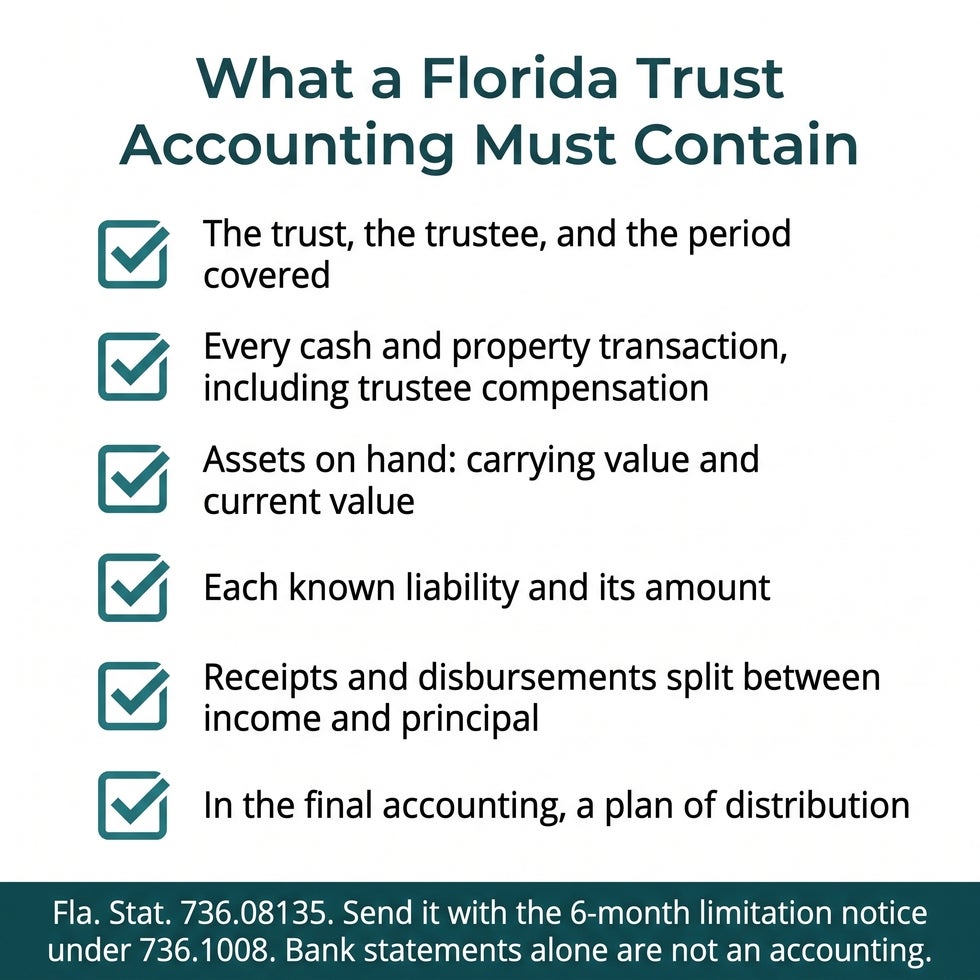
Accountings also protect the trustee, through the limitation notice in section 736.1008. When a beneficiary receives an accounting or other written report that adequately discloses a matter, together with a written statement that claims based on that document may be barred unless an action is commenced within six months, the beneficiary has six months to sue over what was disclosed. The statute supplies the exact wording. Without the notice, the ordinary limitations period in Chapter 95 applies, and for matters never disclosed the clock does not start until the beneficiary has actual knowledge. Send the notice with every accounting.
Best Practices for Clear Communication with Beneficiaries
Good communication is mostly a matter of sending the statutory notices on time, in plain language, and keeping proof. Send the 60-day letter by a method that produces a delivery record, include the trustee's contact information, and state in the letter that a copy of the trust document is available on request rather than waiting to be asked. A beneficiary who receives a copy of the instrument in the first month rarely hires a lawyer to demand one in the sixth.
Set expectations about time. Explain that debts, taxes, and valuations come before distributions, that a probate may be needed for assets left outside the instrument, and that a reserve will be held until the final tax return is filed. Stay neutral when siblings disagree, put anything that touches your own share in writing, and avoid conflicts of interest by never buying from or lending to the trust without the beneficiaries' written consent. Once the beneficiaries know what to expect, the trustee can turn to the assets themselves.
Handling and Managing Trust Assets in Florida
Handling trust assets in Florida means taking control of every account and parcel, keeping them separate from the trustee's own property, protecting them until distribution, and investing them prudently in the meantime. Section 736.0809 requires reasonable steps to take control of and protect the property, section 736.0810 requires clear records and prohibits commingling, and section 736.0815 gives the trustee, without a court order, all the powers over it that an unmarried competent owner has, subject to the fiduciary duties. That last point surprises new trustees: no court involvement is needed to sell the house or close the brokerage account.
The prudent investor rule in section 518.11 governs the investments during administration. For an administration that will distribute outright within a year, that usually means preserving value rather than chasing return, and it always means documenting the reasoning. A trustee who leaves a large cash balance uninvested for three years, or who keeps a concentrated stock position through a crash without a reason, has a problem the accounting will expose.
Valuing, Securing, and Protecting Trust Property
Start with the real property. Confirm the deed actually names the trustee; a Naples condo the settlor meant to transfer but never deeded is a probate asset. Keep the homeowner's and flood insurance in force, change the locks if the home is vacant, and get a written date-of-death valuation, because that figure becomes the beneficiaries' income tax basis. Homestead held this way carries two extra rules. The property tax exemption continues during the settlor's life under section 196.041(2), and the constitutional restriction on devising homestead applies to a trust exactly as it applies to a will: section 732.4015(2) defines "devise" to include a disposition by trust, so if the settlor was survived by a spouse or a minor child, a trust provision leaving the home to anyone else fails as to the homestead and section 732.401 controls instead. My earlier article on Florida homestead in probate walks through that rule.
Then the accounts and everything else. Retitle bank accounts and brokerage accounts into the trustee's name under the new tax number, and record each date-of-death balance. Life insurance and retirement accounts pass by beneficiary designation regardless of what the instrument says, so confirm who was named. Business interests need the operating agreement read for transfer restrictions. Tangible personal property, from the boat to the jewelry, is inventoried and photographed. Every one of those steps produces a record, and the records are what the accounting is built from.
Distribution Process of Trust Assets to Beneficiaries
Distribution comes last, after the settlor's debts, the expenses of administration, and taxes are provided for, and a reasonable reserve is set aside. Section 736.0817 says exactly that: on termination the trustee must proceed expeditiously to distribute the property to the persons entitled to it, subject to the right to retain a reserve for debts, expenses, and taxes. Distribution can be outright, in kind (the condo deeded to the daughter, the brokerage account transferred in place), or into a continuing fund for a minor, a spendthrift beneficiary, or a beneficiary with special needs, whichever the terms of the trust direct. Take a signed receipt and release from each beneficiary for each distribution.
The creditor question is what most often decides when the trustee may safely distribute. Under section 733.707(3) and section 736.05053, the assets of a revocable trust remain liable for the settlor's debts and the expenses of administering the estate to the extent the probate estate cannot pay them, and the trustee must pay whatever the personal representative certifies in writing is needed. The instrument itself has no creditor-claim procedure and no deadline. The only way to start the three-month clock under section 733.702 is to open a probate, even a small or empty formal administration, and publish the notice to creditors under section 733.2121, which also requires notice to the Agency for Health Care Administration when the decedent was 55 or older, so that any Medicaid estate recovery claim is filed or barred. Whether to open one is an important decision, and it should be made early. If nobody publishes, creditor claims are cut off only by the two-year limit in section 733.710, and a careful trustee holds a reserve until then. My earlier article, Florida Probate Creditor Claims: Do Heirs Owe the Debt?, covers the claim classes and deadlines in full.
Then the closing. Prepare the final accounting with its plan of distribution, deliver it with the six-month limitation notice, file the final Form 1041 and issue the last K-1s, distribute the reserve, and keep the records for years afterward. Whether all of that goes smoothly depends on the trustee having done the earlier steps correctly, which is where liability comes in.
Can a Trustee Be Held Personally Liable in Florida?
Yes. Under section 736.1001, any violation of a duty owed to a beneficiary is a breach, and the court may compel performance, order an accounting, surcharge the trustee, deny compensation, or remove the trustee. Trustee liability Florida courts impose is personal liability, paid from the trustee's own pocket.
The protection is procedural rather than magical. A trustee who follows the instrument, sends the notices, keeps the property separate, accounts annually with the limitation notice, and documents the reasons for each decision has both the statute and the record on his or her side. One who treats the role as informal family business has neither.
Common Mistakes and Trustee Liability in Florida
The mistakes that produce surcharge claims are predictable, and most of them happen in the first year:
- Distributing before the debts, taxes, and reserve are settled, then discovering a creditor, a tax bill, or a sibling's objection with no funds left to meet it.
- Never sending the 60-day notices, which is a breach on its own and, under Revah, leaves the limitation period open indefinitely.
- Mixing trust money with personal money, or paying personal expenses from the trust account "to be reimbursed later."
- Self-dealing: buying the house from the trust at a family price, lending trust funds to oneself, or hiring one's own company, each voidable under section 736.0802 unless authorized.
- Treating bank statements as accountings. The Fourth District said in terms that transaction logs are not a statutory accounting.
- Sitting on assets for years without a reason, in violation of the prudent investor rule and the duty to distribute expeditiously.
None of those requires bad intent. Most are the product of a trustee who never got legal advice from a qualified attorney at the start, and complex trusts with continuing shares for grandchildren or a beneficiary with special needs raise the stakes. Section 736.1007(4) lists exactly that advice, from who must be served with notices to the advisability of a probate to bar creditors, as the ordinary services a trustee's attorney provides.
Trustee Resignation, Replacement, and Removal Procedures
A trustee may resign, and a trustee may be removed. Resignation follows whatever procedure the instrument sets, and Chapter 736 requires the departing trustee to account to the successor and to the qualified beneficiaries under section 736.0813(1)(d), because a change of trustee is one of the events that triggers an accounting. Do not resign by walking away; deliver the records, the account balances, and a written accounting to whoever takes over.
Removal is a court matter. Under section 736.0706, a cotrustee, a beneficiary, or the court itself may seek removal for a serious breach of trust, for a lack of cooperation among cotrustees that impairs the administration, for unfitness or persistent failure to administer the trust effectively, or on a substantial change of circumstances when all qualified beneficiaries request it and a suitable successor is available. Venue lies in the county where the trust is administered or where a beneficiary resides under section 736.0204. Those proceedings are litigation in the circuit court, and our office refers contested matters to litigation counsel; the point here is that the beneficiaries have a remedy, and the trustee should administer as if they will use it. One more subject generates friction between trustees and beneficiaries, and it is money.
Florida Trustee Fees and Recordkeeping Requirements
Florida trustee fees are governed by section 736.0708: if the terms of the trust do not specify compensation, the trustee is entitled to compensation that is reasonable under the circumstances, and if the instrument does set a figure, the court may still allow more or less when the duties turn out to be substantially different or the stated amount is unreasonably high or low. A family member serving as trustee may waive compensation, and many do when they are also the main beneficiary, because a fee is taxable income to the trustee and an inheritance is not.
Recordkeeping is the other half of this section because fees are where records get tested. Every payment to the trustee, and every reimbursement, appears in the accounting under section 736.08135(2)(b), which requires compensation paid to the trustee and the trustee's agents to be shown. Keep time logs, receipts, bank statements, valuations, copies of every notice, and the tax returns, and keep them past the limitations periods.
Types of Trustee Fees and Guidelines for Payment in Florida
Two kinds of fees come out during initial administration. The first is the trustee's own reasonable compensation described above. The second is the fee of the attorney the trustee hires, which section 736.1007 makes payable from the trust without a court order. That statute presumes a fee reasonable at 75 percent of the probate attorney schedule in section 733.6171, measured on the value of the trust assets immediately after the settlor's death, but it also states in terms that there is no mandatory statutory attorney fee, that the fee is negotiable, that the trustee may choose any attorney and is not required to hire the one who drafted the instrument, and that the attorney must make those disclosures in writing and obtain the trustee's signature before charging by the schedule. Our office quotes trust administrations as flat fees in writing, with those disclosures, before any work begins.
Payment guidelines are simple. Pay the expenses of trust administration, including the trustee's and the attorney's compensation, before the settlor's estate obligations, which is the order section 736.05053(4) sets. Pay yourself only what the instrument or the reasonableness standard supports, show every payment in the accounting, and remember that any interested person may ask the court under section 736.1007(6) to review the attorney's fee. With the fees and records in order, the remaining question is who should help.
How The Nussbickel Law Firm Handles Trust Administration
The Nussbickel Law Firm, P.A. handles Florida estate planning, probate, and trust administration for families in Lee, Collier, and Charlotte Counties, and Florida estate and probate matters statewide. A trust attorney sees the same legal requirements in every file, and the job is to walk a new trustee through them every step of the way. When a successor trustee calls us after a death, we read the entire instrument and every amendment, identify what is in the trust and what was left outside it, calendar the two 60-day notices and the notice of trust filing, and tell the trustee in writing whether a probate is needed to bar creditors or to move pour-over assets, and what our fee will be. Out-of-state trustees are common here; Florida imposes no residency requirement on a trustee, unlike the rule for personal representatives in section 733.304, and most of the work can be done by phone, video, and email.
Bring the trust and every amendment, the pour-over will, two death certificates, the most recent statement for every account, the deed to every parcel, the settlor's last two income tax returns, and a list of the beneficiaries with addresses, and the first meeting produces a plan rather than a list of questions. To talk through a trust administration after death Florida families in our area are facing, schedule a free consultation or call our Fort Myers office at 239-900-WILL (9455).
Conclusion
Trust administration after death Florida law governs is a sequence with deadlines: accept in writing, file the notice of trust under section 736.05055, send the two 60-day notices under section 736.0813, secure and value the assets, decide whether a probate is needed to cut off creditors under sections 733.707(3) and 733.702, file the tax returns, account annually with the section 736.1008 limitation notice, and distribute with a reserve. None of it requires a courtroom, and all of it requires records. A trustee who does those things in that order will finish a simple administration in well under a year and will have an answer for every question a beneficiary can ask. One illustration follows, then the questions we hear most.
Consider a Naples widower whose revocable living trust holds his condo, a brokerage account, and a bank account, with a car and a small checking account left in his own name and two adult children as equal beneficiaries. In the first 60 days his daughter, the successor trustee, orders death certificates, accepts in writing, files the notice of trust in Collier County, obtains a tax number, opens a trust account, and sends both statutory notices to her brother and herself. She opens a summary administration for the car and the checking account, which together fall under $150,000, and because the decedent was over 55 her attorney serves the Agency for Health Care Administration. She has the condo appraised as of the date of death, sells it as trustee, files her father's final 1040 and the trust's 1041, holds a reserve until the two-year creditor period and the last return are behind her, sends an accounting with the limitation notice, and distributes the balance against signed receipts. That is an illustration, not a case, and every real family differs.
Frequently Asked Questions
Does a trust have to go through probate in Florida?
No, not for the assets that were actually titled in the trustee's name before death. Those pass under the instrument without a court proceeding. A probate is still needed for anything left in the settlor's own name, which the pour-over will moves into the instrument under section 732.513, and a trustee often opens a probate voluntarily so that the notice to creditors can be published and the three-month claims deadline under section 733.702 can run against the assets the trustee holds. The firm's video If I Have a Trust, Do I Still Need a Will in Florida? covers the pour-over side.
How long does a trustee have to distribute assets in Florida?
There is no fixed statutory deadline for trust administration after death Florida trustees run. Section 736.0817 requires the trustee to proceed expeditiously once the trust terminates, subject to a reasonable reserve for debts, expenses, and taxes. In practice a simple administration with liquid assets and cooperative beneficiaries commonly closes within about a year, while one with real estate to sell, a probate to run for creditors, or a federal estate tax return takes longer. A beneficiary who believes the trustee is stalling may ask the court to compel distribution under section 736.1001.
What is on a Florida trust administration checklist?
Order certified death certificates; locate and read the entire instrument and every amendment; accept the trusteeship in writing; file the notice of trust with the clerk under section 736.05055; obtain a taxpayer identification number and file IRS Form 56; send the qualified beneficiaries the two notices section 736.0813 requires within 60 days; inventory and secure every asset with its date-of-death value; and identify any asset left outside it that will need a probate. Those eight items are the first 60 days; everything after, from tax returns to distribution, builds on them.
Can a beneficiary demand a copy of the trust in Florida?
Yes. Under section 736.0813(1)(c), a qualified beneficiary is entitled on reasonable request to a complete copy of the trust instrument, and the 60-day notice must tell the beneficiary that the right exists. A beneficiary may also request relevant information about the assets and liabilities and is entitled to an accounting at least annually. A trustee who refuses is in breach, and in Revah v. Revah, the Fourth District treated a decade of missing accountings as a per se breach of trust.
Gregory J. Nussbickel is the founder of The Nussbickel Law Firm, P.A. in Fort Myers, Florida. His practice is devoted exclusively to estate planning, probate, and trust administration for families throughout Southwest Florida.
This article is for general informational purposes only and is not legal advice or tax advice. Reading it does not create an attorney-client relationship. Trust and probate law changes, every family's life circumstances and legal situation differ, and the right answer depends on individual circumstances, so speak with a qualified Florida attorney about your own.

Comments
There are no comments for this post. Be the first and Add your Comment below.
Leave a Comment