
Key Highlights
- Under elective share Florida law, a surviving spouse may claim 30 percent of the elective estate, even if the will or trust leaves the spouse little or nothing.
- The elective estate is broader than the probate estate: it reaches revocable trust assets, POD and joint accounts, retirement benefits, recent gifts, and the protected homestead.
- The election must be filed in the probate case by the earlier of 6 months after the notice of administration is served on the spouse or 2 years after the date of death.
- Whatever the spouse already receives from the estate is credited first, so the 30 percent is a floor, not a bonus.
- A valid written agreement signed before two witnesses can waive the right; a waiver signed after marriage requires fair disclosure.
Introduction
The short answer: The elective share Florida law provides lets a surviving spouse take 30 percent of the "elective estate" of the decedent (the husband or wife who died), a pool that includes trusts and accounts that skip probate. The spouse must file an election in the probate case before a strict deadline, and anything the spouse already inherits counts toward the 30 percent.
I see two families on opposite sides of this rule. One is the second spouse in a blended family, whose husband or wife left most of the estate to adult children from a prior marriage. The other is those adult children, a successor trustee, or a personal representative who has just been served with a notice of election and wants to know what it reaches.
What Does the Elective Share Florida Law Protect?
It protects a surviving spouse from being left with nothing. Electing does not cost the survivor the homestead, exempt property, or family allowance under section 732.2105, although the value of the survivor's homestead interest is credited toward the 30 percent. The elective share is one of several spousal rights after death in Florida, and they work differently:
| Spouse's right | What it gives | Time limit | If the spouse elects |
|---|---|---|---|
|
Elective share (§ 732.2065) |
30% of the elective estate |
Earlier of 6 months after service of the notice of administration or 2 years after death |
n/a |
|
Intestate share (§ 732.102) |
All or half of the probate estate, other than the homestead, when there is no valid will |
Taken in the administration |
Kept; counts toward the 30% |
|
Pretermitted spouse (§ 732.301) |
An intestate share when the will was signed before the marriage, unless the will provides for the survivor, shows an intent not to, or a marital agreement covers it |
Taken in the administration |
Kept; counts toward the 30% |
|
Homestead (§ 732.401) |
If the home was not validly left by will and the decedent had descendants: a life estate, or a one-half interest if elected |
6 months after death, during the survivor's lifetime, for the one-half election |
Kept; that interest counts toward the 30% |
|
Exempt property (§ 732.402) |
Household furnishings up to $20,000, two vehicles, and more |
Petition, generally within 4 months after service of the notice of administration |
Kept; not counted toward the 30% |
|
Family allowance (§ 732.403) |
Up to $18,000 during administration |
Requested in the administration |
Kept; paid in addition |
Because the homestead and the elective share interact, read my earlier article, Florida Homestead Probate, alongside this one. With the family's protections in view, the next question is who can claim the share.
What Is the Elective Share in Florida and Who Can Claim It?
Can you disinherit a spouse in Florida? Not completely. The elective share is a surviving spouse's statutory right to take 30 percent of the decedent's elective estate, whatever the will or trust says, unless the spouse signed a valid waiver. The spouse must claim it by filing an election on time.
A will or revocable trust that leaves the survivor little does not end the claim, and electing does not forfeit what the will does leave. Section 732.201 says the election does not reduce what the spouse would otherwise receive.
Who qualifies as a surviving spouse?
The right belongs to the surviving spouse of a person who died domiciled in Florida. If the decedent was domiciled outside the State of Florida, Florida's elective share does not apply, and the survivor looks to the law of that state.
A prenuptial agreement or postnuptial agreement can waive the right in whole or in part. Under section 732.702, an elective share waiver must be a valid written agreement signed in the presence of two subscribing witnesses; a waiver a nonresident signed elsewhere is valid if it met the law of the place where it was signed. A waiver signed before marriage needs no financial disclosure; a postnuptial waiver needs fair disclosure of each spouse's estate. A waiver can be partial, giving up the elective share while keeping the spouse's rights to homestead, and a waiver of "all rights" waives the elective share unless it says otherwise. My article on estate planning for married couples covers these agreements.
The survivor usually elects personally. Under section 732.2125, an agent under a power of attorney or a guardian of the property may elect only with court approval, after the court finds the election is in the spouse's best interests during the spouse's probable lifetime. If the surviving spouse receives or may need Medicaid, get advice before deciding: Florida law allows the share to be satisfied through a qualifying special needs trust for an ill or disabled spouse (court-approved unless the trusts hold less than $100,000).
How much of the elective estate can a spouse claim?
The Florida elective share statute, section 732.2065, sets an elective share equal to 30 percent of the elective estate. The figure does not change with the length of the marriage or the number of children.
The 30 percent is a target, not an extra payment. Unless the will says otherwise, property passing to the survivor is applied first: devises, trust interests, accounts, retirement benefits paid to the survivor, and life insurance on the decedent's life that someone other than the survivor owned. Property the survivor disclaims is still counted against the share. Assets are valued net of the claims, mortgages and liens against them.
Suppose the elective estate is $900,000, so the share is $270,000. If the deceased spouse's will left the survivor a $150,000 brokerage account, the unpaid balance is $120,000. That balance comes first from the probate estate and the revocable trust, then from other recipients.
A trust for the survivor usually counts at less than its full value. An elective share trust (one that gives the survivor all income at least annually, or the use of the property, for life, lets the survivor require the trustee to make the property productive, and lets no one else benefit during the survivor's life) counts at 100, 80, or 50 percent of its principal, depending on the survivor's powers. Other trusts count for less. A QTIP trust, the qualified terminable interest property trust used for the federal marital deduction, is often drafted to meet those terms.
Knowing the percentage is only half the math; the other half is the size of the pool.
What Property Counts Toward the Elective Estate?
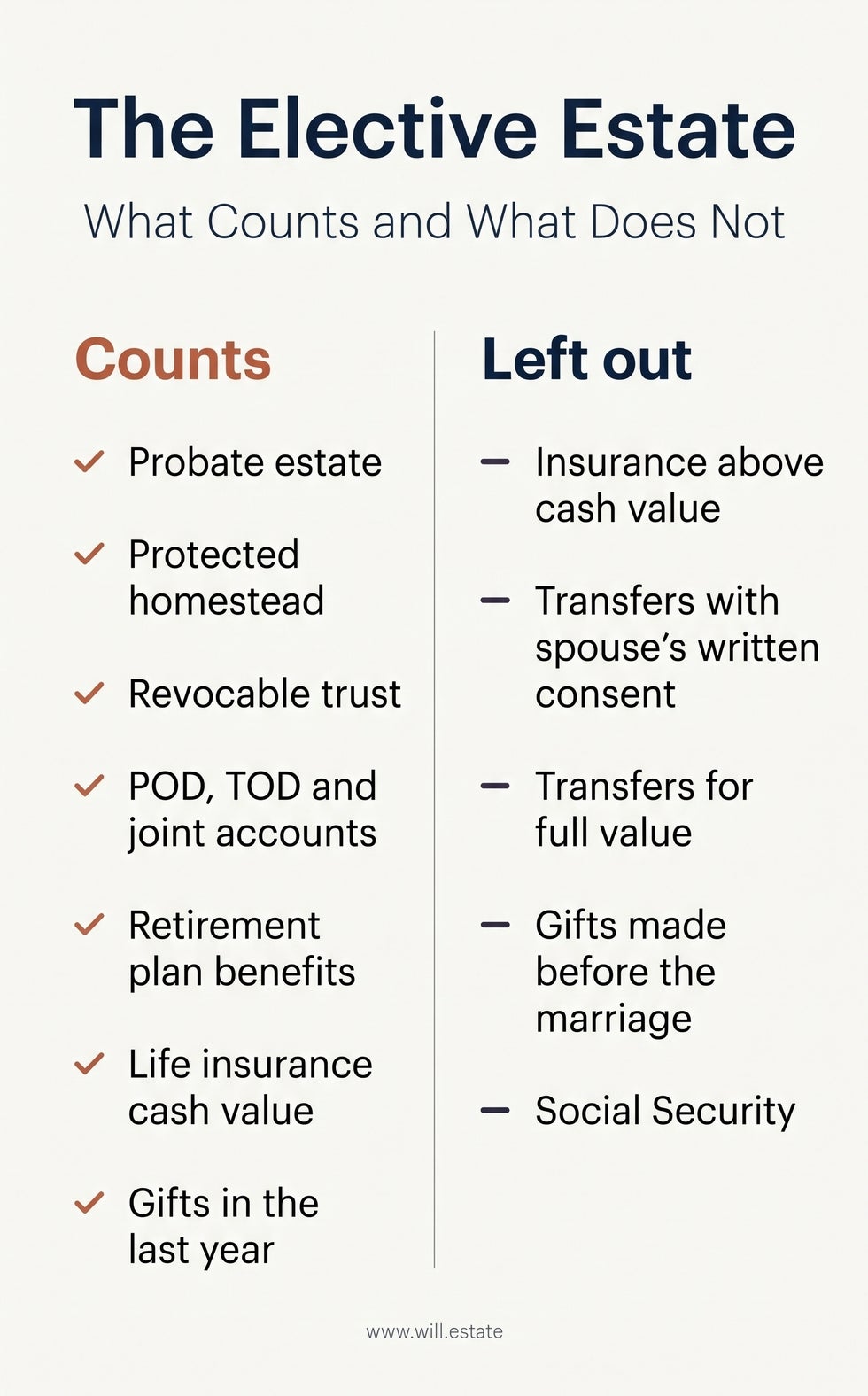
The elective estate counts far more than the probate estate. Under Florida Statutes section 732.2035, it includes the probate estate, the protected homestead, revocable trust assets, POD, TOD and joint accounts, jointly owned real estate, retirement plans, life insurance cash value, and many transfers made in the year before death. Probate avoidance is not elective share avoidance.
The firm's video Do All Assets Go Through Probate in Florida? explains the probate side of that line.
Are revocable trusts included in the elective estate?
Yes. Property the decedent could revoke at death, alone or with someone else, is part of the elective estate. Moving the brokerage account and the family home into a revocable trust avoids probate, but the trust assets still count.
Revocable trusts also pay first. They stand with the probate estate at the front of the line, so the successor trustee may be ordered to contribute before anyone else. My article on revocable vs. irrevocable trusts in Florida explains the difference, and the firm's video What Is a Revocable Living Trust in Florida? covers the basics.
Irrevocable trusts can count too, if the decedent kept the income or could receive principal. An irrevocable transfer made before the marriage does not count.
How are POD, TOD, and joint accounts treated?
They count, measured by what the decedent could withdraw or use just before death. For an account held as tenants by the entirety with the surviving spouse, half the balance counts. For real estate held in joint tenancy with right of survivorship, the value is divided by the number of owners.
Banks and other payors are protected: under section 732.2115 a bank that pays a POD beneficiary in good faith is not liable. The beneficiary who received the money, though, may later be ordered to contribute.
Do retirement accounts and life insurance count?
Retirement accounts usually count. Amounts payable to anyone because they survived the decedent under a pension, retirement, or deferred compensation plan are included; Social Security and Railroad Retirement benefits are not. For business owners and professionals, retirement benefits are often the largest asset in the pool.
Life insurance counts only to the extent of the policy's net cash surrender value just before death. A term policy with no cash value adds nothing, and proceeds above the cash value are left out, whoever the beneficiary is.
Are gifts in the year before death included?
Many are. Families usually ask about gifts in the year of death, but the rule looks back one full year from the date of death. Transfers made in that year are included, except tuition and medical bills paid directly and the first annual exclusion amount given to each person ($19,000 in 2026). Giving up a retained power over a trust during that year is also pulled back in.
Gifts made earlier are generally outside the rule unless the decedent kept the use or income of the property.
What is excluded, and what about homestead?
Protected homestead is not excluded. The family home counts at its full value, less any mortgage, if the survivor inherits it outright, and at half its value if the survivor takes the life estate or the one-half interest under section 732.401. It drops out only when the spouse validly waived homestead rights and receives no interest in the home.
Section 732.2045 leaves these, among others, out of the decedent's elective estate:
- transfers made with the spouse's written consent (consent to split-gift tax treatment does not count);
- transfers for full value in money or money's worth;
- property given away irrevocably before the marriage;
- life insurance above the net cash surrender value, and insurance kept under a court order;
- property in a qualifying special needs trust for the spouse.
Once you know what is in the pool, the next issue is the clock.
What Is the Deadline to Claim the Elective Share in Florida?
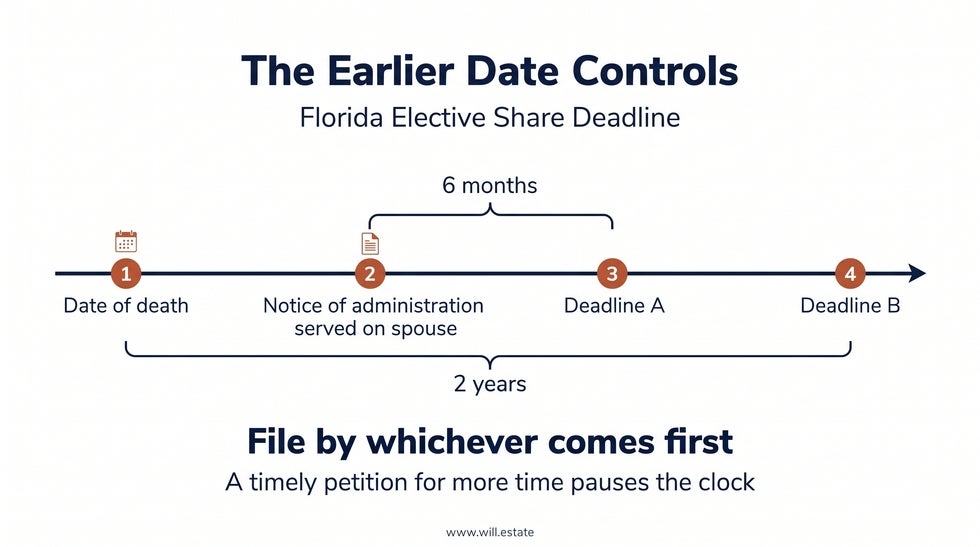
The elective share deadline in Florida is the earlier of 6 months after a copy of the notice of administration is served on the surviving spouse or 2 years after the date of death. The personal representative's notice of administration must state that deadline, so read it the day it arrives.
The election is filed in the probate court handling the estate, so if no one has opened a case, someone must. In a 2022 Broward County appeal, Rasor v. Estate of Rasor, the widow filed her election the same day she petitioned to probate her husband's will.
How long does a spouse have, and can it be extended?
Under section 732.2135, the earlier of the two dates controls. The court may extend it for good cause if the spouse petitions within that period (or within 40 days after a proceeding affecting the amount ends, if later), and the petition must be filed within 2 years after death.
A timely petition stops the clock. In Futch v. Haney (Fla. 2d DCA 2021), a widow filed three extension petitions, each before the last one expired, and then her election. The court held that the pending petitions tolled the deadline, so the election was timely, even though the trial court had not granted them. Florida courts describe a strong public policy of protecting a surviving spouse. A spouse may withdraw an election within 8 months after death and before the court's order of contribution.
What if the spouse misses the deadline or dies first?
Missing an elective share Florida deadline is usually final. A late election is barred, and the survivor keeps only what the will, the trust, intestacy, and the homestead and exempt property rules provide.
If the spouse dies before electing, the right generally ends, because the statute lets only the survivor, or an agent or guardian with court approval, make the election. An election filed before death can still be pursued by the survivor's personal representative, as the statute and the probate rules contemplate. In Rasor, the widow died four months after her husband, and her estate's personal representative carried her election forward.
Next step: a free consultation
If you are a surviving spouse, or a personal representative or trustee who has been served with an election, talk to a Florida probate attorney before the deadline runs. We offer a free consultation by phone, by video, or at our Fort Myers office.
Bring the will, the trust, the notice of administration, and recent account and retirement statements. Schedule your free consultation, call (239) 900-9455, or read more about our Florida probate services.
How Does a Surviving Spouse File for the Elective Share in Florida?
Here is how to file for elective share in Florida: for a surviving spouse elective share claim, the spouse files a written election in the probate administration for the decedent's estate and serves it on the personal representative. A letter to the trustee is not enough. The court then decides entitlement, the amount, and who contributes.
That process follows Florida Probate Rule 5.360. If you have not yet seen how a probate case opens, my article on formal administration in Florida and the firm's video What Is Formal Administration in Florida Probate? walk through it.
Step-by-step filing procedure
- Confirm a probate case is open, or open one; the court issues letters of administration to the personal representative.
- File the election before the deadline and serve it on the personal representative. An agent or guardian petitions for court approval first.
- Within 20 days after service of the election, the personal representative serves a notice of election on all interested persons.
- Interested persons have 20 days after that notice to serve objections, stating their grounds with particularity.
- With no timely objection, the court enters an order that the survivor is entitled to the share; otherwise it decides after a hearing.
- Within 60 days after the entitlement order, the personal representative petitions to set the amount and serves an inventory of the elective estate; if no petition is filed within 90 days after that order, the survivor may file it.
- The court enters an order of contribution naming who pays and how much.
Under section 732.2145, the personal representative collects the contributions, and the survivor may enforce the order directly and recover attorney's fees. Any part of the share not satisfied within 2 years of the date of death bears interest. Trustees facing an order can read my guide to trust administration after death.
How The Nussbickel Law Firm Helps
The Nussbickel Law Firm, P.A. practices estate planning, probate and trust administration and nothing else. From our Fort Myers office we handle probate throughout Florida and estate planning for families in Lee, Collier and Charlotte counties.
After a death, we help surviving spouses decide whether an elective share Florida claim is worth making and file it on time, and we help personal representatives and trustees serve the notice of election, build the elective estate inventory, and carry out the order of contribution. If objections turn into contested litigation, you will need trial counsel; we do not litigate.
Before a death, we draft prenuptial and postnuptial waivers that meet section 732.702, and plans for second marriages that use an elective share trust deliberately. Schedule a free consultation or call 239-900-WILL (9455).
Frequently Asked Questions
Does a wife automatically inherit her husband's assets in Florida?
No. What a wife or husband inherits depends on the will, the trust, how each account is titled, and Florida's intestacy law. With no valid will, the surviving spouse takes all or half of the probate estate other than the homestead, depending on whether either spouse has children who are not the other's; see probate without a will. The elective share is a right the spouse must claim by filing on time.
How does Florida's elective share compare with other states?
Florida's elective share is a flat 30 percent of the elective estate, whatever the length of the marriage, and it applies only when the decedent was domiciled in Florida. Some states, following the Uniform Probate Code, instead scale the share to the marriage's length; Minnesota, for example, starts at 3 percent of a broader "augmented estate" after one year and reaches 50 percent after 15.
Conclusion
The elective share Florida law creates is a floor of 30 percent for a surviving spouse, measured against a pool that includes trusts, accounts, retirement benefits, recent gifts, and the family home. Everything the spouse already receives counts first, and the right is lost if the election is late.
If you have been served with a notice of administration, calendar the date 6 months from service and compare it with the date 2 years from death; the earlier one is your deadline. Then gather the will, the trust, and the account statements, and get advice while there is still time to petition for more. If you are planning instead, have an experienced estate planning attorney review any waiver before you sign it.
Gregory J. Nussbickel is the founder of The Nussbickel Law Firm, P.A. in Fort Myers, Florida, and a member of The Florida Bar. His practice is devoted exclusively to estate planning, probate, and trust administration for families throughout Southwest Florida.
This article is for general information only and is not legal advice. Reading it does not create an attorney-client relationship. Elective share rights depend on the facts and on where the decedent was domiciled; speak with a licensed Florida attorney about your specific situation.

Comments
There are no comments for this post. Be the first and Add your Comment below.
Leave a Comment