

Key Highlights
- An estate planning checklist for seniors runs on six documents: a last will, a revocable trust, a durable power of attorney, a health care surrogate designation, a living will, and a HIPAA release.
- Beneficiary designations on life insurance policies and financial accounts control those dollars no matter what your will says.
- Springing powers of attorney signed in Florida after October 1, 2011 are ineffective (Fla. Stat. 709.2108), so a durable power of attorney works the moment you sign it.
- A Florida will needs two attesting witnesses (Fla. Stat. 732.502); a health care surrogate designation needs two adult witnesses, one not a spouse or blood relative (Fla. Stat. 765.202).
- The federal estate tax exemption is $15,000,000 per person for 2026 deaths and Florida charges no death tax, so most families are planning around probate and incapacity.
Introduction
The short answer: An estate planning checklist for seniors runs in twelve steps: inventory what you own, review every beneficiary designation, sign or update a last will, decide whether a trust fits, name an executor, sign a durable power of attorney, name a health care surrogate, complete a living will, organize the paperwork, cover digital assets, tell your family, and review yearly. Six documents, one binder, one annual check.
Most people we meet in Fort Myers and Naples are not behind because they made bad decisions. They are behind because life kept moving. This guide walks the estate planning process in order.
What Is Estate Planning for Seniors?
Estate planning for seniors is the process of signing legal documents that say who makes your financial and medical decisions if you cannot, and who receives your property when you die. For older adults it also covers incapacity, long-term care costs, and keeping your family out of court.
Estate Planning Explained
A plan is instructions written in a form the law enforces. A legal document signed with the right formalities binds banks, hospitals, and courts.
Who Needs an Estate Plan?
Every adult needs the incapacity documents, and every property owner needs the transfer documents. Contrary to popular belief, this is not a wealth question: a homeowner in Lehigh Acres has more at stake than a renter.
Estate Planning vs Probate Planning
Planning happens while you are alive and in control. Probate is the court process that cleans up whatever planning missed. Proper planning shrinks probate, because unplanned assets land there.
Why Every Senior Needs an Estate Plan
The reasons stack up fast, and only one is about money. A plan protects the people you love from decisions they are not equipped to make, and from a court process nobody wants.
Protect Your Family
Without documents, the family member closest to you has no legal authority to act. They can sit beside you in the hospital and still be told nothing.
Prepare for Incapacity
Incapacity is the likelier event. A durable power of attorney and a health care surrogate designation keep your affairs running without a guardianship case in the Twentieth Judicial Circuit.
Avoid Probate Delays
Assets in your sole name with no beneficiary go through probate first. For the main workarounds, see my earlier article, Top Ways to Avoid Florida Probate: A Quick Guide.
Reduce Family Conflict
Most fights are not about greed but about ambiguity. Clear asset distribution written down in advance removes the guesswork that turns siblings into opponents.
Protect Your Assets
Planning shields what you built from probate fees, a tax burden better titling would have reduced, and long-term care spending. Estate taxes reach very few families, since the federal estate tax exemption is $15,000,000 per person for 2026, and Florida adds none.
Ensure Your Healthcare Wishes Are Honoured
A living will tells healthcare providers what you want when you cannot speak. Without one, your family carries a decision you could have made for them.
Estate Planning Checklist: Step-by-Step
Here is the sequence we use with clients, ordered so each step makes the next easier. Work an estate planning checklist for seniors over a few weeks, not one afternoon.
Step 1: Make a Complete Inventory of Your Estate
You cannot plan around assets you have not listed. Start one page:
- Real Estate: homestead, rental or vacation property, out-of-state land
- Bank Accounts: checking, savings, certificates of deposit
- Retirement Accounts: IRAs, 401(k)s, 403(b)s, pensions
- Investments: brokerage accounts, securities, annuities
- Business Interests: LLC membership, partnership shares, closely held stock
- Vehicles: cars, boats, motorcycles, recreational vehicles
- Valuable Personal Property: jewelry, art, collections, firearms
- Outstanding Debts: mortgages, equity lines, credit cards, medical bills
List your insurance policies, and note where each statement arrives.
Step 2: Review Beneficiary Designations
This step is skipped most often and goes wrong most often: designations pass outside your will, so a stale form quietly rewrites your plan.
Life Insurance
Pull the current form from each carrier, not from memory. Life insurance policies bought decades ago frequently still name a parent or former spouse.
401(k)s & IRAs
Retirement plans pass by designation and carry their own tax rules. Naming a person rather than "my estate" usually preserves better options.
Payable-on-Death Accounts
Florida banks add a payable-on-death designation to financial accounts at no cost. The account stays yours during life, then transfers on proof of death.
Transfer-on-Death Deeds
Florida does not use transfer-on-death deeds. The equivalent is the enhanced life estate deed, or Lady Bird deed, which passes your home to your intended recipients outside probate.
Step 3: Create or Update Your Will
Florida requires the testator and two witnesses to sign in each other's presence under Fla. Stat. 732.502. A notary makes the will self-proving.
What a Will Covers
Your last will governs the distribution of assets titled in your sole name, names your personal representative, and can create trusts for minor children.
What a Will Doesn't Cover
It does not reach jointly owned property, trust assets, or anything with a living beneficiary, and it cannot override Florida homestead rules when a spouse or minor child survives you.
When to Update Your Will
Update after a death, divorce, marriage, major sale, or a move to Florida. A will valid elsewhere is usually valid here.
Step 4: Decide Whether You Need a Trust
A trust is a private instruction set holding title to property. Which type of trust fits depends on whether you want probate avoidance, tax planning, or protection for a beneficiary.
Revocable Living Trust
You keep control and can change it any time. Its value is continuity: your successor trustee steps in on incapacity or death, and assets stay out of the public records probate creates.
Irrevocable Trust
You trade control for creditor protection, Medicaid lead time, or removing growth from a taxable estate. We compare both in revocable and irrevocable trusts in Florida.
Special Needs Trust
This preserves eligibility for government benefits such as Medicaid and SSI while providing for a disabled loved one. It is the safety net a direct inheritance would destroy.
Charitable Trust
A charitable remainder or lead trust supports a cause while producing income or a deduction.
Step 5: Choose an Executor
Florida calls this person the personal representative. Choose for reliability and availability, and always name an alternate.
Responsibilities
Your personal representative gathers assets, notifies creditors, files an inventory, pays valid debts and taxes, and distributes the rest under court supervision.
Who Makes a Good Executor?
Someone organized, financially literate, and calm under family pressure. Florida also limits nonresidents: under Fla. Stat. 733.304, a nonresident must be a close relative.
Common Mistakes
Naming all three children jointly, naming someone already overwhelmed, or naming a person who has never been asked.
Step 6: Appoint Financial Power of Attorney
A power of attorney lets your agent handle financial matters when you cannot. Florida's version is powerful and immediate, so choose carefully.
Durable vs Limited POA
A durable power of attorney survives incapacity and covers broad financial decisions. A limited one covers a single transaction, such as a closing you cannot attend.
When It Takes Effect
Immediately. Under Fla. Stat. 709.2108, a Florida power of attorney signed after October 1, 2011 cannot spring into effect later. Gifting and beneficiary changes must be separately initialed under Fla. Stat. 709.2202.
Step 7: Appoint a Healthcare Power of Attorney
Florida's document is the designation of health care surrogate, signed before two adult witnesses under Fla. Stat. 765.202. At least one witness cannot be your spouse or blood relative.
Healthcare Proxy
What other states call a health care proxy, Florida calls a surrogate. Your surrogate can consent to medical treatment, review records, and discuss your medical care with doctors.
Choosing the Right Person
Pick someone who can hear hard news and still follow your instructions rather than their own.
Step 8: Complete Your Advance Healthcare Directive
Advance care planning is where you write down what you want before anyone guesses. Florida treats it as a document separate from the surrogate designation.
Living Will
A living will directs whether life-prolonging procedures are provided or withheld in a terminal condition, end-stage condition, or persistent vegetative state. See my earlier article, Living Will vs Living Trust Florida: Do You Need Both?.
End-of-Life Preferences
Go past the checkboxes. Note your health care preferences on artificial nutrition, life support, and hospice. These reflect personal values no form captures.
Step 9: Organise Your Estate Planning Documents
The best plan fails if nobody can find it. Gather the important documents in one place, then tell two people where.
Physical Storage
Keep originals in a fireproof home safe, not a bank box, which can be sealed on death. Whoever holds the original will must deposit it with the clerk within ten days of learning of the death.
Digital Copies
Scan everything and store it where your agent can reach it. Copies do not replace an original will.
Emergency Access
Give your surrogate the health care documents now. Hospitals act on what is handed to them, so it is a good idea to leave copies with your doctor.
Step 10: Include Your Digital Assets
Florida's Fiduciary Access to Digital Assets Act, Chapter 740, lets your agent reach online accounts when the documents grant authority:
- Online Banking: logins, autopay arrangements, paperless settings
- Social Media: legacy contacts and memorialization preferences
- Cryptocurrency: wallets, exchanges, seed phrase location
- Password Managers: the master credential and recovery method
Step 11: Talk to Your Family
Open communication prevents most surprises that turn into litigation. You do not owe anyone numbers, but you owe the people you named a heads-up.
What to Share
Who holds each role, where the documents live, and the reasoning behind any arrangement that looks uneven at first glance.
What Not to Share
Account balances, account numbers, and passwords. Circulating those invites pressure you do not need.
How to Prevent Future Disputes
Put clear instructions in the documents rather than side letters, and address unequal gifts out loud. Silence creates potential disputes.
Step 12: Review Your Estate Plan Regularly
Plans go stale. Calendar a review the same week every year.
Annual Review Checklist
Confirm each named person is still willing and able, re-pull beneficiary forms, verify trust funding, and share changes with your financial advisor.
Life Events That Require Updates
A death, divorce, marriage, new grandchild, diagnosis, sale, or change in your financial situation. Kiplinger's checklist of thirteen smart moves is a useful annual prompt.
Do You Need a Will, a Trust, or Both?
Nearly everyone needs a will. Whether you also need a trust depends on what you own, where you own it, and how much privacy matters.
- When a will is enough: modest Florida-only assets, a homestead handled by deed, designations already working.
- When a trust is better: property in two states, a blended family, a beneficiary needing oversight, or a preference for privacy.
- Benefits of having both: the trust holds assets while a pour-over will catches whatever you forgot to retitle.
- Which option helps avoid probate? Only the funded trust. An unfunded trust avoids nothing, which is why funding matters.
If structure is the question, our look at who needs a trust instead of a will uses Florida examples.
Choosing the Right Estate Planning Attorney
The right attorney does this work daily and knows Florida's homestead, elective share, and creditor rules cold. Fit matters as much as credentials, because the relationship is long and built around your family's needs.
When You Need an Estate Planning Attorney
Bring in counsel when real property, a business, a blended family, an out-of-state asset, a special needs beneficiary, or long-term care is involved.
Estate Planning Attorney vs Probate Attorney
A planning attorney builds documents while you are alive; a probate attorney administers what you leave behind. Many Florida firms, ours included, do both.
How to Choose the Right Attorney
Ask what share of the practice is planning, whether the fee is flat, and how updates work. Our guide to finding an estate planning attorney covers the rest.
DIY vs Online Legal Services vs Hiring an Attorney
Software is good at producing documents and bad at spotting the issue you did not know to ask about. Professional guidance is what you are buying.
Estate Planning Attorney vs DIY vs Online Legal Services
All three produce something signable. They differ two years later, when the document has to work under pressure.
Cost Comparison
DIY runs from nothing to a few hundred dollars, online services a few hundred more. Attorney-drafted plans cost more up front and less over time.
Accuracy
Execution formalities, homestead restrictions, and the separate-signing rules for certain powers of attorney are where generic templates break.
Customization
Templates handle the common case. Blended families, unequal gifts, business succession, and heirs with benefits issues need drafting, not menus.
Probate Protection
None of the three avoids probate by itself. Only correct titling, funded trusts, and current designations do, and templates skip that coordination.
Best Option by Estate Complexity
Small and simple: a careful DIY or online will plus good designations can hold. Anything with real property, two states, or a vulnerable heir belongs with counsel.
Pros and Cons Comparison Table
How the three paths compare:
| DIY forms | Online service | Florida attorney | |
|---|---|---|---|
|
Up-front cost |
Lowest |
Moderate |
Highest |
|
Florida execution rules |
On you |
Generic |
Supervised signing |
|
Homestead and spousal rules |
No |
Rarely |
Central to drafting |
|
Trust funding help |
None |
Instructions |
Deeds prepared |
|
Someone to call later |
No |
Chat |
Your attorney |
How Much Does Estate Planning Cost?
Florida planning fees are usually flat, quoted before you engage. Your quote turns on complexity, not your bank balance.
- Cost of a simple will: a few hundred dollars standalone, less inside a package.
- Cost of a living trust: the largest line item, drafting plus the funding work behind it.
- Cost of a complete estate plan: will, trust, both powers of attorney, living will, and HIPAA release quoted as one comprehensive plan.
- Probate attorney fees: set separately by Fla. Stat. 733.6171, and negotiable.
- Flat fee vs hourly billing: planning is flat; administration is often hourly.
- Factors that affect cost: real property, out-of-state assets, business interests, blended families.
- Is estate planning worth the investment? Compare it to summary administration or a full probate, which costs multiples of a comprehensive estate plan.
See our breakdown of what an estate planning lawyer costs and the average cost of a will and trust in Florida.
Common Estate Planning Mistakes Seniors Make
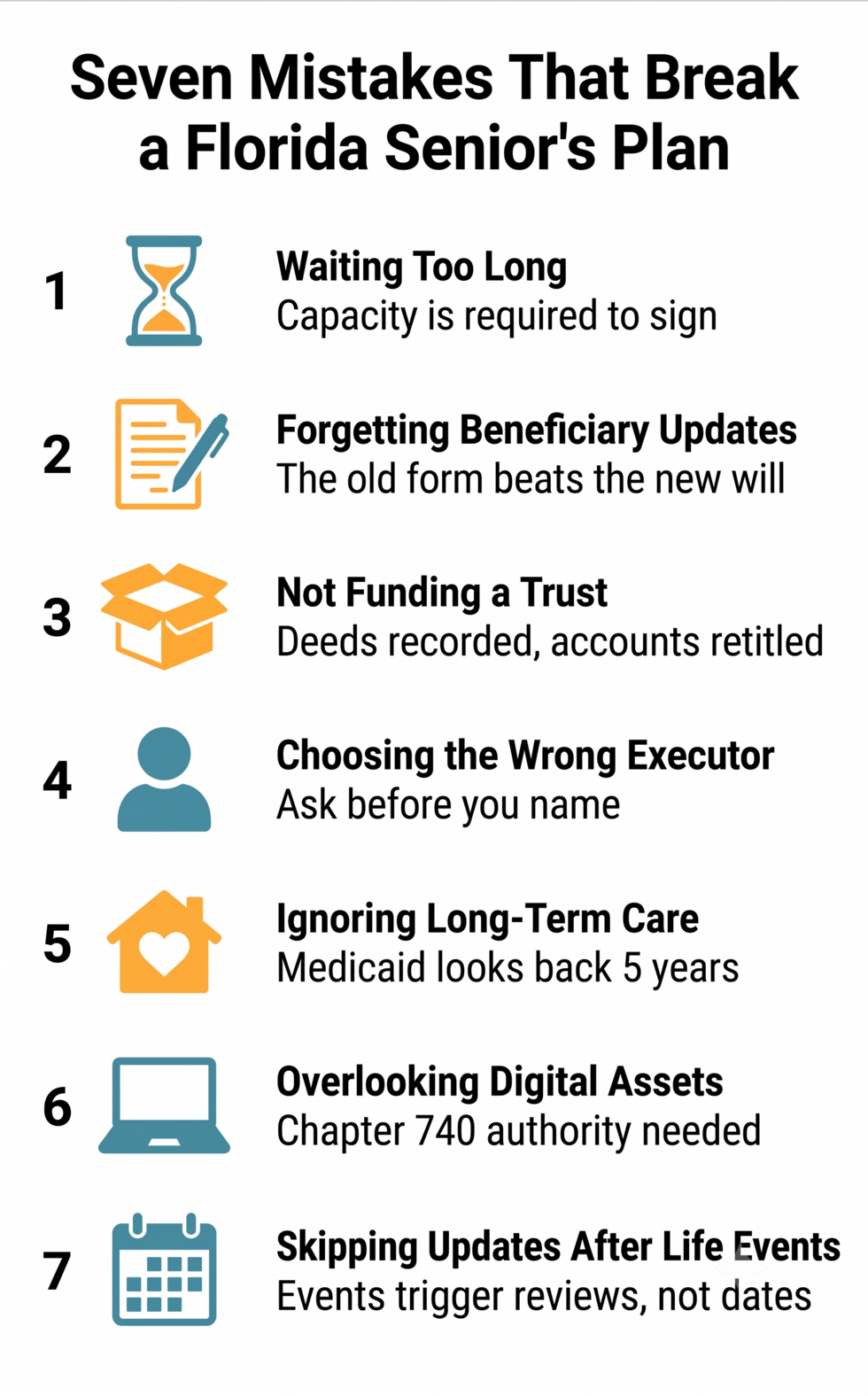
These are the seven we correct most often, each cheaper to prevent than fix.
Waiting Too Long
Capacity is a legal requirement for signing. A diagnosis does not automatically end it, but it narrows the window, and guardianship waits on the other side.
Forgetting Beneficiary Updates
A twenty-year-old designation beats a two-week-old will every time. Re-pull the forms.
Not Funding a Trust
An unfunded trust is an expensive binder. Deeds must be recorded and accounts retitled, or probate happens.
Choosing the Wrong Executor
The wrong choice adds months and legal fees. Reconsider anyone unavailable or estranged.
Ignoring Long-Term Care Planning
Medicare does not pay for long-term care, including assisted living, and Medicaid applies a five-year look-back to transfers. Planning early is the only version of this that works.
Overlooking Digital Assets
Without Chapter 740 authority in your documents, a provider can lawfully refuse your agent access to accounts.
Not Updating After Major Life Events
Life events are the trigger, not the calendar. My earlier article on common Florida estate planning mistakes shows how they compound.
Estate Planning Timeline for Seniors
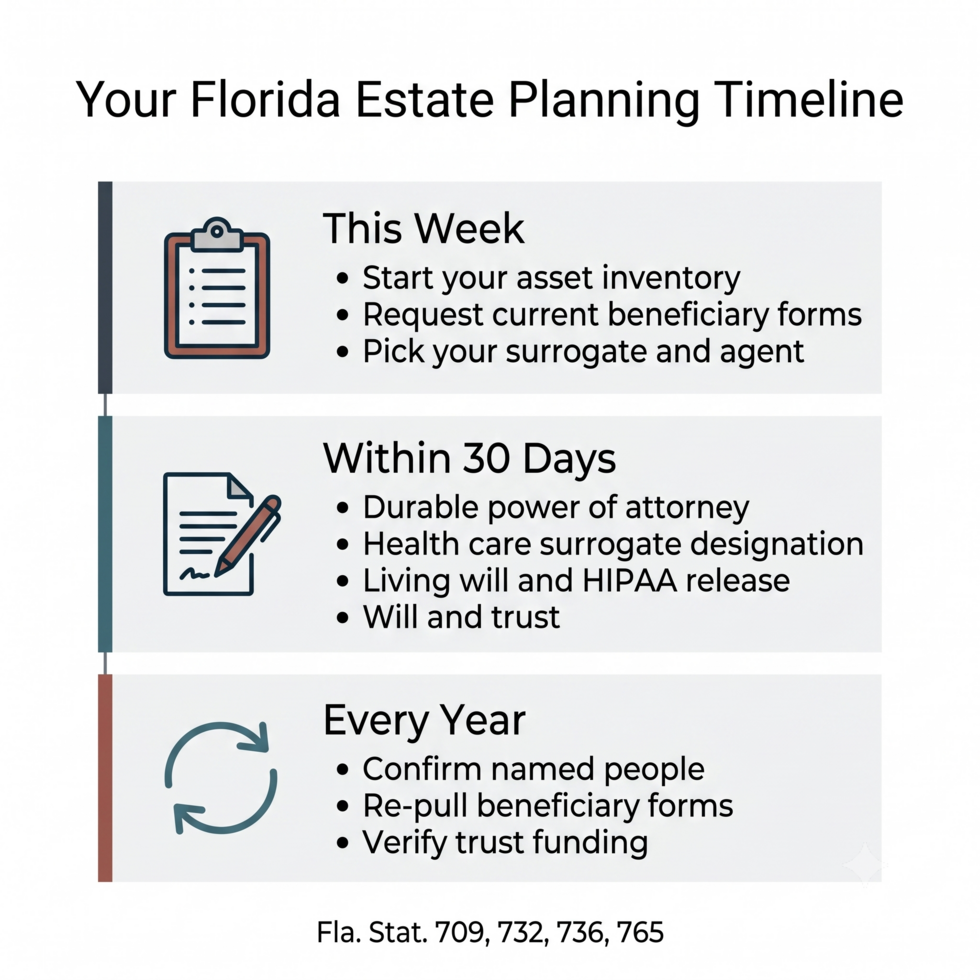
You do not need to finish everything at once. The incapacity documents come first.
What to Complete This Week
Start the inventory, request current beneficiary forms, and pick your surrogate and agent. Those three calls unblock everything.
What to Finish Within 30 Days
Sign the durable power of attorney, surrogate designation, living will, and HIPAA release, then the will and trust.
What to Review Every Year
Named people, beneficiary forms, trust funding, and asset changes. Fifteen minutes catches most problems early.
Estate Planning After Retirement
Retirement changes the mix: required distributions, Medicare enrollment, a possible move to senior living, and a shift from building assets to protecting them.
Simplify Estate Planning with The Nussbickel Law Firm
The Nussbickel Law Firm, P.A. is a Fort Myers firm devoted exclusively to estate planning, probate, and trust administration. We do not split attention with litigation or closings, so Florida's homestead rules and execution formalities are the work, not a sideline.
We serve families throughout Lee, Collier, and Charlotte counties, and we regularly work with out-of-state children handling a parent's Florida matters. Plans are quoted flat, signings are supervised, and funding gets finished rather than assigned to you.
Ready to work through this list with someone who does it daily? Schedule a consultation or call our Fort Myers office.
Conclusion
An estate planning checklist for seniors is not complicated, but it has an order, and that order is what keeps families out of court. Six documents, current designations, a funded trust when one fits, and one honest conversation cover most Florida households.
The best time to do this was when you moved to Florida. The second best is this month. Done properly it buys real peace of mind and leaves the meaningful legacy you intended.
Frequently Asked Questions
At what age should seniors start estate planning?
Any adult should hold incapacity documents, and any property owner should hold transfer documents. Past sixty-five without a current plan, the best time to start is now, while capacity is unquestioned.
Do I need a trust if I already have a will?
Not always. A will alone works when your assets are modest, Florida-only, and covered by beneficiary designations. A trust earns its cost when you own property in two states or want privacy.
What is the difference between an estate planning attorney?
The comparison usually meant is a planning attorney versus a probate attorney. A planning attorney drafts documents during your life; a probate attorney represents the personal representative afterward in court. Many Florida firms handle both.
How often should I update my estate plan?
Review it annually and update whenever something structural changes: a death, divorce, marriage, move to Florida, or a change in who can serve. Most years it takes minutes.
What questions should I ask an estate planning attorney?
Ask what portion of the practice is planning, whether fees are flat, who handles trust funding, and how homestead affects your home.
Are there specific estate planning considerations for seniors who are moving to assisted living?
Yes, and they belong on any estate planning checklist for seniors. Refresh the durable power of attorney and surrogate designation before the move, while capacity is clear. Decide who manages the homestead, since leaving it affects protections. Start Medicaid conversations five years ahead of any anticipated need, and give the facility copies of the health care documents on move-in day.
Gregory J. Nussbickel is the founder of The Nussbickel Law Firm, P.A. in Fort Myers, Florida. His practice is devoted exclusively to estate planning, probate, and trust administration for families throughout Southwest Florida.
This article is for general information only and is not legal advice. Reading it does not create an attorney-client relationship. Estate and probate laws change, and every family is different; speak with a licensed Florida attorney about your specific situation.

Comments
There are no comments for this post. Be the first and Add your Comment below.
Leave a Comment