

Choosing someone to draft the documents that will speak for you when you no longer can is a personal decision, and it's normal to feel unsure about where to start. Here is a Fort Myers attorney's plain-language guide to how to find an estate planning attorney who actually fits your family and your situation.
The quick answer: The most reliable way to find the right lawyer is to combine three sources and then vet a short list. Start with a referral from a professional you already trust — your financial advisor, accountant, or banker — then cross-check names against The Florida Bar's directory of board-certified Wills and Trusts lawyers, and its Lawyer Referral Service. From that list, hire the attorney who does this work specifically (not as a sideline), is in good standing with The Florida Bar, quotes fees in writing, and explains how they'll keep your plan current. Focus, transparency, and fit matter more than the size of the firm.
Key Highlights
- A dedicated planning attorney drafts and coordinates your will, trust, power of attorney, and health care directives — and, in Florida, keeps them compliant with Chapters 732, 736, 709, and 765.
- A strong credibility signal in Florida is being rated AV "Preeminent" by Martindale Hubbell (one of the oldest and most trusted legal rating companies), as is board certification in Wills and Trusts from The Florida Bar - both distinctions are held by only a small fraction of lawyers.
- Professional referrals plus The Florida Bar's public directory and referral service are the two highest-quality ways to build your short list.
- Ask about focus, fees, and future updates before you hire; a good attorney quotes a flat fee in writing and explains what is and isn't included.
- Florida imposes no state death tax, and the federal exemption is $15 million per person for 2026, so most families need good planning far more than they need complex tax shelters.
- Watch for warning signs: no planning focus, hidden pricing, one-size-fits-all documents, and no help funding your trust.
Introduction
Finding a lawyer for something as important as your legacy shouldn't feel like a guessing game. This guide walks through what such an attorney does, when you actually need one, exactly how to find an estate planning attorney in Florida, the questions to ask, what it costs, and the warning signs that tell you to keep looking. The goal is a confident hire — and a plan that gives you peace of mind.
What Does an Estate Planning Attorney Do?
A qualified attorney prepares the legal documents that decide who controls your money and property, and who makes decisions for you, if you die or become incapacitated. In Florida that core set includes a will, a revocable trust, a durable power of attorney, and health care directives.
The everyday services in this area of law typically include:
- Wills — the instructions that direct who inherits and who serves as your personal representative, governed by Florida Statutes Chapter 732.
- Trusts — revocable living trusts and, for asset protection or tax goals, irrevocable trusts, all under the Florida Trust Code (Chapter 736).
- Powers of attorney — a durable power of attorney letting someone manage your finances if you can't.
- Health care directives — a health care surrogate, living will, and HIPAA authorization under Chapter 765.
- Guardianship planning — naming guardians for minor children or planning for a loved one who can't manage alone.
- Probate avoidance strategies — titling, beneficiary designations, and trust funding designed to keep assets out of court.
A good estate planning lawyer doesn't just print documents. They build an estate planning strategy around your family, then help you fund the trust and update the plan as life changes. Many also coordinate with your financial advisor and accountant, and some handle the probate side too, so a single estate planner sees the whole picture — including how a plan will actually work for your heirs.
When Should You Hire an Estate Planning Attorney?
You should hire an attorney whenever your wishes are specific, your assets are more than a bank account, or someone depends on you. The more moving parts, the more a professional plan protects your family from cost, delay, and conflict. Common triggers include:
- If you own property or multiple assets — a home, real estate, investment accounts, or a mix that needs coordinated titling.
- If you have children or dependents — to name guardians and set up how and when young beneficiaries receive money.
- If you have a blended family — where "everything to my spouse" can unintentionally disinherit children from a prior marriage.
- If you own a business — to plan succession so the company survives a transition; this overlaps with, but is distinct from, family law and business law.
- If you want to avoid probate — using trusts and beneficiary designations so your heirs skip the court process.
- If you have aging parents or long-term care concerns — including Medicaid and incapacity planning.
- If you recently moved to another state — a document set from up north may not match Florida's execution rules, and snowbirds with assets in two states have extra issues to sort out.
The greater the complexity of your estate, the sooner it's worth a conversation. Even a simple plan buys real peace of mind.
How to Find an Estate Planning Attorney?
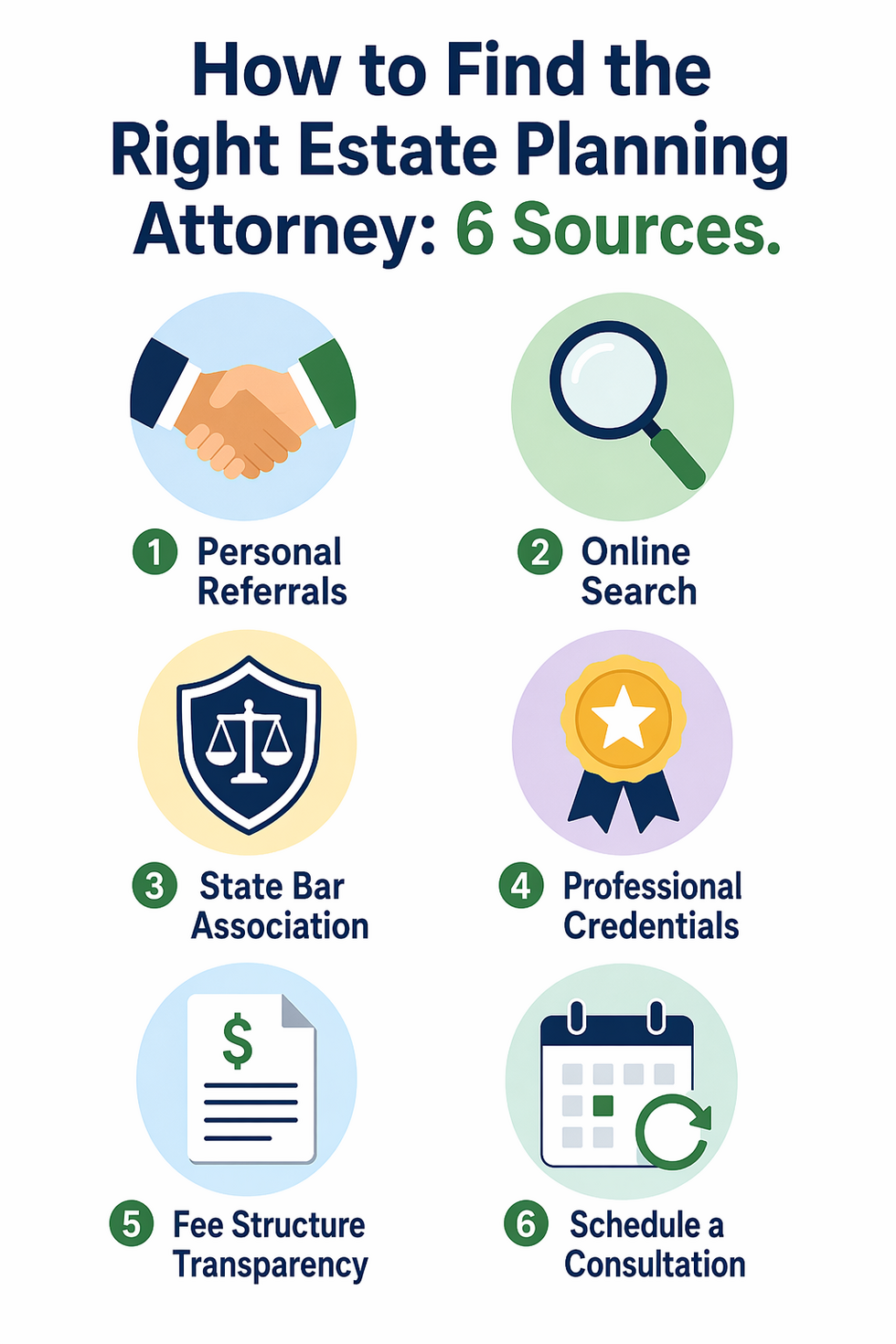
The most reliable way to find the right lawyer is to gather names from a few trustworthy sources, then narrow the field on focus and fit. People phrase this search a dozen ways — "how to find a good estate planning attorney," "how to find an estate planning lawyer," "how to find a good estate planning lawyer," "how to find the best estate planning attorney," "how to find a good lawyer for estate planning," "how to find a good attorney for estate planning," or simply "find an estate planning attorney near me" — but the practical path is the same:
- Professional referrals: Ask your accountant, banker, or financial advisor for trusted recommendations. These advisors work alongside these lawyers constantly and know who does careful work.
- Directory searches: Use reputable online directories rather than a random internet search. You can also check a firm's rating and complaint history at the Better Business Bureau and confirm any professional accreditations.
- State bar association inquiry: Contact The Florida Bar to confirm an attorney is licensed and in good standing, and use its consumer Lawyer Referral Service for vetted referrals. Directory sites also let you filter and find estate planning attorney listings by city and practice area.
- Qualification check: Prefer a lawyer who focuses strictly on wills and trusts. In Florida, two gold standards are an AV Preeminent Rating From Martindale Hubbell (which Attorney Greg Nussbickel holds) and board certification in Wills, Trusts and Estates Law directly. Beyond Florida certification, national credentials like the Accredited Estate Planner (AEP) designation or fellowship in the American College of Trust and Estate Counsel also signal a lawyer serious about this work.
- Fee transparency: Confirm flat fees or hourly rates upfront, and ask whether the first consultation is a free consultation or carries a charge.
- Future updates: Ask how the firm handles long-term document modifications, because your plan should be maintained, not filed and forgotten.
A good place to begin is one solid referral plus a Florida Bar look-up — that pairing quickly separates a qualified attorney from a generalist dabbling in this work.
What are The Questions to Ask Before Hiring an Estate Planning Attorney?
Come to your first meeting with a written list of questions, grouped by services, pricing, and process. The answers tell you fast whether this attorney is right for your family.
Questions about services
- What documents do I actually need — and which can I skip?
- Do you help fund trusts, or just draft them? (Funding is where many plans quietly fail.)
- Will you review my plan in the future, and how does that work?
Questions about pricing
- Do you charge flat fees or hourly rates?
- What is included in the fee — and what counts as extra?
- Are there future update costs, and how are they billed?
Questions about process and communication
- How long does the estate planning process usually take from start to signing?
- Who will I communicate with directly — you, or a paralegal?
- What documents should I prepare before we begin?
It's fair to ask about credentials, too — where they went to law school, how long since they passed the bar exam, their years of experience in estate law, and their personal experience with situations like yours.
How Much Does an Estate Planning Attorney Cost?
Most Florida plans are billed as a flat fee, not by the hour, so you know the price before you commit. What you pay depends on how complex your situation is and which documents you need, not on how many hours a lawyer happens to spend. As a general planning guide:
| Plan type | Typical structure | What it usually covers |
|---|---|---|
|
Basic will-based plan |
Flat fee |
Will, durable power of attorney, health care directives |
|
Revocable trust-based plan |
Flat fee |
Living trust, pour-over will, powers of attorney, directives, funding guidance |
|
Advanced / tax-driven plan |
Flat fee or hourly |
Irrevocable trusts, tax planning, business succession |
Ask for the fee in writing and confirm what's included before you sign. A flat-fee basis rewards efficiency and removes the anxiety of a ticking clock. For a fuller breakdown, see our guide on what planning actually costs.
Here's reassuring context on estate taxes: Florida imposes no state income tax and no death tax of its own, and the federal estate tax exemption is $15 million per person for 2026 — a level made permanent by 2025's tax law. In practice, the overwhelming majority of families owe no such tax at all, so most estate tax planning is about larger or multi-state situations, not the typical household. Our overview of Florida estate and "death" taxes explains where the lines fall.
What Are the Warning Signs to Avoid When Choosing an Estate Planning Attorney?
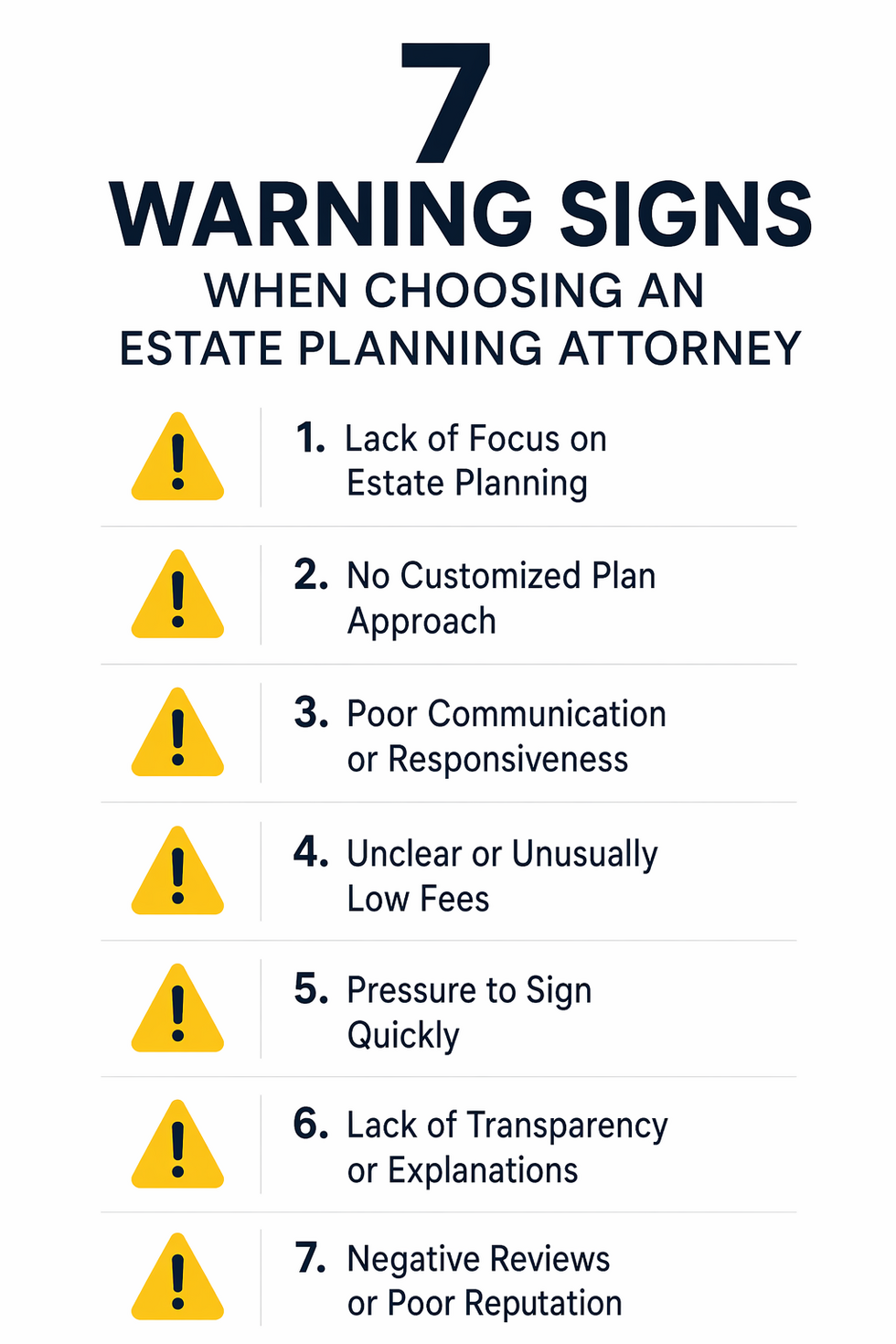
If you notice these red flags, keep looking — a good attorney won't show them.
Lack of estate planning focus
A lawyer who handles a little of everything — a personal injury case one day, a family law matter the next — rarely keeps up with the wills-and-trusts details. Choose someone whose practice centers on this field, ideally a probate attorney or planner who lives in this work daily.
Unclear or hidden pricing
If you can't get a straight answer on fees, that's a preview of how billing will go. A trustworthy firm quotes a flat fee or a clear hourly rate in writing.
One-size-fits-all planning
Beware the shop that sells the same document set to everyone. Good estate planning starts with your family and goals, not a template.
No trust funding guidance
A trust that isn't funded — meaning your assets aren't actually retitled into it — does almost nothing. If an attorney drafts a trust but won't help you fund it, your plan may fail exactly when it's needed.
Outdated planning strategies
Laws change. An attorney relying on a decades-old planning strategy, or unaware of recent Florida and federal updates, can leave gaps. Ask how they stay current.
Pushy upselling tactics
Steer clear of anyone pressuring you into irrevocable trusts or products you don't understand. The right attorney educates first and recommends only what fits.
Poor communication or delayed responses
If it's hard to get a call back before you're a client, it won't improve after. Responsiveness is part of the service you're paying for.
Estate Planning Attorney vs Online Estate Planning Services
An experienced attorney gives you tailored, Florida-compliant advice and stands behind the work; an online service gives you a cheaper template and leaves the legal judgment to you. For anything beyond the simplest situation, the difference shows up when the plan is actually used.
| Online estate planning service | A dedicated attorney | |
|---|---|---|
|
Cost |
Low upfront |
Higher upfront, flat fee |
|
Legal advice |
None — you decide |
Tailored to your family and Florida law |
|
Florida execution rules |
Generic forms, easy to get wrong |
Signed and witnessed correctly |
|
Trust funding |
On your own |
Guided, so the plan works |
|
Updates & questions |
Self-service |
A relationship you can call |
|
Accountability |
Limited |
Licensed lawyer, malpractice insurance |
Online tools can be a reasonable basis for a very simple situation, but they can't weigh homestead rules, blended-family issues, or a business — and mistakes usually surface after you're gone, when they're expensive to fix. Our comparison of online probate services shows how that gap plays out.
How Often Should You Update Your Estate Plan?
Review your plan every three to five years, and right away after any major life event. Documents that were perfect five years ago can misfire after a move or a change in your family. Update after:
- Marriage or divorce
- Birth or adoption of children
- A death in the family, especially a named executor, trustee, or beneficiary
- Buying property or land
- Moving states — Florida newcomers especially should have their plan reviewed
- Business changes — starting, selling, or restructuring
- Tax law changes that affect your strategy
Between events, a quick check-in keeps beneficiary designations and fiduciary choices aligned with your wishes. See why planning matters for Southwest Florida families.
How to Get the Most Value From Your First Estate Planning Consultation?
A little preparation turns your first consultation from a get-acquainted chat into real progress. Here's how to make the meeting count.
1. Organize Your Financial and Legal Documents Ahead of Time
Gather deeds, account statements, life insurance, retirement beneficiary forms, and any existing will or trust. A clear asset picture lets the attorney give specific advice, not generalities.
2. Clarify Your Estate Planning Goals and Priorities
Decide what matters most — avoiding probate, protecting a child, providing for a spouse, charitable giving — so the plan is built around your priorities.
3. Write Down Questions You Want to Ask Your Attorney
Bring your list of questions from above. It keeps the meeting focused and makes sure nothing important gets missed.
4. Be Open About Your Family, Assets, and Concerns
Mention the hard things — a strained relationship, a special-needs heir, a prior marriage. Attorneys plan around real families, and candor produces a better plan.
5. Understand the Attorney's Fees and Planning Process
Confirm the fee, what's included, the timeline, and who you'll work with. Leave knowing the planning process from signing to funding.
6. Take Notes So You Can Review Recommendations Later
You'll cover a lot. Notes help you compare attorneys and remember recommendations when you decide.
7. Leave With a Clear Understanding of the Next Steps
Before you go, confirm what happens next, what you owe, and when you'll see drafts — so momentum carries into the plan itself.
How The Nussbickel Law Firm Helps Families Find the Right Estate Planning Solutions
The Nussbickel Law Firm, P.A. is a Fort Myers law firm focused solely on wills, trusts, probate, and trust administration — it isn't a sideline between other cases. Because this is all we do, we can match a plan to your family instead of handing you a template, and we help you fund it so it actually works.
We serve families throughout Lee, Collier, and Charlotte counties — Fort Myers, Cape Coral, Naples, Bonita Springs, Estero, Punta Gorda, and the surrounding communities — as well as out-of-state families with Florida property or a Florida probate matter. We quote flat fees in writing for standard plans, explain every recommendation in plain language, and stay available to update your documents as life changes. If you're weighing how to find an estate planning attorney who will treat your plan as an ongoing relationship rather than a one-time transaction, that's exactly the fit we aim for. Schedule a consultation or call our Fort Myers office to talk it through.
Conclusion
Knowing how to find an estate planning attorney comes down to a simple sequence: gather names from people and directories you trust, confirm the lawyer is focused on this work and in good standing with The Florida Bar, ask direct questions about services and fees, and watch for the warning signs of a poor fit. Do that, and you'll land on the right estate planning attorney — someone who gives your family clarity, protection, and genuine peace of mind. If you're in Southwest Florida, we're glad to be your first step.
FAQs
Why do I need an estate planning attorney?
Because Florida has specific rules for signing wills, trusts, and powers of attorney, and small mistakes can void a document or send assets through probate. An attorney tailors the plan to your family, keeps it legally valid, and helps you fund a trust so it works as intended.
Should I choose an attorney who specializes only in estate planning?
Generally, yes. A lawyer focused on wills and trusts stays current on the details that matter, and in Florida you can go further by choosing one who is board certified in wills and trusts — a credential only a small share of attorneys hold.
Can online estate planning services replace an attorney?
For very simple situations they can produce basic documents, but they give no legal advice and can't weigh homestead rules, blended families, or a business. Errors usually surface after death, when they're costly to fix, so most families are better served by a lawyer.
What documents should I bring to my first consultation?
Bring deeds, recent account statements, life insurance and retirement beneficiary designations, any existing will or trust, and a list of the people you'd name as executor, trustee, guardian, or agent. A complete picture lets the attorney give specific, useful advice.
How do I know if an estate planning attorney is a good fit for my family?
Look for focus on this field, clear flat-fee pricing, good standing with The Florida Bar, responsive communication, and a willingness to explain rather than upsell. If the attorney listens to your goals and answers plainly, that's usually the right fit.
How often should I update my estate plan after it is created?
Review it every three to five years and after any major change — marriage, divorce, a birth, a death, a move to Florida, buying property, or a business change. Between those events, a quick check keeps your beneficiary designations and fiduciary choices current.
Gregory J. Nussbickel is the founder of The Nussbickel Law Firm, P.A. in Fort Myers, Florida. His practice is devoted exclusively to estate planning, probate, and trust administration for families throughout Southwest Florida.
This article is for general information only and is not legal advice. Reading it does not create an attorney-client relationship. Estate planning laws change, and every family is different — speak with a licensed Florida attorney about your specific situation.

Comments
There are no comments for this post. Be the first and Add your Comment below.
Leave a Comment