
Key Highlights
- Estate planning for business owners means planning two things at once: who inherits the value of the company, and who has legal authority to run it the morning after you die.
- Under Fla. Stat. 605.0602(7)(a), a Florida LLC member is automatically dissociated at death, and heirs usually receive only an economic interest, not the right to vote or manage.
- A personal representative may continue an unincorporated venture for only four months without a court order under Fla. Stat. 733.612(22).
- Florida has no separate state estate tax in practice, and the federal exclusion is $15 million per person for 2026 per IRS Rev. Proc. 2025-32, so most Southwest Florida owners face a liquidity problem rather than a tax problem.
- After the Supreme Court's decision in Connelly v. United States (2024), company-owned life insurance funding a redemption can increase the taxable value of the shares it was bought to redeem.
- Every closely held owner needs both a will or trust and a funded buy-sell agreement; one without the other leaves a gap that lands in probate court.
Introduction
The short answer: Estate planning for business owners is the process of coordinating your personal estate documents with your company's governing documents so that ownership, control, and cash flow all transfer the way you intend. A standard will is not enough. Your operating agreement, shareholder agreement, or partnership agreement usually controls what happens to your interest at death, and if those documents contradict your will, the company documents typically win.
Most of the owners who sit down with us in Fort Myers are not worried about federal estate tax. They are worried about something more immediate: whether their spouse can sign a payroll check, whether their partner can keep the doors open, and whether the company they spent thirty years building survives the six months after their funeral. Those are planning questions, not tax questions, and they have concrete answers under Florida law.
This guide walks through what changes when a closely held interest is part of your personal estate, what happens if you do nothing, and the specific documents that keep a Southwest Florida company running in the event of your passing.
What Is Estate Planning for Business Owners?
Estate planning for business owners is the process of arranging both your personal affairs and your ownership interest so that control, value, and day to day operations pass the way you intend. It covers who inherits, who decides, and who runs things.
For an owner, that means two parallel tracks. The personal track is the familiar one: a will, a trust, powers of attorney, health care documents, beneficiary designations. The company track is the one most people skip: the operating agreement, the shareholder agreement, the buy-sell arrangement, and the practical instructions someone will need on day one.
Why Business Owners Need a Different Estate Plan Than Other Individuals
A salaried professional's estate is mostly liquid and passive. A house, retirement accounts, a brokerage account, some life insurance. Those assets sit still while the paperwork gets done.
A company does not sit still. It has payroll due Friday, a lease, vendors, a line of credit with a personal guarantee, licenses that may not survive a change in ownership, and employees who will start updating their resumes the week they hear the news. The estate planning process for an owner has to account for that clock. It also has to account for the fact that your business interests may be illiquid, hard to value, and subject to restrictions your heirs never agreed to.
There is a second difference that surprises people. For most families, the will controls. For an owner, the company's own governing documents usually control the interest itself, and the will only reaches whatever those documents allow to pass.
What Does a Complete Business Estate Plan Include?
A comprehensive estate plan for an owner has both halves working together:
- Personal documents: a will or revocable trust, a durable power of attorney, a health care surrogate designation, a living will, and current beneficiary designations on retirement accounts and life insurance policies.
- Company documents: an operating agreement, shareholder agreement, or partnership agreement whose transfer-on-death provisions match your personal documents.
- A funded buy-sell agreement that fixes price, terms, and purchase obligations before anyone is grieving or negotiating.
- A written continuity plan: who signs, who has passwords, who calls the bank, who tells the employees.
- A valuation approach everyone has agreed to in advance.
Key Takeaways
Estate planning for business owners is not a document. It is the alignment between several documents, plus the funding that makes them work.
At-a-Glance Summary
Your personal estate plan decides who receives value. Your company documents decide who receives control. Your buy-sell agreement decides whether the two ever have to be reconciled in a courtroom. Proper planning gets all three saying the same thing, in writing, before anyone needs them.
Who Needs This Guide?
Anyone with an ownership stake that other people depend on: a solo consultant with client contracts, a small business owner with four employees, a family business in its second generation, two partners who shook hands in 2009 and never papered it, or a professional practice with a license that cannot pass to a non-licensed heir. If your death would create a question about who is in charge, this applies to you.
Why Estate Planning Is Essential for Business Owners
The reason is concentration. For most owners, one illiquid asset represents the majority of household net worth, and that asset stops functioning without a decision-maker. Estate planning for small business owners is really about keeping a decision-maker in the chair.
Your Business Is Likely Your Largest Asset
Ask an owner what they are worth and they will usually name a number that is mostly the company. The house has a mortgage. The retirement accounts are respectable. The enterprise is the rest.
That concentration is what makes the planning urgent. When personal wealth is tied up in one closely held interest, a bad transition does not just reduce an inheritance, it can eliminate it. The value of your estate is only as durable as the entity that generates it.
Why Personal and Business Estate Planning Must Work Together
We see the same failure over and over. A well-drafted will leaves "all my property" to a spouse. The operating agreement says an interest may not be transferred without unanimous written consent of the other members. Both documents are valid. They point in opposite directions, and the family finds out during probate.
Personal assets and company interests have to be planned as one system. That includes coordinating your personal estate documents with any personal guarantees you signed, because those obligations follow the estate even when the company itself keeps going.
Risks of Delaying Estate Planning
Delay is the most common and most expensive choice. It is not usually a decision; it is a series of postponements while quarterly numbers get handled first.
The risk is that the triggering event does not wait for a convenient quarter. Disability arrives before death for many owners, and a company with no signing authority in place can lose a lease renewal or a licensing deadline in weeks. Proper planning done early is also cheaper, because you are structuring rather than repairing.
How Estate Planning Protects Your Family, Employees, Customers, and Partners
A plan is not only for your heirs. It is the thing that tells four different groups what happens next, on the same day, without contradiction. Here is what goes wrong for each when the plan is missing.
Financial Risks
Revenue drops when clients are uncertain. Lenders can call notes or freeze lines of credit on a change-of-control or death clause. Payroll may need funding from personal accounts that are themselves frozen pending probate. The tax burden, if there is one, comes due nine months after death whether or not anything has sold.
Legal Risks
Heirs who receive only an economic interest can sue for accountings and distributions. Surviving partners can be accused of self-dealing. Professional licensure rules may prohibit an heir from holding an interest at all, forcing a rushed sale under state law.
Operational Risks
Nobody can sign. Bank accounts requiring the deceased owner's signature lock up. Vendor contracts with key-person clauses can be terminated. Passwords and payroll credentials sit in one person's phone. These are mundane problems that become emergencies within days.
Emotional Impact on Family Members
The people making decisions are grieving. Family dynamics that were manageable at Thanksgiving become litigation when one child worked in the company for a decade and another did not. A plan that states your intent plainly, in advance, removes the need for anyone to guess what you would have wanted.
What Happens to Your Business If You Die Without an Estate Plan?
Without a plan, the death of the business owner leaves Florida law and your company's default rules to decide. The result is rarely what the owner would have chosen, and it almost always runs through probate court. What follows depends heavily on how the entity is structured.
Who Takes Control of the Business?
For a sole proprietorship, there is no separate entity: the assets, contracts, and receivables are simply part of your personal estate, and the personal representative appointed by the court controls them.
For an LLC, death causes dissociation. Your heirs generally receive a transferable interest, meaning distributions if any are made, without voting or management rights, unless the operating agreement or the remaining members provide otherwise under Fla. Stat. 605.0502. For a corporation, shares pass as personal property, so heirs typically do become shareholders, subject to any shareholder agreement.
What Happens During Probate?
The court appoints a personal representative, who must inventory the estate, notify creditors, and account for everything before distributing anything. A closely held interest has to be valued for that inventory, which often means hiring an appraiser.
Meanwhile, the authority to act is limited. A personal representative may continue an unincorporated venture in the same form for only four months from appointment without a court order, and longer only with judicial approval, under Fla. Stat. 733.612(22).
How Probate Can Delay Business Operations
Florida's creditor claim period alone runs three months from first publication of the notice to creditors. Formal administration commonly takes six months to a year for an uncomplicated estate, and longer when an operating company is involved. For a realistic month-by-month view, see how long probate takes in Florida.
During that window, decisions that need an owner's signature either wait, go to court, or get made by someone without clear authority. Any of the three costs money.
Ownership Disputes Between Family Members and Partners
This is where most litigation starts. A surviving partner believes there was an understanding about buying out the deceased owner's share. The family believes the company is worth twice what the partner is offering. Nothing was written down.
Add a second marriage, adult children from a first marriage, and one heir who has worked in the company since high school, and the dispute stops being about money. Documents drafted while everyone is alive and friendly are the only reliable fix.
Tax and Liquidity Challenges
Even where no federal estate tax is owed, cash is the problem. Estates need cash for administration expenses, creditor claims, income tax on final returns, and often to equalize inheritances between an heir who takes the company and one who does not.
An illiquid asset cannot fund any of that. Families end up borrowing against the enterprise, selling at a discount, or distributing unequal shares that guarantee a fight.
When a Business May Be Forced to Close or Sell
Forced sales happen for predictable reasons: a lender accelerates, a license lapses, a key contract terminates on a change of control, or the heirs simply cannot run it and cannot agree on a buyer. A company that would have sold for a fair multiple in an orderly process sells for far less under duress, if it sells at all.
Probate Timeline for Business Owners
| Stage | Typical timing | What it means for the company |
|---|---|---|
|
Petition filed, personal representative appointed |
Weeks 1 to 6 |
No clear signing authority until letters issue |
|
Notice to creditors, claim period runs |
3 months from first publication |
Distributions and sales generally wait |
|
Inventory and valuation of the interest |
Within 60 days of letters |
Appraisal cost and disclosure of company financials |
|
Claims resolved, taxes addressed |
Months 4 to 9 |
Cash demands land here |
|
Distribution and discharge |
Month 6 to 12 or later |
Ownership finally transfers |
Common Probate Challenges
Valuing a closely held interest with no market. Producing years of financial records for the court file. Getting a lender to keep a line open for an estate. Locating the digital credentials that run billing and payroll. Persuading heirs who are also employees to keep working during the uncertainty.
Can Probate Be Avoided?
Often, yes, and for owners it is usually worth doing. An interest titled in a funded revocable trust passes outside probate entirely. So do assets with valid beneficiary designations and jointly titled property with survivorship rights. For the main methods, see my earlier article, Top Ways to Avoid Florida Probate: A Quick Guide.
Estate Planning vs. Business Succession Planning
These are two different projects that people treat as one. Estate planning moves value and legal title. Succession planning moves capability and authority. You need both, and estate and succession planning for small business owners works only when the two are drafted together.
What Is Estate Planning?
Estate planning is the legal transfer of everything you own at death or incapacity: the documents that say who receives your property, who manages it, and who makes decisions for you if you cannot. It is title-focused and largely reactive to a single event.
What Is Business Succession Planning?
A business succession plan answers a different question: who actually runs this, and are they ready? It covers identifying a successor, training them, transferring customer and vendor relationships, restructuring compensation, and setting a timeline. It is people-focused and unfolds over years, not on a single date.
Key Differences
Estate planning is drafted by a lawyer and signed. Succession planning is executed by an owner and a management team over time. One is a set of documents; the other is a change-management project that documents merely record.
Why Every Business Owner Needs Both
A perfect will that leaves the company to a child who has never met the banker does not preserve anything. A perfect succession plan with no estate documents leaves that same child fighting a sibling in probate court. The two together are what produce a smooth transition.
Estate Planning Responsibilities
Draft and execute the will or trust. Fund the trust. Sign a durable power of attorney and health care documents. Update beneficiary designations. Coordinate the company documents with all of it. Review after every major life or ownership change.
Succession Planning Responsibilities
Name a successor and tell them. Build their authority gradually. Document processes that live only in your head. Introduce them to lenders, key clients, and vendors. Set a valuation method. Decide how non-participating heirs will be treated fairly.
Comparison Table
| Estate planning | Business succession planning | |
|---|---|---|
|
Core question |
Who receives it? |
Who runs it? |
|
Primary documents |
Will, trust, powers of attorney, beneficiary forms |
Operating or shareholder agreement, buy-sell, training and transition plan |
|
Trigger |
Death or incapacity |
A chosen date, or death or incapacity |
|
Timeline |
Signed once, reviewed periodically |
Years of gradual transfer of ownership |
|
Fails when |
Company documents contradict it |
No funding, or the successor was never prepared |
|
Professional |
Estate planning attorney |
Attorney plus CPA and financial advisor |
Which Business Owners Need Estate Planning?
Every owner with an interest that has value or that other people rely on. That includes single-member LLCs, professional practices, seasonal operations, rental portfolios, and companies with no employees at all. The complexity of the plan scales with the entity, but the need does not.
How Does Your Business Structure Affect Estate Planning?
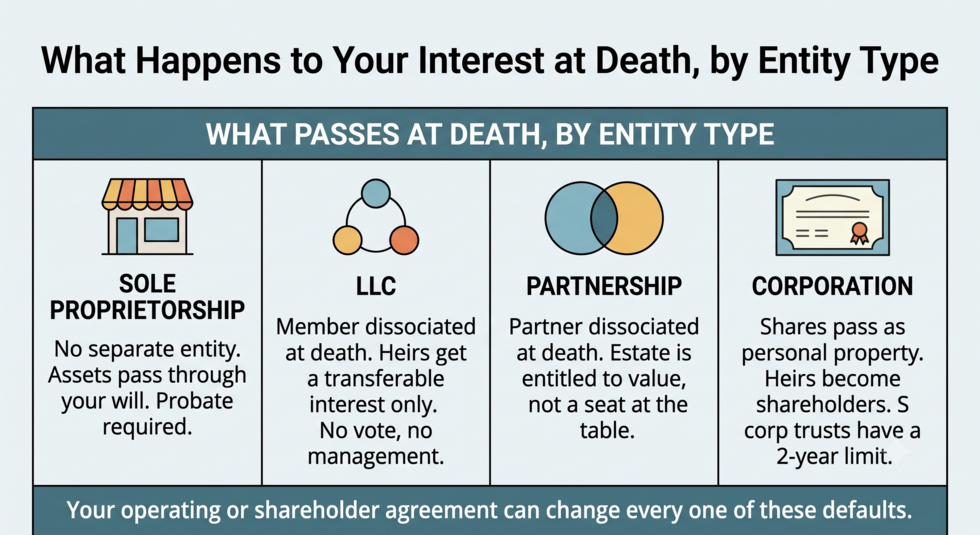
Your entity type determines what actually passes at death, and legal structures differ sharply on this point. Two owners with identical net worth and identical wills can produce completely different outcomes because one holds membership units and the other holds shares. Tax implications differ as well, so structure drives both halves of the plan.
Sole Proprietorships
There is no entity to transfer. The assets, contracts, receivables, equipment, and goodwill are all part of your personal estate and pass through your will, which means they pass through probate.
Practically, a sole proprietorship often dies with the owner unless someone can step in immediately. If you operate this way and want continuity, the usual fix is to form an entity now and hold it in a trust, rather than leaving a collection of loose business assets for a court to sort out.
Limited Liability Companies (LLCs)
Death dissociates the member automatically under Fla. Stat. 605.0602(7)(a). What the heirs receive is a transferable interest: the right to distributions, without the right to vote, manage, or inspect records.
That default surprises families who assumed they were inheriting a company. The operating agreement can change it, by admitting a successor, requiring a buyout, or granting management rights to a named person. For a single-member LLC, the operating agreement should say explicitly who becomes the successor manager and member, because there is no one else to decide.
Partnerships
Under Fla. Stat. 620.8601(7)(a), a partner is dissociated on death, and the estate generally becomes entitled to the value of the partnership interest rather than a seat at the table. In a general partnership with no written agreement, the default rules can force a buyout or a winding up at the worst possible moment.
Limited partnerships and family limited partnerships have their own transfer rules, and those documents should be read alongside the estate plan every time either one is amended.
Corporations (S Corps & C Corps)
Shares are personal property, so they pass under the will or trust and the heirs become shareholders. That is cleaner in one sense and messier in another, because now a grieving family member holds voting stock in a company run by someone else.
S corporations add a trap. Only certain shareholders are permitted under the Internal Revenue Code. A grantor trust qualifies while the deemed owner is alive, and it may continue to hold the stock for two years after that owner's death; after that the trust must qualify as a qualified subchapter S trust or an electing small business trust, or the S election terminates and the company is taxed as a C corporation. That is an income tax problem created entirely by an estate planning oversight, and it is avoidable with drafting.
Essential Estate Planning Documents Every Business Owner Needs
These are the documents we assemble for nearly every owner, personal and company side together. None of them works alone, and the order matters less than the coordination between them.
Last Will and Testament
A will directs what happens to probate assets and names your personal representative. For an owner, it should also name someone competent to hold and vote an ownership interest during administration.
What It Covers
Assets titled in your sole name with no beneficiary designation: the sole proprietorship's equipment and receivables, shares of stock, tangible property, and anything the trust was never funded with.
Limitations
A will does not avoid probate; it directs it. It also cannot override a valid operating agreement, shareholder agreement, or beneficiary designation. If your will leaves your units to your daughter and your operating agreement forbids transfer without consent, the operating agreement governs the transfer.
Revocable Living Trust
For most owners we work with, a funded revocable trust is the center of the plan. You remain trustee during life, with full control, and a successor trustee takes over instantly at death or incapacity without a court order.
Benefits
No probate for the interest held in trust, so no gap in authority. Privacy, because the trust is not filed publicly. Continuity, because the successor trustee can sign the day after you die. Incapacity coverage, which a will does not provide at all.
When It Makes Sense
Almost always for an operating company, and especially when you own real estate in more than one state, have a blended family, or want to avoid a public filing of your company's financial details. The one requirement people forget is funding: the units or shares must actually be assigned to the trust, and any transfer restriction must be satisfied first.
Irrevocable Trust
An irrevocable trust gives up control in exchange for benefits a revocable trust cannot deliver. It is not for everyone, and for owners under the current federal tax exemption it is usually about creditor protection or a specific transfer goal rather than tax.
Tax Benefits
Assets transferred out of your taxable estate, along with future appreciation, are generally not taxed at your death. For a company expected to grow substantially, moving a minority interest early can remove a great deal of future value from the taxable estate. Estate tax planning of this kind is worth modeling with your CPA before you commit.
Asset Protection
Property properly transferred to an irrevocable trust for others is generally beyond the reach of your later creditors. Note the limits of a revocable trust here: under Fla. Stat. 736.0505, revocable trust property remains reachable by the settlor's creditors during life. If creditor exposure is the concern, revocable is not the tool.
Buy-Sell Agreement
If you have any co-owner, this is the single most important document you can sign. A buy-sell agreement fixes in advance who may buy an interest, at what price, on what terms, and how the purchase is funded.
Without one, the surviving owners and the deceased owner's family negotiate from opposite sides at the worst possible time. With one, the transaction is already decided and usually already funded by insurance.
Cross-Purchase Agreements
The surviving owners personally buy the deceased owner's interest, often with life insurance policies each owner holds on the others. Survivors get a stepped-up basis in what they purchase. The drawback is the number of policies required once there are more than two or three owners.
Entity Purchase Agreements
The company itself redeems the interest, usually with company-owned insurance. Simpler to administer, but the Supreme Court's decision in Connelly means the insurance proceeds can increase the company's value for estate tax purposes without the redemption obligation offsetting them. Any entity-purchase structure signed before 2024 deserves a fresh look at its funding and its purchase obligations.
Durable Financial Power of Attorney
This is the document that keeps things running when you are alive but unable to act, and it is the one owners most often lack. A Florida durable power of attorney is exercisable when executed, and under Fla. Stat. 709.2108 a power signed on or after October 1, 2011 that is meant to spring into effect on incapacity is ineffective. There is no "hold this until I am disabled" option in Florida.
Florida also requires certain authorities to be separately initialed by the principal under Fla. Stat. 709.2202, including creating an inter vivos trust, making gifts, and changing beneficiary designations. If your agent may need to make transfers for tax strategies or continuity purposes, those superpowers must be granted explicitly.
Healthcare Power of Attorney
In Florida this is a health care surrogate designation under Chapter 765. It names the person who makes medical decisions for you and, if you choose, gives them authority while you are still competent.
It matters commercially because your incapacity is the trigger for most continuity provisions, and someone has to be able to obtain and share the medical determination that starts the clock.
Living Will
A living will states your wishes about life-prolonging procedures. It is not a company document, but it belongs in every owner's package because it spares your family from making that decision without guidance, at exactly the moment the company most needs them functional.
Operating Agreements and Shareholder Agreements
These control the interest itself, which is why we read them before drafting anything else. Florida permits broad shareholder agreements under Fla. Stat. 607.0732, and LLC operating agreements have similar latitude.
What we look for: transfer restrictions, consent requirements, whether a trust may hold the interest, what happens on death or disability, whether there is a valuation method, and whether the document contradicts the will or trust. When it does, the operating agreement controls, and the estate plan gets amended to match.
Business Continuity Instructions
This is the least legal and most immediately useful document in the package. It is a plain-language memo, updated annually, covering the continuity of your business in the first thirty days: who has signing authority, where the credentials are, which accounts pay payroll, who calls the bank and the insurance broker, which clients need a personal call, and who tells the staff.
Keep it with your estate documents and give a copy to your successor trustee and your successor manager. Intellectual property matters here too: trademarks, source code, customer lists, and domain registrations should be inventoried by name and registrar, because they are frequently the most valuable business assets and the easiest to lose.
How Trusts Help Business Owners Protect Wealth and Avoid Probate
Trusts solve the timing problem. Because a trust already owns the interest, there is no gap between your death and someone's legal authority to act, and no court order required to bridge it. That is the core benefit for a company, ahead of any tax consideration.
Can a Trust Help Protect or Transfer Your Business?
Yes, in three distinct ways: avoiding probate on the interest, providing immediate successor authority, and, for larger estates, removing future appreciation from the taxable estate. Under Fla. Stat. 736.0402 a Florida trust is validly created when the settlor has capacity and intent, there is a definite beneficiary, and the trustee has duties to perform.
The caution is that a trust only helps with what it actually owns. An unfunded trust is an expensive folder.
How Revocable Trusts Help Business Owners
You are trustee, so nothing about daily operations changes. At incapacity or death, your successor trustee steps in without a court appointment and can sign, vote, hire, and sell within the powers you granted.
Transfer restrictions still apply, so the assignment of units or shares into the trust needs the consent the operating agreement requires. Do that while everyone is available to sign it. Note also that death benefits can be made payable to a trustee under Fla. Stat. 733.808, which is how insurance proceeds get into a trust ready to fund a buyout.
How Irrevocable Trusts Help Business Owners
An irrevocable trust removes the interest from your estate for transfer tax purposes and can insulate it from future creditors. For estate planning for closely held business owners with real growth ahead, transferring a minority stake early moves that growth outside the estate.
The trade-off is real: you give up control and, generally, the ability to change your mind. This is a decision to make with counsel and a CPA, not from a template.
When Advanced Trust Strategies Make Sense
These become worth their complexity when the estate is likely to exceed the federal exclusion, or when a specific asset warrants special treatment:
- Grantor retained annuity trusts (GRATs): you transfer an interest and retain an annuity for a term; growth above the government's assumed rate passes to your beneficiaries at little or no gift tax cost. The grantor retained structure suits a company expected to appreciate sharply.
- Irrevocable life insurance trusts (ILITs): the trust owns the policy, so the death benefit is outside your taxable estate and available as liquidity to buy the interest or pay expenses.
- Dynasty trusts: long-term trusts designed to hold an interest for multiple generations while limiting transfer tax at each one.
- Spousal lifetime access trusts: an irrevocable trust for your spouse's benefit that uses your exclusion now while preserving indirect access to the funds during their lifetime.
- Asset protection trusts: used carefully, and with attention to Florida's rules on self-settled trusts, which are far less permissive than some other states.
Which Trust Is Right for Your Business?
The right type of trust depends on estate size, whether you can accept giving up control, and whether the goal is continuity or tax. Most Southwest Florida owners land on a funded revocable trust, sometimes paired with an ILIT for liquidity.
| Revocable living trust | Irrevocable trust | |
|---|---|---|
|
Control during life |
Full; you are trustee |
Given up to a trustee |
|
Avoids probate |
Yes, for funded assets |
Yes |
|
Removes value from taxable estate |
No |
Generally yes |
|
Creditor protection from your creditors |
No (Fla. Stat. 736.0505) |
Generally yes, if properly structured |
|
Can be amended |
Yes, any time |
Rarely, and only by limited means |
|
Typical use for an owner |
Continuity and probate avoidance |
Growth transfer, liquidity, protection |
Pros and cons in one line each: revocable trusts buy you certainty and flexibility but no tax or creditor benefit; irrevocable trusts buy you tax and protection benefits at the cost of control. For a fuller comparison, see revocable vs. irrevocable trusts in Florida, and if you are weighing the threshold question, who needs a trust instead of a will covers it.
How Should You Plan for Business Succession?
Start by deciding where the company is going: to family, to partners, to employees, or to an outside buyer. Every other decision follows from that one, and estate planning for family business owners looks very different from planning for a sale.
Transferring the Business to Family Members
The hard part is rarely the legal transfer. It is deciding among children who are not equally interested or equally capable, and doing it without wrecking the family.
Two techniques do most of the work. First, separate ownership from management: a child who runs the company can hold voting units while others hold non-voting units. Second, equalize with other assets, using life insurance or retirement accounts so the child who does not receive the company still receives a fair share of your personal estate. Estate planning for the family business owner works best when you say all of this out loud, to everyone, while you are alive.
Transferring or Selling to Business Partners
This is the buy-sell agreement's home ground. Decide now whether a cross-purchase or entity purchase fits, agree on a valuation method, and fund it with insurance so the survivors are not borrowing to buy you out.
Review the funding amount every few years. A policy sized to a 2015 valuation will not clear a 2026 price, and the shortfall becomes a promissory note your family did not ask for.
Selling to Employees or a Third Party
An internal sale to a management team can be financed with seller notes, an earnout, or an employee stock ownership plan for larger companies. It preserves culture and rewards the people who built the value with you.
An outside sale usually produces the most cash and the least continuity. If that is the likely path, the estate plan should focus on making the company sellable without you: documented processes, transferable customer relationships, and clean financials. The U.S. Small Business Administration publishes a plain-language guide to closing or selling a company that is a reasonable starting point before you talk to a broker.
Business Valuation
Agree on the method before you need the number. Common approaches include a fixed price updated annually, a formula tied to earnings, or an independent appraisal at the triggering event.
A valuation clause in a buy-sell agreement can also fix the value for estate tax purposes, but only if the arrangement satisfies Internal Revenue Code section 2703: a bona fide arrangement, not a device to transfer value to family cheaply, and comparable to arm's-length terms. Family-owned companies get scrutinized here.
Choosing and Preparing a Successor
Name them, tell them, and then give them room to make decisions while you are still around to correct course. A successor who has never faced a bad quarter, an unhappy key client, or a lender conversation is not yet a successor.
Preparation is also relational. Introduce them to your banker, your insurance broker, your CPA, and your largest customers by name. Those relationships are assets, and they do not transfer automatically.
What Tax and Valuation Issues Should Business Owners Consider?
For most Southwest Florida owners the answer is liquidity, not estate tax. Florida imposes no income tax on individuals, and its estate tax under Fla. Stat. 198.02 is a pick-up tax measured by the federal credit for state death taxes, a credit federal law no longer allows. The federal exclusion is high. The cash needed to settle an estate is the real constraint.
Business Valuation
Every estate with a closely held interest needs a defensible value, for the probate inventory, for any estate tax return, and for dividing assets among heirs. The IRS has long looked to the factors in Revenue Ruling 59-60: earnings history, book value, dividend capacity, goodwill, industry outlook, and comparable sales.
Discounts for lack of marketability and lack of control can meaningfully reduce the reported value of a minority interest, and they are also a frequent audit topic. Use a credentialed appraiser, not a rule of thumb.
Estate and Transfer Tax Considerations
The federal estate and gift tax exemption is $15 million per person for 2026, indexed for inflation, per Rev. Proc. 2025-32. Married couples can effectively double that with portability. Florida adds no separate estate or inheritance tax, which is one reason so many owners relocate here.
On the gift tax side, the annual exclusion is $19,000 per recipient for 2026, and gifts within it do not consume any of your lifetime tax exemption. Systematic annual gifting of minority interests is a slow but effective way to shift value and future appreciation out of the estate. The generation-skipping transfer tax applies its own separate exemption to gifts and bequests that skip a generation, so grandchildren-focused planning needs its own allocation analysis. All of these tax liabilities interact, which is why the modeling belongs with your CPA.
Liquidity and Life Insurance Planning
This is the section that matters most for the typical owner. If the estate needs cash and the main asset is a company, insurance is usually the cheapest source of it.
Life insurance owned by an irrevocable trust keeps the proceeds out of the taxable estate while making cash available to buy the interest from the estate or to equalize among heirs. Where tax is genuinely owed and the interest exceeds 35 percent of the adjusted gross estate, Internal Revenue Code section 6166 permits the estate tax attributable to that interest to be paid in installments, with up to five years of interest-only deferral and up to ten annual installments after that. It is a valuable safety net, not a substitute for planning.
Estate Planning Checklist for Business Owners
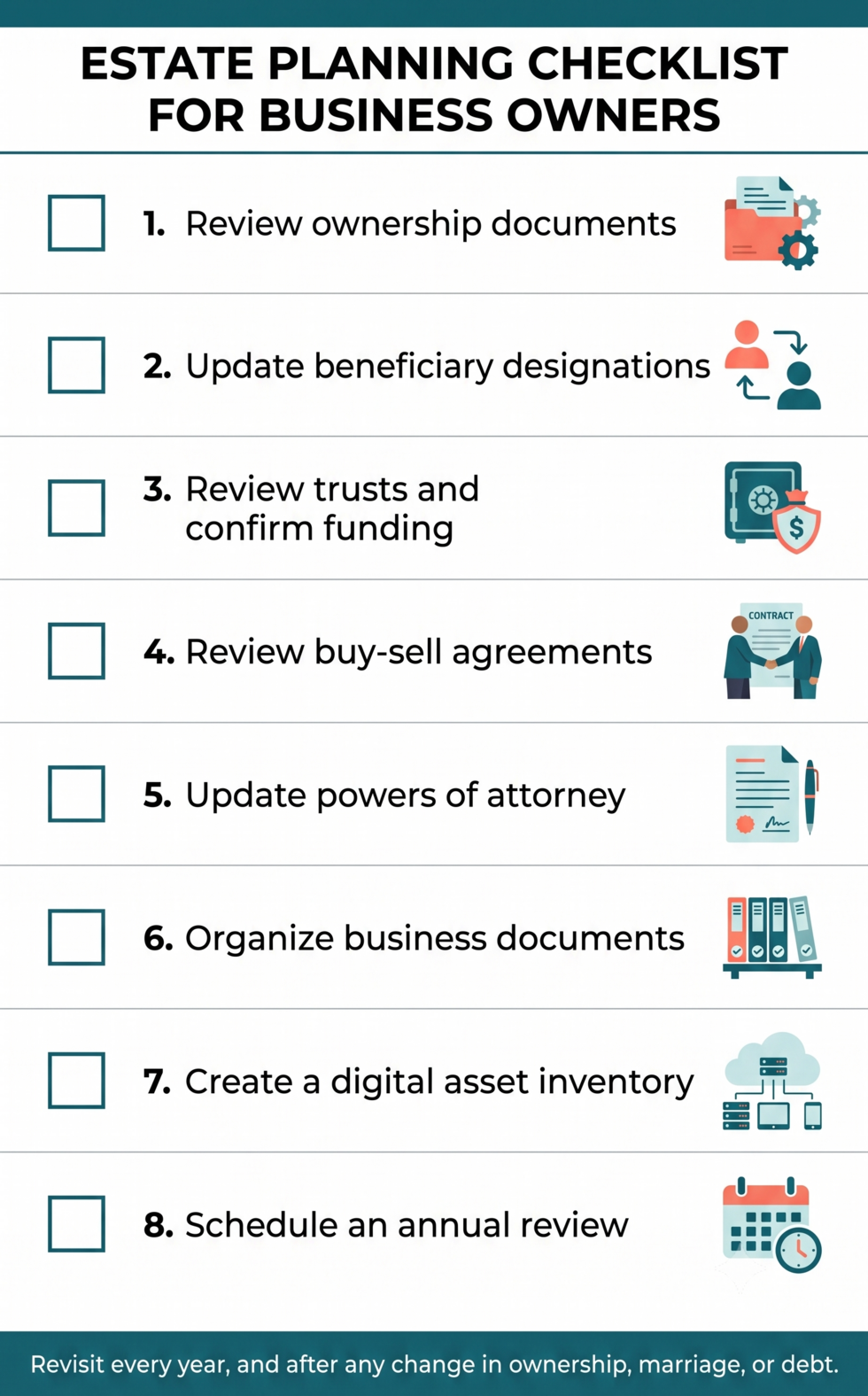
Estate planning for business owners comes down to this list. Work through it once, then revisit it annually. Think of it as an estate planning checklist for business owners transferring control to heirs, whether those heirs are your children, your partners, or your management team.
Review Ownership Documents
Pull the operating agreement, shareholder agreement, or partnership agreement and actually read the transfer, death, and disability provisions. Confirm whether a trust may hold the interest and what consent a transfer requires.
Update Beneficiary Designations
Check every retirement account, life insurance policy, and annuity. Beneficiary forms override your will, and stale designations naming an ex-spouse or a deceased parent are one of the most common defects we find.
Review Trusts
Confirm the trust exists, is signed, and is actually funded with the interest. Verify the successor trustee is still the right person and still willing.
Review Buy-Sell Agreements
Check the valuation method, the trigger events, and above all the funding. Compare the insurance in force to a current value, and reconsider any entity-purchase structure in light of Connelly.
Update Powers of Attorney
Make sure the durable power of attorney is current, names a backup agent, and separately initials the authorities your agent might actually need. Banks reject old or narrow powers routinely.
Organize Business Documents
Assemble formation documents, minutes, tax returns, key contracts, leases, loan documents, and personal guarantees in one place your successor can find. Note which contracts contain change-of-control clauses.
Create a Digital Asset Inventory
List accounts, domains, registrars, payment processors, and where credentials live. Florida's Chapter 740 gives fiduciaries a path to access, and under Fla. Stat. 740.003 a provider's online tool designation overrides contrary instructions in your will or trust, so set those designations deliberately.
Schedule Annual Reviews
Put a recurring date on the calendar with your attorney and CPA. Ownership changes, marriages, divorces, new partners, and new debt all change the answer.
Common Estate Planning Mistakes Business Owners Make
These are the recurring defects we see when reviewing existing plans, and nearly all of them are cheap to fix in advance and expensive to fix afterward.
Waiting Too Long
The most common one. Planning is treated as a task for later, and later turns out to be a stroke on a Tuesday. Every tool in this article requires capacity to sign.
Relying Only on a Will
A will alone leaves the interest in probate, provides nothing for incapacity, and cannot override the company documents. For an operating company, a will by itself is rarely sufficient.
Ignoring Business Succession
Legal transfer without operational readiness produces an heir who owns something they cannot run. Ownership and capability have to be planned separately.
Failing to Coordinate Legal Documents
The estate plan says one thing, the operating agreement says another, the beneficiary form says a third. Coordination is the entire job, and it is where a general practitioner's estate plan most often falls short.
Forgetting Digital Assets
Domains, hosting, payment processors, social accounts, and software licenses can halt operations if nobody can reach them. Inventory them and grant access deliberately.
Not Updating the Plan
A plan drafted around a company worth $600,000 does not fit one worth $6 million. Insurance funding, valuation formulas, and equalization all drift out of date quietly.
Assuming Family Members Want the Business
Ask them. Plenty of children have careers they love and no interest in taking over, and plenty of owners have never had the conversation. Planning around an assumption is planning around a guess.
Choosing the Wrong Fiduciary
The oldest child is not automatically the right trustee or personal representative. Choose for judgment, availability, and the ability to work with professionals, and name a backup.
When Should You Hire an Estate Planning Attorney?
Before a triggering event, and specifically when your ownership interest is a meaningful part of your net worth or when anyone else depends on the company. Waiting until a diagnosis or a partner dispute narrows the options considerably.
When Professional Guidance Matters
Some situations are not do-it-yourself territory:
- Complex ownership: multiple entities, tiered structures, real estate held separately from operations, or interests in more than one state.
- Succession planning: any transfer of ownership to family, partners, or employees, where documents and tax treatment interact.
- Tax and trust planning: irrevocable trusts, GRATs, ILITs, valuation discounts, and section 6166 elections all require drafting precision.
- Multi-owner companies: buy-sell drafting and funding, and reconciling several owners' personal plans with one set of company documents.
Estate Planning vs. Business vs. Probate Attorneys
An estate planning attorney drafts the wills, trusts, powers of attorney, and beneficiary coordination. A business attorney handles entity formation, operating and shareholder agreements, and transactions. A probate attorney administers the estate after death.
Many owners need more than one, and the work overlaps at exactly the point where plans fail. Our practice sits on the estate planning and probate side, and we routinely coordinate with a client's business counsel, CPA, and financial advisor rather than working around them. Collaboration is necessary whenever a document one professional drafts can be contradicted by a document another drafted, which for owners is most of the time. Estate planning for business executives with equity compensation adds another coordination point, since option and restricted-stock terms rarely match a standard estate plan.
How to Choose the Right Estate Planning Attorney
Look for someone who regularly handles estate planning for businesses, not just family wills. Ask directly: how many closely held interests have you planned around, and have you drafted buy-sell agreements?
Ask about state-specific knowledge, because Florida's homestead rules, elective share, and LLC defaults differ meaningfully from other states. Ask what the engagement includes, whether funding the trust is part of the fee, and how they coordinate with your CPA. Reasonable questions for a consultation include: what happens to my interest the day after I die under my current documents, and what would you change first? Red flags: a template package with no review of your company documents, pressure toward a single product, reluctance to quote a fee in writing, or anyone promising a specific tax result before reading anything. For more on the selection process, see my earlier article, How to Find an Estate Planning Attorney for Your Needs, and what estate planning typically costs is a useful companion read.
Why Working With an Experienced Estate Planning Attorney Matters
The Nussbickel Law Firm, P.A. is a Fort Myers firm devoted exclusively to estate planning, probate, and trust administration, and estate planning for business owners is a regular part of that work. We work with owners throughout Lee, Collier, and Charlotte counties, and with out-of-state families who own Florida property or Florida entities.
Personalised Legal Strategies
We start by reading your company documents, not by opening a template. What your operating agreement or shareholder agreement already says determines what your estate plan can do, and that reading is where the real work begins.
Coordinating Estate, Business, and Tax Planning
We draft the estate documents and then reconcile them against the company documents line by line, working with your CPA and financial advisor so the tax and funding assumptions hold up. Where a company document has to change, we say so plainly and coordinate with your business counsel.
Avoiding Costly Probate Mistakes
Because we handle Florida probate every week, we know exactly where an unfunded trust, a stale beneficiary form, or an unaddressed transfer restriction turns into a six-month delay. That perspective shapes how we draft. For background on what the court process involves, Florida estate and death taxes and Florida homestead probate cover two of the most common trouble spots.
Protecting Your Business for the Next Generation
The goal is simple: the future of your business should not depend on how quickly a court can act. If you want to know what your current documents actually do, that is a short conversation. Schedule a consultation or call our Fort Myers office.
Benefits of Early Planning
Early planning is cheaper, because structuring costs less than repairing. It also preserves options that close later: gifting while values are low, funding insurance while you are insurable, and training a successor while you are still there to teach.
Long-Term Peace of Mind
Owners who finish this work describe the same relief. The documents are signed, the funding is in place, the successor knows the plan, and the family has heard it from you. That is the actual deliverable.
Frequently Asked Questions
Do business owners need a separate estate plan?
Not a separate plan, but a broader one. Estate planning for business owners combines the usual personal documents with the company's governing documents, because your operating or shareholder agreement, not your will, usually controls what happens to your interest at death.
What happens to my LLC if I die?
Under Fla. Stat. 605.0602(7)(a) you are dissociated as a member at death. Your heirs generally receive only a transferable interest, meaning a right to distributions without voting or management rights, unless your operating agreement or the remaining members provide otherwise.
Can a trust own a business?
Yes. A trust can hold LLC units, corporate shares, or a partnership interest, subject to any transfer restrictions in the company documents. S corporation stock is the exception that needs care, because only certain trusts qualify as eligible shareholders.
Should I transfer my LLC into a trust?
Usually yes, if continuity matters. Holding the units in a funded revocable trust avoids probate on the interest and lets your successor trustee act immediately. Check the operating agreement first, since most require consent before any transfer of ownership.
What is the best trust for business owners?
For most owners, a funded revocable living trust, because it solves the authority gap at death and incapacity. Owners with estates likely to exceed the federal exemption often add an irrevocable trust or an ILIT for tax and liquidity purposes.
Can estate planning reduce taxes?
It can, though for most Florida owners the bigger win is avoiding probate and creating liquidity. Annual exclusion gifting, irrevocable trusts, valuation discounts, and section 6166 installment elections are the main tools where a taxable estate is actually in play.
What happens if there is no succession plan?
Control defaults to whatever the company documents and Florida law provide, which usually means a personal representative or a transferee with limited powers. Operations stall, disputes start, and forced sales at a discount become likely.
Is a buy-sell agreement part of estate planning?
It is not a personal estate document, but no plan involving co-owners is complete without one. It sets the price, terms, and funding for your interest, and it should be drafted alongside your will or trust rather than years apart.
How does probate affect a business?
It delays authority. Until letters issue, no one can clearly sign for the estate's interest, and a personal representative may continue an unincorporated venture for only four months without court approval under Fla. Stat. 733.612(22).
Gregory J. Nussbickel is the founder of The Nussbickel Law Firm, P.A. in Fort Myers, Florida. His practice is devoted exclusively to estate planning, probate, and trust administration for families throughout Southwest Florida.
This article is for general information only and is not legal advice. Reading it does not create an attorney-client relationship. Business and estate laws change, and every company is different; speak with a licensed Florida attorney about your specific situation.

Comments
There are no comments for this post. Be the first and Add your Comment below.
Leave a Comment