

Key Highlights
- How much does probate cost in Florida? For an uncontested formal administration, plan on the clerk's $400 filing fee, publication of the notice to creditors, and an attorney fee that the statutory schedule presumes reasonable at $3,000 plus 3% of the estate's value above $100,000.
- The personal representative is entitled to a commission of 3% of the first $1 million under section 733.617, and a family member serving in that role can waive it.
- Every one of these costs is paid from estate assets before any beneficiary receives a distribution. They are Class 1 expenses under section 733.707, ahead of every other claim.
- Summary administration, now available to estates of $150,000 or less, requires no letters, no personal representative commission, and no publication of the notice to creditors.
- The statutory attorney fee is not mandatory. Section 733.6171 requires the attorney to disclose in writing that the fee is negotiable before charging by the schedule.
- On September 9, 2026, Florida's Third District Court of Appeal held that a personal representative's commission cannot be denied without an evidentiary hearing on the statutory factors.
Introduction
The short answer: how much does probate cost in Florida depends first on which proceeding the estate needs and second on the value of the assets that pass through it. A typical uncontested formal administration of a $150,000 to $750,000 estate in Lee, Collier or Charlotte County carries a $400 clerk filing fee, a newspaper charge for publishing the notice to creditors, a few dollars per certified copy of the letters, and an attorney fee that the Florida Probate Code presumes reasonable at $4,500 to $22,500 on those values. If the personal representative takes the statutory commission, add the same 3% again. Appraisals, an accountant for the estate's tax returns, a bond premium if the will did not waive bond, and real estate closing costs are extra and depend on the estate.
I wrote this for two readers. The first is an adult child, often living in another state, who has just been named personal representative in a parent's Florida will and wants to know what the estate will spend before anyone in the family sees a dollar. The second is a surviving spouse or sibling handling a modest estate who wants to know whether the estate qualifies for something cheaper than formal administration, and what that saves. Both need actual numbers with a statute behind each one, which is what follows. Two of my earlier articles cover the attorney fee schedule on its own; this one adds up the whole bill.
How Much Does Probate Cost in Florida? Every Line Item
Probate costs in Florida come from five sources: the clerk of court, the newspaper, the attorney, the personal representative, and the third parties hired along the way. The first two are fixed by statute or set by a vendor; the last three scale with the size of the estate. Summing them is the whole probate process in miniature, and three facts frame it. The clerk's fees are capped by section 28.2401 of the Florida Statutes, so a formal administration filed in Fort Myers costs the same at the courthouse as one filed in Naples or Punta Gorda. The attorney's fee and the personal representative compensation are governed by two statutory schedules that are presumed reasonable but not mandatory. And the type of administration matters more than any single fee, because summary administration and disposition without administration skip entire categories of cost.
The Two Statutory Schedules
The ranges most families ask probate attorneys about are the two percentage schedules. For ordinary services in a formal administration, section 733.6171 presumes an attorney fee of $1,500 for an estate of $40,000 or less, rising in steps to $3,000 at $100,000, then 3% of the next $900,000. Section 733.617 gives the personal representative a commission of 3% of the first $1 million. Together, on an estate between $100,000 and $1 million, that is roughly 6% of the compensable value if both are taken, and roughly 3% if the family member serving as personal representative waives the commission, which many do.
Cost by Type of Administration
Disposition without administration is the cheapest route and the narrowest: a $231 filing fee, no attorney, no letters and no publication, for very small estates of exempt personal property. Summary administration costs $345 to file and requires no personal representative and therefore no commission, and no published notice; the attorney fee is whatever the family and the attorney agree, because the section 733.6171 schedule applies only to formal administration. Formal administration carries the $400 filing fee, publication, the attorney's schedule, the commission, and any bond. The comparison table near the end of this article puts the three side by side.
How Much Does Probate Cost in Florida for a Typical Estate?
For a typical uncontested estate in formal administration, the cost of probate in Florida is the statutory attorney fee, plus the personal representative's commission if it is taken, plus about $400 to $500 in clerk charges, plus the newspaper's publication charge, plus whatever appraisals and tax work the assets require. The examples below show the arithmetic at three estate values, using the statutory schedules as the baseline. They are illustrations built from published figures, not a quote, and every real case is different.
Florida Probate Cost Estimates
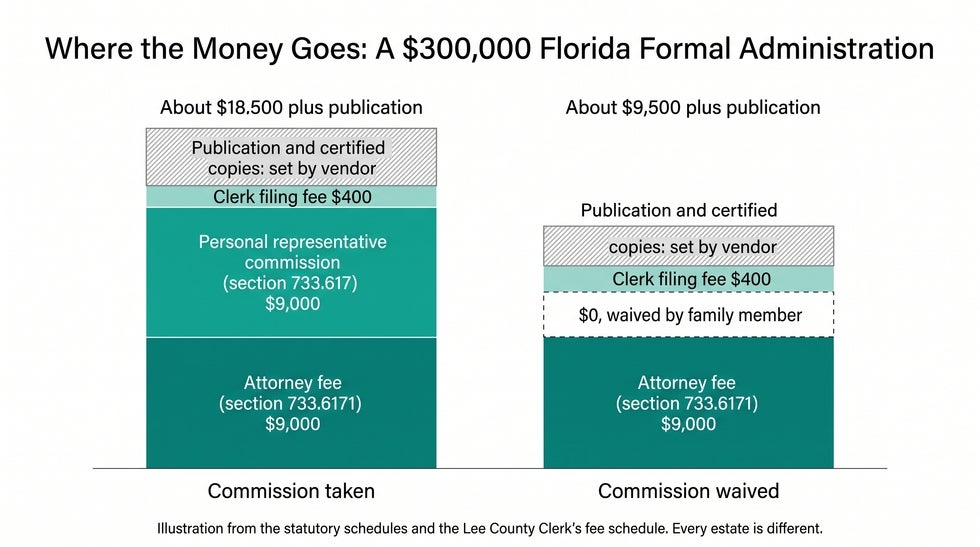
Take a $300,000 estate consisting of a Cape Coral bank account and a brokerage account, with no homestead and a will that waives bond. The clerk charges $400 to open the formal administration. The attorney's presumed reasonable fee is $3,000 for the first $100,000 plus 3% of the remaining $200,000, which is $6,000, for $9,000 in total. The personal representative's commission is 3% of $300,000, or $9,000, unless the daughter serving in that role waives it. Add the newspaper's publication charge and a handful of certified copies at a few dollars each. The florida probate cost for that estate is therefore about $9,500 plus publication if the commission is waived, and about $18,500 plus publication if it is not.
At $150,000, the same arithmetic gives an attorney fee of $4,500 ($3,000 plus 3% of $50,000), a commission of $4,500 if taken, and the same $400 filing fee. At $750,000, the attorney fee is $22,500 ($3,000 plus 3% of $650,000), the commission is $22,500 if taken, and the filing fee is still $400. Notice what those three examples have in common: the court's charge is a rounding error, and the estate's value drives everything else.
The Two Cheaper Proceedings
Summary administration usually saves money for two structural reasons. No personal representative is appointed, so there is no commission at all, and no notice to creditors is published, so there is no newspaper charge. The filing fee is $345 rather than $400, and the attorney fee is negotiated rather than presumed by a schedule, because section 733.6171(3) by its terms governs "a formal estate administration." The cost of summary administration in Florida for a qualifying estate is therefore the filing fee plus an agreed attorney fee plus certified copies of the order, and little else. The firm's video What Is Summary Administration? Florida's Short-Form Probate walks through the proceeding itself.
Disposition without administration is cheaper still, but it fits only very small estates: a $231 filing fee, no attorney required, and an informal application to the court under section 735.301. If the decedent left a car worth $8,000, a checking account holding $3,000 and a $7,000 funeral bill, this is the route.
What Factors Affect Total Probate Fees in Florida?
Six things move probate fees in Florida up or down: the compensable value of the probate estate; whether real property must be sold or transferred; whether the heirs agree or someone contests the will; whether assets pass outside probate by beneficiary designations, joint ownership or a trust; whether the estate needs tax returns, a homestead determination or an ancillary administration in another state; and whether the personal representative takes or waives the commission. A contested case can cost several times what an uncontested one does, because litigation is billed as an extraordinary service at hourly rates, and this office refers contested matters to litigation counsel.
The single largest lever is the fourth one. Life insurance with a named beneficiary, retirement accounts with a named beneficiary, bank accounts held jointly with a spouse or payable on death, and property held in a revocable trust never enter the probate estate, so they never enter the compensable value that both percentage schedules are calculated on. I cover that list in my earlier article, Assets Exempt from Probate in Florida. With the drivers in view, the next sections price each line item, starting with the clerk.
What Court Filing Fees Must Be Paid in Florida Probate?
Florida probate filing fees are capped by section 28.2401, and every circuit clerk charges at or near the cap. In Lee County the court filing fee is $400 to open a formal administration, $345 for a summary administration of $1,000 or more, and $231 for a disposition without administration.
The clerk collects the fee when the petition is e-filed, and it is the only payment the court itself requires to open the case. Filing costs for a summary administration of less than $1,000 are $235.
Two smaller charges sit alongside it. Section 28.2401(3) adds a $4 education surcharge to every petition for summary, formal or ancillary administration, which is built into the figures above along with a further dollar of clerk charges. And section 28.2401(4) requires the clerk to record the petitions that open and close an estate, the letters, the will and the orders, so recording is part of the file rather than a separate trip to the recorder's office.
Clerk's Fees by Proceeding Type
The Lee County Clerk's posted schedule, read on September 18, 2026, tracks the statute item for item, one dollar above the statutory base plus surcharge on each:
- Formal administration, ancillary administration, guardianship or curatorship: $400.
- Summary administration, estate valued at $1,000 or more: $345.
- Summary administration, estate valued at less than $1,000: $235.
- Disposition of personal property without administration: $231.
- Petition to admit a foreign will or an authenticated copy to record: $231.
- Caveat or notice of trust: $41.
- Exemplified certificate: $7.
Certified Copies and Recording Charges
Certified copies of the letters of administration are a separate clerk charge, and a personal representative needs several of them. Banks, brokerage houses, title companies, the tax collector for a vehicle title and the Social Security Administration each want their own. Under section 28.24, the clerk charges $2 to certify a court record plus the per-page copy charge, so a set of eight certified letters is a small line, not a large one. Order them at the time letters issue rather than one at a time later. Certified mail to known creditors and the per-page recording fee on a personal representative's deed are the other small clerk-and-postage lines; those are probate court costs in Florida at the retail level, and they are the same in Collier and Charlotte County because the same statute caps them.
Where to Confirm the Fees
The two places to confirm a figure are the statute and the clerk. Section 28.2401 on the Legislature's Online Sunshine site carries the current caps, unchanged since chapter 2023-284, and each county clerk posts its own schedule. When an article quotes a different filing fee, it is usually reading an older edition; The Florida Bar's consumer pamphlet on probate, for example, still quoted the pre-2026 summary administration ceiling as of early September 2026. The fixed costs are now accounted for; the attorney fee is the first of the two figures that scale with the estate.
How Are Probate Attorney Fees Calculated in Florida?
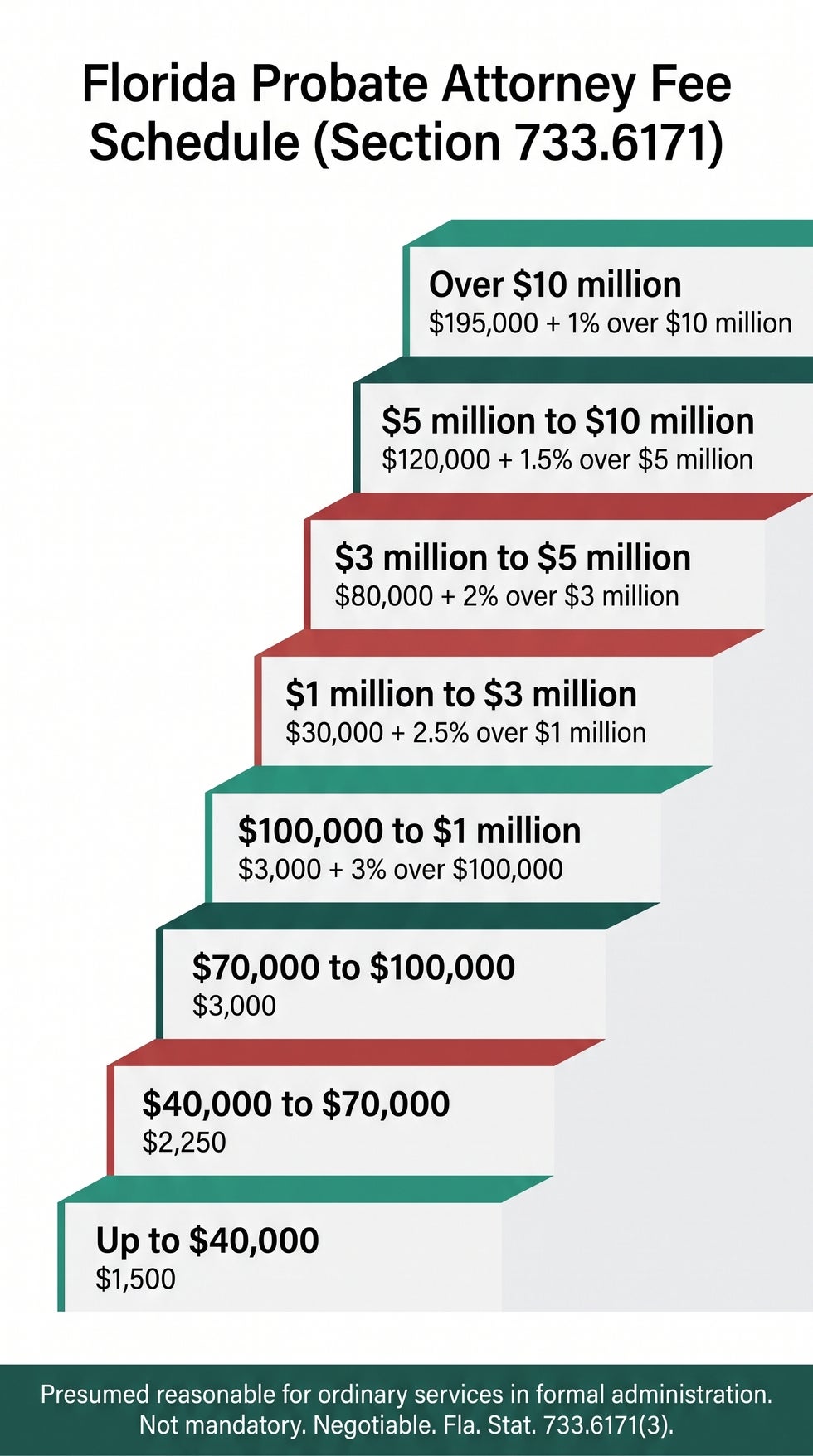
Florida probate attorney fees for ordinary services are measured against the schedule in section 733.6171, which presumes a fee reasonable when it is based on the compensable value of the estate. The presumption is a starting point, not a price list. The statute says in terms that there is no mandatory statutory attorney fee, requires the attorney to disclose that in writing, and allows the personal representative, the attorney and the people whose inheritances bear the fee to agree on any other arrangement. Extraordinary services are billed in addition to the ordinary-services fee.
The Section 733.6171 Fee Table
| Compensable value of the estate | Presumed reasonable attorney fee for ordinary services |
|---|---|
|
$40,000 or less |
$1,500 |
|
More than $40,000, up to $70,000 |
$2,250 |
|
More than $70,000, up to $100,000 |
$3,000 |
|
More than $100,000, up to $1 million |
$3,000 plus 3% of the amount over $100,000 |
|
More than $1 million, up to $3 million |
$30,000 plus 2.5% of the amount over $1 million |
|
More than $3 million, up to $5 million |
$80,000 plus 2% of the amount over $3 million |
|
More than $5 million, up to $10 million |
$120,000 plus 1.5% of the amount over $5 million |
|
More than $10 million |
$195,000 plus 1% of the amount over $10 million |
The statutory fee schedule is cumulative, so each tier's rate applies only to the dollars inside that tier. A $2 million estate is not charged 2.5% of $2 million; it is charged $30,000 for the first million plus 2.5% of the second, or $55,000. The dollar tiers are not indexed for inflation, which is one reason many probate lawyers price routine estates by flat fees instead.
Compensable Value and Exclusions
Compensable value is defined in section 733.6171(3) as "the inventory value of the probate estate assets and the income earned by the estate during the administration." Only probate assets count. The decedent's protected homestead is not an asset in the hands of the personal representative under section 733.608, so it does not enter the compensable value even though it is listed on the inventory, and legal work on the homestead is separately classed as an extraordinary service. My earlier article on Florida homestead in probate explains why the home sits outside the estate.
The same rule excludes everything that passes by contract or title. A life insurance policy with a named beneficiary, an IRA payable to a spouse, a joint account with right of survivorship, and property titled in a revocable trust are not probate assets and are never in the inventory value. That is the practical link between estate planning and probate costs: a decedent who moved most of the estate's value into beneficiary designations and a trust left a small probate estate, and the percentage schedules run on the small number.
Written Fee Agreements and Required Disclosures
Since chapter 2021-145 took effect, an attorney who intends to charge by the schedule must give the personal representative five written disclosures before doing so: that there is no mandatory statutory attorney fee; that the fee need not be based on the size of the estate and the presumed reasonable fee may not fit every administration; that the fee is subject to negotiation; that the personal representative may choose any attorney and is not required to hire the one who drafted the will; and that the personal representative is entitled to a summary of the ordinary and extraordinary services rendered at the end of the representation. The personal representative signs an acknowledgment, and section 733.6171(2)(d) bars an attorney who skipped the disclosures from being paid without court approval or the written consent of all interested parties.
Negotiated Fees and Extraordinary Services
For uncontested estates, flat fees are common and the statute permits them under section 733.6171(2)(a), which allows the attorney, the personal representative and the persons bearing the impact of the fee to agree on compensation "determined in a different manner." Our office quotes routine administrations that way, in writing, before any work starts, and the fee agreement names the fee structure in plain words.
Extraordinary services are the exception to any flat quote. Section 733.6171(4) lists them, and the list is long: a will contest or any litigation by or against the estate; representing the estate in a tax audit; postmortem tax planning; preparing or reviewing the estate's tax returns; the purchase, sale or lease of real property; carrying on the decedent's business; legal advice on homestead status; fee disputes; ancillary administration of assets in another state; and, since chapter 2026-57, proceedings to enforce the personal representative's authority. Each is billed on top of the ordinary fee, usually at an hourly rate, and each can be reviewed by the court on petition. The attorney's fee settled, the next line is the personal representative's own.
What Is the Personal Representative's Commission in Florida Probate?
Florida law separately compensates the personal representative under section 733.617, and the commission is distinct from the attorney's fee. It is payable from estate assets without a court order, it is calculated on the same compensable value the attorney's fee uses, and it is presumed reasonable at 3% of the first $1 million. Personal representative fees in Florida are the second percentage line in the total cost of a formal administration, and the one most families choose to waive.
The right to the commission is real even when it is contested. In Evgrafova v. Estate of McKeehan, No. 3D25-2008, decided September 9, 2026, the Third District Court of Appeal reversed a Miami-Dade probate judge who had denied a personal representative any commission after a six-year administration. The court held that the 3% commission is presumed reasonable, that a court may reduce or deny it for mismanagement only after an evidentiary hearing on the section 733.617 factors, and that no expert testimony is needed to establish it. (The opinion is not final until the time for rehearing runs; confirm its status before relying on it.)
The Section 733.617 Percentage Schedule
The personal representative's commission is 3% of the first $1 million of compensable value, 2.5% of the amount above $1 million up to $5 million, 2% of the amount above $5 million up to $10 million, and 1.5% of everything above $10 million. On a $300,000 estate that is $9,000; on a $750,000 estate it is $22,500. Section 733.617(3) allows further compensation for extraordinary services such as selling real property, conducting litigation, dealing with tax proceedings, running the decedent's business, or dealing with protected homestead.
The Commission Base
The commission base is the same as the attorney's: the inventory value of the probate estate assets plus income earned during administration. Non-probate transfers are excluded, protected homestead is excluded, and assets in a trust are excluded. The commission exists only in formal administration, because only formal administration appoints a personal representative; summary administration and disposition without administration have no personal representative and no commission.
Who can serve, and therefore who can earn the commission, is its own question. The firm's video Who Can Be Personal Representative in Florida? The Rules covers the residency and relationship rules that decide it.
Waiver and Tax Consequences
A family member serving as personal representative may renounce all or any part of the commission under section 733.617(4), and most do when they are also the main beneficiary. The reason is tax. A commission that is paid is compensation for services and is taxable income to the person who receives it. An inheritance is not. A daughter who is the sole beneficiary of a $300,000 estate gains nothing by paying herself a $9,000 commission, because she would receive the same $9,000 as an inheritance without the income tax. When the personal representative is one of several beneficiaries the arithmetic changes, and waiver becomes a decision to make with the numbers in front of you. The professional fees are now priced; the remaining lines come from outside the case.
What Third-Party Costs Must Florida Estates Pay During Probate?
Third-party costs are real probate costs even though neither the court nor the attorney receives them: the newspaper that publishes the notice to creditors, the appraiser, the accountant who prepares the estate's returns, and the title company and recorder when real estate changes hands. Each is an expense of administration paid from estate assets, and each varies with what the decedent owned. Bond, which is also a third-party cost, has its own section next.
Publication of the Notice to Creditors
Section 733.2121 requires the personal representative in a formal administration to publish a notice to creditors once a week for two consecutive weeks in a newspaper published in the county where the estate is administered. The notice starts the three-month claims window that my article on Florida probate creditor claims explains. The newspaper sets the charge, publication costs differ between the Fort Myers, Naples and Punta Gorda papers, and the estate pays them; ask the attorney for the current figure in your county. Summary administration and disposition without administration do not require publication, which is one of the reasons they cost less.
Appraisal Costs
An appraisal is needed when the inventory value of an asset cannot be shown from a statement. Bank accounts and brokerage accounts carry a date-of-death value on paper; real property, a boat or a coin collection does not, and the personal representative must report a value the court and the beneficiaries can rely on. The appraisal also fixes the beneficiary's income tax basis under the date-of-death rule, so underpricing a Naples condo to shave the fees is a bad trade.
Accountant Fees and Tax Returns
Every estate has at least one tax return: the decedent's final Form 1040 for the year of death. A decedent's property that earns income during administration, such as interest, dividends or rent on a Lehigh Acres duplex, files Form 1041, the fiduciary income tax return, and the accountant's fee for both income tax returns is an expense of administration. Florida has no estate tax and no inheritance tax, which I cover in my earlier article, Florida Inheritance Tax: What Heirs Actually Owe, and a federal estate tax return on Form 706 is required only when the gross estate exceeds the basic exclusion amount, which the IRS sets at $15,000,000 for a 2026 death under Public Law 119-21.
One tax point about the fees themselves. Administration expenses, including attorney fees and the personal representative's commission, may be deducted on the estate's Form 706 or on its Form 1041, but not both, under 26 U.S.C. § 642(g), and the choice requires a written waiver. They are not deductible on the heirs' personal returns. That is general information; the accountant preparing the estate's returns makes the election.
Real Estate Closing Costs
When the estate sells real property, the sale carries ordinary closing costs: the broker's commission, title insurance, the title company's settlement fee, documentary stamp tax on the deed, and recording fees. Those are costs of the sale rather than costs of the probate, but the estate pays them, and a personal representative's deed conveying the property is also an extraordinary service for the attorney under section 733.6171(4)(f) and for the personal representative under section 733.617(3)(a). Distributing real estate to a beneficiary instead of selling it avoids the broker and the doc stamps, and the deed still gets recorded at the per-page fee.
Real estate in another state adds an ancillary administration there, with its own filing fee and its own attorney. One more third-party cost depends on what the will says, and that is bond.
Is a Bond Required in Florida Probate Proceedings?
Not in every case. Under section 733.402, every personal representative must post a bond with surety unless the will or the court waives the requirement, and section 733.402(4) lets the court waive, require, increase or decrease the bond on its own motion or on petition. A bond is an insurance policy that pays the estate if the personal representative mishandles it, and the premium is an expense of administration paid from estate funds.
When a Court Orders Bond
A court orders bond when the will is silent, when there is no will, when the personal representative lives out of state, or when the judge sees a reason to protect the beneficiaries or creditors. Section 733.403 sets the amount at whatever penal sum the court considers sufficient after weighing the gross value of the estate, the relationship of the personal representative to the beneficiaries, exempt property and family allowance, the nature of the assets, and known creditors and liens. A surety company then quotes an annual premium on that penal sum; the rate is the surety's, not the court's, so ask for a quote before assuming a number.
When the Will Waives Bond
A will that waives bond is usually honored, and most professionally drafted Florida wills waive it for the named personal representative. In Lee, Collier and Charlotte County the judges routinely accept the waiver when the will contains one and the beneficiaries are the personal representative's own family, though the court keeps the power to require bond anyway if a creditor or beneficiary objects or the estate has unusual features. Checking whether the will waives bond is one of the first things I do when I read it, because a missing waiver is the difference between zero and an annual premium.
Bond Premiums Are Annual
A bond premium is an annual cost, not a single filing charge. The surety bills it each year the bond stays in force, until the estate closes and the personal representative is discharged, so a slow administration pays more premiums than a prompt one. With every line priced, the last question is how the three proceedings compare.
How Do Probate Costs Compare Across Administration Types?
Summary administration is usually less expensive than formal administration, and disposition without administration is less expensive than either, because each simpler proceeding removes whole categories of cost rather than discounting them. No personal representative means no commission and no bond. No published notice means no newspaper charge. A lower filing fee is the least of it. The reason is structural, not a matter of attorney pricing, and it starts with who qualifies.
Who Qualifies for Each Proceeding
Under section 735.201, summary administration is available when the value of the entire estate subject to administration in Florida, less property exempt from creditors' claims, does not exceed $150,000, or when the decedent has been dead for more than two years. The ceiling doubled from $75,000 on July 1, 2026 under chapter 2026-57, which my earlier article on Florida's new summary administration limit covers; many websites still quote the old figure. A will that directs formal administration takes the estate out of the summary route.
Disposition without administration under section 735.301 is for very small estates: personal property exempt under section 732.402 (household furnishings up to $20,000 and two motor vehicles), personal property exempt under the Florida Constitution, and nonexempt personal property worth no more than the preferred funeral expenses and the last 60 days of medical bills. Real estate disqualifies it. Formal administration is the default for everything else and for any estate that needs letters of administration to deal with a bank, a title company or a lawsuit. The firm's video Florida Disposition Without Administration: The Smallest Estates covers the smallest route.
Side-by-Side Comparison
| Category | Disposition without administration | Summary administration | Formal administration |
|---|---|---|---|
|
Who qualifies |
Exempt personal property plus nonexempt personal property not exceeding funeral and last-illness expenses (section 735.301); no real estate |
Estate subject to administration, less exempt property, of $150,000 or less, or death more than two years ago (section 735.201) |
Every estate that does not qualify for the simpler routes, or that needs letters of administration |
|
Clerk filing fee (Lee County) |
$231 |
$345 ($235 if under $1,000) |
$400 |
|
Publication of notice to creditors |
No |
No |
Yes, two weekly insertions under section 733.2121 |
|
Attorney fee basis |
Usually none; no attorney required |
Agreed fee, often a flat fee; section 733.6171 schedule does not apply |
Section 733.6171 schedule, a flat fee, or a hybrid, plus extraordinary services |
|
Personal representative commission |
None; no personal representative |
None; no personal representative |
3% of the first $1 million under section 733.617 unless waived |
|
Bond |
No |
No |
Unless waived by the will or the court |
|
Typical timeline |
Weeks |
A few months |
Six months at a minimum, often longer |
|
Typical total cost band |
Lowest: the filing fee |
Lower: filing fee plus an agreed attorney fee |
Highest: filing, publication, attorney schedule, commission, any bond |
Timeline and Cost Bands
Formal administration costs more partly because it takes longer. The creditor period alone is three months from first publication, letters must issue before anything can be collected, and the estate cannot close until claims are resolved, which my earlier article on how long probate takes in Florida lays out month by month. Time costs money in bond premiums, in accountant fees for another fiduciary return, and in carrying costs on an empty house. The firm's video What Is Formal Administration in Florida Probate? shows the full sequence. Summary administration cuts the timeline along with the cost because there is no personal representative to appoint and no claims period to wait out, though the petitioners remain liable for valid creditor claims for two years under section 735.206; the type of administration decides which cost band you are in.
How The Nussbickel Law Firm Quotes Probate
The Nussbickel Law Firm, P.A. handles estate planning, probate and trust administration for families in Lee, Collier and Charlotte Counties, and Florida probate matters statewide. Before any work begins on a probate administration, we tell the personal representative which proceeding the estate qualifies for, what the clerk and the newspaper will charge, whether bond is required, and what our fee will be, in writing, with the section 733.6171 disclosures the statute requires. Routine administrations are quoted as flat fees; extraordinary services, when an estate needs them, are identified in advance.
Bring the documents listed in the FAQ below and the estimate is arithmetic; the firm's video What Is Probate in Florida? A Plain-English Explanation is a good five-minute primer before the meeting. To talk through your family's estate, schedule a free consultation or call our Fort Myers office at 239-900-WILL (9455).
Conclusion
How much does probate cost in Florida comes down to three numbers and a choice. The numbers are the clerk's filing fee, which is fixed by section 28.2401 and is $400 for a formal administration in Lee County; the attorney fee, which section 733.6171 presumes reasonable on a sliding schedule that runs 3% between $100,000 and $1 million and which the statute itself calls negotiable; and the personal representative's commission, which section 733.617 sets at 3% of the first $1 million and which a family member can waive. The choice is the type of administration, because an estate that qualifies for summary administration under the new $150,000 ceiling skips the commission, the bond and the publication entirely. Everything else, from appraisals to the accountant, follows from what the decedent owned.
Frequently Asked Questions
What is the average cost of probate in Florida for a typical estate?
There is no published average cost of probate in Florida, and any single figure hides the fact that the largest costs are percentages of the estate. For an uncontested formal administration between $100,000 and $1 million, the statutory attorney fee is $3,000 plus 3% of the value over $100,000, the personal representative's commission is another 3% if it is taken, and the fixed costs are about $400 to open the case plus publication. On a $300,000 estate that is roughly $9,500 plus publication with the commission waived, and roughly $18,500 plus publication without the waiver.
Are probate costs in Florida different in 2026 compared to previous years?
Yes, in two ways. Chapter 2026-57 raised the summary administration ceiling from $75,000 to $150,000 on July 1, 2026, so many estates that would have needed a full formal administration last year now qualify for the cheaper proceeding with no personal representative commission and no published notice. The same act amended the list of extraordinary services in section 733.6171. The clerk's filing fees have not changed since chapter 2023-284, and the two percentage schedules are unchanged.
Can heirs or beneficiaries reduce their share of probate fees in Florida?
Heirs bear probate fees indirectly, through a smaller inheritance, so reducing the fees helps them directly. The tools are the personal representative's waiver of the commission, a negotiated flat fee with the attorney, confirming that the estate qualifies for summary administration, and, before death, moving assets outside probate with beneficiary designations, joint ownership or a funded trust, which my earlier article on how to avoid probate in Florida explains. Any interested person may also petition the court under section 733.6171(5) to reduce an attorney fee that the facts do not support.
What should you bring to a consultation to estimate probate fees in Florida?
Bring an asset list with approximate values and how each asset is titled, the most recent statements for bank accounts, brokerage and retirement accounts, the deed to any real property, the original will and any prior estate planning documents such as a trust, the death certificate, a list of known debts and the last medical bills, and identification for the person who will serve as personal representative. With those documents an attorney can tell you which proceeding applies, what the court and newspaper will charge, and what the fee will be, before you commit to anything.
Who pays probate fees in Florida?
The estate pays them, before any beneficiary receives a distribution. Attorney fees, the personal representative's commission, court costs and the other expenses of administration are Class 1 obligations under section 733.707, paid ahead of funeral expenses, taxes and every other claim. A personal representative who advances a filing fee or a publication charge is reimbursed before the remaining assets are distributed, and nobody owes probate costs personally unless he or she agreed to.
How do probate attorney fees compare with the cost of estate planning?
Estate planning is paid once, while alive, at a flat fee for the documents; probate is paid from the estate after death, on a percentage schedule that grows with the estate's value. For many Southwest Florida families a funded revocable trust costs less to set up than a formal administration of the same assets would cost to run, and the planning-side figures for wills and trusts are in my earlier article on the average cost of a will and trust in Florida.
Gregory J. Nussbickel is the founder of The Nussbickel Law Firm, P.A. in Fort Myers, Florida. His practice is devoted exclusively to estate planning, probate, and trust administration for families throughout Southwest Florida.
This article is for general informational purposes only and is not legal advice. Reading it does not create an attorney-client relationship. Probate law changes, and every estate is different, so speak with a licensed Florida attorney about your specific situation.

Comments
There are no comments for this post. Be the first and Add your Comment below.
Leave a Comment