
Key Highlights
- You can say no. The right to disclaim inheritance Florida law gives every heir lives in Florida Statute Chapter 739, the Florida Uniform Disclaimer of Property Interests Act.
- Form matters. The written disclaimer must be signed before two witnesses and a notary, like a deed, and the original must be delivered or filed.
- Not your pick. The property passes as if you died first, often to your own children.
- Hands off first. Accepting the property, its income, or a sale of it bars a disclaimer under section 739.402.
- Nine months for tax. Florida sets no deadline, but a refusal received after nine months is treated as your gift for federal tax purposes.
- No shield. It will not defeat creditors, Medicaid rules, or an IRS lien.
Introduction
The short answer: to disclaim inheritance Florida law lets you sign a written refusal before you accept the property, and the property then passes as if you had died before the person who left it to you. To avoid gift tax, the disclaimer generally must be delivered within nine months of the death.
Most people who ask about refusing an inheritance have a good reason. A son who is already comfortable wants his share to go to his own children. A daughter does not want a timeshare with rising assessments. A widow's estate plan was built to use a disclaimer. Some heirs simply have personal reasons. This guide explains who gets the property, what the document must say, what bars it, the steps in order, and the limits.
What Is a Disclaimer, and Why Use One?
A disclaimer is a formal refusal to accept property you would otherwise inherit. Florida defines it in section 739.102 as "the refusal to accept an interest in or power over property," and the term includes a renunciation. So whether you call it a decision to renounce an inheritance or to disclaim it, the same statute governs every decision to disclaim inheritance Florida families make.
Heirs use one for a number of reasons:
- Passing assets to the next generation: refused property usually flows to the next family member in line, often the disclaimant's own children, so it skips a step without a gift.
- Keeping it out of your own estate: an heir who receives a large inheritance late in life may not need it; property never accepted is not part of your own estate for estate taxes at your death.
- Refusing a burden: an underwater house, a condo with special assessments, or a timeshare can be a financial burden that costs more than it is worth.
- Running a spouse's plan: many estate planning documents for married couples give the surviving spouse a choice to disclaim into a family trust.
The Florida Uniform Disclaimer of Property Interests Act took effect July 1, 2005, and under section 739.103 it is now the exclusive means of making a disclaimer under Florida law. Before you sign anything, the first question is where the property would go.
Who Gets the Property If You Disclaim?
The property goes where the document that created your inheritance sends it, and if that document is silent, it passes as if you had died just before the person who left it to you. You do not choose the new owner, even among the members of the family. If you name one, you have made a gift, not a disclaimer.
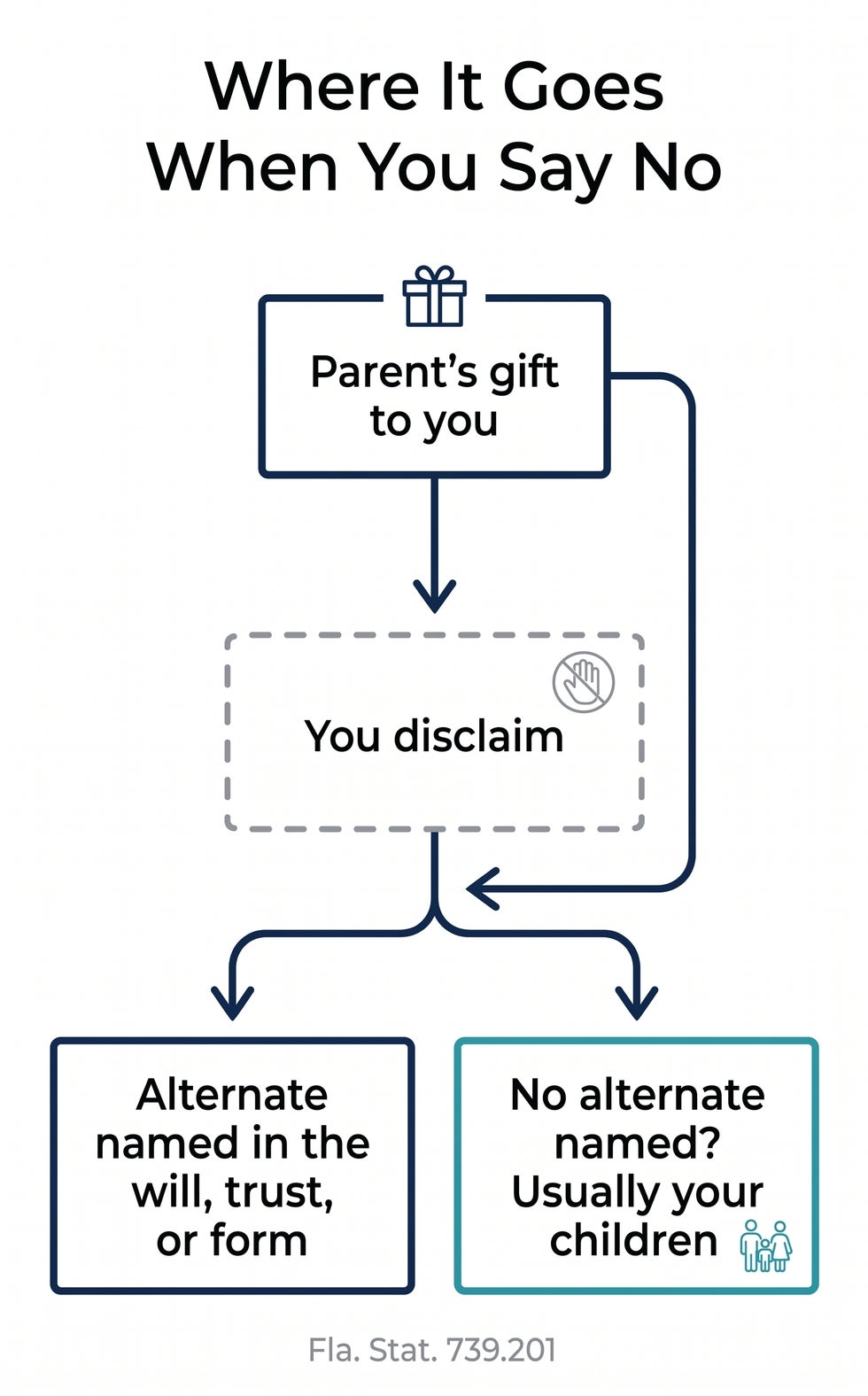
Clients usually phrase it this way: "Who gets the inheritance if I disclaim?" Under section 739.201, the disclaimed interest follows the governing instrument or other applicable law, depending on the kind of transfer.
- Under a will: the will's own alternate gift controls first. If it has none, Florida's antilapse statute, section 732.603, usually creates a substitute gift to your descendants when you are a grandparent or descendant of a grandparent of the testator. Words such as "if he survives me" can defeat that rule and send your share to the residue instead.
- When there is no will: under state intestacy laws, a disclaimed share passes as if you predeceased, so your children take it by representation. Our guide to probate without a will shows who the intestate heir is in each family pattern.
- In a trust: the trust's terms decide. A revocable trust that became irrevocable at death is treated much like the grantor's will for this purpose, so its alternate gifts to contingent beneficiaries usually control.
- Accounts with a beneficiary designation: life insurance, an IRA, or a payable-on-death account passes to the contingent beneficiary named on the form. If none is named, the account may fall back to the estate. The firm's video Do All Assets Go Through Probate in Florida? explains why those forms override the will.
- Jointly owned property: a survivor can refuse the survivorship share. For a joint bank account, that is generally the part the deceased owner contributed; for survivorship real estate owned by two people, and for spouses' tenancy by the entirety property, it is one-half.
If your children are minors, the refused share lands with them, and a minor cannot manage it. Our article on estate planning for grandchildren covers custodial accounts and trusts, which matter once a gift tops the $15,000 natural guardian limit in section 744.301(2). Once you know where it goes, the next question is the paperwork.
What Does a Valid Florida Disclaimer Require?
A valid disclaimer must meet five legal requirements in section 739.104(3), and the courts enforce every one. The disclaimer must be in writing, declare that it is a disclaimer, describe the interest refused, and be signed by the disclaiming party. It must also be witnessed and acknowledged "in the manner provided for deeds of real estate to be recorded," which means two witnesses and a notary.
A sixth step makes it effective: an original of the disclaimer must be delivered or filed as section 739.301 directs. For an interest under a will or by intestacy, it goes to the personal representative, or, if none is serving, it is filed with the clerk in any county where the probate court could administer the estate. A trust interest goes to the trustee, and a beneficiary designation goes to whoever must pay it out.
Real estate adds one more layer. Under section 739.601, a disclaimer carrying a legal description and recorded with the clerk in the county where the land sits gives notice to the world. The Third District held in Lee v. Lee, 263 So. 3d 826 (Fla. 3d DCA 2019), that a missing legal description makes the document unrecordable but does not make it invalid between the disclaimant and the new owners.
This is a specific legal process, and close is not good enough. In Feldman v. Schocket, No. 3D21-1509 (Fla. 3d DCA Sept. 21, 2022), an appellate court refused to treat an unacknowledged spousal waiver as a disclaimer, noting the statute makes no provision for partial compliance and is the exclusive legal procedure. This Florida disclaimer of interest statute reaches a power of appointment as well as property, and lets you disclaim even if the will or trust has a spendthrift provision or similar restriction. It cannot help you, though, once any of five events has occurred.
When Is a Disclaimer Barred in Florida?
Section 739.402 lists the events that end the right. If any of them happens before the disclaimer takes effect, it is ineffective, no matter how well it was drafted. A disclaimer of inheritance Florida courts will enforce must clear all of them.
Accepting it. Moving into the inherited house, driving the car, cashing a distribution check, or keeping the rent all count. Chapter 739 does not define acceptance. The federal rules in Treasury Regulation section 25.2518-2 give useful examples: merely holding title that passed automatically, or paying the property taxes, is not acceptance.
Selling, pledging, or transferring it. Signing a contract to sell the condo, mortgaging it, or borrowing against inherited stock bars the refusal.
Being insolvent. Under section 739.102(8), you are insolvent when your debts exceed your assets at fair value and you are generally not paying debts as they come due. A judicial sale of the interest is also a bar.
Signing a waiver. A written waiver of the right to disclaim, sometimes inside a prenuptial or settlement agreement, ends it.
The practical rule is simple: decide before you touch anything. The next section puts that rule in order.
What Are the Steps to Disclaim an Inheritance in Florida?
Here is how to refuse an inheritance in Florida, in order. Do not use the property; confirm where it will go; prepare the written disclaimer; sign it before two witnesses and a notary; deliver the original to the right person; record it if real estate is involved; and finish inside the federal disclaimer deadline nine months after the death.
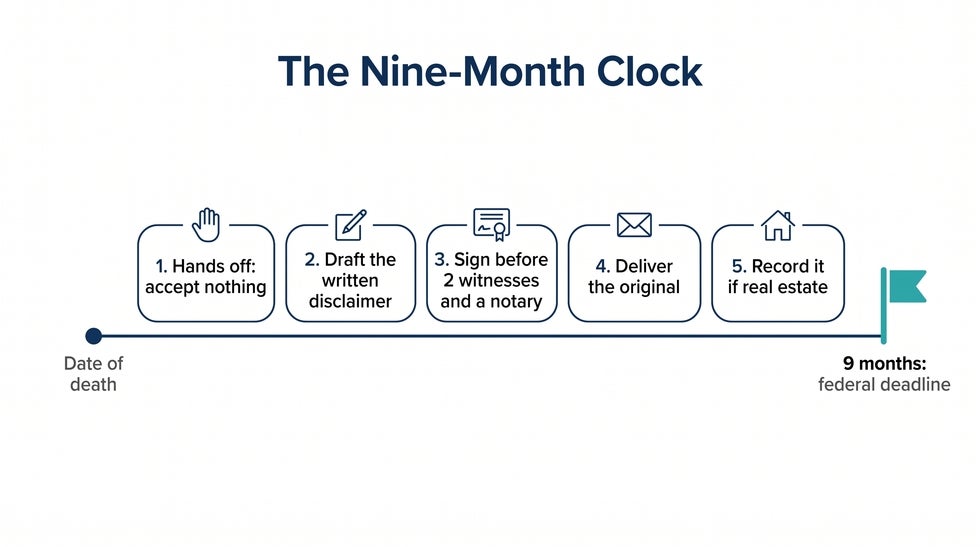
These steps apply each time you disclaim inheritance Florida law has passed to you, whether under a will, a trust, or intestacy.
- Hands off. Do not use the inherited assets: no distributions, rents, or car keys. If the personal representative offers you something, say you are still deciding.
- Trace the path. Read the will, the trust, or the beneficiary form so you know who takes next.
- Draft it. Name the decedent, describe the property or the fraction refused, and state that the writing is a disclaimer.
- Execute it. Sign before two witnesses and a notary.
- Deliver the original. To the personal representative, trustee, plan administrator, or, for joint property, the person who takes your share, as section 739.301 directs. The firm's video What Is Probate in Florida? A Plain-English Explanation explains the personal representative's role.
- Record real estate. File it with the clerk in each county where the land sits.
- Watch the calendar. Under the federal rule, it must be received within nine months of the death. Do not leave it to the last minute.
Once delivered, and once any condition you attached is met, a disclaimer is irrevocable under section 739.104(5). The Fourth District applied exactly that rule in Reid v. Amerifund Equity Group, No. 4D2025-2277 (Fla. 4th DCA Aug. 19, 2026): siblings who properly disclaimed a mortgaged condo could not reclaim a foreclosure surplus later. That finality is why the tax timing deserves its own look.
Are There Tax Consequences for Renouncing an Inheritance?
A qualified disclaimer has none for you, and one that falls short can be a taxable gift. If you disclaim inheritance Florida property on time and without accepting any benefit, federal law treats it as never yours. Under 26 U.S.C. § 2518, a qualified disclaimer is treated for federal tax purposes as if the property was never transferred to you.
To be a qualified disclaimer under the Internal Revenue Code, the refusal must be in writing, received by the personal representative or title holder within nine months of the decedent's death (or, for an heir who is still a minor, nine months after the minor reaches age 21), made before you accept any benefit, and the property must pass without direction from you to the spouse or to someone other than you. Section 739.501 makes a federally qualified disclaimer effective under Florida law as well, subject to the bars above.
Miss the nine months and the refusal may still work under Florida law, but for estate tax purposes and gift tax purposes you are treated as having received the property and then given it away. Those tax implications are real: anything above the $19,000 annual exclusion per recipient for 2026 is a taxable gift. Gift taxes are owed only after your lifetime exclusion is used up, but the gift still draws it down. The IRS puts that exclusion at $15,000,000 for 2026 under Public Law 119-21. Florida itself has no estate or inheritance tax, as our post on the Florida inheritance tax explains.
Spouses get special room. A surviving spouse may disclaim into a trust in which she keeps an income interest, provided she holds no power to redirect it beyond an ascertainable standard. A spouse can also disclaim the homestead life estate under section 732.401(4) without divesting the children, as our guide to homestead in probate explains. For how couples build disclaimers in, see my earlier article, Estate Planning for Married Couples: What Do You Need?. Tax rules also allow you to refuse just part, which is the next question.
Can You Partially Disclaim an Inheritance in Florida?
Yes. Section 739.104(4) allows a partial disclaimer expressed as a fraction, a percentage, a dollar amount, a term of years, or any other interest in the property, and federal law treats a refused undivided portion as qualified.
A partial disclaimer lets you keep part of your inheritance and send the rest down the line. You might keep the cash and refuse the timeshare, or keep half of a brokerage account and disclaim the other half for your children. Accepting one separate interest does not by itself bar disclaiming another, but a refusal must be of specific assets or an undivided share, not "whatever is left after I pick."
Disclaiming an inherited IRA is the most common partial case. Withdrawals are taxable income, so an heir already in a higher tax bracket may refuse some or all of it in favor of children in lower brackets. Under Revenue Ruling 2005-36, taking the required minimum distribution for the year of death does not prevent a qualified disclaimer of the rest, as long as the disclaimed amount and its income are paid to the next beneficiary or segregated.
When Does a Disclaimer Not Work?
It does not work as a shield. A disclaimer moves property; it does not erase your obligations. Three situations come up often, and each has its own rule.
Creditors and insolvency. Clients ask, "Can you disclaim an inheritance to avoid creditors?" Not if you are insolvent when the disclaimer becomes irrevocable; section 739.402 bars it. In bankruptcy, an inheritance from a death within 180 days after the petition becomes part of the bankruptcy estate under 11 U.S.C. § 541(a)(5)(A). Results depend on timing, so get professional help before you sign. Your heir's debts are different from the estate's own debts, which our guide to probate creditor claims covers.
Medicaid and SSI. Disclaiming an inheritance and Medicaid eligibility interact badly. Federal law, 42 U.S.C. § 1396p(h)(1), counts as your assets what you are entitled to but do not receive because of your own action, and a transfer inside the 60-month look-back can bring a penalty period. For SSI, the Social Security Administration treats a refused inheritance as a transfer of assets you constructively received (POMS SI 01150.110). Anyone on government benefits for living expenses should talk with an experienced estate planning lawyer before disclaiming.
Federal tax liens. In Drye v. United States, 528 U.S. 49 (1999), the Supreme Court held that a disclaimer valid under state law did not defeat federal tax liens on the heir's inheritance. If you owe the IRS, the lien can follow the property. The chart below summarizes the trade-offs.
How Do the Three Options Compare?
The choice is between a timely disclaimer, a late one, and accepting the property and giving it away. Only the first keeps the transfer out of your hands for tax purposes, and none of them helps an insolvent heir.
| Option | Who ends up with the property | Gift tax effect | Effect on the heir's creditors | Deadline |
|---|---|---|---|---|
|
Qualified disclaimer |
Whoever takes next under the will, trust, form, or intestacy |
None; never transferred to you |
Barred if you are insolvent; an IRS lien still attaches |
Received within 9 months of death (or of age 21) |
|
Disclaimer that misses 9 months |
The same next taker, if Florida's bars do not apply |
Treated as your taxable gift |
Same as above |
Florida has none; federal treatment is lost |
|
Accept, then give it away |
Whoever you choose |
Taxable gift above $19,000 per recipient |
Reachable before the gift; the gift itself may be challenged |
None, but you own it first |
If you are leaning toward a refusal, a short consultation with the right papers in hand can clarify the path.
What Should You Bring to a Consultation?
Bring the documents that show what you inherited and how. Before you disclaim inheritance Florida property of any kind, those papers decide the path. That means the death certificate, the will or trust and any amendments, and the beneficiary designation forms for any IRA, annuity, or life insurance.
Add a record of anything you have already received or used, including checks, rent, or keys. Finally, list your own debts, any bankruptcy or judgment, and any Medicaid or SSI benefits. Those facts decide whether a disclaimer is possible at all, and a probate attorney can often answer that in a first meeting. If you are the personal representative receiving a disclaimer, an estate administration attorney can confirm it is valid before the distribution of the estate. If a trust is involved, our article on trust administration after death explains the trustee's role.
Conclusion
A disclaimer is a clean way to send an inheritance down a generation or away from you, but only if it is done before you touch the property, in the exact form section 739.104 requires, and inside nine months if taxes matter. The decision to disclaim inheritance Florida heirs make cannot be undone, so map who takes next first.
If you are on the fence, do nothing with the property until you have decided. Leaving it untouched while you decide preserves the option, but keep the nine-month federal deadline in view; spending one rent check can cost you the choice.
How The Nussbickel Law Firm Helps
The Nussbickel Law Firm, P.A. practices estate planning, probate, and trust administration and nothing else. From our office at 12487 Brantley Commons Court in Fort Myers, we serve estate planning clients throughout Lee, Collier, and Charlotte counties and handle probate matters statewide.
When an heir asks how to disclaim inheritance Florida property, our work as probate lawyers is concrete. We trace where the property will go, check the acceptance and insolvency bars, prepare the disclaimer to the section 739.104 formalities, and deliver and record it as the statute requires. If you serve as an agent, remember that disclaiming for someone else requires the initialed power described in section 709.2202; see my earlier article, Durable Power of Attorney in Florida. When disclaimed property will land with young children, the firm's video Choosing a Guardian for Your Minor Child in Florida is a useful primer.
Schedule a free consultation or call 239-900-WILL (9455). We meet by phone, by video, or at our office, . If a deadline is close, ask for help today.
Frequently Asked Questions
What happens if you refuse an inheritance in Florida?
The disclaimed inheritance passes as if you had died before the person who left it to you. It goes to the alternate named in the will, trust, or beneficiary form, or, if none is named, often to your own descendants, depending on the will's wording and your relationship to the decedent. You cannot choose the new owner, and the refusal cannot be undone.
Can I disclaim part of an inheritance in Florida?
Yes. Section 739.104(4) allows a partial disclaimer stated as a fraction, a percentage, a dollar amount, or a specific asset. You can keep cash and refuse a timeshare, for example. Federal law also respects a refused undivided portion, so a partial refusal can still be a qualified disclaimer.
Can I disclaim an inheritance to avoid creditors?
Not if you are insolvent. Section 739.402 bars a disclaimer made while your debts exceed your assets and you are not paying them as they come due. A federal tax lien also survives a disclaimer, and an inheritance from a death within 180 days after a bankruptcy filing belongs to the bankruptcy estate.
How long do you have to disclaim an inheritance in Florida?
Florida sets no deadline; under section 739.401, you may disclaim any time unless a bar applies. For tax purposes, though, the right to refuse inheritance Florida heirs hold should be used within nine months of the death, because a later refusal is treated as a taxable gift.
Gregory J. Nussbickel is the founder of The Nussbickel Law Firm, P.A. in Fort Myers, Florida. His practice is devoted exclusively to estate planning, probate, and trust administration for families throughout Southwest Florida.
This article is for general information only and is not legal advice. Reading it does not create an attorney-client relationship. Tax and benefit rules change, and every family is different; speak with a licensed Florida attorney about your specific situation.

Comments
There are no comments for this post. Be the first and Add your Comment below.
Leave a Comment