

Key Highlights
- A durable power of attorney Florida law recognizes must be signed by the principal, signed by two subscribing witnesses, and acknowledged before a notary public.
- The document must say the agent's authority survives the principal's later incapacity, or it stops working when the family needs it most.
- A POA signed on or after October 1, 2011 that waits for a future event to take effect is not delayed under Florida law; it is ineffective.
- Gifts, trust changes, beneficiary designations, and four other powers work only if the principal initialed or signed next to each one.
- Catch-all language such as "do all acts I could do" grants no authority under Florida Statutes § 709.2201.
- Four business days is the presumed reasonable time for a bank to accept or reject a POA that carries Florida's statutory banking language, and a wrongful rejection can cost the bank the agent's attorney fees.
Introduction
The short answer: a durable power of attorney Florida courts and banks will honor is a written legal document, signed by you in front of two witnesses and a notary, that names an agent to handle your finances and says the agent's authority continues if you later lose capacity. It works only during your lifetime, it takes effect the day you sign it, and the powers that matter most in a crisis must be spelled out, often with your initials beside them.
If a parent in Fort Myers or Cape Coral is starting to slip, you are asking at the right time. The document must be signed while the person still has the legal capacity to understand it. Once that window closes, the family's option is usually a court proceeding instead. This guide explains Florida's rules and where the forms families find in a desk drawer tend to fail.
Who Needs a Durable Power of Attorney Florida Recognizes?
Every adult with a bank account, a home, or a retirement plan needs one, because no one else has automatic legal authority over those assets during your lifetime. That includes family members: a daughter in Estero who has paid her mother's bills for years cannot move money, refinance the condo, or talk to the brokerage once her mother can no longer manage things, unless she holds a valid POA.
The need is sharper for three groups in Southwest Florida:
- Retirees whose estate plan predates their move here.
- Business owners whose business interests, payroll, and contracts would stall during a long hospital stay.
- Married couples who assume each spouse can act for the other, especially on the homestead.
A POA is one of the six core documents on the firm's estate planning checklist for seniors, and owners will find the succession side in our guide to estate planning for business owners. Knowing who needs one leads to what the law requires.
What Are the Florida Power of Attorney Requirements?
Florida power of attorney requirements come down to the right words and the right signing ceremony, both set by Part II of Chapter 709, the Florida Power of Attorney Act.
The words come first. Under Florida Statutes § 709.2104, the power of attorney is durable only if it says the agent's authority is "not terminated by subsequent incapacity of the principal," or uses similar words. A general power of attorney without that sentence ends at the principal's incapacity, which is exactly when the family reaches for it.
Specific authority comes next. Under § 709.2201(1), an agent may exercise only authority the document specifically grants, and a clause allowing the agent "to do all acts that the principal can do" grants nothing. In Florida, catch-all language grants no authority at all. Broad powers have to be broken into separate grants: real estate, banking transactions, investments, taxes, insurance, and government benefits.
These legal requirements apply to every durable power of attorney Florida residents sign today. For a short walkthrough, watch the firm's video What Is a Durable Power of Attorney in Florida?
How Do You Sign a Valid Power of Attorney in Florida?
You sign it in one sitting, in front of two subscribing witnesses and a notary public who acknowledges your signature. That is how to get power of attorney in Florida that will hold up: your signature, two witness signatures, and the notary's certificate, all from the same signing.
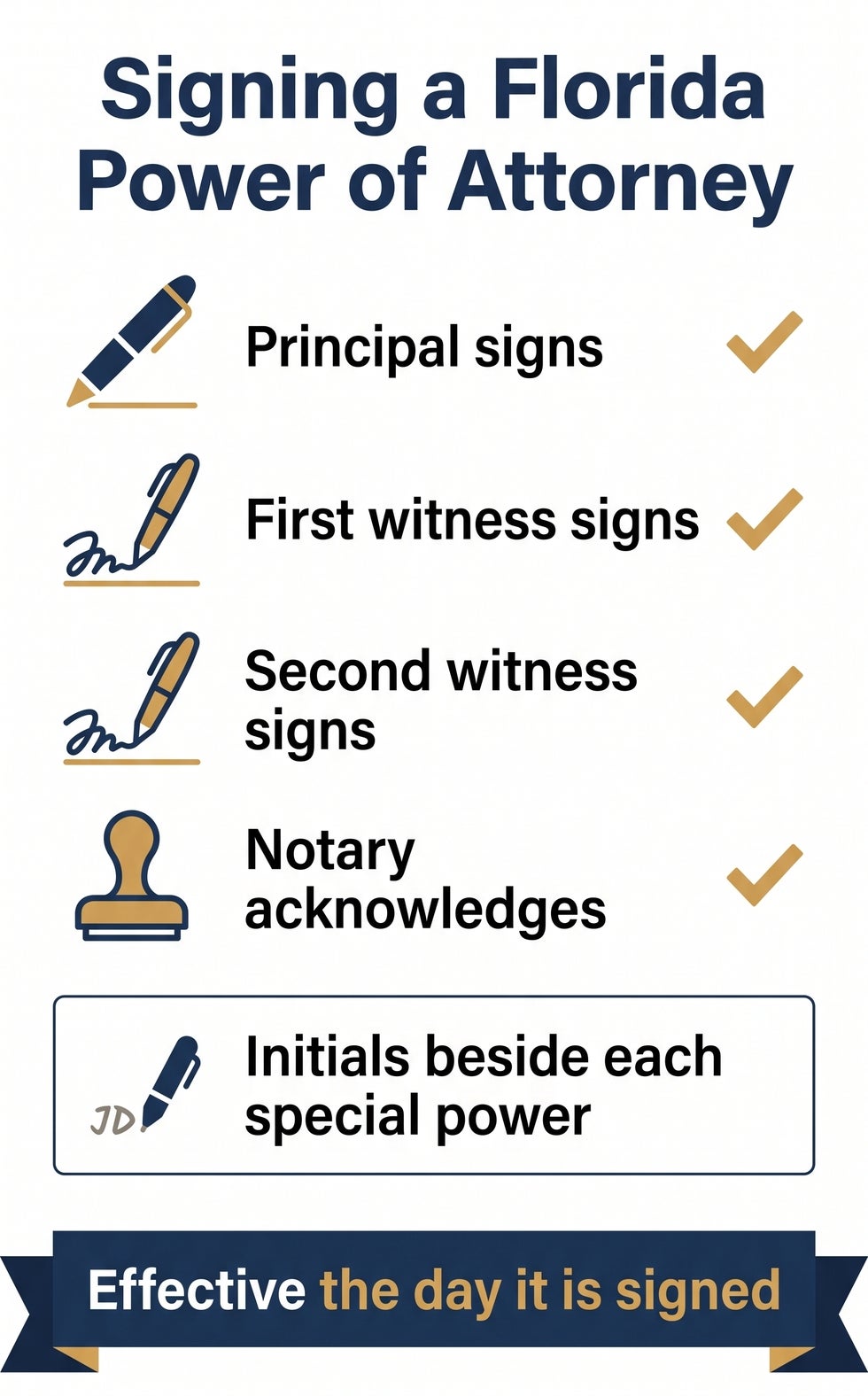
Two Witnesses and a Notary
Section 709.2105(2) requires the principal's signature, two subscribing witnesses, and an acknowledgment before a notary. So, does a power of attorney need to be notarized in Florida? Yes, and witnesses alone are not enough. Missing either requirement is a defect.
If the principal is physically unable to sign, a Florida notary public may sign the principal's name at the principal's direction. For a frail parent, the signing process works best at home or in the facility, with everyone present and nothing left for later. The Florida Bar's consumer pamphlet on Florida powers of attorney summarizes the same rule.
Who Can Serve as Agent?
Your agent must be a natural person at least 18 years old, or a financial institution with trust powers and a place of business in Florida. A nephew in Ohio qualifies as easily as a son in Naples.
The practical test is harder: choose someone honest, organized, and willing to keep records, and name a successor. Under § 709.2111, a successor agent acts only if the first agent dies, resigns, becomes incapacitated, or declines. Co-agents, by contrast, may each act independently unless the document says otherwise.
Remote Online Notarization Limits
Florida allows remote online signing, with limits. When fewer than two witnesses share the principal's physical presence and the document covers banking or investments, § 117.285(5) requires screening questions about impairment and need for daily care. A yes answer means the witnesses must be in the room.
Under § 709.2202(6), a Florida resident whose POA is witnessed remotely cannot grant any of the initialed powers described below. For a parent who may need gifting or trust authority later, sign in person.
Which Agent Powers Need Your Initials?
Seven specific powers need your signature or initials next to each one; everything else needs only a specific written grant. Routine financial management (paying bills, depositing checks, filing taxes, managing accounts) falls in the second group.
For banking, Florida offers a shortcut. A document stating the agent has "authority to conduct banking transactions as provided in section 709.2208(1), Florida Statutes" picks up a full statutory menu of banking powers, and it triggers the four-day response rule for financial institutions covered below.
The Seven Initialed Powers
Under § 709.2202(1), these powers work only if the principal signed or initialed beside each:
- Creating a living trust.
- Amending, revoking, or terminating the principal's trust, and only if the trust itself permits the settlor's agent to do so.
- Making a gift.
- Creating or changing rights of survivorship.
- Creating or changing beneficiary designations.
- Waiving a joint and survivor annuity, including a retirement plan survivor benefit.
- Disclaiming property and powers of appointment.
Check the trust too: an initialed power to amend means nothing unless the trust instrument separately allows it, a point covered in our guide to revocable vs. irrevocable trusts. Unless the document says otherwise, general gifting authority is capped at the federal annual gift tax exclusion per recipient, and an agent who is not the principal's spouse, ancestor, or descendant may not use these powers to benefit himself or herself.
Digital assets need their own grant. Under § 740.008, an agent sees the content of your email only if the power of attorney document expressly grants that access. For the drafting errors that most often derail these powers, see my earlier article, Common Florida Estate Planning Mistakes and Fixes.
Can an Agent Sell a Florida Homestead?
Yes, if the document grants real estate authority, but a married principal's spouse must also join. Section 709.2201(2)(b) confirms an agent may convey or mortgage homestead property, and § 689.111 requires that POA to be executed like a deed.
Under § 709.2106(5), a copy generally works like the original, but an original relied on to affect title to real property may be required for recording in the official records. Keep the original where the agent can reach it.
Spousal Joinder Rules
A married principal's agent cannot convey the homestead without the spouse joining. The spouse can join through his or her own POA, and spouses may appoint each other, which is why married couples should sign matching documents.
Families who want the home to pass at death without probate often pair the POA with a Lady Bird deed in Florida. Timing raises the next question: when the agent's authority starts.
Can a Power of Attorney Be Springing in Florida?
No. A power of attorney signed on or after October 1, 2011 is exercisable when signed. A document that says it takes effect on a future date or event, such as a doctor's letter, is ineffective under § 709.2108(3), not merely postponed. Your choice of agent is the safeguard.
That surprises people who search for a springing power of attorney Florida lawyers once drafted routinely. Section 709.2108 ended the practice because springing documents left banks guessing whether the triggering event had occurred. If you would not trust someone with authority today, do not name that person.
Older Springing Documents
A conditional POA signed before October 1, 2011 can still work. It becomes exercisable when the agent delivers an affidavit from the principal's primary physician, licensed in Florida, stating the physician believes the principal lacks capacity to manage property. That takes time a family in crisis does not have, so replace a pre-2011 conditional document while the principal can still sign.
Can a Bank Refuse a Power of Attorney in Florida?
Yes, but only for reasons the statute allows, and only after answering within a reasonable time. Under § 709.2120, four days, excluding weekends and legal holidays, are presumed reasonable for a bank or broker-dealer when the document carries the § 709.2208 banking or investment language.
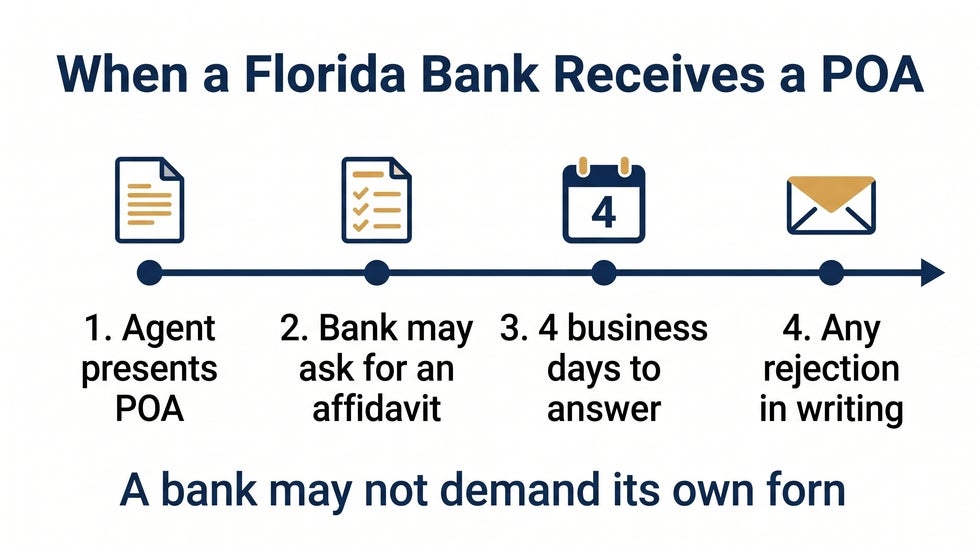
The statute protects agents three ways. A bank may not demand its own form. A bank that rejects must give its reason in writing. A bank that rejects wrongfully faces a court order compelling acceptance and liability for the agent's attorney fees and costs.
Third parties may still refuse in limited cases: known death or revocation, an agent who will not supply a requested affidavit or opinion of counsel, a good-faith belief the document is invalid, or a report to adult protective services. Most rejections trace to the form itself: catch-all grants, springing language, missing initials, or an unfamiliar out-of-state document.
Affidavits and Opinions of Counsel
Under § 709.2119, a bank may require the agent's sworn affidavit that the principal is alive, the document has not been revoked or suspended, and no divorce action has been filed between agent and principal. The statute supplies a model form.
The bank may also request additional documentation: a certified English translation, an opinion of counsel with a written reason, or the notary's electronic journal for a remotely signed POA. Those costs fall on the principal unless the request comes after the bank's time to answer has run.
Is an Out-of-State POA Valid in Florida?
Usually yes, because Florida honors durable powers of attorney from other states. Under § 709.2106(3), an out of state power of attorney Florida newcomers bring with them is valid here if it complied with the law of the state where it was signed. A military POA executed under federal law is valid too.
Valid is not the same as easy. A bank asked to accept a document that is valid only because of that rule may require an opinion of counsel at the principal's expense, and may reject it with no liability if the agent cannot produce one. For transplants, the practical answer is a new POA signed under Florida law. Wills follow a different rule, explained in our guide to what makes a will valid in Florida.
What Must a Florida Agent Do?
An agent is a fiduciary who must act within the granted authority, in good faith, and in the principal's best interest. Under § 709.2114, every action taken on behalf of the principal must also try to preserve the principal's known estate plan.
The agent must keep a record of all receipts, disbursements, and transactions made on the principal's behalf. If the principal, a guardian, or after death the personal representative asks for those records, the agent has 60 days to produce them, with one documented 60-day extension.
Under § 709.2112, only a "qualified agent" may be paid: a spouse, an heir, a financial institution with trust powers and a Florida office, a Florida attorney or CPA, or a Florida resident who has never served as agent for more than three principals at once. Any agent may be reimbursed for reasonable expenses.
Agent authority also has hard limits. Under § 709.2201(3), no agent may sign or revoke a will, vote in a public election, or exercise powers the principal holds as trustee. The Consumer Financial Protection Bureau publishes a free guide for agents under a power of attorney that pairs well with these rules.
When Does a Florida POA End?
It ends at the death of the principal, on revocation, or when a court adjudicates the principal incapacitated, unless the court preserves some authority. Section 709.2109 lists every termination event, and four of them catch families off guard:
- Death ends everything. There is no power of attorney after death; the personal representative or successor trustee takes over, as our guide to a deceased person's bank account in Florida explains.
- A spouse-agent's authority ends once a dissolution, annulment, or legal separation action is filed, unless the document says otherwise.
- A new POA does not automatically revoke an old one. Under § 709.2110, revocation must be stated in a signed writing.
- An incapacity petition suspends the agent's authority, unless the agent is the principal's parent, spouse, child, or grandchild; then suspension requires a separate verified motion under § 744.3203.
That last rule, from a 2015 amendment, is one reason to name a close relative when one is suitable. It also ties the POA to guardianship.
Power of Attorney vs Guardianship: How Do They Differ?
A power of attorney is private and chosen by you; guardianship is public and imposed by a court. A health care surrogate, a third tool, covers medical decisions.
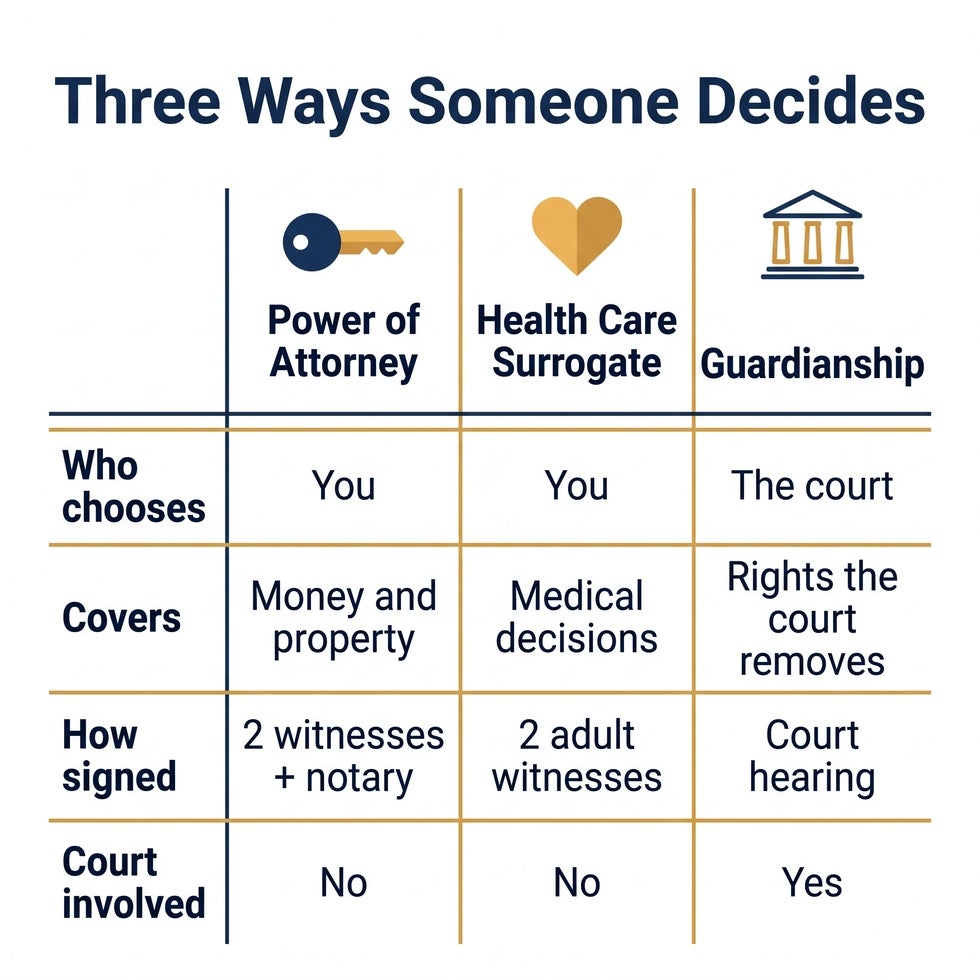
| Durable power of attorney | Health care surrogate | Guardianship | |
|---|---|---|---|
|
Who picks the decision-maker |
You |
You |
The court |
|
Decisions covered |
Financial and legal matters |
Health care decisions |
Rights the court removes |
|
How it is signed |
Two witnesses and a notary |
Two adult witnesses |
Court petition and hearing |
|
Court involvement |
None |
None |
Ongoing court supervision |
|
When it starts |
When signed |
Under its terms |
By court order |
|
When it ends |
Death, revocation, other § 709.2109 events |
Death or revocation |
Court order or death |
Under § 709.2201(2)(c), a durable POA can also cover medical decisions if it says so specifically, but a separate surrogate designation controls if the two conflict, unless the POA is later and says otherwise. Most Florida estate plans include both documents as a matched set. The firm's video What Is a Health Care Surrogate in Florida? explains the medical side, and our post on the living will vs. living trust covers end-of-life directives.
How Does a POA Avoid Guardianship?
It gives the court an alternative it must consider first. Under § 744.331(6)(b), the court must decide whether an alternative to guardianship would sufficiently address the person's problems, and if one would, it may not appoint a guardian.
That rule has teeth. In Frank v. Guardianship of Muriel Frank, No. 4D2024-1073 (Fla. 4th DCA Aug. 19, 2026), the Fourth District reversed a plenary guardianship because the trial court appointed a professional guardian without first ruling on the mother's valid durable power of attorney and health care surrogate designation. The court called skipping that step reversible structural error.
When Guardianship Becomes Necessary
Guardianship proceedings become necessary when the person has already lost capacity and no valid, sufficient POA exists: none was signed, the one that exists is defective, or it lacks the specific authority the situation demands. At that point no family member can fix the document, and only a court order can supply authority. That makes periodic review the last piece of the plan.
When Should You Replace Your POA?
Replace it when the law, your family, or your address changes. Common triggers:
- You moved to Florida with a POA signed elsewhere.
- It was signed before October 1, 2011, or contains springing language.
- It lacks initialed powers for gifts, trusts, or beneficiary designations.
- Your agent died, moved, became ill, or lost your trust.
- You divorced or remarried.
When you sign a new POA, include a sentence revoking prior ones, and give written notice to the old agent and any bank holding a copy.
Conclusion
A durable power of attorney Florida banks will accept is a short document with long consequences. Signed correctly, with specific grants and initialed powers, it lets someone you chose manage your affairs without a judge and gives your family real peace of mind. Signed carelessly, it fails at the worst moment. Review yours now, while every option is still open.
Work With The Nussbickel Law Firm
The Nussbickel Law Firm, P.A. practices estate planning, probate, and trust administration exclusively. From our Fort Myers office at 12487 Brantley Commons Court, we provide legal services to families throughout Lee, Collier, and Charlotte counties, including powers of attorney, health care surrogate designations, wills, and trusts.
If you are signing a POA for the first time, or wondering whether an older or out-of-state form still works, legal counsel can tell you plainly. We review existing documents and, when a new durable power of attorney Florida institutions will accept is needed, draft it with specific grants, initialed powers that fit your plan, and a signing that meets every Florida requirement. Consultations are free, by phone, by video, or in our office. Schedule a consultation or call our Fort Myers office.
Frequently Asked Questions
What Happens If My Florida Durable Power of Attorney Was Not Properly Notarized?
A Florida POA without a proper notary acknowledgment fails § 709.2105, so banks and title companies can treat it as invalid. If the principal still has capacity, the fix is a new document signed with two witnesses and a notary present. If capacity is gone, the family may need a guardianship proceeding instead.
Can I Use a Notarized Power of Attorney from Another State in Florida?
Usually yes, if it was valid under the law of the state where you signed it. A Florida bank may still request an opinion of counsel at your expense and may reject the document if the agent cannot provide one. Signing a new Florida POA avoids that delay entirely.
Do I Need Both a Durable Power of Attorney and a Health Care Surrogate Form in Florida?
Yes, for nearly everyone. The POA handles money and property, while the health care surrogate designation handles medical decisions and records. Florida signs them differently: the surrogate form needs two adult witnesses, and the POA needs two witnesses plus a notary. Most plans sign both at the same meeting.
Are Any Florida Powers of Attorney Exempt From Notarization?
Yes, a few. Section 709.2103 excludes government-prescribed forms, voting proxies, and powers coupled with an interest from Chapter 709, so their own rules govern signing. A health care surrogate designation is not a POA and needs only two adult witnesses. Ordinary financial POAs signed in Florida need both witnesses and a notary.
Does a POA Work After Death?
No. Every Florida power of attorney ends at the principal's death under § 709.2109. From that moment the personal representative named in the will, a successor trustee, or an account's named beneficiary takes over. An agent who keeps acting after learning of the death acts without legal authority.
How Do I Get a POA for My Parent?
Your parent must sign it while he or she still understands it, in front of two witnesses and a notary. An adult child cannot sign one on a parent's behalf. If the principal's incapacity has already set in and your parent cannot understand the document, the remaining route is usually a guardianship petition.
Gregory J. Nussbickel is the founder of The Nussbickel Law Firm, P.A. in Fort Myers, Florida. His practice is devoted exclusively to estate planning, probate, and trust administration for families throughout Southwest Florida.
This article is for general information only and is not legal advice. Reading it does not create an attorney-client relationship. Florida law changes, and every family is different; speak with a licensed Florida attorney about your specific situation.

Comments
There are no comments for this post. Be the first and Add your Comment below.
Leave a Comment