
Key Highlights
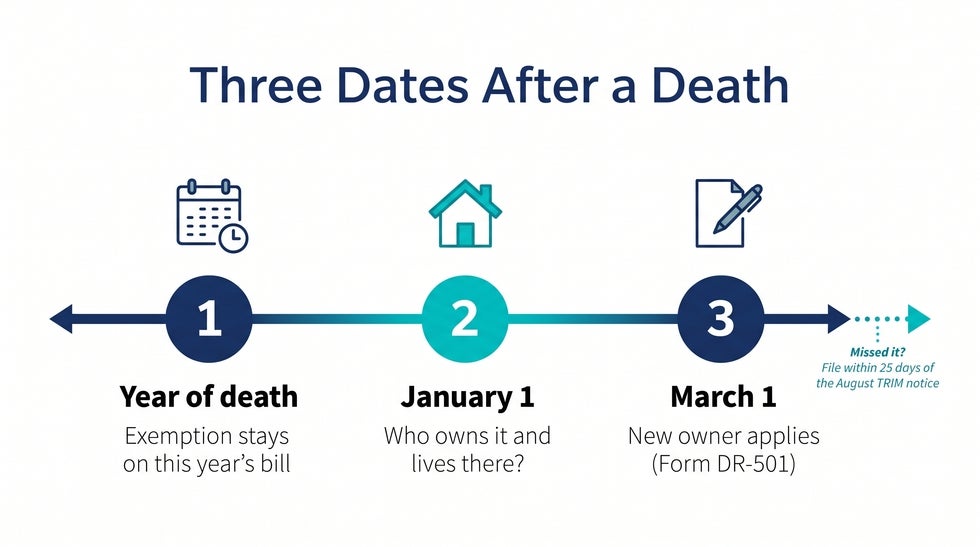
- The homestead exemption after death Florida law allows does not pass to anyone automatically: it usually stays on the tax bill for the year of death, and a new owner must qualify on the next January 1.
- A surviving spouse, heir or trust beneficiary who makes the home a permanent residence must file Form DR-501 with the county property appraiser by March 1 (section 196.011).
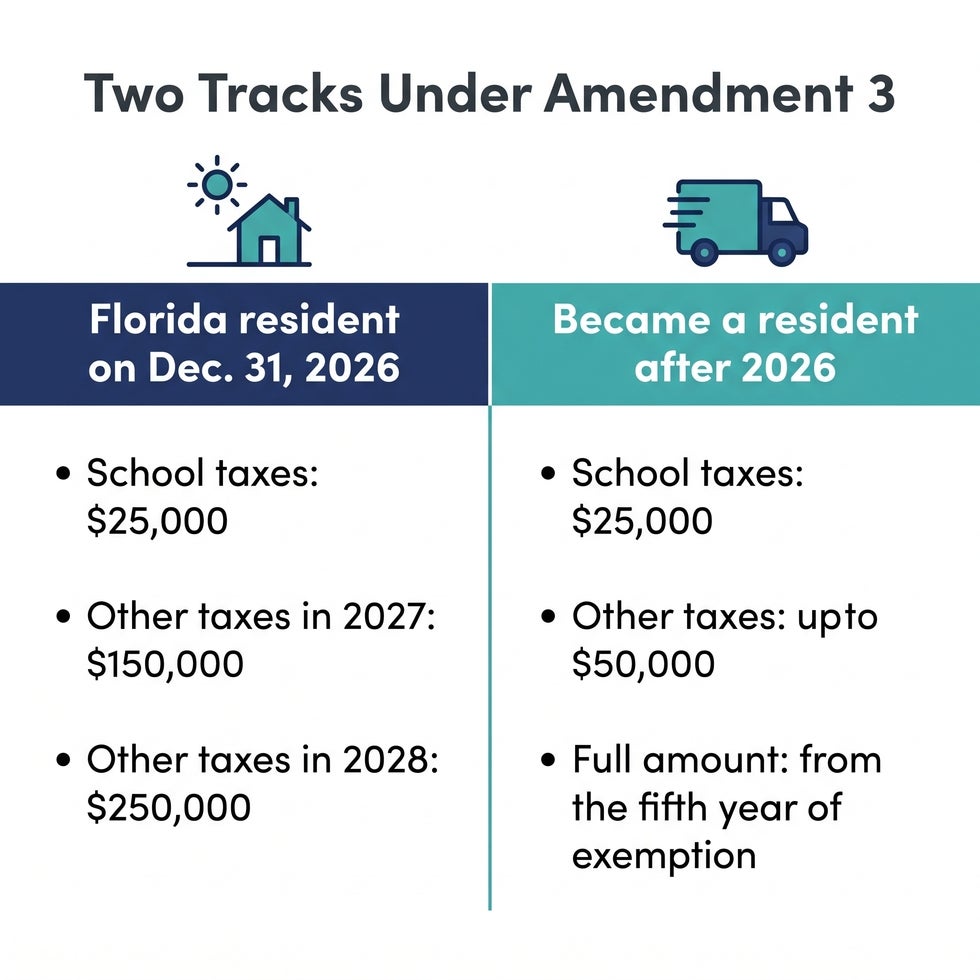
- Amendment 3 raises the non-school homestead exemption to $150,000 in 2027 and $250,000 in 2028; the $25,000 school-tax exemption does not change.
- A new owner who was not a Florida resident on December 31, 2026 receives $25,000 for school taxes and up to $50,000 for other taxes until the fifth year of exemption.
- The Save Our Homes cap survives a transfer to a surviving spouse, and a transfer under section 732.401 to a minor child; most other heirs are reassessed at just value.
- An exemption left on after no one qualifies can bring back taxes for up to 10 years, plus a 50 percent penalty and 15 percent interest (section 196.161).
Introduction
The short answer: The homestead exemption after death Florida law allows belongs to the owner who lived in the home on January 1, so it usually stays on the tax bill for the year of death but does not transfer to anyone automatically. A surviving spouse or heir who makes the home a permanent residence must apply in their own name by March 1. Starting in 2027, Amendment 3 also makes the size of the new exemption depend on whether the new owner was a Florida resident on December 31, 2026.
Most families learn this from the first tax bill in a child's name, which arrives much higher than the parent's. Nothing went wrong in probate; the property tax benefits simply follow a new owner.
This guide covers the tax side only. Who inherits the home is covered in my earlier article, Florida Homestead Probate.
What Is the Homestead Exemption After Death in Florida?
There is no special homestead exemption after death Florida law creates for a home whose owner has died. It is the ordinary Florida homestead exemption, and after a death the only question is who, if anyone, now qualifies.
Under section 196.031, a person who on January 1 holds legal or equitable title to Florida real estate and in good faith makes it a permanent residence is entitled to the exemption. The right comes from Article VII, section 6 of the Florida Constitution, and it belongs to that owner and that tax year.
Florida's homestead laws use one word for three ideas. Article X gives homestead rights that protect the family home from most creditor claims, and it imposes the homestead devise restrictions and homestead inheritance rules that decide who inherits. Those homestead restrictions, the inheritance restrictions and homestead protection from creditors are all separate from the tax exemption. The firm's video on Florida homestead law, creditor protection and taxes explains the difference.
Does the exemption transfer to heirs in probate?
No. It is personal to the owner who lived in the home on January 1, and it ends with that owner's tax year. A surviving spouse, an heir or a trust beneficiary must qualify on their own facts and file a new application; probate does not carry it over.
Probate decides who owns the home, not its tax status. A protected homestead often passes outside a Florida estate's probate assets entirely, and it does not count toward the $150,000 limit for summary administration. Either way, the property appraiser asks the same two questions every January 1: who owns the home, and who lives there.
Who can claim the exemption after an owner passes away?
The Florida homestead exemption for inherited property works as it does for any home. A new owner can claim it if, on January 1, the new owner holds legal or equitable title, the home is the permanent residence (the primary residence, in everyday terms) of that owner or a dependent, and the owner gets no residency-based tax benefit in another state.
That last test, in section 196.031(6), catches out-of-state heirs. Florida also allows one homestead exemption per individual or family unit. Typical claimants after a death are:
- a surviving spouse who stays in the family home;
- adult children who inherit and move in full time;
- a trust beneficiary entitled under the trust to use and occupy the home, which section 196.041(2) treats as equitable title;
- an owner whose minor child or other dependent lives there.
Residence is the property appraiser's factual call. Section 196.015 lists factors such as a Florida driver's license, voter registration at the address, a Florida license tag and utility bills. My article on being an out-of-state heir in Florida covers the probate side.
What Happens to the Homestead Exemption When the Owner Dies?
Under the homestead exemption after death Florida rules, the exemption usually stays in place for the tax year in which the owner died. It does not carry over to the spouse, the children, a trust or the estate for any later year.
Does the exemption stay for the year of death?
Yes, in most cases. Florida fixes homestead status as of January 1, so an owner who qualified on January 1 keeps the existing homestead exemption on that year's bill even after a death in March or November.
That bill arrives in November, with a 4 percent discount for paying that month under section 197.162. The personal representative usually pays taxes on estate property; for protected homestead, the heirs usually carry them, as my article on an inherited house with a mortgage explains.
What happens on the January 1 after death?
The next January 1 resets the question. The property appraiser looks at the new owner, the new residence facts and whether an application arrives by March 1.
| Who ends up in the home | Year of death | From the next January 1 | Save Our Homes cap | What to file |
|---|---|---|---|---|
|
Surviving spouse who stays |
Exemption stays |
Yes, if the spouse applies |
Kept |
DR-501 by March 1 |
|
Minor child taking under section 732.401 |
Exemption stays |
Depends on who owns and lives there |
Kept if the home still gets the exemption |
DR-501 by March 1 |
|
Adult child, Florida resident before 2027, moves in |
Exemption stays |
Yes, larger amendment amount |
Reset |
DR-501; add DR-501T only if porting your own prior homestead |
|
Adult child who became a resident after 2026, moves in |
Exemption stays |
Yes, $50,000 track until year five |
Reset |
DR-501 by March 1 |
|
Heirs rent the home or leave it empty |
Exemption stays |
No |
Reset |
Notify the appraiser |
|
Heirs sell |
Exemption stays |
Only for a qualifying buyer |
Reset for the buyer |
Buyer files |
Who must reapply, and by what deadline?
The new owner must apply. Under section 196.011 the deadline is March 1 of the tax year, on Department of Revenue Form DR-501.
Counties may waive the yearly renewal, but a new application is required whenever ownership changes in any manner, and a death changes ownership. Expect to show title (the recorded deed, a court order determining homestead status, or the trust) and proof of residence. File with the county property appraiser where the home sits; in Lee County you can apply for homestead online.
Miss March 1 and you may still file by the 25th day after the August TRIM notice is mailed. The appraiser may grant it for extenuating circumstances; if not, you may petition the value adjustment board within the same 25-day window.
What if nobody qualifies the next year?
Then the tax break ends, the home is assessed as non-homestead property, and the bill usually rises. The bigger risk is a tax break left on by mistake.
If the appraiser finds an exemption granted to someone not entitled to it in the prior 10 years, section 196.161 imposes the unpaid taxes, a 50 percent penalty and 15 percent interest a year, through a recorded lien after 30 days' notice. Section 193.155(10) imposes the same back taxes, penalty and interest for an improper Save Our Homes cap, except that an owner who qualifies for the exemption and kept the old cap by mistake after a change of ownership owes only the corrected assessment.
Snowbird families face one more rule. If an estate is probated in another state on the theory that the person lived there, the appraiser must record a lien within 3 years after death for any Florida homestead exemption taken in the 10 years before death, unless the Florida ancillary court finds Florida residence.
If you will rent the home or leave it empty, tell the appraiser in writing. A buyer for value who takes title before a lien is recorded takes free of it, so settle this before any sale; my article on selling inherited property in Florida covers the rest. Capital gains on a sale are a separate, federal question.
How Does Amendment 3 Change the Homestead Exemption for Inherited Homes?
Amendment 3 makes the exemption larger starting with the 2027 tax roll, but it does not change who qualifies or when to apply. The Amendment 3 homestead exemption changes the amount and adds a residency date that matters to heirs; Florida voters approved it on November 3, 2026, with about 62 percent of the vote in unofficial returns; the state is scheduled to certify results on November 17, 2026.
The joint resolution is CS/HJR 1-F. The Department of Revenue's bulletin PTO 26-21 confirms it takes effect January 1, 2027 and first applies to the 2027 tax roll, so the first bills affected are mailed in November 2027.
New 2027 amounts and the unchanged school-tax break
For school district taxes, the exemption stays at $25,000 of assessed value. For all other taxes, it becomes $150,000 in 2027 and $250,000 in 2028, then adjusts with the consumer price index.
| Tax year | School district taxes | All other taxes |
|---|---|---|
|
2026 (old rules) |
$25,000 |
$25,000 plus up to $26,411 on value above $50,000 |
|
2027 |
$25,000 |
Up to $150,000 |
|
2028 |
$25,000 |
Up to $250,000, then inflation-adjusted |
The amendment also cuts the yearly assessment cap on non-homestead property from 10 percent to 5 percent for non-school taxes, which matters to heirs who keep a parent's home as a rental. For a 2026 death, the Florida homestead exemption 2027 amounts are the first a new owner will see.
The December 31, 2026 residency cutoff
An owner who had not maintained a permanent residence in this state as of December 31, 2026 (in practice, someone who becomes a Florida resident in 2027 or later) gets a smaller exemption tied to the existing homestead exemption amounts: $25,000 for school taxes and up to $50,000 for other taxes. The full amount arrives beginning with the fifth year of exemption.
The $50,000 figure is inflation-adjusted from 2028, and beginning in 2030 a county or city may vote by two-thirds to shorten the wait for a critical local need. The amendment tells the Legislature to write uniform procedures, and it has not yet done so, so how residency on that date is proven is not settled. A Bloomberg Tax column notes that proof may come down to old leases and tax returns, so keep yours.
Spouses or children living in Florida before 2027
For Florida homeowners and Florida residents already here on December 31, 2026, the amendment changes the amount, not the rules. They still need title, a permanent residence in the home and their own application.
Take a hypothetical Fort Myers widow whose husband died in August 2026. His exemption covers her 2026 bill. She applies in her own name by March 1, 2027, keeps the Save Our Homes cap as a surviving spouse, and qualifies for the $150,000 amount. That is the homestead exemption after death of spouse Florida rules working as intended.
What happens for a child who becomes a Florida resident after 2026?
That child can still claim homestead once the inherited home becomes a permanent residence, but starts on the smaller track until the fifth year of exemption.
Take a hypothetical son from Ohio who inherits his mother's Cape Coral home in 2027 and moves in. He applies by March 1, 2028 and receives $25,000 off school taxes and up to $50,000, adjusted for inflation, off other taxes until his fifth year of exemption. His sister, a Fort Myers resident since 2015, would qualify for the full amount from her first year in the house.
So do heirs get the homestead exemption in Florida? Yes, when they live there, but the amount now depends on where they lived on one December night. How earlier Florida residence is counted remains an open question.
Will the Property Taxes Go Up After the Owner Dies?
Often, yes. Property taxes on an inherited house in Florida rise when the exemption ends, when the assessed value jumps to market value, or both.
Save Our Homes limits annual increases in a homestead's assessed value to 3 percent or the rate of inflation under the consumer price index, whichever is lower. After decades, a parent's assessed value can sit far below full market value, and a change of ownership usually ends that gap.
Save Our Homes cap: does it remain or reset?
For most heirs it resets. Under section 193.155(3), a home is reassessed at just value on the January 1 after a change of ownership, and the homes cap starts over.
The form of ownership decides a lot. These are the important exceptions, the cases in which Save Our Homes after death Florida law keeps the cap:
- a transfer to a surviving spouse;
- a transfer by operation of law to the surviving spouse or minor child under section 732.401;
- a transfer at death to a permanent resident who was legally or naturally dependent on the owner;
- a surviving joint owner with right of survivorship who already received the exemption and still qualifies for it.
Adult children are not on that list. Neither is the grantee of a Lady Bird deed (an enhanced life estate deed) unless an exception fits, so the deed avoids probate but not reassessment; see my article on the Lady Bird deed.
Portability of an heir's own prior savings
Apart from the spouse, minor-child, dependent and joint-owner exceptions above, an heir cannot keep a parent's Save Our Homes savings. Portability is personal: it carries your own prior homestead's savings to a new Florida homestead.
Florida homestead portability under section 193.155(8) applies if you held your own homestead exemption on January 1 of any of the three preceding years, and moves up to $500,000 of the difference between that home's just value and assessed value. File Form DR-501T from the Department of Revenue forms page with your DR-501 by March 1. Chapter 2026-239 also drops the requirement that the prior homestead be your immediately preceding one, starting with the 2027 tax roll.
Special situations: surviving spouse, minor children, and the widow's exemption Florida
A surviving spouse keeps the cap, applies by March 1, and may add the $5,000 widow's or widower's exemption under section 196.202. Surviving spouses of certain veterans and first responders have separate exemptions under section 196.081.
When the home passes under section 732.401, the spouse often takes a life estate and the children a remainder interest; the spouse, as the life tenant living there, claims the exemption. Those homestead rules apply when there is no will or when the will leaves the home in a way Florida law does not allow, often after a previous marriage or a prior relationship, and the spouse may instead elect a one-half interest within 6 months; my article on probate without a will explains them.
A home in a revocable living trust can keep the exemption if a beneficiary entitled under the trust to live there does so and applies, though the Save Our Homes cap resets unless an exception fits; see trust administration after death and the firm's video What Is a Revocable Living Trust in Florida?. An estate has no permanent residence, so a home left in the estate with no qualifying occupant loses the tax break.
Conclusion
The homestead exemption after death Florida families deal with runs on a simple calendar: the old exemption covers the year of death, the new owner's status is fixed on January 1, and the application is due March 1. For 2026 deaths, that first application meets Amendment 3's 2027 amounts and its December 31, 2026 residency date.
Before you call the property appraiser or an attorney, gather:
- the death certificate and the recorded deed, or the trust;
- the last tax bill and TRIM notice;
- proof of your Florida residency and when it began;
- any Florida homestead you held in the last three years;
- whether anyone has rented the home since the death.
How The Nussbickel Law Firm Helps
The Nussbickel Law Firm, P.A. practices estate planning, probate and trust administration and nothing else. From our Fort Myers office at 12487 Brantley Commons Court, we handle probate matters throughout Florida and Florida estate planning for families in Lee, Collier and Charlotte counties.
After a death, we clear title to the home so the right family members can apply: an order determining homestead status, a deed out of the estate, a trustee's deed, or the paperwork for a spouse's life estate. We also build estate plans that account for these tax rules. We do not handle value adjustment board petitions or property-tax appeals.
Schedule a free consultation by phone, by video or at our office, or call 239-900-WILL (9455). If March 1 is close, call now.
Frequently Asked Questions
Do I need to reapply for the homestead exemption after my spouse dies?
Plan on it. When title passes to you as the surviving spouse, ownership has changed, and Florida law requires a new application whenever ownership changes, even in counties that renew automatically. File Form DR-501 with your county property appraiser by March 1; the Save Our Homes cap carries over to a surviving spouse.
Gregory J. Nussbickel is the founder of The Nussbickel Law Firm, P.A. in Fort Myers, Florida. His practice is devoted exclusively to estate planning, probate, and trust administration for families throughout Southwest Florida.
This article is for general information only and is not legal advice. Reading it does not create an attorney-client relationship. Property tax rules and the procedures for Amendment 3 are still being written; speak with a licensed Florida attorney and your county property appraiser about your specific situation.

Comments
There are no comments for this post. Be the first and Add your Comment below.
Leave a Comment