

Key Highlights
- A summary administration Florida court grants ends with one order that hands each asset to a named person, with no personal representative appointed.
- An estate qualifies if its non-exempt Florida probate assets total $150,000 or less, or if the person died more than two years ago (section 735.201).
- The $150,000 ceiling has applied since July 1, 2026, when chapter 2026-57 doubled it from $75,000.
- The surviving spouse and the beneficiaries sign the petition; a beneficiary taking a full share need not, but must receive formal notice (section 735.203).
- People who receive assets stay personally liable for the decedent's debts, pro rata and up to what each received, until the two-year bar runs (section 735.206).
- In Lee County, the clerk's summary administration filing fee is $345 for an estate worth $1,000 or more.
Introduction
The short answer: summary administration Florida law allows is the state's shortened probate process for estates whose non-exempt Florida probate assets are worth $150,000 or less, or where the person died more than two years ago. The court enters an order distributing the assets without appointing a personal representative, and the people who receive them can remain liable for the decedent's debts.
That is the whole summary administration Florida rule in two sentences: a simplified probate process, not a way around the law. The details decide whether it fits your family: what counts toward the limit, who signs, how creditors are handled, and how a bank actually uses the order. I walk through each below, in the order families face them.
Who Qualifies for Summary Administration in Florida?
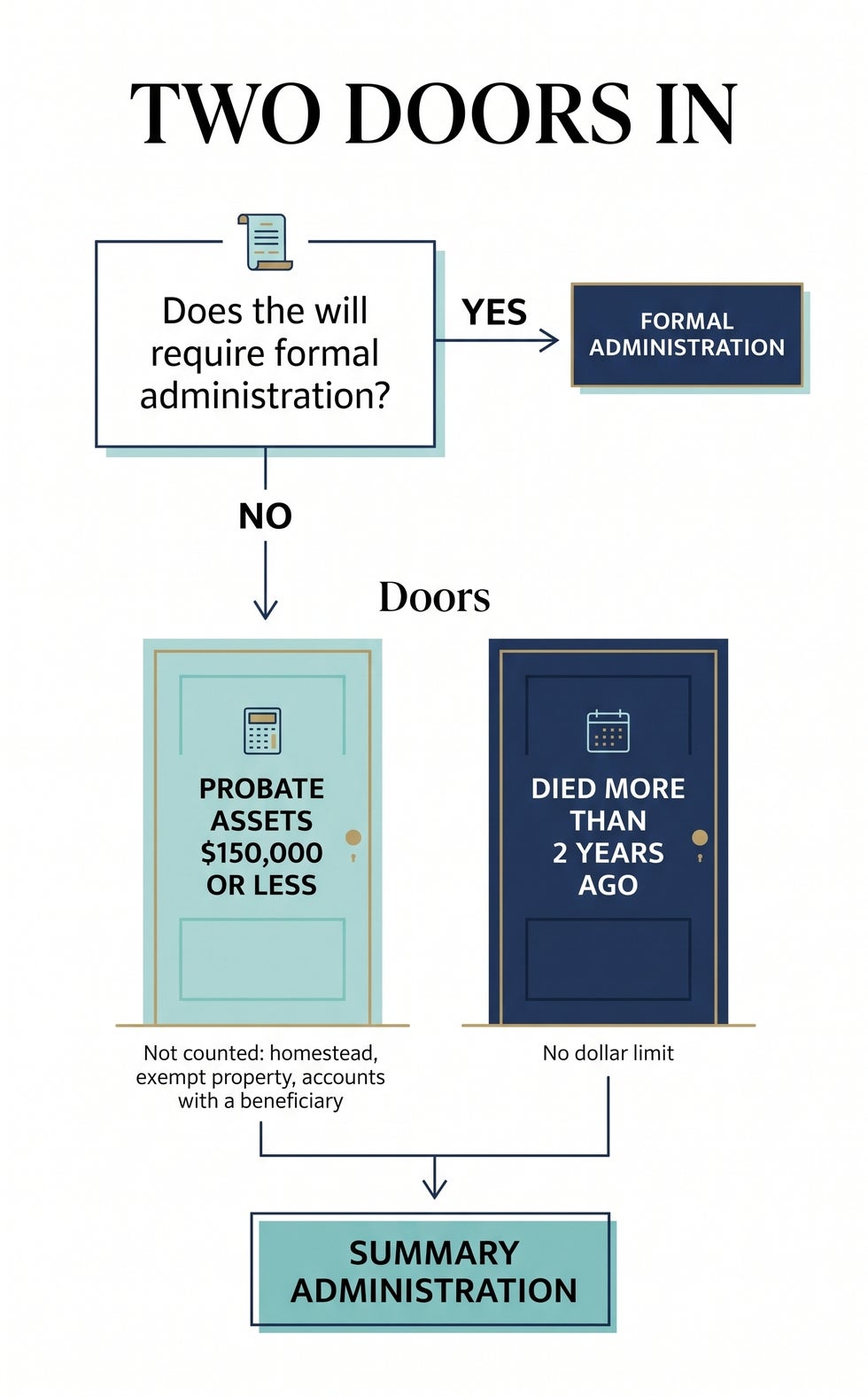
An estate qualifies if the decedent's will, if any, does not direct formal administration, and either the non-exempt Florida probate estate is worth $150,000 or less or the person died more than two years ago. Those are the full summary administration requirements Florida sets, both in section 735.201.
The statute is short, and every word of it matters. Read it on the Legislature's site at section 735.201, Florida Statutes. It also says the summary administration Florida courts grant works for a resident or a nonresident decedent, so a Michigan snowbird's Fort Myers condo can qualify too; our guide to ancillary administration covers the out-of-state side.
The $150,000 Probate Asset Test
The first door is the value of the estate. Add up the estate assets subject to administration in Florida, subtract the property exempt from creditors' claims, and compare the result with $150,000.
Probate assets are what the decedent owned in his or her own name with no beneficiary or survivor attached:
- A bank account in the decedent's sole name with no pay-on-death designation.
- A vacant lot, a rental house or other non-homestead real property.
- A brokerage account or a business interest titled to the decedent alone.
If the estate's value sits close to the line, the classification of each asset decides the case. A family that counts the value of property it should leave out, such as the house or a joint account, can talk itself into a formal case it never needed.
The Two-Year Rule
The second door has no dollar limit. If the decedent has been dead for more than two years, summary administration is available whatever the estate is worth.
That is why summary administration after two years is so common. Under section 733.710, two years after a death most claims against the estate are barred, with exceptions for claims timely filed within the two years and still unresolved, and for recorded mortgages, security interests and liens. With the claims of creditors generally barred, the petition can simply say so, and the case becomes a title-clearing exercise.
I see this most when a family waited, and a buyer's title company now needs a court order before closing on an inherited lot in Lehigh Acres.
What Does Not Count Toward the $150,000 Limit
Much of what people think of as “the estate” never enters the calculation. That is why many families who believe they are over the limit are not.
Leave these out of the math:
- Homestead property that passes to family. A Florida home that passes to the spouse or an heir is protected homestead and is not part of the estate the court administers, though it often needs an order confirming its homestead status. A homestead the will leaves to someone who is not an heir can be a probate asset that counts.
- Exempt property, if the decedent was domiciled in Florida, under section 732.402: household furniture, furnishings and appliances up to $20,000, and two motor vehicles in the decedent's name of 15,000 pounds or less regularly used by the family, unless the will specifically gives those items to someone. These exempt assets go to the surviving spouse or, if none, the children.
- Anything that passes outside probate: pay-on-death and transfer-on-death accounts, jointly held property with survivorship, life insurance and retirement accounts with a living beneficiary, a funded revocable trust, and a house deeded by Lady Bird deed.
So an estate with a $400,000 protected homestead, two cars, a life insurance policy and a $95,000 checking account usually qualifies. Only the checking account counts. For truly small estates, Florida has even lighter routes than this: a court letter for an estate holding only exempt property and personal property worth no more than the funeral bill and last-60-days medical bills, under section 735.301, and a family affidavit for sole-name bank accounts totaling $2,000 or less, six months after death, under section 735.303. Our guide to a deceased person's bank account explains that affidavit.
When a Will Requires Formal Administration
Sometimes the numbers work but the will does not. If the will directs administration under chapter 733, meaning a full formal case, the estate cannot use the summary route, however small it is.
Even when the will is silent, summary administration is a choice, not a requirement. Section 735.202 says any qualifying estate may still be administered like any other estate. I read the will, look at the family, and ask what must happen after the order is entered. If someone needs ongoing authority to sell property, chase a lawsuit or sort out a dispute, formal administration is often the safer path even for a small estate.
What Florida Statute Governs Summary Administration?
Part I of chapter 735 of the Florida Statutes governs summary administration: sections 735.201 through 735.2063. Florida Probate Rule 5.530 adds the procedure, and section 733.710 supplies the two-year creditor bar that makes delayed estates simpler.
Those are the three sources of summary administration Florida law a probate attorney reads first. The table below lists the ones this guide relies on.
Current Law and Statute Number
Here is the statute answer in one table. Each section is the 2026 text on Online Sunshine.
| Statute or rule | What it does |
|---|---|
|
§ 735.201 |
Sets the two tests: $150,000 or more than two years |
|
§ 735.202 |
Keeps formal administration available for any estate |
|
§ 735.203 |
Says who files and who must sign the petition |
|
§ 735.2055 |
Allows the petition at any stage of a pending estate |
|
§ 735.206 |
Requires the creditor search, authorizes the order, sets recipient liability |
|
§ 735.2063 |
Lets a recipient publish an optional notice to creditors |
|
§ 733.710 |
Bars most claims two years after death |
|
§ 732.901 |
Requires the original will to be deposited within 10 days |
|
Fla. Prob. R. 5.530 |
Lists the 12 things the petition must contain |
In practice, these tell you three things: whether the estate qualifies, what the petition must prove, and why the order can transfer ownership without a personal representative. Section 735.2055 adds a useful twist: a formal case already open can switch to summary administration if the estate qualifies when the petition is filed.
How Recent Changes Affect Eligibility
The Florida summary administration ceiling doubled. Chapter 2026-57, Laws of Florida, raised the limit in section 735.201 from $75,000 to $150,000, effective July 1, 2026.
The same act raised the related small-estate figures: the bank affidavit from $1,000 to $2,000, tax refunds paid to the family without administration from $2,500 to $5,000, and the intestate personal property route in section 735.304 from $10,000 to $20,000. For small estate probate Florida families now have more room at every level.
A note on stale sources. Older articles, forms and checklists still show $75,000. The act contains no clause tying the new figure to the date of death, so if a death occurred before July 1, 2026, ask your lawyer which figure your county applies before relying on either.
How Does Summary Administration Work, Step by Step?
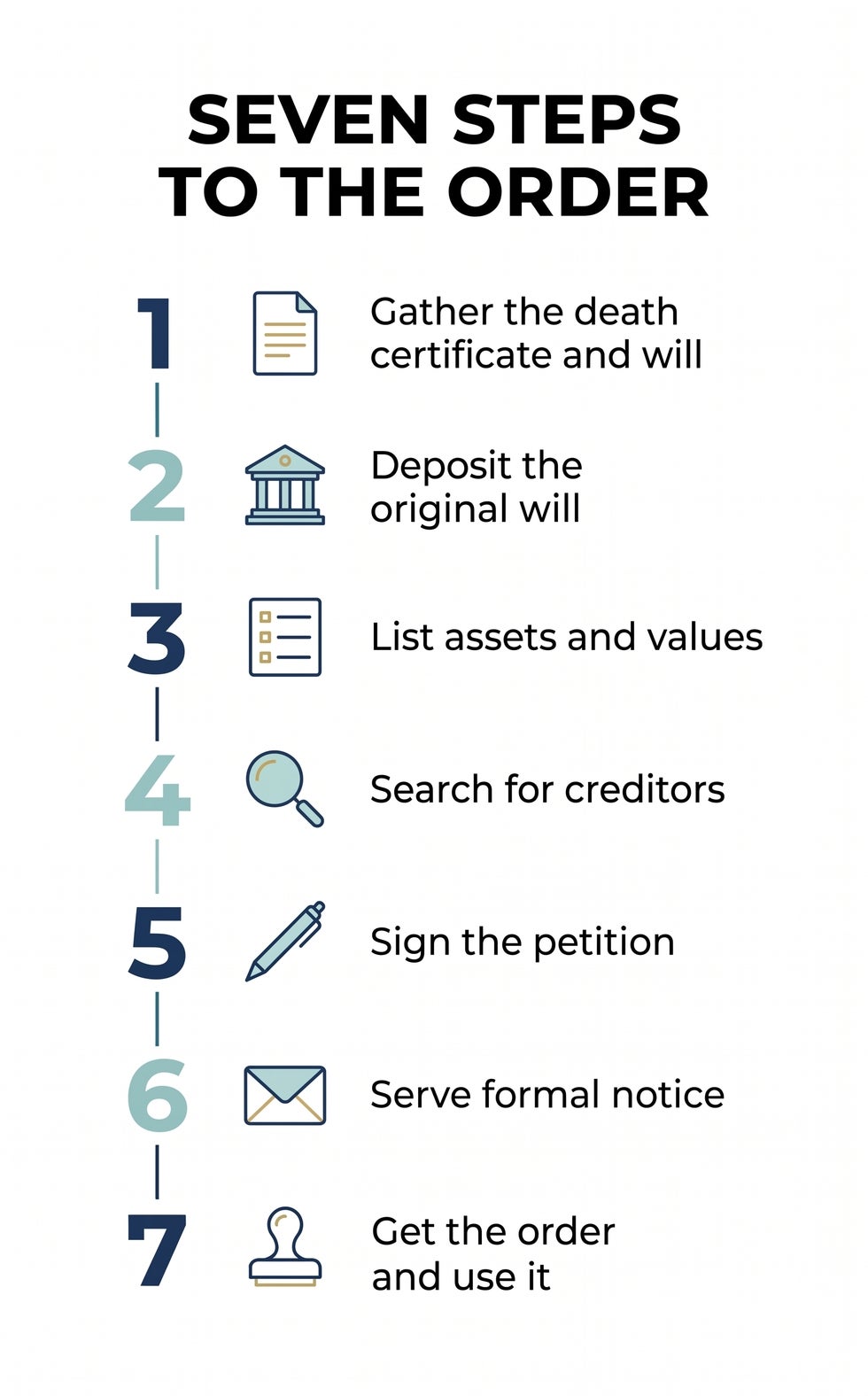
The probate procedure is short: gather the documents, deposit the will, have it admitted to probate, list the probate assets, search for creditors, prepare and sign the petition, serve formal notice on anyone who did not sign, and ask the court for the order. Then use certified copies of the order to move each asset.
The order is the engine of the whole summary administration process. Everything before it builds the record the probate judge needs; everything after it is the family using the order.
Gathering Documents: Will, Death Certificate, Asset List
Start with three things: certified copies of the death certificate, the original will if there is one, and a working list of everything the deceased person owned and how each item was titled.
- The death certificate fixes the date of death, which decides the two-year test.
- The original will controls who receives property; with no will, the intestate estate passes to heirs under Florida law.
- The asset list needs account numbers, approximate balances and the legal description of any real estate.
This is also when you separate probate assets from everything else. An account with a pay-on-death designation belongs to its beneficiary and does not go in the petition at all.
Depositing the Original Will with the Court
Whoever holds the original will must deposit it with the clerk of the probate court in the county where the estate will be administered within 10 days after learning of the death, under section 732.901.
Deposit first, then decide on strategy. The Lee County Clerk takes original wills in person at the Justice Center or by mail and notes that wills cannot be e-filed. A custodian who sits on a will can be compelled to produce it and, if the court finds no just or reasonable cause for the delay, ordered to pay costs, damages and a reasonable attorney's fee.
Listing Assets and Their Values
Next, list each probate asset with an estimated value. Rule 5.530 requires the petition to describe every asset and its estimated value, list protected homestead and exempt property separately, and include a schedule of proposed distribution naming who receives each asset.
That proposed asset distribution is what the court will sign, so precision matters: a bank and a title company will rely on it years later.
Finding and Searching for Creditors
Before the order is entered, the petitioner must make a diligent search and reasonable inquiry for known or reasonably ascertainable creditors, serve them with the petition, and provide for payment to the extent assets allow. That duty comes from section 735.206(2).
In practice I look at the mail, recent statements, final medical bills, credit cards, loans and any collection letters. The petition must then say that the estate is not indebted, or list each creditor with the debt and how it will be paid. Our guide to probate creditor claims covers the priority order for paying them.
Completing the Petition and Who Must Sign It
The petition for summary administration may be filed by any beneficiary or by the person nominated as personal representative in the will. Under section 735.203, the surviving spouse and the beneficiaries must sign and verify it, except a beneficiary who will receive a full share.
- A beneficiary taking a full distributive share need not join, but must receive formal notice.
- A minor or incapacitated beneficiary signs through a guardian.
- When the trustee of a trust that inherits is also a petitioner, the trust's qualified beneficiaries receive formal notice unless they consent.
So do you need a lawyer for summary administration in Florida? Florida Probate Rule 5.030 requires a member of The Florida Bar to represent every personal representative and guardian, and summary administration has neither, so the rule does not require one by its terms. Practically, the petition, the will proof and the creditor statement are technical, and a mistake can expose every signer to liability.
Formal Notice to Interested Parties
Anyone entitled to notice who does not sign, including any beneficiary and any known creditor, must receive formal notice of the petition. Formal notice under Rule 5.040 goes by mail or delivery service requiring a signed receipt, or on the person's attorney if one has appeared.
The interested parties then have 20 days to serve written defenses. If no one objects in that time, the court may consider the petition ex parte as to them. Notice sent to a stale address stalls clean cases.
Court Order of Summary Administration
With a will, it must also be proved and admitted to probate when the petition is filed (section 735.206(1)). Once the petition, the will and the notices are in order, the judge signs the order of summary administration. Rule 5.530(d) requires it to distribute the probate assets and name the person who receives each one.
That order is powerful but limited. It controls the distribution of assets, not their management: it appoints no one and creates no ongoing authority. It is also hard to undo in later probate proceedings. In Jones-Bishop v. Estate of Sweeney, 27 So. 3d 176 (Fla. 5th DCA 2010), the court held that even if the petitioner lacked standing to file, the order was at most voidable, not void, so it could not be set aside two years later as void.
Using the Order with Banks, DMV, and Property Records
After the judge signs, you use certified copies of the court order to move each asset. Section 735.206(4) authorizes anyone holding the decedent's property to pay or transfer it as the order directs, and protects them from liability when they do.
- Financial institutions release or retitle accounts on a certified copy.
- The tax collector's office retitles motor vehicles for the Department of Highway Safety and Motor Vehicles; our vehicle title guide covers the forms.
- For real property, a certified copy is recorded in the county's Official Records.
Can a house be transferred through summary administration? Yes. A non-homestead house or lot passes under the order, and a buyer who later purchases in good faith and for value from the person named takes it free of the decedent's creditors' claims. A protected homestead usually also needs an order determining homestead status, which our guide to homestead in probate explains.
How Does Summary Administration Differ from Formal Administration?
Summary administration ends with one order distributing the assets; formal administration (often called formal probate) appoints a personal representative who manages the estate under court supervision for months. That is the core of summary administration vs formal administration, and it drives the differences in speed, cost and creditor protection.
| Summary administration | Formal administration | |
|---|---|---|
|
Who qualifies |
$150,000 or less, or death more than 2 years ago |
Any estate |
|
Personal representative |
None |
Appointed, with letters |
|
Creditor process |
Diligent search; optional notice |
Published notice; 3 months for unknown creditors, 30 days after service for known ones |
|
Who carries unpaid debts |
The people who received assets |
The estate, before distribution |
|
Typical length |
4 to 12 weeks |
About 9 to 12 months, uncontested |
Personal Representative: Is One Appointed?
No. There is no appointment of a personal representative in summary administration, and no letters of administration issue.
That is the main reason summary probate is faster, and its main limit. With no one holding legal authority, there is nobody to sell property during the estate administration, chase a hidden account or bring a lawsuit. Our guide to letters of administration explains what that authority does.
Level of Court Oversight and Procedure
Court involvement is lighter. The court reviews one petition, the notices and the proposed distribution, then enters an order; there is no inventory, no accounting and no discharge.
Formal probate administration keeps the court involved from appointment to discharge, which costs time but gives structure to an estate with debts or disputes. My earlier article, Florida Formal Administration: Probate Steps and Deadlines, walks through that full sequence, and the firm's video What Is Formal Administration in Florida Probate? covers it in a few minutes.
Timeframes and Typical Costs
How long does summary administration take in Florida? In our experience, a summary probate administration commonly takes 4 to 12 weeks, sometimes longer, against roughly 9 to 12 months for an uncontested formal administration, the same ranges we publish in our probate timeline guide. Missing signatures, a creditor problem or a busy docket all add time.
The court filing fees are set by law. Section 28.2401 sets the clerk's summary administration charge at $340 for an estate of $1,000 or more and $230 below that, plus a $4 statutory service charge on the petition, and the Lee County Clerk's published fee schedule lists $345 and $235. Add certified copies, and newspaper publication if you use the optional creditor notice.
Attorney fees for summary administration are a matter of agreement between you and the lawyer, so ask for the fee and what it covers in writing before work starts. Complexity, not the estate's value, drives the work.
What Happens to Creditors in Summary Administration?
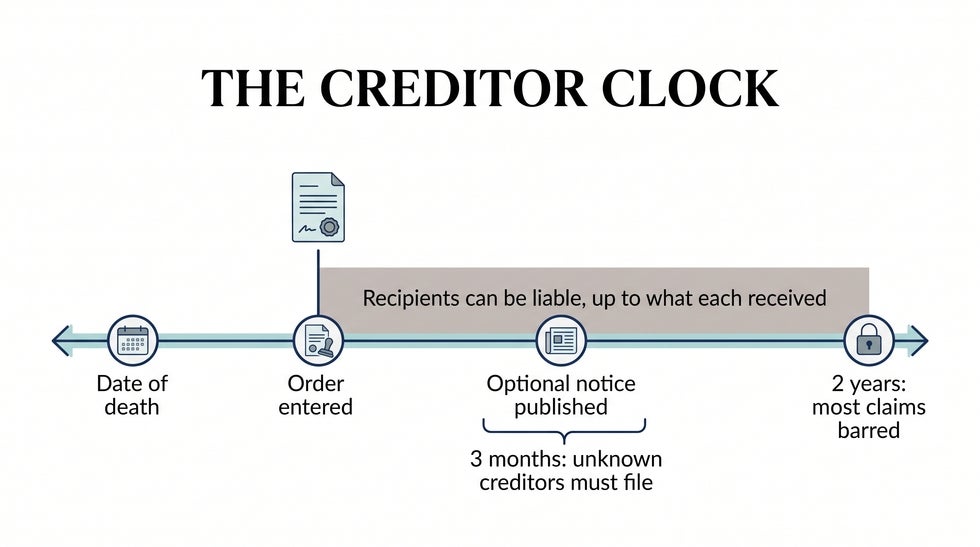
Creditors do not disappear because the summary administration Florida courts offer is shorter. The petitioner must still search for them and provide for known debts, and until two years after death, the people who receive the assets can be pursued for unpaid claims.
A formal case gives creditors a fixed window and shuts it; a summary case leaves part of the risk with the recipients.
Diligent Search for Creditors
A diligent search means a real, documented effort to find every known or reasonably ascertainable creditor before asking for distribution. Each one found must be served with the petition and either paid, provided for, or shown to have agreed in writing to another arrangement.
The search does two jobs. It protects family members, because a known creditor who was skipped can enforce its claim against the people who received assets and, if it wins, recover attorney's fees from those who signed the petition. And it tells you whether summary administration still makes sense. The Lee County Clerk also asks for a copy of the funeral bill when the death was less than two years ago.
Optional Notice and Medicaid Recovery
After the order, anyone who obtained it may publish a notice to creditors under section 735.2063. Once proof of publication is filed, unknown creditors are barred unless they file claims within three months after the first publication.
Medicaid is the creditor families most often miss. Under the Medicaid Estate Recovery Act, benefits paid after a recipient turned 55 create a debt to the Agency for Health Care Administration. The agency cannot enforce it if a spouse, a child under 21, or a blind or disabled child survives, or against exempt property, but otherwise, if Medicaid paid benefits after 55, the agency is a known creditor the petition must address under section 735.206(2).
Personal Liability of Asset Recipients
This is the warning I give in plain English: under section 735.206(4)(e), the people who receive property under the order are personally liable for a pro rata share of lawful claims, but only up to the value each actually received, not counting exempt property.
That liability ends two years after death unless a creditor has already started proceedings to enforce its claim. An heir or devisee left out of the order can also sue those who procured it and recover fees. When I see large medical bills or uncertain debts, I step back: a formal administration may be the better tool because it resolves claims before anyone receives anything.
Conclusion
This simplified process is the right tool for smaller estates and delayed estates whose families agree. Check the two tests, count only non-exempt probate assets, get the right signatures, search honestly for creditors, and the summary administration Florida courts offer can finish in weeks rather than months.
It is the wrong tool when debts are uncertain or heirs disagree. The firm's video What Is Summary Administration? Florida's Short-Form Probate recaps the basics, and if your situation fits, the next step is the asset list and the original will.
How The Nussbickel Law Firm Helps
The Nussbickel Law Firm, P.A. practices estate planning, probate and trust administration and nothing else. From our Fort Myers office at 12487 Brantley Commons Court, we handle probate matters throughout Florida and estate planning for families in Lee, Collier and Charlotte counties.
In a summary administration Florida case, we act as your Florida probate attorney: we confirm which route fits, value and classify the assets, run the creditor search, prepare the petition and the proposed distribution for every signer, serve the notices, and see the order through to the bank, the vehicle title and the deed. When the estate needs a full administration instead, we tell you why at the start. We do not handle will contests or other probate litigation.
Schedule a free consultation by phone, by video or at our office, call 239-900-WILL (9455), or use the contact form. Bring the death certificate, the will and a rough asset list, and we can usually tell you in one conversation whether your family qualifies.
Frequently Asked Questions
Is there a sample form for summary administration in Florida?
There is no single statewide court form that fits every estate. Florida Probate Rule 5.530 lists the 12 things a petition for summary administration must contain, including the decedent's domicile, a description and value of each asset, a creditor statement and a schedule of proposed distribution. Clerks can explain filing requirements but cannot give legal advice, so most families have a probate attorney prepare the petition and order.
Is there a checklist of steps for summary administration in Florida?
Yes. Get certified death certificates, deposit the original will within 10 days, have it admitted to probate, list each probate asset and its value, search for creditors, prepare the petition and have the surviving spouse and beneficiaries sign it, serve formal notice on anyone who does not sign, obtain the order, and use certified copies to move each asset. Publishing a notice to creditors afterward is optional.
Gregory J. Nussbickel is the founder of The Nussbickel Law Firm, P.A. in Fort Myers, Florida. His practice is devoted exclusively to estate planning, probate, and trust administration for families throughout Southwest Florida.
This article is for general information only and is not legal advice. Reading it does not create an attorney-client relationship. Every family's situation is different; speak with a licensed Florida attorney about your specific situation.

Comments
There are no comments for this post. Be the first and Add your Comment below.
Leave a Comment