
Key Highlights
- A sibling refusing to share inheritance Florida law has already divided cannot change anyone's share by holding the keys; with no will and no surviving spouse, the children inherit equally.
- Whoever holds a parent's original will must deposit it with the clerk within 10 days of learning of the death, and a court can order it produced.
- A will that a sibling destroys is not revoked; a lost will can still be proved in court.
- A caveat makes the court give you formal notice and a chance to be heard before anyone is appointed.
- A personal representative's powers begin at appointment, and since July 1, 2026 the court must award fees to a representative who goes to court to enforce those powers and wins.
- If the house was a protected homestead not left by will, it passes straight to the heirs; a sibling living there is a co-owner question, not a simple eviction.
Introduction
The short answer: a sibling refusing to share inheritance Florida law has already divided does not get extra rights by getting to the house first. With no will and no surviving spouse, the children inherit equally. Florida probate gives an excluded heir real tools: a caveat for notice, the right to open the estate, a say in who serves as personal representative, and an emergency curator when property is disappearing.
The story is a familiar one in probate. A parent dies in Fort Myers, Cape Coral, Port Charlotte or anywhere else in the State of Florida. One brother or sister lived nearby, had a key, and got there first. Now that sibling won't answer questions about the will, the bank accounts or the furniture, and the rest of the family is three states away wondering whether they have any rights at all.
You do. If the probate process itself is new to you, start with our short video What Is Probate in Florida? A Plain-English Explanation.
Who Inherits When a Parent Dies Without a Will?
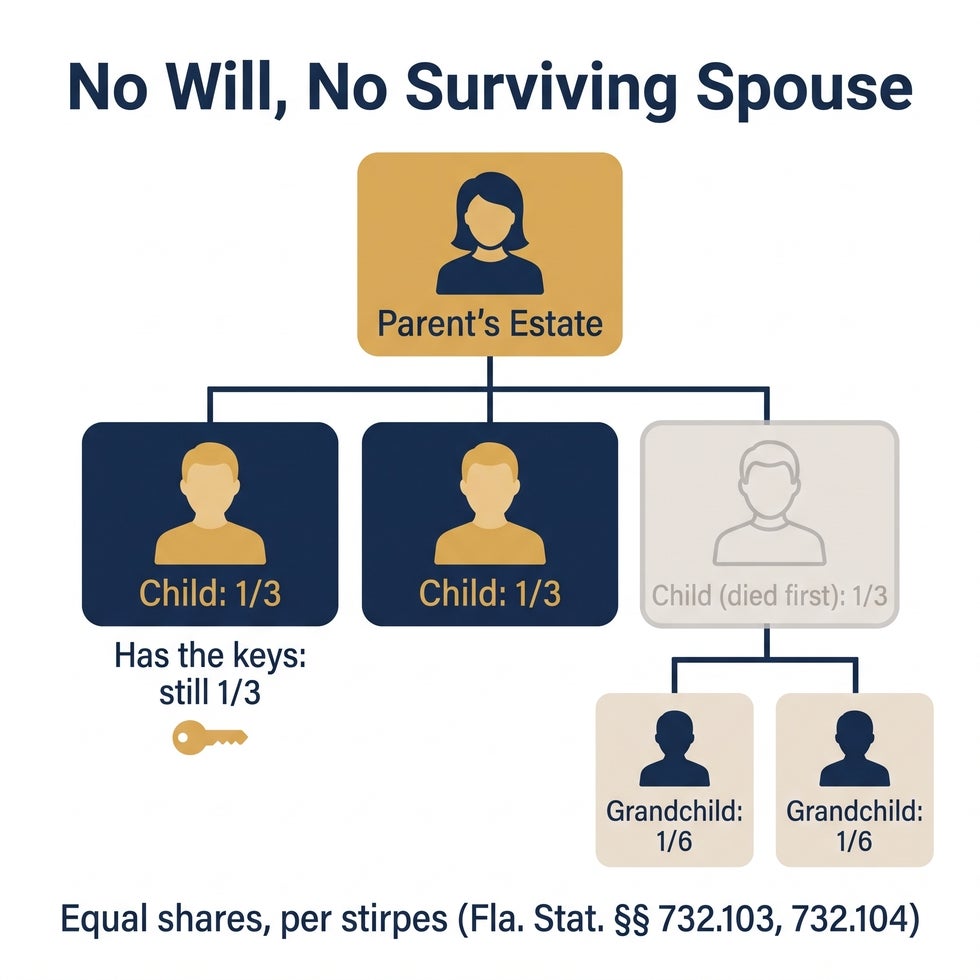
When a parent dies without a will and without a surviving spouse, the children inherit equally. Florida's intestacy statutes decide who takes, and they do not care which child has the mailbox key, the alarm code or the checkbook. A deceased person's estate assets pass by law, not by possession.
How Does Intestacy Divide Assets Among Children?
Under Fla. Stat. § 732.103, the whole intestate estate goes to the decedent's descendants when there is no surviving spouse. Section 732.104 adds that descent is per stirpes: each child's branch takes an equal share, and if a child died before the parent, that child's share passes to his or her own children.
Two details matter here. First, the children as a group also hold the right to exempt property under § 732.402: household furniture, furnishings and appliances in the decedent's home up to $20,000 in net value, plus up to two motor vehicles that were in the decedent's name at the time of death and regularly used. The right has to be claimed by petition, generally within 4 months after the notice of administration is served, or it is waived. That makes the disposition of personal property a shared question, not one sibling's decision. The sibling who empties the living room or drives Dad's truck home is taking property the law gives to all of the children together. Second, with no surviving spouse there is no elective share and no spousal life estate to work around, which usually makes the math simpler than families expect. Our article on what happens in Florida probate without a will covers the full intestacy order.
Do the Keys Change Anything?
No. Possession is not authority. For a sibling refusing to share inheritance Florida law offers no reward for getting there first. Fla. Stat. § 733.601 says a personal representative's duties and powers commence upon appointment. Before a court appoints anyone, no sibling holds legal authority over the decedent's assets, no matter how confidently he or she tells the bank, the neighbors or you that "I'm handling everything." The fix is to get the estate into the probate court, where the rules apply to everyone.
What Are an Excluded Heir's Rights?
As an heir, you are an interested person in the estate, which gives you three immediate rights: formal notice before anyone is appointed (if you file a caveat), the right to open the estate yourself, and the estate's financial information once a personal representative serves. You do not need your sibling's permission for any of them.
Under § 731.201, a "beneficiary" in an estate with no will means an heir at law, which is why the notice and inventory rules discussed below protect you directly. These are the rights of heirs in Florida that a sibling cannot waive on your behalf.
Can You Get Estate Information Right Away?
Not from the bank, usually. Before letters of administration issue, banks and brokerages will not share a deceased person's account details with an heir, and they will not share them with your sibling either unless your sibling is a joint owner or named beneficiary. The legal path to financial information runs through the probate case. Once a personal representative is appointed, the inventory rules discussed below give every heir a written list of the decedent's assets and values.
If your sibling won't share bank information, it may also be because the account was never part of the estate. A joint account with rights of survivorship, a payable-on-death account, a life insurance policy or a retirement account with a named person as beneficiary passes outside probate. Our guide to what happens to a deceased person's bank account explains which accounts the estate controls and which it does not.
Can You See the Original Will?
Yes: Florida law does not let anyone keep a parent's original will in a drawer. The custodian must deposit it with the clerk of court, and once it is filed with a petition, it becomes part of the court record that interested persons can review. If a sibling says a valid will exists but refuses to show it, the court can compel production.
What If There Is No Will or It's Missing?
If no will can be found, the estate passes under the intestacy rules unless someone proves a lost will in court. Missing is not the same as revoked. Ask who last had it, and whether a lawyer or a safe deposit box held the original.
If your parent tore up the will intending to revoke it, intestacy controls. If a sibling hid or destroyed it, the will may still govern.
Proving a Lost Will in Florida
A lost will in Florida can still be admitted to probate. Under Fla. Stat. § 733.207, any interested person may establish the full and precise terms of a lost or destroyed will. The contents must be proved by two disinterested witnesses, or by one disinterested witness if a correct copy exists. Note the word "disinterested": the sibling who benefits from the will is not the witness who proves it.
Destruction by someone other than the parent does not revoke a will. Section 732.506 limits revocation by act to the testator, or someone acting in the testator's presence and at the testator's direction, with the intent to revoke. A sibling hiding the will or shredding it after the funeral does not erase it. Proof is the hard part, not the law. Our article on proving a lost will in Florida walks through the evidence courts look for.
One caution: if the original was last in your parent's possession and cannot be found, Florida courts presume your parent destroyed it to revoke it. That presumption can be overcome with evidence, and the lost-will article above explains how.
Who Must Deposit the Original Will?
Anyone holding the original must deposit it with the clerk within 10 days after learning of the decedent's death. That is Fla. Stat. § 732.901(1) of the Florida Statutes, and it applies whether or not anyone plans to open probate.
If the custodian refuses, any interested person can petition the court to compel production. If the court finds there was no just or reasonable cause for holding the will back, it must award costs, damages and a reasonable attorney's fee against that custodian. The next tool, the caveat, works before anyone has filed anything.
What Is a Caveat in Florida Probate?
A caveat in Florida probate is a short filing that tells the court you want formal notice before a will is admitted or a personal representative is appointed. It does not decide anything. It makes sure nothing important happens in the case without you.
Who May File a Caveat?
Under Fla. Stat. § 731.110, any interested person who is worried that an estate will be administered, or a will admitted, without his or her knowledge may file a caveat. An heir qualifies. A non-creditor may file before or after the death. If you live outside Florida, the caveat must designate a resident agent in the county unless a Florida attorney signs it.
Once your caveat is on file, the court may not admit a will or appoint a personal representative until formal notice of the petition has been served on you and you have had the chance to participate. For an out-of-state heir Florida probate courts would otherwise have no reason to contact, that one protection is often the difference between hearing about the case in time and hearing about it after letters have issued.
Does a Caveat Stop the Estate?
No. A caveat secures notice and a hearing; it does not freeze the case. If your sibling files a petition, the probate proceeding still moves forward, but you get formal notice and a chance to object to the appointment or to the will before the judge acts. It is a measured first step that protects you without starting a fight.
What Can an Excluded Heir Do This Week?
This week, you can file a caveat, open the estate yourself, ask to be appointed personal representative (or agree on a neutral one), or ask the court for a curator if property is being removed or wasted. Which one fits depends on whether your problem is silence, delay, control or loss.
Open the Estate Yourself
Any heir can petition to open the estate; you do not need the sibling who has the papers. If your parent owned assets in his or her own name and nobody has filed, opening the case yourself moves the decision-making from one sibling's kitchen table into the probate court, where the estate administration follows written rules and deadlines.
Florida has two main types of probate administration, and choosing between them is the first decision in the administration process. Formal administration appoints a personal representative (our guide covers its steps). Summary administration under § 735.201 is available when the estate subject to administration, less property exempt from creditors, does not exceed $150,000 (raised from $75,000 by ch. 2026-57, Laws of Florida, effective July 1, 2026) or the decedent has been dead for more than two years. Summary administration appoints no personal representative, so it gives you no one with the power to demand property back from a sibling. When control is the problem, formal administration is usually the better fit. Our video What Is Summary Administration? Florida's Short-Form Probate explains it.
Seek Appointment or a Neutral Choice
You can ask the court to appoint you, or propose a neutral personal representative the heirs can accept. In families where every move by one sibling is read as a power grab, a neutral choice can lower the temperature fast.
An out-of-state heir can serve. You do not have to be a resident of Florida: a Florida resident qualifies by default, and the nonresident rule, § 733.304, lets a person domiciled elsewhere qualify if related to the decedent by lineal consanguinity, which includes every child and grandchild, or if the person is a brother, sister, uncle, aunt, nephew or niece. Living in Ohio or Ontario does not disqualify a son or daughter. Our article on letters of administration in Florida covers qualification, and the firm's video Who Can Be Personal Representative in Florida? The Rules does the same in five minutes.
Ask for an Emergency Curator
If property is being hauled away, sold or wasted before anyone is appointed, the court can appoint a curator without first notifying the other heirs. Under Fla. Stat. § 733.501, when there is significant danger that the decedent's property will be wasted, destroyed or removed beyond the court's reach, and giving notice would delay the appointment, the court may proceed without notice to other interested persons. The person apparently entitled to letters still receives formal notice.
A curator is a temporary, court-supervised caretaker who can be authorized to perform any duty of a personal representative. The statute requires a bond unless the court waives it, and reports when the court orders them. A curator is the strongest emergency tool an excluded heir has to protect the decedent's estate, and it is still an administration tool, not a lawsuit.
Who Has Priority to Serve as Personal Representative in Florida?
In an estate with no will and no surviving spouse, the person selected by a majority in interest of the heirs has first priority to serve as personal representative in Florida, then the heir nearest in degree. That order comes from Fla. Stat. § 733.301(1)(b). Nothing in it favors the sibling who arrived first.
Selection by Majority in Interest
"Majority in interest" is generally understood to mean share size, not headcount, though with equal children the two are the same. If three of four siblings agree on one of you, or on a neutral person, that choice has priority over the fourth sibling's petition. When several heirs are equally entitled and no majority has chosen, the court selects the one best qualified.
Co-heirs can serve together, but two siblings who cannot agree on lunch will not agree on a sale price. The best choice is whoever can keep records and meet deadlines, and that is sometimes nobody in the family. With the appointment settled, the next question is what that person can actually do.
What Powers Does a Personal Representative Have?
Once appointed, the personal representative controls the probate estate: the representative takes possession of estate property, can demand it back from whoever holds it, and can sue to recover it. Those powers belong to the office, not to the loudest heir.
When Do the Powers Begin?
At appointment, and not a day before. Under § 733.601, powers relate back only for acts that benefited the estate. A sale that hurt the estate does not become proper just because the seller is appointed later.
Fla. Stat. § 733.607 gives the representative the right to take possession or control of the decedent's property, except the protected homestead. The representative may leave property with the person presumptively entitled to it, so not every item at a sibling's house is wrongfully held. But if the representative asks a beneficiary to turn property over, that request is conclusive proof the property is needed for administration, and the representative may file an action to recover possession.
The 2026 Fee-Shifting Rule
Since July 1, 2026, a sibling who forces an enforcement fight can be ordered to pay for it. Fla. Stat. § 733.6125, created by ch. 2026-57, requires the court to award a prevailing personal representative taxable costs, including attorney fees, in any proceeding to enforce the representative's authority. The court may direct payment from any person whose action or inaction made the proceeding necessary, and may enter a judgment collectible from that person's other property.
Refusing to return estate property is no longer just slow; it can get expensive for the person refusing, rather than for the estate everyone shares.
The representative also pays the estate's valid debts before anyone inherits, in the order § 733.707 sets: administration costs and the representative's reasonable compensation first, then funeral expenses up to $6,000. Estate creditors must file creditor claims within the deadlines in § 733.702. Federal estate taxes rarely apply: the 2026 basic exclusion is $15,000,000 under Public Law 119-21, so most families never file a federal estate tax return.
Can the Representative Make a Sibling Leave the House?
Usually not, if the house was your parent's protected homestead. Protected homestead passes directly to the heirs at death (or to whoever the will names) and is not an estate asset the personal representative controls in the ordinary way. Most questions about a sibling living in deceased parent's house turn on that one fact. In most cases, the sibling is one co-owner occupying property the other co-owners also own.
It cuts both ways: the sibling in the house owns a share, not the whole house. Our article on Florida homestead in probate covers the descent rules in detail.
Securing a Vacant Home
Fla. Stat. § 733.608(2) gives the personal representative a narrow power: if property reasonably appears to be protected homestead and is not occupied by a person who appears to have an interest in it, the representative may take possession to preserve, insure and protect it for the people entitled to it. That is useful for an empty house after a hurricane or a long vacancy. It does not reach a sibling-heir who lives there.
So when a sibling refuses to vacate, the question becomes one of co-ownership: who pays the taxes and insurance, whether the heirs agree to sell, and whether one of them wants to buy the others out. When heirs cannot agree, the remedy is a partition action, which is litigation. Our article on selling inherited property in Florida explains how co-owner heirs sell, and what happens when one refuses.
What Information Are Heirs Entitled To?
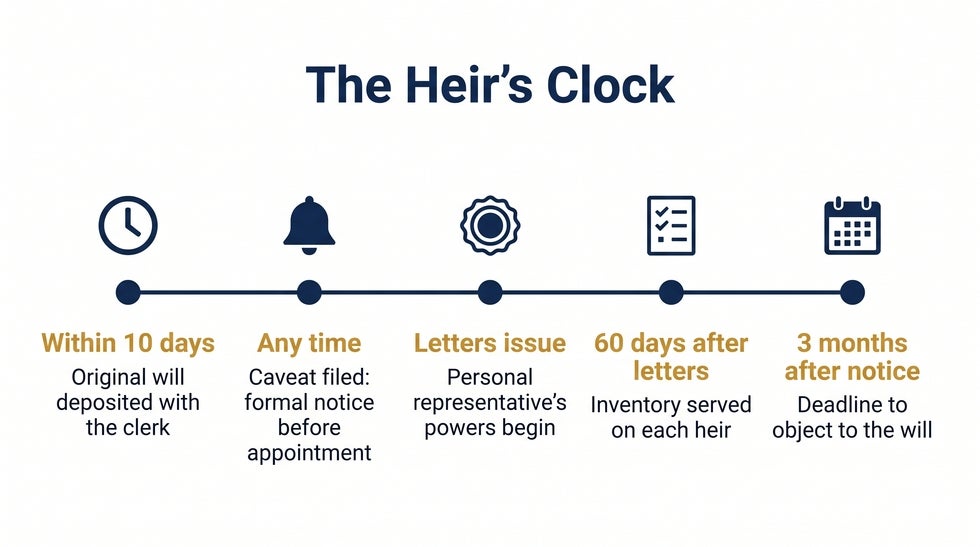
Every heir is entitled to the inventory: a sworn list of the probate estate's assets and their estimated values, filed within 60 days after letters issue and served on each heir in an intestate estate. For an heir who has been shut out, it is usually the first reliable look at what the estate holds.
Inventory Timing and Contents
Under Fla. Stat. § 733.604, the personal representative files a verified inventory listing estate property with reasonable detail and its estimated fair market value at the date of death. The filed copy is confidential in the court file, but it must be disclosed to any interested person. The Florida Probate Rules fill in the rest: Rule 5.340 sets the deadline at 60 days after letters and requires service on each heir at law in an intestate estate.
The inventory is the formal record of the assets of a deceased person that the probate estate holds. Compare the list with what you know existed. Bank and brokerage accounts in the decedent's name, vehicles, non-homestead real estate and valuable personal property belong on it. Accounts that passed by rights of survivorship, life insurance and assets in a revocable living trust will not, because they are not probate assets. If your parent's estate plan used a revocable trust, trust assets pass through trust administration instead. Our article on assets exempt from probate in Florida explains the difference, and so does our video Do All Assets Go Through Probate in Florida?
What Not to Do: Self-Help That Backfires
Do not answer a sibling's self-help with your own. Changing locks, removing property or a confrontation feels like action, but it muddies the facts a court will later look at and can create legal matters of its own.
Common mistakes:
- Changing the locks on a parent's house without legal authority
- Taking boxes, jewelry, firearms or papers "for safekeeping" before anyone is appointed
- Telling a bank or title company you are in charge when no court has appointed you
- Signing a waiver, release or receipt your sibling sends before you have seen an inventory
- Making threats in texts or emails, which tend to resurface in court
Keep a written record instead: what was in the house, who has keys, what your sibling has said, and when.
How Do the Protective Steps Compare?
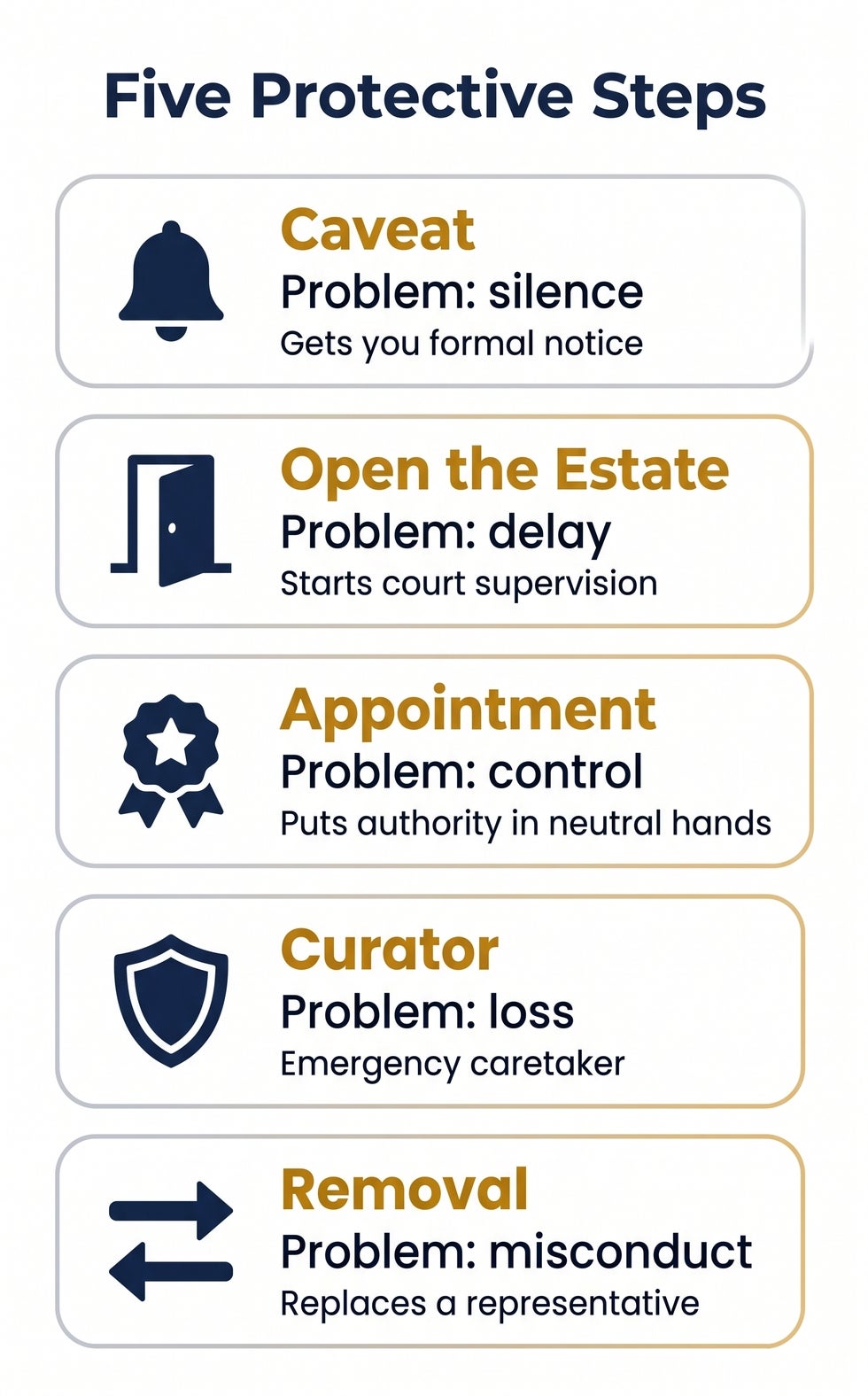
Each protective step answers a different problem. A caveat answers silence, opening the estate answers delay, appointment answers control, a curator answers loss, and a removal petition answers misconduct by someone already serving.
| Protective step | What it does | Who can ask | When it fits |
|---|---|---|---|
|
Caveat (§ 731.110) |
Requires formal notice before a will is admitted or a personal representative appointed |
Any interested person, including an heir |
You fear a quiet filing |
|
Opening the estate |
Starts court-supervised administration |
Any heir |
Nobody has filed and assets sit in the decedent's name |
|
Appointment as personal representative (§ 733.301) |
Puts someone with legal authority in charge |
An heir, or the person a majority in interest selects |
Control of property and records is the problem |
|
Curator (§ 733.501) |
Temporary caretaker, possibly appointed without notice to other interested persons |
An interested person |
Property is being wasted, destroyed or removed |
|
Removal petition (§§ 733.504, 733.506) |
Asks the court to replace a representative and revoke letters |
Any interested person, or the court itself |
The person serving is the problem |
When Does a Probate Dispute Become a Lawsuit?
A probate dispute becomes a lawsuit when someone asks the court to decide a contested question between parties: whether a will is valid, whether a lost will should be admitted, whether a personal representative should be removed, or who gets possession of property. The Florida Probate Rules treat many of these, including proving a lost will, removing a personal representative and partition of estate property for distribution, as adversary proceedings. Up to that point, the steps above are administration.
What Turns Administration Into Litigation?
Contesting a will, proving a lost will over objection, petitions to remove a representative, partition between co-owner heirs, and actions to recover property a sibling took are all probate litigation. Challenging the will itself also has a deadline: under § 733.212, once you are served with the notice of administration, you have 3 months to object to the will's validity, venue or jurisdiction, or those objections are barred.
Our firm handles the administration side: caveats, opening the estate, appointment, inventories and the personal representative's work. We do not handle probate litigation, but we will tell you plainly when you have reached that point, and refer you accordingly. Most disputes never get there, because notice, an appointment and an inventory resolve the information gap that caused them. Mediation over a sale or buyout is another way to stop short of trial.
Homestead and Inheritance Rights in Florida
A parent's homestead property in Florida usually passes directly to the heirs at death, outside the probate estate; however most title companies (who insure property sales) still demand a Court Order, so probate may nevertheless be required. When there is no surviving spouse and no minor child, a homestead that was not left by will descends to the children like other intestate property under § 732.401(1), and the personal representative does not sell it or control it the way it controls other estate assets.
What Makes a Home Homestead?
Under Article X, Section 4 of the Florida Constitution, homestead is property owned by a natural person and used as the residence of the owner or the owner's family, up to one-half acre inside a city or 160 acres outside one. Section 4(b) says the protections inure to the surviving spouse or heirs. "Protected homestead" under § 731.201 is the property on which, at the owner's death, those protections pass to the spouse or heirs, and real property held in joint tenancy with rights of survivorship or tenancy by the entirety is not protected homestead.
Because the decedent's homestead property belongs to the heirs together, a sibling living in it cannot sell it alone, and neither can you. Every heir who owns a share signs the deed, or a court decides.
What Protects Heirs From Unfair Siblings?
Against a sibling refusing to share inheritance Florida probate judges have real tools, and the probate court is the protection. Court supervision brings deadlines, sworn inventories, notice to every heir, and the power to order property returned, to remove a representative who misbehaves, and now to shift enforcement costs onto the person who caused them.
How to Remove a Personal Representative
If your sibling ends up serving and stonewalls, any interested person can petition for removal under § 733.506, and the court can act on its own motion. Section 733.504 lists the grounds, including failing to comply with a court order, failing to account for or produce estate assets when required, wasting or maladministering the estate, and holding interests adverse to the estate that interfere with its administration.
Removal does not excuse the removed representative from liability, and the court revokes the letters. A personal representative's authority comes with a fiduciary duty to every heir, not just the one serving. That is the practical answer to anyone wondering what to do if a sibling took everything and was then appointed anyway.
Conclusion
A sibling with the keys has a head start, not a bigger share. Florida law divides the estate equally among the children when there is no will and no spouse, requires the original will to be filed, protects a will someone else destroyed, and gives every heir notice, information and a voice. Most of that protection comes from administration steps you can take this week, before anyone needs a courtroom. A sibling refusing to share inheritance Florida heirs are owed is a problem with a procedure, and the procedure starts with a filing.
Talk to a Florida Probate Attorney
The Nussbickel Law Firm, P.A. practices estate planning and probate and trust administration. From our Fort Myers office we handle probate administration throughout Florida, and estate planning for families in Lee, Collier and Charlotte counties. We often work with heirs who live out of state and need someone in Florida to file the caveat, open the estate and get the inventory moving.
If a sibling refusing to share inheritance Florida law has already divided is the reason you're reading this, a consultation with a probate attorney will give you specific guidance on your probate matter: which step fits your situation and what comes next. Legal guidance early is cheaper than repairing a mistake later. Consultations are by phone, by video or at our office. Schedule a consultation or call our Fort Myers office at 239-900-WILL (9455).
Frequently Asked Questions
Are heirs always entitled to a copy of the will in Florida?
Heirs are not mailed a copy automatically, but the original must be deposited with the clerk within 10 days of the custodian learning of the decedent's death, and a will filed with a petition becomes part of the court file. If a sibling holds the will back, the court can compel production and, if there was no good reason for the delay, charge costs, damages and attorney's fees.
What happens if my sibling refuses to share financial account details?
Open the estate or ask to be appointed personal representative. Banks give account information to the appointed representative, not to individual heirs. Once letters issue, the inventory listing every probate account must be filed within 60 days and served on each heir. Some accounts pass outside probate to a named beneficiary.
Can an heir be disqualified from inheriting in Florida?
Only in narrow cases. Under § 732.802, a person who unlawfully and intentionally kills, or helps bring about the death of, the decedent inherits nothing, and § 732.8031 generally bars a person convicted of abusing, neglecting or exploiting an elderly or disabled decedent. Being difficult is not a ground; the remedies are court orders, removal and fee awards.
Can my sibling sell our parent's house without the other heirs?
Not if it was a protected homestead that passed to all of you. Each heir who owns a share must sign the deed. If the heirs cannot agree on a sale or a buyout, the remaining option is a partition action, which is a lawsuit handled by a litigator.
How long do I have to object to a will in Florida?
Three months after you are served with the notice of administration. Objections to the will's validity, venue or jurisdiction are barred after that, and in any event no later than the earlier of the representative's discharge or one year after service. Do not let the notice sit unread.
Gregory J. Nussbickel is the founding attorney of The Nussbickel Law Firm, P.A. in Fort Myers, Florida, in practice in Florida since 2002. He holds an AV Preeminent rating (2026) from Martindale-Hubbell, the highest rating that organization confers.
This article is general information about Florida law, not legal advice for your situation. Reading it does not create an attorney-client relationship. Laws change; speak with a qualified attorney about your specific facts.

Comments
There are no comments for this post. Be the first and Add your Comment below.
Leave a Comment